
Cities in Scripture are described in several ways. In the Prophets they are often pictured as women, such as virgins, wives, widows, or harlots, according to their condition, with Jerusalem, Babylon, Tyre, Nineveh, and Samaria among the examples given. The Hebrew words for city, ir and kiryah, are associated with raised walls and watch-posts, and the towns of Palestine were commonly built on heights for security. Cain is credited with founding one (Genesis 4:16-17). Scripture also speaks of God's city, the church on earth and in heaven, which he founded, built, and governs.
For a city, as the metropolis of a kingdom with all its territories, see HEAD and MOTHER.
Cities are frequently represented in the Prophets under the type of women, (virgins, wives, widows, and harlots,) according to their different conditions. So in Isa 37:22; Jer 18.; Lam 1:15, and other places, Jerusalem is called a virgin; and Egypt is so named in Jer 46:11. Widow is said of Babylon in Isa 47:8-9; and of Jerusalem in Lament 1:1; and harlot, of Jerusalem, Isa 1:21; of Tyre, Isa 23:16; of Nineveh, Nah 3:4; and of Samaria, Eze 23:5.
The great city, Rev 9:8, and Rev 16:19, denotes the anti-Christian confederacy: its character and acts are symbolised by Sodom and Egypt; the one proverbial for impurity; the other for tyranny, persecution, and cruelty.
The cities of the nations denote political and ecclesiastical communities and governments, as in Rev 16:19.
Which hath foundations, whose builder and maker is God, (Heb. xi. 10.) I think it not improper to notice this, in a work of this kind, inasmuch as we meet with the expression frequently in Scripture, both in allusion to the church of God upon earth, and the church triumphant in heaven. (See Ps. xlvi 4; xl8. 1.8; l37. 3. Song 3: 2, 3. and also Heb. x2: 22. Rev. 3: 12; xxi. 2 - 10; xx2: 19.) The city of God in his church upon earth, and in heaven, is one and the same. It is peculiarly called his, because he hath founded it and built it, and dwells in it, and is the governor of it, and grants to the citizens the privileges and immunities of it. It is the Lord’s property both by purchase, and by conquest, and he hath the whole revenue of it. And hence, all the inhabitants of this city are, in heart and mind, one and the same. For though the church here below is in a militant state, and the church above, freed from this warfare, is triumphant, yet, equally dear are the citizens of both to the Lord of the country. They all speak the same language, all wear the samegarment, Christ’s righteousness, all love the same Lord, and his Zion, and prefer her interests above their chief joy. (Ps. c37. 6.) Reader, what saith your heart to those characters? (See that Scripture, Rev. xx2: 14, 15.)
The towns and cities of Palestine were commonly built on heights, for better security against robbers or invaders. These heights, surrounded by walls, sometimes formed the entire city. In other cases, the citadel alone crowned the hill, around and at the base of which the town was built; and in time of danger the surrounding population all took refuge in the fortified place. Larger towns and cities were often not only defended by strong outer walls, with towers and gates, but by a citadel or castle within these limits-a last resort when the rest of the city was taken, Jdg 9:46,51 . The "fenced cities" of the Jews, Deu 3:5, were of various sizes and degrees of strength; some being surrounded by high and thick stone walls, and others by feebler ramparts, often of clay or sun-dried bricks, and sometimes combustible, Isa 9:10 1Sa 1:7-14 . They were also provided with watchmen, Psa 127:1 Son 5:7 . The streets of ancient towns were usually narrow, and often unpaved. Some cities were adorned with vast parks and gardens; this was the case with Babylon, which embraced an immense at this day to form any reliable estimate of the population of the cities of Judea. Jerusalem is said by Josephus to have had 150,000 inhabitants, and to have contained, at the time of its siege by the Romans, more than a million of persons crowded in its circuit of four miles of wall. See GATE, REFUGE, CITIES OF, WATCHMEN.\par CITY OF DAVID, usually denotes mount Zion, the southwest section of Jerusalem, which David took from the Jebusites, and occupied by a palace and city called by his name. In Luk 2:11, Bethlehem his native city is meant.\par CITY OF GOD, Deu 12:5 Psa 46:4, and the HOLY, HOLINESS CITY, Neh 11:1, names of Jerusalem. Its modern name is El-Kuds, the Holy.\par
Cain first founded one (Gen 4:16-17). The material civilization of the Cainite race was superior to that of the Sethite. To the former belonged many inventions of useful arts and luxury (Gen 4:20-22). Real refinement and moral civilization are by no means necessary concomitants of material civilization; in these the Sethites took the lead (Gen 4:25-26). The distinction between tent or nomadic and town life early began. The root meaning of the Hebrew terms for "city,"
So, "the tower of Edar," i.e. flocks (Gen 35:21). Of course, the first "cities" would be mere groups of rude dwellings, fenced round together. Sir H. Rawlinson supposes Rehoboth, Calah, etc., in Gen 10:11, denote only sites of buildings afterward erected. The later dates assigned to the building of Nineveh, Babylon, etc., refer to their being rebuilt on a larger scale on the sites of the primitive towns. Unwalled towns are the symbol of peace and security (Zec 2:4). Special cities furnished supplies for the king’s service (1Ki 9:19; 1Ki 4:7; 1Ch 27:25; 2Ch 17:12). So, our Lord represents the different servants having the number of cities assigned them in proportion to their faithfulness (Luk 19:17; Luk 19:19).
Forty-eight cities were assigned to the Levites, of which 13 were for the family of Aaron, nine were in Judah, four were in Benjamin, and six were cities of refuge. The streets of eastern cities are generally narrow, seldom allowing more than two loaded camels to pass one another. But Nineveh’s admitted of chariots passing, and had large parks and gardens within (Nah 2:4). Those of one trade generally lived on the same street (Jer 37:21). The GATES are the usual place of assembly, and there courts of judges and kings are held (Gen 23:10; Rth 4:1).
The Hebrews term most frequently thus rendered is
This distinction is found actually existing in countries, as Persia and Arabia, in which the tent-dwellers are found, like the Rechabites, almost side by side with the dwellers in cities, sometimes even sojourning within them, but not amalgamated with the inhabitants, and in general making the desert their home, and, unlike the Rechabites, robbery their undissembled occupation (Jdg 5:7; Jer 35:9; Jer 35:11; see Fraser, Persia, p. 366, 380; Malcolm, Sketches of Persia, p. 147-156; Burckhardt, Notes on Bedouins, 1, 157; Wellsted, Travels in Arabia, 1, 335; Porter, Damascus, 2, 96, 181, 188; Vaux, Nineveh and Persepolis, c. 2, note A; Layard, Nineveh, 2, 272; Nin. and Bab. p. 141).” SEE VILLAGE.
1. Towns are a natural result of the aggregative principle in human nature. Necessity led the early races of men to build their towns on lofty spots, where, with the aid of the natural advantages of the ground, they could easily protect themselves against beasts of prey and human foes. A town, and a stronghold or fort, would thus be originally identical. As population increased and agriculture spread, so some degree of security came, which permitted the inhabitants of the castle to diffuse themselves over the hill- side, and take up their abode in the valley, and by the side of the stream that lay nearest their acropolis; still the inhabitants kept at no great distance from the center of strength, in order not to be deprived of its protection. The town, however, would thus be enlarged, and as the necessity for self- defense still existed, so would the place soon be surrounded with walls. Thus there would be outer and inner bulwarks, and in some sort two species of community — the townspeople, who tilled the ground and carried on trade, and the soldiers, whose business it was to afford protection: these two, however, in the earliest stages of civilization, were one, the peasant and tradesman taking arms when the town was put in danger.
How early towns were formed cannot be determined by any general principle: they were obviously a work of time. The primary tendency in population was to diffuse itself. Aggregation on particular spots would take place at a later period. When, then, Cain is said to have built a city (Gen 4:17), we have evidence which concurs with other intimations to show that it is only a partial history of the first ages that we possess in the records of the book of Genesis. In the time of the Patriarchs we find towns existing in Palestine which were originally surrounded with fortifications, so as to make them “fenced cities.” (See below.) In these dwelt the agricultural population, who, by means of these places of strength, defended themselves and their property from the nomad tribes of the neighboring desert, who then, as they do now, lived by plunder. Nor were works of any great strength necessary. In Palestine at the present day, while walls are in most parts an indispensable protection, and agriculture can be advantageously prosecuted only so far as sheltered by a fortified town, erections of a very slight nature are found sufficient for the purpose, the rather because the most favorable localities offer themselves on: all sides, owing to the natural inequality of the ground. Hence we find that hills or eminences were almost invariably chosen as sites for this purpose, a fact which even grew into a proverb “a city upon a hill.” (See Hackett’s Illustra. of Script. p. 70.)
Of the ancient method of building in towns and cities we have no accurate knowledge, any farther than we may gather information from the ruins which still lie on the soil of Palestine. But these ruins can afford only general notions, as, though they are numerous, and show that the Land of Promise was thickly peopled and highly flourishing in its better days, the actual remains of ancient towns are to be ascribed to different and very distant periods of history. The Crusades left many strongholds which are now in a state of dilapidation; but the Crusades are of modern days compared with the time of the Savior, which itself is remote from the proper antiquity of the nation. The law of sameness, however, which prevails so rigidly in Eastern countries, gives us an assurance that a modern town in Palestine may be roughly taken as a type of its ancient predecessors. (See Olin’s Travels, 2, 423.) To distinguish cities that bore the same name, the name of the tribe was added. In “the latter days,” especially under the Herods, it was the fashion to give to ancient towns new Greek names, as Diospolis, Neapolis, Sebaste, Cmesarea, Tiberias. Jerusalem, at a later period, was denominated AElia Capitolina. These innovations indicated the slavish disposition of the age, and were tokens of the bondage in which the nation was held.
Palestine underwent constant changes in regard to its towns from the earliest ages; one consequence of which is, that there are names of towns that belong exclusively to certain eras. The period of the Roman domination gave existence, as to structures of great splendor, so to many towns and fortified places. Galilee was especially rich in towns and villages, which, according to Josephus (Life, 45), amounted in all to the number of 204. The names of the. Palestinian cities, for the most part, have meaning, reference being made to the nature of the locality or the character of the inhabitants. The population of towns cannot now be ascertained with any degree of accuracy, for the materials are not only scanty and disconnected, but in a measure uncertain. SEE CENSUS.
2. The earliest notice in Scripture of city-building is of that of the city called Enoch (q.v.) by Cain, in the land of his “exile” (Nod, Gen 4:17). After the confusion of tongues, the descendants of Nimrod founded Babel, Erech, Accad, and Calneh, in the land of Shinar; and Asshur, a branch from the same stock, built Nineveh, Rehoboth-by-the-river, Calah, and Resen, the last being “a great city.” A subsequent passage mentions Sidon, Gaza, Sodom, Gomorrah, Admah, Zeboim, and Lasha, as cities of the Canaanites, but without implying for them antiquity equal to that of Nineveh and the rest (Gen 10:10-12; Gen 10:19; Gen 11:3; Gen 11:9; Gen 36:37). Sir H. Rawlinson supposes, (1.) that the expedition of Chedorlaomer (Genesis 14) was prior to the building of Babylon or Nineveh, indicating a migration or conquest from Persia or Assyria; (2.) that by Nimrod is to be understood, not an individual, but a name denoting the “settlers” in the Assyrian plain; and (3.) that the names Rehoboth, Calah, etc., when first mentioned, only denoted sites of buildings afterwards erected. He supposes that Nineveh was built about B.C. 1250, and Calah about a century later, while Babylon appears to have existed in the 15th century B.C.
If this be correct, We must infer that the places then attacked, Sodom, Gomorrah, etc., were cities of higher antiquity than Nineveh or Babylon, inasmuch as when they were destroyed a few years later they were cities in every sense of the term. The name Kirjathaim, “double city” (Gesenius, Thesaur. Heb. p. 1236), indicates an existing city, and not a site only. It may be added that the remains of civic buildings existing in Moab are evidently very ancient, if not, in some cases, the same as those erected by the aboriginal Emim and Rephaim. (Compare also the name Avith, “ruins,” Gesenius, ib. p. 1000; Gen 19:1; Gen 19:29; Gen 36:35; Isa 23:13; see Wilkinson, Anc. Egypt. 1, 308; Layard, Nin. and Bab. p. 532; Porter, Damascus, 1, 309; 2:196; Rawlinson, Outlines of Assyr. Hist. p. 4, 5.) But though it appears probable that, whatever dates maybe assigned to the building of Babylon or Nineveh in their later condition, they were in fact rebuilt at those epochs, and not founded for the first time, and that towns in some form or other may have occupied the sites of the later Nineveh or Calah; it is quite clear that cities existed in Syria prior to the time of Abraham, who himself came from “Ur,” the “city” of the Chaldaeans (Gesenius, ib. p. 55; Rawlinson, p. 4).
The earliest description of a city, properly so called, is that of Sodom (Gen 19:1-22); but it is certain that from very early times cities existed on the sites of Jerusalem, Hebron, and Damascus. The last, said to be the oldest city in the world, must, from its unrivalled situation, have always commanded a congregated population; Hebron is said to have been built seven years before Zoan (Tanis) in Egypt, and is thus the only Syrian town which presents the elements of a date for its foundation (Num 13:22; see Stanley, Palest. p. 409; Josephus, Ant. 1, 6, 4; Conybeare and Howson, St. Paul, 1, 94, 96). But there can be no doubt that, whatever date may be given to Egyptian civilization, there were inhabited cities in Egypt long before this (Gen 12:14-15; see Martineau, Eastern Life, 1, 151; Wilkinson, 1:307; Smith, Dict. of Class. Geog. s.v. Tanis). The name, however, of Hebron, Kirjath-Arba, indicates its existence at least as early as the time of Abraham, as the city, or fortified place of Arba, an aboriginal province of Southern Palestine (Gen 23:2; Jos 14:15). The “tower of Edar,” near Bethlehem, or “of flocks,” indicates a position fortified against marauders (Gen 35:21). Whether “the city of Shalem” be a site or an existing town cannot be determined; but there can be no doubt that the situation of Shechem is as well identified in the present day, as its importance as a fortified place is plain from the Scripture narrative (Gen 33:18; Gen 34:20; Gen 34:26; see Robinson, 3, 114). On the whole, it seems plain that the Canaanite, who was “in the land” before the coming of Abraham, had already built cities of more or less importance, which had been largely increased. by the time of the return from Egypt. Even before the time of Abraham there were cities in Egypt (Gen 12:14-15; Num 13:22; see Wilkinson, 1:4, 5).
The Israelites, during their sojourn there, were employed in building or fortifying the “treasure cities” of Pithom (Abbasieh) and Raamses (Exo 1:11; Herod. 2:158; see Robinson, 1:79); but their pastoral habits make it unlikely that they should build, still less fortify, cities of their own in Goshen (Gen 46:34; Gen 47:1-11). Meanwhile the settled inhabitants of Syria on both sides of the Jordan had grown in power, and in number of “fenced cities.” In the kingdom of Sihon are many names of cities preserved to the present day; and in the kingdom of Og, in Bashan, were sixty “great cities with walls and brazen bars,” besides unwalled villages; and also twenty-three cities in Gilead, which were occupied, and perhaps partly rebuilt or fortified, by the tribes on the east of Jordan (Num 21:21; Num 21:32-33; Num 21:35; Num 32:1-3; Num 32:34; Num 32:42; Deu 3:4-5; Deu 3:14; Joshua 11, 13; 1Ki 4:13; 1Ch 2:22; see Burckhardt, Syria, p. 311, 457; Porter, Damascus, 2, 195, 196, 206, 259, 275). On the west of Jordan, whilst 31 “royal” cities are enumerated (Joshua 12), in the district assigned to Judah 125 “cities” with villages are reckoned (Joshua 15); in Benjamin, 26; to Simeon, 17; Zebulun, 12; Issachar, 16; Asher, 22; Naphtali. 19; Daniel 17 (Joshua 18, 19). But from some of these the possessors were not expelled till a late period, and Jerusalem itself was not captured till the time of David (2Sa 5:6-9). From this time the Hebrews became a city-swelling and agricultural rather than a pastoral people. David enlarged Jerusalem; and Solomon, besides embellishing his capital, also built or rebuilt Tadmor, Palmnyra, Gezer, Beth-horon, Hazor, and Megiddo, besides storecities (2Sa 5:7; 2Sa 5:9-10; 1Ki 9:15-18; 2Ch 8:6). To Solomon also is ascribed by Eastern tradition the building of Persepolis (Chardin, Voyage, 8, 390; Mandelslo, 1:4; Kuran, c. 38). The works of Jeroboam at Shechem (1Ki 12:25; Jdg 9:45), of Rehoboam (2Ch 11:5-10), of Baasha at Rama, interrupted by Asa (1Ki 15:17; 1Ki 15:22), of Omri at Samaria (16, 24), the rebuilding of Jericho in the time of Ahab (16, 34), the works of Jehoshaphat (2Ch 17:12), of Jotham (2Ch 27:4), the rebuilding of Jerusalem, and, later still, the works of Herod and his family, belong to their respective articles.
3. Collections of houses in Syria for social habitation may be classed under three heads: (1.) cities; (2.) towns, with citadels or towers for resort and defense; (3.) unwalled villages. The cities may be assumed to have been in almost all cases “fenced cities,” i.e. possessing a wall with towers and gates (Lev 25:29; Deu 9:1; Jos 2:15; Jos 6:20; 1Sa 23:7; 1Ki 4:13; 2Ki 6:26; 2Ki 7:3; 2Ki 18:8; 2Ki 18:13; Act 9:25); and that, as a mark of conquest was to break down a portion at least of the city wall of the captured place, so the first care of the defenders, as of the Jews after their return from captivity, was to re. build the fortifications (2Ki 14:13; 2Ki 14:22; 2Ch 26:2; 2Ch 26:6; 2Ch 33:14; Nehemiah 3, 4, 6, 7; 1Ma 4:60-61; 1Ma 10:45; Xen. Hell. 2, 2, 15). But around the city, especially in peaceable times, lay undefended suburbs (1Ch 6:57 sq.; Num 35:1-5; Joshua 21), to which the privileges of the city extended. (See below.) The city thus became the citadel, while the population overflowed into the suburbs (1Ma 11:61). The absence of walls as indicating security in peaceable times, combined with populousness, as was the case in the flourishing period of Egypt, is illustrated by the prophet Zechariah (Zec 2:4; 1Ki 4:25; see Martineau, East. Life, 1, 306).
According to Eastern custom, special cities were appointed to furnish special supplies for the service of the state: cities of store, for chariots, for horsemen, for building purposes, for provision for the royal table. Special governors for these and their surrounding districts were appointed by David and Solomon (1Ki 4:7; 1Ki 9:19; 1Ch 27:25; 2Ch 17:12; 2Ch 21:3; 1Ma 10:39; Xen. Anab. 1, 4, 10). To this practice our Lord alludes in his parable of the pounds, and it agrees with the theory of Hindoo government, which was to be conducted by lords of single townships, of 10, 100, or 1000 towns (Luk 19:17; Luk 19:19; see Elphinstone, India, ch. 2, 1, 39, and App. 5, p. 485). To the Levites 48 cities were assigned, distributed throughout the country, together with a certain amount of suburban ground, and out of these 48, 13 were specially reserved for the family of Aaron, 9 in Judah and 4 in Benjamin, and 6 as refuge cities (Jos 21:13; Jos 21:42), but after the division of the kingdoms the Levites in Israel left their cities and resorted to Judah and Jerusalem (2Ch 11:13-14). (See below.)
4. The internal government of Jewish cities was vested before the Captivity in a council of elders, with judges, who were required to be priests: Josephus says seven judges, with two Levites as officers,
FENCED CITY (seldom simply
CITY.—In the East the city developed from the necessity of protection from hostile invasion, and its characteristic was the wall or rampart. It was the wall that originally constituted the
The government of the
This density of population passed over the Lake of Galilee to the region eastward. The Decapolis (Mat 4:25) consisted of a group of ten or more cities east of the Jordan, united in a league for purposes of defence. These were Greek cities in the province of Syria, but possessing certain civil rights, such as coinage, etc., granted them by Rome. The cities constituting the Decapolis are variously named. Pliny (HN v. xviii. 74) enumerates them as follows: Scythopolis, Hippos, Gadara, Dion, Pella, Gerasa, Philadelphia, Canatha, and, with less probability, Damascus and Raphana. To the north of Galilee again lay the Phœnician cities of Tyre and Sidon (Mat 15:21). Tyre, even in its decline, was a noble city, with a teeming population. The circumference of its walls is given by Pliny as nineteen Roman miles. Inland, Caesarea Philippi nestled at the base of Mt. Hermon, in a situation of remarkable beauty and fertility. This city received its name from Herod the Great, who built there a temple to Augustus. It was in its neighbourhood that Peter made his striking confession (Mat 16:13 ff.). The cities of Samaria to the south occupy no large place in our Lord’s mission. Though Jesus passed through Samaria (Joh 4:4), it is not recorded that He visited its capital, and the disciples were specially enjoined to refrain from preaching the gospel in any city of the Samaritans (Mat 10:5). Samaria was itself a beautiful city—one of the cities rebuilt on a magnificent scale by Herod the Great owing to its strategic situation—the population being mixed, half-Greek, half-Samaritan, wholly alien, therefore, in sympathy from the Jews, alike through the Samaritan hostility and the Greek culture. The city of Sychar (Joh 4:5), the scene of our Lord’s conversation with the Samaritan woman, is generally identified with the modern ‘Ain ‘Askar, at the foot of Mt. Ebal, about a mile from Nâblus (Shechem). Judaea, with its desolate mountain ranges, was never rich in cities. Jericho lay on its borders, situated in an oasis of remarkable fertility, a city of palms, in striking contrast to the stony and barren region of which it was the gateway. Jericho was rich in the natural wealth of the East, but singularly poor in heroic memories.
But to the Jew the city of cities—the city that symbolized all that was highest alike in his political and religious aspirations—was Jerusalem. Twice in St. Matthew’s Gospel is Jerusalem called ‘the holy city’ (Mat 4:5; Mat 27:53), and as such it was enshrined in every Jewish heart through the noble poetry of the Psalter. It was the city where God had His chosen seat, and round which clustered the heroic traditions of the Hebrew race—the city, indeed, with which was intertwined the very conception of Judaism as a national religion, for in the Temple of Jerusalem alone could God be worshipped with the rites He had Himself ordained. The cities of Galilee owed their greatness and importance to commercial or political causes. Though some were preponderantly Jewish, and others, such as Tiberias, almost exclusively Gentile, there was yet in them all a mingling of races and a tolerably free and humane intercourse. Samaria was a great Roman stronghold, dominating the main trade-route from Caesarea on the coast to the East. But Jerusalem remained a city of the Jews, cherishing its own ecclesiastical traditions, and holding its patriotic exclusiveness with a narrowness all the greater from the pressure of the Roman subjection. It had almost complete autonomy under the Sanhedrin. Caesarea was the seat of the Roman Procurator, except during the great Jewish feasts, when he found it necessary to reside at Jerusalem to restrain the turbulence of a fanatically patriotic people who were ready to court martyrdom for the national cause. It is perhaps significant, as showing the ecclesiastical character of the population of Jerusalem, that it was a priest and a Levite who first passed the man lying wounded and bleeding on the road to Jericho (Luk 10:31 f.).
In the time of our Lord, then, the Jews had made the transition from a life mainly pastoral and agricultural to the more advanced life of the city. The Twelve and the Seventy are sent to preach the gospel in cities, and when they are persecuted in one city they are to flee to another (Mat 10:1 ff., Mat 10:23, Luk 10:1). Jesus, after He had given instructions to the Twelve, departs to preach and to teach in their cities (Mat 11:1). The conception of the city as the flower and fruit of the highest civilization is emerging, and the civitas Dei is taking the place of the regnum Dei, and thus bringing Hebrew into line with Greek ideals. This fact is very significant for the modern presentation of the gospel. It is sometimes assumed that Christianity is possible only for a primitive community, and many modern ideals of communal life are based on the supposition that the city is wholly an artificial product, and that the way of true progress lies in reverting to village communities. All through the Christian centuries there has been a tendency on the part of many who have felt with singular intensity the influence of Jesus, to seek the cultivation of the Christian life either in isolation or in withdrawing themselves from the strenuous civic activities. The Christian ideal of saintship has been largely that of the cloister. But it is becoming more and more realized that Jesus lived His life in a crowd, that He was so seldom alone that occasions when He sought solitude are specially noted, and that it was the sight of great masses of people that most powerfully touched His emotions (Mat 14:14, Luk 19:41). The gospel of Jesus is essentially a social gospel. Its ideal is a civic ideal. Its precepts have no meaning and no applicability except to those who are living in a community. Its ultimate goal is the ‘holy city, new Jerusalem, descending from God out of heaven, prepared as a bride adorned for her husband’ (Rev 21:2). The fact is noteworthy as showing the place and influence of Christianity in the natural evolution of humanity. For the history of civilization is the history of cities. Babylon, Nineveh, Jerusalem, Athens, Rome, Alexandria, Venice, Florence, and the mediaeval cities all mark stages in the development of the higher culture of the race. The modern city, indeed, still lacks its raison d’être. It is as yet a huge amorphous entity, presenting problems which, so far from finding solution, are only now beginning to be fully faced. And the supreme test of the Divine power of the religion of Jesus in our day will lie in its capability of giving to the city rational meaning, of transmuting the blind force of economic pressure to the law of reciprocal harmony, of so applying the principles of the gospel to the marvellous complexities of our civic life as to educe the noblest faculties of the individual while securing the unity of communal existence.
Literature.—Schürer, HJP [Note: JP History of the Jewish People.] ii. i. 154 ff., 160 f.; G. A. Smith, HGHL [Note: GHL Historical Geog. of Holy Land.] pp. 420–435; Fairbairn, City of God, pp. 349–370; Westcott, Hebrews, pp. 386–389.
A. Miller.
By: Emil G. Hirsch, Eduard König
The Hebrews distinguished in size between villages and cities. The individual homesteads ( , Ex. viii. 9; Lev. xxv. 31; Josh. xiii. 23; Isa. xlii. 11; Ps. x. 8; Neh. xi. 25, xii. 39) developed either into villages (
 , Gen. xxv. 16, or
 , I Sam. vi. 18; Cant. vii. 12; I Chron. xxvii. 25, Neh. vi. 2) or into cities (
 or
 , Gen. iv. 17, xix. 25, 29). The larger settlements were formed where the banks of a lake or river widened into a plain, as at Tiberias and Jericho; at the confluence of several rivers, as at Beth-shean and Nineveh; at a convenient fordingplace, or where an isolated mountainside afforded a natural protection against attacks, as was the case at Jerusalem. Villages and cities are not always distinguished as unfortified and walled places respectively, as Benzinger ("Arch." § 18, 2) maintains: for
 ("cities of the flat or open country") are also mentioned (Esth. ix. 19); and these are equivalent to
 , as Ḳimḥi correctly interpreted in his work on Hebrew roots under
 . The same may be inferred from
 (Lev. xxv. 29; compare Prov. xxv. 28), according to which there might also be
 ; i.e., without walls. Naturally, however, most of the cities were surrounded by walls in those ancient times, when attacks from hostile, roving bands were imminent, and this danger probably gave the first stimulus to the building of cities. In any case it is significant that Cain undertook to build a city only after the birth of his first son, and that he named it for this son. It was meant to be a place of refuge for his family.
Water-Works.
In the enumeration of the chief features of a city mention must first be made of the water-sources; for an abundant supply of good water for drinking purposes is the first prerequisite for the welfare of a city. This view is supported by passages in the Old Testament. At the siege of Jebus, David offered a prize to the hero who should advance as far as the water-works ("ẓinnor," II Sam. v. 8), and in Isa. vii. 3 King Ahaz's care in having the water-works protected against the attack of the enemy is recorded.
The streets ("ḥuẓ," "shuḳ")formed the second important feature. They were as narrow in the cities of the ancient Orient as they are in those of the modern East (Josephus, "B. J." vi. 8, § 5; Benzinger,l.c. § 18, 4). It was also an exception if a street could be called straight, as, for example, the street in Damascus referred to in Acts ix. 11; for the majority were very crooked, with many corners. The Law commands that the roads leading to the cities of refuge shall be kept in repair (Deut. xix. 3); but in early times the paving of streets was probably unknown. Josephus ("Ant." viii. 7, § 4), indeed, relates that Solomon had the streets leading to Jerusalem paved with black stones; but the statement is ambiguous, since the mud of the streets is often mentioned as something proverbial (Isa. v. 25, x. 6; Micah vii. 10; Zech. ix. 3, x. 5; Ps. xviii. 43). Since Herod, however, had the principal street of Antiochia paved (Josephus, "Ant." xvi. 5, § 3), it may be assumed that he showed like favor to the inhabitants of Jerusalem. It is certain that under Herod Agrippa the streets of Jerusalem were paved with white stones (Josephus, "Ant." xx. 9, § 7). In antiquity the cleaning of streets was almost as little known as lighting them; the latter being a very recent innovation in Oriental cities. It is recounted, however, that Herod constructed in the recently built port of Cæsarea a subterranean channel, to carry off the rain and the refuse of the streets (ib. xv. 9, § 6).
Streets and Gates.
The streets were named after the place to which they led ("the highway of the fuller's field," Isa. vii. 3), or after the occupation of the majority of its inhabitants ("the street of the bakers," Jer. xxxvii. 21; "the valley of craftsmen," Neh. xi. 35; and the quarter of the "goldsmiths and merchants," Neh. iii. 32). Here and there the streets broadened out into open places, which were formed at the parting of ways ( ; Ezek. xxi. 24 [A. V., 21]), or at the corners of streets; (
 ; Prov. vii. 8), or where two streets crossed. These points are called "mother of the way," or "head of the two ways" (Ezek. xxi. 26 [A. V., 21]), or "the house of ways" (Prov. viii. 2). Open squares were mainly found near the gates. Here travelers tarried overnight (Judges xix. 15); and here the children played (Zech. viii. 5).
In a walled town the gates were most important parts; for near them citizens were wont to gather in the dusk to watch or greet the caravans of travelers (Gen. xix. 7; Job xxix. 7); and here also court was held (Deut. xiii. 17; Isa. lix. 14; Ps. lv. 12), compacts were made (Gen. xxiii. 10; Ruth iv. 11), and the market-place was situated (II Kings vii. 1).
Extent and Cultural Importance.
The designation "mother city" (metropolis) indicated that the city so styled was one of importance. This epithet is expressly applied to the old city of Abel Beth-maachah (II Sam. xx. 19); while the same idea is indirectly expressed when the "daughters" of a city are spoken of (Num. xxi. 25). Occasionally a city is explicitly designated as a large one, as in Gen. x. 12, where the clause "the same is a great city" can not refer to Calah, but is evidently meant as a designation for Nineveh together with the three neighboring cities. Nineveh is also called "great" in Jonah iii. 3, where it is hyperbolically described as "a city of three days' journey": this must refer to its diameter and not the circumference, for it is more natural to assume that a person would go through a city than around it. The actual size of the cities of Palestine can not be definitely ascertained, as explicit statistics regarding the number of inhabitants are seldom found. Not even the statement that the total population of Ai was 12,000 (Josh. viii. 25) can be regarded as a fact. Benzinger (l.c. § 10, 5) estimates the number of the inhabitants of Jerusalem to have been about 110,000, a number that coincides with the statement that 80,000 of the inhabitants of Jerusalem perished and yet many remained (II Macc. v. 14). The statement of Josephus ("B. J." vi. 9, § 3) that at the time of the Passover Jerusalem had 3,000,000 inhabitants is manifestly an exaggeration.
Life in the villages was more simple and natural than that in the cities. But the large cities had of course many attractions; for there magnificent temples and palaces, and whole streets taken up by bazaars displaying the treasures of the most distant countries, were to be found. These sights are described very picturesquely in reference to Tyre in Ezek. xxvii. 5 et seq. The large cities were also the seats of learning, and contained the colleges and the libraries (Isa. xlvii. 10; Dan. ii. 2). But luxuriousness to the utmost degree also prevailed in the large cities, as may be gathered from Isaiah's description of the feasts (Isa. v. 11, xxviii. 8). Extravagance in dress was also carried beyond due limits (Isa. iii. 16 et seq.), and, worst of all, boldness and shamelessness kept pace with the vices mentioned (Amos iv. 1 et seq.; Isa. xxxii. 9 et seq.; Nahum iii. 4).
Changes in Names.
The frequent changing of the names of the cities is an interesting fact to note; and the Old Testament has been especially careful in recording these changes. The long and detailed series of these records begins with the words "Bela which is [the later] Zoar" (Gen. xiv. 2, 8), other examples being Luz, i.e., Beth-el (ib. xxviii. 19; xxxv. 6, 27; Josh. xviii. 13; Judges i. 23, 26; xviii. 29); Kirjath-arba, i.e., Hebron (Gen. xxiii. 2; Josh. xiv. 15; xv. 13, 54; xx. 7. xxi. 11; Judges i. 10); Kirjath-sepher, i.e., Debir (Josh. xv. 15, 49; Judges i. 11); Jebus, i.e., Jerusalem (Judges xix. 20 = I Chron. xi. 4). This process of changing the names of cities was continued in later times. The ancient Shechem, for example, was called "Neapolis" (New City); and the name of Jerusalem was changed by the Romans (Hadrian) to Ælia and by the Arabs to al-Ḳuds (the Sanctuary). Thus, many of the cities of Biblical antiquity have continued their existence down to modern times under new names, and not infrequently under their old ones. For the city in postbiblical times see Community, Organization of.
Bibliography:
Schegg, Bibl. Archäologie, 1887, pp. 60 et seq. Benzinger, Arch. § 18.
CITY.—The surprisingly large number of places in the ‘least of all lands’ which receive in Scripture the honourable designation of ‘city’ is in itself evidence that the OT ‘cities,’ like the NT ‘ships,’ must not be measured by modern standards. The recent excavations in Palestine have confirmed this conclusion. In his recent work, Canaan d’après l’exploration récente (1907), the Dominican scholar, Father Vincent, has prepared plans on a uniform scale of the various sites excavated (see op. cit. 27 ff. with plate). From these the modest proportions of an ancient Canaanite or Hebrew city may be best realized. The area of Lachish, for example, did not exceed 15 acres; Taanach and Megiddo each occupied from 12 to 13 acres—an area about equal to the probable extent of the Jehusite city on Ophel captured by David (2Sa 5:6 ff.). Gezer, at the time of its greatest expansion, did not exceed 23 acres, or thereby, the circuit of its outer wall being only 1500 yards, about 1/3 of the extent of the present wall of Jerusalem.
With the exception of cities on the sea-board, the situation of the Canaanite city was determined, as elsewhere in that old world, by two supreme considerations—the presence of an adequate water-supply and the capability of easy defence against the enemy. ‘The cities of Canaan,’ says Vincent, ‘were almost invariably perched upon a projecting spur of a mountain slope, or upon an isolated eminence in the plain: Megiddo, Gezer, Tell-es-Safy [Gath?]—not to mention the hill of the primitive Jerusalem—are characteristic examples of the former site, Taanach and Lachish of the latter.’ With this well-known fact agrees the mention of the ‘cities on their mounds’ (Jos 11:13 RV
The relation between the city and the dependent villages was regarded as that of a mother (2Sa 20:19 ‘a mother in Israel’) and her daughters, a point lost in our rendering ‘villages’ (e.g. Jos 15:32; Jos 15:36; Jos 15:41 and passim), though noted in the margins. From these the city was outwardly distinguished by its massive walls (cf. Num 13:28, Deu 1:28 ‘walled up to heaven’), on the construction of which recent excavation has thrown a flood of new light (see Fortification). Close to, if not actually upon, the walls, houses were sometimes built, as we learn from Jos 2:15 (cf. 2Co 11:33).
The streets are now seen to have been exceedingly narrow and to have been laid out on no definite plan, ‘a maze of narrow crooked causeways and blind alleys,’ as at Gezer. Only at the intersection of the more important streets, and especially near the city gates, were broad places (Jer 5:1, Neh 8:1; Neh 8:3; Neh 8:16 RV
The houses were absurdly small to Western ideas (see House), for the city folk lived their life in the courts and streets, retiring to their houses mainly to eat and sleep. Every city of any importance, and in particular every royal city, had its castle, citadel, or acropolis, as the excavations show, to which the inhabitants might flee as a last defence. Such was the ‘strong tower within the city’ of Thebez (Jdg 9:51). Indeed the common term for city (‘ir) is often used in this restricted sense; thus the ‘stronghold of Zion’ is re-named ‘David’s castle’ or citadel (2Sa 5:7, AV
As regards the water-supply, it was essential, as we have seen, to have one or more springs in the immediate vicinity, to which ‘at the time of evening’ (Gen 24:11) the city maidens went forth to draw (see Well). Against the long rainless summer, and especially against the oft-recurring cases of siege, it was not less necessary that the city should be provided with open pools and covered cisterns for the storage of water. Mesha, king of Moab, tells in his famous inscription how, as there was ‘no cistern in the midst of’ a certain city, he ‘said to all the people: make you each a cistern in his house’ (cf. Cistern).
In the internal affairs of the city the king in Canaanite days was supreme. Under the Hebrew monarchy and later, law and justice were in the hands of ‘the elders of the city’ (Deu 19:12; Deu 21:3 ff., Rth 4:2 etc.). In addition to freemen, possessing the full rights of citizenship—the ‘men of the city’ par excellence—with their wives and children, the population will have included many slaves, mostly captives of war, and a sprinkling of sojourners and passing strangers (see Stranger).
No city, finally, was without its sanctuary or high place, either within its own precincts, as in most cities of note (see High Place), or on an adjoining height (1Sa 9:12 ff.). With due religious rites, too, the city had been founded in far-off Canaanite, or even, as we now know, in pre-Canaanite days, when the foundation sacrifice claimed its human victim (see House, § 3). A survival of this wide-spread custom is almost certainly to be recognized in connexion with the rebuilding of Jericho, the foundation of which was laid by Hiel the Bethelite, ‘with the loss of Abiram his first born,’ and whose gates were set up ‘with the loss of’ his youngest son, Segub (1Ki 16:34 RV
A. R. S. Kennedy.
Term frequently used to designate the Church; "a city seated on a mountain" (Matthew 5); also applied to heaven (Hebrews 12). The "City of God" is the title of Augustine’s great work.
A city is also the emblem in Christian art for
New Catholic Dictionary
New Catholic Dictionary
I. The Canaanite City
1. Origin
2. Extent
3. Villages
4. Sites
5. External Appearance
6. General
II. The City of the Jewish Occupation
1. Tower or Stronghold
2. High Place
3. Broad Place
4. Streets
5. General Characteristics
III. Store Cities
IV. Levitical Cities
Literature
I. The Canaanite City
1. Origin
The development of the Canaanite city has been traced by Macalister in his report on the excavation at Gezer (Palestine Exploration Fund Statement, 1904, 108ff). It originated on the slopes of a bare rocky spur, in which the Neolithic Troglodytes quarried their habitations out of the solid rock, the stones therefrom being used to form a casing to the earthen ramparts, with which the site was afterwards surrounded and which served as a protection against the intrusion of enemies. Later Semitic intruders occupied the site, stone houses were built, and high stone defense walls were substituted for the earthen stone-cased ramparts. These later walls were much higher and stronger than those of the Neilithic occupation and were the walls seen by the Israelites when they viewed the country of their promise.
2. Extent
“The people that dwell in the land are strong, and the cities are fortified, and very great” (Num 13:28) was the report of the spies sent by Moses to spy out the land of Canaan, to see “what cities they are that they dwell in, whether in camps, or in strongholds” (Num 13:19, Num 13:20). The difficulties of the task set before the advancing Israelites and their appreciation of the strength of the cities, is here recorded, and also in Deu 1:28: “The people are greater and taller than we; the cities are great and fortified up to heaven; and moreover we have seen the sons of the Anakim there.” This assessment of greatness was based upon comparative ignorance of such fortifications and the want of war experience and the necessary implements of assault. It need not, therefore, be supposed that the cities were “great” except by comparison in the eyes of a tent-dwelling and pastoral people. On the contrary, most recent exploration has proved that they were small (see Père Vincent, Canaan, 27, note 3, and Pl. I, where comparative measurements of the areas of ancient cities show that, in nine cities compared, Tell Sandahannah (barely 6 acres) is the smallest). Gezer measures approximately 22 1/4 acres and Tell el-Hesy somewhat greater. By way of illustration, it is interesting to note that the Acropolis at Athens, roughly computed, measures Deu 7:1/4 acres, while the Castle Rock at Edinburgh is about 6 acres, or the same as the whole Seleucidan city of Tell Sandahannah. The Acropolis at Tell Zakarîya measures about 2 acres or nearly one-fourth of the area of the whole city (about 8 1/2 acres). It is unlikely that Jebus (Jerusalem) itself was an exception, although in Solomonic and later times it extended to a far greater area.
3. Villages
Besides the walled cities there were “unwalled (country) towns a great many” (Deu 3:5), “villages,” unfortified suburbs, lying near to and under the protection of the walled cities and occupied by the surplus population. The almost incredible number of cities and their villages mentioned in the Old Testament, while proving the clannishness of their occupants, proves, at the same time, their comparatively small scale.
4. Sites
Traces of similar populations that rise and fall are seen in China and Japan today. As a little poem says of Karakura:
“Where were palaces and merchants and the blades of warriors,
Now are only the cicadas and waving blades of grass.”
“Cities that stood on their mounds” (Jos 11:13; Jer 30:18) as at Lachish and Taanach are distinguished from those built on natural hills or spurs of hills, such as Jebus, Gezer, Tell es Sail (Gath?), Bethshemesh (see Vincent, Canaan, 26ff). The Arabic name “Tell” is applied to all mounds of ancient cities, whether situated on a natural eminence or on a plain, and the word is common in the geographical nomenclature of Palestine Sites were chosen near a water supply, which was ever the most essential qualification. For purposes of defense, the nearest knoll or spur was selected. Sometimes these knolls were of no great height and their subsequent elevation is accounted for by the gradual accumulation of débris from town refuse and from frequent demolitions; restoration being effected after a levelng up of the ruins of the razed city (see Fig. 2: Tell el-Hesy, Palestine Exploration Fund, which shows a section of the Tell from which the levels of the successive cities in distinct stratification were recovered). Closely packed houses, in narrow alleys, with low, rude mud, brick, or stone and mud walls, with timber and mud roofs, burned readily and were easily razed to the ground (Jos 8:1; Jos 11:11).
It would seem that, viewed from the outside, these cities had the appearance of isolated forts, the surrounding walls being strengthened at frequent intervals, with towers. The gates were approached by narrow roads, which mounted the slopes of the mound at the meeting-point of the meandering paths on the plain below.
5. External Appearance
The walls of Tell ej-Judeideh were strengthened by towers in the inside, and presented an unbroken circuit of wall to the outside view (see Fig. 4, PEF). Houses on the wall (Jos 2:15; 2Co 11:33) may have been seen from the outside; but it is unlikely that any building within the walls was visible, except possibly the inner tower or stronghold. The whole of the interior of the early Jerusalem (Jebus) was visible from the hills to the East, but this peculiarity of position is uncommon. Strong and high walls, garrisoned by men-at-arms seen only through the battlements, showed no weakness, and the gates, with their narrow and steep approaches and projecting defense towers, looked uninviting traps. The mystery of these unseen interiors could therefore be easily conjured into an exaggeration of strength.
6. General
The inhabitants of the villages (
II. The City of the Jewish Occupation
After the conquest, and the abandonment of the pastoral life for that of agriculture and general trade, the condition of the cities varied but little, except that they were, from time to time, enlarged and strengthened. Solomon’s work at Jerusalem was a step forward, but there is little evidence that, in the other cities which he is credited with having put his hands to, there was any embellishment. Megiddo and Gezer at least show nothing worthy of the name. Greek influence brought with it the first real improvements in city building; and the later work of Herod raised cities to a grandeur which was previously undreamed of among the Jews. Within the walls, the main points considered in the “layout” were, the Tower or Stronghold, the High Place, the Broad Place by the Gate, and the Market-Place.
1. Tower or Stronghold
The Tower or Stronghold was an inner fort which held a garrison and commander, and was provisioned with “victuals, and oil and wine” (2Ch 11:11), to which the defenders of the city when hard pressed betook themselves, as a last resource. The men of the tower of Shechem held out against Abimelech (Jdg 9:49) who was afterward killed by a stone thrown by a woman from the Tower of Thebez “within the city” (Jdg 9:51, Jdg 9:53). David took the stronghold of Zion, “the same is the city of David” (2Sa 5:7), which name (Zion) was afterward applied to the whole city. It is not unlikely that the king’s house was included in the stronghold. Macalister (Palestine Exploration Fund Statement, 1907, 192ff) reports the discovery of a Canaanite castle with enormously thick walls abutting against the inside of the city wall. The strongholds at Taanach and Tell el-Hesy are similarly placed; and the Acropolis at Tell Zakarîya lies close to, but independent of, the city wall.
2. High Place
The High Place was an important feature in all Canaanite cities and retained its importance long after the conquest (1Sa 9:12; 1Ki 3:2; Amo 7:9). It was a sanctuary, where sacrifices were offered and feasts were held, and men did “eat before Yahweh” (Deu 14:26). The priests, as was their custom, received their portion of the flesh (1Sa 2:12). The High Place discovered at Gezer (Bible Sidelights, chapter iii) is at a lower level than the city surrounding it, and lies North and South. It is about 100 ft. in length, and when complete consisted of a row of ten rude undressed standing stones, of which eight are still remaining, the largest being 10 ft. 6 inches high, and the others varying to much smaller sizes. See HIGH PLACE.
3. Broad Place
The Broad Place (Neh 8:1, Neh 8:3, Neh 8:16; Jer 5:1) seems to have been, usually, immediately inside the city gate. It was not, in early Jewish cities, an extensive open area, but simply a widening of the street, and was designated “broad” by comparison with the neighboring alleys, dignified by the name of street. It took the place of a general exchange. Justice was dispensed (Rth 4:2) and punishment was administered. Jeremiah was put in “the stocks that were in the upper gate of Benjamin” (Jer 20:2), proclamations were read, business was transacted, and the news and gossip of the day were exchanged. It was a place for all classes to congregate (Job 29:7 m; Pro 31:23), and was also a market-place (2Ki 7:1). In later times, the market-place became more typically a market square of the Greek agora plan, with an open area surrounded by covered shelters. The present market-place at Haifa resembles this. Probably it was this type of market-place referred to in Mat 11:16; Mat 20:3 and Luk 7:32; Luk 11:43. The street inside the Damascus gate of Jerusalem today is, in many ways, similar to the Broad Place, and retains many of its ancient uses. Here, Bedouin and Fellahin meet from the outlying districts to barter, to arbitrate, to find debtors and to learn the news of the day. Lying as it did immediately inside the gate, the Broad Place had a defensive value, in that it admitted of concentration against the forcing of the gate. There does not seem to have been any plan of either a Canaanite or early Jewish city, in which this question of defense did not predominate. Open areas within the city were “waste places” (Isa 58:12) and were not an integral part of the plan.
4. Streets
The streets serving these quarters were not laid out on any fixed plan. They were, in fact, narrow, unpaved alleys, all seeming of equal importance, gathering themselves crookedly to the various centers. Having fixed the positions of the City Gates, the Stronghold and the High Place, the inhabitants appear to have been allowed to situate themselves the best way they could, without restriction of line or frontage. Houses were of modest proportions and were poorly built; planned, most often, in utter disregard of the square, and presenting to the street more or less dead walls, which were either topped by parapets or covered with projecting wood and mud roofs (see ARCHITECTURE Fig. 1; HOUSE).
The streets, as in the present day in Palestine,were allocated to separate trades: “bakers’ street” (Jer 37:21), place “of the merchants” (Neh 3:31, Neh 3:32 the King James Version), “goldsmiths,” etc. The Valley of the Cheesemakers was a street in the Tyropceon Valley at Jerusalem.
For a discussion of the subject of “cisterns” , see the separate article under the word
5. General Characteristics
The people pursued the industries consequent upon their own self-establishment. Agriculture claimed first place, and was their most highly esteemed occupation. The king’s lands were farmed by his subjects for his own benefit, and considerable tracts of lands belonged to the aristocracy. The most of the lands, however, belonged to the cities and villages, and were allotted among the free husbandmen. Various cereals were raised, wheat and barley being most commonly cultivated. The soil was tilled and the crops reaped and threshed in much the same manner and with much the same implements as are now used in Syria. Cities lying in main trade routes developed various industries more quickly than those whose positions were out of touch with foreign traffic. Crafts and trades, unknown to the early Jews, were at first monopolized by foreigners who, as a matter of course, were elbowed out as time progressed. Cities on the seaboard of Phoenicia depended chiefly on maritime trade. Money, in the form of ingots and bars of precious metals, “weighed out” (2Ki 12:11), was current in preëxilic times, and continued in use after foreign coinage had been introduced. The first native coinage dates from the Maccabean period (see Madden, Jewish Coinage, chapter iv). Slavery was freely trafficked in, and a certain number of slaves were attached to the households of the more wealthy. Although they were the absolute property of their masters, they enjoyed certain religious privileges not extended to the “sojourners” or “strangers” who sought the protection of the cities, often in considerable numbers.
The king’s private property, from which he drew full revenue, lay partly within the city, but to a greater extent beyond it (1Sa 8:15, 1Sa 8:16). In addition to his private property, he received tithes of fields and flocks, “the tenth part of your seed.” He also drew a tax in the shape of certain “king’s mowings” (Amo 7:1). Vassal kings, paid tribute; Mesha, king of Moab, rendered wool unto the king of Israel” (2Ki 3:4).
See G. A. Smith, Jerusalem, I, chapters v-x, for detailed account of the conditions of Jewish city life. For details of government, see ELDER; JUDGE; SANHEDRIN.
III. Store Cities
These were selected by Solomon and set aside for stores of victuals, chariots, horsemen, etc. (1Ki 9:19). Jehoshaphat “built in Judah castles and cities of store” (2Ch 17:12). Twelve officers were appointed by Solomon to provision his household, each officer being responsible for the supply in one month in the year (1Ki 4:7). There were also “storehouses in the fields, in the cities, and in the villages” (1Ch 27:25 the King James Version).
IV. Levitical Cities
These were apportioned 13 to the children of Aaron, 10 to Kohath, 13 to Gershon, 12 to Merari, 48 cities in all (Jos 21:13), 6 of which were cities of Refuge (Num 35:6); see REFUGE, CITIES OF. For further details see ARCHITECTURE; HOUSE.
Literature
PEFS; Bliss and Dickie, Excavations at Jerusalem; Macalister, Excavation at Gezer; Bliss and Macalister, Excavations in Palestine; Sellin, Excavation at Taanach; Schumacher, Excavation at Tell Mutesellim; Macalister, Bible Sidelights; G. A. Smith, Jerusalem; Historical Geography of the Holy Land; Bliss, Mounds of Many Cities; Vincent, Canaan.
Pro 25:28 (a) The Christian is compared to a city filled with treasures, jewels and valuables. His treasures are patience, love, peace, zeal, et cetera, which, unless guarded, will be taken from him by critics, enemies, fault-finders and gossips.
Rev 18:10 (a) This city is a figure of the religious-political groups of earth which build huge buildings, manifest outward piety, have a mixture of Christian doctrines with heathen practices. This "city" is engaged in the business of buying and selling every kind of merchandise, and ruling in the affairs of men. Their merchandise includes the bodies and the souls of men (Rev 18:13 margin). GOD is telling us here that He will visit such religious movements in judgment, and will pour out His wrath upon them. This "city" is said to be decked or guilded with gold, whereas GOD’s true city is said to be pure gold. (Compare Rev 18:16 with Rev 21:18).
In the language of the Bible any organized human settlement may be called a city. This applies whether the settlement was large or small (Gen 4:17; Gen 13:12; Deu 21:3; Jon 1:2).
Larger cities were walled, with a central fortress to provide the citizens with defence against attack (Num 13:28; Jos 6:5; Jdg 9:51; 2Sa 5:7; 1Ki 4:13; 2Ki 14:13). During an attack, people living in the farming villages around the city took refuge inside the city walls (Num 35:2; Jos 17:11; 1Sa 6:18). In some cases farmers had their fields outside the city and their homes inside. They worked in the fields during the day, but returned to the city before nightfall, when the gates were shut (Jos 2:5; Jdg 9:43-44; see also WAR).
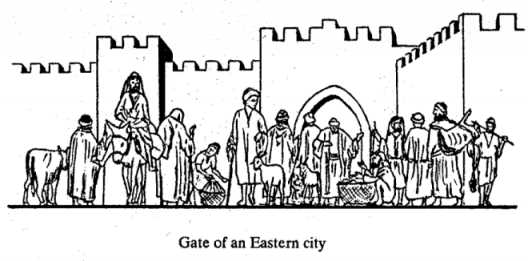
Immediately inside the main gate of the city was an open area where people sat, talked, sold goods and conducted business. It was also the place where the elders of the city sat to decide cases brought before them for legal judgment. This open area was popularly called the ‘gate’ of the city (Gen 19:1; Deu 21:19; Rth 4:1-2; 2Ki 7:1). As commerce grew in Israel, city life became more and more characterized by greed and injustice, the chief offenders being ruthless merchants and corrupt officials. The gate of the city, instead of being a place to find justice and contentment, became a centre of bribery and oppression (Isa 29:20-21; Amo 5:10-15; Amo 8:4-6).
Godly people saw the wickedness of city life as symbolic of the wickedness of humankind in general. To them the world was like one great evil city (Rev 11:8). They pictured human society, organized in arrogant defiance of God, as the great city Babylon, doomed to be destroyed (Rev 18:2-24; cf. Dan 4:30; see BABYLON).
By contrast, the eternal city where God will dwell with his people is called new Jerusalem, a city from which all forms of evil are excluded (Rev 21:2-4; Rev 21:22-27; see JERUSALEM). The Bible considers that Christians are already citizens of this heavenly city. In the present world they are considered to be temporary residents, whose real citizenship is in the ‘Jerusalem which is above’ (Gal 4:26; Php 3:20; Heb 11:13-16; Heb 12:22; Heb 13:14; 1Pe 2:11).
The Bible does not generally distinguish between a city, town, or village. There is an emphasis upon walls and fortifications (Leviticus 25:29–31; Joshua 19:35). The Bible repeats references to towers, gates, and sieges. So, cities provided the primary security for the surrounding towns and villages.
Ancient Times
Practical Requirements
Settled communities depended upon a controlled food supply. Unlike city dwellers, nomads (people who moved from place to place) lived in tents that they could carry as they searched for food. There is a contrast between settled city life and the nomadic experience. The Bible shows this difference when it talks about Abraham, who lived a partly nomadic life: “For he was looking forward to the city with foundations, whose architect and builder is God” (Hebrews 11:10).
The First Biblical City
The first biblical reference to a city is in Genesis 4:17. The Hebrew verb indicates that Cain “was building” the city. It is probable that he did not complete it. Nor did he stay there. God earlier condemned him to a live as "a fugitive and a wanderer" (verse 12).
The Genesis account is consistent when affirming that city life started early. The first human offspring were Cain and Abel. They produced food (Genesis 4:2). Cain was a farmer, and Abel a shepherd. Genesis 4 shows both the need to produce food and the specialization that results. Jabal was a tentmaker (verse 20). Jubal was a musician (verse 21). Tubal-Cain was a metalworker (verse 22).
Archaeological Evidence
Archaeological discoveries generally support the idea that cities began very early. Jericho is the oldest known city discovered in the land of Canaan. By testing wood from the site using carbon-14 dating, archaeologist Kathleen Kenyon determined Jericho existed before 7000 BC. Although less than 4 hectares (10 acres), it was a well-developed city. It had an impressive wall 1.8 meters (6 feet) thick. It also had a round stone tower almost 9 meters (30 feet) high with a staircase inside from top to bottom.
Jericho seems to be 3,000 years older than other Canaanite cities. Most of the great Sumerian cities like Ur, Ish, Lagah, and Uruk came later. They originated in the fourth or early third millennium BC.
Location and Name
Topographical Necessities
There were four primary considerations in the selection of a site for a city:
Security. The topography (terrain or location) of the ancient city must contribute to its defense. A city built on a natural hill tended to be less vulnerable than one built in the valley. Defenders had a substantial advantage if an enemy had to attack on an incline.
The location of Jerusalem illustrates the importance of a secure location. Higher mountains surround it (Psalm 125:2). They first established Jerusalem on a limestone ridge. On the east the deep Kidron Valley protected it. On the west was the impressive Tyropoean Valley. The two valleys met, providing Jerusalem with protection from the south. To complete the security, they constructed walls around the city. They focused on the northern side, otherwise this would expose Jerusalem (compare 2 Samuel 5:6).
Water. There was one absolute necessity for the existence of a city. This was a water source located in a convenient place. The city spring or well became the center of social communication. This was most true for the women. They were the usual water carriers. There are many Biblical examples of socializing at the village well (Genesis 29:1–12; 1 Kings 1:38–39).
In general, valleys were the source for water. So the nearest spring to a city was often outside the walls. An attacking enemy might seize the water source. The water supply stored inside the city walls could run dry. This could cause a city to surrender. In Jerusalem, King Hezekiah constructed a water tunnel. He made it to neutralize the impending attack of the Assyrian king Sennacherib (2 Kings 20:20; 2 Chronicles 32:30). It was an amazing accomplishment of engineering. The tunnel extended more than 518 meters (1,700 feet). Now over 2,500 years old, visitors to Jerusalem can still see it today.
Food. Every city needed enough food for those who lived there. Ancient farmers lived in a village or city. They walked each day to their fields. A city could only exist if there were enough farmable fields nearby to feed all the people.
Trade. A city must allow for importing raw materials and exporting finished products. Being close to local and international roads was desirable, if not a necessity. The important cities of the Bible were along primary roads of business.
The importance of these four factors has changed over time. When strong nations like Rome appeared, cities could rely on standing armies instead of being built on hard-to-reach hilltops. The development of plastered water tanks and aqueducts made it possible to build cities farther from natural water sources.For example, Caesarea, built by Herod the Great, was 19.3 kilometers (12 miles) from the springs of Mount Carmel. Trade routes changed with shifting international conditions, causing some cities to decline while others grew.
See also Archaeology and the Bible.
Aquifer Open Bible Dictionary © 2026 Mission Mutual, an adaptation of the Tyndale Open Bible Dictionary © 2023 Tyndale House Publishers. Licensed under CC BY-SA 4.0.
A large walled centre of population providing security for its inhabitants. The OT often uses the term as a symbol of the security of heaven.
Types of city
Ancient cities
Fortified cities
NUM 32:34–32:36; ; DEU 9:1; ; JOS 10:20, JOS 14:12
Royal cities
JOS 10:2; ; 1SA 27:5; ; 1CH 11:7
Cities of refuge
Cities were frequently large
DEU 1:28; JON 3:2–3:3 See also DEU 6:10, DEU 9:1; NEH 7:4; JON 4:11
Cities were surrounded by walls
DEU 3:5; EZR 4:12; 2CO 11:32–11:33 See also DEU 28:52; JOS 2:15; 1KI 3:1, 1KI 4:13; 2CH 33:14
Cities were places of security
NUM 32:17 See also JOS 10:20; 2CH 11:5–11:12, 2CH 14:6, 2CH 17:2; JER 4:5
Cities could fall
2SA 5:7; NEH 1:3; JER 51:58 See also DEU 20:12, DEU 20:19–20:20; 1KI 16:17–16:18; 2KI 25:1–25:4; ISA 13:19; JER 32:24–32:25; AMO 5:9
The holy city
PSA 48:1–48:2 See also 1KI 11:36, 1KI 14:21; 1CH 11:7; NEH 11:1; ISA 52:1; JER 25:29; DAN 9:16; MAT 5:35
City law
The city as a symbol
Of strength
Of heaven
HEB 11:10 See also HEB 11:16, HEB 12:22, HEB 13:14; REV 21:2, REV 21:20–21:27, REV 22:1–22:5
Dictionary of Bible Themes © 1999 Martin H. Manser. Licensed under CC BY-SA 4.0.