
01.08. The Sabbath
The “First day of the Week”, “The Lord’s Day” and Sabbath by Clint Branham clint@AwakenedChurch.com http://AwakenedChurch.com
Why do I think that I have gotten this knowledge when thousands of scholars over a hundreds of years haven’t come to the same conclusions? Ya’ll aren’t the first to ask us this. This is the very question that we and I have asked each other many times when we started down this path.
1. I had the same mindset as these “thousands of scholars” until a couple of years ago, Sunday was the only day to worship. End of story. It was never an issue for me, or my Father, any of his preacher friends, or any of their friends. It wasn’t an issue for my grandfathers, great grand fathers, great-great grandfathers; basically it wasn’t an issue with anyone I knew.
2. My prevalent thought was that anyone that worships on Saturday was part of a cult.
3.Why should I even look at anything that is, and has been settled for hundreds of years? Anyone who kept Sabbath is part of a cult. When Clinton started asking Lynn and me “Why do we believe what we believe?” and “Why do we worship the way we do?” and “Why do we worship on Sunday, and not on Thursday?” My answer to all three questions was “Because it is right!” or “That is what God intended for us to do!” To a 19 year old those kinds of answers were pretty shallow, and in reality, they were. Lynn and I were scared to death that Clinton was: “going off the deep end”, “Leaving the Faith”, “becoming an Atheist”. We knew that in order to keep our oldest son from leaving the faith we had no choice but to answer his questions without “because I said so” answers. Because we knew what we believed was right these questions should be easy to answer.
Once Lynn and I had the challenge of proving Clinton wrong, we first chose the question of Sabbath vs. Sunday. We were on a quest to utterly prove Biblically that Sunday was the only choice. Even considering this question is ridiculous to the vast majority of scholars, (why look at a settled issue). We knew that we had to have Biblical as well as historical evidence to back up our original flippant reply. At this point we were not worried about whether Sabbath worship was a cult. To be honest, we were 200% confident that we would find so much evidence pointing to Sunday being The Lord’s day that it would be embarrassing to Clinton.
We had tools at our disposal that scholars of old, and not so old, could never have imagined. With the computer we were able to search historical documents that were not within reach of 99.9% of scholars 200, 100, 50, 25 nor even 10 years ago. Not only did we have access to read these documents, we also were able to search and cross reference them electronically. We had access to scholarly and historical works that earlier we would have been unaware that even existed. Another and potentially the biggest advantage over the earlier scholars was the ability to have a Bible computer program that allowed us to read, search dozens of bible translations, do in-depth word studies, search original language with Strong’s numbering, lookup words in dictionaries, and cross reference scriptures in concordances. We were confident that with the tools available to us, this one would be easy…
Here is some of the research that we did in our quest to discover:
Who, what, when, where, and how was the Saturday Sabbath changed to Sunday?
First, there is no question that the day of worship in Old Testament times is the Saturday Sabbath.
Genesis 2:2-3 KJV And on the seventh day God ended his work which he had made; and he rested on the seventh day from all his work which he had made. And God blessed the seventh day, and sanctified it: because that in it he had rested from all his work which God created and made.
Second, there is no direct change given in scripture. The word “Sunday” never appears in Scripture. However, the phrase “First day of the Week” does appear 8 times in Scripture. And “The Lord’s Day” appears once. In that phrase first day of the week, you will notice that the word “day” is in italics. Here is a quote explaining why certain words are italicized: “The King James Version used italics to indicate words that had no exact equivalent in the original text, but had been supplied by the translators for various reasons, usually to make the text read properly in English.” Obviously there is a Greek phrase for “day”, so, what is the original phrase?
Matthew 28:1 In the end of the sabbath, as it began to dawn toward the first day of the week, came Mary Magdalene and the other Mary to see the sepulcher.
Mark 16:2 And very early in the morning the first day of the week, they came unto the sepulcher at the rising of the sun.
Mark 16:9 Now when
Luke 24:1 Now upon the first day of the week, very early in the morning, they came unto the sepulcher, bringing the spices which they had prepared, and certain
John 20:1 The first day of the week cometh Mary Magdalene early, when it was yet dark, unto the sepulcher, and seeth the stone taken away from the sepulcher.
John 20:19 Then the same day at evening, being the first day of the week, when the doors were shut where the disciples were assembled for fear of the Jews, came Jesus and stood in the midst, and saith unto them,
Acts 20:7 And upon the first day of the week, when the disciples came together to break bread, Paul preached unto them, ready to depart on the morrow; and continued his speech until midnight.
1 Corinthians 16:2 Upon the first day of the week let every one of you lay by him in store, as
You will notice that the first six verses are referring to the same day; Resurrection Day. The passage in Acts and 1 Corinthians are both approximately 35 years later. So there are only 3 separate days referenced and called the “First day of the Week”.
Let’s look at the phrase with the corresponding Strong’s concordance numbers:
Matthew 28:1 the firstG3391
Upon the - G2596
Week - G4521
Almost all English translations render the Greek phrasesmian sabbaton,mias sabbaton,mia ton sabbaton, andprote sabbatouas "first day of the week." However, none of these Greek phrases can literally be translated that way. The Greek wordmiaand all of its forms represent the cardinal number "one." The Greek wordprotosis the ordinal "first." In the New Testament,mia,mian, andmiasappear 79 times. They are rendered as "first" eight times in theAuthorized King JamesVersion, seven of them in the "firstdayof the week" passages (Matthew 28:1; Mark 16:2; Luke 24:1; John 20:1; John 20:19; Acts 20:7; 1 Corinthians 16:2), and also in Titus 3:10 (where a better translation would be "once"). In Greek, the phrase "first day of the week" is properly renderedprotes hemeras tes hebdomados. Interestingly, the Greek word for "day" does not appear in any of the "firstdayof the week" verses in the New Testament. In the King James Concordance we can look at how a word Greek word was translated into English:
G4521
Matthew 12:1-2 (2), Matthew 12:5 (2), Matthew 12:8, Matthew 12:10-12 (3), Matthew 24:20, Matthew 28:1, Mark 1:21, Mark 2:23-24 (2), Mark 2:27-28 (3), Mark 3:2, Mark 3:4, Mark 6:2, Mark 16:1, Luke 4:16, Luke 4:31, Luke 6:1-2 (2), Luke 6:5-7 (3), Luke 13:9-10 (2), Luke 13:14-16 (4), Luke 14:1, Luke 14:3, Luke 14:5, Luke 23:54, Luke 23:56, John 5:9-10 (2), John 5:16, John 5:18, John 7:22-23 (3), John 9:14, John 9:16, John 19:31 (2), Acts 1:12, Acts 13:14, Acts 13:27, Acts 13:42, Acts 13:44, Acts 15:21, Acts 16:13, Acts 17:2, Acts 18:4, Colossians 2:16 week, 9 Mark 16:1-2 (2), Mark 16:9, Luke 18:12, John 20:1 (2), John 20:19, Acts 20:7, 1 Corinthians 16:2 So What?!?!
Well when we look at ALL the scriptures that refers to “First day of the Week”: The word translated “day” is not there in the Greek. It was added for “Clarity” The word translated “first” is usually translated as “one” The word “week” is overwhelmingly translated “Sabbath” (outside these passages we are looking at only Luke 18:12 translates “Sabbaton” as week.)
If we look at a literal rendering of these phrases, we see that they would be better translated as "one of the Sabbaths" (mian sabbaton, mias sabbaton, and mia ton sabbaton), or "First Sabbath" (prote sabbatou).
Again… So what? This is where a little history and understanding the Biblical feasts come in. After Passover is First Fruits, after First Fruits there is Pentecost, This feast is 50 days after the Sabbath of First Fruits.
Leviticus 23:15-16 KJV And ye shall count unto you from the morrow after the sabbath, (First Fruits) from the day that ye brought the sheaf of the wave offering; seven sabbaths shall be complete: Even unto the morrow after the seventh sabbath shall ye number fifty days; and ye shall offer a new meat offering unto the LORD.
“Seven sabbaths were to be counted from the Feast of First-fruits or Passover. Consequently, these came to be known as "First Sabbath," "Second Sabbath" etc., down to the seventh. And according to Julian Morgenstern, former President of Hebrew University, this practice continued in Galilee till the time of Christ or the Common Era. It is still observed by some groups in Palestine today. Thus, there was an annual date known as "First Sabbath," just after Passover.”(p.230,The Life of Christ in Stereo) Johnston M. Cheney . Is there any New Testament scripture to support this? Yes there is…
Luke 6:1 KJV And it came to pass on the second sabbath after the first, that he went through the corn fields; and his disciples plucked the ears of corn, and did eat, rubbing
What does this prove?
All of the verses that have the phrase “First day of the Week” occur during this 50 Day period between Passover and Pentecost. So the English translation for that phrase doesn’t fit with the literal Greek or the cultural context. As a matter of fact, it actually ignores the historical and cultural significance of the First of the Sabbaths, and the counting of days until Penticost.
What about the phrase “The Lord’s Day”?
Revelation 1:10 KJV I was in the Spirit on the Lord’s day, and heard behind me a great voice, as of a trumpet, This phrase only occurs once in the bible. It is often used as “proof” that Sabbath was changed to Sunday. But that thought process doesn’t fit with what Jesus said.
Matthew 12:8 KJV
Mark 2:27-28 KJV And he said unto them,
Luke 6:5 KJV And he said unto them,
Matthew 5:17-20 KJV
“Jesus quoted a Hebrew idiom when He said He came not to destroy the Law or the prophets. He was using a familiar phrase easily understood during Biblical times. Jesus had been accused of misinterpreting the Torah, yet He said that He was actually rightly and correctly teaching it. Traditional Jewish writings support this idiom, "Should all the nations of the world unite to uproot one word of the Law, they would be unable to do it," Leviticus Rabbah 19:2. To understand the meaning of this verse, everything hinges on the meaning of the words "destroy" and "fulfill" in verse 17. What does Jesus mean by "destroy the Law" and "fulfill the Law"? "Destroy" and "fulfill" are technical terms used in rabbinic argumentation. When a sage felt that a colleague had misinterpreted a passage of Scripture, he would say, "You are destroying the Law!" Needless to say, in most cases, his colleagues strongly disagreed. What was "destroying the Law" for one sage was "fulfilling the Law" (correctly interpreting Scripture) for another," wrote Bivin and Blizzard in their book Understanding the Difficult Words of Jesus (Yahshua).
Just a couple of verses later Jesus is fulfilling (correctly interpreting) the Law
Matthew 5:21-24 KJV
Matthew 5:27-28 KJV
If the interpretation of Matthew 5:1-48 (the Law was “fulfilled”) is license to ignore the law or end the law, then the following passage doesn’t fit.
Matthew 24:19-21 KJV
If Jesus knew that the Sabbath was being changed to Sunday, why would he be worried that your flight was on the Sabbath? This doesn’t make sense if it was changing to Sunday. Obeying the Sabbath (commandment #4) doesn’t even qualify as one of the “least of the commandments”. Even breaking one of those will make you least in the kingdom. Does Paul or the other Apostles ever allude to the fact that the Sabbath was, is, or would ever be changed to Sunday? No, as well. The book of Acts covers the timeframe from the ascension of Jesus until Approx AD 61. This is plenty of time to record the change from Sabbath to Sunday.
Acts 13:27 KJV For they that dwell at Jerusalem, and their rulers, because they knew him not, nor yet the voices of the prophets which are read every sabbath day, they have fulfilled
Acts 13:42 KJV And when the Jews were gone out of the synagogue, the Gentiles besought that these words might be preached to them the next sabbath.
Acts 13:44 KJV And the next sabbath day came almost the whole city together to hear the word of God.
Acts 15:21 KJV For Moses of old time hath in every city them that preach him, being read in the synagogues every sabbath day. As a matter of fact there are 84 worship services on the Sabbath recorded in Acts (Acts 13:14; Acts 13:44; Acts 16:13; Acts 17:2; Acts 18:4; Acts 18:11) If Sabbath was changed/changing to Sunday wouldn’t it have been recorded in Acts???
Now let’s look at prophecies concerning the Tribulation and Millennial Reign and see if Sabbath is ever mentioned. If it was changed to Sunday, it would have to be reflected in the prophecies.
Isaiah 66:22-23 KJV For as the new heavens and the new earth, which I will make, shall remain before me, saith the LORD, so shall your seed and your name remain. And it shall come to pass,
(Prophecy of the New Temple in the Millennial Reign.)
Ezekiel 44:24 KJV And in controversy they shall stand in judgment;
Ezekiel 45:17 KJV And it shall be the prince’s part
Ezekiel 46:1-3 KJV Thus saith the Lord GOD; The gate of the inner court that looketh toward the east shall be shut the six working days; but on the sabbath it shall be opened, and in the day of the new moon it shall be opened. And the prince shall enter by the way of the porch of
I have one more section that has a lot of information in it. I pray you can see that Sabbath was not changed by Jesus, Paul, or any of the Apostles. The fact remains that worship was changed and this next section tells us by whom. So how did we get to this point?
History records there were pagans that crept into the church and tried to include pagan worship into the Early Church. This was also prophesied by Paul.
Acts 20:29-30 KJV For I know this, that after my departing shall grievous wolves enter in among you, not sparing the flock. Also of your own selves shall men arise, speaking perverse things, to draw away disciples after them.
None of the early historians record First Century Christians worshiping on Sunday. World leading historians also confirm that the Sabbath was kept by both Jews and believing Gentiles until about 120 A.D. When the persecution of the Jews and believing Gentiles became so great, many Christians decided to start keeping Sunday to avoid persecution and death, using the excuse that it was in honor of the resurrection. In the battle of Milvian Bridge in 312 A.D., Constantine looked up at the Sun and saw a cross of light and the words “In this Victory”. According to the early Church historian Eusebius, this was Constantine’s conversion to Christianity. In 313 A. D. “The Edict of Milan” was signed by Constantine and Licinius. This edict gave religious tolerance throughout the Roman Empire. In 316 A.D. Constantine led the first battle of Christian on Christian warfare against the Donatists; a schism that more closely adhered to scripture. Constantine won and that wining group of Christians went on to become the Catholic Church we are now familiar with. In 321 A.D., Constantine became Caesar in Rome and he began to see the balance of power shift from paganism to the Church. He passed the first law enforcing Sunday observance.
"On the venerable day of the Sun let the Magistrates and the people residing in the cities rest, and let all workshops be closed." Codex Justinian 3.12.2
Until then, there had never been a law enforcing Sunday observance. Keep in mind he supposedly converted in 312 A.D. His conversion was more than likely politically motivated since many years after his “conversion” Constantine commissioned coins with the phrase “Sol Invictus” meaning “Unconquered Sun” with an image of the Sun god Sol pressed in the coin. In order to control the eastern and western halves of his empire, he moved his capital from Rome to Byzantium by building a new city there. He named Constantinople after himself and hence transferred his headquarters over to Constantinople, leaving Rome vacant. As a result the Papacy moved in and sat on the throne of Caesar and so the Church took over Rome.
"Thus we learn from Socrates (H.E., vi.c.8) that in his time public worship was held in the churches of Constantinople on both days.... The view that the Christian’s Lord’s day, or Sunday, is but the Christian Sabbath deliberately transferred from the seventh to the first day of the week does not indeed find categorical expression till a much later period.... The earliest recognition of the observance of Sunday as a legal duty is a constitution of Constantine in A.D. 321, enacting that all courts of justice, inhabitants of towns, and workshops were to be at rest on Sunday (venerabili die Solis), with an exception in favour of those engaged in agricultural labour... Encyclopaedia Britannica, 1899 Edition, Vol. XXIII, page 654 This was further strengthened by the council of Laodicea:
"Christians shall not Judaize and be idle on Saturday, the Sabbath, but shall work on that day; but the Lord’s day (Sunday) they shall especially honor, and, as being Christians, shall, if possible, do no work on that day. If, however, they are found Judaizing, they shall be shut out from Christ." ---Canon 29, Council of Laodicea, 364 C.E.
Statements by the Catholic Church about the Sabbath.
“Some theologians have held that God likewise directly determined the Sunday as the day of worship in the New Law, that He Himself has explicitly substituted the Sunday for the Sabbath. But this theory is now entirely abandoned. It is now commonly held that God simply gave His Church the power to set aside whatever day or days she would deem suitable as Holy Days. The (Roman Catholic) Church chose Sunday, the first day of the week, and in the course of time added other days as holy days.” John Laux, A Course in Religion for Catholic High Schools and Academies, 1936 edition, vol. 1, p. 51. “Nowhere in the Bible is it stated that worship should be changed from Saturday to Sunday...Now the Church...instituted, by God’s authority, Sunday as the day of worship. This same Church, by the same divine authority, taught the doctrine of Purgatory long before the Bible was made. We have, therefore, the same authority for Purgatory as we have for Sunday.” Martin J. Scott, Things Catholics Are Asked About, 1927 edition, p. 136. “Protestantism, in discarding the authority of the (Roman Catholic) Church, has no good reasons for its Sunday theory, and ought logically to keep Saturday as the Sabbath.” John Gilmary Shea, American Catholic Quarterly Review, January 1883. “The Catholic church for over one thousand years before the existence of a Protestant, by virtue of her divine mission, changed the day from Saturday to Sunday...The Protestant World at its birth found the Christian Sabbath too strongly entrenched to run counter to its existence; it was therefore placed under the necessity of acquiescing in the arrangement, thus implying the (Catholic) Church’s right to change the day, for over three hundred years. The Christian Sabbath is therefore to this day, the acknowledged offspring of the Catholic Church as spouse of the Holy Ghost, without a word of remonstrance from the Protestant World.” James Cardinal Gibbons in the Catholic Mirror, September 23, 1983.
Most Christians assume that Sunday is the biblically approved day of worship. The Catholic Church protests that it transferred Christian worship from the biblical Sabbath (Saturday) to Sunday, and that to try to argue that the change was made in the Bible is both dishonest and a denial of Catholic authority. If Protestantism wants to base its teachings only on the Bible, it should worship on Saturday.” Rome’s Challenge www.immaculateheart.com/maryonline Dec 2003 Why would the Translators have kept the Catholic Tradition of Sunday Worship? From 321 A.D. until the Reformation in 1517 A.D., the Catholic Church had dominated the entire world. They had instilled an utter hatred for Jews and anything Jewish during the inquisition. After the Reformation, Martin Luther translated the Scripture into German. All priests and monks that translated the scripture had been trained in the Catholic Traditions and like Luther, had an anti-Jewish bias. To illustrate this; one of Adolph Hitler’s favorite books was written by Martin Luther: On the Jews and their Lies (1543). It was quoted extensively in all the Third Reich material about the Jews. Even though Martin Luther had little if anything to do with the translation of the scripture into English, the same Anti-Semitic teachings from the Catholic Church and the Church of England existed among the King James translators as well. The only logical reason that the translators substituted Sunday for Sabbath, was that it was politically expedient; it would have been viewed as heresy for the Authorized Version to suggest otherwise, since the Church of England had been worshiping on Sunday for centuries.
Since the Law is done away with what does this matter? Let’s look at what scripture says:
Matthew 24:15-24 KJV
John 5:45-47 KJV
1 John 5:1-3 KJV Whosoever believeth that Jesus is the Christ is born of God: and every one that loveth him that begat loveth him also that is begotten of him. By this we know that we love the children of God, when we love God, and keep his commandments. For this is the love of God, that we keep his commandments: and his commandments are not grievous.
Revelation 12:17 KJV And the dragon was wroth with the woman, and went to make war with the remnant of her seed, which keep the commandments of God, and have the testimony of Jesus Christ.
Revelation 22:12-16 KJV
Romans 6:1-2 KJV What shall we say then? Shall we continue in sin, that grace may abound? God forbid. How shall we, that are dead to sin, live any longer therein?
Jeremiah 16:19-21 KJV O LORD, my strength, and my fortress, and my refuge in the day of affliction, the Gentiles shall come unto thee from the ends of the earth, and shall say, Surely our fathers have inherited lies, vanity, and
You may not agree with me, because these things are very radical according to what we have always practiced. But in studying these things it has become crystal clear that God has not changed on his sanctification of the Sabbath. Coming to this realization has not been easy and it pains me greatly to know that I have caused any of you pain. No matter how much I care for you all, I must be true to God, His Son, and God’s unchanging Word.
Malachi 3:6-7 KJV For I
Hebrews 13:8-9 KJV Jesus Christ the same yesterday, and today, and forever. Be not carried about with divers and strange doctrines. For
Additional Catholic Statements on the Sabbath
“Is not every Christian obliged to sanctify Sunday and to abstain on that day from unnecessary servile work? Is not the observance of this law among the most prominent of our sacred duties? But you may read the Bible from Genesis to Revelation, and you will not find a single line authorizing the sanctification of Sunday. The Scriptures enforce the religious observance of Saturday, a day which we never sanctify.” James Cardinal Gibbons, The Faith of Our Fathers (1917 edition), p. 72-73 (16th Edition, p 111; 88th Edition, p. 89). “For example, nowhere in the Bible do we find that Christ or the Apostles ordered that the Sabbath be changed from Saturday to Sunday. We have the commandment of God given to Moses to keep holy the Sabbath day, that is the 7th day of the week, Saturday. Today most Christians keep Sunday because it has been revealed to us by the [Roman Catholic] church outside the Bible.” Catholic Virginian, October 3, 1947, p. 9, article “To Tell You the Truth.” Who Made Sunday Holy?
“Written by the finger of God on two tables of stone, this Divine code (ten commandments) was received from the Almighty by Moses amid the thunders of Mount Sinai...Christ resumed these Commandments in the double precept of charity--love of God and of the neighbour; He proclaimed them as binding under the New Law in Matthew 19:1-30 and in the Sermon on the Mount (Matthew 5:1-48)...The (Catholic) Church, on the other hand, after changing the day of rest from the Jewish Sabbath, or seventh day of the week, to the first, made the Third Commandment refer to Sunday as the day to be kept holy as the Lord’s Day...He (God) claims one day out of the seven as a memorial to Himself, and this must be kept holy...”The Catholic Encyclopaedia, vol. 4, “The Ten Commandments”, 1908 edition by Robert Appleton Company; and 1999 Online edition by Kevin Knight, Imprimatur, John M. Farley, Archbishop of New York.
“Question: How prove you that the church had power to command feasts and holydays?
“Answer: By the very act of changing the Sabbath into Sunday, which Protestants allow of and therefore they fondly contradict themselves by keeping Sunday strictly, and breaking most other feasts commanded by the same church.
“Question: Have you any other way of proving that the church has power to institute festivals of precept?
“Answer: Had she not such power, she could not a done that in which all modern religionists agree with her; -she could not have substituted the observance of Sunday the first day of the week, for the observance of Saturday the seventh day of the week, a change for which there is no Scriptural authority.” Stephen Keenan, A Doctrinal Catechism On the Obedience Due to the Church, 3rd edition, Chapter 2, p. 174 (Imprimatur, John Cardinal McCloskey, Archbishop of New York). “Perhaps the boldest thing, the most revolutionary change the Church ever did, happened in the first century. The holy day, the Sabbath, was changed from Saturday to Sunday. ‘The day of the Lord’ was chosen, not from any direction noted in the Scriptures, but from the (Catholic) Church’s sense of its own power...People who think that the Scriptures should be the sole authority, should logically become 7th Day Adventists, and keep Saturday holy.” St. Catherine Church Sentinel, Algonac, Michigan, May 21, 1995. “Question - Which is the Sabbath day?
“Answer - Saturday is the Sabbath day.
“Question - Why do we observe Sunday instead of Saturday?
“Answer - We observe Sunday instead of Saturday because the Catholic Church, in the Council of Laodicea (A.D. 364), transferred the solemnity from Saturday to Sunday.” Peter Geiermann, C.S.S.R., The Convert’s Catechism of Catholic Doctrine, p. 50, 3rd edition, 1957. “Is Saturday the seventh day according to the Bible and the Ten Commandments? I answer yes. Is Sunday the first day of the week and did the Church change the seventh day - Saturday - for Sunday, the first day? I answer yes. Did Christ change the day’? I answer no!”
“Faithfully yours, J. Card. Gibbons.” James Cardinal Gibbons, Archbishop of Baltimore, Md. (1877-1921), in a signed letter. “Question. What warrant have you for keeping Sunday preferably to the ancient sabbath which was Saturday?
“Answer. We have for it the authority of the Catholic church and apostolic tradition.
“Question. Does the Scripture anywhere command the Sunday to be kept for the Sabbath?
“Answer. The Scripture commands us to hear the church (Matthew 1:1; Luke 10:16), and to hold fast the traditions of the apostles. 2 Thessalonians 2:15. But the Scripture does not in particular mention this change of the Sabbath. “St John speaks of the Lord’s day (Revelation 1:10) but he does not tell us what day of the week that was, much less does he tell us what day was to take the place of the Sabbath ordained in the commandments. St.Luke speaks of the disciples meeting together to break bread on the first day of the week. Acts 20:7. And St. Paul (1 Corinthians 1:1) orders that on the first day of the week the Corinthians should lay in store what they designated to bestow in charity on the faithful in Judea: but neither the one or the other tells us that this first day of the week was to be henceforth a day of worship, and the Christian Sabbath; so that truly the best authority we have for this ancient custom is the testimony of the church. And therefore those who pretend to be such religious observers of Sunday, whilst they take no notice of other festivals ordained by the same church authority, show that they act more by humor, than by religion; since Sundays and holidays all stand upon the same foundation, namely the ordinance of the (Roman Catholic) church.” Catholic Christian Instructed, 17th edition, p. 272-273. Whose Day of Worship is Sunday?
“They [the Protestants] deem it their duty to keep the Sunday holy. Why? Because the Catholic Church tells them to do so. They have no other reason...The observance of Sunday thus comes to be an ecclesiastical law entirely distinct from the divine law of Sabbath observance...The author of the Sunday law...is the Catholic Church.” Ecclesiastical Review, February 1914.
“The Sunday...is purely a creation of the Catholic Church.”American Catholic Quarterly Review, January 1883. “Sunday...is the law of the Catholic Church alone...” American Sentinel (Catholic), June 1893. “Sunday is a Catholic institution and its claim to observance can be defended only on Catholic principles...From beginning to end of Scripture there is not a single passage that warrants the transfer of weekly public worship from the last day of the week to the first.” Catholic Press, Sydney, Australia, August 1900. “It is well to remind the Presbyterians, Baptists, Methodists, and all other Christians, that the Bible does not support them anywhere in their observance of Sunday. Sunday is an institution of the Roman Catholic Church, and those who observe the day observe a commandment of the Catholic Church.” Priest Brady, in an address reported in The News, Elizabeth, New Jersey, March 18, 1903. Who Do We Reverence and Pay Homage to by Keeping Sunday Holy?
“From this we may understand how great is the authority of the church in interpreting or explaining to us the commandments of God - an authority which is acknowledged by the universal practice of the whole Christian world, even of those sects which profess to take the holy Scriptures as their sole rule of faith, since they observe as the day of rest not the seventh day of the week demanded by the Bible, but the first day. Which we know is to be kept holy, only from the tradition and teaching of the Catholic church.” Henry Gibson, Catechism Made Easy, #2, 9th edition, vol. 1, p. 341-342.
“It was the Catholic church which...has transferred this rest to Sunday in remembrance of the resurrection of our Lord. Therefore the observance of Sunday by the Protestants is an homage they pay, in spite of themselves, to the authority of the (Catholic) church.” Monsignor Louis Segur, Plain Talk About the Protestantism of Today, p. 213. “Sunday is our mark or authority...the church is above the Bible, and this transference of Sabbath observance is proof of that fact.” Catholic Record of London, Ontario, September 1, 1923. “Of course the Catholic Church claims that the change (Saturday Sabbath to Sunday) was her act...And the act is a mark of her ecclesiastical authority in religious things.” H.F. Thomas, Chancellor of Cardinal Gibbons. “I have repeatedly offered $1,000 to anyone who can prove to me from the Bible alone that I am bound to keep Sunday holy. There is no such law in the Bible. It is a law of the holy Catholic Church alone. The Bible says, ‘Remember the Sabbath day to keep it holy.’ The Catholic Church says: ‘No. By my divine power I abolish the Sabbath day and command you to keep holy the first day of the week.’ And lo! The entire civilized world bows down in a reverent obedience to the command of the holy Catholic Church.” father T. Enright, C.S.S.R. of the Redemptoral College, Kansas City, in a lecture at Hartford, Kansas, February 18, 1884, printed in History of the Sabbath, p. 802. “Protestants...accept Sunday rather than Saturday as the day for public worship after the Catholic Church made the change...But the Protestant mind does not seem to realize that...In observing the Sunday, they are accepting the authority of the spokesman for the church, the Pope.” Our Sunday Visitor, February 15, 1950.
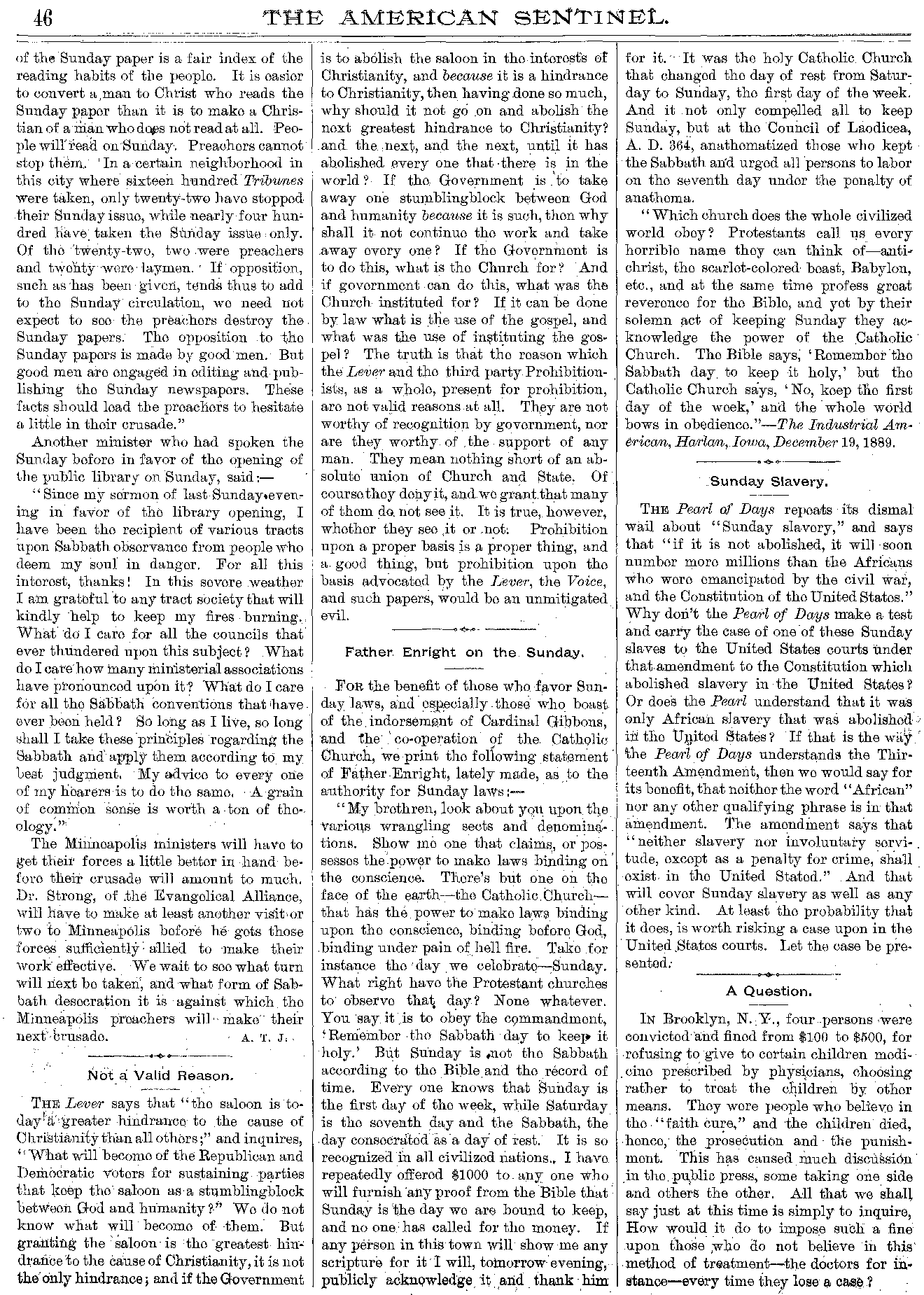
Conclusion and the Challenge.
“The (Roman Catholic) Church changed the observance of the Sabbath to Sunday by right of the divine, infallible authority given to her by her founder, Jesus Christ. The Protestant claiming the Bible to be the only guide of faith, has no warrant for observing Sunday.” The Catholic Universe Bulletin, August 14, 1942, p. 4.
“Sunday is founded, not of scripture, but on tradition, and is distinctly a Catholic institution. As there is no scripture for the transfer of the day of rest from the last to the first day of the week, Protestants ought to keep their Sabbath on Saturday and thus leave Catholics in full possession of Sunday.” Catholic Record, September 17, 1893. “Regarding the change from the observance of the Jewish Sabbath to the Christian Sunday, I wish to draw your attention to the facts: “1) That Protestants, who accept the Bible as the only rule of faith and religion, should by all means go back to the observance of the Sabbath. The fact that they do not, but on the contrary observe the Sunday, stultifies them in the eyes of every thinking man. “2) We Catholics do not accept the Bible as the only rule of faith. Besides the Bible we have the living Church, the authority of the Church, as a rule to guide us. We say, this Church, instituted by Christ to teach and guide man through life, has the right to change the ceremonial laws of the Old Testament and hence, we accept her change of the Sabbath to Sunday. We frankly say, yes, the Church made this change, made this law, as she made many other laws, for instance, the Friday abstinence, the unmarried priesthood, the laws concerning mixed marriages, the regulation of Catholic marriages and a thousand other laws... “It is always somewhat laughable, to see the Protestant churches, in pulpit and legislation, demand the observance of Sunday, of which there is nothing in their Bible.” Peter R. Kraemer, Catholic Church Extension Magazine, USA (1975), Chicago, Illinois, “Under the blessing of the Pope Pius XI” “I am going to propose a very plain and serious question to those who follow ‘the Bible and the Bible only’ to give their most earnest attention. It is this: Why don’t you keep holy the Sabbath day?... “The command of the Almighty God stands clearly written in the Bible in these words: ‘Remember the Sabbath day, to keep it holy. Six days shalt thou labor, and do all thy work; but the seventh day is the Sabbath of the Lord thy God; in it thou shalt not do any work.’ Exodus 20:8-10... “You will answer me, perhaps, that you do keep the Sabbath; for that you abstain from all worldly business and diligently go to church, and say your prayers, and read your Bible at home every Sunday of your lives... “But Sunday is not the Sabbath day. Sunday is the first day of the week: the Sabbath day is the seventh day of the week. Almighty God did not give a commandment that men should keep holy one day in seven; but He named His own day, and said distinctly: ‘Thou shalt keep holy the seventh day’; and He assigned a reason for choosing this day rather than any other - a reason which belongs only to the seventh day of the week, and cannot be applied to the rest. He says, ‘For in six days the Lord made heaven and earth, the sea and all that in them is, and rested on the seventh day: wherefore the Lord blessed the Sabbath day and hallowed it’, Exodus 20:11, Genesis 2:1-3. Almighty God ordered that all men should rest from their labor on the seventh day, because He too had rested on that day: He did not rest on Sunday, but on Saturday. On Sunday, which is the first day of the week, He began the work of creation; He did not finish it. It was on Saturday that He ‘ended His work which he had made: and God blessed the seventh day, and sanctified it: because that in it He had rested from all His work which God created and made.’ Genesis 2:2-3... “Nothing can be more plain and easy to understand than all this; there is nobody who attempts to deny it. It is acknowledged by everybody that the day which Almighty God appointed to be kept holy was Saturday, not Sunday. Why do you then keep holy the Sunday and not Saturday? “You will tell me that Saturday was the Jewish Sabbath, but that the Christian Sabbath has been changed to Sunday. Changed! But by whom? Who has the authority to change an express commandment of Almighty God? When God has spoken and said, ‘Thou shalt keep holy the seventh day’, who shall dare to say, ‘Nay, thou mayest work and do all manner of worldly business on the seventh day: but thou shalt keep holy the first day in its stead?’ This is a most important question, which I know not how you answer... “You are a Protestant, and you profess to go by the Bible and the Bible only; and yet, in so important a manner as the observance of one day in seven as the holy day, you go against the plain letter of the Bible, and put another day in the place of that day which the Bible has commanded. The command to keep holy the seventh day is one of the Ten Commandments; you believe that the other nine are still binding. Who gave you authority to tamper with the fourth? If you are consistent with your own principles, if you really follow the Bible, and the Bible only you ought to be able to produce some portion of the New Testament in which this fourth commandment is expressly altered.” Excerpts from “Why Don’t You Keep Holy the Sabbath Day?”, pages 3-15 in The Clifton Tract, vol. 4, published by the Roman Catholic Church 1869. “The arguments...are firmly grounded on the word of God, and having been closely studied with the Bible in hand, leave no escape for the conscientious Protestant except the abandonment of Sunday worship and the return to Saturday, commanded by their teacher, the Bible, or, unwilling to abandon the tradition of the Catholic Church, which enjoins the keeping of Sunday, and which they have accepted in direct opposition to their teacher, the Bible, consistently accept her (the Catholic Church) in all her teachings. Reason and common sense demand the acceptance of one or the other of these alternatives: either Protestantism and the keeping holy of Saturday, or Catholicism and the keeping holy of Sunday. Compromise is impossible.” James Cardinal Gibbons, in Catholic Mirror, December 23, 1893.