
Pottery is among the most common and ancient of manufactures. The Hebrews used earthenware vessels in the wilderness, and the potter's trade continued in Palestine after their settlement, though they had earlier worked at it in Egypt (Psalm 81:6). The process begins with clay trodden by foot into a paste (Isaiah 41:25). The potter then shaped it by hand on a wheel, which was a wooden disc turned by hand or treadle (Jeremiah 18:3). The vessel was smoothed, glazed, and burnt. Scripture references include Exodus 5:6-12 and 2 Chronicles 16:6.
Pottery. The art of pottery is one of the most common and most ancient of all manufactures. It is abundantly evident, both that the Hebrews used earthenware vessels in the wilderness, and that the potter’s trade was, afterward, carried on in Palestine. They had themselves been concerned in the potter’s trade in Egypt, Psa 81:6, and the wall-paintings minutely illustrate the Egyptian process.
The clay, when dug, was trodden by men’s feet so as to form a paste, Isa 41:25; Wis 15:7; then, placed, by the potter, on the wheel beside which he sat, and shaped by him, with his hands. How early the wheel came into use in Palestine is not known, but it seems likely that it was adopted from Egypt. Isa 45:9; Jer 15:3.
The vessel was then, smoothed and coated with a glaze, and finally, burnt in a furnace. There was at Jerusalem, a royal establishment of potters, 1Ch 4:23, from whose employment, and from the fragments cast away in the process, the Potter’s Field, perhaps, received its name. Isa 30:11.
Early known in Egypt. Israel in bondservice there wrought at it (Psa 81:6, so the Hebrew in 1Sa 2:14); but translated for "pots" the harden baskets for carrying clay, bricks, etc., such as are depicted in the sepulchral vaults at Thebes (Exo 5:6-12; 2Ch 16:6). The potter trod the clay into a paste (Isa 41:25), then put it on a wheel, by which he sat and shaped it. The wheel or horizontal lathe was a wooden disc, placed on another larger one, and turned by hand or worked by a treadle (Jer 18:3); on the upper he molded the clay into shape (Isa 45:9); the vessel was then smoothed, glazed, and burnt. Tiles with painting and writing on them were common (Eze 4:1). There was a royal establishment of potters at Jerusalem under the sons of Shelab (1Ch 4:25), carrying on the trade for the king’s revenue. The pottery found in Palestine is divisible into Phoenician, Graeco-Phoenician, Roman, Christian, and Arabic; on handles of jars occur inscriptions: "to king Zepha .... king Shat" and Melek (Palestine Exploration, Our Work in Palestine).
Emblem of man’s brittle frailty, and of God’s potter-like power to shape our ends as He pleases (Psa 2:9; Isa 29:16; Isa 30:14; Jer 19:11; Lam 4:2). As Isa 40:3 and Mal 3:1 are thrown together in Mar 1:2-3; also Isa 62:11 and Zec 9:9 in Mat 21:4-5; and Isa 8:14; Isa 28:16 in Rom 9:33; so Jer 18:3-6; Jer 18:19, and Zec 11:12-13 in Mat 27:9. Matthew presumes his reader’s full knowledge of Scripture, and merges the two human sacred writers, Jeremiah and Zechariah, in the one voice of the Holy Spirit speaking by them. In Matthew and Zechariah alike, the Lord’s representative, Israel’s Shepherd, has a paltry price set upon Him by the people; the transaction is done deliberately by men connected with the house of Jehovah; the money is given to the potter, marking the perpetrators’ baseness, guilt, and doom, and the hand of the Lord overrules it all, the Jewish rulers while following their own aims unconsciously fulfilling Jehovah’s "appointment."
By: Emil G. Hirsch, Wilhelm Nowack, Frederick J. Bliss.
—Biblical Data:
There can be no doubt that the Israelites first learned the art of making pottery on Palestinian soil. The nomad in his continual wanderings can not use the breakable wares of the potter; and the proper vessels for the latter's use are the leathern bag and hollowed fruits or wooden bowls. Even after their settlement the Israelites seem to have maintained for some time a disinclination to the use of earthen vessels; and mention of earthenware occurs in only one passage in early literature (II Sam. xvii. 28). Naturally the Canaanites were the teachers of the Israelites; but no doubt the Canaanites in their turn learned the potter's art from the Phenicians, who supplied foreign countries with pottery, and who, perhaps, even went through Palestine peddling their wares. The handicraft does not appear to have developed until the time of the later kings.
The process by which pottery is made was familiar to the Prophets and to the people. They understood the kneading of the potter's clay ("ḥomer"), which was trodden by the feet (Isa. xli. 25); and Jeremiah mentions the potter's disks ("obnayim"), which, as the name indicates, were two in number, revolving one above the other. The lower and larger disk was set spinning by the feet, while the clay, placed on the upper disk, which followed the motion of the lower one, but could be turned in the opposite direction also, was molded with the hands into the desired shape. The process of burning and glazing vessels is not mentioned until considerably later (comp. Prov. xxvi. 23; Sirach [Ecclus.] xxviii. 34); but there can be little doubt that the Canaanites, and through them the Israelites, learned this part of the craft from the Phenicians at a rather early period. In Jeremiah's time a potter's workshop was probably located in one of the valleys in the neighborhood of the Potters' Gate (comp. Jer. xviii. 1 et seq., xix. 1).
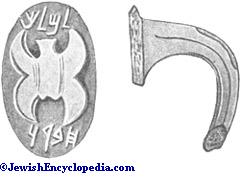
Royal Stamp on Jar-Handle.(In the possession of the Palestine Exploration Fund.)
The custom of making colored drawings on the vessels was probably also of Phenician origin, and was known at an early period, certainly in pre-exilic times. Some finds at Jerusalem, showing careful execution, must, from their location in the lowest strata, be assigned to the time of the Kings. Compared with these the finds at Tell al-Ḥasi seem very primitive. Perhaps the former are of Phenician workmanship and the latter are domestic imitations. The ornaments in both cases are purely geometric.
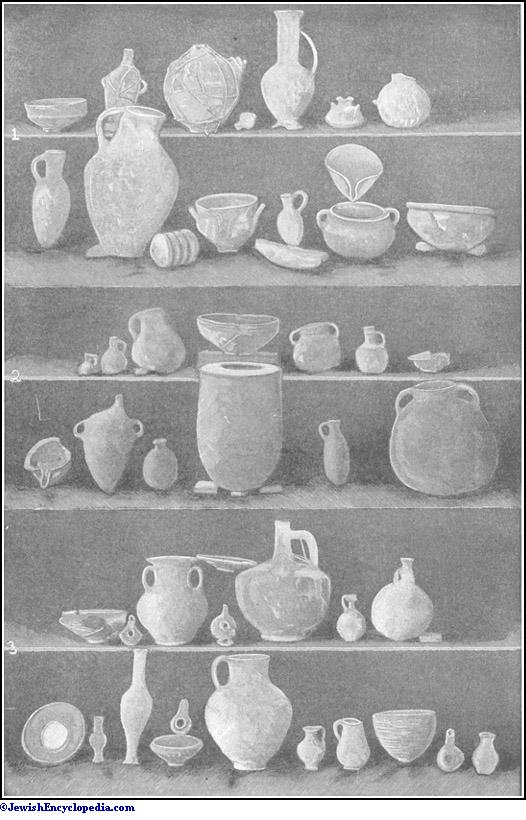
Pottery Discovered in Palestine.1. Pre-Israelitic Period. 2. Jewish Period. 3. Seleucidan Period.(From Bliss and Macalister, "Excavations in Palestine.")
It is known that earthenware was frequently used as a symbol of fragility and of that which may be quickly and completely destroyed (comp. Ps. ii. 9; Isa. xxii. 34; Jer. xix. 11). God, as the Creator, especially as the Creator of man and as the Lord who decides the fate of individuals and nations according to His judgment, is often likened to a potter (Isa. xxix. 16, xlv. 9, lxiv. 8; Jer. xviii. 6, xix. 11; Sirach [Ecclus.] xxxiii. 13). It is probable that the reference in Zech. xi. 13 is to the Temple treasure ("ha-oẓar") and not to the potter ("yoẓer").
Early Pre-Israelitic Period:
Various Strata. This period begins with the earliest known pottery (probably before 1700 B.C.), and ceases with the appearance of Phenician and Mycenæan influence (about 1500 B.C.). In deteriorated forms some of the types continued later. The chief characteristics are as follows: (1) the absence of wheel-turned ware, except possibly late in the period; (2) the peculiar ledge-handles fixed on the sides of jars, found also in the early Egyptian ware which connects with the first-dynasty pottery; (3) methods of heating the surface, such as scraping with a comb, and the use of burnished lines on a colored face; and (4) potters' marks, comparable with early Egyptian specimens.
Late Pre-Israelitic Period:
The beginning of this period is marked by the appearance of the above-mentioned foreign influence on the pottery of Palestine, about 1500 B.C. How far this influence extended into the Jewish monarchy is yet to be determined; the choice of the name therefore was suggested by the origin of the types. Among the characteristics of the period may be noted the following: (1) almost universal use of the wheel; (2) direct Cypriote (or Phenician) and Mycenæan importations; (3) local imitations of these; (4) introduction of the lamp in its earliest known form (an open bowl with pinched spout and rounded bottom); (5) small teraphim or idols; and (6) painted ornamentation, consisting of lines, zigzags, spirals, birds and other animals, etc. This is perhaps the most unique characteristic. While certain resemblances to Phenician, Mycenæan, and especially Cappadocian motives may be traced, the differences are so great as to permit one to regard this form of decoration as a native production.
Jewish Period:
Characteristics of Jewish Pottery. It has been intimated that the line of demarcation between this period and the preceding one is not distinct. By Jewish pottery are meant those types in which the foreign influence is almost lost, or at best appears in deteriorated forms, and which certainly prevailed during the later years of the Jewish kingdom, though some of them also survived its overthrow. The forms are, as a rule, rude and ungainly, and decoration, except in the style of burnished lines, is rare. Some of the minute flasks are hand-made; but the pottery is generally wheel-turned. Greek importations occur. The most interesting features of this period are the stamped jar-handles, falling into the following two groups: (1) Handles stamped with the Hebrew seal of the potter or owner. On some of these the Phenician characters are exquisite. Though the Divine Name ( or
 ) often occurs in compounds, yet in the same stratum with these handles are often associated heathen teraphim and other symbols. (2) Royal stamps. The oval stamped on the handles contains one of two symbols, both of which are Egyptian in origin. The first represents a scarabæus with four extended wings; the second, a winged disk. In all cases are found two lines of writing; above the symbol occurs the word
 ("to the king"); below, the name of a town. Although these handles have been found at seven sites, only four place-names occur:
 (Hebron),
 (Ziph),
 (Shocho), and
 (Memshath?). The first three are Scriptural names; the last appears nowhere in the Bible. Bliss regards the place-names as indicating the sites of royal potteries (see the obscure reference in I Chron. iv. 23). Macalister would consider them to be the centers of districts in which taxes in kind destined for the capital were collected (comp. I Kings iv. 7-19 with II Chron. xxxii. 28). According to the first supposition, the inscription would represent a dedication of the jars to the king by the royal potters; according to the second, a dedication of their contents by the taxed districts. The jars to which the handles were affixed are dated tentatively between 650 and 500 B.C., though they may be earlier. Thus "the king" may be relegated either to the later Jewish monarchy or to the period of Persian sovereignty. The representation of the scarabæus and winged disk might be used as an argument in favor of a period of heathen domination.
Seleucidan Period:
While some of the Jewish types come down to this period, it is chiefly characterized by Greek importations and imitations. Among the former are the well-known Rhodian amphoræ with inscribed handles.
The post-Seleucidan pottery has not been systematically studied; but it may be roughly divided into Roman, Byzantine, and Arab. Stamps of the tenth legion (Fretensis) are common near Jerusalem. Byzantine times show lamps with Christian inscriptions. The geometrical decoration of the Arab period should be carefully distinguished from the pre-Israelitic ornamentation, to which it bears a superficial resemblance.
The pottery of southern Palestine from early pre-Israelitic times to the close of the Seleucidan period has been systematically studied in a series of excavations undertaken by the Palestine Exploration Fund. Petrie led the way in 1890, in a reconnaissance of Tell al-Ḥasi (Lachish), where he was fortunate in finding the steep eastern slope so encroached upon by the stream that the various strata of the mound (60 feet in height) were practically laid bare. Both Phenician and Greek types were found, serving to date approximately the local types with which they were associated or which they overlaid. Bliss, systematically cutting down (1891-93) one-third of the mound, was able not only to verify Petrie's general chronological scale, but also to add to the material available for study. Owing to the disturbed nature of the soil, the excavations at Jerusalem (conducted by Bliss and Dickie, 1894-97) were of little help in the systematization; but the latter was greatly forwarded by the finds in the four stratified mounds of Tell Zakariya, Tell al-Ṣafi, Tell al-Judaidah, and Tell Sandaḥannah, excavated by Blissand Macalister in 1898 and 1900. In 1902 Macalister began the excavation of Gezer, where much early pottery has also been found. On the basis of these discoveries (prior to the campaign still [1905] in progress) Bliss and Macalister have classified the pre-Roman pottery of southern Palestine under the four chronological groups mentioned above: (1) early pre-Israelitic; (2) late pre-Israelitic; (3) Jewish; and (4) Seleucidan.
Bibliography:
W. M. Flinders Petrie, Tell-el-Hesy (Lachish), London, 1891;
F. J. Bliss, A Mound of Many Cities, or Tellel-Hesy Excavated, ib. 1894;
idem and R. A. S. Macalister, Excavations in Palestine, 1898-1900, ib. 1902;
F. B. Welch, The Influence of the Ægean Civilization on Southern Palestine, in Pal. Explor. Fund, Quarterly Statement, 1900, p. 342. A collection of Palestinian pottery, arranged and classified by Bliss, may be seen in the government museum in Jerusalem.
The manufacture of clayware and earthenware.
History and Development
The first pottery was made by hand, molded into the desired shape and dried in the sun. There are no records describing the work of the ancient potter and his or her place in society, although the walls of tombs and palaces in Egypt abound with pictures of potters at work and a great deal can be learned by observing the activities portrayed. The first potters are thought to have been women who, out of necessity, produced vessels for food preparation, while the men were out trying to bring in the food. This still seems to be the pattern in places like Africa, Anatolia, Kurdistan, and the southwestern United States. Eventually, the making of pottery became a profession, apparently practiced by certain people in a large village and often by itinerant craftsmen moving from village to village making pottery to meet the demand and then moving on.
The discovery that moved pottery making from an occasional activity of a housewife to that of a profession was the invention of the potter’s wheel. The speed with which vessels could then be made industrialized the craft, and it eventually became primarily a male occupation, although there is evidence that people (one would assume women) continued to make some vessels at home. Until the discovery of the potter’s wheel, the techniques of making pots by laying coils of clay, one on top of the other, was the predominant method used, especially for large vessels. The first potter’s wheel found in excavations in the lands of the Bible come from Ur in Sumer around 3500 to 3000 BC. It may have been developed in emerging urban settlements due to a greater market for pottery. Jeremiah speaks of a potter’s workshop in the sixth century BC: “So I did as he told me and found the potter working at his wheel. But the jar he was making did not turn out as he had hoped, so the potter squashed the jar into a lump of clay and started again” (Jer 18:3–4, nlt). There is evidence in Greece of large workshops in the classical period employing more than 50 workers.
Clay must be spun at least 100 revolutions a minute to create the centrifugal force necessary to “throw” the vessel. The oldest wheels were made of two stones, a lower one with a hole in the center and an upper one with a protrusion that fits into the lower hole, allowing the upper stone to be turned. The upper stone, with a larger board attached to it on which the vessel rested, was undoubtedly turned by an apprentice. By the Hellenistic period, after 300 BC, the foot wheel was invented.
Another technique used in ancient pottery making was the mold. Molds were carved out of soft stone or made from clay for use in mass production of the same kind of vessel. Lamp molds are rather common in museums of the Middle East from the Hellenistic and Roman periods. Small oil lamps were made in two parts in the molds, an upper half and lower half, and then fused together before firing. Herodian lamps also had spatulated spouts that were formed independently of the other two parts.
The amount of diversity in both the size and shape of ancient pottery is remarkable. An average ancient home would have within it large vessels (amphorae and pithoi) to hold liquids such as wine or water. These were pointed on the bottom and designed originally to lie against the slope of a ship’s hull while being transported. In homes of the common people they were partially set into the ground and leaned against the wall. In taverns in Pompeii and Herculaneum they were stored in wooden racks. Large, open-mouthed jars would be partially buried in the ground to keep the liquid contained in them cool. Also, grains of various kinds could be kept in these, some of which were four feet (1.2 meters) in height and three feet (.9 meter) wide. Smaller water decanters holding a quart (.9 liter) or more were commonly used. Globular jugs were used to serve wine, having spouts that prevented spilling the precious liquid. Round canteens, with handles on either shoulder, were used to carry water on a journey. Bowls and dishes were common in various sizes and depths in ancient homes. Large-mouth dishes known as kraters were used for drinking. Cooking was done in medium-sized (about one gallon, or 3.8 liters) pots with rounded bottoms that would sit easily in the fire or in a dug-out place in the floor after being taken from the fire. They also had two looped handles, which allowed them to be hung over the fire.
Vessels were painted in classical Greece with vivid descriptions of religion, sex, warfare, and community life. Earlier vessels of Minoan and Mycenaean cultures contain beautiful artwork in the form of plants, animals, and marine life as well as geometric designs. From earliest times in the Middle East, variations in design were created by the use of dark and light shades of slip painted or poured randomly on vessels.
Pottery in Scripture
There are many references to the potter and his work in the Bible. Typical are the following: “Israel, can I not do to you as this potter has done to his clay? As the clay is in the potter’s hand, so are you in my hand” (Jer 18:6, nlt); “Lord, you are our Father. We are the clay, and you are the potter. We are all formed by your hand” (Is 64:8, nlt). In the Creation story God is portrayed as a potter making man from the ground (Gn 2:7). His absolute sovereignty in the election of Israel is argued by Paul (Rom 9:20–21) from an illustration used by Isaiah (Is 45:9) concerning a pot arguing with its potter: “Does a clay pot ever argue with its maker? Does the clay dispute with the one who shapes it, saying, ‘Stop, you are doing it wrong!’ Does the pot exclaim, ‘How clumsy can you be!’ ” (nlt).
Jeremiah graphically prophesied the destruction of Jerusalem by breaking a potter’s earthen flask into so many pieces that it could not be restored (Jer 19:11). The Jews, at the time of the destruction, though precious in God’s sight, were “treated like pots of clay” (Lam 4:2)—an expression of their human frailty; they could be easily broken and destroyed.
A broken pottery vessel in the ancient world was considered so worthless that the pieces were swept aside or thrown out the window and a new one made. The potter’s art was widely known and vessels were readily available at a cheap price. People normally did not transport their vessels when they moved. It was easier to make or buy new ones than to try to carry them, especially the larger ones. Broken pieces, however, were not without some use. Job scraped the secretion from his sores with a potsherd, which is a broken piece of pottery (Jb 2:8). At a much later time, potsherds were used to write notes on and were called ostraca. The psalmist spoke of his strength as having dried up like a potsherd (Ps 22:15)—a reference to the lack of moisture in a dried and fired pottery vessel. The eventual defeat of polytheistic and idolatrous pagan nations is described as vessels of pottery being dashed to the ground and broken to pieces by the righteous (Ps 2:9; Rv 2:27).
See also Archaeology and the Bible; Brick, Brick Kiln; Inscriptions.
Aquifer Open Bible Dictionary © 2026 Mission Mutual, an adaptation of the Tyndale Open Bible Dictionary © 2023 Tyndale House Publishers. Licensed under CC BY-SA 4.0.