
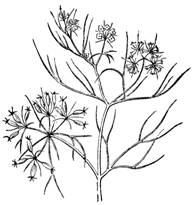
Fig. 142—Cummin Plant
Cummin, or Kammon, is an umbelliferous plant, mentioned both in the Old and New Testaments, and which, like the dill and the coriander, continues to be cultivated in modern, as it was in ancient times, in Eastern countries. These are similar to, and used for many of the same purposes as the anise and caraway, which supply their place, and are more common in Europe. All these plants produce fruits, commonly called seeds, which abound in essential oil of a more or less grateful flavor, and warm stimulating nature; hence they were employed in ancient as in modern times, both as condiments and as medicines.
Cummin is first mentioned in Isaiah (Isa 28:25): ’When he (the plowman) hath made plain the face thereof, doth he not cast abroad the fitches, and scatter the cummin?’ showing that it was extensively cultivated, as it is in the present day, in Eastern countries, as far even as India. In the south of Europe it is also cultivated to some extent. England is chiefly supplied from Malta and Sicily; 53 cwt. having been imported in the year 1839 from these islands. In the above chapter of Isaiah (Isa 28:27) cummin is again mentioned: ’For the fitches are not threshed with a threshing instrument, neither is a cart-wheel turned about upon the cummin; but the fitches are beaten out with a staff, and the cummin with a rod.’ This is most applicable to the fruit of the common cummin, which, when ripe, may be separated from the stalk with the slightest stroke, and would be completely destroyed by the turning round of a wheel, which, bruising the seed, would press out the oil on which its virtues depend.
In the New Testament cummin is mentioned in Mat 23:23, where our Savior denounces the scribes and Pharisees, who paid their ’tithe of mint, and anise, and cummin,’ but neglected the weightier matters of the law.
A plant much like fennel, and which produces blossoms and branches in an umbellated form. Its seeds yield an aromatic oil, of a warm, stimulating nature, Isa 28:25-27 . Our Lord reproved the scribes and Pharisees for so very carefully paying tithe of mint, anise, and cummin, and yet neglecting good works and obedience to God’s law, Mat 23:23 .\par
Cummin. Cummin is one of the cultivated plants of Palestine. Isa 28:25; Isa 28:27; Mat 23:23. It is an umbelliferous plant something like fennel. The seeds have a bitterish warm taste and an aromatic flavor. The Maltese are said to grow it at the present day, and to thresh it in the manner described by Isaiah.
CUMMIN.—Cummin (or cumin) is the seed of the Cuminum cyminum, an annual herbaceous umbellifer. It has a slender, branching stem, and grows to the height of a foot. The seeds, which are ovoid in form, are strongly aromatic, and have a flavour not unlike that of caraway, but more pungent. Cummin was used by the Jews as a condiment, and also for flavouring bread. It has carminative and other medicinal properties, and was employed not only as a remedy for colic, but also to stanch excessive bleeding, and to allay swellings. It is indigenous to Upper Egypt and the Mediterranean countries, but it was also cultivated from early times in Western Asia, India, and China.
Cummin is mentioned twice in the Bible (Isa 28:25-27
Hugh Duncan.
CUMMIN.—The seed of an umbelliferous plant, the Cuminum cyminum (syriacum), widely cultivated in and around Palestine. It is used to flavour dishes, and, more particularly, bread; in flavour and appearance it resembles carraway; it has long been credited with medicinal properties; it certainly is a carminative. It is even now beaten out with rods (Isa 28:27). Tithes of cummin were paid by the Jews (Mat 23:23).
E. W. G. Masterman.
Isa 28:25-27 (c) Probably in this story the wheat represents the Gospel message, while the other four grains represent other truths that should and do accompany Gospel preaching. In all of our preaching and teaching the good news about the rich provision the Lord JESUS makes for the soul should have the principal place. Other things that accompany this message may be prophecy, history, personal experience, godly living. Certainly there are many such truths to be found in all good teaching and preaching, but these are not to replace the Gospel of GOD’s grace.