
A well - known and interesting name in the Bible, the beloved wife of the patriarch Jacob, and daughter of Laban. The name itself means sheep. And from being engaged in keeping flocks, in these early days of patriarchal simplicity, it is probable the name was taken on that account. Her history we have, Gen. 29. 30, &c. It may be observed, that we have a city in the tribe of Judah called Rachal, or Rachel; probably in honour of this mother in Israel. (1 Sam. xxx. 29.)
the daughter of Laban, and sister of Leah. The Prophet Jer 31:15, and St. Mat 2:18, have put Rachel for the tribes of Ephraim and Manasseh, the children of Joseph, the son of Rachel. This prophecy was completed when these two tribes were carried into captivity beyond the Euphrates; and St. Matthew made application of it to what happened at Bethlehem, when Herod put to death the children of two years old and under. Then Rachel, who was buried there, might be said to make her lamentations for the death of so many innocent children sacrificed to the jealousy of a wicked monarch.
Ra´chel (an ewe), one and the most beloved of the two daughters of Laban, whom Jacob married (Gen 29:16, seq.), and who became the mother of Joseph and Benjamin, in giving birth to the latter of whom she died near Bethlehem, where her sepulcher is shown to this day (Gen 30:22; Gen 35:16). For more minute particulars see Jacob, with whose history Rachel’s is closely involved.
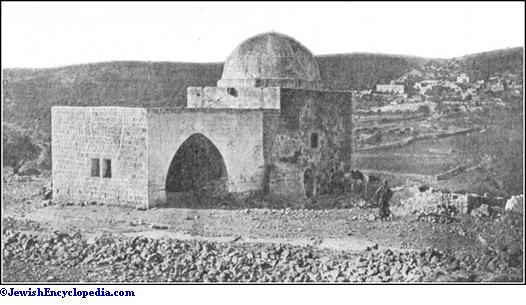
Ewe or sheep, Rth 4:11, the younger sister of Leah, daughter of Laban, and the chosen wife of Jacob, though her sister was favored with more children. Rachel was the mother of Joseph and Benjamin, and died soon after the birth of the latter. See her history in Gen 29:1-35:29. Her sepulchre, half an hour’s walk north of Bethlehem, is shown unto this day, the spot being marked by a Mohammedan wely or tomb, a stone enclosure and a dome. The prophecy, Jer 31:15, representing her as mourning over her posterity, the tribes of Ephraim, Manasseh, and Benjamin, is quoted in Mat 2:18, in reference to the massacre at Bethlehem, in which undoubtedly many of her descendants suffered. It is supposed that one of the many places called Ramah was adjacent to Bethlehem.\par
Ra’chel. (ewe or sheep). The younger of the daughters of Laban, the wife of Jacob, (B.C. 1753), and mother of Joseph and Benjamin. The incidents of her life may be found in Genesis 29-33; Genesis 35. The story of Jacob and Rachel has always had a peculiar interest. The beauty of Rachel, Jacob’s deep love and long servitude for her, their marriage, and Rachel’s death on giving birth to Benjamin, with Jacob’s grief at her loss, Gen 48:7, makes a touching tale. Yet from what is related to us concerning her character, there does not seem much to claim any high degree of admiration and esteem.
She appears to have shared all the duplicity and falsehood of her family. See, for instance, Rachel’s stealing her father’s images, and the ready dexterity and presence of mind with which she concealed her theft. Gen 31:1. "Rachel died and was buried on the way to Ephrath, which is Bethlehem," (B.C. 1729), "and Jacob set a pillar upon her grave; that is the pillar of Rachel’s grave unto this day." Gen 35:19-20. The site of Rachel’s tomb, "on the way to Bethlehem," "a little way to come to Ephrath," "in the border of Benjamin," has never been questioned. It Is about two miles south of Jerusalem and one mile north of Bethlehem.
("an ewe.")
At Joseph’s birth she by his name ("adding") expressed her fond anticipation, "the Lord shall add to me another son" (Gen 30:24). In obtaining her wish, the greatest joy to her, she suffered her sharpest pang; Ben-oni’s ("son of her sorrow") birth was her death. Her stealing her father’s images or
The patriarch on his death bed vividly recalls that tender, deep, and lasting sorrow (Gen 48:7). Though fretful, cunning, and superstitions, Rachel still worshipped Jehovah; and after she had complained to her husband, and received his reproof, she turned in prayer to God, for we read "God remembered Rachel, and hearkened to her, and opened her womb" (compare 1Sa 1:19). She had given up all her idols before the death stroke fell on her (Genesis 35), and, we may well believe, was prepared for her great change by the hallowing influences of God’s blessing on her husband and his seed immediately before, at Bethel. Moreover, Joseph, the only son over whom she exercised a mother’s influence, was from early years the choice one of the family; such a son must have had a mother not altogether dissimilar. Hers is the first instance recorded of death in childbirth, and her sepulchral pillar is the first on record in the Bible.
Caves were the usual places of sepulcher (1Sa 10:2). Jeremiah (Jer 31:15) says as to Nebuzaradan’s collecting the captive Jews at Ramah, previous to their removal to Babylon (Jer 40:1), "a voice was heard in Ramah, lamentation and bitter weeping, Rachel weeping for her children ... refused to be comforted because they were not; thus saith the Lord, Refrain thy voice from weeping, for ... there is hope in thine end, that thy children shall come again to their own border." Rachel, who pined so for children and died in bearing "the son of her sorrow," and was buried in the neighborhood of Ramah (of Benjamin) and Bethlehem, is poetically represented as "weeping" for her Ephraimite sons carried off by the Chaldees. Matthew (Mat 2:17-18) quotes this as fulfilled in Herod’s massacre of the innocents.
"A lesser, and a greater, event of different times may answer to the single sense of one scripture, until the prophecy be exhausted" (Bengel). Besides the reference to the Babylonian exile of Rachel’s sons, the Holy Spirit foreshadowed Messiah’s exile to Egypt, and the accompanying desolation caused near Rachel’s tomb by Herod’s massacre, to the grief of Benjamite mothers who had "sons of sorrow," as Rachel’s son proved to her. Israel’s representative Messiah’s return from Egypt, and Israel’s (both the literal and the spiritual) future restoration (including the innocents) at His second advent, are antitypical to Israel’s restoration from Babylon, the consolation held out by Jeremiah. "They were not," i.e. were dead (Gen 42:13), does not apply so strictly to the Babylonian exiles as it does to Messiah and His people, past, present, and future.
"There is hope in thine end," namely, when Rachel shall meet her murdered children at the resurrection of the saints bodily, and of Israel nationally (Ezekiel 37). Literally, "each was not," i.e. each Bethlehemite mother had but one child to lament, as Herod’s limit, "two years old and under," implies; a coincidence the more remarkable as not obvious. The singular too suits Messiah going to exile in Egypt, Rachel’s chief object of lamentation. Rachel’s tomb (Arabic
Rachel (râ’chel), an ewe. The daughter of Laban and wife of Jacob. Her history is given in Genesis, chaps. 29-35. She died after giving birth to Benjamin, and was buried near the road from Bethlehem to Jerusalem. Gen 35:19.
[Ra’chel]
The beautiful daughter of Laban, for whom Jacob served seven years, which seemed to him but a few days, because of his great love for her. When the time was expired Jacob was cheated by Laban, and Leah was given him instead. He served another seven years for Rachel. She was at first childless, and foolishly said to Jacob, "Give me children, or else I die"; for which she was duly rebuked by her husband. Apparently she prayed to God, for we read that He ’hearkened’ to her: she bore Joseph and then Benjamin, at whose birth she died. Jacob set up a pillar at her grave.
It was Rachel who stole the household gods of her father, and then with cunning concealed them. Otherwise we read nothing of her character: at home she had evidently been in a bad school. Her history is given in Gen 29 - Gen 35. In the N.T. she is represented as weeping for her children when Herod slew the young children, Mat 2:17-18, a fulfilment of that spoken in Jer 31:15 (where she is called RAHEL), though the circumstances in the two cases were different. A mother in Israel weeping for the loss of her children applies to both.
( = "a ewe").
By: Emil G. Hirsch, M. Seligsohn, Executive Committee of the Editorial Board.
—Biblical Data:
Laban's younger daughter, who became one of Jacob's wives (Gen. xxix. 26-28). Her first meeting with Jacob occurred at a well near Haran, whither she had taken the flocks for water. As she was beautiful and well favored, Jacob fell in love with her and agreed to serve Laban for seven years on the condition that at the end of that time Rachel should become his wife. Through the fraud of Laban, Jacob's marriage with Rachel took place after he had married her elder sister, Leah, who, though less loved than Rachel, became the mother of four sons, while the latter was childless. This filled Rachel with envy, and, having expressed her feelings to Jacob, she bade him take her handmaid Bilhah to wife in order that she might obtain a family through her (xxix. 9-12, 17-18, 31; xxx. 3).
Later, Rachel became the mother of Joseph (xxx. 22-24). Rachel and Leah persuaded their husband to flee from Laban's house, and at the moment of Jacob's flight Rachel stole her father's teraphim. She put them in the "furniture" of the camel on which she sat, and when her father came to search for them she pleaded sickness (xxxi. 14-16, 19, 34-35). At his meeting with Esau, Jacob showed his particular affection for Rachel by placing her last, with her son Joseph (xxxiii. 2, 7). Jacob was on his way back to his native country when Rachel died while giving birth to her second son, Benjamin. Her death occurred not far from Ephrath, and she was buried on the road leading thither, Jacob setting up a pillar on her grave to perpetuate her memory (xxxv. 16-20). Rachel and her sister Leah are mentioned as the two women who founded the house of Israel, Rachel, though younger, being mentioned first (Ruth iv. 11). Jeremiah represents Rachel, weeping for her children being driven into captivity, as the personification of tenderness (Jer. xxxi. 14).
—In Rabbinical Literature:
Rachel and Leah were twin sisters, fourteen years old when Jacob came to their father's house; consequently they were twenty-one years old at the time of their marriage to Jacob (Seder 'Olam Rabbah ii.). The terms "elder" and "younger," applied respectively to Leah and Rachel (Gen. xxix. 16), are explained by the Rabbis as referring to the divine gifts bestowed upon their descendants; for while royalty and the priesthood remained permanently with Leah's descendants, they were held only temporarily by Rachel's—royalty with Joseph and Saul, and the priesthood with the tabernacle of Shiloh (Gen. R. lxx. 15). In other respects the two sisters were alike, both being ancestresses of kings, heroes, prophets, judges, and conquerors (ib. lxx. 14; Tan., Wayeẓe, 13).
Rachel and Leah.
When Jacob met Rachel near the well, and proposed to marry her, she informed him that she had an elder sister, and that as her father was of a deceitful nature, he (Jacob) would be imposed upon. Jacob replied that he was her father's equal in trickery; and he agreed with Rachel upon certain signs which would enable him to recognize her. Later, when Leah was given in marriage instead of Rachel, the latter revealed the signs to her sister in order to spare her from being disgraced by Jacob. It was through the merit of her discretion that Rachel became the ancestress of King Saul, who also was discreet (Meg. 13b; B. B. 123a; Midr. Agadah to Gen. xxix. 12; Targ. pseudo-Jonathan ad loc.).
Rachel's envy at her sister's fertility (comp. Gen. xxx. 1) is only once (Gen. R. xlv. 6) interpreted by the Rabbis as indicating one of the characteristics of women. Most of the Rabbis consider the idea of Rachel being an envious woman as incompatible with what has been previously said of her. They declare that Rachel was not envious of her sister's fertility, but of her righteousness; she thought that if Leah had not been a better woman than she, she would not have had children. Besides, Rachel was afraid that her father, seeing that she had no children by Jacob, might marry her to Esau (Midr. Agadat Bereshit li. 1; Gen. R. lxxi. 9). She therefore insisted that Jacob pray to God for children, arguing that his father, Isaac, had done so(comp. Gen. xxv. 21). Jacob objecting on the ground that his father had one wife only, while he himself had two, and that though one of them was childless, he had children by the other, she urged him to follow Abraham's example, and to take her handmaid for a wife (Midr. Agadat Bereshit l.c.; comp. Midr. Agadah to Gen. xxx. 1; Tan., Wayeẓe, 19; Gen. R. lxxi. 10). According to the "Sefer ha-Yashar" (section "Wayeẓe," p. 46a, Leghorn, 1870), Rachel herself prayed God to give her children, and God finally answered her prayer.
Her Self-Abnegation.
In the episode of the mandrakes, when Leah reproached her sister for having robbed her of her husband (Gen. xxx. 14-15), Rachel's feelings were wounded, and she replied bitterly: "Jacob is not thy husband; he is mine. It was for my sake that he came here and served our father for so many years. Had I not revealed to thee our signs, he would never have become thy husband" (Midr. Agadah to Gen. xxx. 15). The affair of the mandrakes is generally represented by the Rabbis as unfavorable to Rachel; and it was due to her mode of obtaining them (comp. Gen. l.c.) that she was not buried in the cave of Machpelah by the side of her husband (Gen. R. lxxii. 2). God remembered Rachel on Rosh ha-Shanah (Ber. 29a; R. H. 11a), and it was particularly her self-abnegation at the time of her sister's marriage which gained for her the divine clemency (Gen. R. lxxiii. 2; Midr. Agadah to Gen. xxx. 22).
Rachel's words at the birth of Joseph, "The Lord shall add to me another son" (Gen. xxx. 24), show that she was a prophetess. She knew that Jacob was to have only twelve sons, and, Joseph being the eleventh son, she prayed for only one son more (Tan., Wayeẓe, 20). According to Gen. R. (lxxii. 6), this prayer of Rachel caused Leah's seventh child, which at the time of conception was a son, to be transformed into a daughter; otherwise Rachel would have been the mother of only one son (comp., however, Ber. 60a, and Targ. pseudo-Jonathan to Gen. xxx. 21).
The Rabbis differ as to the reason why Rachel stole her father's teraphim. Some consider that she did so in order to conceal Jacob's flight; others, that her object was to turn her father from idolatry (Pirḳe R. El. xxxvi.; Gen. R. lxxiv. 4; "Sefer ha-Yashar," section "Wayeẓe," p. 47a).
As Rachel's death occurred fifteen years after her marriage, she must have died at the age of thirty-six (Seder 'Olam Rabbah l.c.; Midr. Tadshe, in Epstein, "Mi-Ḳadmoniyyot ha-Yehudim," Supplement, p. xxi., where the number 37 must be corrected to 36). The "Sefer ha-Yashar" (section "Wayishlaḥ," p. 56b), however, gives her age at the time of her death as forty-five. Rachel's early decease was due, according to the general opinion of the Rabbis, to Jacob's involuntary curse uttered when Laban was searching for the teraphim, "With whomsoever thou findest thy gods, let him not live" (Gen. xxxi. 32), he not knowing that Rachel had taken the images. R. Judan's opinion, however, was that Rachel died before Leah because, although she was the younger sister, she spoke before Leah when they were addressed by their husband (ib. xxxi. 14; Midr. Agadat Bereshit li. 3; Pirḳe R. El. l.c.; Gen. R. lxxiv. 3, 6).
Traditional Tomb of Rachel.(From a photograph by Bonfils.)
"Rachel Mourning for Her Children."
Rachel's death was so deeply felt by Jacob that he considered it the greatest of all his sorrows (Ruth R. i. 3). He buried her on the road to Ephrath because he foresaw that the Israelites, when driven into captivity along that road, would need her intercession with God in their behalf (Midr. Agadah toGen. xxxv. 19; Gen. R. lxxxii. 11). Jer. xxxi. 15 (see Biblical Data, above) is the source of the midrashic legend that when the Israelites were driven into captivity by Nebuzar-adan, and the supplications of the Patriarchs and of Moses proved of no avail, Rachel arose from her grave and implored God's clemency, basing her plea upon her own self-abnegation with regard to her sister. God thereupon promised her the restoration of Israel (Lam. R., Petiḥta, 25).
Rachel was one of the four Jewish matriarchs, all of whom were prophetesses (Ber. 60a), and who are often referred to in the liturgy, Rachel being mentioned before Leah. As the four different plants with which the Jews were commanded to celebrate the Feast of Tabernacles (Lev. xxiii. 40) are considered by the Rabbis to symbolize the four matriarchs, Rachel, who died the youngest, they consider symbolized by the willows of the brook, which fade sooner than any other plant (Lev. R. xxx. 10).
RACHEL (Rahel in Jer 31:15 AV
Rachel’s grave.—The location of this is disputed. It was near Ephrath. Gen 35:16; Gen 35:19-20, 1Sa 10:2, Jer 31:15 indicate that it was on the N. border of Benjamin towards Ephraim, about ten miles N. of Jerusalem. In other places, however (Rth 1:2; Rth 4:11, Mic 5:2), Ephrath is another name for Bethlehem, as it is also explained in Gen 35:19; Gen 48:7. In accordance with this latter group of passages, tradition from at least the 4th cent. has fixed the spot 4 miles S. of Jerusalem and 1 mile N. of Bethlehem. Either the northern location is correct, or there are here two variant accounts. The former view is probably to be preferred, since Rachel has no connexion with Judah. In that case ‘that is Bethlehem’ is an incorrect gloss. Cf. also Ramah, 3.
George R. Berry.
(Hebrew: a ewe)
Laban’s younger daughter and favorite wife of Jacob (Genesis 29-31). Mother of Joseph and Benjamin (Genesis 30-35), she died giving birth to the latter and was buried near Bethlehem.
Rachel ("a ewe"), daughter of Laban and younger sister of Lia. The journey of Jacob to the "east country" (Mesopotamia) in quest of a bride of his own kin, and his providential meeting with Rachel at the well in the open country followed by his introduction into the household of Laban are told with idyllic charm in the twenty-ninth chapter of Genesis. Jacob, being in love with Rachel, agreed to serve her father for her seven years. Laban accepted the proposal, and the seven years seemed to Jacob "but a few days, because of the greatness of his love". He was deceived, however, by Laban, who at the end of the term of service gave him to wife, not Rachel, who "was well favoured, and of a beautiful countenance", but her elder sister Lia, who was "blear-eyed", and Jacob received the younger daughter to wife only on condition of serving seven years more. Rachel, being for a time without offspring and envious of her sister, to whom four children were born, gave to Jacob as a secondary wife her handmaid Bala, whose issue, according to a custom of the times, would be reckoned as her own. From this union were born Dan and Nephtali. In the quarrel which arose between Jacob and Laban, Rachel as well as Lia sided with the former, and when departing from her father’s home she carried away with her the teraphim or household gods, believing in their protecting influence over herself and her husband (Genesis 31:19). Among the sons of Rachel after the "Lord remembered" her were Joseph and Benjamin, in giving birth to the latter of whom Rachel died. At the point of death "she called the name of her son Benomi, that is, The son of my pain: but his father called him Benjamin, that is, the Son of the right hand". Rachel was buried "in the highway that leadeth to Ephrata, this is Bethlehem. And Jacob erected a pillar over her sepulchre: this is the pillar of Rachel’s monument, to this day" (Genesis 35:18-20). The exact location of the grave of Rachel is a disputed point. A passage in Jeremias (xxxi, 15) would seem to indicate that it was on the northern border of Benjamin towards Ephraim, about ten miles north of Jerusalem. Tradition, however, has from at least the fourth century fixed the spot four miles south of Jerusalem and one mile north of Bethlehem. VIGOUROUX, Dict. de la Bible, s. v. ; VON HUMMELAUER, Comment. in Gen., ch. xxix-xxxv. -----------------------------------JAMES.F. DRISCOLL Transcribed by Sean Hyland The Catholic Encyclopedia, Volume XIICopyright © 1911 by Robert Appleton CompanyOnline Edition Copyright © 2003 by K. KnightNihil Obstat, June 1, 1911. Remy Lafort, S.T.D., CensorImprimatur. +John Cardinal Farley, Archbishop of New York
1. Biography:
An ancestress of Israel, wife of Jacob, mother of Joseph and Benjamin. Rachel was the younger daughter of Laban, the Aramean, the brother of Jacob’s mother; so Rachel and Jacob were cousins. They met for the first time upon the arrival of Jacob at Haran, when attracted by her beauty he immediately fell in love with her, winning her love by his chivalrous act related in Gen 29:10 ff. According to the custom of the times Jacob contracted with Laban for her possession, agreeing to serve him 7 years as the stipulated price (Gen 29:17-20). But when the time had passed, Laban deceived Jacob by giving him Leah instead of Rachel. When Jacob protested, Laban gave him Rachel also, on condition that Jacob serve 7 years more (Gen 29:21-29). To her great dismay “Rachel was barren” (Gen 29:30, Gen 29:31), while Leah had children. Rachel, envious of her sister, complained to Jacob, who reminded her that children are the gift of God. Then Rachel resorted to the expedient once employed by Sarah under similar circumstances (Gen 16:2 ff); she bade Jacob take her handmaid Bilhah, as a concubine, to “obtain children by her” (Gen 30:3). Dan and Naphtali were the offspring of this union. The evil of polygamy is apparent from the dismal rivalry arising between the two sisters, each seeking by means of children to win the heart of Jacob. In her eagerness to become a mother of children, Rachel bargained with Leah for the mandrakes, or love-apples of her son Reuben, but all to no avail (Gen 30:14). Finally God heard her prayer and granted her her heart’s desire, and she gave birth to her firstborn whom she named Joseph (Gen 30:22-24).
Some years after this, when Jacob fled from Laban with his wives, the episode of theft of the teraphim of Laban by Rachel, related in Gen 31:19, Gen 31:34, Gen 31:35, occurred. She hoped by securing the household gods of her father to bring prosperity to her own new household. Though she succeeded by her cunning in concealing them from Laban, Jacob later, upon discovering them, had them put away (Gen 35:2-4). In spite of all, she continued to be the favorite of Jacob, as is clearly evidenced by Gen 33:2, where we are told that he assigned to her the place of greatest safety, and by his preference for Joseph, her son. After the arrival in Canaan, while they were on the way from Beth-
2. Character:
In a marked manner Rachel’s character shows the traits of her family, cunning and covetousness, so evident in Laban, Rebekah and Jacob. Though a believer in the true God (Gen 30:6, Gen 30:8, Gen 30:22), she was yet given to the superstitions of her country, the worshipping of the teraphim, etc. (Gen 31:19). The futility of her efforts in resorting to self-help and superstitious expedients, the love and stronger faith of her husband (Gen 35:2-4), were the providential means of purifying her character. Her memory lived on in Israel long after she died. In Rth 4:11, the names of Rachel and Leah occur in the nuptial benediction as the foundresses of the house of Israel.
Rachel’s Tomb
(
Mr. Nathan Strauss, of New York City, has purchased the land surrounding Rachel’s grave for the purpose of erecting a Jewish university in the Holy Land.
Favorite wife of Jacob. Mother of Joseph and Benjamin. One of the Matriarchs of Judaism.
When Jacob went to Paddan-aram to find a wife, he met and fell in love with Rachel, the younger daughter of his uncle, Laban. Jacob worked seven years for Laban as payment for Rachel, but when the wedding day came, Laban deceived Jacob by giving him the older daughter, Leah, instead. After the wedding festivities he gave Rachel also to Jacob, but made Jacob work for him an extra seven years as payment for her. Laban also gave each of the two daughters a slave-girl as a wedding gift (Gen 29:1-30).
While Leah produced several sons for Jacob, Rachel remained childless. She then gave her maid to Jacob, so that the maid might bear sons whom Rachel could adopt as her own. Leah did likewise with her maid, after which she produced more sons of her own. Jacob already had ten sons and a daughter by the time Rachel gave birth to her first son, Joseph (Gen 29:31-35; Gen 30:1-24).
Although Laban had enriched himself through his daughters’ bride price (Jacob’s years of hard work), he now planned to exclude them from the inheritance, in favour of his sons. This made Rachel so angry that when Jacob and his family left Paddan-aram for Canaan, she took her father’s idols with her. According to local custom, these gave her some claim to his inheritance (Gen 31:1-21). Laban never regained his idols, but Jacob made sure that Rachel did not keep them once the family entered Canaan (Gen 31:34-35; Gen 35:1-4).
Rachel died when giving birth to Benjamin, the only son of Jacob born in Canaan. She was buried near Ramah, on the road from Bethel to Bethlehem (Gen 35:16-20; 1Sa 10:2; Jer 31:15). Centuries later, Jeremiah imagined the dead Rachel mourning from her tomb as her descendants were led past on their way to captivity in a foreign land (Jer 31:15). She might likewise have mourned over the slaughter of the Jewish babies by Herod (Mat 2:16-18).