
The name (as the margin of our Bibles states) means drawn out The illustrious history of Moses forms so large a page in the sacred volume of the Old Testament, that it supersedes the necessity of saying much about him here. He was a faithful servant in the house of the Lord: this is the character given of him by the Holy Ghost. (Heb. 3: 2.) And a blessed testimony it is! But the same testimony gives him no higher a character than a servant of Christ; and Moses himself thought this an honour high enough. He was a typehimself of the law which he was commissioned to deliver; for as he was not permitted to enter into the promised land, so he thereby represented that the law could not bring God’s people into Canaan, and consequently not into heaven, of which Canaan was a type. It is Jesus alone that can do this; "The law was given by Moses, but grace and truth came by Jesus Christ." (John i. 17.)
This illustrious legislator of the Israelites was of the tribe of Levi, in the line of Koath and of Amram, whose son he was, and therefore in the fourth generation after the settlement of the Israelites in Egypt. The time of his birth is ascertained by the exode of the Israelites, when Moses was eighty years old, Exo 7:7. By a singular providence, the infant Moses, when exposed on the river Nile, through fear of the royal decree, after his mother had hid him three months, because he was a goodly child, was taken up and adopted by Pharaoh’s daughter, and nursed by his own mother, whom she hired at the suggestion of his sister Miriam. Thus did he find an asylum in the very palace of his intended destroyer; while his intercourse with his own family and nation was still most naturally, though unexpectedly, maintained: so mysterious are the ways of heaven. And while he was instructed “in all the wisdom of the Egyptians,” and bred up in the midst of a luxurious court, he acquired at home the knowledge of the promised redemption of Israel; and, “by faith” in the Redeemer Christ, “refused to be called the son of Pharaoh’s daughter, choosing rather to suffer affliction with the people of God, than to enjoy the pleasures of sin for a season; esteeming the reproach of Christ,” or persecution for Christ’s sake, “greater riches than the treasures of Egypt: for he had respect to the recompense of reward,” Exo 2:1-10; Act 7:20-22; Heb 11:23-26; or looked forward to a future state.
When Moses was grown to manhood, and was full forty years old, he was moved by a divine intimation, as it seems, to undertake the deliverance of his countrymen; “for he supposed that his brethren would have understood how that God, by his hand, would give them deliverance; but they understood not.” For when, in the excess of his zeal to redress their grievances, he had slain an Egyptian, who injured one of them, in which he probably went beyond his commission, and afterward endeavoured to reconcile two of them that were at variance, they rejected his mediation; and “the man who had done wrong said, Who made thee a judge and a ruler over us? Intendest thou to kill me, as thou killedst the Egyptian yesterday?” So Moses, finding it was known, and that Pharaoh sought to slay him, fled for his life to the land of Midian, in Arabia Petraea, where he married Zipporah, the daughter of Jethro, or Reuel, prince and priest of Midian; and, as a shepherd, kept his flocks in the vicinity of Mount Horeb, or Sinai, for forty years, Exo 2:11-21; Exo 3:1; Exo 18:5; Num 10:29; Act 7:23-30. During this long exile Moses was trained in the school of humble circumstances for that arduous mission which he had prematurely anticipated; and, instead of the unthinking zeal which at first actuated him, learned to distrust himself. His backwardness, afterward, to undertake that mission for which he was destined from the womb, was no less remarkable than his forwardness before, Exo 4:10-13.
At length, when the oppression of the Israelites was come to the full, and they cried to God for succour, and the king was dead, and all the men in Egypt that sought his life, “the God of glory” appeared to Moses in a flame of fire, from the midst of a bush, and announced himself as “the God of Abraham, of Isaac, and of Jacob,” under the titles of Jahoh and AEhjeh, expressive of his unity and sameness; and commissioned him first to make known to the Israelites the divine will for their deliverance; and next to go with the elders of Israel to Pharaoh, requiring him, in the name of “the Lord, the God of the Hebrews, to suffer the people to go three, days’ journey into the wilderness, to sacrifice unto the Lord their God,” after such sacrifices had been long intermitted during their bondage; for the Egyptians had sunk into bestial polytheism, and would have stoned them, had they attempted to sacrifice to their principal divinities, the apis, or bull, &c, in the land itself: foretelling, also, the opposition they would meet with from the king, the mighty signs and wonders that would finally compel his assent, and their spoiling of the Egyptians, by asking or demanding of them (not borrowing) jewels of silver, and jewels of gold, and raiment, (by way of wages or compensation for their services,) as originally declared to Abraham, that “they should go out from thence with great substance,”
Gen 15:14; Exo 2:23-25; Exo 3:2-22; Exo 8:25-26.
To vouch his divine commission to the Israelites, God enabled Moses to work three signal miracles:
1. Turning his rod into a serpent, and restoring it again:
2. Making his hand leprous as snow, when he first drew it out of his bosom, and restoring it sound as before when he next drew it out: and,
3. Turning the water of the river into blood. And the people believed the signs, and the promised deliverance, and worshipped. To assist him, also, in his arduous mission, when Moses had represented that he was “not eloquent, but slow of speech,” and of a slow or stammering tongue, God inspired Aaron, his elder brother, to go and meet Moses in the wilderness, to be his spokesman to the people, Exo 4:1-31, and his prophet to Pharaoh; while Moses was to be a god to both, as speaking to them in the name, or by the authority, of God himself, Exo 7:1-2. At their first interview with Pharaoh, they declared, “Thus saith the Lord, the God of Israel, Let my people go, that they may hold a feast unto me in the wilderness. And Pharaoh said, Who is the Lord, that I should obey his voice to let Israel go? I know not,” or regard not, “the Lord, neither will I let Israel go.” In answer to this haughty tyrant, they styled the Lord by a more ancient title, which the Egyptians ought to have known and respected, from Abraham’s days, when he plagued them in the matter of Sarah: “The God of the Hebrews hath met with us: Let us go, we pray thee, three days’ journey into the desert, and sacrifice unto the Lord our God, lest he fall upon us with pestilence or with the sword:” plainly intimating to Pharaoh, also, not to incur his indignation, by refusing to comply with his desire. But the king not only refused, but increased the burdens of the people, Exo 5:1-19; and the people murmured, and hearkened not unto Moses, when he repeated from the Lord his assurances of deliverance and protection, for anguish of spirit, and for cruel bondage, Exo 5:20-23; Exo 6:1-9.
At their second interview with Pharaoh, in obedience to the divine command, again requiring him to let the children of Israel go out of his land; Pharaoh, as foretold, demanded of them to show a miracle for themselves, in proof of their commission, when Aaron cast down his rod, and it became a serpent before Pharaoh and before his servants, or officers of his court. The king then called upon his wise men and magicians, to know if they could do as much by the power of their gods, “and they did so with their enchantments; for they cast down every man his rod, and they became serpents; but Aaron’s rod swallowed up their serpents.” Here the original phrase,
At Mount Sinai the Lord was pleased to make Moses, the redeemer of Israel, an eminent type of the Redeemer of the world. “I will raise them up a prophet from among their brethren, like unto thee, and will put my words in his mouth; and he shall speak unto them all that I shall command him: and it shall come to pass, that whosoever will not hearken unto my words, which he shall speak in my name, I will require it of him:” which Moses communicated to the people. “The Lord thy God will raise up unto thee a prophet, from the midst of thee, of thy brethren, like unto me: unto him shall ye hearken,” Deu 18:15-19. This prophet like unto Moses was our Lord Jesus Christ, who was by birth a Jew, of the middle class of the people, and resembled his predecessor, in personal intercourse with God, miracles, and legislation, which no other prophet did, Deu 34:10-12; and to whom God, at his transfiguration, required the world to hearken, Mat 17:5. Whence our Lord’s frequent admonition to the Jewish church, “He that hath ears to hear, let him hear,” Mat 13:9, &c; which is addressed, also, by the Spirit to the Christian churches of Asia Minor, Rev 3:22.
In the affair of the Golden Calf, (See CALF,) the conduct of Moses showed the greatest zeal for God’s honour, and a holy indignation against the sin of Aaron and the people. And when Moses drew nigh, and saw their proceedings, his anger waxed hot, and he cast away the tables of the covenant, or stone tablets on which were engraven the ten commandments by the finger of God himself, and brake them beneath the mount, in the presence of the people; in token that the covenant between God and them was now rescinded on his part, in consequence of their transgression. He then took the golden calf, and burned it in the fire, and ground it to powder, and mixed it with water, and made the children of Israel drink of it. After thus destroying their idol, he inflicted punishment on the idolaters themselves; for he summoned all that were on the Lord’s side to attend him; and all the Levites having obeyed the call, he sent them, in the name of the Lord, to slay all the idolaters, from one end of the camp to the other, without favour or affection either to their neighbour or to their brother; and they slew about three thousand men. The Lord also sent a grievous plague among them for their idolatry, Exo 32:2-35, on which occasion Moses gave a signal proof of his love for his people, by interceding for them with the Lord; and of his own disinterestedness, in refusing the offer of the Almighty to adopt his family in their room, and make of them “a great nation.” He prayed that God would blot him out of his book, that is, take away his life, if he would not forgive “the great sin of his people;” and prevailed with God to alter his determination of withdrawing his presence from them, and sending an inferior angel to conduct them to the land of promise. So wonderful was the condescension of God to the voice of a man, and so mighty the power of prayer.
When the Lord had pardoned the people, and taken them again into favour, he commanded Moses to hew two tablets of stone, like the former which were broken, and to present them to him on the top of the mount; and on these the Lord wrote again the ten commandments, for a renewal of the covenant between him and his people. To reward and strengthen the faith of Moses, God was pleased, at his request, to grant him a fuller view of the divine glory, or presence, than he had hitherto done. And, to confirm his authority with the people on his return, after the second conference of forty days, he imparted to him a portion of that glory or light by which his immediate presence was manifested: for the face of Moses shone so that Aaron and all the people were afraid to come nigh him, until he had put a veil on his face, to hide its brightness. This was an honour never vouchsafed to mortal before nor afterward till Christ, the Prophet like Moses, in his transfiguration also, appeared arrayed in a larger measure of the same lustre. Then Moses again beheld the glory of the Word made flesh, and ministered thereto in a glorified form himself, Exo 34:1-35; Mat 17:1-8.
At Kibroth Hataavah, when the people loathed the manna, and longed for flesh, Moses betrayed great impatience, and wished for death. He was also reproved for unbelief. At Kadesh-barnea, Moses having encouraged the people to proceed, saying, “Behold, the Lord thy God hath set the land before thee, go up and possess it, as the Lord God of thy fathers hath said unto you: fear not,” Deu 1:19-21; they betrayed great diffidence, and proposed to Moses to send spies to search out the land, and point out to them the way they should enter, and the course they should take. And the proposal “pleased him well,” and with the consent of the Lord he sent twelve men, one out of each tribe, to spy out the land, Deu 1:22-23; Num 13:1-20. All these, except Caleb and Joshua, having brought “an evil report,” so discouraged the people, that they murmured against Moses and against Aaron, and said unto them, “Would God that we had died in the land of Egypt; or would God that we had died in the wilderness! And wherefore hath the Lord brought us unto this land to fall by the sword, that our wives and our children shall be a prey? Were it not better for us to return into Egypt? And they said one to another, let us make a captain, and return into Egypt.” They even went so far as to propose to stone Joshua and Caleb, because they exhorted the people not to rebel against the Lord, nor to fear the people of the land, Num 14:1-10;. Deu 1:26-28. Here again the noble patriotism of Moses was signally displayed. He again refused the divine offer to disinherit the Israelites, and make of him and his family a “greater and mightier nation than they.” He urged the most persuasive motives with their offended God, not to destroy them with the threatened pestilence, lest the Heathen might say, “that the Lord was not able to bring them into the land which he sware unto them.” He powerfully appealed to the long-tried mercies and forgivenesses they had experienced ever since their departure from Egypt; and his energetic supplication prevailed; for the Lord graciously said, “I have pardoned, according to thy word: but verily, as I live, all the earth shall be filled with the glory of the Lord;” or shall adore him for his righteous judgments; “for all these men which, have seen my glory and my miracles which I did in Egypt, and in the wilderness, and have tempted me these ten times, and have not hearkened to my voice, surely shall not see the land which I sware unto their fathers: neither shall any of them that provoked me see it. As ye have spoken in my ears, so will I do unto you,” by a righteous retaliation: “your carcasses shall fall in this wilderness. But your little ones, which ye said should be a prey, them will I bring in; and they shall wander in the wilderness forty years, and bear your whoredoms, after the number of the days in which ye searched the land, each day for a year, until your carcasses be wasted in the wilderness.” And immediately after this sentence, as the earnest of its full accomplishment, all the spies, except Caleb and Joshua, were cut off, and died by the plague before the Lord, Num 14:11-37; Deu 1:34-39.
The people now, to repair their fault, contrary to the advice of Moses, presumptuously went to invade the Amalekites and Canaanites of Mount Seir, or Hor; who defeated them, and chased them as bees to Hormah, Num 14:39-45; Deu 1:41-44. On the morrow they were ordered to turn away from the promised land, and to take their journey south-westward, toward the way of the Red Sea: and they abode in the wilderness of Kadesh many days, or years, Num 14:25; Deu 1:40-46. The ill success of the expedition against the Amalekites, according to Josephus, occasioned the rebellion of Korah, which broke out shortly after, against Moses and Aaron, with greater violence than any of the foregoing, under Korah, the ringleader, who drew into it Dathan and Abiram, the heads of the senior tribe of Reuben, and two hundred and fifty princes of the assembly, among whom were even several of the Levites. (See Korah.) But although “all Israel round about had fled at the cry of the devoted families of Dathan and Abiram, for fear that the earth should swallow them up also;” yet, on the morrow, they returned to their rebellious spirit, and murmured against Moses and Aaron, saying, “Ye have killed the people of the Lord.” On this occasion also, the Lord threatened to consume them as in a moment; but, on the intercession of Moses, only smote them with a plague, which was stayed by an atonement made by Aaron, after the destruction of fourteen thousand seven hundred souls, Num 16:41-50.
On the return of the Israelites, after many years’ wandering, to the same disastrous station of Kadesh-barnea, even Moses himself was guilty of an offence, in which his brother Aaron was involved, and for which both were excluded, as a punishment, from entering the promised land. At Meribah Kadesh the congregation murmured against Moses, for bringing them into a barren wilderness without water; when the Lord commanded Moses to take his rod, which had been laid up before the Lord, and with Aaron to assemble the congregation together, and to speak to the rock before their eyes; which should supply water for the congregation and their cattle. “But Moses said unto the congregation, when they were assembled, Hear now, ye rebels, must we fetch you water out of this rock? And he smote the rock twice with his rod, and the water came out abundantly; and the congregation drank, and their cattle also. And the Lord spake unto Moses and Aaron, Because ye believed me not, to sanctify me in the eyes of the children of Israel; therefore ye shall not bring this congregation into the land which I have given them,” Num 20:1-13; and afterward in stronger terms: “Because ye rebelled against my commandment,” &c.
The offence of Moses, as far as may be collected from so concise an account, seems to have been,
1. He distrusted or disbelieved that water could be produced from the rock only by speaking to it; which was a higher miracle than he had performed before at Rephidim, Exo 17:6.
2. He unnecessarily smote the rock twice; thereby betraying an unwarrantable impatience.
3. He did not, at least in the phrase he used, ascribe the glory of the miracle wholly to God, but rather to himself and his brother: “Must we fetch you water out of this rock?” And he denominated them “rebels” against his and his brother’s authority, which although an implied act of rebellion against God, ought to have been stated, as on a former occasion, “Ye have been rebels against the Lord, from the day that I knew you,” Deu 9:24, which he spake without blame. For want of more caution on this occasion, “he spake unadvisedly with his lips, because they provoked his spirit,” Psa 106:33. Thus “was God sanctified at the waters of Meribah,” by his impartial justice, in punishing his greatest favourites when they did amiss, Num 20:13. How severely Moses felt his deprivation, appears from his humble, and it should seem repeated, supplications to the Lord to reverse the sentence: “O Lord of gods, thou hast begun to show thy servant thy greatness, and thy mighty hand; for what god is there in heaven or in earth that can do according to thy works, and according to thy might? I pray thee let me go over and see the good land beyond Jordan, even that goodly mountain Lebanon,” or the whole breadth of the land. “But the Lord was wroth with me for your sakes, and would not hear me: and he said unto me, Let it suffice thee; speak no more unto me of this matter. Get thee up unto the top of Pisgah, and lift up thine eyes westward, and northward, and southward, and eastward, and behold it with thine eyes: for thou shalt not go over this Jordan,” Deu 3:23-27.
The faculties of this illustrious legislator, both of mind and body, were not impaired at the age of a hundred and twenty years, when he died. “His eye was not dim, nor his natural strength abated,” Deu 34:7: and the noblest of all his compositions was his Song, or the Divine Ode, which Bishop Lowth elegantly styles, Cycnea Oratio, “the Dying Swan’s Oration.” His death took place after the Lord had shown him, from the top of Pisgah, a distant view of the promised land, throughout its whole extent. “He then buried his body in a valley opposite Beth-peor, in the land of Moab; but no man knoweth his sepulchre unto this day,” observes the sacred historian, who annexed the circumstances of his death to the book of Deuteronomy, Deu 34:6. From an obscure passage in the New Testament, in which Michael the archangel is said to have contended with the devil about the body of Moses, Jud 1:9, some have thought that he was buried by the ministry of angels, near the scene of the idolatry of the Israelites; but that the spot was purposely concealed, lest his tomb might also be converted into an object of idolatrous worship among the Israelites, like the brazen serpent. Beth-peor lay in the lot of the Reubenites, Jos 13:20. But on so obscure a passage nothing can be built. The “body of Moses,” may figuratively mean the Jewish church; or the whole may be an allusion to a received tradition which, without affirming or denying its truth, might be made the basis of a moral lesson.
Josephus, who frequently attempts to embellish the simple narrative of Holy Writ, represents Moses as attended to the top of Pisgah by Joshua, his successor, Eleazar, the high priest, and the whole senate; and that, after he had dismissed the senate, while he was conversing with Joshua and Eleazar, and embracing them, a cloud suddenly came over and enveloped him; and he vanished from their sight, and he was taken away to a certain valley. “In the sacred books,” says he, “it is written, that he died; fearing to say that on account of his transcendent virtue, he had departed to the Deity.” The Jewish historian has here, perhaps, imitated the account of our Lord’s ascension, furnished by the evangelist, Luk 24:50; Act 1:9; wishing to raise Moses to a level with Christ. The preeminence of Moses’s character is briefly described by the sacred historian, Samuel or Ezra: “And there arose not a prophet since, in Israel, like unto Moses, whom the Lord knew face to face; in all the signs and the wonders which the Lord sent him to do in the land of Egypt, to Pharaoh, and all his servants, and all his land; and in all that mighty hand, and in all the great terror which Moses showed in the sight of all Israel,” Deu 34:10-12.
So marked and hallowed is the character of this, the most eminent of mere men, that it has often been successfully made the basis of an irresistible argument for the truth of his divine mission. Thus Cellerier observes, Every imposture has an object in view, and an aim more or less selfish. Men practice deceit for money, for pleasure, or for glory. If, by a strange combination, the love of mankind ever entered into the mind of an impostor, doubtless, even then, he has contrived to reconcile, at least, his own selfish interests with those of the human race. If men deceive others, for the sake of causing their own opinions or their own party to triumph, they may sometimes, perhaps, forget their own interests during the struggle, but they again remember them when the victory is achieved. It is a general rule, that no impostor forgets himself long. But Moses forgot himself, and forgot himself to the last. Yet there is no middle supposition. If Moses was not a divinely inspired messenger, he was an impostor in the strongest sense of the term. It is not, as in the case of Numa, a slight and single fraud, designed to secure some good end, that we have to charge him with, but a series of deceits, many of which were gross; a profound dishonest, perfidious, sanguinary dissimulation, continued for the space of forty years. If Moses was not a divinely commissioned prophet, he was not the saviour of the people, but their tyrant and their murderer. Still, we repeat, this barbarous impostor always forgot himself; and his disinterestedness, as regarded himself personally, his family, and his tribe, is one of the most extraordinary features in his administration. As to himself personally: He is destined to die in the wilderness; he is never to taste the tranquillity, the plenty, and the delight, the possession of which he promises to his countrymen; he shares with them only their fatigues and privations; he has more anxieties than they, on their account, in their acts of disobedience, and in their perpetual murmurings. As to his family: He does not nominate his sons as his successors; he places them, without any privileges or distinctions, among the obscure sons of Levi; they are not even admitted into the sacerdotal authority. Unlike all other fathers, Moses withdraws them from public view, and deprives them of the means of obtaining glory and favour. Samuel and Eli assign a part of their paternal authority to their sons, and permit them even to abuse it; but the sons of Moses, in the wilderness, are only the simple servants of the tabernacle; like all the other sons of Kohath, if they even dare to raise the veil which covers the sacred furniture, the burden, of which they carry, death is denounced against them. Where can we find more complete disinterestedness than in Moses? Is not his the character of an upright man, who has the general good, not his own interests, at heart; of a man who submissively acquiesces in the commands of God, without resistance and without demur? When we consider these several things; when we reflect on all the ministry of Moses, on his life, on his death, on his character, on his abilities, and his success; we are powerfully convinced that he was the messenger of God. If we consider him only as an able legislator, as a Lycurgus, as a Numa, his actions are inexplicable: we find not in him the affections, the interests, the views which usually belong to the human heart. The simplicity, the harmony, the verity of his natural character are gone; they give place to an incoherent union of ardour and imposture; of daring and of timidity, of incapacity and genius, of cruelty and sensibility. No! Moses was inspired by God: he received from God the law which he left his countrymen.
To Moses we owe that important portion of Holy Scripture, the Pentateuch, which brings us acquainted with the creation of the world, the entrance of sin and death, the first promises of redemption, the flood, the peopling of the postdiluvian earth, and the origin of nations, the call of Abraham, and the giving of the law. We have, indeed, in it the early history of religion, and a key to all the subsequent dispensations of God to man. The genuineness and authenticity of these most venerable and important books have been established by various writers; but the following remarks upon the veracity of the writings of Moses have the merit of compressing much argument into few words:—
1. There is a minuteness in the details of the Mosaic writings, which bespeaks their truth; for it often bespeaks the eye-witness, as in the adventures of the wilderness; and often seems intended to supply directions to the artificer, as in the construction of the tabernacle.
2. There are touches of nature in the narrative which bespeak its truth, for it is not easy to regard them otherwise than as strokes from the life; as where “the mixed multitude,” whether half-castes or Egyptians, are the first to sigh for the cucumbers and melons of Egypt, and to spread discontent through the camp, Num 11:4; as the miserable exculpation of himself, which Aaron attempts, with all the cowardice of conscious guilt, “I cast into the fire, and there came out this calf:” the fire, to be sure, being in the fault, Exo 32:24.
3. There are certain little inconveniences represented as turning up unexpectedly, that bespeak truth in the story; for they are just such accidents as are characteristic of the working of a new system and untried machinery. What is to be done with the man who is found gathering sticks on the Sabbath day? Num 15:32. (Could an impostor have devised such a trifle?) How is the inheritance of the daughters of Zelophehad to be disposed of, there being no heir male? Num 36:2. Either of them inconsiderable matters in themselves, but both giving occasion to very important laws; the one touching life, and the other property.
4. There is a simplicity in the manner of Moses, when telling his tale, which bespeaks its truth: no parade of language, no pomp of circumstance even in his miracles, a modesty and dignity throughout all. Let us but compare him in any trying scene with Josephus; his description, for instance, of the passage through the Red Sea, Exodus 14, of the murmuring of the Israelites and the supply of quails and manna, with the same as given by the Jewish historian, or rhetorician we might rather say, and the force of the observation will be felt.
5. There is a candour in the treatment of his subject by Moses, which bespeaks his truth; as when he tells of his own want of eloquence, which unfitted him for a leader, Exo 4:10; his own want of faith, which prevented him from entering the promised land, Num 20:12; the idolatry of Aaron his brother, Exo 32:21; the profaneness of Nadab and Abihu, his nephews, Leviticus 10; the disaffection and punishment of Miriam, his sister, Num 12:1.
6. There is a disinterestedness in his conduct, which bespeaks him to be a man of truth; for though he had sons, he apparently takes no measures during his life to give them offices of trust or profit; and at his death he appoints as his successor one who had no claims upon him, either of alliance, of clanship, or of blood.
7. There are certain prophetical passages in the writings of Moses, which bespeak their truth; as, several respecting the future Messiah, and the very sublime and literal one respecting the final fall of Jerusalem, Deuteronomy 28.
8. There is a simple key supplied by these writings, to the meaning of many ancient traditions current among the Heathens, though greatly disguised, which is another circumstance that bespeaks their truth: as, the golden age; the garden of the Hesperides; the fruit tree in the midst of the garden which the dragon guarded; the destruction of mankind by a flood, all except two persons, and those righteous persons,
Innocuos ambos, cultores numinis ambos; [Both innocent, both worshippers of Deity;]
the rainbow, “which Jupiter set in the cloud, a sign to men;” the seventh day a sacred day; with many others, all conspiring to establish the reality of the facts which Moses relates, because tending to show that vestiges of the like present themselves in the traditional history of the world at large.
9. The concurrence which is found between the writings of Moses and those of the New Testament bespeaks their truth: the latter constantly appealing to them, being indeed but the completion of the system which the others are the first to put forth. Nor is this an illogical argument; for, though the credibility of the New Testament itself may certainly be reasoned out from the truth of the Pentateuch once established, it is still very far from depending on that circumstance exclusively, or even principally. The New Testament demands acceptance on its own merits, on merits distinct from those on which the books of Moses rest, therefore (so far as it does so) it may fairly give its suffrage for their veracity, valcat quantum valet: [it may avail as far as it goes;] and surely it is a very improbable thing, that two dispensations, separated by an interval of some fifteen hundred years, each exhibiting prophecies of its own, since fulfilled; each asserting miracles of its own, on strong evidence of its own; that two dispensations, with such individual claims to be believed, should also be found to stand in the closest relation to one another, and yet both turn out impostures after all.
10. Above all, there is a comparative purity in the theology and morality of the Pentateuch, which argues not only its truth, but its high original; for how else are we to account for a system like that of Moses, in such an age and among such a people; that the doctrine of the unity, the self-existence, the providence, the perfections of the great God of heaven and earth, should thus have blazed forth (how far more brightly than even in the vaunted schools of Athens at its most refined era!) from the midst of a nation, of themselves ever plunging into gross and grovelling idolatry; and that principles of social duty, of benevolence, and of self-restraint, extending even to the thoughts of the heart, should have been the produce of an age which the very provisions of the Levitical law itself show to have been full of savage and licentious abominations? Exo 3:14; Exo 20:3-17; Lev 19:2; Lev 19:18; Deu 6:4; Deu 30:6. Such are some of the internal evidences for the veracity of the books of Moses.
11. Then the situation in which the Jews actually found themselves placed, as a matter of fact, is no slight argument for the truth of the Mosaic accounts; reminded, as they were, by certain memorials observed from year to year, of the great events of their early history, just as they are recorded in the writings of Moses, memorials universally recognized both in their object and in their authority. The passover, for instance, celebrated by all, no man doubting its meaning, no man in all Israel assigning to it any other origin than one, viz. that of being a contemporary monument of a miracle displayed in favour of the people of Israel; by right of which credentials, and no other, it summoned from all quarters of the world, at great cost, and inconvenience, and danger, the dispersed Jews, none disputing the obligation to obey the summons.
12. Then the heroic devotion with which the Israelites continued to regard the law, even long after they had ceased to cultivate the better part of it, even when that very law only served to condemn its worshippers, so that they would offer themselves up by thousands, with their children and wives, as martyrs to the honour of their temple, in which no image, even of an emperor, who could scourge them with scorpions for their disobedience, should be suffered to stand, and they live: so that rather than violate the sanctity of the Sabbath day, the bravest men in arms would lay down their lives as tamely as sheep, and allow themselves to be burned in the holes where they had taken refuge from their cruel and cowardly pursuers. All this points to their law, as having been at first promulgated under circumstances too awful to be forgotten even after the lapse of ages.
13. Then again, the extraordinary degree of national pride with which the Jews boasted themselves to be God’s peculiar people, as if no nation ever was or ever could be so nigh to him; a feeling which the early teachers of Christianity found an insuperable obstacle to the progress of the Gospel among them, and which actually did effect its ultimate rejection, this may well seem to be founded upon a strong traditional sense of uncommon tokens of the Almighty’s regard for them above all other nations of the earth, which they had heard with their ears, or their fathers had declared unto them, even the noble works that he had done in the old time before them.
14. Then again, the constant craving after “a sign,” which beset them in the latter days of their history, as a lively certificate of the prophet; and not after a sign only, but after such a one as they would themselves prescribe:
“What sign showest thou, that we may see, and believe? Our fathers did eat manna in the desert,” Joh 6:31. This desire, so frequently expressed, and with which they are so frequently reproached, looks like the relic of an appetite engendered in other times, when they had enjoyed the privilege of more intimate communion with God; it seems the wake, as it were, of miracles departed.
15. Lastly, the very onerous nature of the law; so studiously meddling with all the occupations of life, great and small;—this yoke would scarcely have been endured, without the strongest assurance, on the part of those who were galled by it, of the authority by which it was imposed. For it met them with some restraint or other at every turn. Would they plough? then it must not be with an ox and an ass. Would they sow? then must not the seed be mixed. Would they reap? then must they not reap clean. Would they make bread? then must they set apart dough enough for the consecrated loaf. Did they find a bird’s nest? then must they let the old bird fly away. Did they hunt? then they must shed the blood of their game, and cover it with dust. Did they plant a fruit tree? for three years was the fruit to be uncircumcised. Did they shave their beards? they were not to cut the corners. Did they weave a garment? then must it be only with threads prescribed. Did they build a house? they must put rails and battlements on the roof. Did they buy an estate? at the year of jubilee, back it must go to its owner. All these (and how many more of the same kind might be named!) are enactments which it must have required extraordinary influence in the lawgiver, to enjoin, and extraordinary reverence for his powers to perpetuate.
Still, after all, says Mr. Blunt, unbelievers may start difficulties,—this I dispute not; difficulties, too, which we may not always be able to answer, though I think we may be always able to neutralize them. It may be a part of our trial, that such difficulties should exist and be encountered; for there can be no reason why temptations should not be provided for the natural pride of our understanding, as well as for the natural lusts of our flesh. To many, indeed, they would be the more formidable of the two, perhaps to the angels who kept not their first estate they proved so. With such facts, however, before me, as these which I have submitted to my readers, I can come to no conclusion but one,—that when we read the writings of Moses, we read no cunningly devised fables, but solemn and safe records of great and marvellous events, which court examination, and sustain it; records of such apparent veracity and faithfulness, that I can understand our Lord to have spoken almost without a figure, when he said, that he who believed not Moses, neither would he be persuaded though one rose from the dead.
Mos´es, the lawgiver of Israel, belonged to the tribe of Levi, and was a son of Amram and Jochebed (Exo 6:20). According to Exo 2:10, the name means drawn out of water, and is therefore a significant memorial of the marvelous preservation of Moses when an infant, in spite of those Pharaonic edicts which were promulgated in order to lessen the number of the Israelites. It was the intention of divine providence that the great and wonderful destiny of the child should be from the first apparent: and what the Lord had done for Moses he intended also to accomplish for the whole nation of Israel.
It was an important event that the infant Moses, having been exposed near the banks of the Nile, was found there by an Egyptian princess; and that, having been adopted by her, he thus obtained an education at the royal court (Exo 2:1-10). Having been taught all the wisdom of the Egyptians (Act 7:22; comp. Josephus, Antiq. ii. 9. 7), the natural gifts of Moses were fully developed, and he thus became in many respects better prepared for his future vocation.
After Moses had grown up, he returned to his brethren, and, in spite of the degraded state of his people, manifested a sincere attachment to them. He felt deep compassion for their sufferings, and showed his indignation against their oppressors by slaying an Egyptian whom he saw ill treating an Israelite. This doubtful act became by Divine Providence a means of advancing him further in his preparation for his future vocation, by inducing him to escape into the Arabian desert, where he abode for a considerable period with the Midianitish prince, Jethro, whose daughter Zipporah he married (Exo 2:11, sq.). Here, in the solitude of pastoral life, he was appointed to ripen gradually for his high calling, before he was unexpectedly and suddenly sent back among his people, in order to achieve their deliverance from Egyptian bondage.
His entry upon this vocation was not in consequence of a mere natural resolution of Moses, whose constitutional timidity and want of courage rendered him disinclined for such an undertaking. An extraordinary divine operation was required to overcome his disinclination. On Mount Horeb he saw a burning thorn-bush, in the flame of which he recognized a sign of the immediate presence of Deity, and a divine admonition induced him to resolve upon the deliverance of his people. He returned into Egypt, where neither the dispirited state of the Israelites, nor the obstinate opposition and threatenings of Pharaoh, were now able to shake the man of God.
Supported by his brother Aaron, and commissioned by God as his chosen instrument, proving by a series of marvelous deeds, in the midst of heathenism, the God of Israel to be the only true God, Moses at last overcame the opposition of the Egyptians. According to a divine decree, the people of the Lord were to quit Egypt, under the command of Moses, in a triumphant manner. The punishments of God were poured down upon the hostile people in an increasing ratio, terminating in the death of the firstborn, as a sign that all had deserved death. The formidable power of paganism, in its conflict with the theocracy, was obliged to bow before the apparently weak people of the Lord. The Egyptians paid tribute to the emigrating Israelites (Exo 12:35), who set out laden with the spoils of victory.
The enraged king vainly endeavored to destroy the emigrants. Moses, firmly relying upon miraculous help from the Lord, led his people through the Red Sea into Arabia, while the host of Pharaoh perished in its waves (Exodus 12-15).
After this began the most important functions of Moses as the lawgiver of the Israelites, who were destined to enter into Canaan as the people of promise, upon whom rested the ancient blessings of the patriarchs. By the instrumentality of Moses they were appointed to enter into intimate communion with God through a sacred covenant, and to be firmly bound to him by a new legislation. Moses, having victoriously repulsed the attack of the Amalekites, marched to Mount Sinai, where he signally punished the defection of his people, and gave them the law as a testimony of divine justice and mercy. From Mount Sinai they proceeded northward to the desert of Paran, and sent spies to explore the Land of Canaan (Numbers 10-13). On this occasion broke out a violent rebellion against the lawgiver, which he, however, by divine assistance, energetically repressed (Numbers 14-16).
The Israelites frequently murmured, and were disobedient during about forty years. In a part of the desert of Kadesh, which was called Zin, near the boundaries of the Edomites, after the sister of Moses had died, and after even the new generation had, like their fathers, proved to be obstinate and desponding, Moses fell into sin, and was on that account deprived of the privilege of introducing the people into Canaan. He was appointed to lead them only to the boundary of their country, to prepare all that was requisite for their entry into the land of promise, to admonish them impressively, and to bless them.
It was according to God’s appointment that the new generation also, to whom the occupation of the country had been promised, should arrive at their goal only after having vanquished many obstacles. Even before they had reached the real boundaries of Canaan they were to be subjected to a heavy and purifying trial. It was important, that a man like Moses was at the head of Israel during all these providential dispensations. His authority was a powerful preservative against despondency under heavy trials.
Having in vain attempted to pass through the territory of the Edomites, the people marched round its boundaries by a circuitous and tedious route. Two powerful kings of the Amorites, Sihon and Og, were vanquished. Moses led the people into the fields of Moab over against Jericho, to the very threshold of Canaan (Numbers 20-21).
Moses happily averted the danger which threatened the Israelites on the part of Midian (Numbers 25-31). Hence he was enabled to grant to some of the tribes permanent dwellings in a considerable tract of country situated to the east of the river Jordan (Numbers 32), and to give to his people a foretaste of that well-being which was in store for them.
Moses made excellent preparations for the conquest and distribution of the whole country, and took leave of his people with powerful admonitions and impressive benedictions, transferring his government to the hands of Joshua, who was not unworthy to become the successor of so great a man. With a longing but gratified look, he surveyed, from the elevated ground on the border of the Dead Sea, the beautiful country destined for his people.
Moses died in a retired spot at the age of one hundred and twenty years. He remained vigorous in mind and body to the last. His body was not buried in the Promised Land, and his grave remained unknown, lest it should become an object of superstitious and idolatrous worship.
The Pentateuch is the greatest monument of Moses as an author. Psalms 90 also seems to be correctly ascribed to him. Some learned men have endeavored to prove that he was the author of the book of Job, but their arguments are inconclusive [JOB]. Numerous traditions, as might have been expected, have been current respecting so celebrated a personage. Some of these were known to the ancient Jews, but most of them occur in later rabbinical writers.
The name of Moses is celebrated among the Arabs also, and is the nucleus of a mass of legends. The Greek and Roman classics repeatedly mention Moses, but their accounts contain the authentic Biblical history in a greatly distorted form.
The name of the illustrious prophet and legislator of the Hebrews, who led them from Egypt to the Promised Land. Having been originally imposed by a native Egyptian princess, the word is no doubt Egyptian in its origin, and Josephus gives its true derivation—from the two Egyptian words, MO, water, and USE, saved. With this accords the Septuagint form, MOUSES. The Hebrews by a slight change accommodated it to their own language, as they did also in the case of some other foreign words; calling it MOSHIE, from the verb MASHA, to draw. See Exo 2:10 . Moses was born about 15.71 B. C., the son of Amram and Jochebed, of the tribe of Levi, and the younger brother of Miriam and Aaron. His history is too extensive to permit insertion here, and in general too well known to need it. It is enough simply to remark, that it is divided into three periods, each of forty years. The first extends from his infancy, when he was exposed in the Nile, and found and adopted y the daughter of Pharaoh, to his flight to Midian.\par During this time he lived at the Egyptian court, and "was learned in all the wisdom of the Egyptians, and was nightly in words and in deeds," Mal 7:22 . This is no unmeaning praise; the "wisdom" of the Egyptians, and especially of their priests, was then the profoundest in the world. The second period was from his flight till his return to Egypt, Mal 7:30, during the whole of which interval he appears to have lived in Midian, it may be much after the manner of the Bedaween sheikhs of the present day. Here he married Zipporah, daughter of the wise and pious Jethro, and became familiar with life in the desert. What a contrast between the former period, spent amid the splendors and learning of a court, and this lonely nomadic life. Still it was in this way that God prepared him to be the instrument of deliverance to His people during the third period of his life, which extends from the exodus out of Egypt to his death on mount Nebo. In this interval how much did he accomplish, as the immediate agent of the Most High.\par The life and institutions of Moses present one of the finest subjects for the pen of a Christian historian, who is at the same time a competent biblical antiquary. His institutions breathe a spirit of freedom, purity, intelligence, justice, and humanity, elsewhere unknown; and above all, of supreme love, honor, and obedience to God.\par They molded the character of the Hebrews, and transformed them from a nation of shepherds into a people of fixed residence and agricultural habits. Through that people, and through the Bible, the influence of these institutions has been extended over the world; and often where the letter has not been observed, the spirit of them has been adopted. Thus it was in the laws established by the pilgrim fathers of New England; and no small part of what is of most value in the institutions which they founded, is to be ascribed to the influence of the Hebrew legislator.\par The name of this servant of God occurs repeatedly in Greek and Latin writings, and still more frequently in those of the Arabs and the rabbinical Jews. Many of their statements, however, are mere legends without foundation, or else distortions of the Scripture narrative. By the Jews he has always been especially honored, as the most illustrious personage in all their annals, and as the founder of their whole system of laws and institutions. Numerous passages both in the Old and New Testament show how exalted a position they gave him, Psa 103:7 105:26 106:16 Isa 63:12 Jer 15:1 Dan 9:11 Mat 8:4 Joh 5:45 9:28 Mal 7:20,37 1Ch 10:5,19 Heb 3:1-19 11:23.\par In all that he wrought and taught, he was but the agent of the Most High; and yet in all his own character stands honorably revealed. Though naturally liable to anger and impatience, he so far subdued himself as to be termed the meekest of men, Num 12:3 ; and his piety, humility, and forbearance, the wisdom and vigor of his administration, his unfailing zeal and faith in God, and his disinterested patriotism are worthy of all imitation. Many features of his character and life furnish admirable illustrations of the work of Christ—as the deliver, ruler, and guide of his people, bearing them on his heart, interceding for them, rescuing, teaching, and nourishing them even to the promised land. All the religious institutions of Moses pointed to Christ; and he himself, on the mount, two thousand years after his death, paid his homage to the Prophet he had foretold, Deu 18:15-19, beheld "that goodly mountain and Lebanon," Deu 3:25, and was admitted to commune with the Savior on the most glorious of themes, the death He should accomplish at Jerusalem, Luk 9:31 .\par Moses was the author of the Pentateuch, as it is called, or the first five books of the Bible. In the composition of them he was probably assisted by Aaron, who kept a register of public transactions, Exo 17:14 24:4,7 34:27 Nu 33:1,2 Deu 31:24, etc. Some things were added by a later inspired hand; as for example, Deu 34:1-12 Psa 90:1-17 also is ascribed to him; and its noble and devout sentiments acquire a new significance, if received as from his pen near the close of his pilgrimage.\par
Mo’ses. (Hebrew, Mosheh. "drawn", that is, from the water; in the Coptic, it means, "saved from the water"). The legislator of the Jewish people, and, in a certain sense, the founder of the Jewish religion. The immediate pedigree of Moses is as follows:
Levi was the father of: Gershon, Kohath, Merari
Kohath was the father of: Amram = Jochebed
Amram = Jochebed was the father of: Hur = Miriam, Aaron = Elisheba, Moses = Zipporah
Aaron = Elisheba was the father of: Nadab, Abihu, Eleazar, Ithamar
Eleazar was the father of: Phineas
Moses = Zipporah was the father of: Gershom, Eliezer
Gershom was the father of: Jonathan.
The history of Moses. Naturally. Divides itself into three periods of 40 years each. Moses was born at Goshen, in Egypt, B.C. 1571. The story of his birth is thoroughly Egyptian in its scene. His mother made extraordinary efforts for his preservation, from the general destruction, of the male children of Israel. For three months, the child was concealed in the house. Then, his mother placed him in a small boat or basket of papyrus, closed against the water by bitumen. This was placed among the aquatic vegetation, by the side of one of the canals, of the Nile. The sister lingered to watch her brother’s fate.
The Egyptian princess, who, tradition says, was a childless wife, came down to bathe in the sacred river. Her attendant slaves followed her. She saw the basket in the flags, and despatched divers, who brought it. It was opened, and the cry of the child moved the princess to compassion. She determined to rear it as her own. The sister was at hand to recommend a Hebrew nurse, the child’s own mother.
Here was the first part of Moses’ training, -- a training, at home, in the true religion, in faith in God, in the promises to his nation, in the life of a saint, -- a training which he never forgot, even amid the splendors and gilded sin of Pharaoh’s court. The child was adopted by the princess.
From this time, for many years, Moses must be considered as an Egyptian. In the Pentateuch, this period is a blank, but in the New Testament, he is represented as "learned in all the wisdom of the Egyptians," and as "mighty in words and deeds;" Act 7:22; this was the second part of Moses’ training.
The second period of Moses’ life began when he was forty years old. Seeing the sufferings of his people, Moses determined to go to them as their helper, and made his great life-choice, "choosing rather to suffer affliction, with the people of God, than to enjoy the pleasures of sin for a season; esteeming the reproach of Christ greater riches than the treasures in Egypt." Heb 11:25-26.
Seeing an Israelite suffering the bastinado [A sound beating with a stick or cudgel; the blows given with a stick or staff. This name is given to a punishment in use among the Turks, of beating an offender on the soles of his feet] from an Egyptian, and thinking that they were alone, he slew the Egyptian, and buried the corpse in the sand. But the people soon showed themselves unfitted as yet to obtain their freedom, nor was Moses yet fitted to be their leader.
He was compelled to leave Egypt, when the slaying of the Egyptian became known, and he fled to the land of Midian, in the southern and southeastern part of the Sinai peninsula. There was a famous well, ("the well,"). Exo 2:15, surrounded by tanks for the watering of the flocks of the Bedouin herdsmen. By this well, the fugitive seated himself and watched the gathering of the sheep. There were the Arabian shepherds, and there were also seven maidens, whom the shepherds rudely drove away from the water.
The chivalrous spirit, which had already broken forth in behalf of his oppressed countrymen, broke forth again in behalf of the distressed maidens. They returned unusually soon to their father, Jethro, and told him of their adventure. Moses, who up to this time had been "an Egyptian," Exo 2:19, now became for a time an Arabian. He married Zipporah, daughter of his host, to whom he also became the slave and shepherd. Exo 2:21; Exo 3:1.
Here, for forty years, Moses communed with God and with nature, escaping from the false ideas taught him in Egypt, and sifting out the truths that were there. This was the third process of his training for his work; and from this training, he learned infinitely more than from Egypt. Stanely well says, after enumerating what the Israelites derived from Egypt, that the contrast was always greater than the likeness. This process was completed when God met him on Horeb, appearing in a burning bush, and, communicating with him, appointed him to be the leader and deliverer of his people.
Now, begins the third period of forty years in Moses’ life. He meets Aaron, his next younger brother, whom God permitted to be the spokesman, and together, they return to Goshen in Egypt. From this time, the history of Moses is the history of Israel, for the next forty years. Aaron spoke and acted for Moses, and was the permanent inheritor of the sacred staff of power. But Moses was the inspiring soul behind. He is, incontestably, the chief personage of the history, in a sense in which, no one else is described before or since. He was led into a closer communion with the invisible world, than was vouchsafed to any other in the Old Testament.
There are two main characters in which he appears -- as a leader and as a prophet.
(1) As a leader, his life divides itself into the three epochs -- the march to Sinai; the march from Sinai to Kadesh, and the conquest of the TransJordanic kingdoms. On approaching Palestine, the office of the leader becomes blended with that of the general or the conqueror. By Moses, the spies were sent to explore the country. Against his advice, took place the first disastrous battle at hormah. To his guidance is ascribed the circuitous route by which the nation approached Palestine from the east, and to his generalship, the two successful campaigns in which Sihon and Og were defeated. The narrative is told so briefly that we are in danger of forgetting that, at this last stage of his life, Moses must have been as much a conqueror and victorious soldier as was Joshua.
(2) His character as a prophet is, from the nature of the case, more distinctly brought out. He is the first, as he is the greatest example of a prophet in the Old Testament. His brother and sister were both endowed with prophetic gifts. The seventy elders, and Eldad and Medad also, all "prophesied." Num 11:25-27. But Moses rose high above all these. With him, the divine revelations were made "mouth to mouth." Num 12:8. Of the special modes of this more direct communication, four great examples are given, corresponding to four critical epochs in his historical career.
(a) The appearance of the divine presence in the flaming acacia tree. Exo 3:2-6.
(b) In the giving of the law from Mount Sinai, the outward form of the revelation was a thick darkness as of a thunder-cloud, out of which proceeded a voice. Exo 19:19; Exo 20:21. On two occasions, he is described as having penetrated, within the darkness. Exo 24:18; Exo 34:28.
(c) It was nearly at the close of these communications in the mountains of Sinai, that an especial revelation of God was made to him personally. Exo 33:2-22; Exo 34:5-7. God passed before him.
(d) The fourth mode of divine manifestation was that which is described as beginning at this juncture, and which was maintained with more or less continuity through the rest of his career. Exo 33:7. It was the communication with God in the Tabernacle, from out the pillar of cloud and fire. There is another form of Moses’ prophetic gift, namely, the poetical form of composition, which characterizes the Jewish prophecy generally. These poetical utterances are --
i. "The song which Moses and the children of Israel sung," (after the passage of the Red Sea). Exo 15:1-19.
ii. A fragment of the war-song against Amalek. Exo 17:16.
iii. A fragment of lyrical burst of indignation. Exo 32:18.
iv. The fragments of war-songs, probably from either him or his immediate prophetic followers, in Num 21:14-15; Num 21:27-30, preserved in the "book of the wars of Jehovah," Num 21:14, and the address to the well. Num 21:16-18.
v. The song of Moses, Deu 32:1-43, setting forth the greatness and the failings of Israel.
vi. The blessing of Moses on the tribes, Deu 33:1-29.
vii. The 90th Psalm, "A prayer of Moses, the man of God." The title, like all the titles of the psalms, is of doubtful authority, and the psalm has often been referred to a later author.
Character. -- The prophetic office of Moses can only be fully considered in connection with his whole character and appearance. Hos 12:13. He was, in a sense peculiar to himself, the founder and representative of his people; and in accordance, with this complete identification of himself with his nation, is the only strong personal trait which we are able to gather from his history. Num 12:3. The word "meek" is hardly an adequate reading of the Hebrew term, which should be rather "much enduring." It represents what we should now designate by the word "disinterested."
All that is told of him indicates a withdrawal of himself, a preference of the cause of his nation to his own interests, which makes him the most complete example of Jewish patriotism. (He was especially a man of prayer and of faith, of wisdom, courage and patience). In exact conformity with his life is the account of his end.
The book of Deuteronomy describes, and is, the long last farewell of the prophet to his people. This takes place on the first day of the eleventh month of the fortieth year of the wanderings, in the plains of Moab. Deu 1:3; Deu 1:5. Moses is described as 120 years of age, but with his sight and his freshness of strength unabated. Deu 34:7. Joshua is appointed his successor. The law is written out and ordered to be deposited in the ark. Deuteronomy 31. The song and the blessing of the tribes conclude the farewell. Deuteronomy 32; Deuteronomy 33.
And then comes the mysterious close. He is told that he is to see the good land beyond the Jordan, but not to possess it himself. He ascends the mount of Pisgah and stands on Nebo, one of its summits, and surveys the four great masses of Palestine west of the Jordan, so far as it can be discerned from that height. The view has passesd into a proverb for all nations.
"So Moses, the servant of Jehovah, died there in the land of Moab, according to the word of Jehovah. And he buried him in a ’ravine’ in the land of Moab, ’before’ Beth-peor: but no man knoweth of his sepulchre unto this day. And the children of Israel wept for Moses in the plains of Moab thirty days." Deu 34:6; Deu 34:8.
This is all that is said in the sacred record. (This burial was thus hidden probably --
(1) To preserve his grave from idolatrous worship or superstitious reverence; and
(2) Because it may be that God did not intend to leave his body to corruption, but to prepare it, as he did the body of Elijah, so that Moses could, in his spiritual body, meet Christ, together with Elijah, on the mount of transfiguration).
Moses is spoken of as a likeness of Christ; and as this is a point of view which has been almost lost in the Church, compared with the more familiar comparisons of Christ to Adam, David, Joshua, and yet, has as firm a basis in fact, as any of them, it may be well to draw it out in detail.
(1) Moses is, as it would seem, the only character, of the Old Testament, to whom Christ expressly likens himself: "Moses wrote of me." Joh 5:46. It suggests three main points of likeness:
(a) Christ was, like Moses, the great prophet of the people -- the last, as Moses was the first.
(b) Christ, like Moses, is a lawgiver: "Him shall ye hear."
(c) Christ, like Moses, was a prophet out of the midst of the nation, "from their brethren." As Moses was the entire representative of his people, feeling for them more than for himself, absorbed in their interests, hopes and fears, so, with reverence, be it said, was Christ.
(2) In Heb 3:1-19; Heb 12:24-29; Act 7:37, Christ is described, though more obscurely, as the Moses of the new dispensation -- as the apostle or messenger or mediator of God to the people -- as the controller and leader of the flock or household of God.
(3) The details of their lives are sometimes, though not often, compared. Act 7:24-28; Act 7:35. In Jud 1:9, is an allusion to an altercation between Michael and Satan over the body of Moses. It probably refers to a lost apocryphal book, mentioned by Origen, called the "Ascension" or "Assumption of Moses." Respecting the books of Moses, see Pentateuch, The.
Son of Amram (a later one than Kohath’s father) and Jochebed (whose name, derived from Jehovah, shows the family hereditary devotion); Miriam, married to Hur, was oldest; Aaron, married to Elisheba, three years older (Exo 7:7, compare Exo 2:7); next Moses, youngest.
Some prophecies probably accompanied his birth. These explain the parents’ "faith" which laid hold of God’s promise contained in those prophecies; the parents took his good looks as a pledge of the fulfillment. Heb 11:23, "by faith Moses when he was born was hid three months of his parents, because they saw he was a proper (good-looking: Act 7:20, Greek ’fair to God’) child, and they were not afraid of the king’s commandment" to slay all the males. For three months Jochebed hid him. Then she placed him in an ark of papyrus, secured with bitumen, and laid it in the "flags" (
Pharaoh’s daughter (holding an independent position and separate household under the ancient empire; childless herself, therefore ready to adopt Moses; Thermutis according to Josephus) coming down to bathe in the sacred and life giving Nile (as it was regarded) saw the ark and sent her maidens to fetch it. The babe’s tears touched her womanly heart, and on Miriam’s offer to fetch a Hebrew nurse she gave the order enabling his sister to call his mother. Tunis (now San), Zoan, or Avaris near the sea was the place, where crocodiles are never found; and so the infant would run no risk in that respect. Aahmes I, the expeller of the shepherd kings, had taken it. Here best the Pharaohs could repel the attacks of Asiatic nomads and crush the Israelite serfs. "The field of Zoan" was the scene of God’s miracles in Israel’s behalf (Psa 78:43). She adopted Moses as "her son, and trained him "in all the wisdom of the Egyptians," Providence thus qualifying him with the erudition needed for the predestined leader and instructor of Israel, and "he was mighty in words and in deeds."
This last may hint at what Josephus states, namely, that Moses led a successful campaign against Ethiopia, and named Saba the capital Meroe (Artapanus in Eusebius 9:27), from his adopted mother Merrhis, and brought away as his wife Tharbis daughter of the Ethiopian king, who falling in love with him had shown him the way to gain the swamp surrounding the city (Josephus Ant. 2:10, section 2; compare Num 12:1). However, his marriage to the Ethiopian must have been at a later period than Josephus states, namely, after Zipporah’s death in the wilderness wanderings. An inscription by Thothmes I, who reigned in Moses’ early life, commemorates the "conqueror of the nine bows," i.e. Libya. A statistical tablet of Karnak (Birch says) states that Chebron and Thothmes I overran Ethiopia. Moses may have continued the war and in it wrought the "mighty deeds" ascribed to him.
When Moses was 40 years old, in no fit of youthful enthusiasm but deliberately, Moses "chose" (Heb 11:23-28) what are the last things men choose, loss of social status as son of Pharaoh’s daughter, "affliction," and "reproach." Faith made him prefer the "adoption" of the King of kings. He felt the worst of religion is better than the best of the world; if the world offers "pleasure" it is but "for a season." Contrast Esau (Heb 12:16-17). If religion brings "affliction" it too is but for a season, its pleasures are "forevermore at God’s right hand" (Psa 16:11). Israel’s "reproach" "Christ" regards as His own (2Co 1:5; Col 1:24), it will soon be the true Israel’s glory (Isa 25:8). "Moses had respect unto" (Greek
"It came into his heart (from God’s Spirit, Pro 16:1) to visit his brethren, the children of Israel" (Act 7:23). An Egyptian overseer, armed probably with one of the long heavy scourges of tough pliant Syrian wood (Chabas’ "Voyage du Egyptien," 119, 136), was smiting an Hebrew, one of those with whom Moses identified himself as his "brethren." Giving way to impulsive hastiness under provocation, without regard to self when wrong was done to a brother, Moses took the law into his own hands, and slew and hid the Egyptian in the sand. Stephen (Act 7:25; Act 7:35) implies that Moses meant by the act to awaken in the Hebrew a thirst for the freedom and nationality which God had promised and to offer himself as their deliverer. But on his striving to reconcile two quarreling Hebrew the wrong doer, when reproved, replied: "who made thee a prince (with the power) and a judge (with the right of interfering) over us? (Luk 19:14, the Antitype.) Intendest thou to kill me as thou killedst the Egyptian?"
Slavery had debased them, and Moses dispirited gave up as hopeless the enterprise which he had undertaken in too hasty and self-relying a spirit. His impetuous violence retarded instead of expedited their deliverance. He still needed 40 more years of discipline, in meek self-control and humble dependence on Jehovah, in order to qualify him for his appointed work. A proof of the genuineness of the Pentateuch is the absence of personal details which later tradition would have been sure to give. Moses’ object was not a personal biography but a history of God’s dealings with Israel. Pharaoh, on hearing of his killing the Egyptian overseer, "sought to slay him," a phrase implying that Moses’ high position made necessary special measures to bring him under the king’s power. Moses fled, leaving his exalted prospects to wait God’s time and God’s way. Epistle to the Hebrew (Heb 11:27) writes, "by faith he forsook Egypt, not fearing the wrath of the king." Moses "feared" (Exo 2:14-15) lest by staying he should sacrifice his divinely intimated destiny to be Israel’s deliverer, which was his great aim.
But he did "not fear" the king’s wrath which would be aggravated by his fleeing without Pharaoh’s leave. He did "not fear the king" so as to shrink from returning at all risks when God commanded. "Faith" God saw to be the ruling motive of his flight more than fear of personal safety; "he endured as seeing (through faith) Him who is invisible" (Luk 12:4-5). Despondency, when commissioned at last by God to arouse the people, was his first feeling on his return, from past disappointment in not having been able to inspire Israel with those high hopes for which he had sacrificed all earthly prospects (Exo 3:15; Exo 4:1; Exo 4:10-12). He dwells not on Pharaoh’s cruelty and power, but on the hopelessness of his appeals to Israel and on his want of the "eloquence" needed to move their stubborn hearts. He fled from Egypt to southern Midian because Reuel (his name "friend of God" implies he worshipped
The northern people of Midian through contact with Canaan were already idolaters. Reuel’s daughters, in telling of Moses’ help to them in watering their flocks, called him "an Egyptian," judging from his costume and language, for he had not yet been long enough living with Israelites to be known as one; an undesigned coincidence and mark of genuineness. Moses "was content to live with Reuel" as in a congenial home, marrying Zipporah his daughter. From him probably Moses learned the traditions of Abraham’s family in connection with Keturah (Gen 25:2). Zipporah bore him Gershom and Eliezer whose names ("stranger," "God is my help") intimate how keenly he felt his exile (Exo 18:3-4). The alliance between Israel and the Kenite Midianites continued permanently. Horab, Moses’ brother-in-law, was subsequently Israel’s guide through the desert.
An interval of solitude is needed especially by men of fervor and vehemence; so Paul in Arabia (Act 24:27; Gal 1:17). He who first attempted the great undertaking without God’s call, expecting success from his own powers, in the end never undertook anything without God’s guidance. His hasty impetuosity of spirit in a right cause, and his abandonment of that cause as hopeless on the first rebuff, gave place to a meekness, patience, tenderness, long suffering under wearing provocation and trials from the stiff-necked people, and persevering endurance, never surpassed (Num 12:3; Num 27:16). To appreciate this meekness, e.g. under Miriam’s provocation, and apparent insensibility where his own honor alone was concerned, contrast his vigorous action, holy boldness for the Lord’s honor, and passionate earnestness of intercession for his people, even to the verge of unlawful excess, in self sacrifice.
His intercessions restored Miriam, stayed plagues and serpents, and procured water out of the rock (Exo 32:10-11; Exo 32:20-25, Exo 32:31-32). His was the reverse of a phlegmatic temper, but divine grace subdued and sanctified the natural defects of a man of strong feelings and impetuous character. His entire freedom from Miriam’s charge of unduly exalting his office appears beautifully in his gentle reproof of Joshua’s zeal for his honor: "enviest thou for my sake? would God that all the Lord’s people were prophets!" etc. (Num 11:29.) His recording his own praises (Num 12:3-7) is as much the part of the faithful servant of Jehovah, writing under His inspiration, as his recording his own demerits (Exo 2:12; Exo 3:11; Exo 4:10-14; Num 20:10-12). Instead of vindicating himself in the case of Korah (Numbers 16) and Miriam (Numbers 12) he leaves his cause with God, and tenderly intercedes for Miriam. He is linked with Samuel in after ages as an instance of the power of intercessory prayer (Jer 15:1).
He might have established his dynasty over Israel, but he assumed no princely honor and sought no preeminence for his sons (Deu 9:13-19). The spiritual progress in Moses between his first appearance and his second is very marked. The same spirit prompted him to avenge his injured countryman, and to rescue the Midianite women from the shepherds’ violence, as afterward led him to confront Pharaoh; but in the first instance he was an illustration of the truth that "the wrath of man worketh not the righteousness of God" (Jas 1:20). The traditional site of his call by the divine "Angel of Jehovah" (the uncreated
He came to "the mountain of God" (Sinai, called so by anticipation of God’s giving the law there) on his way toward Horeb. The altar of Catherine’s convent is said to occupy the site of the (the article is in the Hebrew,: the well known) burning bush. The vision is generally made to typify Israel afflicted yet not consumed (2Co 4:8-10); but the flame was in the bush, not the bush in the flame; rather, Israel was the lowly acacia, the thorn bush of the desert, yet God deigned to abide in the midst of her (Zec 2:5). So Israel’s Antitype, Messiah, has "all the fullness of the Godhead dwelling in Him bodily" (Joh 1:14; Col 2:9). Jehovah gave Moses two signs as credentials to assure him of his mission: the transformation of his long "rod" of authority (as on Egyptian monuments) or pastoral rod into a "serpent," the basilisk or cobra, the symbol of royal and divine power on the Pharaoh’s diadem; a pledge of victory over the king and gods of Egypt (compare Mar 16:18; Moses’ humble but wonder working crook typifies Christ’s despised but allpowerful cross). (On Zipporah’s [see] CIRCUMCISION of her son.)
The hand made leprous, then restored, represents the nation of lepers (as Egyptian tradition made them, and as spiritually they had become in Egypt) with whom Moses linked himself, divinely healed through his instrumentality. No patriarch before wrought a miracle. Had the Pentateuch been mythical, it would have attributed supernatural wonders to the first fathers of the church and founders of the race. As it is, Moses first begins the new era in the history of the world with signs from God by man unknown before. To Moses’ disinterested and humble pleadings of inability to speak, and desire that some other should be sent, Jehovah answers: "Aaron shall be thy spokesman ... even he shall be to thee a mouth, and thou shalt be to him instead of God." Aaron, when he heard of Moses leaving Midian, of his own accord went to meet him; Jehovah further directed him what way to go in order to meet him, namely, by the desert (Exo 4:14; Exo 4:27). The two meeting and kissing on the mountain of God typify the law and the sacrificing priesthood meeting in Christ (Exo 4:27; Psa 85:10).
Nothing short of divine interposition could have enabled Moses to lead an unwarlike people of serfs out of a powerful nation like Egypt, to give them the law with their acceptance of it though so contrary to their corrupt inclinations, to keep them together for 40 years in the wilderness, and finally to lead them to their conquest of the eastern part of Canaan. Moses had neither eloquence nor military prowess (as appears Exo 4:10; Exo 17:8-12), qualities so needful for an ordinary popular leader. He had passed in rural life the 40 years constituting the prime of his vigor. He had seemingly long given up all hopes of being Israel’s deliverer, and settled himself in Midian. Nothing but God’s extraordinary call could have urged him, against his judgment, reluctantly at fourscore to resume the project of rousing a debased people which in the rigor of manhood he had been forced to give up as hopeless. Nothing but such plagues as Scripture records could have induced the most powerful monarchy then in the world to allow their unarmed serfs to pass away voluntarily.
His first efforts only aggravated Pharaoh’s oppression and Israel’s bondage (Exo 5:2-9). Nor could magical feats derived from Egyptian education have enabled Moses to gain his point, for he was watched and opposed by the masters of this art, who had the king and the state on their side, while Moses had not a single associate save Aaron. Yet in a few months, without Israel’s drawing sword, Pharaoh and the Egyptians urge their departure, and Israel "demands" (not "borrows,"
Nothing but the miracle recorded can account for the issue; Egypt’s king and splendid host perish in the waters, Israel passes through in triumph (Exo 13:17; Exo 14:3; Exo 14:5; Exo 14:9; Exo 14:11-12; Exo 14:14). Again Moses with undoubting assurance of success on the borders of Canaan tells Israel "go up and possess the land" (Deu 1:20-21). By the people’s desire spies searched the land; they reported the goodness of the land but yet more the strength and tallness of its inhabitants. The timid Israelites were daunted, and even proposed to stone the two faithful spies, to depose Moses, and choose a captain to lead them back to Egypt. Moses, instead of animating them to enter Canaan, now will neither suffer them to proceed, nor yet to return to Egypt; they must march and counter-march in the wilderness for 40 years until every adult but two shall have perished; but their little ones, who they said should be a prey, God will bring in. Only a divine direction, manifested with miracle, can account for such an unparalleled command and for its being obeyed by so disobedient a people.
Too late they repented of their unbelieving cowardice, when Moses announced God’s sentence, and in spite of Moses’ warning presumed to go, but were chased by the Amalekites to Hormah (Deu 1:45-46; Deu 2:14; Num 14:39). The sustenance of 600,000 men besides women and children, 40 years, in a comparative desert could only be by miracle; as the Pentateuch records, they were fed with
Israel’s rejection of Moses prefigures their rejection of Christ. His mediatorship in giving the law answers to Christ’s; also Exo 17:11; Exo 32:10-14; Exo 32:31-34; Exo 33:18-16; Gal 3:19, compare 1Ti 2:5. Moses was the only prophet to whom Jehovah spoke "face to face," "as a man speaketh unto his friend" (Exo 33:11; Num 12:8; Deu 34:10): so at Horeb (Exo 33:18-23); compare as to Christ Joh 1:18. For the contrast between "Christ the Son over His own house" and "Moses the servant faithful in all God’s house" see Heb 3:1-6. Pharaoh’s murder of the innocents answers to Herod’s; Christ like Moses sojourned in Egypt, His 40 days’ fast answers to that of Moses. Moses stands at the head of the legal dispensation, so that Israel is said to have been "baptized unto Moses" (initiated into the Mosaic covenant) as Christians are into Christ.
Moses after the calf worship removed the temporary tabernacle (preparatory to the permanent one, subsequently described) outside the camp; and as he disappeared in this "tent of meeting" (rather than "tabernacle of congregation") the people wistfully gazed after him (Exo 33:7-10). On his last descent from Sinai "his face shone"; and he put on a veil as the people "could not steadfastly behold the face of Moses for the glory of his countenance, which glory was to be done away," a type of the transitory dispensation which he represented, in contrast to the abiding Christian dispensation (Exo 34:30; Exo 34:38; 2Co 3:13-14; 2Co 3:7; 2Co 3:11). "They were afraid to come nigh him": Alford’s explanation based on the Septuagint is disproved by Exo 34:30; 2Co 3:7, namely, that Moses not until he had done speaking to the people put on the veil "that they might not look on the end (the fading) of his transitory glory." Paul implies, "Moses put on the veil that (God’s judicial giving them up to their willful blindness: Isa 6:10; Act 28:26-27) they might not look steadfastly at (Christ, Rom 10:4; the Spirit, 2Co 3:17) the end of that (law in its mere letter) which (like Moses’ glory) is done away."
The evangelical glory of Moses’ law, like the shining of Moses’ face, cannot be borne by a carnal people, and therefore remains veiled to them until the Spirit takes away the veil (2 Corinthians 14-17; Joh 5:45-47). There is a coincidence between the song of Moses (Deuteronomy 32; 33) and his Psalm 90; thus Deu 33:27 compare Psa 90:1; Psa 32:4; Psa 32:36 with Psa 90:13; Psa 90:16. The time of the psalm was probably toward the close of the 40 years’ wandering in the desert. The people after long chastisement beg mercy (Psa 90:15-17). The limitation of life to 70 or 80 years harmonizes with the dying of all that generation at about that age; 20 to 40 at the Exodus, to which the 40 in the wilderness being added make 60 to 80. Kimchi says the older rabbis ascribed Psalm 91 also to Moses Israel’s exemption from Egypt’s plagues, especially the death stroke on the firstborn, which surrounded but did not touch God’s people, in Exo 8:22; Exo 10:28; Exo 11:7; Exo 12:23, corresponds to Psa 91:3-10.
His song in Exodus 15 abounds in incidents marked by the freshness and simplicity which we should expect from an eye-witness: he anticipates the dismay of the Philistines and Edomites through whose territories Israel’s path lay to the promised land. The final song (Deuteronomy 32) and blessing (Deuteronomy 33) have the same characteristics. These songs gave atone to Israel’s poetry in each succeeding age. They are the earnest of the church’s final "song of Moses the servant of God and the song of the Lamb" (Rev 15:3), the song which shall unite in triumph the Old Testament church and the New Testament church, after their conflicts shall have been past. Like the Antitype, his parting word was blessing (Deu 33:29; Luk 24:51). His exclusion from Canaan teaches symbolically the law cannot bring us into the heavenly Canaan, the antitypical Joshua must do that. Two months before his death (Numbers 31), just before his closing addresses, the successful expedition, by God’s command to Moses, against Midian was undertaken.
Preparatory to that expedition was the census and mustering of the tribes on the plains of Moab (Numbers 26). The numbers were taken according to the families, so as equitably to allot the land. Moses among his last acts wrote the law and delivered it to the priests to be put in the side of the ark for a witness against Israel (Deu 31:9-12; Deu 31:22-27) and gave a charge to Joshua. In Exo 24:12 "I will give thee tables of stone, and a law, and the commandment" (Hebrew), the reference is to the ten commandments on the two stone tables, the Pentateuch "law," and the ceremonial commandment. However, Knobel translated it as "the tables of stone with the law, even the commandment." His death accorded with his life. He was sentenced (for "unbelievingly not sanctifying the Lord" and "speaking unadvisedly with his lips," to the people, though told to address the rock, in a harsh unsympathetic spirit which God calls rebellion, Num 20:8-13; Num 27:14, through the people’s "provocation of his spirit," his original infirmity of a hasty impetuous temper recurring) to see yet not enter the good land.
Meekly submitting to the stroke, he thought to the last only of God’s glory and Israel’s good, not of self: "let Jehovah, the God of the spirits of all flesh, set a man over the congregation" (Num 27:12-16). Yet how earnestly he had longed to go over into the good land appears in Deu 3:24-27. Ascending to Nebo, a height on the western slope of the range of Pisgah, so-called from a neighboring town, he was showed by Jehovah "all Gilead unto Dan, Naphtali, Ephraim, Manasseh, all Judah, unto the Mediterranean, the S. and the plain of Jericho unto Zoar" (N. according to Tristram, rather S. of the Dead Sea); like Christ’s view of the world kingdoms (Luk 4:5), it was supernatural, effected probably by an extraordinary intensification of Moses’ powers of vision.
Then he died there "according to the word of Jehovah," Hebrew "on the mouth of Jehovah," which the rabbis explain "by a kiss of the Lord" (Son 1:2); but Gen 45:21 margin supports KJV (compare Deu 32:51.) Buried by Jehovah himself in a valley in Moab over against Bethpeor, Moses was probably translated soon after; for he afterward appears with the translated Elijah and Jesus at the transfiguration, when the law and the prophets in Moses’ and Elijah’s persons gave place to the Son whose servants and fore witnesses they had been: "hear ye Him" answers to "unto Him ye shall hearken" (Deuteronomy 18; Mat 17:1-10; compare Jud 1:9). His sepulchre therefore could not be found by man.
The term "decease," Exodus, found in Luk 9:31, and with the undesigned coincidence of truth repeated by Peter an eye-witness of the transfiguration (2Pe 1:15), was suggested by the Exodus from Egypt, the type of Jesus’ death and resurrection. Josephus (Ant. 4:8) thought God hid Moses’ body lest it should be idolized. Satan (Heb 2:14) contended with Michael, that it should not be raised again on the ground of Moses’ sin (Jud 1:9, compare Zec 3:2). "His eye was not dim, nor his natural force abated" before death. Israel mourned him for 30 days. The remembrance of Moses ages after shall be a reason for Jehovah’s mercy awaiting Israel (Isa 63:11).
"And had he not high honor?
The hillside for his pall,
To lie in state while angels wait,
With stars for tapers tall;
And the dark rock pines,
like tossing plumes,
Over his bier to wave,
And God’s own hand,
in that lonely land
To lay him in the grave." - C. F. Alexander.
Moses (mo’zez), from the water, i.e., drawn from the water. The prophet and legislator of the Hebrews and the son of Amram and Jochebed, and of the tribe of Levi, the son of Jacob. Exo 2:1; Exo 2:10; Exo 6:16-20; Jos 1:1-2; Jos 1:15; 1Ki 8:53; 1Ki 8:56; 2Ch 1:3; Dan 9:11; Deu 34:5; Psa 90:1-17: title; Ezr 3:2. He was born in Egypt, about b.c. 1571. In his infancy, because of the cruel edict of Pharaoh, he was hid in a boat-cradle in the Nile; but was found and adopted by the daughter of Pharaoh. He was educated at the Egyptian court, and "was learned in all the wisdom of the Egyptians, and was mighty in words and in deeds." Exo 2:1-10; Act 7:20-22. When Moses had grown up, he resolved to deliver his people. Having slain an Egyptian, however, he fled into the land of Midian, where he was a shepherd chief. Among the Midians, the Minni, who we now know were a cultured and literary people, God further prepared him to be the deliverer of his chosen people. By a succession of miracles, which God wrought by his hand, Moses brought the Hebrews out of Egypt, and through the wilderness, unto the borders of Canaan. See Sinai. He was only allowed to behold, not to enter the Promised Land. Having accomplished his mission and attained to the age of 120 years, with the faculties of mind and body unimpaired, the legislator transferred his authority to Joshua; and, ascending the summit of Pisgah, he gazed on the magnificent prospect of the "goodly Land." There he died, and "the Lord buried him in a valley in the land of Moab, over against Beth-peor; but no man knoweth of Ms sepulchre unto this day." Deu 34:1-7. God buried Moses. It was fitting, therefore, that he too should write his epitaph. "And there arose not a prophet since in Israel like unto Moses, whom the Lord knew face to face, in all the signs and the wonders which the Lord sent him to do in the land of Egypt, to Pharaoh, and to all his servants, and to all his land, and in all that mighty land, and in all the great terror which Moses showed in the sight of all Israel." Deu 34:10-12.
[Mo’ses]
Son of Amram and Jochebed, of the tribe of Levi, brother of Aaron and Miriam. He was born after the mandate by the king that all male children of the Hebrews were to be killed, but his parents by faith hid him three months, and when he could no longer be hidden he was put in an ark of bulrushes and placed among the reeds in the river. Being found there by Pharaoh’s daughter he was named by her MOSES, signifying ’drawn out,’ and adopted as her son, being nursed for her by his own mother. He became learned in all the wisdom of Egypt, and was mighty in words and deeds.
When forty years of age he visited his brethren, and seeing one ill-used he defended him, and slew the Egyptian; but the next day, on seeing two of the Israelites contending, he reminded them that they were brethren, and would have judged between them; but the wrong-doer repulsed him, and asked whether he would kill him as he had killed the Egyptian. Moses, finding that his deed was known, feared the wrath of the king, and fled from Egypt. He had acted with zeal, but without divine direction, and had therefore to become a fugitive for forty years (being the second period of forty years of his life, as the forty years in the wilderness was the third ). In the land of Midian he married Zipporah, daughter of Jethro, the priest of Midian, by whom he had two sons.
At the end of the forty years God spoke to him out of the burning bush, telling him to go and deliver Israel out of the hand of the Egyptians. He who had once used an arm of flesh is now conscious of his own nothingness, but learns that God would be with him. He is to make known to the people the name of Jehovah, and to attest his mission, as sent by the God of their fathers, by doing certain signs in their sight.
No trace of timidity is apparent in his dealings with Pharaoh, he boldly requests him to let the people go into the wilderness to sacrifice to Jehovah; but Pharaoh refused and made the burdens of the Israelites greater. Ten plagues followed, when the Egyptians themselves, on the death of all their firstborn, were anxious for them to depart.
God constantly spoke to Moses and gave him instructions in all things. Though Aaron was the elder brother, Moses had the place of leader and apostle. He conducted them out of Egypt, and through the Red Sea. He led the song of triumph when they saw their enemies dead on the sea shore. The N.T. declares that it was by faith he refused to be called the son of Pharaoh’s daughter, choosing rather to suffer affliction with the people of God. He forsook Egypt, not now fearing the wrath of the king, for he endured as seeing Him who is invisible. Heb 11:24-27.
Moses needed such faith, for the murmurings and rebellion of the people were great, and they charged him with causing their trials: why had he brought them out to perish in the wilderness? When God’s anger was kindled against them, he pleaded for them. When God spake of consuming all the people, and making a great nation of Moses, he besought God to turn from His anger, urging what a reproach it would be for the Egyptians to say that He had led them out only to slay them; and he reminded God of what He had sworn to His servants Abraham, Isaac, and Jacob. He thus acted as intercessor with God for the people. Exo 32:7-13.
When Miriam and Aaron complained of Moses because he had married an Ethiopian woman, and said, "Hath the Lord indeed spoken only by Moses? hath he not spoken also by us?" it does not appear that Moses rebuked them; but on that very occasion it is recorded, "Now the man Moses was very meek, above all the men which were upon the face of the earth." God had, however, heard them, and He defended Moses, and declared, He "is faithful in all mine house. With him will I speak mouth to mouth, even apparently, and not in dark speeches." Num 12:1-8.
When Korah, Dathan, and Abiram, and their company rose against Moses and Aaron, ’he fell on his face,’ and left the matter in God’s hands. "Even to-morrow the Lord will show who are his and who is holy;" and they were all consumed. Num 16:1-35. God also called Moses up into the mount, dictated to him the law, gave him the ten commandments written on stone by the finger of God, and showed him the pattern of the tabernacle. He was the mediator, that is, he received all communications from God for the people. He was also called ’King in Jeshurun’ (or Israel), Deu 33:5; and was a prophet of a unique type. Deu 34:10.
In one instance Moses failed. When without water, God told him to take the rod (namely, that of priesthood), and speak to the rock, and water would come forth. Moses took "the rod from before the Lord as he commanded him," and with Aaron said unto the people, "Hear now, ye rebels; must we fetch you water out of this rock? And Moses lifted up his hand, and with his rod he smote the rock twice: and the water came out abundantly." Moses then had to hear the voice of God saying "Because ye believed me not, to sanctify me in the eyes of the children of Israel, therefore ye shall not bring this congregation into the land which I have given them." It was called the water of Meribah, that is ’strife.’ Num 20:7-13. After this Moses besought the Lord saying "I pray thee, let me go over, and see the good land that is beyond Jordan, that goodly mountain, and Lebanon." But the Lord told him to speak no more to Him of that matter. He was to go up to the top of Pisgah, and view the land. There the Lord showed him all the land: after which he died in the land of Moab, over against Beth-peor; but no man knew where. He "was an hundred and twenty years old when he died: his eye was not dim, nor his natural force abated." Deu 3:25-27; Deu 34:1-7.
In the N.T. it is said respecting the body of Moses that Michael, the archangel, contended with the devil about it, the object of Satan probably being to make his tomb to be regarded as a holy place, to which the people would go for blessing, as people do still to the tombs of saints. Jud 1:9.
The law having been given through Moses, his name is often used where the law is alluded to; and Moses is mentioned by the Apostle John when contrasting the dispensations of the law and the gospel: "The law was given by Moses, but grace and truth came by Jesus Christ." Joh 1:17. The fact of the two dispensations being entirely different furnishes the reason why Moses was not allowed to enter into Canaan. That being a type of the heavenly blessings of Christianity, it would not have agreed with Moses, as the dispenser of the law, leading the Israelites into the land: that must be done by JOSHUA, type of Christ risen. Moses had his proper line of service, and was greatly honoured of God. He was faithful in that service amid great discouragements and trials; he was faithful in all God’s house. On the mount of transfiguration Moses still represented the law, as Elias did the prophets.
That Moses was the writer of the first five books of the O.T., called the Pentateuch, there are many proofs in scripture; such as "have ye not read in the book of Moses?" Mar 12:26; "If they hear not Moses and the prophets," Luk 16:31; Luk 24:27; "When Moses is read," 2Co 3:15. Of course the section where his death is recorded was added by a later hand. When the inspiration of scripture is fully held, God is known as the author of His word, and it becomes a secondary question who was the instrument that God used to write down what He wished to be recorded. Respecting some of the books of scripture we know not who wrote them; but that in no way touches their inspiration. It is plain, however, from the above and other passages that Moses was the writer of the Pentateuch, which is often called "the law of Moses."
MOSES (Heb.
1. (a) It was the opinion universally held among Jews and Christians in Apostolic times, that Moses was the author of the Pentateuch. (On our Lord’s acceptance of this opinion, see below).
Mar 12:26. The passage in Exodus relating God’s appearance in the bush is said to occur ‘in the book of Moses.’ And in || Luk 20:37 Moses ‘pointed out’ (
Mar 12:19 || Luk 20:28. The Sadducees, in referring to the Levirate law, claim that ‘Moses wrote unto us.’ On || Mat 22:24 see below.
Joh 1:45. Philip speaks of ‘him of whom Moses in the law, and the prophets, wrote.’
Luk 16:29; Luk 16:31; Luk 24:27. Moses being the author of the Pentateuch, his name stands as synonymous with that which he wrote.
To these must be added the passages which speak of ‘the law of Moses’: Luk 2:22 (the offering after childbirth), Luk 24:44 (‘the law of Moses, and the prophets, and the psalms’), Joh 7:23 (circumcision; cf. Act 15:1; Act 15:5). See also Act 13:39; Act 26:22; Act 28:23, Rom 5:14; Rom 10:5, 1Co 9:9, 2Co 3:15, Heb 10:28.
(b) Besides this somewhat impersonal use of the name of Moses, there are passages which invest hint with a more conscious responsibility and authority in connexion with the Law.
Mat 8:4 || Mar 1:44, Luk 5:14. The healed leper is told to offer the gift which ‘Moses enjoined.’
Mat 19:7 || Mar 10:3 f. The Pharisees, ‘tempting’ Jesus, argue on the assumption that ‘Moses commanded’ a man to give his wife a writ of divorcement. And our Lord answers them—‘Moses allowed you to put away your wives (Mt.), he wrote you this commandment (Mk.), with a view to (
Mar 7:10 Our Lord quotes the Fifth Commandment of the Decalogue, together with Exo 21:17, with the words ‘Moses said.’ || Mat 15:4 has ‘God said.’
Mat 23:2. Moses, as the great teacher of the Law, used to sit (cf. Exo 18:1 f.), and deliver ex cathedra decisions. And the recognized teachers of the nation, the scribes and Pharisees, took up the same authoritative position (
In the Fourth Gospel this view of Moses’ authority appears no less prominently.—
Joh 1:17, ‘The Law was given through Moses.’ But this very fact places him and it on a lower plane than Christ and the Gospel. Moses was merely a channel, through whom the Law—which was something separate from himself—was given; whereas ‘grace and truth came into being (
Joh 5:45. The national adherence to the Law is the resting of the national hopes upon Moses (‘Moses on whom ye have placed your hope’). But (Joh 5:46 f.) this adherence on your part ought to mean a loyal acceptance of his words, even though their true meaning is at variance with national expectations. Moses’ words accuse you, for belief in his writings really involves belief in My words. ‘He wrote of me.’
There are two senses in which it may be said that Moses wrote of Christ. Christ said (Mat 22:36-40, cf. Deu 6:5, Lev 19:18) that on the two commandments—love to God, and love to man—‘all the Law is hung, and the prophets.’ so that the true underlying meaning and motive of the whole Law was reflected in the spirit of Christ (see ‘Christ the Interpreter of Prophecy,’ by Kennett, Interpreter, Jan. 1906). But the Pentateuch contains more than the laws. A further sense in which Moses wrote of Christ is indicated in the whole of § 2 of the present article. Moses was quite unconscious that he wrote of Christ when he hung’ the Law upon love; and he was similarly unconscious of it when he related events which were afterwards to receive a spiritual fulfillment in the religion of Christ.
Joh 7:19; Joh 7:22. Our Lord shows the Jews that a strict observance of the letter of the whole Law is, in practice, impossible; and that He is therefore, from their own standpoint, entitled to heal on the Sabbath. ‘Did not Moses give you the law? and yet not one of you carries it out in actual practice (
Joh 9:28 f. The Pharisees taunted the man who had been healed of his blindness with being a disciple of Jesus, while they were ‘Moses’ disciples.’ In their eyes Moses held a position analogous to that of Mohammed or Buddha, or any great founder of a religion. They were Moses’ disciples because they revered his writings and obeyed his commands. But Christ’s true followers, while they are His disciples, are at the same time far more, because they are partakers in His Divine life.
See also Rom 10:19 (the expression ‘Moses saith’ introducing the words of God, Deu 32:21), Heb 7:14.
The thought of this section finds concrete illustration in the narrative of Mat 17:1-8 || Mar 9:2-8, Luk 9:28-36. Moses and Elijah, the two grandest figures of the OT, who both fasted forty days and nights, who were both privileged to behold a theophany on Mt. Horeb, and who were both taken from the earth in a supernatural manner, represented ‘the Law and time Prophets.’ And they appeared to Him who was the fulfilment to which both pointed, and conversed with Him (Lk.) concerning His impending departure (
In all the above passages, both in (a) and (b), Moses does not appear strictly as a personality. He is not a man, possessed of individual character—of moral or spiritual attainments. He is the instrument through whom the Law was given to Israel (Act 7:38)—the hand which wrote and the voice which spoke. And Jesus, together with the Jews of His day, thought of him as such. This fact is held by some to cut away the ground from the critical arguments which go to prove that Moses was not the author of the Pentateuch as it stands, and, indeed, that the greater part of the Pentateuchal law is in its present form later than the age of Moses. The question has been very fully discussed by many writers, so that only a brief notice is needed here. If, as Hebrew scholars contend, the evidence is overwhelming that the Pentateuch and the Laws contained in it are the result of a long growth, which was not completed until a period after time return of the Jews from exile, it is impossible for us to shut our eyes to this evidence on the assumption (for it is only an assumption) that our Lord’s use of the name of Moses precludes further argument. An explanation sometimes given is that Jesus must have known the exact truth about the authorship of the Pentateuch, but that He made a concession to the ignorance of the Jews of His day. But a growing body of students rejects this as untenable, because it detracts from the complete humanity of our Lord. If, as man, He had a full knowledge of the results which modern study has reached with regard to the literary problems of time OT, He must also, as man, have known all future results which will be reached by the study of generations to come. In other words, as man He was omniscient. But this conflicts alike with our conception of complete manhood and with the explicit declaration that He ‘advanced in wisdom’ (Luk 2:52). We know that He could feel hungry and thirsty and weary, that He could be overcome with sleep, that He could manifest surprise; and on one occasion at least He spoke of` something which ‘no one knoweth, not the angels of heaven, nor the Son, but the Father only’ (Mat 24:36, Mar 13:32). He was subject, therefore, to the ordinary limitations of manhood, and, as man, He acquired His knowledge by the methods which other men follow. The problem is a part of a larger one—the problem of determining to what extent, or in what sense, His Divine powers and prerogatives were in abeyance during His earthly life. Although fully and completely man, He did not cease to be God, and He did not cease to be conscious of His Divinity. ‘It is this continuous self-consciousness of the Son of God that gives the true measure of His transcendent humility’ (Gifford, The Incarnation, p. 90). We can venture the statement with respect to His knowledge, that though, as God, He never ceased to be omniscient, yet He refused to know, as man, anything which could not be learnt by human means. But when we have said that, we have only enunciated and not solved the problem. This is not the place to enter into it further. But there can be no doubt that it is along this line of thought that we must move, to justify modern criticism in denying to Moses the authorship of the Pentateuch which our Lord and His Apostles ascribed to him. See also artt. Humanity of Christ and Kenosis.
2. But because Moses was the representative of the Old Dispensation, Jesus and the NT writers thought of him as something more. He was an historical personage of such unique prominence in Israel’s history, that his whole career affords parallels to spiritual factors in the New Covenant. The history of the old Israel repeats itself in that of the new. To say this is not to affirm that the OT writers had the slightest idea that the events which they described were one day to receive a spiritual fulfilment. The mind of God alone knew it, when He guided the events and inspired the writings.
The series of Mosaic events which NT writers cite as affording points of comparison with things spiritual, form an extremely interesting study, since they cover so many of the distinctive features of the New Dispensation, and illustrate in a striking manner the essential unity of the ‘Divine Library.’
(a) 2Co 3:7-18. The centre of Christianity is the Incarnation—the dwelling of God’s glory among men in the Person of Jesus Christ (Joh 1:14). And St. Paul argues that the ‘glory’ upon Moses’ face,*
(b) Joh 3:14. The Incarnation had its issue in the Passion. The connexion of this verse with Joh 3:13 by the opening ‘and,’ and the repetition of the title ‘Son of Man,’ express this thought (see Westcott, in loc). The difficulties in arriving at the ideas attached to the brazen serpent in the original story (Num 21:7-9), and of our Lord’s application of it, are great. Patristic writers deal with it in a variety of ways—some of them deeply suggestive (see Westcott, p. 63 ff.). Two points stand out clearly—the lifting up of the Son of Man upon the Cross, and the spiritual healing of those who look up with faith to Him. But two others suggest themselves, though we cannot estimate the exact part which they played in our Lord’s thought. (1) The serpent on the pole symbolized the evil from which the people had suffered; and Christ identified Himself with sinful humanity so completely, that when He was crucified He took sin ‘out of the way, nailing it to his cross’ (Col 2:14, cf. Gal 3:13, 1Pe 2:24, with (Revised Version margin) ). (2) The word ‘be lifted up’ (
(c) Joh 19:36. Christ’s death and the shedding of His blood procured atonement. This, in the minds of all Christians, has its counterpart in the Passover (Heb 11:28). St. John traces a fulfilment of a particular detail in the fact that no bone of our Lord’s body was broken. And see 1Co 5:7 f.
(d) Christ’s sacrifice is more clearly connected with the covenant sacrifice at Horeb (Exo 24:4-8). Our Lord explicitly refers to it in the words of the institution of the Eucharist (Mat 26:28, Mar 14:21, Luk 22:20, 1Co 11:25; see also Heb 9:18-20, 1Pe 1:2, with Hort’s note).
(e) Heb 12:18-24. Though pleading in heaven, Christ is still present among men; He is still incarnate; hence the existence of the Church which is His Body. In these verses the position and condition of the Church under the New Covenant is contrasted with that of the Israelites at Sinai, the characteristics of the two covenants being summed up in the words ‘terror’ and ‘grace’ (cf. Keble’s Christian Year, ‘Whitsunday’).
(f) 1Co 10:2. Sacramental incorporation into Christ’s Divine life had its counterpart in the old Jewish Church; all the Israelites were ‘baptized into Moses in the cloud and in the sea.’
Joh 6:30-35; Joh 6:41-58. By the other great sacrament, the Divine life is fed and nourished in the members of the Church. Our Lord teaches that ‘it was not Moses, but God revealing Himself through Moses, who gave the manna; and again the manna—the perishable bread—was not in the highest sense “bread from heaven,” but rather the symbol of spiritual food.’ [It is not here asserted that our Lord’s discourse had reference exclusively to the Sacrament of the Holy Communion, which He was afterwards to institute. But it must have been impossible for St. John—and it is impossible for us—having heard the words spoken at the Last Supper, not to see in the present passage their fullest and deepest application].
1Co 10:3-4. As Christ is the Bread of Life, so He is the Water of Life. The Israelites, in the mind of St. Paul, did not eat and drink mere physical food and water, but spiritual. The two accounts of the striking of the rock by Moses for the production of water (Exo 17:6, Num 20:11) gave rise to the Rabbinic explanation that the rock which was struck followed them through the desert, affording a continual supply. That rock, says St. Paul, is typical of Christ.
(g) Act 3:22; Act 7:37. Besides the spiritual nourishment, which fosters the Divine life in the soul, Christians need a Teacher, who will at all times reveal the will of God. Both St. Peter and St. Stephen see in Christ the fulfilment of the declaration in Deu 18:15-18 that God would raise up a prophet like unto Moses. And John the Baptist, in his truthfulness and self-effacement, declares that he himself is not ‘the Prophet,’ but only a voice heralding His coming (Joh 1:21 ff.). And see Joh 6:14; Joh 7:40 [Luk 7:39].
(h) While the Israelites are the counterpart of the Christian Church, their enemies who opposed Moses (cf. 2Ti 3:8) afford a parallel to those who obey not the gospel. In Rev 8:5; Rev 8:7-8; Rev 9:2-4; Rev 15:6 ff; Rev 16:2-4; Rev 16:10; Rev 16:13; Rev 16:18; Rev 16:21 the symbolism of punishment is clearly based on the plagues of Egypt. On the other hand, those who have been redeemed from the slavery of sin can, like the Israelites rescued from Egypt, ‘sing the song of Moses the servant of God’ (Rev 15:3).
Literature.—Besides the works mentioned in the article, reference should be made throughout to the principal commentaries on the NT. See also, for our Lord’s relation to the Law, artt. Accommodation, Authority of Christ, Law, Law of God.
A. H. M‘Neile.
By: Joseph Jacobs, George A. Barton, Wilhelm Bacher, Jacob Zallel Lauterbach, Crawford Howell Toy, Kaufmann Kohler
—Biblical Data:
The birth of Moses occurred at a time when Pharaoh had commanded that all male children born to Hebrew captives should be thrown into the Nile (Ex. ii.; comp. i.). Jochebed, the wife of the Levite Amram, bore a son, and kept the child concealed for three months. When she could keep him hidden no longer, rather than deliver him to death she set him adrift on the Nile in an ark of bulrushes. The daughter of Pharaoh, coming opportunely to the river to bathe, discovered the babe, was attracted to him, adopted him as her son, and named him "Moses." Thus it came about that the future deliverer of Israel was reared as the son of an Egyptian princess (Ex. ii. 1-10).
When Moses was grown to manhood, he went one day to see how it fared with his brethren, bondmen to the Egyptians. Seeing an Egyptian maltreating a Hebrew, he killed the Egyptian and hid his body in the sand, supposing that no one who would be disposed to reveal the matter knew of it. The next day, seeing two Hebrews quarreling, he endeavored to separate them, whereupon the Hebrew who was wronging his brother taunted Moses with slaying the Egyptian. Moses soon discovered from a higher source that the affair was known, and that Pharaoh was likely to put him to death for it; he therefore made his escape to the Sinaitic Peninsula and settled with Hobab, or Jethro, priest of Midian, whose daughter Zipporah he in due time married. There he sojourned forty years, following the occupation of a shepherd, during which time his son Gershom was born (Ex. ii., 11-22).
One day, as Moses led his flock to Mount Horeb, he saw a bush burning but without being consumed. When he turned aside to look more closely at the marvel, Yhwh spoke to him from the bush and commissioned him to return to Egypt and deliver his brethren from their bondage (Ex. iii. 1-10). According to Ex. iii. 13 et seq., it was at this time that the name of Yhwh was revealed, though it is frequently used throughout the patriarchal narratives, from the second chapter of Genesis on. Armed with this new name and with certain signs which he could give in attestation of his mission, he returned to Egypt (Ex. iv. 1-9, 20). On the way he was met by Yhwh, who would have killed him; but Zipporah, Moses' wife, circumcised her son and Yhwh's anger abated (Ex. iv. 24-26). Moses was met and assisted on his arrival in Egypt by his elder brother, Aaron, and readily gained a hearing with his oppressed brethren (Ex. iv. 27-31). It was a more difficult matter, however, to persuade Pharaoh to let the Hebrews depart. Indeed, this was not accomplished until, through the agency of Moses, ten plagues had come upon the Egyptians (Ex. vii.-xii.). These plagues culminated in the slaying of the Egyptian first-born (Ex. xii. 29), whereupon such terror seized the Egyptians that they urged the Hebrews to leave.
In the Wilderness.
The children of Israel, with their flocks and herds, started toward the eastern border at the southern part of the Isthmus of Suez. The long procession moved slowly, and found it necessary to encamp three times before passing the Egyptian frontier at the Bitter Lakes. Meanwhile Pharaoh had repented and was in pursuit of them with a large army (Ex. xiv. 5-9). Shut in between this army and the Red Sea, or the Bitter Lakes, which were then connected with it, the Israelites despaired, but Yhwh divided the waters of the sea so that they passed safely across; when the Egyptians attempted to follow, He permitted the waters to return upon them and drown them (Ex. xiv. 10-31). Moses led the Hebrews to Sinai, or Horeb, where Jethro celebrated their coming by a great sacrifice in the presence of Moses, Aaron, and the elders of Israel (Ex. xviii.). At Horeb, or Sinai, Yhwh welcomed Moses upon the sacred mountain and talked with him face to face (Ex. xix.). He gave him the Ten Commandments and the Law and entered into a covenant with Israel through him. This covenant bound Yhwh to be Israel's God, if Israel would keep His commandments (Ex. xix. et seq.).
Moses on Mount Sinai.(From the Sarajevo Haggadah of the fourteenth century.)
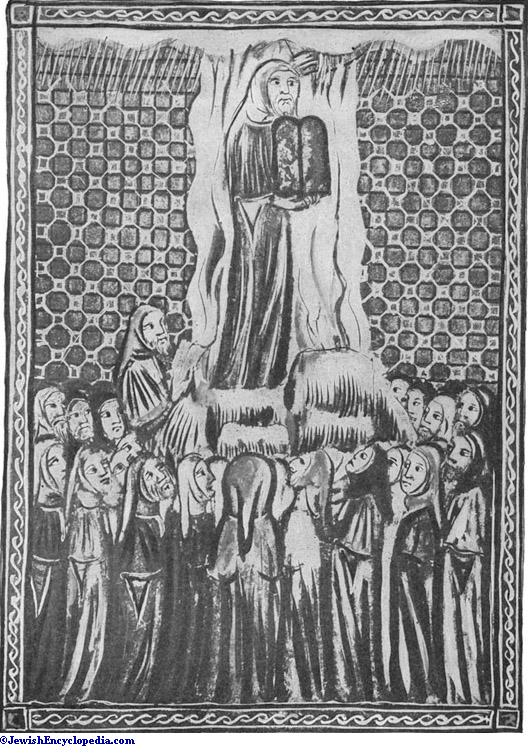
Moses and the Israelites sojourned at Sinai about a year (comp. Num. x. 11), and Moses had frequent communications from Yhwh. As a result of these the Tabernacle, according to the last chapters of Exodus, was constructed, the priestly law ordained, the plan of encampment arranged both for the Levites and the non-priestly tribes (comp. Num. i. 50-ii. 34), and the Tabernacle consecrated. While at Sinai Joshua had become general of the armies of Israel and the special minister, or assistant, of Moses (Ex. xvii. 9). From Sinai Moses led the people to Kadesh, whence the spies were sent to Canaan. Upon the return of the spies the people were so discouraged by their report that they refused to go forward, and were condemned to remain in the wilderness until that generation had passed away (Num. xiii.-xiv.).
After the lapse of thirty-eight years Moses led the people eastward. Having gained friendly permission to do so, they passed through the territory of Esau (where Aaron died, on Mount Hor; Num. xx. 22-29), and then, by a similar arrangement, through the land of Moab. But Sihon, king of the Amorites, whose capital was at Heshbon, refused permission, and was conquered by Moses, who allotted his territory to the tribes of Reuben and Gad. Og, King of Bashan, was similarly overthrown (comp. Num. xxi.), and his territory assigned to the half-tribe of Manasseh.
Death of Moses.
After all this was accomplished Moses was warned that he would not be permitted to lead Israel across the Jordan, but would die on the eastern side (Num. xx. 12). He therefore assembled the tribes and delivered to them a parting address, which forms the Book of Deuteronomy. In this address it is commonly supposed that he recapitulated the Law, reminding them of its most important features. When this was finished, and he had pronounced a blessing upon the people, he went up Mount Nebo to the top of Pisgah, looked over the country spread out before him, and died, at the age of one hundred and twenty. Yhwh Himself buried him in an unknown grave (Deut. xxxiv.). Moses was thus the human instrument in the creation of the Israelitish nation; he communicated to it all its laws. More meek than any other man (Num. xii. 3), he enjoyed unique privileges, for "there hath not arisen a prophet since in Israel like unto Moses, whom the Lord knew face to face" (Deut. xxxiv. 10).
J. G. A. B.—In Rabbinical Literature:
Of all Biblical personages Moses has been chosen most frequently as the subject of later legends; and his life has been recounted in full detail in the poetic haggadah. As liberator, lawgiver, and leader of a people which was transformed by him from an unorganized horde into a nation, he occupies a more important place in popular legend than the Patriarchs and all the other national heroes. His many-sided activity also offered more abundant scope for imaginative embellishment. A cycle of legends has been woven around nearly every trait of his character and every event of his life; and groups of the most different and often contradictory stories have been connected with his career. It would be interesting to investigate the origin of the different cycles, and the relation of the several cycles to one another and to the original source, if there was one. The present article attempts to give, without claiming completeness, a picture of the character of Moses according to Jewish legend and a narrative of the most important incidents of his life.
Traditional Tomb of Moses: Scene During a Pilgrimage.(From a photograph by the American Colony, Jerusalem.)
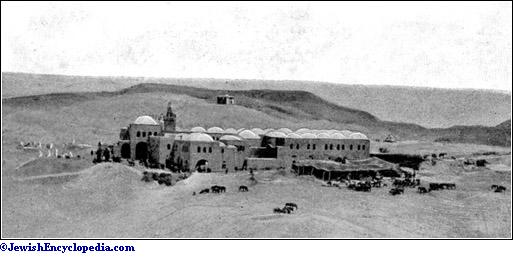
(The following special abbreviations of book-titles are used: "D. Y." = "Dibre ha-Yamim le-Mosheh Rabbenu," in Jellinek, "B. H." ii.; "S. Y." = "Sefer ha-Yashar"; "M. W." = "Midrash Wayosha'," in Jellinek, l.c.)
The Beginnings.
Moses' influence and activity reach back to the days of the Creation. Heaven and earth were created only for his sake (Lev. R. xxxvi. 4). The account of the creation of the water on the second day (Gen. i. 6-8), therefore, does not close with the usual formula, "And God saw that it was good," because God foresaw that Moses would sufferthrough water (Gen. R. iv. 8). Although Noah was not worthy to be saved from the Flood, yet he was saved because Moses was destined to descend from him (ib. xxvi. 15). The angels which Jacob in his nocturnal vision saw ascending to and descending from heaven (Gen. vii. 12) were really Moses and Aaron (Gen. R. lxviii. 16). The birth of Moses as the liberator of the people of Israel was foretold to Pharaoh by his soothsayers, in consequence of which he issued the cruel command to cast all the male children into the river (Ex. i. 22). Later on Miriam also foretold to her father, Amram, that a son would be born to him who would liberate Israel from the yoke of Egypt (Soṭah 11b, 12a; Meg. 14a; Ex. R. i. 24; "S. Y.," Shemot, pp. 111a, 112b; comp. Josephus, "Ant." ii. 9, § 3). Moses was born on Adar 7 (Meg. 13b) in the year 2377 after the creation of the world (Book of Jubilees, xlvii. 1). He was born circumcised (Soṭah 12a), and was able to walk immediately after his birth (Yalḳ., Wayelek, 940); but according to another story he was circumcised on the eighth day after birth (Pirḳe R. El. xlviii.). A peculiar and glorious light filled the entire house at his birth (ib.; "S. Y." p. 112b), indicating that he was worthy of the gift of prophecy (Soṭah l.c.). He spoke with his father and mother on the day of his birth, and prophesied at the age of three (Midr. Peṭirat Mosheh, in Jellinek, "B. H." i. 128). His mother kept his birth secret for three months, when Pharaoh was informed that she had borne a son. The mother put the child into a casket, which she hid among the reeds of the sea before the king's officers came to her (Jubilees, l.c. 47; "D. Y." in Jellinek, "B. H." ii. 3; "S. Y." p. 112b). For seven days his mother went to him at night to nurse him, his sister Miriam protecting him from the birds by day (Jubilees, l.c. 4).
Pharaoh's Daughter.
Then God sent a fierce heat upon Egypt ("D. Y." l.c.), and Pharaoh's daughter Bithiah (comp. I. Chron. iv. 18; Tarmut [Thermutis], according to Josephus, l.c. and Jubilees, l.c.), who was afflicted with leprosy, went to bathe in the river. Hearing a child cry, she beheld a casket in the reeds. She caused it to be brought to her, and on touching it was cured of her leprosy (Ex. R. i. 27). For this reason she was kindly disposed toward the child. When she opened the casket she was astonished at his beauty (Philo, "Vita Mosis," ii.), and saw the Shekinah with him (Ex. R. i. 28). Noticing that the child was circumcised, she knew that the parents must have been Hebrews (Soṭah 12b). Gabriel struck Moses, so as to make him cry and arouse the pity of the princess (Ex. R. i. 28). She wished to save the child; but as her maids told her she must not transgress her father's commands, she set him down again (Midr. Abkir, in Yalḳ., Ex. 166). Then Gabriel threw all her maids down (Soṭah 12b; Ex. R. i. 27); and God filled Bithiah with compassion (Yalḳ., l.c.), and caused the child to find favor in her eyes ("M. W." in Jellinek, l.c. i. 41). Thereupon she took the child up, saved him, and loved him much (Ex. R. l.c.). This was on the sixth day of the month of Siwan (Soṭah 12b); according to another version, on Nisan 21 (ib.). When the soothsayers told Pharaoh that the redeemer of Israel had been born and thrown into the water, the cruel edict ordering that the children be thrown into the river was repealed (Ex. R. i. 29; Soṭah l.c.). Thus the casting away of Moses saved Israel from further persecution. According to another version (Gen. R. xcvii. 5),600,000 children had already been thrown into the river, but all were saved because of Moses.
His Bringing up.
Bithiah, Pharaoh's daughter, took up the child to nurse him; but he refused the breast ("M. W." l.c.). Then she gave him to other Egyptian women to nurse, but he refused to take nourishment from any of them (Josephus, l.c. ii. 9, § 5; "S. Y." p. 112b; Soṭah 12b; "D. Y." p. 3). The mouth which was destined to speak with God might not take unclean milk (Soṭah l.c.; "D. Y." l.c.); Bithiah therefore gave him to his mother to nurse. Another legend says that he did not take any milk from the breast (Yalḳ., Wayelek, 940). Bithiah then adopted him as her son ("S. Y." p. 113b). Aside from the name "Moses," which Bithiah gave to him (Ex. ii. 10), he had seven (Lev. R. i. 3), or according to other stories ten, other names given to him by his mother, his father, his brother Aaron, his sister Miriam, his nurse, his grandfather Kehat, and Israel ("D. Y." p. 3; "S. Y." p. 112b; Meg. 13a). These names were: Jared, Abi Gedor, Ḥeber, Abi Soko, Jekuthiel, Abi Zanoah, and Shemaiah ("Shama 'Yah" = "God has heard"), the last one being given to him by Israel. He was also called "Heman" ([i.e.,  ; Num. xii. 7] B. B. 15a).
Removes Pharaoh's Crown.
Moses was a very large child at the age of three (Ex. R. i. 32; comp. Josephus; l.c.; Philo, l.c.); and it was at this time that, sitting at the king's table in the presence of several princes and counselors, he took the crown from Pharaoh's head and placed it on his own ("D. Y." l.c.; for another version see "M. W." l.c.). The princes were horrified at the boy's act; and the soothsayer said that this was the same boy who, in accordance with their former predictions, would destroy the kingdom of Pharaoh and liberate Israel (Josephus, l.c.; "M. W." l.c.). Balaam and Jethro were at that time also among the king's counselors (Soṭah 11a; Sanh. 106). Balaam advised the king to kill the boy at once; but Jethro (according to "D. Y." l.c., it was Gabriel in the guise of one of the king's counselors) said that the boy should first be examined, to see whether he had sense enough to have done such an act intentionally. All agreed with this advice. A shining piece of gold, or a precious stone, together with a live coal, was placed on a plate before the boy, to see which of the two he would choose. The angel Gabriel then guided his hand to the coal, which he took up and put into his mouth. This burned his tongue, causing him to stutter (comp. Ex. iv. 10); but it saved his life ("M. W." l.c.; "D. Y." l.c.; "S. Y." l.c.; Ex. R. i. 31).
Moses remained in Pharaoh's house fifteen years longer ("D. Y." l.c.; "M. W." l.c.). According to the Book of Jubilees (l.c.), he learned the writing of the Assyrians (the "Ketab Ashurit"; the square script ?) from his father, Amram. During his sojourn in the king's palace he often went to his brethren, the slaves of Pharaoh, sharing their sad lot. Hehelped any one who bore a too heavy burden or was too weak for his work. He reminded Pharaoh that a slave was entitled to some rest, and begged him to grant the Israelites one free day in the week. Pharaoh acceded to this request, and Moses accordingly instituted the seventh day, the Sabbath, as a day of rest for the Israelites (Ex. R. i. 32; "S. Y." p. 115a).
Flees from Egypt.
Moses did not commit murder in killing the Egyptian (Ex. ii. 12); for the latter merited death because he had forced an Israelitish woman to commit adultery with him (Ex. R. i. 33). Moses was at that time eighteen years of age ("D. Y." l.c.; "M. W." l.c.; "S. Y." l.c.). According to another version, Moses was then twenty, or possibly forty, years of age (Ex. R. i. 32, 35). These divergent opinions regarding his age at the time when he killed the Egyptian are based upon different estimates of the length of his stay in the royal palace (Yalḳ., Shemot, 167; Gen. R. xi.), both of them assuming that he fled from Egypt immediately after the slaying (Ex. ii. 15). Dathan and Abiram were bitter enemies of Moses, insulting him and saying he should not act as if he were a member of the royal house, since he was the son not of Batya, but of Jochebed. Previous to this they had slandered him before Pharaoh. Pharaoh had forgiven Moses everything else, but would not forgive him for killing the Egyptian. He delivered him to the executioner, who chose a very sharp sword with which to kill Moses; but the latter's neck became like a marble pillar, dulling the edge of the sword ("M. W." l.c.). Meanwhile the angel Michael descended from heaven, and took the form of the executioner, giving the latter the shape of Moses and so killing him. He then took up Moses and carried him beyond the frontier of Egypt for a distance of three, or, according to another account, of forty, days ("D. Y." l.c.; "S. Y." p. 115b). According to another legend, the angel took the shape of Moses, and allowed himself to be caught, thus giving the real Moses an opportunity to escape (Mek., Yitro. 1 [ed. Weiss. 66a]; Ex. R. i. 36).
King in Ethiopia.
The fugitive Moses went to the camp of King Nikanos, or Kikanos, of Ethiopia, who was at that time besieging his own capital, which had been traitorously seized by Balaam and his sons and made impregnable by them through magic. Moses joined the army of Nikanos, and the king and all his generals took a fancy to him, because he was courageous as a lion and his face gleamed like the sun ("S. Y." P. 116a; comp. B. B. 75a). When Moses had spent nine years with the army King Nikanos died, and the Hebrew was made general. He took the city, driving out Balaam and his sons Jannes and Jambres, and was proclaimed king by the Ethiopians. He was obliged, in deference to the wishes of the people, to marry Nikanos' widow, Adoniya (comp. Num. xii.), with whom he did not, however, cohabit ("D. Y." l.c.; "S. Y." p. 116b). Miriam and Aaron spoke against Moses on account of the Cushite (Ethiopian) woman whom he had married. He was twenty-seven years of age when he became king; and he ruled over Ethiopia for forty years, during which he considerably increased the power of the country. After forty years his wife, Queen Adoniya, accused him before the princes and generals of not having cohabited with her during the many years of their marriage, and of never having worshiped the Ethiopian gods. She called upon the princes not to suffer a stranger among them as king, but to make her son by Nikanos, Munahas or Munakaros, king. The princes complied with her wishes, but dismissed Moses in peace, giving him great treasures. Moses, who was at this time sixty-seven years old, went from Ethiopia to Midian (ib.).
According to Josephus' account of this story (see Moses in Hellenistic Literature), after Moses' marriage to the daughter of the Ethiopian king, he did not become King of Ethiopia, but led his troops back to Egypt, where he remained. The Egyptians and even Pharaoh himself were envious of his glorious deeds, fearing also that he might use his power to gain dominion over Egypt. They therefore sought how they might assassinate him; and Moses, learning of the plot, fled to Midian. This narrative of Josephus' agrees with two haggadic accounts, according to which Moses fled from Egypt direct to Midian, not staying in Ethiopia at all. These accounts are as follows: (1) Moses lived for twenty years in Pharaoh's house; he then went to Midian, where he remained for sixty years, when, as a man of eighty, he undertook the mission of liberating Israel (Yalḳ., Shemot, 167). (2) Moses lived for forty years in Pharaoh's house; thence he went to Midian, where he stayed for forty years until his mission was entrusted to him (Gen. R. xi.; comp. Sifre, Deut. xxxiv. 7).
Relations with Jethro.
On his arrival at Midian Moses told his whole story to Jethro, who recognized him as the man destined to destroy the Egyptians. He therefore took Moses prisoner in order to deliver him to Pharaoh ("D. Y." l.c.). According to another legend, Jethro took him for an Ethiopian fugitive, and intended to deliver him to the Ethiopians ("S. Y." l.c.). He kept him prisoner for seven ("D. Y." l.c.) or ten ("S. Y." l.c.) years. Both of these legends are based on another legend according to which Moses was seventy-seven years of age when Jethro liberated him. According to the legend ("D. Y." l.c.) which says that he went to Nikanos' camp at the age of thirty, and ruled over Ethiopia for forty years, he was only seven years in Jethro's hands (30+40+7 = 77). According to the other legend ("S. Y." l.c.) he was eighteen years old when he fled from Egypt; he remained for nine years in the camp of Nikanos; and was king over Ethiopia for forty years. Hence he must have been Jethro's captive for ten years, or till his seventy-seventh year.
The Circumcision of Gershom.
Moses was imprisoned in a deep dungeon in Jethro's house, and received as food only small portions of bread and water. He would have died of hunger had not Zipporah, to whom Moses had before his captivity made an offer of marriage by the well, devised a plan by which she no longer went out to pasture the sheep, but remained at home to attend to the household, being thereby enabled to supply Moses with food without her father's knowledge. After ten (or seven) years Zipporah reminded her father that he had at one time cast a man into the dungeon, who must have died long ago; but ifhe were still living he must be a just man whom God had kept alive by a miracle. Jethro went to the dungeon and called Moses, who answered immediately. As Jethro found Moses praying, he really believed that he had been saved by a miracle, and liberated him. Jethro had planted in his garden a marvelous rod, which had been created on the sixth day of the Creation, on Friday afternoon, and had been given to Adam. This curious rod had been handed down through Enoch, Shem, Abraham, Isaac, and Jacob to Joseph, at whose death it came into the possession of Pharaoh's court. Jethro, who saw it there, stole it and planted it in his garden. On the rod were engraved the name of God (Yhwh) and the initials of the ten plagues destined for Egypt. Jethro asked every one who wished to marry one of his daughters to pull up the rod; but no suitor had yet succeeded in doing so. Moses, on being set at liberty, walked in the garden, saw the rod, and read the inscription. He easily pulled it out of the ground and used it for a staff (see Aaron's Rod). Jethro thereby recognized Moses as the deliverer of Israel, and gave him the virtuous Zipporah as wife, together with much money ("S. Y.," "D. Y.," and "M. W." l.c.). Jethro stipulated that the first-born son of the marriage should adopt Jethro's pagan belief, while all the other children might be reared as Jews; and Moses agreed thereto (Mek., Yitro, 1 [ed. Weiss, p. 65b]). According to "M. W." l.c., one-half of the children of this marriage were to belong to Judaism and one-half to paganism. When therefore his son Gershom—who subsequently became the father of Jonathan—was born, Moses, under his agreement with Jethro, could not circumcise him ("S. Y." l.c.). Moses, therefore, went with his wife and child (another version says that both of his sons were then already born) to Egypt. On the way he met Satan, or Mastema, as he is called in the Book of Jubilees (xlviii. 2), in the guise of a serpent, which proceeded to swallow Moses, and had ingested the upper part of his body, when he stopped. Zipporah seeing this, concluded that the serpent's action was due to the fact that her son had not been circumcised (Ned. 31b-32a; Ex. R. v.), whereupon she circumcised him and smeared some of the blood on Moses' feet. A voice ("bat ḳol") was then heard commanding the serpent to disgorge the half-swallowed Moses, which it immediately did. When Moses came into Egypt he met his old enemies Dathan and Abiram, and when they asked him what he was seeking in Egypt, he immediately returned to Midian ("M. W." l.c.).
At the Burning Bush.
As the shepherd of his father-in-law he drove his sheep far into the desert (Ex. iii. 1), in order to prevent the sheep from grazing in fields not belonging to Jethro (Ex. R. i. 3). Here God appeared to him and addressed him for seven consecutive days (ib. iii. 20). Moses, however, refused to listen, because he would not allow himself to be disturbed in the work for which he was paid. Then God caused the flaming bush to appear (Ex. iii. 2-3), in order to divert Moses' attention from his work. The under-shepherds with Moses saw nothing of the marvelous spectacle, which Moses alone beheld (Ex. R. ii. 8). Moses then interrupted his work, and stepped nearer the bush to investigate (ib. ii. 11). As Moses was at this time entirely inexperienced in prophecy, God, in calling him, imitated the voice of Amram, so as not to frighten him. Moses, who thought that his father, Amram, was appearing to him, said: "What does my father wish?" God answered: "I am the God of thy father" (Ex. iii. 6), and gave him the mission to save Israel (ib.). Moses hesitated to accept the mission (comp. Ex. iii. 11) chiefly because he feared that his elder brother, Aaron, who until then had been the only prophet in Israel, might feel slighted if his younger brother became the savior of the people; whereupon God assured him that Aaron would be glad of it (Ex. R. iii. 21-22). According to another version (ib. xv. 15), Moses said to God: "Thou hast promised Jacob that Thou Thyself wouldest liberate Israel [comp. Gen. xlvi. 4], not appointing a mediator." God answered: "I myself will save them; but go thou first and announce to My children that I will do so." Moses consented, and went to his father-in-law, Jethro (Ex. iv. 18), to obtain permission to leave Midian (Ned. 65a; Ex. R. iv. 1-4), for he had promised not to leave Midian without his sanction. Moses departed with his wife and children, and met Aaron (comp. Ex. iv. 27), who told him it was not right to take them into Egypt, since the attempt was being made to lead the Israelites out of that country. He therefore sent his wife and children back to Midian ("S. Y." p. 123a; Mek., Yitro, 1 [ed. Weiss, p. 65b]). When they went to Pharaoh, Moses went ahead, Aaron following, because Moses was more highly regarded in Egypt (Ex. R. ix. 3); otherwise Aaron and Moses were equally prominent and respected (Mek., Bo, 1 [ed. Weiss, p. 1a]). At the entrance to the Egyptian royal palace were two leopards, which would not allow any one to approach unless their guards quieted them; but when Moses came they played with him and fawned upon him as if they were his dogs ("D. Y." l.c.; "S. Y." l.c.). According to another version, there were guards at every entrance. Gabriel, however, introduced Moses and Aaron into the interior of the palace without being seen (Yalḳ., Shemot, 175). As Moses' appearance before Pharaoh resulted only in increasing the tasks of the children of Israel (comp. Ex. v.), Moses returned to Midian; and, according to one version, he took his wife and children back at the same time (Ex. R. v. 23).
Before Pharaoh.
After staying six months in Midian he returned to Egypt (ib.), where he was subjected to many insults and injuries at the hands of Dathan and Abiram (ib. v. 24). This, together with the fear that he had aggravated the condition of the children of Israel, confused his mind so that he uttered disrespectful words to God (Ex. v. 22). Justice ("Middat ha-Din") wished to punish him for this; but as God knew that Moses' sorrow for Israel had induced these words he allowed Mercy ("Middat ha-Raḥamim") to prevail (ib. vi. 1). As Moses feared that Middat ha-Din might prevent the redemption of Israel, since it was unworthy of being redeemed, God swore to him to redeem the people for Moses' sake (ib. vi. 3-5, xv. 4). Moses in treating with Pharaoh alwaysshowed to him the respect due to a king (ib. vii. 2). Moses was really the one selected to perform all the miracles; but as he himself was doubtful of his success (ib. vi. 12) some of them were assigned to Aaron (ib. 1). According to another version, Aaron and not Moses undertook to send the plagues and to perform all the miracles connected with the water and the dust. Because the water had saved Moses, and the dust had been useful to him in concealing the body of the Egyptian (ib. ii. 12), it was not fitting that they should be the instruments of evil in Moses' hand (ib. ix. 9, x. 5, xx. 1). When Moses announced the last plague, he would not state the exact time of its appearance, midnight, saying merely "ka-ḥaẓot" = "about midnight" (ib. xi. 4), because he thought the people might make a mistake in the time and would then call him a liar (Ber. 3b, 4a). On the night of the Exodus, when Moses had killed his paschal lamb, all the winds of the world were blowing through paradise, carrying away its perfumes and imparting them to Moses' lamb so that the odor of it could be detected at a distance of forty days (Ex. R. xix. 6).
At the Exodus.
During this night all the first-born, including the female first-born, were killed, with the exception of Pharaoh's daughter Batya, who had adopted Moses. Although she was a first-born child, she was saved through Moses' prayer ("S. Y." p. 125b). During the Exodus while all the people thought only of taking the gold and silver of the Egyptians, Moses endeavored to carry away boards for use in the construction of the future Temple (comp. Gen. R. xciv. 4 and Jew. Encyc. vii. 24, s.v. Jacob) and to remove Joseph's coffin (Ex. R. xviii. 8). Serah, Asher's daughter, told Moses that the coffin had been lowered into the Nile; whereupon Moses went to the bank of the river and cried: "Come up, Joseph" (according to another version, he wrote the name of God on a slip of paper, which he threw into the Nile), when the coffin immediately rose to the surface (Soṭah 13a; Ex. R. xx. 17; "D. Y." l.c.; "S. Y." p. 126). Another legend says that Joseph's coffin was among the royal tombs, the Egyptians guarding it with dogs whose barking could be heard throughout Egypt; but Moses silenced the dogs and took the coffin out (Soṭah l.c.; Ex. R. l.c.; comp. Joseph in Rabbinical Literature).
On arriving at the Red Sea Moses said to God when commanded by Him to cleave the water: "Thou hast made it a law of nature that the sea shall never be dry," whereupon God replied that at the Creation He had made an agreement with the sea as to the separation of its waters at this time (Ex. R. xxi. 16; comp. "M. W." p. 38). When the Israelites saw Pharaoh and his army drown in the Red Sea (Ex. xiv. 30-31) they wished to return to Egypt and set up a kingdom there; but Moses prevented them, urging them on by force. He also removed the idols which the Israelites had brought with them from Egypt (Ex. R. xxiv. 2).
Receives the Torah.
The giving of the tables of the Law and of the Torah in general to Moses is a favorite subject for legends. In contrast to the pithy sentence of R. Jose (Suk. 5a) to the effect that Moses never ascended into heaven, there are many haggadot which describe in detail how Moses made his ascension and received the Torah there. Moses went up in a cloud which entirely enveloped him (Yoma 4a). As he could not penetrate the cloud, God took hold of him and placed him within it (ib. 4b). When he reached heaven the angels asked God: "What does this man, born of woman, desire among us?" God replied that Moses had come to receive the Torah, whereupon the angels claimed that God ought to give the Torah to them and not to men. Then God told Moses to answer them. Moses was afraid that the angels might burn him with the breath of their mouths; but God told him to take hold of the throne of glory. Moses then proved to the angels that the Torah was not suited to them, since they had no passions to be subdued by it. The angels thereupon became very friendly with Moses, each one of them giving him something. The angel of death confided to him the fact that incense would prevent the plague (Shab. 88b-89a; Ex. R. xxviii.). Moses subsequently caused Aaron to employ this preventive (Num. xvii. 11-13). Moses, following the custom of the angels, ate nothing during his forty days' sojourn in heaven (B. M. 87b), feeding only on the splendor of the Shekinah. He distinguished day from night by the fact that God instructed him by day in the Scripture, and by night in the Mishnah (Ex. R. xlvii. 9). God taught him also everything which every student would discover in the course of time (ib. i.). When Moses first learned the Torah he soon forgot it; it was then bestowed upon him as a gift and he did not again forget it (Ned. 35a).
Worship of the Golden Calf.
The Torah was intended originally only for Moses and his descendants; but he was liberal enough to give it to the people of Israel, and God approved the gift (Ned. 38a). According to another version, God gave the Torah to the Israelites for Moses' sake (Ex. R. xlvii. 14). Moses' burnt tongue was healed when he received the Law (Deut. R. i. 1). As Moses was writing down the Torah, he, on reaching the passage "Let us make man" (Gen. i. 26), said to God, "Why dost thou give the Minim the opportunity of construing these words to mean a plurality of gods?" whereupon God replied: "Let those err that will" (Gen. R. viii. 7). When Moses saw God write the words "erek appayim" (= "long-suffering"; Ex. xxxiv. 6), and asked whether God was long-suffering toward the pious only, God answered, "Toward sinners also." When Moses said that sinners ought to perish, God answered, "You yourself will soon ask me to be long-suffering toward sinners" (Sanh. 111a). This happened soon after Israel had made the golden calf (ib.). Before Moses ascended to heaven he said that he would descend on the forenoon of the forty-first day. On that day Satan confused the world so that it appeared to be afternoon to the Israelites. Satan told them that Moses had died, and was thus prevented from punctually fulfilling his promise. He showed them a form resembling Moses suspended in the air, whereupon the people made the golden calf (Shab. 89a; Ex. R. lxi.). When, in consequence of this, Moses was obliged to descend from heaven (Ex. xxxii. 7), he saw the angels of destruction, who were ready todestroy him. He was afraid of them; for he had lost his power over the angels when the people made the golden calf. God, however, protected him (Ex. R. xli. 12). When Moses came down with the tables and saw the calf (Ex. xxxii. 15-20), he said to himself: "If I now give to the people the tables, on which the interdiction against idolatry is written (Ex. xx. 2-5), they will deserve death for having made and worshiped the golden calf." In compassion for the Israelites he broke the tables, in order that they might not be held responsible for having transgressed the command against idolatry (Ab. R. N. ii.). Moses now began to pray for the people, showing thereby his heroic, unselfish love for them. Gathering from the words "Let me" (Ex. xxxii. 10) that Israel's fate depended on him and his prayer, he began to defend them (Ber. 32a; Meg. 24a). He said that Israel, having been sojourning in Egypt, where idolatry flourished, had become accustomed to this kind of worship, and could not easily be brought to desist from it (Yalḳ., Ki Tissa, 397). Moreover, God Himself had afforded the people the means of making the golden calf, since he had given them much gold and silver (Ber. l.c.). Furthermore, God had not forbidden Israel to practise idolatry, for the singular and not the plural was used in Ex. xx. 2-5, referring, therefore, only to Moses (Ex. R. xlvii. 14).
Moses and Israel.
Moses refused God's offer to make him the ancestor of a great people (Ex. xxxii. 10), since he was afraid that it would be said that the leader of Israel had sought his own glory and advantage and not that of the people. He, in fact, delivered himself to death for the people (Ber. l.c.). For love of the Israelites he went so far as to count himself among the sinners (comp. Isa. liii. 12), saying to God: "This calf might be an assistant God and help in ruling the world." When God reproved him with having himself gone astray and with believing in the golden calf, he said: "Lord, why doth thy wrath wax hot against thy people" (Ex. xxxii. 11; Num. R. ii. 14; Deut. R. i. 2). Moses atoned for the sin of making the calf; he even atoned for all the sins of humanity down to his time, freeing men from their burden of sin (Yalḳ., Ki Tissa, 388, from the Tanna debe Eliyahu; this, as well as the interpretation of Isa. liii. as referring to Moses [Soṭah 14a], must be either ascribed to Christian influence or regarded as a polemic against the Christian interpretations referring to Jesus). Moses loved the people (Men. 65a, b), showing his affection on every occasion. During the battle with Amalek he sat on a stone, and not on a cushion which he could easily have procured, because, Israel being at that time in trouble, he intended to show thereby that he suffered with them (Ta'an. 11a). When he begged God, before his death, to recall the oath that he (Moses) should never enter Palestine, God replied, "If I recall this oath I will also recall the oath never to destroy Israel," whereupon Moses said: "Rather let Moses and a thousand like him perish than that one of the people of Israel should perish" (Midr. Peṭirat Mosheh, in Jellinek, "B. H." i. 121). Moses requested that the Shekinah might rest in Israel only in order that Israel might thereby be distinguished among all peoples (Ber. 7a); that if they sinned and were penitent, their intentional sins might be regarded merely as trespasses (Yoma 36b); and that when Israel should suffer under the yoke of the nations, God would protect the pious and the saints of Israel (B. B. 8a). All the injuries and slanders heaped upon Moses by the people did not lessen his love for them.
The words "They looked after Moses" (Ex. xxxiii. 8) are differently interpreted. According to one opinion the people praised Moses, saying: "Hail to the mother who has borne him; all the days of his life God speaks with him; and he is dedicated to the service of God." According to another opinion they repreached and reviled him: they accused him of committing adultery with another man's wife; and every man became jealous and forbade his wife to speak to Moses. They said: "See how fat and strong he has grown; he eats and drinks what belongs to the Jews, and everything that he has is taken from the people. Shall a man who has managed the building of the Tabernacle not become rich?" (Sanh. 110a; Ḳid. 33b; Ex. R. li. 4; SheḲ. v. 13). Yet Moses was the most conscientious of superintendents (Ber. 44a), and although he had been given sole charge of the work, he always caused his accounts to be examined by others (Ex. R. li. 1). He was always among the workmen, showing them how to do the work.
In the Tabernacle.
When everything was prepared Moses set up the Tabernacle alone (Ex. R. lii. 3). He fastened the ceiling of the tent over it, as he was the only one able to do so, being ten ells tall (Shab. 92a). During the seven days of the dedication he took the Tabernacle apart every day and set it up again without any help. When all was completed he gave a detailed account of the various expenses (Ex. R. li. 4). During the seven days of the dedication, or, according to another account, during the forty years of the wandering in the desert, Moses officiated as high priest. He was also king during this entire period. When he demanded these two offices for his descendants God told him that the office of king was destined for David and his house, while the office of high priest was reserved for Aaron and his descendants (Ex. R. ii. 13; Lev. R. xi. 6; Zeb. 102a).
All the different cycles of legends agree in saying that Moses was very wealthy, probably on the basis of Num. xvi. 15 (comp. Ned. 35a, where this interpretation is regarded as uncertain); they differ, however, as to the source of his wealth. According to one, he derived it from the presents and treasures given to him by the Ethiopians when they took the crown away from him ("D. Y." l.c.). According to another, Jethro gave him a large sum of money as dowry when he married Zipporah ("M. W." l.c.). Still another story relates that Moses received a large part of the booty captured from Pharaoh and, later, from Sihon and Og (Lev. R. xxviii. 4). In contrast to these versions, according to which Moses gained his wealth by natural means, there are two other versions according to which Moses became wealthy by a miracle. One of these narratives saysthat Moses became rich through the breaking of the tables, which were made of sapphires (Ned. 35a); and the other that God showed him in his tent a pit filled with these precious stones (Yalḳ., Ki Tissa, 39b).
Personal Qualities.
Moses was also distinguished for his strength and beauty. He was, as stated above, ten ells tall and very powerful. In the battle against Og, Moses was the only one able to kill that king (Ber. 54b; see Og in Rabbinical Literature). His face was surrounded by a halo (comp. Ex. xxxiv. 29-35); this was given to him in reward for having hidden his face on first meeting God in the burning bush (ib. iii. 2-6; Ber. 7a), or he derived it from the cave in the cleft of the rock (comp. Ex. xxxiii. 22) or from the tables, which he grasped while God was holding one side and the angels the other. Another legend says that a drop of the marvelous ink with which he wrote down the Torah remained on the pen; and when he touched his head with the pen he received his halo (Ex. R. xlvii. 11).
Moses was called the "father of wisdom" on account of his great sagacity (Meg. 13a; Lev. R. i. 15). He possessed forty-nine of the fifty divisions of wisdom (R. H. 21b; Ned. 35a). The question why the pious sometimes have bad luck while the sinners are fortunate was solved for him (Ber. 7a). He wished to know also how good deeds are rewarded in the future world, but this was not revealed to him (Yalḳ., Ki Tissa, 395). Piety was not burdensome to him (Ber. 33b). His prayers were immediately answered (Gen. R. lx. 4). He was so prominent a figure that his authority was equal to that of an entire sanhedrin of seventy-one members (Sanh. 16b), or even of the whole of Israel (Mek., Beshallaḥ, Shir, 1 [ed. Weiss, p. 41a]).
His Prophetic Powers.
Aside from the Pentateuch, Moses wrote also the Book of Job and some Psalms. He also introduced many regulations and institutions (Shab. 30a; comp. Ber. 54; Ta'an. 27; Meg. 4; Yeb. 79; Mak. 24). On account of the excellence of his prophecy he is called "the father," "the head," "the master," and "the chosen of the Prophets" (Lev. R. i. 3; Esth. R. i.; Ex. R. xxi. 4; Gen. R. lxxvi. 1). While all the other prophets ceased to prophesy after a time, Moses continued to talk with God and to prophesy throughout his life (Ex. R. ii. 12); and while all the other prophets beheld their visions as through nine spectacles ("espaḳlarya") or through dim ones, Moses beheld his as through one clear, finely ground glass (Yeb. 49b; Lev. R. i. 14). Balaam surpassed him in prophecy in two respects: (1) Balaam always knew when God was about to speak with him, while Moses did not know beforehand when God would speak with him; and (2) Balaam could speak with God whenever he wished, which Moses could not do. According to another tradition (Num. R. xiv. 34), however, Moses also could speak with God as often as he wished. The fact that God would speak with him unawares induced Moses to give up domestic life, and to live separated from his wife (Shab. 87a).
Can Not Enter the Promised Land.
Moses' modesty is illustrated by many fine examples in the Haggadah (comp. Num. xii. 3). When God pointed to R. Akiba and his scholarship, Moses said: "If Thou hast such a man, why dost Thou reveal the Torah through me?" (Men. 29b; see also Akiba). When Moses descended from heaven Satan came to ask him where the Torah was which God had given to him. Moses said: "Who am I? Am I worthy to receive the Torah from God?" When God asked him why he denied that the Torah had been given to him, he replied: "How can I claim anything which belongs to Thee and is Thy darling?" Then God said to him: "As thou art so modest and humble, the Torah shall be called after thee, the 'Torah of Moses'" (Shab. 89a; comp. Mal. iii. 22). Moses' modesty never allowed him to put himself forward (e.g., in liberating Israel, in dividing the sea, and subsequently also in connection with the Tabernacle) until God said to him: "How long wilt thou count thyself so lowly? The time is ready for thee; thou art the man for it" (Lev. R. i. 15). When Moses had made a mistake, or had forgotten something, he was not ashamed to admit it (Zeb. 101a). In his prayers he always referred to the merits of others, although everything was granted to him on account of his own merit (Ber. 10b). Whenever the cup is handed to him during the banquet of the pious in the other world, that he may say grace over the meal, he declares: "I am not worthy to say grace, as I have not deserved to enter the land of Israel" (Pes. 119b). The fact that Moses, the foremost leader of Israel, who ceaselessly prayed for it and partook of its sorrows (Num. R. xviii. 5), and on whose account the manna was showered down from heaven and the protecting clouds and the marvelous well returned after the death of Aaron and Miriam (Ta'an. 9a), should not be allowed to share in Israel's joys and enter the promised land ("M. W." l.c.), was a problem that puzzled the Haggadah, for which it tried to find various explanations. Moses was anxious to enter the promised land solely because many of the commandments given by God could be observed only there, and he was desirous of fulfilling all the commandments. God, however, said that He looked upon Moses as having fulfilled all the commandments, and would therefore duly reward him therefor (Soṭah 14a). Moses prayed in vain to be permitted to go into the promised land if only for a little while; for God had decreed that he should not enter the country either alive or dead. According to one opinion, this decree was in punishment for the words addressed by him to God: "Wherefore hast thou so evil entreated this people?" (Ex. v. 22; Ex. R. v. 27). According to another version, this punishment was inflicted upon him for having once silently renounced his nationality. When Moses had helped the daughters of Jethro at the well, they took him home, letting him wait outside while they went into the house and told their father that an Egyptian had protected them (Ex. ii. 19). Moses, who overheard this conversation, did not correct them, concealing the fact that he was a Hebrew ("M. W." l.c.). There is still another explanation, to the effect that it would not have redounded to the glory of Moses if he who had led 600,000 persons out of Egypt had been the only one to enter Palestine, while the entire people were destinedto die in the desert (comp. Num. xiv. 28-37). Again, Moses had to die with the generation which he took out of Egypt, in order that he might be able to lead them again in the future world (Num. R. xix. 6).
Moses Strikes the Rock.
Denying all these reasons, another explanation, based on Scripture, is that Moses and Aaron were not permitted to enter the promised land because they did not have the proper confidence in God in calling water from the rock (Num. xx. 12). Moses asked that this error should be noted down in the Torah (Num. xx. 12) in order that no other errors or faults should be ascribed to him (Num. R. l.c.). This story of his lack of true confidence in God when calling forth the water is elaborated with many details in the legends.
Moses was careful not to provoke the people during the forty years of wandering in the desert, because God had sworn that none of the generation which had left Egypt should behold the promised land (Deut. i. 35). When he went to call forth the water he did not know exactly from which rock it would come. The people became impatient and said that there was no difference between the rocks, and that he ought to be able to call forth water from any one of them. Vexed, he replied, "Ye rebels!" (Num. xx. 10) or, according to the Midrash, "fools!" ( =
=
At Aaron's Death.
When Moses heard that Aaron also had to die he grieved and wept so much as to occasion his own death (Midr. Peṭirat Aharon, l.c.). This story, as well as the reference to his early death (Yoma 87a), was probably based on Deut. xxxiv. 7, according to which he retained all his faculties and his full strength down to his end; but they contradict the many other versions of his death (see below). When Moses took Aaron up the mountain where the latter was to die, and announced his death to him, he comforted him, saying: "You, my brother, will die and leave your office to your children; but when I die a stranger will inherit my office. When you die you will leave me to look after your burial; when I die I shall leave no brother, no sister, and no son to bury me" (Midr. Peṭirat Aharon, l.c.; Num. R. xix. 11; Yalḳ., Num. 763, 787)—for Moses' sons died before him (comp. the note in "Zayit Ra'anan" to Yalḳ., Num. 787). When Moses witnessed the quiet and peaceful death of Aaron he desired a similar death for himself (ib.). After Aaron's death Moses was accused by the people of having killed him through jealousy; but God cleared him from this suspicion by a miracle (Yalḳ., Num. 764).
When Moses was about to take vengeance on Midian before his death (comp. Num. xxxi.) he did not himself take part in the war, because he had at one time sojourned in Midian and had received benefits in that country (Num. R. xxii. 4). When Zimri brought the Midianitish woman Cozbi before Moses (Num. xxv. 6), asking that he might marry her, and Moses refused his request, Zimri reproached him with having himself married the Midianitish woman Zipporah (Sanh. 82a). Later, also, Moses was reproached for this marriage, the Rabbis saying that on account of it he became the ancestor of Jonathan, the priest of Micah's idol (Judges xviii. 30; B. B. 109b). God revealed to Moses before his death all the coming generations, their leaders and sages, as well as the saints and sinners. When Moses beheld Saul and his sons die by the sword he grieved that the first king of Israel should come to such a sad end (Lev. R. xxvi. 7). When God showed him hell he began to be afraid of it; but God promised him that he should not go thither (Num. R. xxiii. 4). He beheld paradise also. A detailed description of Moses' wanderings through paradise and hell is found in the apocalypse "Gedullat Mosheh" (Salonica, 1727; see Jew. Encyc. i. 679).
Death of Moses.
The different legends agree in saying that Moses died on Adar 7, the day on which he was born, at the age of 120 years (Meg. 13b; Mek., Beshallaḥ, Wayassa', 5 [ed. Weiss, p. 60a]; comp. Josephus, l.c. iv. 8, § 49), the angel of death not being present (B. B. 17a). But the earlier and the later legends differ considerably in the description and the details of this event. The earlier ones present the hero's death as a worthy close to his life. It takes place in a miraculous way; and the hero meets it quietly and resignedly. He ascends Mount Abarim accompanied by the elders of the people, and Joshua and Eleazar; and while he is talking with them a cloud suddenly surrounds him and he disappears. He was prompted by modesty to say in the Torah that he died a natural death, in order that people should not say that God had taken him alive into heaven on account of his piety (Josephus, l.c.). The event is described somewhat differently, but equally simply, in Sifre, Deut. 305 (ed. Friedmann, p. 129b). For the statement that Moses did not die at all, compare Soṭah 13b. "When the angel of death, being sent by God to Moses, appeared before him and said, 'Give me your soul,' Moses scolded him, saying, 'You have not even the right to appear where I am sitting; how dare you say to me that I shall give you my soul?' The angel of death took this answer back to God. And when God said to the angel the second time, 'Bring Me the soul of Moses,' he went to the place where Moses had been, but the latter had left. Then he went to the sea to look for Moses there. The sea said that it had not seen Moses since the time when he had led the children of Israel through it. Then he went to the mountains and valleys, which told him that God had concealed Moses, keeping him for the life in the future world, and no creature knew where he was."
This simple story of the old midrash follows the Bible closely, making the mountains and valleys the speakers because, according to Deut. xxxiv. 1-5, Moses died on the mountain and was buried in the valley. In the later legends the death of Moses isrecounted more fantastically, with many marvelous details. But instead of the hero being glorified, as was certainly intended by these details, he is unconsciously lowered by some traits ascribed to him. He appears weak and fearsome, not displaying that grandeur of soul which he might reasonably have been expected to exhibit at his death.
Wishes to Avoid Death.
When God said to Moses that he must die Moses replied: "Must I die now, after all the trouble I have had with the people? I have beheld their sufferings; why should I not also behold their joys? Thou hast written in the Torah: 'At his day thou shalt give him his hire' [Deut. xxiv. 15]; why dost thou not give me the reward of my toil?" (Yalḳ., Deut. 940; Midr. Peṭirat Mosheh, in Jellinek, l.c. i. 115-129). God assured him that he should receive his reward in the future world. Moses then asked why he must die at all, whereupon God enumerated some of the sins for which he had deserved death, one of them being the murder of the Egyptian (Ex. ii. 12; Midr. Peṭirat Mosheh, l.c.). According to another version, Moses had to die so that he might not be taken for a god (ib.). Moses then began to become excited (Yalḳ., Wa'etḥanan, 814), saying he would live like the beasts of the field and the birds, which get their daily food only for the sake of remaining alive (Yalḳ., Deut. 940). He desired to renounce the entry into the promised land and remain with the tribes of Reuben and Gad in the country east of the Jordan, if only he might remain alive. God said that this could not be done, since the people would leave Joshua and return to him (Midr. Peṭirat Mosheh, l.c.). Moses then begged that one of his children or one of the children of his brother Aaron might succeed him (ib. and Num. R. xxi. 15). God answered that his children had not devoted themselves to the Law, whereas Joshua had served Moses faithfully and had learned from him; he therefore deserved to succeed his teacher (ib.). Then Moses said: "Perhaps I must die only because the time has come for Joshua to enter upon his office as the leader of Israel. If Joshua shall now become the leader, I will treat him as my teacher and will serve him, if only I may stay alive." Moses then began to serve Joshua and give him the honor due to a master from his pupil. He continued to do this for thirty-seven days, from the first of Shebaṭ to the seventh of Adar. On the latter day he conducted Joshua to the tent of the assembly. But when he saw Joshua go in while he himself had to remain outside, he became jealous, and said that it was a hundred times better to die than to suffer once such pangs of jealousy. Then the treasures of wisdom were taken away from Moses and given to Joshua (comp. Soṭah 13b). A voice ("bat ḳol") was heard to say, "Learn from Joshua!" Joshua delivered a speech of which Moses understood nothing. Then, when the people asked that Moses should complete the Torah, he replied, "I do not know how to answer you," and tottered and fell. He then said: "Lord of the world, until now I desired to live; but now I am willing to die." As the angel of death was afraid to take his soul, God Himself, accompanied by Gabriel, Michael, and Zagziel, the former teacher of Moses, descended to get it. Moses blessed the people, begged their forgiveness for any injuries he might have done them, and took leave of them with the assurance that he would see them again at the resurrection of the dead. Gabriel arranged the couch, Michael spread a silken cover over it, and Zagziel put a silken pillow under Moses' head. At God's command Moses crossed his hands over his breast and closed his eyes, and God took his soul away with a kiss. Then heaven and earth and the starry world began to weep for Moses (Midr. Peṭirat Mosheh, l.c.; Yalḳ., Deut. 940; Deut. R. xi. 6). Although Moses died in the territory of the tribe of Reuben, he was buried in that of Gad at a spot four miles distant from the place of his death. He was carried this distance by the Shekinah, while the angels said to him that he had practised God's justice (Deut. xxxiii. 22). At the same time the bat ḳol cried out in the camp of the people: "Moses, the great teacher of Israel, is dead!" (Soṭah 13b).
God Himself buried Moses (Soṭah 14a; Sanh. 39a) in a grave which had been prepared for him in the dusk of Friday, the sixth day of the Creation (Pes. 54a). This tomb is opposite Beth-peor (Deut. xxxiv. 6), in atonement for the sin which Israel committed with the idol Peor (Soṭah 14a). Yet it can not be discovered; for to a person standing on the mountain it seems to be in the valley; and if one goes down into the valley, it appears to be on the mountain (ib.).
Bibliography:
B. Beer, Leben Moses, nach Auffassung der Jüdischen Sage, in Jahrb. für Gesch. der Jud. iii. 1 et seq.;
M. Grünbaum, Neue Beiträge zur Semitischen Sagenkunde, pp. 15-85, Leyden, 1893.
W. B. J. Z. L.Moses in the Jahvist. —Critical View:
In 1753 Jean Astruc, a French physician, published at Brussels a little book in which he advanced the theory that Moses had employed certain documents in composing the Book of Genesis. This work was thought by its author to establish the Mosaic authorship of Genesis upon a more secure basis, but it contained the key which, in the hands of a long line of critics, has led to the modern view that the Pentateuch originated from four great documents, all of which were written some centuries after Moses (see Pentateuch, Critical View). The oldest of these documents, known as J or the Jahvist, contains in its present state no account of the early life of Moses, but presents him first as a fugitive in the land of Midian. Nearly all the after-events of the life of Moses, enumerated above, are, however, given by J, who has a definite and interesting point of view. Critics differ as to whether Aaron had any place in the original narrative of J or not, Dillmann and Bacon assigning to him an important rôle, while Wellhausen, Stade, Carpenter, and Harford Battersby hold that such passages as Ex. iv. 13-14 are later interpolations. Be this as it may, J represents Moses as holding the unique position of importance. For example, in J's description of the plagues he pictures Moses as announcing the plague; then he tells how Yhwh sent it, usually through some natural agency (comp. Ex. viii. 20-24, the flies; x. 13, 19, the locusts). Similarly, J tells that Yhwh "caused the sea to go back by a strong east windall the night, and made the sea dry land" (Ex. xiv. 21). Thus he explains the passage of the Red Sea.
It is J who represents Moses as alone enjoying the privilege of intercourse with Yhwh face to face. He gives the account of the burning bush (Ex. iii. 2); he relates that Moses, Aaron, Nadab, and Abihu, with seventy of the elders of Israel, went up into the mountain, and that Aaron and the seventy beheld Yhwh from afar off and ate and drank in His presence, but that Moses alone went near unto Yhwh (Ex. xxiv. 1-2, 9-11). In Ex. xxxiv. 5 Yhwh descended in a cloud and stood to talk with Moses. In J the basis of Yhwh's covenant are the ten "words" contained in Ex. xxxiv. J, too, in Num. xiv. 11-17, 19-24 presents one of the most noble pictures of Moses. Yhwh was angry, and declared that He would destroy Israel and make of Moses a great nation, but the unselfish leader pleaded against his own interests for the forgiveness of the nation which had so often thwarted him, and the prayer prevailed.
Moses in the Elohist.
The second prophetic document in point of age, known as E or the Elohist, contains the account of Moses' birth and exposure on the Nile, together with the incidents which led to his flight to Midian. Aaron and Miriam also played a part in the original E narrative. E gives especial attention to the part of Jethro in initiating Moses into the worship of Yhwh and in the organization of legal procedure (Ex. xviii. 12 et seq.). According to E, before the Exodus the Hebrews dwelt in the midst of the Egyptians (not in Goshen, as in J); and E asserts that on the advice of Moses the Hebrews borrowed freely of the Egyptians just before leaving. E pictures Moses as raising the fateful rod when he would have any plague come, at which sign the plague came. At the Red Sea also Moses lifted this rod and the waters parted. In the Enarrative Moses had a "tent of meeting" pitched at a distance from the camp, to which he resorted, accompanied only by Joshua, his minister, and there he talked with Yhwh face to face (Ex. xxxiii. 8-11). E makes the basis of the covenant which Moses mediated to be the code in Ex. xx. 24-xxiii. 19. This covenant, however, was not communicated at the tent of meeting, but on the top of the sacred mountain, which E calls "Horeb" and J calls "Sinai." E's narrative contains the chief events of the life of Moses already given. His portrait is dignified and noble, though lacking in the touches of highest heroism which make the picture of J superb.
In the Priestly Code.
The writer of the Priestly Code (P), like the two older prophetic writers, includes in his account the chief events in the life of Moses, but in accord with his usual habit tells these events in a few chronicle-like words in order to make them the setting of his history of the sacred institutions. P declares that Amram was the father of Moses, and Jochebed his mother (Ex. vi. 20), and gives to Aaron a prominence much greater than in the older narratives. Moses is a god to Pharaoh, and Aaron is Moses' prophet (Ex. vii. 1). In accord with this view, in P's account of the Egyptian plagues Moses communicates in each case a command to Aaron, who then stretches out the sacred rod to invoke the affliction. Thus Aaron is associated with Moses at almost every point. P increases everywhere the miraculous element. In his account the simple driving back of the waters of the Red Sea by the east wind becomes an astounding miracle (comp. Ex. xiv. 22). P traces to Moses the sacred institutions; the Levitical law was communicated by Yhwh to Moses; Moses received on the mount the pattern of the Tabernacle, which was constructed under his direction; even the duties of the Levites were arranged by him (see Levites, Critical View).
The Deuteronomist (D) adds nothing to the knowledge of the character of Moses. The account of the second giving of the Law in Moab, and various notes which expound and interpret the older narratives, constitute the whole Pentateuchal product of this writer.
Moses and Sargon.
The cuneiform library of Assurbanipal has furnished a legend of the birth of Sargon of Agade (a Babylonian king who, according to Nabonidos, ruled about 3800 B.C.) which is strikingly parallel to the story of the secret birth of Moses and of his exposure on the Nile. The legend runs:
"Sargon, the powerful king, King of Agade am I. My mother was of low degree; my father I did not know. The brother of my father dwelt in the mountain. My city was Azupirani, which is situated on the bank of the Euphrates. My humble mother conceived me; in secret she bore me. She placed me in a boat of reeds; with bitumen my door she closed. She entrusted me to the river, which did not overwhelm me. The river bore me along; to Akki the irrigator it carried me. Akki the irrigator in goodness . . . brought me to land. Akki the irrigator as his son brought me up. Akki the irrigator his gardener appointed me. While I was gardener, Ishtar loved me . . . four years I ruled the kingdom."
The parallelism between this narrative and the story of the exposure of Moses is thought by many scholars to be too close to be accidental.
Name.
The name  is explained in Ex. ii. 12 (E) as though it were of Hebrew origin, and from
  ("to draw out"). If this were its real etymology, the name would mean "deliverer," "savior" (comp. Ps. xviii. 17, Hebr.). As an Egyptian princess could not have spoken Hebrew, this etymology has been generally abandoned. A second one dates from the time of Josephus ("Ant." ii. 9, § 6; "Contra Ap." i., § 31), and is built on the Greek form of the name
Founder of the Israelitish Nation.
It is clear from the different representations of three of the great Pentateuchal documents that some allowance must be made for traditional accretion in the narratives of the life of Moses. But modern scholars with much unanimity of opinion regard Moses as a great historical character, the emancipator of Israel, the mediator of the covenant with Yhwh, and the real founder of the Israelitish nation. Though few of the laws can be traced back to him, it is believed that he gave to Israel, by his covenant with Yhwh, and by his legal decisions at Kadesh, the beginnings of religious law, and so became the founder of the legal system which prophets and priests developed as time passed on. It is true that Winckler ("Gesch. Israels," ii. 86 et seq., Leipsic, 1900) regards Moses as a Yhwh-Tammuz myth, that Cheyne ("Encyc. Bibl.") regards him as a personified clan, and that two other scholars, Renan ("Hist. of the People of Israel," i. 135 et seq.) and Stade ("Gesch. des Volkes Israel," pp. 129 et seq.), regard his historicity as possible only. The great majority of modern scholars, however, though differing in details, hold not only to the reality of Moses as a historical character, but to the reality of his magnificent work as stated. This is the position of Wellhausen ("I. J. G." pp. 13 et seq.), W. R. Smith ("Old Test. in the Jewish Church," 2d ed., pp. 333 et seq.), Kittel ("Hist. of the Hebrews," i. 238 et seq.), Cornill ("Hist. of the People of Israel," pp. 41 et seq.), Budde ("Religion of Israel to the Exile," pp. 12 et seq.), Guthe ("Gesch. des Volkes Israel," pp. 19 et seq.), A. B. Davidson ("Theology of the Old Test." p. 110), McCurdy ("History, Prophecy, and the Monuments," ii. 92 et seq.), Kent ("Hist. of the Hebrew People," i. 36 et seq.), Barton ("Sketch of Semitic Origins," pp. 272, 291 et seq.), J. P. Peters ("The Old Test. and the New Scholarship," pp. 116 et seq., and "The Religion of Moses," in "Jour. Bib. Lit." 1901, xx. 101 et seq.), Paton ("Early Hist. of Syria and Palestine," pp. 137 et seq.), and H. P. Smith ("Old Test. History," pp. 55-65). Such a consensus of opinion is significant. See Pentateuch.
—In Hellenistic Literature:
While the Pentateuch represents Moses as the greatest of all prophets, to whom the Lord made Himself known face to face (Deut. xxxiv. 10; comp. Num. xii. 7), and who, when descending Mount Sinai, had a halo about his head which so filled the people with awe that they could not look at him (Ex. xxxiv. 29), yet there is no attempt made to lift him above the ordinary man in his nature. He lived for forty days and forty nights on the mount without eating and drinking (Deut. ix. 9), but this was owing to the power God lent him while he received the Law; he died and was buried like any other mortal (ib. xxxiv. 5-6). Owing to the contact of the Jews with the Greeks in Alexandria, Moses was made the subject of many legends, and in many respects lifted to supernatural heights.
Ben Sira was probably the first to compare him with the angels—a suggestion from Ex. xxxiv. 29 (Ecclus. xlv. 2; the Hebrew text reads "ke-elohim," while the Greek reads
(Eusebius, l.c. ix. 27).
"Jealousy of Moses' excellent qualities induced Chenephres to send him with unskilled troops on a military expedition to Ethiopia, where he won great victories. After having built the city of Hermopolis, he taught the people the value of the ibis as a protection against the serpents, making the bird the sacred guardian spirit of the city; then he introduced circumcision. After his return to Memphis, Moses taught the people the value of oxen for agriculture, and the consecration of the same by Moses gave rise to the cult of Apis. Finally, after having escaped another plot by killing the assailant sent by the king, Moses fled to Arabia, where he married the daughter of Raguel, the ruler of the district. Chenephres in the meantime died from elephantiasis [comp. Ex. R. i. and Targ. Yer. to Ex. ii. 23]—a disease with which he was the first to be afflicted—because he had ordered that the Jews should wear garments that would distinguish them from the Egyptians and thereby expose them to maltreatment [this is characteristic of the age in which it was written]. The sufferings of Israel then caused God to appear to Moses in a flame bursting forth from the earth [not from the bush!], and to tell him to march against Egypt for the rescue of his people. Accordingly he went to Egypt to deliberate with his brother Aaron about the plan of warfare, but was put into prison. At night, however, the doors of the prison opened of their own accord, while the guards died or fell asleep. Going to the royal palace and finding the doors open there and the guards sunk in sleep, he went straight to the king, and when scoffingly asked by the latter for the name of the God who sent him, he whispered the Ineffable Name into his ear, whereupon the king became speechless and as one dead. Then Moses wrote the name upon a tablet and sealed it up, and a priest who made sport of it died in convulsions. After this Moses performed all the wonders, striking land and people with plagues until the king let the Jews go. In remembrance of the rod with which Moses performed his miracles every Isis temple in Egypt has preserved a rod—Isis symbolizing the earth which Moses struck with his rod"
The record closes with a description of the personalityof Moses: "He was eighty-nine years old when he delivered the Jews; tall and ruddy, with long white hair, and dignified."
Fantastic and grotesque as these stories are, they are scarcely inventions of Artapanus only. Long contact of the Jews of Alexandria with Egyptian men of letters in a time of syncretism, when all mythology was being submitted to a rationalizing process, naturally produced such fables (see Freudenthal, "Hellenistische Studien," 1875, pp. 153-174), and they have found a place in the Palestinian as well as in the Hellenistic haggadah, in Josephus, Philo ("De Vita Moysis"), and the Alexandrian dramatist Ezekiel (Eusebius, l.c. ix. 28), as well as in the Midrash (Ex. R. i.-ii.; Tan., Shemot), the Targum, and the "Sefer ha-Yashar," or the older "Chronicles of Jerahmeel" (xliv.-l.).
Most elaborate is the haggadah from which Josephus drew his story ("Ant." ii. 9, § 2-ii. 10, § 2):
(comp. Sanh. 101b; Ex. R. i.; Targ. Yer. to Ex. i. 14; see Jannes and Jambres).
"Egyptian priests skilled in prophesying foretold the birth of a Hebrew who would bring misfortune on Egypt, and thus caused Pharaoh's edict to have every new-born male child drowned in the river"
(see Amram; Miriam).
"Amram in his distress at the fate of every new-born child prays to God and receives a revelation"
(comp. Ezekiel in Eusebius, l.c. ix. 29; "Chronicles of Jerahmeel," xliv. 8; Yalḳ. i. 166).
"Thermutis was the name of the princess who saw Moses in the water-cradle and conceived a love for him on account of his striking beauty. The child, however, refused to suckle from any other breast but that of his mother." "Moses excelled all by his tall stature and beauty of countenance as well as by his quickness of apprehension." "Thermutis, being without child, brought him up as her own son, and one day when she presented him to her father as her own child, and heir to the throne—a gift she had received from the river-god—Pharaoh took the child on his lap and placed his diadem upon its head; whereupon it cast it down on the ground and trampled upon it. This was taken as an evil omen by the king, and the priestly soothsayer, finding Moses to be the one who would bring upon the kingdom the misfortune predicted for it, wished to slay him, but Thermutis succeeded in saving his life"
(comp. "Chronicles of Jerahmeel," xlv.-xlvi.; Yalḳ. i. 168).
"An attack on Egypt by the Ethiopians caused all to look to Moses for aid, and the king asked his daughter to permit him to go forth as general of an army to Ethiopia. Moses took the short road along the desert, deemed impassable on account of its many flying serpents ('serafim'), and provided himself with numerous baskets filled with ibises, the destroyers of serpents, by the help of which he removed the dangers of the desert. He thus took the Ethiopians by surprise and defeated them, driving them back to Merve, a fortified city. While he was besieging the city, Therbis, the daughter of the king, saw him upon the walls, fell in love with him, and proposed to him to become his wife. He accepted the offer under the condition that the city should surrender to him; finally he married her"
This is obviously a midrashic tale connected with Num. xii. 1, but disavowed at a later stage (see Sifre, Num. 99, and Targ. ad loc.).
Philo also shows familiarity with these legends; he refers to the beauty of the babe Moses (l.c. i. 3) and mentions the fact that the princess, being childless, contrived to make Moses appear as her own child (i. 4-5). Moses' education in science, art, and philosophy, however, is ascribed to Egyptian masters (i. 6); he was grieved by the sufferings of his Hebrew brethren, many of whom died an untimely death and did not have even seemly burial (i. 7); his prophetic powers were attested at the Red Sea when the Egyptian dead were cast up by the waves and were actually seen by the Israelites, as Moses had announced (iii. 34, with reference to Ex. xiv. 13, 30).
Moses' Preexistence.
The end of the great lawgiver especially was surrounded with legends. "While, after having taken leave of the people, he was going to embrace Eleazar and Joshua on Mount Nebo, a cloud suddenly stood over him, and he disappeared, though he wrote in Scripture that he died, which was done from fear that people might say that because of his extraordinary virtue he had been turned into a divinity" ("Ant." iv. 8, § 48). Philo says: "He was entombed not by mortal hands, but by immortal powers, so that he was not placed in the tomb of his forefathers, having obtained a peculiar memorial [i.e., grave] which no man ever saw" ("De Vita Moysis," iii. 39). Later on, the belief became current that Moses did not die, but was taken up to heaven like Elijah. This seems to have been the chief content of the apocryphon entitled "Assumptio Moysis," preserved only in fragmentary form (comp. Charles, "The Assumption of Moses," 1897, Introduction; Deut. R. xi.; Jellinek, "B. H." i. 115-129, vi. 71-78; M. R. James, "Apocrypha Anecdota," pp. 166-173, Cambridge, 1893). No sooner was the view maintained that Moses was translated to heaven than the idea was suggested that his soul was different from that of other men. Like the Messiah, he is said to have been preexistent; he is thus represented in "Assumptio Moysis" (i. 12-14); so too "He was prepared before the foundation of the world to be the mediator of God's covenant, and as he was Israel's intercessor with God during life [xi. 11, 17], so is he to be the intercessor in all the future." While his death was an ordinary one (i. 15, x. 14), "no place received his body"; "his sepulcher is from the rising of the sun to the setting thereof, and from the south to the confines of the north; all the world is his sepulcher" (xi. 5-8). Philo also calls Moses "the mediator and reconciler of the world" (ib. iii. 19). Especially in Essene circles was Moses apotheosized: "Next to God," says Josephus ("B. J." ii. 8, § 9), "they honor the name of their legislator, and if any one blasphemes him he meets with capital punishment" (comp. "Ant." iii. 15, § 3). Against such excessive adoration of a human being a reaction set in among the Rabbis, who declared that no man ever ascended to heaven (Suk. 5a).
Bibliography:
Beer, Das Leben Moses nach Auffassung der Jüdischen Sage, Leipsic, 1863.
MOSES
1. Name—The Hebrew narrator regards Môsheh as a participle from the vb. mâshâh, ‘to draw’ Ex (Exo 2:10). Jos.
2. History
(i.) The narrative of J.
The reason for the insertion of the laws so late in the book was that the compiler of JE
A solemn ceremony sealed the covenant (Exo 24:1 f., Exo 24:9-11). Something then occurred which roused the wrath of J″
(ii.) The narrative of E
(iii.) The narrative of D
(iv.) The narrative of P
3. Historicity.—In the OT, there are presented to us the varying fortunes of a Semitic people who found their way into Palestine, and were strong enough to settle in the country in defiance of the native population. Although the Invaders were greatly in the minority as regards numbers, they were knit together by an esprit de corps which made them formidable. And this was the outcome of a strong religious belief which was common to all the branches of the tribe—the belief that every member of the tribe was under the protection of the same God, Jahweh. And when it is asked from what source they gained this united belief, the analogy of other religions suggests that it probably resulted from the influence of some strong personality. The existence and character of the Hebrew race require such a person as Moses to account for them. But while the denial that Moses was a real person is scarcely within the bounds of sober criticism, it does not follow that all the details related of him are literally true to history. What Prof. Driver says of the patriarchs in Genesis is equally true of Moses in Ex., Nu.: ‘The basis of the narratives in Genesis is in fact popular oral tradition; and that being so, we may expect them to display the characteristics which popular oral tradition does in other cases. They may well include a substantial historical nucleus; but details may be due to the involuntary action of popular invention or imagination, operating during a long period of time; characteristic anecdotes, reflecting the feelings, and explaining the relations, of a later age may thus have become attached to the patriarchs; phraseology and expression will nearly always be ascribed rightly to the narrators who cast these traditions into their present literary shape’ (art. ‘Jacob’ in DB
Moses is portrayed under three chief aspects—as (i.) a Leader, (ii.) the Promoter of the religion of J″
(i.) Moses as Leader.—Some writers think that there is evidence which shows that the Israelites who went to Egypt at the time of the famine did not comprise the whole nation. Whether this be so or not, however, there is no sufficient reason for doubting the Hebrew tradition of an emigration to Egypt. Again, if Israelites obtained permission—as foreign tribes are known to have done—to occupy pasture land within the Egyptian frontier, there could be nothing surprising if some of them were pressed into compulsory building labour; for it was a common practice to employ foreigners and prisoners in this manner. But in order to rouse them, and knit them together, and persuade them to escape, a leader was necessary. If, therefore, it is an historical fact that they were in Egypt, and partially enslaved, it is more likely than not that the account of their deliverance by Moses also has an historical basis. It is impossible, in a short article, to discuss the evidence in detail. It is in the last degree unsafe to dogmatize on the extent to which the narratives of Moses’ life are historically accurate. In each particular the decision resolves itself into a balance of probabilities. But that Moses was not an individual, but stands for a tribe or group of tribes, and that the narratives which centre round him are entirely legendary, are to the present writer pure assumptions, unscientific and uncritical. The minuteness of personal details, the picturesqueness of the scenes described, the true touches of character, and the necessity of accounting for the emergence of Israel from a state of scattered nomads into that of an organized tribal community, are all on the side of those who maintain that in its broad outlines the account of Moses’ leadership is based upon fact.
(ii.) Moses as the Promoter of the religion of Jahweh.—Throughout the OT, with the exception of Eze 40:1-49; Eze 41:1-26; Eze 42:1-20; Eze 43:1-27; Eze 44:1-31; Eze 45:1-25; Eze 46:1-24; Eze 47:1-23; Eze 48:1-35, the forms and ceremonies of J″
(iii.) Moses as Prophet and Lawgiver.—If Moses taught the Israelites to worship J″
4. Moses in the NT.—(i.) All Jews and Christians in Apostolic times (including our Lord Himself) held that Moses was the author of the Pentateuch. Besides such expressions as ‘The law of Moses’ (Luk 2:22), ‘Moses enjoined’ (Mat 8:4), ‘Moses commanded’ (Mat 19:7), ‘Moses wrote’ (Mar 12:19), ‘Moses said’ (Mar 7:10), and so on, his name could be used alone as synonymous with that which he wrote (Luk 16:20; Luk 16:31; Luk 24:27).
(ii.) But because Moses was the representative of the Old Dispensation, Jesus and the NT writers thought of him as something more. He was an historical personage of such unique prominence in Israel’s history, that his whole career appeared to them to afford parallels to spiritual factors in the New Covenant. The following form an interesting study, as illustrating points which cover a wide range of Christian truth: The ‘glory’ on Moses’ face (2Co 3:7-18), the brazen serpent (Joh 3:14), the Passover (Joh 19:36, Heb 11:28, 1Co 5:7 f.), the covenant sacrifice at Horeb (Mat 26:28, Mar 14:24, Luk 22:20, 1Co 11:25; see also Heb 9:18-20, 1Pe 1:2 with Hort’s note), the terrors of the Sinai covenant (Heb 12:18-24), the crossing of the sea (1Co 10:2), the manna (Joh 6:30-35; Joh 6:41-58), the water from the rock (1Co 10:3-4), Moses as a prophet (Act 3:22; Act 7:37, Joh 1:21-23; and see Joh 6:14; Joh 7:40 [Luk 7:39]), the magicians of Egypt (2Ti 3:8), the plagues (Rev 8:5; Rev 8:7-8; Rev 9:2-4; Rev 15:6-8; Rev 16:2-4; Rev 16:10; Rev 16:13; Rev 16:18; Rev 16:21), and ‘the song of Moses the servant of God’ (Rev 15:3).
A. H. M‘Neile.
(Hebrew: Mosheh, "saved from the waters")
Hebrew liberator, law giver, and prophet. He belonged to the tribe of Levi and was born in Egypt (10th century B.C.), at a time of grievous persecution, when Pharao had ordered the killing of all male Hebrew children (Exodus 1) Exposed on the waters of the Nile, he was rescued by Pharao’s daughter and educated at court. Having killed an Egyptian to save one of his brethren from ill-treatment, he fled to Madian where he married Jethro’s daughter (Exodus 2). God appeared to him in the burning bush and commanded him to go and deliver his brethren (3), with the help of his brother Aaron, but Pharao stubbornly refused to let the Israelites go, and the terrible chastisements known as the Ten Plagues of Egypt, only hardened his heart (7-10). However the last one, viz., the death of every first born, forced him to yield, and the Hebrews departed, after celebrating the first Pasch (11-13). Then began, under the leadership of Moses, a long and wearisome journey in the direction of the Promised Land, the dramatic episodes of which are related in the remaining chapter of Exodus and in Numbers. Only a few can be enumerated here: The Passage of the Red Sea and the Canticle of Moses (Exodus 14-15); the Manna (16); the promulgation of the Law on Mount Sinai (19-31); the many revolts of the people, who are saved each time by the intervention of their leader (Exodus 16; Numbers 13-14, 21); the march from Mount Sinai to Cades, and the stay at Cades for 38 years during which the present generation is condemned never to enter the Promised Land (Numbers 10-20); Moses himself is excluded from it because of his lack of confidence at the "Waters of Contradiction" (ib., 20); Balaam’s Prophecies (23-24). The Israelites finally reached the banks of the Jordan, after defeating the Amorrhites and Moabites, and Moses died on Mount Nebo after pronouncing the three memorable discourses preserved in Deuteronomy. He was buried in the valley of Moab, but "no man knows his sepulchre" (Deuteronomy 34), and "there arose no more a prophet in Israel like unto Moses" (ib., 10). See also, Exodus, Numbers and Deuteronomy.
Moses (3) (Moyses), Roman presbyter (? of Jewish origin), a leading member of an influential group of confessors in the time of Cyprian, about the commencement of the Novatianist schism. The others were Maximus, Nicostratus, Rufinus, Urbanus, Sidonius, Macarius, and Celerinus. They wrote early in the persecution, urging the claims of discipline on the Carthaginian confessors (Ep. 27) (cf. Tillem. t. iii. Notes s. Moyse, t. iv., S. Cyp. a. xv., Lipsius, Chr. d. röm. Bisch. p. 200), and Moyses signed the second letter of the Roman clerus (viz. Ep. 30), drawn up by Novatian according to Cyprian (Ep. 55, iv.), and he wrote with the other confessors Ep. 31 to Cyprian (Ep. 32). When they had been a year in prison (Ep. 37), or more accurately 11 months and days (Liberian Catalogue, Mommsen, Chronogr. v. Jahre 354, p. 635). i.e. c. Jan. 1, 251, Moyses died and was accounted a confessor and martyr (Ep. 55). Shortly before his death he refused to communicate with Novatian and the five presbyters who sided with him (
Moyses’ severance was not because Novatian had already left the Catholics, which he did not do till June 4, after the election of Cornelius; and Novatus, who induced it, did not leave Carthage for Rome until April or May (Rettberg, p. 109). Moyses’ great authority remained a strong point in Cornelius’s favour, when the rest of the confessors (Ep. 51) after their release threw their influence on the side of Novatian as representing the stricter discipline against Cornelius. The headship of the party belonged after Moyses’ death to MAXIMUS (3).
[E.W.B.]
Hebrew liberator, leader, lawgiver, prophet, and historian, lived in the thirteenth and early part of the twelfth century, B. C. NAMEMoshéh (M. T.), Mouses, Moses. In Ex., ii, 10, a derivation from the Hebrew Mashah (to draw) is implied. Josephus and the Fathers assign the Coptic mo (water) and uses (saved) as the constituent parts of the name. Nowadays the view of Lepsius, tracing the name back to the Egyptian mesh (child), is widely patronized by Egyptologists, but nothing decisive can be established. SOURCESTo deny or to doubt the historic personality of Moses, is to undermine and render unintelligible the subsequent history of the Israelites. Rabbinical literature teems with legends touching every event of his marvellous career: taken singly, these popular tales are purely imaginative, yet, considered in their cumulative force, they vouch for the reality of a grand and illustrious personage, of strong character, high purpose, and noble achievement, so deep, true, and efficient in his religious convictions as to thrill and subdue the minds of an entire race for centuries after his death. The Bible furnishes the chief authentic account of this luminous life. BIRTH TO VOCATION (EXODUS 2:1-22)Of Levitic extraction, and born at a time when by kingly edict had been decreed the drowning of every new male offspring among the Israelites, the "goodly child" Moses, after three months’ concealment, was exposed in a basket on the banks of the Nile. An elder brother (Exodus 7:7) and sister (Exodus 2:4), Aaron and Mary (AV and RV, Miriam), had already graced the union of Jochabed and Amram. The second of these kept watch by the river, and was instrumental in inducing Pharaoh’s daughter, who rescued the child, to entrust him to a Hebrew nurse. The one she designedly summoned for the charge was Jochabed, who, when her "son had grown up", delivered him to the princess. In his new surroundings, he was schooled "in all the wisdom of the Egyptians" (Acts 7:22). Moses next appears in the bloom of sturdy manhood, resolute with sympathies for his degraded brethren. Dauntlessly he hews down an Egyptian assailing one of them, and on the morrow tries to appease the wrath of two compatriots who were quarrelling. He is misunderstood, however, and, when upbraided with the murder of the previous day, he fears his life is in jeopardy. Pharaoh has heard the news and seeks to kill him. Moses flees to Madian. An act of rustic gallantry there secures for him a home with Raguel, the priest. Sephora, one of Raguel’s seven daughters, eventually becomes his wife and Gersam his first-born. His second son, Eliezer, is named in commemoration of his successful flight from Pharaoh. VOCATION AND MISSION (EXODUS 2:23-12:33)After forty years of shepherd life, Moses speaks with God. To Horeb (Jebel Sherbal?) in the heart of the mountainous Sinaitic peninsula, he drives the flocks of Raguel for the last time. A bush there flaming unburned attracts him, but a miraculous voice forbids his approach and declares the ground so holy that to approach he must remove his shoes. The God of Abraham, Isaac, and Jacob designates him to deliver the Hebrews from the Egyptian yoke, and to conduct them into the "land of milk and honey", the region long since promised to the seed of Abraham, the Palestine of later years. Next, God reveals to him His name under a special form Yahweh as a "memorial unto all generations". He performs two miracles to convince his timorous listener, appoints Aaron as Moses’s "prophet", and Moses, so to speak, as Aaron’s God (Exodus 4:16). Diffidence at once gives way to faith and magnanimity. Moses bids adieu to Jethro (Raguel), and, with his family, starts for Egypt. He carries in his hand the "rod of God", a symbol of the fearlessness with which he is to act in performing signs and wonders in the presence of a hardened, threatening monarch. His confidence waxes strong, but he is uncircumcised, and God meets him on the way and fain would kill him. Sephora saves her "bloody spouse", and appeases God by circumcising a son. Aaron joins the party at Horeb. The first interview of the brothers with their compatriots is most encouraging, but not so with the despotic sovereign. Asked to allow the Hebrews three days’ respite for sacrifices in the wilderness, the angry monarch not only refuses, but he ridicules their God, and then effectually embitters the Hebrews’ minds against their new chiefs as well as against himself, by denying them the necessary straw for exorbitant daily exactions in brick making. A rupture is about to ensue with the two strange brothers, when, in a vision, Moses is divinely constituted "Pharaoh’s God", and is commanded to use his newly imparted powers. He has now attained his eightieth year. The episode of Aaron’s rod is a prelude to the plagues. Either personally or through Aaron, sometimes after warning Pharaoh or again quite suddenly, Moses causes a series of Divine manifestations described as ten in number in which he humiliates the sun and river gods, afflicts man and beast, and displays such unwonted control over the earth and heavens that even the magicians are forced to recognize in his prodigies "the finger of God". Pharaoh softens at times but never sufficiently to meet the demands of Moses without restrictions. He treasures too highly the Hebrew labour for his public works. A crisis arrives with the last plague. The Hebrews, forewarned by Moses, celebrate the first Pasch or Phase with their loins girt, their shoes on their feet, and staves in their hands, ready for rapid escape. Then God carries out his dreadful threat to pass through the land and kill every first-born of man and beast, thereby executing judgment on all the gods of Egypt. Pharaoh can resist no longer. He joins the stricken populace in begging the Hebrews to depart. EXODUS AND THE FORTY YEARS (EXODUS 12:34 AND AFTER)At the head of 600,000 men, besides women and children, and heavily laden with the spoils of the Egyptians, Moses follows a way through the desert, indicated by an advancing pillar of alternating cloud and fire, and gains the peninsula of Sinai by crossing the Red Sea. A dry passage, miraculously opened by him for this purpose at a point to-day unknown, afterwards proves a fatal trap for a body of Egyptian pursuers, organized by Pharaoh and possibly under his leadership. The event furnishes the theme of the thrilling canticle of Moses. For upwards of two months the long procession, much retarded by the flocks, the herds, and the difficulties inseparable from desert travel, wends its way towards Sinai. To move directly on Chanaan would be too hazardous because of the warlike Philistines, whose territory would have to be crossed; whereas, on the south-east, the less formidable Amalacites are the only inimical tribes and are easily overcome thanks to the intercession of Moses. For the line of march and topographical identifications along the route, see ISRAELITES, subsection The Exodus and the Wanderings. The miraculous water obtained from the rock Horeb, and the supply of the quails and manna, bespeak the marvellous faith of the great leader. The meeting with Jethro ends in an alliance with Madian, and the appointment of a corps of judges subordinate to Moses, to attend to minor decisions. At Sinai the Ten Commandments are promulgated, Moses is made mediator between God and the people, and, during two periods of forty days each, he remains in concealment on the mount, receiving from God the multifarious enactments, by the observance of which Israel is to be moulded into a theocratic nation (cf. MOSAIC LEGISLATION). On his first descent, he exhibits an all-consuming zeal for the purity of Divine worship, by causing to perish those who had indulged in the idolatrous orgies about the Golden Calf; on his second, he inspires the deepest awe because his face is emblazoned with luminous horns.After instituting the priesthood and erecting the Tabernacle, Moses orders a census which shows an army of 603,550 fighting men. These with the Levites, women, and children, duly celebrate the first anniversary of the Pasch, and, carrying the Ark of the Covenant, shortly enter on the second stage of their migration. They are accompanied by Hobab, Jethro’s son, who acts as a guide. Two instances of general discontent follow, of which the first is punished by fire, which ceases as Moses prays, and the second by plague. When the manna is complained of, quails are provided as in the previous year. Seventy elders -- a conjectural origin of the Sanhedrin -- are then appointed to assist Moses. Next Aaron and Mary envy their brother, but God vindicates him and afflicts Mary temporarily with leprosy. From the desert of Pharan Moses sends spies into Chanaan, who, with the exceptions of Joshue and Caleb, bring back startling reports which throw the people into consternation and rebellion. The great leader prays and God intervenes, but only to condemn the present generation to die in the wilderness. The subsequent uprising of Core, Dathan, Abiron, and their adherents suggests that, during the thirty-eight years spent in the Badiet et-Tih., habitual discontent, so characteristic of nomads, continued. It is during this period that tradition places the composition of a large part of the Pentateuch (q.v.). Towards its close, Moses is doomed never to enter the Promised Land, presumably because of a momentary lack of trust in God at the Water of Contradiction. When the old generation, including Mary, the prophet’s sister, is no more, Moses inaugurates the onward march around Edom and Moab to the Arnon. After the death of Aaron and the victory over Arad, "fiery serpents" appear in the camp, a chastisement for renewed murmurings. Moses sets up the brazen serpent, "which when they that were bitten looked upon, they were healed". The victories over Sehon and Og, and the feeling of security animating the army even in the territory of the hostile Balac, led to presumptuous and scandalous intercourse with the idolatrous Moabites which results, at Moses’s command, in the slaughter of 24,000 offenders. The census, however, shows that the army still numbers 601,730, excluding 23,000 Levites. Of these Moses allows the Reubenites, Gadites, and the half-tribe of Manasses to settle in the east-Jordan district, without, however, releasing them from service in the west-Jordan conquest. DEATH AND POSTHUMOUS GLORYAs a worthy legacy to the people for whom he has endured unparalleled hardships, Moses in his last days pronounces the three memorable discourses preserved in Deuteronomy. his chief utterance relates to a future Prophet, like to himself, whom the people are to receive. He then bursts forth into a sublime song of praise to Jahweh and adds prophetic blessings for each of the twelve tribes. From Mount Nebo -- on "the top of Phasga" -- Moses views for the last time the Promised Land, and then dies at the age of 120 years. He is buried "in the valley of Moab over against Phogor", but no man "knows his sepulchre". His memory has ever been one of "isolated grandeur". He is the type of Hebrew holiness, so far outshining other models that twelve centuries after his death, the Christ Whom he foreshadowed seemed eclipsed by him in the minds of the learned. It was, humanly speaking, an indispensable providence that represented him in the Transfiguration, side by side with Elias, and quite inferior to the incomparable Antitype whose coming he had predicted.-----------------------------------THOMAS A K. REILLY Transcribed by Sean Hyland The Catholic Encyclopedia, Volume XCopyright © 1911 by Robert Appleton CompanyOnline Edition Copyright © 2003 by K. KnightNihil Obstat, October 1, 1911. Remy Lafort, S.T.D., CensorImprimatur. +John Cardinal Farley, Archbishop of New York
I. LIFE
1. Son of Levi
2. Foundling Prince
3. Friend of the People
4. Refuge in Midian
5. Leader of Israel
II. WORK AND CHARACTER
1. The Author
2. The Lawgiver
3. The Prophet
LITERATURE
The traditional view of the Jewish church and of the Christian church, that Moses was a person and that the narrative with which his life-story is interwoven is real history, is in the main sustained by commentators and critics of all classes.
It is needless to mention the old writers among whom these questions were hardly under discussion. Among the advocates of the current radical criticism may be mentioned Stade and Renan, who minimize the historicity of the Bible narrative at this point. Renan thinks the narrative “may be very probable.” Ewald, Wellhausen, Robertson Smith, and Driver, while finding many flaws in the story, make much generally of the historicity of the narrative.
The critical analysis of the Pentateuch divides this life-story of Moses into three main parts, J, E, and P, with a fourth, D, made up mainly from the others. Also some small portions here and there are given to R, especially the account of Aaron’s part in the plagues of Egypt, where his presence in a J-document is very troublesome for the analytical theory. It is unnecessary to encumber this biography with constant cross-references to the strange story of Moses pieced together out of the rearranged fragments into which the critical analysis of the Pentateuch breaks up the narrative. It is recognized that there are difficulties in the story of Moses. In what ancient life-story are there not difficulties? If we can conceive of the ancients being obliged to ponder over a modern life-story, we can easily believe that they would have still more difficulty with it. But it seems to very many that the critical analysis creates more difficulties in the narrative than it relieves. It is a little thing to explain by such analysis some apparent discrepancy between two laws or two events or two similar incidents which we do not clearly understand. It is a far greater thing so to confuse, by rearranging, a beautiful, well-articulated biography that it becomes disconnected - indeed, in parts, scarcely makes sense.
The biographical narrative of the Hebrew national hero, Moses, is a continuous thread of history in the Pentateuch. That story in all its simplicity and symmetry, but with acknowledgment of its difficulties as they arise, is here to be followed.
I. Life.
The recorded story of Moses’ life falls naturally into five rather unequal parts:
1. Son of Levi
“And there went a man of the house of Levi, and took to wife a daughter of Levi” Exo 2:1. The son of Levi born of that union became the greatest man among mere men in the whole history of the world. How far he was removed in genealogy from Levi it is impossible to know. The genealogical lists Gen 46:11; Exo 6:16-20; Num 3:14-28; Num 26:57-59; 1Ch 6:1-3 show only 4 generations from Levi to Moses, while the account given of the numbers of Israel at the exodus Exo 12:37; Exo 38:26; Num 1:46; Num 11:21 imperatively demand at least 10 or 12 generations. The males alone of the sons of Kohath “from a month old and upward” numbered at Sinai 8,600 Num 3:27-28. It is evident that the extract from the genealogy here, as in many other places (1Ch 23:15; 1Ch 26:24; Ezr 7:1-5; Ezr 8:1-2; compare 1Ch 6:3-14; Mt 1:1-17; Lk 3:23-38) is not complete, but follows the common method of giving important heads of families. The statement concerning Jochebed: “And she bare unto Amram Aaron and Moses, and Miriam their sister” Num 26:59 really creates no difficulty, as it is likewise said of Zilpah, after the mention of her grandsons, “And these she bare unto Jacob” (Gen 46:17-18; compare Gen 46:24-25).
The names of the immediate father and mother of Moses are not certainly known. The mother “saw him that he was a goodly child” Exo 2:2. So they defied the commandment of the king Exo 1:22, and for 3 months hid him instead of throwing him into the river.
2. Foundling Prince
The time soon came when it was impossible longer to hide the child (Josephus, Ant., II, ix, 3-6). The mother resolved upon a plan which was at once a pathetic imitation of obedience to the commandment of the king, an adroit appeal to womanly sympathy, and, if it succeeded, a subtle scheme to bring the cruelty of the king home to his own attention. Her faith succeeded. She took an ark of bulrushes (Exo 2:3-4; compare ARK OF BULRUSHES), daubed it with bitumen mixed with the sticky slime of the river, placed in this floating vessel the child of her love and faith, and put it into the river at a place among the sedge in the shallow water where the royal ladies from the palace would be likely to come down to bathe. A sister, probably Miriam, stood afar off to watch Exo 2:3-4. The daughter of Pharaoh came down with her great ladies to the river Exo 2:5-10. The princess saw the ark among the sedge and sent a maid to fetch it. The expectation of the mother was not disappointed. The womanly sympathy of the princess was touched. She resolved to save this child by adopting him. Through the intervention of the watching sister, he was given to his own mother to be nursed Exo 2:7-9. “And the child grew, and she brought him unto Pharaoh’s daughter, and he became her son” Exo 2:10. Thus, he would receive her family name.
Royal family names in Egypt then were usually compounded of some expression of reverence or faith or submission and the name of a god, e.g. “loved of,” “chosen of,” “born of,” Thoth, Ptah, Ra or Amon. At this period of Egyptian history, “born of” (Egyptian
It was the time of the Ramesside dynasty, and the king on the throne was Rameses II. Thus the foundling adopted by Pharaoh’s daughter would have the family name Mes or Moses. That it would be joined in the Egyptian to the name of the sungod Ra is practically certain. His name at court would be Ramoses. But to the oriental mind a name must mean something. The usual meaning of this royal name was that the child was “born of” a princess through the intervention of the god Ra. But this child was not “born of” the princess, so falling back upon the primary meaning of the word, “drawn out,” she said, “because I drew him out of the water” Exo 2:10. Thus, Moses received his name. Pharaoh’s daughter may have been the eldest daughter of Rameses II, but more probably was the daughter and eldest child of Seti Merenptah I, and sister of the king on the throne. She would be lineal heir to the crown but debarred by her sex. Instead, she bore the title “Pharaoh’s Daughter,” and, according to Egyptian custom, retained the right to the crown for her first-born son. A not improbable tradition (Josephus, Ant., II, ix, 7) relates that she had no natural son, and Moses thus became heir to the throne, not with the right to supplant the reigning Pharaoh, but to supersede any of his sons.
Very little is known of Moses’ youth and early manhood at the court of Pharaoh. He would certainly be educated as a prince, whose right it probably was to be initiated into the mysteries. Thus he was “instructed in all the wisdom of the Egyptians” Act 7:22, included in which, according to many Egyptologists, was the doctrine of one Supreme God.
Many curious things, whose value is doubtful, are told of Moses by Josephus and other ancient writers (Josephus, Ant., II, ix, 3; Apion, I, 31; compare Smith, Dictionary of the Bible; for Mohammedan legends, see Palmer, The Desert of the Exodus, Appendix; for rabbinical legends, see Jewish Encyclopedia). Some of these traditions are not incredible but lack authentication. Others are absurd. Egyptologists have searched with very indifferent success for some notice of the great Hebrew at the Egyptian court.
3. Friend of the People
But the faith of which the Epistle to the Hebrews speaks Heb 11:23-28 was at work. Moses “refused to be called the son of Pharaoh’s daughter” Exo 2:11-14; Act 7:24. Whether he did so in word, by definite renunciation, or by his espousal of the cause of the slave against the oppressive policy of Pharaoh is of little importance. In either case he became practically a traitor, and greatly imperiled his throne rights and probably his civil rights as well. During some intervention to ameliorate the condition of the state slaves, an altercation arose and he slew an Egyptian Exo 2:11-12. Thus, his constructive treason became an overt act. Discovering through the ungrateful reproaches of his own kinsmen Act 7:25 that his act was known, he quickly made decision, “choosing rather to share ill treatment with the people of God,” casting in his lot with slaves of the empire, rather than “to enjoy the pleasures of sin for a season,” amid the riotous living of the young princes at the Egyptian court; “accounting the reproach of Christ” his humiliation, being accounted a nobody (“Can any good thing come out of Nazareth?”) As “greater riches than the treasures of Egypt” Heb 11:25-26; Act 7:25-28. He thought to be a nobody and do right better than to be a tyrant and rule Egypt.
4. Refuge in Midian
Moses fled, “not fearing the wrath of the king” Heb 11:27, not cringing before it or submitting to it, but defying it and braving all that it could bring upon him, degradation from his high position, deprivation of the privileges and comforts of the Egyptian court. He went out a poor wanderer Exo 2:15. We are told nothing of the escape and the journey, how he eluded the vigilance of the court guards and of the frontier-line of sentinels. The friend of slaves is strangely safe while within their territory. At last he reached the Sinaitic province of the empire and hid himself away among its mountain fastnesses Exo 2:15. The romance of the well and the shepherdesses and the grateful father and the future wife is all quite in accord with the simplicity of desert life Exo 2:16-22. The “Egyptian” saw the rude, selfish herdsmen of the desert imposing upon the helpless shepherd girls, and, partly by the authority of a manly man, partly, doubtless, by the authority of his Egyptian appearance in an age when “Egypt” was a word with which to frighten men in all that part of the world, he compelled them to give way. The “Egyptian” was called, thanked, given a home and eventually a wife. There in Midian, while the anguish of Israel continued under the taskmaster’s lash, and the weakening of Israel’s strength by the destruction of the male children went on, with what more or less rigor we know not, Moses was left by Providence to mellow and mature, that the haughty, impetuous prince, “instructed in all the wisdom of the Egyptians,” might be transformed into the wise, well-poised, masterful leader, statesman, lawgiver, poet and prophet. God usually prepares His great ones in the countryside or about some of the quiet places of earth, farthest away from the busy haunts of men and nearest to the “secret place of the Most High.” David keeping his father’s flocks, Elijah on the mountain slopes of Gilead, the Baptist in the wilderness of Judaea, Jesus in the shop of a Galilean carpenter; so Moses a shepherd in the Bedouin country, in the “waste, howling wilderness.”
5. Leader of Israel
(1) The Commission
One day Moses led the flocks to “the back of the wilderness” (Exo 3:1-12; see BURNING BUSH). Moses received his commission, the most appalling commission ever given to a mere man Exo 3:10 - a commission to a solitary man, and he a refugee - to go back home and deliver his kinsmen from a dreadful slavery at the hand of the most powerful nation on earth. Let not those who halt and stumble over the little difficulties of most ordinary lives think hardly of the faltering of Moses’ faith before such a task Exo 3:11-13; Exo 4:1, Exo 4:10-13. “Thus shalt thou say unto the children of Israel, I AM hath sent me unto you” Exo 3:14, was the encouragement God gave him. He gave him also Aaron for a spokesman Exo 4:14-16, the return to the Mount of God as a sign Exo 3:12, and the rod of power for working wonders Exo 4:17.
One of the curious necessities into which the critical analysis drives its advocates is the opinion concerning Aaron that “he scarcely seems to have been a brother and almost equal partner of Moses, perhaps not even a priest” (Bennett, Hastings, Dictionary of the Bible (five volumes), III, 441). Interesting and curious speculations have been instituted concerning the way in which Israel and especially Pharaoh were to understand the message, “I AM hath sent me unto you” (Exo 3:13-14; compare Exo 6:3). They were evidently expected to understand this message. Were they to so do by translating or by transliterating it into Egyptian? Some day Egyptologists may be able to answer positively, but not yet.
With the signs for identification Exo 4:1-10, Moses was ready for his mission. He went down from the “holy ground” to obey the high summons and fulfil the great commission Exo 4:18-23. After the perplexing controversy with his wife, a controversy of stormy ending Exo 4:24-26, he seems to have left his family to his father-in-law’s care while he went to respond to the call of God Exo 18:6. He met Aaron, his brother, at the Mount of God Exo 4:27-28, and together they returned to Egypt to collect the elders of Israel Exo 4:29-31, who were easily won over to the scheme of emancipation. Was ever a slave people not ready to listen to plans for freedom?
(2) The Conflict with Pharaoh
The next move was the bold request to the king to allow the people to go into the wilderness to hold a feast unto Yahweh Exo 5:1. How did Moses gain admittance past the jealous guards of an Egyptian court to the presence of the Pharaoh himself? And why was not the former traitorous refugee at once arrested? Egyptology affords a not too distinct answer. Rameses II was dead Exo 4:19; Merenptah II was on the throne with an insecure tenure, for the times were troublous. Did some remember the “son of Pharaoh’s daughter” who, had he remained loyal, would have been the Pharaoh? Probably so. Thus he would gain admittance, and thus, too, in the precarious condition of the throne, it might well not be safe to molest him. The original form of the request made to the king, with some slight modification, was continued throughout Exo 8:27; Exo 10:9, though God promised that the Egyptians should thrust them out altogether when the end should come, and it was so Exo 11:1; Exo 12:31, Exo 12:33, Exo 12:39. Yet Pharaoh remembered the form of their request and bestirred himself when it was reported that they had indeed gone “from serving” them Exo 14:5. The request for temporary departure upon which the contest was made put Pharaoh’s call to duty in the easiest form and thus, also, his obstinacy appears as the greater heinousness. Then came the challenge of Pharaoh in his contemptuous demand, “Who is Yahweh?” Exo 5:2, and Moses’ prompt acceptance of the challenge, in the beginning of the long series of plagues (see PLAGUES) (Exo 8:1 ff; Exo 12:29-36; Exo 14:31). Pharaoh, having made the issue, was justly required to afford full presentation of it. So Pharaoh’s heart was “hardened” (Exo 4:21; Exo 7:3, Exo 7:13; Exo 9:12, Exo 9:35; Exo 10:1; Exo 14:8; see PLAGUES) until the vindication of Yahweh as God of all the earth was complete. This proving of Yahweh was so conducted that the gods of Egypt were shown to be of no avail against Him, but that He is God of all the earth, and until the faith of the people of Israel was confirmed Exo 14:31.
(3) Institution of the Passover
It was now time for the next step in revelation Exo 12; 13:1-16. At the burning bush God had declared His purpose to be a saviour, not a destroyer. In this contest in Egypt, His absolute sovereignty was being established; and now the method of deliverance by Him, that He might not be a destroyer, was to be revealed. Moses called together the elders Exo 12:21-28 and instituted the Passover feast. As God always in revelation chooses the known and the familiar - the tree, the bow, circumcision, baptism, and the Supper - by which to convey the unknown, so the Passover was a combination of the household feast with the widespread idea of safety through blood-sacrifice, which, however it may have come into the world, was not new at that time. Some think there is evidence of an old Semitic festival at that season which was utilized for the institution of the Passover.
The lamb was chosen and its use was kept up Exo 12:3-6. On the appointed night it was killed and “roasted with fire” and eaten with bitter herbs Exo 12:8, while they all stood ready girded, with their shoes on their feet and their staff in hand Exo 12:11. They ate in safety and in hope, because the blood of the lamb was on the door Exo 12:23. That night the firstborn of Egypt were slain. Among the Egyptians “there was not a house where there was not one dead” Exo 12:30, from the house of the maid-servant, who sat with her handmill before her, to the palace of the king that “sat on the throne,” and even among the cattle in the pasture. If the plague was employed as the agency of the angel of Yahweh, as some think, its peculiarity is that it takes the strongest and the best and culminates in one great stunning blow and then immediately subsides (see PLAGUES). Who can tell the horror of that night when the Israelites were thrust out of the terror-stricken land Exo 12:39?
As they went out, they “asked,” after the fashion of departing servants in the East, and God gave them favor in the sight of the over-awed Egyptians that they lavished gifts upon them in extravagance. Thus “they despoiled the Egyptians” Exo 12:36. “Moreover the man Moses was very great in the land of Egypt, in the sight of Pharaoh’s servants, and in the sight of the people” Exo 11:3; Exo 12:35-36.
(4) The Exodus
“At the end of 430 years, even the selfsame day it came to pass, that all the hosts of Yahweh went out from the land of Egypt” Exo 12:41. The great oppressor was Rameses II, and the culmination and the revolution came, most probably, in connection with the building of Pithom and Raamses, as these are the works of Israel mentioned in the Bible narrative Exo 1:11. Rameses said that he built Pithom at the “mouth of the east” (Budge, History of Exodus, V, 123). All efforts to overthrow that statement have failed and for the present, at least, it must stand. Israel built Pithom, Rameses built Pithom; there is a synchronism that cannot in the present knowledge of Egyptian history even be doubted, much less separated. The troublous times which came to Egypt with the beginning of the reign of Merenptah II afforded the psychological moment for the return of the “son of Pharaoh’s daughter” and his access to the royal court. The presence and power of Yahweh vindicated His claim to be the Lord of all the earth, and Merenptah let the children of Israel go.
A little later when Israel turned back from the border of Khar (Palestine) into the wilderness and disappeared, and Merenptah’s affairs were somewhat settled in the empire, he set up the usual boastful tablet claiming as his own many of the victories of his royal ancestors, added a few which he himself could truly boast, and inserted, near the end, an exultation over Israel’s discomfiture, accounting himself as having finally won the victory:
“Tehennu is devastation, Kheta peace, the Canaan the prisoner of all ills;
“Asgalon led out, taken with Gezer, Yenoamam made naught;
“The People of Israel is ruined, his posterity is not; Khar is become as the widows of Egypt.”
The synchronisms of this period are well established and must stand until, if it should ever be, other facts of Egyptian history shall be obtained to change them. Yet it is impossible to determine with certainty the precise event from which the descent into Egypt should be reckoned, or to fix the date BC of Moses, Rameses and Merenptah, and the building of Pithom, and so, likewise, the date of the exodus and of all the patriarchal movements. The ancients were more concerned about the order of events, their perspective and their synchronisms than about any epochal date. For the present we must be content with these chronological uncertainties. Astronomical science may sometimes fix the epochal dates for these events; otherwise there is little likelihood that they will ever be known.
They went out from Succoth (Egyptian “Thuku,” Budge, History of Egypt, V, 122, 129), carrying the bones of Joseph with them as he had commanded Exo 13:19; Gen 50:25. The northeast route was the direct way to the promised land, but it was guarded. Pithom itself was built at “the mouth of the East,” as a part of the great frontier defenses (Budge, op. cit., V, 123). The “wall” on this frontier was well guarded Exo 14, and attempts might be made to stop them. So they went not “by the way of the land of the Philistines ... lest peradventure the people repent when they see war” Exo 13:17. The Lord Himself took the leadership and went ahead of the host of Israel in a pillar of cloud by day and a pillar of fire by night Exo 13:21. He led them by “the way of the wilderness by the Red Sea” Exo 13:18. They pitched before Pi-hahiroth, over against Baal-zephon between Migdol and the sea Exo 14:2. Not one of these places has been positively identified. But the Journeys before and after the crossing, the time, and the configuration of the land and the coast-line of the sea, together with all the necessities imposed by the narrative, are best met by a crossing near the modern town of Suez (Naville, Route of the Exodus; Palmer, The Desert of the Exodus), where
Word was carried from the frontier to Pharaoh, probably at Tanis, that the Israelites had “fled” Exo 14:5, had taken the impassioned thrusting out by the frenzied people of Egypt in good faith and had gone never to return. Pharaoh took immediate steps to arrest and bring back the fugitives. The troops at hand Exo 14:6 and the chariot corps, including 600 “chosen chariots,” were sent at once in pursuit, Pharaoh going out in person at least to start the expedition Exo 14:6-7. The Israelites seemed to be “entangled in the land,” and, since “the wilderness (had) shut them in” Exo 4:3, must easily fall a prey to the Egyptian army. The Israelites, terror-stricken, cried to Moses. God answered and commanded the pillar of cloud to turn back from its place before the host of Israel and stand between them and the approaching Egyptians, so that while the Egyptians were in the darkness Israel had the light Exo 14:19-20.
The mountain came down on their right, the sea on the left to meet the foot of the mountain in front of them; the Egyptians were hastening on after them and the pillar of cloud and fire was their rearward. Moses with the rod of God stood at the head of the fleeing host. Then God wrought. Moses stretched out the rod of God over the sea and “Yahweh caused the sea to go back by a strong east wind all the night” Exo 14:16-21. A pathway was before them and the sea on the right hand, and on the left was a “wall unto them,” and they passed through Exo 14:21-22. Such heaping up of the waters by the wind is well known and sometimes amounts to 7 or 8 ft. in Lake Erie (Wright, Scientific Confirmations of the Old Testament, 106). No clearer statement could possibly be made of the means used and of the miraculous timing of God’s providence with the obedience of the people to His command to Moses.
The host of Israel passed over on the hard, sandy bottom of the sea. The Egyptians coming up in the dark and finding it impossible to tell exactly where the coastline had been on this beach, and where the point of safety would lie when the wind should abate and the tide come in again, impetuously rushed on after the fleeing slaves. In the morning, Yahweh looked forth and troubled the Egyptians “and took off their chariot wheels, and they drove them heavily” Exo 14:24-25. The wind had abated, the tide was returning and the infiltration that goes before the tide made the beach like a quicksand. The Egyptians found that they had gone too far and tried to escape Exo 14:27, but it was too late. The rushing tide caught them Exo 14:28. When the day had come, “horse and rider” were but the subject of a minstrel’s song of triumph Exo 15:1-19; Psa 106:9-12 which Miriam led with her timbrel Exo 15:20. The Bible does not say, and there is no reason to believe, that Pharaoh led the Egyptian hosts in person further than at the setting off and for the giving of general direction to the campaign Exo 15:4. Pharaoh and his host were overthrown in the Red Sea Psa 136:15. So Napoleon and his host were overthrown at Waterloo, but Napoleon lived to die at St. Helena. And Merenptah lived to erect his boastful inscription concerning the failure of Israel, when turned back from Kadesh-barnea, and their disappearance in the wilderness of Paran. His mummy, identified by the lamented Professor Groff, lies among the royal mummies in the Cairo Museum. Thus at the Red Sea was wrought the final victory of Yahweh over Pharaoh; and the people believed Exo 14:31.
(5) Special Providences
Now proceeded that long course of special providences, miraculous timing of events, and multiplying of natural agencies which began with the crossing of the Red Sea and ended only when they “did eat of the fruit of the land” Jos 5:12. God promised freedom from the diseases of the Egyptians Exo 15:26 at the bitter waters of Marah, on the condition of obedience. Moses was directed to a tree, the wood of which should counteract the alkaline character of the water Exo 15:23-25. A little later they were at Elim (
At Rephidim was the first of the instances when Moses was called upon to help the people to some water. He smote the rock with the rod of God, and there came forth an abundant supply of water Exo 17:1-6. There is plenty of water in the wady near this point now. The Amalekites, considering the events immediately following, had probably shut the Israelites off from the springs, so God opened some hidden source in the mountain side. “Then came Amalek, and fought with Israel” Exo 17:8. Whether the hand which Moses lifted up during the battle was his own hand or a symbolical hand Exo 17:9-12, thought to have been carried in battle then, as sometimes even yet by the Bedouin, is of no importance. It was in either case a hand stretched up to God in prayer and allegiance, and the battle with Amalek, then as now, fluctuates according as the hand is lifted up or lowered Exo 17:8-16.
Here Jethro, Moses’ father-in-law, met him and brought his wife and children to him (Exo 18:5-6; compare Num 10:29). A sacrificial feast was held with the distinguished guest Exo 18:7-12. In the wise counsel of this great desert-priest we see one of the many natural sources of supply for Moses’ legal lore and statesmanship. A suggestion of Jethro gave rise to one of the wisest and most far-reaching elements in the civil institutions of Israel, the elaborate system of civil courts Exo 18:13-26.
(6) Receiving the Law
At Sinai Moses reached the pinnacle of his career, though perhaps not the pinnacle of his faith. (For a discussion of the location of Sinai, see SINAI; EXODUS.) It is useless to speculate about the nature of the flames in the theophany by fire at Sinai. Some say there was a thunderstorm (Hastings, Dictionary of the Bible (five volumes)); others think a volcanic eruption. The time, the stages of the journey, the description of the way, the topography of this place, especially its admirable adaptability to be the cathedral of Yahweh upon earth, and, above all, the collocation of all the events of the narrative along this route to this spot and to no other - all these exercise an overwhelming influence upon one (compare Palmer, The Desert of the Exodus). If they do not conclusively prove, they convincingly persuade, that here the greatest event between Creation and Calvary took place
Here the people assembled. “And Mount Sinai, the whole of it, smoked,” and above appeared the glory of God. Bounds were set about the mountain to keep the people back Exo 19:12-13. God was upon the mountain: “Under his feet as it were a paved work of a sapphire stone, and as it were the very heaven for clearness” Exo 19:16-19; Exo 24:10. 16-17, “and God spake all these words” Exo 20:1-17. Back over the summit of the plain between these two mountain ridges in front, the people fled in terror to the place “afar off” Exo 20:18, and somewhere about the foot of this mountain a little later the tabernacle of grace was set up Exo 40:17. At this place the affairs of Moses mounted up to such a pinnacle of greatness in the religious history of the world as none other among men has attained unto. He gave formal announcement of the perfect law of God as a rule of life, and the redeeming mercy of God as the hope through repentance for a world of sinners that “fall short.” Other men have sought God and taught men to seek God, some by the works of the Law and some by the way of propitiation, but where else in the history of the world has any one man caught sight of both great truths and given them out?
Moses gathered the people together to make the covenant Exo 24:1-8, and the nobles of Israel ate a covenant meal there before God Exo 24:11. God called Moses again to the mountain with the elders of Israel Exo 24:12. There Moses was with God, fasting 40 days Exo 34:28. Joshua probably accompanied Moses into the mount Exo 24:13. There God gave directions concerning the plan of the tabernacle: “See ... that thou make all things according to the pattern that was showed thee in the mount” (Heb 8:5-12, summing up Exo 25:40; Exo 26:30; Exo 27:8). This was the statement of the architect to the builder. We can only learn what the pattern was by studying the tabernacle (see TABERNACLE). It was an Egyptian plan (compare Bible Student, January, 1902). While Moses was engaged in his study of the things of the tabernacle on the mount, the people grew restless and appealed to Aaron Exo 32:1. In weakness Aaron yielded to them and made them a golden calf and they said, “These are thy gods, O Israel, which brought thee up out of the land of Egypt” (Exo 32:2-6; compare CALF, GOLDEN). This was probably, like the later calf-worship at Bethel and Dan, ancient Semitic bull-worship and a violation of the second commandment Exo 20:5; compare Bible Student, August, 1902). The judgment of God was swift and terrible 32:7-35, and Levi was made the Divine agent Exo 32:25-29. Here first the “tent of meeting” comes into prominence as the official headquarters of the leader of Israel Exo 33:7-11. Henceforth independent and distinct from the tabernacle, though on account of the similarity of names liable to be confused with that building, it holds its place and purpose all through the wanderings to the plain of Moab by Jordan Deu 31:14. Moses is given a vision of God to strengthen his own faith Exo 33:12-23; 34:1-35. On his return from communion with God, he had such glory within that it shone out through his face to the terror of the multitude, an adumbration of that other and more glorious transfiguration at which Moses should also appear, and that reflection of it which is sometimes seen in the life of many godly persons Mat 17:1-13; Mar 9:2-10; Luk 9:28-36.
Rationalistic attempts to account for the phenomena at Sinai have been frequent, but usually along certain lines. The favorite hypothesis is that of volcanic action. God has often used natural agencies in His revelation and in His miracles, and there is no necessary obstacle to His doing so here. But there are two seemingly insuperable difficulties in the way of this naturalistic explanation: one, that since geologic time this has not been a volcanic region; the other, that volcanic eruptions are not conducive to literary inspiration. It is almost impossible to get a sane account from the beholders of an eruption, much less has it a tendency to result in the greatest literature, the most perfect code of laws and the profoundest statesmanship in the world. The human mind can easily believe that God could so speak from Sinai and direct the preparation of such works of wisdom as the Book of the Covenant. Not many will be able to think that Moses could do so during a volcanic eruption at Sinai. For it must be kept in mind that the historical character of the narrative at this point, and the Mosaic authorship of the Book of the Covenant, are generally admitted by those who put forward this naturalistic explanation.
(7) Uncertainties of History
From this time on to the end of Moses’ life, the materials are scant, there are long stretches of silence, and a biographer may well hesitate. The tabernacle was set up at the foot of the “mountain of the law” Exo 40:17-19, and the world from that day to this has been able to find a mercy-seat at the foot of the mountain of the law. Nadab and Abihu presumptuously offered strange fire and were smitten Lev 10:1-7. The people were numbered (Num 1:1 ff). The Passover was kept Num 9:1-5.
(8) Journey to Canaan Resumed
The journey to Canaan began again Num 10:11-13. From this time until near the close of the life of Moses the events associated with his name belong for the most part to the story of the wanderings in the wilderness and other subjects, rather than to a biography of Moses. (compare WANDERINGS; AARON; MIRIAM; JOSHUA; CALEB; BRAZEN SERPENT, etc.). The subjects and references are as follows:
The March Num (Num 2:10-18; Num 9:15-23)
The Complaining (Num 11:1-3)
The Lusting (Num 11:4-6, 18-35)
The Prophets (Num 11:16)
Leprosy of Miriam (Num 12:1-16
(9) The Border of the Land
Kadesh-barnea (Num 13:3-26)
The Spies (Deu 1:22; Num 13:2, Num 13:21; Num 23:27-28 -33; 14:1-38)
The Plagues (Num 14:36-37, Num 14:40-45
(10) The Wanderings
Korah, Dathan and Abiram (Num 16:1-35)
The Plague (Num 16:41-50; Num 17:1-13)
Death of Miriam (Num 20:1)
Sin of Moses and Aaron (Num 20:2-13; Psa 106:32)
Unfriendliness of Edom (Num 20:14-21)
Death of Aaron (Num 20:22-29)
Arad (Num 21:1-3)
Compassing of Edom (Num 21:4)
Murmuring (Num 21:5-7)
Brazen Serpent (Num 21:8-9; Joh 3:14
(11) Edom
The Jordan (Num 21:10-20)
Sihon (Num 21:21-32)
Og (Num 21:33-35)
Balak and Balaam (Num 22:4; Num 24:25)
Pollution of the People (Num 25:6-15)
Numbering of the People (Num 26)
Joshua Chosen (Num 27:15-23)
Midianites Punished (Num 31)
(12) Tribes East of Jordan
(Numbers 32)
(13) Moses’ Final Acts
Moses was now ready for the final instruction of the people. They were assembled and a great farewell address was given Deut 1-30:20. Joshua was formally inducted into office Deu 31:1-8, and to the priests was delivered a written copy of this last announcement of the Law now adapted to the progress made during 40 years (Deu 31:9-13; compare Deu 31:24-29). Moses then called Joshua into the tabernacle for a final charge Deu 31:14-23, gave to the assembled elders of the people “the words of this song” Deu 31:30; 32:1-43 and blessed the people Deut 33. And then Moses, who “by faith” had triumphed in Egypt, had been the great revelator at Sinai, had turned back to walk with the people of little faith for 40 years, reached the greatest triumph of his faith, when, from the top of Nebo, the towering pinnacle of Pisgah, he lifted up his eyes to the goodly land of promise and gave way to Joshua to lead the people in Deu 34:1-12. And there Moses died and was buried, “but no man knoweth of his sepulchre unto this day” Deu 34:5-6, “and Moses was a hundred and twenty years old when he died” Deu 34:7.
This biography of Moses is the binding-thread of the Pentateuch from the beginning of Exodus to the end of Deuteronomy, without disastrous breaks or disturbing repetitions. There are, indeed, silences, but they occur where nothing great or important in the narrative is to be expected. And there are, in the eyes of some, repetitions, so-called doublets, but they do not seem to be any more real than may be expected in any biography that is only incidental to the main purpose of the writer. No man can break apart this narrative of the books without putting into confusion this life-story; the one cannot be treated as independent of the other; any more than the narrative of the English Commonwealth and the story of Cromwell, or the story of the American Revolution and the career of Washington.
Later references to Moses as leader, lawgiver and prophet run all through the Bible; only the most important will be mentioned: Jos 8:30-35; Jos 24:5; 1Sa 12:6-8; 1Ch 23:14-17; Psa 77:20; Psa 99:6; 105; 106; Isa 63:11-12; Jer 15:1; Dan 9:11-13; Hos 12:13; Mic 6:4; Mal 4:4.
The place held by Moses in the New Testament is as unique as in the Old Testament, though far less prominent. Indeed, he holds the same place, though presented in a different light. In the Old Testament he is the type of the Prophet to be raised up “like unto” him. It is the time of types, and Moses, the type, is most conspicuous. In the New Testament the Prophet “like unto Moses” has come. He now stands out the greatest One in human history, while Moses, the type, fades away in the shadow. It is thus he appears in Christ’s remarkable reference to him: “He wrote of me” Joh 5:46. The principal thing which Moses wrote specifically of Christ is this passage: “Yahweh thy God will raise up unto thee a prophet from the midst of thee, of thy brethren, like unto me” (Deu 18:15, Deu 18:18). Again in the Epistle to the Hebrews, which is the formal passing over from the types of the Old Testament to the fulfilment in the New Testament, Jesus is made to stand out as the Moses of the new dispensation Heb 3; 12. 24-29. Other most important New Testament references to Moses are Mat 17:3; Mar 9:4; Luk 9:30; Joh 1:17, Joh 1:45; Joh 3:14; Rom 5:14; Jud 1:9; Rev 15:3.
II. Work and Character
So little is known of the private life of Moses that his personal character can scarcely be separated from the part which he bore in public affairs. It is the work he wrought for Israel and for mankind which fixes his place among the great ones of earth. The life which we have just sketched as the life of the leader of Israel is also the life of the author, the lawgiver, and the prophet.
1. The Author
It is not within the province of this article to discuss in full the great critical controversies concerning the authorship of Moses which have been summed up against him thus: “It is doubtful whether we can regard Moses as an author in the literary sense” (Hastings, Dictionary of the Bible (five volumes), III, 446; see PENTATEUCH; DEUTERONOMY). It will only be in place here to present a brief statement of the evidence in the case for Moses. There is no longer any question concerning the literary character of the age in which Moses lived. That Moses might have written is indisputable. But did he write, and how much? What evidence bears at these points?
(1) “Moses wrote”
The idea of writing or of writings is found 60 times in the Pentateuch It is definitely recorded in writing purporting to be by Moses. 7 times that Moses wrote or was commanded to write Exo 17:14; Exo 34:27; Exo 39:30; Num 17:2-3; Deu 10:4; Deu 31:24 and frequently of others in his times Deu 6:9; Deu 27:3; Deu 31:19; Jos 8:32. Joshua at the great convocation at Shechem for the taking of the covenant wrote “these words in the book of the law of God” Jos 24:26. Thus is declared the existence of such a book but 25 years after the death of Moses (compare Bible Student, 1901, 269-74). It is thus clearly asserted by the Scriptures as a fact that Moses in the wilderness a little after the exodus was “writing” “books.”
(2) Moses’ Library
There are many library marks in the Pentateuch, even in those portions which by nearly all, even the most radical, critics are allowed to be probably the writings of Moses. The Pentateuch as a whole has such library marks all over it.
On the one hand this is entirely consistent with the known literary character of the age in which Moses lived. One who was “instructed in all the wisdom of the Egyptians” might have had in his possession Egyptian records. And the author of this article is of that class to whom Professor Clay refers, who believe “that Hebraic (or Amoraic) literature, as well as Aramaic, has a great antiquity prior to the 1st millennium BC” (Clay, Amurru, 32).
On the other hand, the use of a library to the extent indicated by the abiding marks upon the Pentateuch does not in the least militate against the claim of Moses for authorship of the same. The real library marks, aside from the passages which are assigned by the critics to go with them, are far less numerous and narrower in scope than in Gibbon or in Kurtz. The use of a library no more necessarily endangers authorship in the one case than in the other.
(3) The Moses-Tradition
A tradition from the beginning universally held, and for a long time and without inherent absurdity, has very great weight. Such has been the Moses-tradition of authorship. Since Moses is believed to have been such a person living in such an age and under such circumstances as might suitably provide the situation and the occasion for such historical records, so that common sense does not question whether he could have written “a” Pentateuch, but only whether he did write “the” Pentateuch which we have, it is easier to believe the tradition concerning his authorship than to believe that such a tradition arose with nothing so known concerning his ability and circumstances. But such a tradition did arise concerning Moses. It existed in the days of Josiah. Without it, by no possibility could the people have been persuaded to receive with authority a book purporting to be by him. The question of the truthfulness of the claim of actually finding the Book of the Law altogether aside, there must have been such a national hero as Moses known to the people and believed in by them, as well as a confident belief in an age of literature reaching back to his days, else the Book of the Law would not have been received by the people as from Moses. Archaeology does not supply actual literary material from Israel much earlier than the time of Josiah, but the material shows a method of writing and a literary advancement of the people which reaches far back for its origin, and which goes far to justify the tradition in Josiah’s day. Moreover, to the present time, there is no archaeological evidence to cast doubt upon that tradition.
(4) The Pentateuch in the Northern Kingdom
The evidence of the Pentateuch in the Northern Kingdom before the fall of Samaria is very strong - this entirely aside from any evidence from the Sam Pentateuch. Although some few insist upon an early date for that book, it is better to omit it altogether from this argument, as the time of its composition is not absolutely known and is probably not very far from the close of the Babylonian exile of Judah. But the prophets supply indubitable evidence of the Pentateuch in the Northern Kingdom (Hos 1:10; Hos 4:6; Hos 8:1, Hos 8:13; Hos 9:11; Hos 12:9; Amo 5:21-22; Amo 8:5; compare Green, Higher Criticism and the Pentateuch, 56-58).
(5) Evidence for the Mosaic Age
Beyond the limit to which historical evidence reaches concerning the Mosaic authorship of the Pentateuch, internal evidence for the Mosaic age as the time of its composition carries us back to the very days of Moses. Egyptian words in the Pentateuch attest its composition in the Mosaic age, not because they are Egyptian words, for it is quite supposable that later authors might have known Egyptian words, but because they are Egyptian words of such marked peculiarities in meaning and history and of such absolutely accurate use in the Pentateuch, that their employment by later authors in such a way is incredible. The list of such words is a long one. Only a few can be mentioned here. For a complete list the authorities cited must be consulted. There is
(6) The Obscurity of the Doctrine of the Resurrection in the Pentateuch
This obscurity has been urged against the Mosaic authorship of the Pentateuch Because of the popular belief concerning the doctrine of the resurrection among the Egyptians, this objection to the Mosaic authorship of the Pentateuch becomes the most forcible of all the objections urged by critics. If the Pentateuch was written by Moses when Israel had just come out of Egypt, why did he leave the doctrine of the resurrection in such obscurity? The answer is very simple. The so-called Egyptian doctrine of the resurrection was not a doctrine of resurrection at all, but a doctrine of resuscitation. The essential idea of resurrection, as it runs through Scripture from the first glimpse of it until the declaration of Paul: “It is sown a natural body; it is raised a spiritual body. If there is a natural body, there is also a spiritual body” 1Co 15:35-45, is almost absolutely beyond the Egyptian vision of the future life.
With the Egyptians the risen body was to live the same old life on “oxen, geese, bread, beer, wine and all good things” (compare for abundant illustration Maspero’s Guide to Cairo Museum). The omission of the doctrine of the resurrection from the Pentateuch at the later date assigned by criticism is very hard to account for. In view of some passages from the Pss and the Prophets, it appears inexplicable Job 19:25-27; Psa 16:10; Psa 49:15; Isa 26:19; Ezek 37; Dan 12:2. The gross materialism of the Egyptian doctrine of the rising from the dead makes the obscurity of the doctrine of the resurrection in the Pentateuch in Moses’ day perfectly natural. Any direct mention of the subject at that time among a people just come out of Egypt would have carried at once into Israel’s religion the materialism of the Egyptian conception of the future life. The only way by which the people could be weaned away from these Egyptian ideas was by beginning, as the Pentateuch does, with more spiritual ideas of God, of the other world and of worship. The obscurity of the doctrine of the resurrection in the Pentateuch, so far from being against the Mosaic authorship, is very cogent reason for believing the Pentateuch to have come from that age, as the only known time when such an omission is reasonably explicable. Lord, in his lectures, though not an Egyptologist, caught sight of this truth which later work of Egyptologists has made clear (Moses, 45). Warburton had a less clear vision of it (see Divine Legation).
(7) The Unity of the Pentateuch
Unity in the Pentateuch, abstractly considered, cannot be indicative of particular time for its composition. Manifestly, unity can be given a book at any time. There is indisputably a certain appearance of unity in narrative in the Pentateuch, and when this unity is examined somewhat carefully, it is found to have such peculiarity as does point to the Mosaic age for authorship. The making of books which have running through them such a narrative as is contained in the Pentateuch which, especially from the end of Genesis, is entangled and interwoven with dates and routes and topographical notes, the history of experiences, all so accurately given that in large part to this day the route and the places intended can be identified, all this, no matter when the books were written, certainly calls for special conditions of authorship. A narrative which so provides for all the exigencies of desert life and so anticipates the life to which Israel looked forward, exhibits a realism which calls for very special familiarity with all the circumstances. And when the narrative adds to all this the life of a man without breaks or repetitions adverse to the purpose of a biography, and running through from beginning to end, and not a haphazard, unsymmetrical man such as might result from the piecing together of fragments, but a colossal and symmetrical man, the foremost man of the world until a greater than Moses should appear, it demands to be written near the time and place of the events narrated. That a work of fiction, struck off at one time by one hand, might meet all these requirements at a later date, no one can doubt, but a scrap-book, even though made up of facts, cannot do so. In fact, the scraps culled. out by the analysis of the Pentateuch do not make a connected life-story at all, but three fragmentary and disconnected stories, and turn a biography, which is the binding-thread of the books, into what is little better than nonsense.
The unity of the Law, which also can be well sustained, is to the same effect as the unity of the narrative in certifying the narrative near to the time and place of the events narrated. The discussion of the unity of the Law, which involves nearly the whole critical controversy of the day, would be too much of a digression for an article on Moses (see LAW; LEVITICUS; DEUTERONOMY; also Green, Higher Criticism and the Pentateuch; Orr, Orr, The Problem of the Old Testament; Wiener, Biblical Sac., 1909-1910).
Neither criticism nor archaeology has yet produced the kind or degree of evidence which rationalism demands for the Mosaic authorship of the Pentateuch No trace has yet been found either of the broken tablets at Mt. Sinai or of the autograph copy of the Law of the Lord “by the hand of Moses” brought out of the house of the Lord in the days of Josiah. Nor are these things likely to be found, nor anything else that will certify authorship like a transcription of the records in the copyright office. Such evidence is not reasonably demanded. The foregoing indications point very strongly to the production of the Pentateuch in the Mosaic age by someone as familiar with the circumstances and as near the heart of the nation as Moses was. That here and there a few slight additions may have been made and that, perhaps, a few explanations made by scribes may have slipped into the text from the margin are not unlikely Num 12:3; Deu 34:1-12, but this does not affect the general claim of authorship.
Ps 90 is also attributed to Moses, though attempts have been made to discredit his authorship here also (Delitzsch, Commentary on the Psalms). There are those who perhaps still hold to the Mosaic authorship of the Book of Job. But that view was never more than a speculation.
2. The Lawgiver
The character of Moses as lawgiver is scarcely separable from that of Moses as author, but calls for some separate consideration.
(1) The Extent of the Mosaic Element
The extent of the Mosaic element in the Pentateuch legislation has been so variously estimated that for any adequate idea of the discussion the reader must consult not only other articles (LAW; BOOK OF THE COVENANT; PENTATEUCH) but special works on this subject. In accord with the reasons presented above for the authorship of the Pentateuch in Mosaic times, the great statesman seems most naturally the author of the laws so interwoven with his life and leadership. Moses first gave laws concerning the Passover Exo 13. At Sinai, after the startling revelation from the summit of the mountain, it is most reasonable that Moses should gather the people together to covenant with God, and should record that event in the short code of laws known as the Book of the Covenant Exo 24:7. This code contains the Moral Law Exo 20:1-17 as fundamental, the constitution of the theocracy and of all ethical living.
This is followed by a brief code suitable to their present condition and immediate prospects Exo 20:24-26; 21-23. Considering the expectations of both leader and people that they would immediately proceed to the promised land and take possession, it is quite in order that there should be laws concerning vineyards and olive orchards Exo 23:11, and harvests Exo 23:10-16 and the first-fruits Exo 23:19. Upon the completion of the tabernacle, a priest-code became a necessity. Accordingly, such a code follows with great minutiae of directions. This part of the Law is composed almost entirely of “laws of procedure” intended primarily for the priests, that they might know their own duties and give oral instruction to the people, and probably was never meant for the whole people except in the most general way. When Israel was turned back into the wilderness, these two codes were quite sufficient for the simple life of the wanderings. But Israel developed. The rabble became a nation. Forty years of life under law, under the operation of the Book of the Covenant in the moralities of life, the Priestly Code in their religious exercises, and the brief statutes of Leviticus for the simple life of the desert, prepared the people for a more elaborate code as they entered the promised land with its more complex life. Accordingly, in Deuteronomy that code was recorded and left for the guidance of the people. That these various codes contain some things not now understood is not at all surprising. It would be surprising if they did not. Would not Orientals of today find some things in Western laws quite incomprehensible without explanation?
That some few items of law may have been added at a later time, as some items of history were added to the narrative, is not at all unreasonable, and does in no way invalidate the claim of Moses as the lawgiver, any more than later French legislation has invalidated the Corsican’s claim to the Napoleonic Code.
The essential value of the Mosaic legislation is beyond comparison. Some of the laws of Moses, relating as they did to passing problems, have themselves passed away; some of them were definitely abrogated by Christ and others explicitly fulfilled; but much of his legislation, moral, industrial, social and political, is the warp and woof of the best in the great codes of the world to this day. The morality of the Decalogue is unapproached among collections of moral precepts. Its divinity, like the divinity of the teachings of Jesus, lies not only in what it includes, but also in what it omits. The precepts of Ptah-hotep, of Confucius, of Epictetus include many things found in the Decalogue; the Decalogue omits many things found among the maxims of these moralists. Thus, in what it excludes, as in what it includes, the perfection of the Decalogue lies.
(2) The Laws of Moses Were Codes
It should be emphasized that the laws of Moses were codes, not a collection of court decisions known to lawyers as common law, but codes given abstractly, not in view of any particular concrete case, and arranged in systematic order (Wiener, Biblical Sac., 1909-10). This is entirely in harmony with the archaeological indications of the Mosaic and preceding ages. The Code of Hammurabi, given at least 5 centuries before, is one of the most orderly, methodical and logical codes ever constructed (Lyon, Journal of the American Oriental Society, XXV, 254).
3. The Prophet
The career and the works and the character of Moses culminate in the prophetic office. It was as prophet that Moses was essentially leader. It was as prophet that he held the place of highest eminence in the world until a greater than Moses came.
(1) The statesman-prophet framed a civil government which illustrated the kingdom of God upon earth. The theocracy did not simulate any government of earth, monarchy, republic or socialistic state. It combined the best elements in all of these and set up the most effective checks which have ever been devised against the evils of each.
(2) The lawgiver-prophet inculcated maxims and laws which set the feet of the people in the way of life, so that, while failing as a law of life in a sinful world, these precepts ever remain as a rule of conduct.
(3) The priest-prophet prepared and gave to Israel a ritual of worship which most completely typified the redemptive mercy of God and which is so wonderfully unfolded in the Epistle to the Hebrews, as it has been more wonderfully fulfilled in the life and atoning death of Christ.
(4) In all the multiform activities of the prophetic career he was a type of Christ, the type of Christ whose work was a “tutor unto Christ.”
Moses’ revelation of God ever transcends the speculations of theologians about God as a sunrise transcends a treatise on the solar spectrum. While the speculations are cold and lifeless, the revelation is vital and glorious. As an analysis of Raphael’s painting of the transfiguration belittles its impression upon the beholder, while a sight of the picture exalts that scene in the mind and heart, so the attempts of theologians to analyze God and bring Him within the grasp of the human mind belittle the conception of God, dwarf it to the capacity of the human intellect, while such a vision of Him as Moses gives exalts and glorifies Him beyond expression. Thus, while theologians of every school from Athanasius to Ritschl come and go, Moses goes on forever; while they stand cold on library shelves, he lives warm in the hearts of men.
Such was the Hebrew leader, lawgiver, prophet, poet; among mere men, “the foremost man of all this world.”
Literature
Commentaries on the Pentateuch; for rabbinical traditions, compare Lauterbach in Jewish Encyclopedia; for pseudepigraphical books ascribed to Moses, see Charles, Assumption of Moses; for Mohammedan legends, compare Smith, Dictionary of the Bible; Ebers, Egypten und die Bucher Mosis; for critical partition of books of Moses, compare the Polychrome Bible and Bennett in Hastings, Dictionary of the Bible (five volumes); for comprehensive discussion of the critical problems, compare Orr, The Problem of the Old Testament.
Just as, in the Synagogue, the Law (the Torah), was accounted the most important division of the Canon, and as Holy Scripture in its entirety might thus a parte potiori be designated the ‘Law’ (ὁ íüìïò, the tôrâh), so in the primitive Church Moses was regarded as the supreme figure of the OT.
1. Moses as the author of the Pentateuch.-Moses was honoured as the author of the ‘Law,’ i.e. the Pentateuch: Rom_10:5 (‘Moses writeth’); cf. Act_3:22; Act_7:37. His name had become so closely identified with the books of the Torah that we even find it said, ‘Moses is read’ (Act_15:21, 2Co_3:15 [cf. 2Co_3:14]). The Mosaic origin of the Pentateuch was an assumption of Jewish tradition and, as such, seems to have been taken over by Jesus and His apostles without criticism of any sort. It is to be noted, however, that they attached no special importance to the belief that Moses himself wrote the Pentateuch. This is in no sense the point of the above references, as the name ‘Moses’ is used either metonymically for the Law (‘the Old Covenant’) as in Act_15:21 and 2Co_3:15 (cf. 2Co_3:14), or as a designation of the correlative, i.e. the first, portion of Holy Scripture or Divine revelation; cf. e.g. Rom_10:19 (where Moses is referred to only as the mouth-piece of God, exactly like ‘Isaiah’ in the next verse). Occasionally, however, special emphasis is laid upon the fact that Moses, as a prophet, gave utterance to certain sayings, since, as the recognized representative of Judaism, he forms in some sense a contrast to Jesus; cf. Act_7:37; Act_3:22 (‘Moses said’) with Joh_5:46 (Rom_10:5).
2. Moses as a prophet.-Among the early Christians generally Moses was honoured as preeminently a prophet. While the religion of the OT revolved around the two foci, Law and Promise, primitive Christianity-in contrast to later Judaism-laid the chief emphasis upon the Promise; and, if the Jews exploited Moses in their controversies with the Christians, the latter could always appeal to his Messianic prediction; cf. Act_3:22; Act_7:37; Act_26:22; Act_28:23, Luk_24:27; Luk_24:44, Joh_5:45-47 (Deu_18:15 : ‘The Lord thy God will raise up unto thee a prophet from the midst of thee, of thy brethren, like unto me’). More especially in the speech of Stephen a strong emphasis is laid upon the prophetic character of Moses (Act_7:37); here, moreover, Moses does not merely foretell the coming of Christ, but in his calling, and even in his experiences, he is also, as indicated in the passage cited from Dt., a prototype of Christ, having been first of all disowned by his people (Act_7:23-29), then exalted by God to be their leader and deliverer (Act_7:35), and at length once more rejected by them (Act_7:39-41). St. Paul, too, uses the figure of Moses as a type of Christ: the Israelites in their exodus from Egypt ‘were all baptized unto Moses’ in the Red Sea (1Co_10:2); and in Heb_3:2 Moses is spoken of as typifying Christ’s faithfulness in the service of God’s house. That Christ is called the Mediator of the New Covenant (Heb_8:6; Heb_12:24) doubtless presupposes that Moses was the mediator of the Old (cf. Act_7:38, Gal_3:19). In the speech of Stephen the life of Moses is sketched at some length, and is furnished with certain particulars which were derived from the oral tradition of the Synagogue (the Haggâdâ), as e.g. in Act_7:22 (‘instructed in all the wisdom of the Egyptians’)-just as the names of the Egyptian magicians, Jannes and Jambres, are given by St. Paul (2Ti_3:8). Further, among the heroes of the faith enumerated in Hebrews 11, Moses wins more than a passing reference as a pattern of faith (Heb_11:24-26).
High as Moses stands in the Old Covenant, however, his glory pales before that of Christ, as the transient and the material gives place to the permanent and the spiritual (2Co_3:7-18, Heb_3:3-5). Moses was but the servant of God, while Jesus Christ is God’s Son, who not merely superintends, but actually governs God’s house, and was in fact its builder (Heb_3:3-5). In the fading away of the dazzling glory on the face of Moses (Exo_34:33-35) St. Paul finds a symbol of the transient glory of the Old Covenant mediated by Moses, while the glory of the Lord (i.e. Christ), and thus also of the New Covenant, is imperishable (2Co_3:12-18; cf. 2Co_3:7-11).
3. Moses as the law-giver.-This brings us to the function of Moses as the law-giver. As Judaism became more and more definitely legalistic, an ever higher position was assigned to the great intermediary of the Law. He towered above every other character in the OT, and Judaism became neither more nor less than Mosaism. To impugn the Law in any way was to speak blasphemy, not only against Moses, but even against God (cf. the charge against Stephen, Act_6:11). The primitive Church, on the other hand-as was said above-laid great stress upon the prophetic and prototypic character of Moses, as also upon his subordinate position in relation to Christ. But as long as Moses remained the great canonical standard, the Church could not renounce his legislative authority. Even the Lord Jesus Himself had sanctioned the Law of Moses, and co-ordinated it with the Prophets (Mat_5:17-20, Luk_16:17; cf. Luk_16:29-31), and the primitive community in Jerusalem could never have entertained the thought of disparaging the authority of Moses for Christians as well as Jews. Still, the relation of the disciples of Jesus to the Mosaic Law could not permanently remain the same as that of the unbelieving Jews; the differentiating factor of belief in Jesus was felt more and more to be paramount, and at length it was fully realized that salvation could be secured not by the Law but by faith, or grace, and that it came not from Moses, but from Jesus Christ.
Thus too had come the time when the believing Gentiles must be fully recognized as brethren, and received into the Church without circumcision.* [Note: A detailed explanation of this development is given in the art. Law.] Yet this does not in any sense imply that the mother church in Jerusalem and the rest of the Jewish Christians believed themselves to be exempt from the obligation of the Law. On the contrary, we are told in Acts that the many thousands of Jewish Christians continued to be ‘zealous for the law’ (Act_21:20), and in a continuation of the passage we are shown that the rumour of St. Paul’s having taught the Jewish Christians in his churches to forsake Moses was without foundation (Act_21:21-26), while we learn from St. Paul’s own letters that within certain limits he desired the distinction made by Moses between Jew and Gentile to be maintained in his churches (cf. 1Co_7:18, Gal_5:3; see also article Law, p. 690). Furthermore, even as regards a Gentile Christian community, the Apostle could appeal to particular regulations of the Mosaic Law as expressions of the Divine will in contrast to the dictates of human reason (1Co_9:8 f.; cf. 1Ti_5:18, where the same OT passage-Deu_25:4 -is placed side by side with a saying of Jesus)-just as elsewhere he frequently refers to special provisions of the Law, or to the Law as a whole. Yet this in no way detracts from the validity of the principle that all things are spiritually judged (1Co_2:14 f.), and that nothing is to be enforced according to the letter which killeth (2Co_3:5), the regulative canon being that the external statutes, ‘the commandments in ordinances’ (Eph_2:15), are merely the shadow of things to come, while the body is Christ’s (Col_2:17)-whence it follows that the outward regulations of the Law are to be applied in a typological (or allegorical) way. A further result was a certain relaxation of the Mosaic ordinances relating to practical life, enabling the Jewish Christians to live in brotherly intercourse with the believing Gentiles.
In this connexion, however, certain difficulties arose which seemed actually to necessitate some limitation of Gentile Christian liberty, and it was this state of things that led the primitive Church to promulgate the ‘Apostolic Decree.’ According to Act_15:19-21, St. James, the brother of the Lord, justified his proposal regarding the Decree by the circumstance that ‘Moses from generations of old hath in every city them that preach him, being read in the synagogues every sabbath.’ The point of this statement is much debated. Does St. James mean thereby that the apostles do not need to trouble regarding the dissemination of the Mosaic legislation, and that they should therefore lay upon the Gentile Christians nothing beyond the four prohibitions specified by him, since Moses had from of old been sufficiently represented throughout the Diaspora (so e.g. Zahn)? If this be the true interpretation, the statement of St. James fails to explain why these particular prohibitions were fixed upon. We must thus rather look for an interpretation according to which Act_15:21 provides a reason why precisely these four injunctions were laid upon the Gentile churches. Such a reading of the passage would be as follows: Since, not only in the Holy Land, but also in heathen lands, the doctrines of Moses are every Sabbath inculcated upon those who attend the Synagogue, it is necessary that the believing Gentiles-like the so-called ‘God-fearing’ (ïἱóåâüìåíïéôὸí èåüí)-should give some consideration to the Mosaic Law, and should at least abstain from taking part in those heathen practices which were most revolting to the Jewish mind. The prohibitions of the Apostolic Decree, which resemble those imposed upon Jewish proselytes, were probably framed in conformity with Leviticus 17, 18, which contain, inter alia, laws to be observed by aliens resident in the land of Israel. They seem at first sight to be a strange mingling of moral and purely ritual laws, the prohibition of sexual immorality being conjoined with three interdicts about food (cf. Act_15:29). But while this collocation has certainly an appearance of arbitrariness, a glance at Rev_2:20-24 (where we undoubtedly hear an echo of the Apostolic Decree), as also a comparison with 1Co_10:7 f., shows us that abstinence from idolatrous sacrifices and abstinence from sexual immorality are closely related, and that ðïñíåßá here refers not merely to the forbidden degrees of marriage but also to ceremonial prostitution; the Gentile Christians must abstain both from taking part in the sacrificial meals of the heathen world and from the immoralities connected therewith, i.e. from practices regarded among the heathen as adiaphora (cf. 1Co_6:12). As regards the other two restrictions, it is clear that they converge upon a single point-the supreme necessity of maintaining the sacredness of blood in every form, as already recognized in the so-called Noachian dispensation: the believing Gentiles must no longer partake of blood either in the flesh or by itself (e.g. mixed with wine, as drunk by the heathen in their sacrificial feasts); in other words, only the flesh of ritually slaughtered animals may be eaten.
The essential equivalence of these two prohibitions might also explain the uncertainty attaching to the reading ðíéêôïῦ in the textual tradition. Here, however, another consideration arises. In the Western text, which omits êáὶ ðíéêôïῦ (ðíéêôῶí), we find an addition which points to an entirely different conception of the Apostolic Decree, viz. êáὶ ὅóá ìὴ èÝëïõóéí ἑáõôïῖò ãßíåóèáé ἑôÝñïéò ìὴ ðïéåῖí (1Co_15:20; so D, Iren., Tert., Cypr., some Minuscules, and the Sahidic). The ‘golden rule’ being thus added to the prohibitions of idolatrous sacrifices, fornication, and blood, the Decree is transformed into a short moral catechism, in which are forbidden the three cardinal vices-idolatry, fornication, and murder (áἶìá = ‘shedding of blood’). But although the genuineness of this form of the text is defended by able scholars, such as Blass and Harnack, it should in all probability be rejected as of secondary origin. For not only is the golden rule introduced most inaptly in a formal respect, but the purely ethical character of the decree as thus transformed presupposes the conditions of a later time-a time when the Church was no longer concerned with the specific problem that had called for the attention of the Apostolic Council; in the West, where the ‘ethical’ form of the Decree took its rise, Jewish Christianity was a relatively insignificant force, and what was wanted there was a brief compendium of the anti-heathen morality of Christianity. At the same time, however, the altered form of the Decree shows that the Church never regarded it as an inviolable law, but thought of it simply as a provisional arrangement which might be varied to suit local and temporary circumstances.
In Revelation 2 the prohibitions of idolatrous sacrifices and (ritual) immorality are once more brought to view, while in 1Co_6:8-10 St. Paul urges the same restrictions, though without appealing to the Apostolic Decree. Nor, strangely enough, does he mention the Decree in Gal_2:1-10; this, however, would be sufficiently explained on the ground that the Apostle had emphasized its provisions (which, be it remembered, were not new, but had already found a regular place in the Jewish propaganda) in his missionary labours in the Galatian region (Act_16:6). In that case it was not necessary that he should complicate the deliverance of the Council as to the recognition of his gospel and his apostolic status by mentioning the Decree, and all the less so because the account in Acts 15 does not imply that St. Paul himself was charged with the duty of enforcing its provisions in his missionary sphere.
We may sum up the whole by saying that while primitive Christianity originally set Moses and Jesus side by side, it came at length, in the process of development, to contrast them with each other, and St. John, in the Prologue to his Gospel, gives expression to this result in his great saying: ‘The law was given by Moses; grace and truth came by Jesus Christ’ (1:17).
Literature.-H. H. Wendt, Apostelgeschichte8, in Meyer’s Kommentar, 1899; G. Hoennicke, Apostelgeschichte, Leipzig, 1913; text-books of NT Theology, by B. Weiss (Eng. translation , 1882-83), H. J. Holtzmann (21911), P. Feine (1910), G. B. Stevens (1899); E. B. Reuss, Hist. of Christian Theology in the Apostolic Age, Eng. translation , 1872-74, i. 139, 205, etc.; J. R. Cohu, St. Paul, 1911, p. 40 ff.; A. E. Garvie, Studies of Paul and his Gospel, 1911, p. 192 ff.
Olaf Moe.
The greatest of all of the prophets, who saw all that all of the other prophets combined saw, and more. See also Prophets and Prophecy.
Exo 2:10 (c) He is sometimes considered as a type of CHRIST in that he was the mediator between GOD and Israel. He was rejected and repudiated by Israel the same number of times that JESUS was rejected while on earth. He was somewhat clothed with glory on Mount Simi, as JESUS was clothed with glory on the Mount of Transfiguration. (See also Deu 18:15 which indicates this truth).
The life of Moses divides conveniently into three periods of forty years each. The first period ended with his flight from Egypt to Midian (Act 7:23-29), the second with his return from Midian to liberate his people from Egyptian power (Act 7:30-36; Exo 7:7), and the third with his death just before Israel entered Canaan (Deu 34:7).
As the leader God chose to establish Israel as a nation, Moses had absolute rule over Israel. God spoke to the people through him (Exo 3:10-12; Exo 24:12; Exo 25:22). Moses’ position was unique. No other person of his time, and no leader after him, had the face-to-face relationship with God that Moses had (Exo 24:1-2; Exo 33:11; Num 12:6-8; Deu 34:10).
Relations with Egypt
Moses was the third child of Amram and Jochabed, and belonged to the tribe of Levi. His older sister was Miriam and his older brother Aaron (Exo 6:20; 1Ch 6:1-3). Through a series of remarkable events, the young child Moses was adopted into the Egyptian royal family but grew up under the influence of his godly Israelite mother (Exo 2:8-10; Heb 11:23). From his mother he learnt about the true and living God who had chosen Israel as his people, and from the Egyptians he received the best secular education available (Act 7:22).
By the time he was forty, Moses was convinced God had chosen him to rescue Israel from Egypt. But his rash killing of an Egyptian slave-driver showed he was not yet ready for the job. To save his life he fled from Egypt to live among the Midianites, a nomadic people who inhabited a barren region that spread from the Sinai Peninsular around the Gulf of Aqabah into the western part of the Arabian Desert. By such a decisive act, Moses demonstrated his total rejection of his Egyptian status (Exo 2:11-15; Act 7:23-29; Heb 11:24-25).
In Midian Moses lived with a local chief named Jethro (or Reuel), from whom he probably learnt much about desert life and tribal administration. He married one of Jethro’s daughters, and from her had two sons (Exo 2:16-22; Exo 18:1-3).
During Moses’ forty years in Midian, Israel’s sufferings in Egypt increased. God’s time to deliver Israel from bondage had now come, and the person he would use as the deliverer was Moses (Exo 2:23-25; Exo 3:1-12). Because the Israelites had only a vague understanding of God, Moses had to explain to them the character of this one who would be their redeemer. He, the Eternal One, would prove himself able to meet every need of his people, but they had to learn to trust in him (Exo 3:13-15; Exo 6:2-8; see YAHWEH).
In response to Moses’ complaint that the Israelites would not believe him, God gave him three signs (Exo 4:1-9; Exo 4:30). In response to his excuse that he was not a good speaker, God gave him Aaron as a spokesman (Exo 4:10-16; Exo 7:1-2). Moses then returned to Egypt, where the elders of Israel welcomed him (Exo 4:20; Exo 4:29; Exo 4:31).
God warned Moses that his job would be difficult and that Pharaoh would not listen to his pleas for freedom for the Israelites (Exo 4:21-23). Pharaoh’s response to Moses’ initial meeting was to increase the Israelites’ suffering, with the result that they turned bitterly against Moses (Exo 5:1-21). God gave Moses further assurance that Pharaoh would be defeated, but when Moses told the people, they were too disheartened to listen (Exo 6:1; Exo 6:9).
Moses again put his request to Pharaoh, and again Pharaoh refused (Exo 7:1-13). God therefore worked through Moses and Aaron to send a series of plagues upon Egypt, resulting in the overthrow of Egypt and the release of Israel (Exo 7:14-25; Exodus 8; Exodus 9; Exodus 10; Exodus 11; Exodus 12; Exodus 13; Exodus 14; Exo 15:1-21; see PHARAOH; PLAGUE).
Israel’s lawgiver
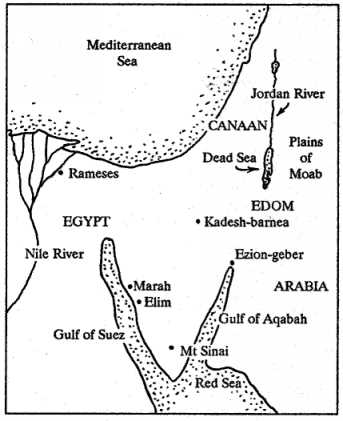
Having crossed the Red Sea, the Israelites headed through the semi-barren countryside for Mt Sinai. They complained constantly, sometimes because they had no water (Exo 15:23-25; Exo 17:2-3), other times because they had no food (Exo 16:2-3). In each case God enabled Moses to satisfy their needs. He also answered Moses’ prayer in giving victory over some raiding Amalekites (Exo 17:8-13).
When Jethro met Moses on the journey, he quickly saw that the heavy burden of leading the people was wearing Moses out. People brought even their minor personal disputes to Moses for his judgment (Exo 18:13-18). Jethro suggested that Moses share the load by appointing others to judge lesser cases, leaving Moses to judge only the more difficult ones. Moses heeded Jethro’s advice, and so took the first steps in organizing the administration of Israel (Exo 18:19-27).
Jethro returned home, and the Israelites moved on to Mt Sinai. They remained there for the next year (Exo 19:1; Num 10:11), during which God prepared them for the life that lay ahead for them as an independent nation under his lordship.
There now had to be some recognized standard for the recently appointed officials to administer. God therefore gave the basic principles of the law in the form of ten simple commandments (Exo 20:1-17), which were probably the principles Moses had been using as his standard all the time. The miscellaneous laws collected in the remainder of Exodus, and in the books of Leviticus, Numbers and Deuteronomy, were based on these principles. As Moses judged the cases brought before him, the people accepted his decisions as having the authority of God. Many of these decisions became the basis of laws for the future (Exo 18:16; Num 15:32-40; Num 27:5-11; see LAW).
Mediator of the covenant
God then formally established his covenant with Israel in a ceremony at Mt Sinai. Moses, who acted as the mediator or go-between, announced God’s covenant commands to the people, and the people declared their willingness to obey. Moses sealed the covenant by blood, sprinkling half of it on the people and half of it against the altar (representing God) (Exo 24:3-8; see COVENANT). He took the leaders of the people with him up into the mountain, where they saw the glory of God, but Moses alone entered God’s presence. He remained there about six weeks and received God’s directions for the construction of the tabernacle and the institution of the priesthood (Exo 24:9-18; Exo 25:40).
While Moses was absent on the mountain, the Israelites built an idol. God told Moses he would destroy the nation and build it afresh, using Moses as the new ‘father’. Moses, thinking more of God’s glory than his own fame, successfully pleaded with God not to destroy the people (Exo 32:11-14). Nevertheless, God could not ignore Israel’s sin. When he allowed a limited judgment to fall upon the people, Moses again pleaded for them, even offering to die on their behalf (Exo 32:30-34).
In response to God’s statement that he would not go to Canaan with such a rebellious people, Moses again pleaded for them. Once more God answered Moses’ prayer, this time promising Moses his presence (Exo 33:1-3; Exo 33:12-16). This encouraged Moses to ask even more. He asked for a greater understanding of the nature of God, and God replied by revealing to him more of his character and glory (Exo 33:17-23). This revelation took place when Moses returned to the mountain to receive fresh copies of the law (Exo 34:1-9). His face became so dazzling because of his meeting with God that on certain occasions he had to cover it with a cloth (Exo 34:28-35; 2Co 3:7-18).
A patient leader
Moses’ gracious response to Israel’s disgraceful behaviour, both on the journey from Egypt and at Mt Sinai, showed that although he was a strong and decisive leader, he was not hot-headed or self-assertive. He was a humble man (Num 12:3), whose patience was demonstrated constantly.
After the fatal judgment on Aaron’s rebellious sons Nadab and Abihu (Num 10:1-2), the other two sons thought it better to burn their portion of the sacrifice in sorrow than to eat it. Their action was wrong, but it came from good motives. Moses, with understanding and sympathy, saw this and so said no more (Lev 10:16-20). In a later case of wilful blasphemy, and in another of deliberate disobedience to God’s law, Moses refused to act hastily. In both cases he waited for God to show him how to deal with the offenders (Lev 24:12; Num 15:34).
When Moses married a Cushite woman (his first wife had apparently died), Miriam and Aaron criticized him. The real reason for their attack, however, was their jealousy of Moses’ leadership. Though Moses made no effort to defend himself, God rebuked Miriam and Aaron. Again Moses showed his forgiving spirit by asking God’s mercy on his critics (Num 12:1-13). His generous nature was shown also on a previous occasion, when Joshua had wanted to protect Moses’ status as a prophet by stopping others from prophesying. Moses replied that he wished all God’s people were prophets (Num 11:27-29).
After the people’s refusal to accept Joshua and Caleb’s report and move ahead into Canaan, God again threatened to destroy the nation and rebuild it through Moses. Once more Moses prayed earnestly that God would forgive the people (Num 14:11-19). Although God did not destroy the people, he refused to allow the unbelieving adult generation to enter Canaan. Israel would therefore remain in the wilderness forty years, till the former generation had passed away and a new had grown up to replace it. Only then would Israel enter the promised land (Num 14:26-35).
Some time later there was a widespread rebellion against Moses and Aaron, headed by Korah, Dathan and Abiram. As usual Moses left the matter with God rather than take action to defend himself (Num 16:4-5). In righteous anger God threatened the rebellious nation with destruction, but again Moses prayed for them (Num 16:20-24; Num 16:44-48).
The one occasion on which Moses lost his temper with the people was at Meribah. By his rash words and disobedient actions he misrepresented God before the people and brought God’s judgment upon himself. Because of his position of leadership, the cost of his failure was high. God punished him by not allowing him to enter Canaan (Num 20:10-13; Psa 106:32-33).
Later events
About forty years after Israel left Egypt, the new generation prepared to enter Canaan. During a long detour that Israel was forced to make around Edom, Aaron died (Num 20:21-29). As the people of Israel moved north, they conquered large areas of good land east of Jordan, with the result that two and a half tribes asked to settle there instead of in Canaan. This at first worried Moses, because it seemed they were repeating the unbelief of their forefathers. He showed that he was fair and reasonable by agreeing to the two and a half tribes’ proposal to help conquer Canaan first and then return to settle east (Num 32:6-8; Num 32:20-23).
When sexual immorality and foreign religious practices threatened Israel at this time, Moses took decisive action (Numbers 31). He also conducted a census, for the double purpose of determining Israel’s military strength for the attack on Canaan and making arrangements for the division of the land (Num 26:1-2; Num 26:54-56).
Moses showed no bitterness at being refused entry into the land, but was concerned only that Israel have a godly leader (Num 27:12-17; cf. Deu 3:23-28). That leader was to be Joshua, though Joshua would not have the absolute authority that Moses had. Civil and religious leadership were to be separated. Joshua would not, like Moses, speak with God face to face, but would receive God’s instructions through the high priest (Num 27:18-21; cf. Deu 31:7-8; Deu 31:14; Deu 31:23; Deu 34:9-12).
During the remaining weeks before he died, Moses repeated the law for the sake of the new generation that had grown up since the first giving of the law at Sinai. This teaching, recorded in the book of Deuteronomy, was in the style of the preacher rather than the lawgiver. It was an exposition of the law rather than a straight repetition (Deu 10:12-22; see DEUTERONOMY).
Moses was a prophet, one who brought God’s message to the people of his time, and this was well demonstrated in his final messages to his people (Deu 18:18; cf. Deu 6:1-9). He wanted the people to remind themselves constantly of the law’s requirements by memorizing a song he had written for them (Deu 31:30; Deu 32:44-46) and by conducting periodic readings of the law (Deu 31:10-12).
Shortly before he died, Moses announced his prophetic blessings on the various tribes of Israel (Deuteronomy 33). According to the permission God had given him earlier, Moses then climbed the peak (Pisgah) of Mt Nebo in the Abarim Range to view the magnificent land his people were to possess. He died at the age of 120 and was buried in the territory east of Jordan (Deu 34:1-8).
Moses’ writings
Throughout his time as Israel’s leader, Moses was busy as a writer. When Israel escaped from Egypt, he wrote a song celebrating the overthrow of the enemy at the Red Sea (Exo 15:1), and he recorded Israel’s subsequent conflict with Amalek (Exo 17:14). In the initial covenant ceremony at Sinai, he wrote God’s commandments in a book (Exo 24:4), and added further writings when the covenant was renewed a few weeks later (Exo 34:27). He kept a full record of the stages of Israel’s journey from Egypt to Canaan (Num 33:1-2).
When he repeated and expounded the law for the new generation that was about to enter Canaan, Moses recorded his teaching in a book, which was then kept safely inside the tabernacle (Deu 31:9; Deu 31:24-25). At this time he also wrote a song (Deu 31:22; Deu 31:30). Another song credited to him has been collected in the book of Psalms (Psalms 90).
From the time of Israel’s settlement in Canaan, people regarded Moses as the writer of the law (Jos 8:31; 2Ch 34:14; Neh 8:1; Mar 12:19; Mar 12:26). Over the years it became common practice to use the name ‘Moses’ as a title for Israel’s law in general (Luk 5:14; Act 6:11; Act 6:13; Act 15:1), and as an overall title for the first five books of the Bible (Luk 16:31; Luk 24:27; Joh 5:46-47; Act 15:21; Act 26:22; Act 28:23; see PENTATEUCH). In fact, Moses symbolized all that the old covenant represented in the purposes of God. His greatness in Israel was unchallenged.
Great though Moses was, he was but a servant in God’s vast household. He fulfilled his duty by helping to prepare the way for one who was God’s Son and the world’s Saviour (Mar 9:4-8; Heb 3:2-6).
One of the most important leaders
of the Israelites during the time of the
Old Testament. God used him to give
the people his law, which is often called
“the Law of Moses.”