
Scripture often speaks of gold, silver, brass, of certain sums of money, of purchases made with money, of current money, of money of a certain weight; but we do not observe coined or stamped money till a late period; which makes it probable that the ancient Hebrews took gold and silver only by weight; that they only considered the purity of the metal, and not the stamp. The most ancient commerce was conducted by barter, or exchanging one sort of merchandise for another. One man gave what he could spare to another, who gave him in return part of his superabundance. Afterward, the more precious metals were used in traffic, as a value more generally known and fixed. Lastly, they gave this metal, by public authority, a certain mark, a certain weight, and a certain degree of alloy, to fix its value, and to save buyers and sellers the trouble of weighing and examining the coins. At the siege of Troy in Homer, no reference is made to gold or silver coined; but the value of things is estimated by the number of oxen they were worth. For instance: they bought wine, by exchanging oxen, slaves, skins, iron, &c: for it. When the Greeks first used money, it was only little pieces of iron or copper, called oboli or spits, of which a handful was a drachma, says Plutarch. Herodotus thinks that the Lydians were the first that stamped money of gold or silver, and introduced it into commerce. Others say it was Ishon, king of Thessaly, a son of Deucalion. Others ascribe this honour to Erichthonius, who had been educated by the daughters of Cecrops, king of Athens: others, again, to Phidon, king of Argos. Among the Persians it is said Darius, son of Hystaspes, first coined golden money. Lycurgus banished gold and silver from his commonwealth of Lacedaemon, and only allowed a rude sort of money, made of iron. Janus, or rather the kings of Rome, made a kind of gross money of copper, having on one side the double face of Janus, on the other the prow of a ship. We find nothing concerning the money of the Egyptians, Phenicians, Arabians, or Syrians, before Alexander the Great. In China, to this day, they stamp no money of gold or silver, but only of copper. Gold and silver pass as merchandise. If gold or silver be offered, they take it and pay it by weight, as other goods: so that they are obliged to cut it into pieces with shears for that purpose, and they carry a steel yard at their girdles to weigh it.
But to return to the Hebrews. Abraham weighed out four hundred shekels of silver, to purchase Sarah’s tomb, Gen 23:15-16; and Scripture observes that he paid this in “current money with the merchant.” Joseph was sold by his brethren to the Midianites for twenty pieces (in Hebrew twenty shekels) of silver, Gen 37:28. The brethren of Joseph bring back with them into Egypt the money they found in their sacks, in the same weight as before, Gen 43:21. The bracelets that Eliezer gave Rebekah weighed ten shekels, and the ear rings two shekels, Gen 24:22. Moses ordered that the weight of five hundred shekels of myrrh, and two hundred and fifty shekels of cinnamon, of the weight of the sanctuary, should be taken, to make the perfume which was to be burnt to the Lord on the golden altar, Exo 30:24. He acquaints us that the Israelites offered for the works of the tabernacle seventy-two thousand talents of brass, Exo 38:29. We read, in the books of Samuel, that the weight of Absalom’s hair was two hundred shekels of the ordinary weight, or of the king’s weight, 2Sa 14:26. Isa 46:6, describes the wicked as weighing silver in a balance, to make an idol of it; and Jer 32:10, weighs seventeen pieces of silver in a pair of scales, to pay for a field he had bought. Isaiah says, “Come, buy wine and milk without money and without price. Wherefore do ye weigh money for that which is not bread?” Amo 8:5, represents the merchants as encouraging one another to make the ephah small, wherewith to sell, and the shekel great, wherewith to buy, and to falsify the balances by deceit.
In all these passages three things only are mentioned:
1. The metal, that is, gold or silver, and never copper, that not being used in traffic as money.
2. The weight, a talent, a shekel, a gerah or obolus, the weight of the sanctuary, and the king’s weight.
3. The alloy (standard) of pure or fine gold and silver, and of good quality, as received by the merchant. The impression of the coinage is not referred to; but it is said they weighed the silver, or other commodities, by the shekel and by the talent. This shekel, therefore, and this talent, were not fixed and determined pieces of money, but weights applied to things used in commerce. Hence those deceitful balances of the merchants, who would increase the shekel, that is, would augment the weight by which they weighed the gold and silver they were to receive, that they might have a greater quantity than was their due; hence the weight of the sanctuary, the standard of which was preserved in the temple to prevent fraud; hence those prohibitions in the law, “Thou shalt not have in thy bag divers weights,” in Hebrew, stones, “a great and a small,” Deu 25:13; hence those scales that the Hebrews wore at their girdles, Hos 12:7, and the Canaanites carried in their hands, to weigh the gold and silver which they received in payment. It is true that in the Hebrew we find Jacob bought a field for a hundred kesitahs, Gen 33:19; and that the friends of Job, after his recovery, gave to that model of patience each a kesitah, and a golden pendant for the ears, Job 42:11. We also find there darics, (in Hebrew, darcmonim or adarcmonim,) and mina, staterae, oboli; but this last kind of money was foreign, and is put for other terms, which in the Hebrew only signifies the weight of the metal. The kesitah is not well known to us; some take it for a sheep or a lamb; others, for a kind of money, having the impression of a lamb or a sheep; but it was more probably a purse of money. The darcmonim or darics are money of the kings of Persia; and it is agreed that Darius, son of Hystaspes, first coined golden money. Eze 45:12, tells us that the mina makes fifty shekels: he reduces this foreign money to the weight of the Hebrews. The mina might probably be a Persian money originally, and adopted by the Greeks and by the Hebrews. But under the dominion of the Persians, the Hebrews were hardly at liberty to coin money of their own, being in subjection to those princes, and very low in their own country. They were still less able under the Chaldeans, during the Babylonish captivity; or afterward under the Grecians, to whom they were subject till the time of Simon Maccabaeus, to whom Antiochus Sidetes, king of Syria, granted the privilege of coining money in Judea, 1Ma 15:6. And this is the first Hebrew money, properly so called, that we know of. There were shekels and demi-shekels, also the third part of a shekel, and a quarter of a shekel, of silver.
The shekel of silver, or the silverling, Isa 7:23, originally weighed three hundred and twenty barleycorns; but it was afterward increased to three hundred and eighty-four barleycorns, its value being considered equal to four Roman denarii, was two shillings and seven pence, or according to Bishop Cumberland, two shillings and four pence farthing. It is said to have had Aaron’s rod on the one side, and the pot of manna on the other. The bekah was equal to half a shekel, Exo 38:26. The denarius was one- fourth of a shekel, seven pence three farthings of our money. The gerah, or meah, Exo 30:13, was the sixth part of the denarius, or diner, and the twenty-fourth part of the shekel. The assar, or assarion, Mat 10:29, was the ninety-sixth part of a shekel: its value was rather more than a farthing. The farthing, Mat 5:26, was in value the thirteenth part of a penny sterling. The mite was the half of a farthing, or the twenty-sixth part of a penny sterling. The mina, or maneh, Eze 45:12, was equal to sixty shekels, which, taken at two shillings and seven pence, was seven pounds fifteen shillings. The talent was fifty minas; and its value, therefore, three hundred and eighty-seven pounds ten shillings. The gold coins were as follows; a shekel of gold was about fourteen and a half times the value of silver, that is, one pound seventeen shillings and five pence halfpenny. A talent of gold consisted of three thousand shekels. The drachma was equal to a Roman denarius, or seven pence three farthings of our money. The didrachma, or tribute money, Mat 17:24, was equal to fifteen pence halfpenny. It is said to have been stamped with a harp on one side, and a vine on the other. The stater, or piece of money which Peter found in the fish’s mouth, Mat 17:27, was two half shekels. A daric, dram, 1Ch 29:7; Ezr 8:27, was a gold coin struck by Darius the Mede. According to Parkhurst its value was one pound five shillings. A gold penny is stated by Lightfoot to have been equal to twenty-five silver pence.
Hug derives a satisfactory argument for the veracity of the Gospels from the different kinds of money mentioned in them:—The admixture of foreign manners and constitutions proceeded through numberless circumstances of life. Take, for example, the circulation of coin; at one time it is Greek coin; at another, Roman; at another time ancient Jewish. But how accurately is even this stated according to history, and the arrangement of things! The ancient imposts which were introduced before the Roman dominion were valued according to the Greek coinage; for example, the taxes of the temple, the
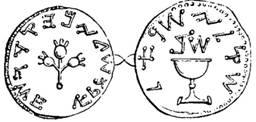
Fig. 256—Jewish Coin
This term is used to denote whatever commodity the inhabitants of any country may have agreed or are compelled to receive as an equivalent for their labor, and in exchange for other commodities.
Different commodities have been used as money in the primitive state of society in all countries, such as skins, cattle, corn, dried fish, sugar, and salt. A long period of time must have intervened between the first introduction of the precious metals into commerce, and their becoming generally used as money. The peculiar qualities which so eminently fit them for this purpose would only be gradually discovered. They would probably be first introduced in their gross and unpurified state. A sheep, an ox, a certain quantity of corn, or any other article, would afterwards be bartered or exchanged for pieces of gold or silver in bars or ingots, in the same way as they would formerly have been exchanged for iron, copper, cloth, or anything else. The merchants would soon begin to estimate their proper value, and, in effecting exchanges, would first agree upon the quality of the metal to be given, and then the quantity which its possessor had become bound to pay would be ascertained by weight. This, according to Aristotle and Pliny, was the manner in which the precious metals were originally exchanged in Greece and Italy. The same practice is still observed in different countries. In many parts of China and Abyssinia the value of gold and silver is always ascertained by weight. Iron was the first money of the Lacedemonians, and copper of the Romans.
In the sacred writings there is frequent mention of gold, silver, and brass, sums of money, purchases made with money, current money, and money of a certain weight. Indeed, the money of Scripture is all estimated by weight. ’Abraham weighed to Ephron the silver which he had named in the audience of the sons of Heth, four hundred shekels of silver, current money with the merchant’ (Gen 23:19). The brethren of Joseph carried back into Egypt the money ’in full weight’ which they had found in their sacks (Gen 43:21; see also Gen 24:22; Jer 32:9; Amo 8:5; Deu 25:13). It was customary for the Jews to have scales attached to their girdles for weighing the gold and silver they received; but the Canaanites carried them in their hands.
There is no direct allusion in the sacred writings to coined money as belonging to the Jewish nation. In Gen 33:19, Jacob is said to have bought a part of a field ’for an hundred pieces of money;’ and the friends of Job are said to have given him each ’a piece of money’ (Job 42:11). The term in the original is kesitoth, and is by some thought to denote ’sheep’ or ’lamb;’ by others a kind of money having the impression of a sheep or lamb; and by others again a purse of money. The most correct translation may be presumed to be that which favors the idea of a piece of money bearing some stamp or mark indicating that it was of the value of a sheep or lamb. Maurice, in his Antiquities of India (vol. 7), bears testimony to the fact that the earliest coins were stamped with the figure of an ox or sheep. In the British Museum there is a specimen of the original Roman As, the surface of which is nearly the size of a brick, with the figure of a bull impressed upon it. Other devices would suggest themselves to different nations as arising out of, or connected with, particular places or circumstances, as the Babylonish lion, Ægina’s tortoise, Bœotia’s shield, the lyre of Mitylene, the wheat of Metapontum. Religion would also at an early period claim to be distinguished, and accordingly the effigies of Juno, Diana, Ceres, Jove, Hercules, Apollo, Bacchus, Pluto, Neptune, and many other of the heathen deities are found impressed upon the early coins. The Jews, however, were the worshippers of the one only true God; idolatry was strictly forbidden in their law; and therefore their shekel never bore a head, but was impressed simply with the almond rod and the pot of manna.
The first Roman coinage took place, according to Pliny (Hist. Nat. xxxiii. 3), in the reign of Serving Tullius, about 550 years before Christ; but it was not until Alexander of Macedon had subdued the Persian monarchy, and Julius Caesar had consolidated the Roman Empire, that the image of a living ruler was permitted to be stamped upon the coins. Previous to that period heroes and deities alone gave currency to the money of imperial Rome.
Antiochus Sidetes, king of Syria, is represented to have granted to Simon Maccabeus the privilege of coining money in Judea (1Ma 15:6). This is considered to be the first mention of Hebrew money, properly so called. It consisted of shekels and demi-shekels, the third part of a shekel, and the quarter of a shekel, of silver.
From the time of Julius Caesar, who first struck a living portrait on his coins, the Roman coins run in a continued succession of so-called Caesars, their queens and crown-princes, from about B.C. 48 down to Romulus Augustulus, emperor of the West, who was dethroned by Odoacer about A.D. 475.
After its subjugation by Rome much foreign money found its way into the land of Judea. The piece of tribute money, or coin mentioned in Luk 20:24, as presented to our Savior, bore the image and superscription of the Roman emperor, and it is reasonable to suppose that a large quantity of Roman coins was at that time in circulation throughout Judea.
Was anciently weighed, and did not at first exist in the form of coins. The most ancient commerce was conducted by barter, or exchanging one sort of merchandise for another. One man gave what he could spare to another, who gave him in return part of his superabundance. Afterwards, the more precious metals were used in traffic, as a value more generally known and stated, and the amount agreed upon was paid over by weight, Gen 23:16 43:21 Exo 30:24 . Lastly they gave this metal, a certain weight, and a certain degree of alloy, to fix its value, and to save buyers and sellers the trouble of weighing and examining the coins. The first regular coinage among the Jews is supposed to have been in the time of Simon Maccabaeus, less than a century and a half before Christ. The coins were the shekel, and a half, a third, and a quarter of a shekel. The Jewish coins bore an almond rod and a vase of manna, but no image of any man was allowed. Compare Mat 22:16-22 . Many Greek and Roman coins circulated in Judea in New Testament times. See MITE, PENNY, SHEKEL.\par Volney says, "The practice of weighing money is general in Syria, Egypt, and all Turkey. No piece, however effaced, is refused there: the merchant draws out his scales and weighs it, as in the days of Abraham, when he purchased his sepulchre. In considerable payments, an agent of exchange is sent for, who counts paras by thousands, rejects pieces of false money, and weighs all the sequins, either separately or together." This may serve to illustrate the phrase, "current money with the merchant," Gen 23:16 ; and the references to "divers weights" —a large one to weigh the money received, and a small one for that paid out; and to "wicked balances," Deu 25:13 1Sa 8:5 Mic 6:11 . Our Savior alludes to a class of "exchangers," who appear to have taken money on deposit, and so used it that the owner might afterwards receive his own with interest, Mat 25:27 . There were also money brokers who had stands in the outer court of the temple, probably to exchange foreign for Jewish coins; and to accommodate those who wished to pay the yearly half-shekel tax, Exo 30:15, or to present an offering. They were expelled by the Lord of the temple, not only for obtruding a secular business within the house of prayer, but also for pursuing it dishonestly, Mar 11:15-17 .\par In 1Ti 6:10, Paul speaks of the "love of money" as a root of all evils; censuring not money itself, but the love of it—a prevailing form of human selfishness and covetousness. This passion, to which so many crimes are chargeable, may infest the heart of a poor man as well as that of the rich; for the one may have as much of "the love of money" as the other.\par
Money.
1. Uncoined money. -- It is well known that ancient nations, that were without a coinage, weighed the precious metals, a practice represented on the Egyptian monuments, on which gold and silver are shown to have been kept in the form of rings. We have no evidence of the use of coined money, before the return from the Babylonian captivity; but silver was used for money, in quantities determined by weight, at least as early as the time of Abraham; and its earliest mention is in the generic sense of the price paid for a slave. Gen 17:13.
The 1000 pieces of silver, paid by Abimelech to Abraham, Gen 20:16, and the 20 pieces of silver, for which Joseph was sold to the Ishmaelites, Gen 37:28, were probably rings such as we see on the Egyptian monuments, in the act of being weighed.
In the first recorded transaction of commerce, the cave of Machpelah is purchased by Abraham for 400 shekels of silver. The shekel weight of silver was the unit of value through the whole age of Hebrew history, down to the Babylonian captivity.
2. Coined money. -- After the captivity, we have the earliest mention of coined money, in allusion, as might have been expected, to the Persian coinage, the gold daric, (Authorized version, dram). Ezr 2:69; Ezr 8:27; Neh 7:70-72. See Daric.
No native Jewish coinage appears to have existed till Antiochus VII. Sidetes granted Simon Maccabaeus, the license to coin money, B.C. 140; and it is now generally agreed that the oldest Jewish silver coins belong to this period. They are shekels and half-shekels, of the weight of 220 and 110 grains. With this silver, there was associated a copper coinage.
The abundant money of Herod the Great, which is of a thoroughly Greek character, and of copper only, seems to have been a continuation of the copper coinage of the Maccabees, with some adaptation to the Roman standard. In the money of the New Testament, we see the native copper coinage, side by side with the Graeco-Roman copper, silver and gold.
(The first coined money mentioned in the Bible refers to the Persian coinage, 1Ch 29:7; Ezr 2:69, and translated dram. It is the Persian daric, a gold coin worth about $5.50. The coins mentioned by the evangelists, and first those of silver, are the following: The stater, Mat 17:24-27, called piece of money, was a Roman coin equal to four drachmas. It was worth 55 to 60 cents, and is of about the same value as the Jewish stater, or coined shekel.
The denarius, or Roman penny, as well as the Greek drachma, then of about the same weight, are spoken of as current coins. Mat 22:15-21; Luk 20:19-25. They were worth about 15 cents. Of copper coins, the farthing and its half, the mite, are spoken of, and these probably formed the chief native currency.
(The Roman farthing, (quadrans), was a brass coin worth.375 of a cent. The Greek, farthing (as or assarion), was worth four Roman farthings, that is, about one cent and a half. A mite was half a farthing, and therefore, was worth about two-tenths of a cent if the half of the Roman farthing, and about 2 cents if the half of the Greek farthing. See Table of Jewish Weights and Measures. -- Editor).
No coined money is mentioned in the Bible before Ezra’a time , when other evidence also exists of its having been current in Palestine.
"Shekel" previously meant a weight, not a coinage. The "thousand pieces of silver" which Abimelech gave Abraham (Gen 20:16) were of this kind; so the 400 shekels "weighed" by Abraham to Ephron (Gen 23:3; Gen 23:9; Gen 23:16), "current (money) with the merchant"; implying that the silver was in some conventional shapes, with a rude sign to mark its weight. The "weighing" however implies that this currency did not bear the stamp of authority, and so needed weighing for barter. Jacob paid 100
Joseph’s brethren received their money "in full weight" (Gen 43:21). Silver money alone was used, the standard shekel weight being kept in the sanctuary under charge of the priests, from whence arose the phrase "the shekel of the sanctuary" (Exo 30:18). The wedge or tongue of gold that Achan took was not money probably, as the 200 shekels of silver were, but an article of value used for costly ornamentation. In Isa 46:6, however, gold seems to mean uncoined money, "they lavish gold out of the purse (’bag’), and weigh silver in the balance." The Attic talent was the standard one under Alexander, and subsequently down to Roman times; the drachma however becoming depreciated from 67.5 or 65.5 grains under Alexandra to 55 under the early Ceasars; the Roman coinage, gold and silver, in weights was conformed to the Greek, and the denarius the chief silver coin was equivalent to the then depreciated Attic drachma.
Antiochus VII granted Simon the Maccabee permission to coin money with his own stamp, the first recorded coining of Jewish money (1Ma 15:6; 140 B.C.); inscribed "shekel of Israel"; a vase, possibly the pot of manna, and the Hebrew letter
The Alexandrian Jews adopted for "shekel" the term didrachma, the coin corresponding to it in weight. But as two drachmas each (1 shilling, 3 pence) was the ransom "tribute" (as the Greek
Copper coins of Herod are extant in abundance, as the "farthing" of the New Testament, a piece of brass or copper (
Tiberius’ passion for augury and astrology suggested the augur’s lithus. A Lydian coin extant mentions the Asiarchs, "chief of Asia" (Act 19:31). A coin of Ephesus mentions its "town clerk"; also another its temple and statue of Diana. A coin of Domitian records rich Laodicea’s restoration by its citizens after an earthquake which also destroyed Colessae and Hierapolis, which accounts for their omission in the addresses in Revelation. Coins exist of the time of Judea’s revolt from Rome, inscribed with "the liberty of Zion," a vine stalk, leaf, and tendril. The famous Roman coin (see p. 405), struck after Titus took Jerusalem, has the legend Judaea Capta, with a female" sitting on the ground desolate" (fulfilling Isa 3:26) under a palm tree. Also a Greek coin has Titus’ head, and the legend "the emperor Titus Caesar"; reverse, Victory writing on a shield, before her a palm. The Attic talent (the one current in New Testament period) had 100 drachmas, the drachma being = 7 3/4d.; the mina was 3 British pounds, 4 shillings, 7 pence, and the talent 193 British pounds, 15 shillings.
The talent was not a coin but a sum. The Hebrew talent = 3,000 shekels, or 375 British pounds (about the weight of the Aegina talent), for 603,550 persons paid 100 talents and 1,775 shekels of silver, i.e., as each paid a half shekel, 301,775 whole shekels; so that 100 talents contained 300,000 shekels. The gold talent was 100
Money. Gen 17:12. This word occurs about 130 times in the A. V., and represents three Hebrew words: keseph or k’saph occurring most frequently (about 110 times) in historical books, only a few times in the poetical books, as Psa 15:5; Pro 7:20; Lam 5:4. Two other Hebrew words, qesitah and qinyon, also appear early in the Old Testament, Gen 33:19; Lev 22:11. Money also represents six Greek words in the New Testament: argurion, meaning "silver," Mat 25:18; kerma, a small coin, Joh 2:15; nomisma, meaning possibly "legal coin," Mat 22:19; chalkos, a copper coin, Mar 6:8; chrema, Act 8:18, and stater, rendered "shekel"in the R. V., equal to 24 drachmas. Mat 17:27. Coined money, as now in use among civilized nations, was unknown in the world until about six hundred years before Christ. The Assyrians, Babylonians, and Egyptians had no coins until about b.c. 300. David and Solomon never saw any coined money. The Jews had none until the time of the Maccabees, about b.c. 139. Before the periods named, gold and silver were used as money by weight; and are now so used in some eastern countries. The first mention of money is in the touching story of Abraham’s buying a burial place for his wife. It is said, "Abraham weighed the silver, four hundred shekels, current with the merchant." (Jen. 23:4-16. It appears to have been then in general use. The study of ancient coined money is interesting, showing the rise of the arts and their fall during the dark ages of priestcraft, from the fourth to the fifteenth centuries; the coins of 400 years before Christ being superb, while those a thousand years after Christ are hardly discernible. The early coins show, not only the likenesses of kings and emperors, but also many of the most important events of their reigns. For the corns mentioned in the Bible, see Shekel, Penny, Farthing.
Mention is made of money as early as Gen 17:12-13, where persons are said to be ’bought with money;’ and from Genesis to Zechariah it is spoken of as being not counted, but weighed, which would give the true value of the precious metals in the form of rings or in odd pieces of gold or silver. The names Gerah, Bekah, Shekel, Maneh, and Talent, being used for weights as well as money, the two are better considered together. See WEIGHTS AND MEASURES.
On the return of the Jews, B.C. 536, Persian money was used by them. This would be followed by Greek money when they were under the dominion of the Greeks. Antiochus VII about B.C. 140, granted permission to Simon Maccabeus to coin Jewish money. Shekels were coined bearing a pot of manna and an almond rod. Under the Romans, Roman money was used.
MONEY.—We propose to treat first of money in general as referred to in the Gospels, and afterwards of the definite sums or coins which are there named.
I. Money in General.—In the Authorized Version six Greek words are rendered ‘money,’ ‘tribute money,’ or ‘piece of money.’ In two cases this is a mistranslation, and is rectified by the Revised Version NT 1881, OT 1885 . The words are as follows: 1.
To the above words used for money in general (though under slightly different aspects) may be added the comprehensive description of money in Mat 10:9 in terms of the three metals used as specie—gold, silver, and brass (or copper). This verse may be taken as evidence that gold as well as silver and copper coins circulated in Palestine in the time of our Lord, although no gold coin is mentioned in the Gospels. The current gold coin was doubtless the Roman aureus, frequently referred to in the Mishna as a golden denarius. In silver there was more variety. The Roman denarius was, of course, largely, in evidence, and was probably the silver coin in most common use. But there were also coins of larger size, bearing Greek names. When Pompey made Syria a Roman province (b.c. 65), he found in circulation tetradrachms of two different kinds. There were those issued chiefly from Antioch by the Seleucid kings on the Attic standard, weighing 262 grains troy. There were also those issued by the semi-autonomous cities of Phœnicia on the Phœnician standard of 224 grains to the tetradrachm. Tetradrachms of both standards were recognized by Pompey as equivalent to four denarii (Mommsen, Gesch. des Röm. Münzwesens, 36, 715). Both would still be lawful coin in the time of our Lord, though, as Mommsen surmises (ib. 72), the heavier royal tetradrachms would tend to be driven out of circulation by the lighter Phœnician coins, which, besides, as corresponding exactly to the Hebrew shekel, were in special demand in Palestine for religious purposes (see below, under ‘Didrachm’). The supply of silver from the mints at Tyre and Sidon, which continued to issue tetradrachms and didrachms under the Emperors,*
A vexed question, which cannot be held to be yet decided, is whether prior to the time of the first Jewish revolt any silver coins had been produced in Palestine itself. Until lately it has been usual for numismatologists to assign to Simon Meccabaeus certain silver shekels and half-shekels struck on the Phœnician standard, and bearing the inscription in Hebrew, ‘Jerusalem the Holy’ (Madden, Coins of the Jews, 65–71; Head, Hist. Num. 681, 682). Strong historical reasons, however, have been brought by Schürer (HJP
On the other hand, the supply of copper money must have been almost, if not quite, exclusively of native production. There were the copper coins of the Hasmonaean princes, those of the various Herods, and those which had been struck since a.d. 6 by successive procurators of Judaea. Unlike the foreign silver money, they have, in deference to Jewish feeling, no Imperial effigy or the likeness of any living thing; even those of the procurators have only the name of the reigning Emperor, and innocent ears of corn, palm-trees, lilies, and the like. As to their denomination we have no sure evidence. Schürer holds that the Romans imposed their monetary standard more rigorously in Palestine than elsewhere, and that even the Herodian coins followed the Roman system (HJP
Before proceeding to speak in detail of the coins named in the Gospels, it will be well to give in tabular form the main elements of the two systems, the Greek and the Roman, which obtained concurrently in Palestine at the time of our Lord. For convenience of reference the average value in sterling money is put opposite the larger sums.
Greek system. |
1 Talent (£240) | = | 60 Minas. |
1 Mina (£4) | = | 100 Drachms |
1 Drachm (9½d.) | = | 6 Obols. |
1 Obol | = | 8 Chalki. |
(To this system belong also the stater of four, and the didrachm of two, drachms and the lepton, whose relation to the chalkus is uncertain. See below, under ‘Lepton’).
Roman system. |
1 Aureus (£1) | = | 25 Denarii. |
1 Denarius (9½d) | = | 16 Asses. |
1 As. | = | 4 Quadrantes. |
The point of connexion between the two systems is found in the identification of the Roman denarius with the Attic drachm. This identification was rendered easy by the fact that at the time when Rome began her career of conquest in the East the drachm of the Attic standard had fallen to a weight which only slightly exceeded that of the denarius; but there can be little doubt that it was made deliberately by the Romans as a matter of policy. Alexander the Great had made the Attic drachm the unit of his Imperial coinage, which he imposed upon all the lands he had conquered; and in adopting the Alexandrine drachm as equal to their own denarius, the Romans wished to indicate that they served themselves heirs to his kingdom in the East (Mommsen, op. cit. 691). In imperial times the identification was so completely established that Hellenistic writers regularly refer to the denarius as ‘the Attic drachm.’ This identification enables us to assign values to those coins which follow the Greek system. The weight of the gold aureus is known, and its value admits of easy calculation (see Hasting’s Dictionary of the Bible iii. 427), and the other values, as given above, follow at once. This method of ascertaining the value of the silver coins of the Gospels does justice to the fact that, in the Roman Empire then, as in Britain now, the value of silver coins was legally defined in terms of the gold standard.
II. Definite sums of money and coins mentioned in the gospels.—These may most conveniently be treated of under three heads: money of account, silver coins, and copper coins.
(i.) Money of account.—Two sums of money, to which no actual coin corresponded, receive a special name in the Gospels. These are the talent and the mina.
1. Talent (
The talent is mentioned twice by our Lord. In the parable of the Unmerciful Servant (Mat 18:23-35) the one servant owes the king 10,000 talents, or nearly two-and-a-half millions of our money—an enormous sum, of which the 100 denarii (= £4) owed him by his fellow-servant represents but an insignificant fraction (1/6000). It may be remarked that the juxtaposition in this parable of the talent and the denarius is a confirmation of the view that it is the Attic talent that is meant). In the parable of the Talents (Mat 25:14-30) the master intrusts his capital of eight talents or £1920 to his three servants in sums of £1200, £480, and £240 respectively. It will be seen that even he who received but one talent had yet quite a respectable capital to trade with, so that the excuse which is sometimes made by commentators on his behalf, viz. that he was discouraged by the smallness of the sum committed to him, is as little valid as that which he offered for himself. The real reason for his conduct was, of course, just his slothfulness.
2. Mina (
The only mention of this sum in the Gospels is in the parable of the Pounds (Luk 19:12-27), where a nobleman, going to a far country to get a kingdom, gives one mina to each of his ten servants, bidding them trade with it till his return. The smallness of the sum in such a connexion is remarkable, especially when compared with the companion parable of the Talents. The explanation (as far as the story is concerned) seems to be that the master is not in this case a trader making provision for the suitable employment of his capital in his absence, but one who, having in prospect the acquisition of a kingdom, desires to test capacity of his servants for high office in that kingdom. Ingenuity and diligence would be more thoroughly tested in multiplying a small sum than a large one.
(ii.) Silver coins.—Of these there are mentioned by name, the denarius, the drachm, the didrachm, and the stater. The ‘piece of money’ of the Authorized Version in Mat 17:27 is the stater, the ‘pieces of silver’ in Luk 15:8 are drachms, while the ‘pieces of silver’ in Mat 26:15 are probably staters, and are discussed under that heading.
1. Denarius (
We find the denarius used in the Gospels for the reckoning of even fairly large sums. Thus in the parable of the Unmerciful Servant (Mat 18:28, see above under ‘Talent’) a sum of 100 denarii is mentioned, while in the parable of the Two Debtors (Luk 7:41) the two debts are stated at 500 and 50 denarii respectively (£20 and £2). In Mar 6:37 = Joh 6:7 the disciples estimate that it would seed bread to the value of at least 200 denarii (£8) to provide for the five thousand. (There is no probability in the suggestion that this figure was named as the amount of money then in ‘the bag.’ It is intended to indicate a sum far beyond the means of the little company). In Mar 14:5 = Joh 12:5 the vase of ointment with which Mary anointed our Lord is valued at 300 denarii (£12). The ‘exceeding costliness’ of this loving tribute is realized when we remember that the sum named represents at least the annual income of a labourer of those days. This appears from the parable of the Labourers in the Vineyard (Mat 20:1-15), where a denarius is evidently looked upon as liberal pay for a day’s work; for we may be quite sure that the employer who dealt so generously with the labourers engaged late in the day had struck no niggardly bargain with those hired in the morning. (A passage which may be quoted in confirmation is To 5:14, where the disguised angel is promised by Tobit a drachm a day—at that time a little less than a denarius—for acting as companion to his son. It is true that this was to be exclusive of his necessary expenses; but, on the other hand, the position was one of trust, and would naturally be more highly remunerated than field labour). In the parable of the Good Samaritan (Luk 10:30-37) two denarii are given to the innkeeper as a reasonable payment in advance for the keep of the wounded traveller for a day or two, to he supplemented if necessary on the return of the Samaritan. (This is the most natural way to explain the reference; see Jülicher, Gleichnisreden, ii. 591. On the other hand, Ramsay in Hasting’s Dictionary of the Bible , Ext. Vol. 394, holds that the two denarii were simply payment for the one night that the two had spent in the inn).
Of special interest is the reference to the denarius in Mat 22:19 = Mar 12:15 = Luk 20:24 in connexion with the Pharisees’ question as to the lawfulness of paying tribute to Caesar. The denarius was ‘the money of the tribute’ (Mat 22:19), all Imperial taxes being payable in terms of it in accordance with a rescript of Germanicus (c.
2. Drachm (
3. Didrachm (
The well-established correspondence of the didrachm to the half-shekel has been obscured for some writers by the fact that the LXX Septuagint regularly translate
In Mat 26:15 Cod. D
(iii.) Copper coins.—There are three copper coins mentioned in the Gospels: the assarion, the kodrantes, and the lepton. The last is translation ‘mite’ in the Authorized and Revised Versions , while the two others are called, without distinction, by the name ‘farthing.’
1. Assarion (
2. Kodrantes (
3. Lepton (
Nevertheless, the statement of Mk. (
The value, then, as men reckon values, of the widow’s gift was little more than a farthing. But the fact that it consisted of two tiny coins,—a fact which we constantly obscure by talking, in our careless way, of ‘the widow’s mite,’—is full of significance. She might have kept back one.†
Literature.—Madden’s Coins of the Jews (vol. ii. of Numismata Orientalia) contains an exhaustive account of all the extant Jewish coins, and an appendix (289–310) on the money of the NT. The subject is treated briefly, but clearly, in Schürer, HJP
Norman Fraser.
By: Emil G. Hirsch, Wilhelm Nowack, Isidore Singer, Lewis N. Dembitz
—Biblical Data:
I. As far back as the history of Israel can be traced, gold and silver were used as standards of value and mediums of exchange, and, as the Egyptian tribute-lists show, they were thus employed in Canaan even before the Israelites inhabited it. The general use of the word "kesef," meaning "silver," to designate money shows that silver was the prevailing medium of exchange. Up to the time of the Exile, and even later, the metals were not coined, but were weighed (Ex. xxii. 16; II Sam. xviii. 12; I Kings xx. 39; see Numismatics). The scales and weights were carried about with the precious metal in a bag attached to the girdle (Deut. xxv. 13 et seq.; Isa. xlvi. 6; Prov. xvi. 11). An adulteration or debasement of the value of the precious metals by means of certain alloys seems not to have occurred; at least the practise was not given any thought, and warnings are uttered only against false measures (Deut. l.c.; Lev. xix. 36).To disprove the opinion that during the whole period before the Exile coined money was unknown—that is, money under state control in regard to weight, purity, etc.—the passage in I Sam. ix. 8 is cited. Here it is related that Saul's slave gave him the fourth part of a shekel of silver, which he had with him. The conclusion, however, that this is a reference to coined money is too hasty. The only inference to be drawn is that at the time when the author of I Sam. ix. lived silver pieces of a certain weight may have existed and that they were cast into certain shapes known to every one, in order to obviate the necessity of weighing them at eachtransaction. Perhaps the name for "talent" ("kikkar" = "ring") is derived from such forms, since Egyptian documents show that it was quite usual to cast the metals into such rings or into bars. These forms were not found among the Assyrians, who, however, used wedge-shaped pieces of gold, which are mentioned in Josh. vii. 21.
The Shekel.
For money, as for weight, the shekel was the standard unit, the pieces of metal being either fractions or multiples of the shekel. The struggle between the Egyptian decimal system and the sexagesimal method of the Babylonians first made itself felt in regard to weights of gold and silver. The Phenicians were probably the mediators; and a mina of 50 shekels was established as a standard. According to certain indications, the relative value of gold to silver was as 10 to 1. Later, in consequence of the great increase in the supply of silver, the relative value was as 40 to 3. This may, perhaps, have affected the possibility of introducing the sexagesimal system.
The gold shekel originally weighed 1/60 of a mina. The silver shekel, to have had an equal value, must have weighed 40/3 x 1/60 = 2/9 of a mina. As this would have been impracticable for use, it was decided to make a smaller piece, one more suitable for circulation. Two methods presented themselves: (1) either the silver equivalent of the gold shekel could be divided into ten parts in which case a silver shekel of 2/90 = 1/45 of a shekel of weight would result; or (2) the silver equivalent could be divided into fifteen parts, in which case a silver shekel would weigh 2/135 of a mina.
The Mina.
When the decimal system made its way into use, the gold mina as well as the silver mina was reckoned at 50 such shekels. Consequently there was (1) the Babylonian silver mina, equivalent to 50/45 = 10/9 of a mina of weight; (2) the Phenician silver mina, equivalent to 100/135 = 20/27 of a mina of weight.
In the earlier system of Babylonian silver values (which was used also in the Lydian and Persian kingdoms) the silver shekel was divided into thirds, sixths, and twelfths, whereas in the Phenician system it was divided into halves, fourths, eighths, etc.
The Phenician silver shekel is found among the Jews also. This is proved by the fact that they had the same method of division: the quartershekel appears in I Sam. ix. 8; the half-shekel is the Temple-tax in the Priestly Code. The shekels of the Maccabean period which have been preserved vary between 14.50 and 14.65 gr., which is exactly 2/135 of the large "common" (see Weights and Measures) Babylonian mina. The mina accordingly weighed 727.7 gr., and the talent 43,659 kg.
The Siglos.
In the Persian period the Babylonian shekel, equivalent to one-tenth of the mina of weight, came into use, since Nehemiah (x. 33 [A. V. 32]) assessed the Temple-tax at one-third of a shekel. This Persian system of coinage had the small mina as a basis. The unit was the siglos, which corresponded to one-half of a Babylonian shekel. The relation between it and the Jewish one was 3 to 8. It was considered as the one-hundredth part of a mina and not the fiftieth. It amounted to 5.61-5.73 gr.; the mina, to 561-573 gr.; and the talent to 33,660-34,380 kg. In the Maccabean period the Phenician silver shekel was again in use. Consequently the Temple-tax was again a half-shekel (Matt. xvii. 24, 27).
II. Coined money did not come into use among the Jews until the time of the Persians. In the Old Testament, Persian darics (A. V. "drams") are mentioned in Ezra viii. 27 and I Chron. xxix. 7 as "adarkon," and in Ezra ii. 69 and Neh. vii. 70-72 as "darkemon. They weighed 8.40 gr., thus corresponding almost exactly to one-sixtieth of the Babylonian light mina. The corresponding silver coin was one-twentieth of the daric; which, perhaps, was meant by the term "shekel" in Neh. v. 15, x. 33. See Numismatics.
Bibliography:
Benzinger, Hebräische Archäologie, pp. 189-198;
Madden, Coins of the Jews, London, 1881;
Nowack, Lehrbuch der Hebräischen Archäologie, 1894;
Herzfeld, Handelsgeschichte der Juden des Alterthums, Brunswick, 1879, pp. 171-185;
F. de Saulcy, Recherches sur la Numismatique Judaïque, 1854;
Levy, Geschichte der Jüdischen Münzen, 1862.
—In Rabbinical Literature:
In conformity with the unvarying usage of the Mosaic law, the Mishnah (B. M. iv. 1) treats both gold and copper coins as commodities when they come to be exchanged for silver coins (see Alienation); but the Gemara upon this section gives a glimpse into the history of the battle of the gold and silver standards, which raged with varying fortunes from the days of Hillel and Shammai, in King Herod's time, to the compilation of the Mishnah by Rabbi. Shammai's leading disciple, R. Ḥiyya, addresses him: "Rabbi, you teach us now in your old age that gold [as a commodity] gives title to silver; but when you were young you taught us the contrary!" In the discussion that follows the Mishnah is referred to (Ma'as. Sh. ii. 7). The school of Shammai says: "A man must not turn shekels into gold denarii [for transport of second tithe to Jerusalem]." The school of Hillel permitted it. The former school seemed to look on gold as a commodity, at least as compared with silver; the latter school was willing, for this purpose, at least, to treat both alike as money, if not to give gold a preference over silver. The Hillelites seemingly yielded to the Roman influence of their time, which maintained the gold standard.
The gold denarius passed generally for twenty-five silver denarii—that is, 6¼ shekels. It is urged in favor of gold as the true money that it was usual in the redemption of the first-born son for the father to give a gold denarius to the kohen, and for the latter to return five zuz, or silver denarii, in change, though the rate of exchange between silver and gold at the time might be such as to make the former worth either more or less than twenty-five of the latter. Another point is made in a responsum by R. Ḥiyya himself, that a loan made in gold may be recovered in gold, though it has risen in exchange value, without violating the law against usury (B. M. 44b-45b). Rabbi, as most of the intervening patriarchs, was one of Hillel's descendants, and naturally followed his teachings. It was probably a change in the Roman currency laws and inthe habits of business which induced him in his later years to reestablish the old silver standard among the Jews.
MONEY
1. Antiquity of a metallic currency: weights and values.—That the precious metals, gold and silver, and to a less extent copper, were the ordinary media of exchange in Palestine from a time long prior to the appearance there of the Hebrews, is now amply attested by evidence from Egypt and Babylonia, and even from the soil of Palestine itself. The predominance of silver as the metal currency for everyday transactions is further shown by the constant use in Hebrew literature of the word for ‘silver’ (keseph) in the sense of ‘money.’
As there can be no question of the existence of coined money in Palestine until the Persian period, the first step in the study of the money of OT is to master the system of weights adopted for the weighing of the precious metals. Money might indeed be ‘told’ or counted, but the accuracy of the ‘tale’ had to be tested by means of the balance; or rather, as we see from such passages as 2Ki 12:10-11 (RV
As this weight-system spread westwards with the march of Babylonian civilization and commerce, it came into conflict with the decimal system of calculation, and a compromise was effected, which resulted in the mina being reduced to 50 shekels, while the talent remained at 60 minas, although reduced in weight to 3000 shekels. That the Hebrew talent by which the precious metals were weighed contained 3000, not 3600, shekels may be seen by a simple calculation from the data of Exo 38:25 ff., Further, the heavy Babylonian shekel of 252 grains remained in use among the Hebrews for the weighing of gold until NT times. For this we have the express testimony of Josephus, who tells us (Ant. XIV. vii. 1) that the Hebrew gold mina was equal to 21/2 Roman pounds. On the basis of 5053 grains to the libra or pound, this gives a shekel of 2522/3 grains, the exact weight of the heavy Babylonian shekel of the common or trade standard.
For the weighing of silver, on the other hand, this shekel was discarded for practical reasons. Throughout the East in ancient times the ratio of gold to silver was 131/3:1, which means that a shekel of gold could buy 131/3 times the same weight of silver.
The latest explanation of this invariable ratio, it may be added in passing, is that advocated by Winckler and his followers. On this, the so-called ‘astral mythology’ theory of the origin of Babylonian culture, gold, the yellow metal, was specially associated with the sun, while the paler silver was the special ‘moon-metal.’ Accordingly it was natural to fix the ratio between them as that which existed between the year and the month, viz. 360: 27 or 40: 3.
In ordinary commerce, however, this ratio between the two chief media of exchange was extremely inconvenient, and to obviate this inconvenience, the weight of the shekel for weighing silver was altered so that a gold shekel might be exchanged for a whole number of silver shekels. This alteration was effected in two ways. On the one band, along the Babylonian trade-routes into Asia Minor the light Babylonian shekel of 126 grains was raised to 168 grains, so that 10 such shekels of silver now represented a single gold shekel, since 126 × 131/3 = 168 × 10. On the other hand, the great commercial cities of Phœnicia introduced a silver shekel of 224 grains, 15 of which were equivalent to one heavy Babylonian gold shekel of 252 grains, since 252 × 131/3 = 224 × 15. This 224-grain shekel is accordingly known as the Phœnician standard. It was on this standard that the sacred dues of the Hebrews were calculated (see § 3); on it also the famous silver shekels and half-shekels were struck at a later period (§ 5).
With regard, now, to the intrinsic value of the above gold and silver shekels, all calculations must start from the mint price of gold, which in Great Britain is £3, 17s. 101/2d. per ounce of 480 grains. This gives £2, 1s. as the value of the Hebrew gold shekel of 252 grs., and since the latter was the equivalent of 15 heavy Phœnician shekels, 2s. 9d. represents the value as bullion of the Hebrew silver shekel. Of course the purchasing power of both in Bible times, which is the real test of the value of money, was many times greater than their equivalents in sterling money at the present day.
The results as to weights and values above set forth may be presented in tabular form as follows:—
Denomination. | Weight. | Intrinsic Value. |
Gold— |
Shekel | 2522/3 grs. troy. | £2 | 1 | 0 |
Mina = 50 shekels | 12,630 grs. troy. | 102 | 10 | 0 |
Talent = 3000 | 758,000 grs. troy. | 6150 | 0 | 0 |
(circa 108 lbs. avoir.) | ||
Silver— |
Shekel | 224½ grs. troy. | 0 | 2 | 9 |
Mina | 11,225 grs. troy. | 6 | 16 | 8 |
(circa 1 lb. 10 oz. avoir.) |
Talent | 673,500 grs. troy. | 410 | 0 | 0 |
(circa 96 lbs. avoir.) |
Since the effective weight of the extant shekels is somewhat under the theoretical weight above given, the intrinsic value of any number of shekels of silver may be found with sufficient accuracy by equating the shekel roughly with our half-crown (2s. 6d.).
Although we have literary and numismatic evidence for the gold and silver shekels of these tables only, it may now be regarded as certain that other standards were in use in Palestine in historic times for weighing the precious metals. The best attested is that which the present writer, in his article ‘Weights and Measures’ in Hastings’ DB
2. Money in the pre-exilic period.—Throughout the whole of this period, as has already been emphasized, in every transaction involving the payment of sums of considerable value, the money was reckoned by weight. Accordingly, when Abraham bought the field and cave of Machpelah he ‘weighed to Ephron the silver … four hundred shekels of silver, current money with the merchant’ (Gen 23:15). In view of what has just been said regarding the variety of standards in use in Palestine in early times, it would be unwise, in the present state of our knowledge, to pronounce as to the value of the price paid in this transaction. On the Phœnician standard it would be approximately £55 sterling; on the netseph standard, which stands to the Phœnician in the ratio of 5:7, it would be under £40. Similarly, the price which David paid for the threshing-floor of Araunah the Jebusite, 50 shekels of silver (2Sa 24:24), will vary from £5 to £7 according to the standard adopted. On the other hand, where gold is concerned, as in the case of the 30 talents which Sennacherib ‘appointed unto Hezekiah’ (2Ki 18:14), we may with some confidence assume the gold standard common to Palestine and Assyria. In this case Hezekiah’s tribute will represent the respectable sum of £184, 500.
A noteworthy feature of the entries of prices in the pre-exilic writings of the Hebrews is the disappearance of the mina, the sums being stated in terms of shekels and talents exclusively. Thus Abraham, as we have seen, paid 400 shekels, not 8 minas, to the children of Heth; the weight, and therefore the value, of Achan’s ‘wedge of gold’ (see next paragraph) is given as 50 shekels, not as 1 mina, and so throughout.
In this period the precious metals circulated in three forms. The shekel, its subdivisions (cf. the quarter-shekel of 1Sa 9:8) and smaller multiples, had the form of ingots of metal, without any stamp or other mark, so far as our evidence goes, as a guarantee of their purity and weight. Larger values were made up in the shape of bars, such as Schliemann discovered at Troy and Macalister found at Gezer (illust. Bible Sidelights, etc., fig. 36). The ‘wedge (lit. ‘tongue’) of gold’ which Achan appropriated from the loot of Jericho (Jos 7:21) was probably such a thin bar of gold. Further, Rebekah’s nose-ring of half a shekel of gold, and her bracelets of ten shekels (Gen 24:22), represent a third form which the metal currency of the early period might assume. The vases and other vessels of gold and silver which are so frequently mentioned in ancient tribute lists also, in all probability, represented definite weights and values.
To such an extent was the shekel the exclusive unit in all ordinary transactions, that the Hebrew writers frequently omit it in their statements of prices. This applies to gold as well as to silver, e.g. 2Ki 5:5 ‘six thousand’ of gold, where AV
3. Money in the Persian period: introduction of coins.—In this period the money of the small Jewish community was still, as before the Exile, chiefly ingots and bars of the precious metals, without official mark of any kind. The addition of such a mark by the issuing authority serves as a public guarantee of the purity of the metal and the weight of the ingot, and transforms the latter into a coin. Coined money is usually regarded as the invention of the Lydians early in the 7th cent. b.c., but it is very improbable that any ‘coins’ reached Palestine before the fall of the Jewish State in b.c. 587. The first actual coins to reach Jerusalem were more probably those of Darius Hystaspis (b.c. 522–485), who struck two coins, the daric in gold, and the siglos or siktos (from sheket) in silver. The daric was a light shekel of 130 grains—7 grains heavier than our ‘sovereign’—worth twenty-one shillings sterling. The siglos was really a half-shekel of 861/2 grains, equal therefore to 1/20th of the daric, on the ten-shekel basis set forth in § 1, or a fraction more than a shilling.
In several passages of Chron., Ezr., and Neh. the RV
In this period, however, the wealthy commercial cities on the Phœnician seaboard—Aradus, Sidon, Tyre, and others—acquired the right of issuing silver coins, which they naturally did on the native standard. The effective weight of these shekels or tetradrachms, as they are usually termed, averages about 220 grains, a few grains short of the normal 224. These coins have a special interest for the Bible student, from the fact that they are the numismatic representatives of ‘the shekel of the sanctuary,’ which is prescribed in the Priests’ Code as the monetary unit of the post-exilic community (see Lev 27:25 ‘all thy estimations shall be according to the shekel of the sanctuary’). In Exo 30:13 and elsewhere this shekel is said to consist of 20 gerahs, which the Greek translators identified with the small silver obol of the Gr. coinage, 20 of which yield a shekel of 224 grains. Moreover, it is repeatedly stated in the Talmud that ‘all payments according to the shekel of the sanctuary are to be made in Phœnician currency’ (Mishna, Bekhoroth, viii. 7). For the mode of payment of the half-shekel tax for the Temple services see § 7.
4. Money in the period from Alexander to the Maccabees.—Alexander’s conquest of Syria was naturally followed by the introduction of his coinage in gold, silver, and bronze. On his death, Ptolemy I. established himself in Egypt, to which be soon added Palestine. During the following century (b.c. 301–198) the Jews had at their command the coins of the Ptolemaic dynasty, struck at Alexandria on the Phœnician standard, as well as those of the flourishing cities on the Mediterranean. The tribute paid by the Jews to the third Ptolemy did not exceed the modest sum of 20 talents of silver, or circa £4360.
In b.c. 198 Antiochus iii. wrested Palestine from the Ptolemys. Now the Seleucids had continued Alexander’s silver coinage on the Attic standard, the basis of which was the drachm of, originally, 67 grs., but the effective weight of the Syrian drachms and tetradrachms of this period is slightly below this standard, and may be valued at 11d. and 3s. 8d. respectively. The drachms (To 5:14, 2Ma 4:19; 2Ma 12:43) and talents (6000 drachms) of the Books of Maccabees are to be regarded as on this Syrian-Attic standard.
5. The first native coinage: the problem of the ‘shekel of Israel’.—In b.c. 139–138 Antiochus Sidetes granted to Simon Maccabæus the right to coin money (see 1Ma 15:5 f.). ‘The thorniest question of all Jewish numismatics,’ as it has been called, is the question whether and to what extent Simon availed himself of this privilege. A series of silver shekels and half-shekels on the Phœnician standard, bearing dates from ‘year 1’ to ‘year 5,’ has long been known to students. They show on the obverse and reverse respectively a cup or chalice and a spike of a lily with three flowers. The legends in old Hebrew letters on the shekels are: obv. ‘Shekel of Israel’; rev. ‘Jerusalem the holy’ (see illust. in plate accompanying art. ‘Money’ in Hastings’ DB
The present writer is of opinion that the arguments he has advanced elsewhere in favour of the later date (DB
6. Money in Palestine under the Romans.—From a numismatic point of view Judæa may be said to have formed a part of the Roman dominions from b.c. 53, from which date the Roman monetary unit, the silver denarius, with its subdivisions in copper, as quadrans, etc., was legal tender in Jerusalem. Since the denarius was almost equal in weight to the Syrian-Attic drachm (§ 4)—the silver unit throughout the Seleucid empire—the two coins were regarded as of equal value, and four denarii were in ordinary business the equivalent of a tetradrachm of Antioch.
The Roman gold coin, the aureus, representing 25 denarii, varied in weight in NT times from 126 to 120 grains. Since a British ‘sovereign’ weighs a little over 123 grains, the aureus may for approximate calculations be reckoned at £1. Similarly the denarius from Augustus to Nero weighed 60 grs.—our sixpenny piece weighs 43.6 grs.—and was equal to 16 copper asses. To reach the monetary value of the denarius in sterling money, which is on a gold standard, we have only to divide the value of the gold aureus by 25, which gives 93/8 d., say nine pence halfpenny for convenience, or a French franc.
In addition to these two imperial coins, the system based on the Greek drachm was continued in the East, and both drachms and tetradrachms were issued from the imperial mint at Antioch. In our Lord’s day Tyre still continued to issue silver and bronze coins, the former mainly tetradrachms or shekels on the old Phœnician standard (220–224 grs.). As the nearest equivalent of the Heb. shekel these Tyrian coins were much in demand for the payment of the Temple tax of one half-shekel (see next §). Besides all these, the procurators issued small bronze coins, probably the quadrans (1/4 of an as), from their mint at Cæsarea, not to mention the numerous cities, such as Samaria-Sebaste, which had similar rights.
7. The money of NT.—This article may fitly close with a few notes on each of the various denominations mentioned in NT. The currency was in three metals: ‘get you no gold nor silver nor brass (copper) in your purses’ (Mat 10:9 RV
Passing to the copper coins of the Gospels, we find three denominations in the original, the tepton, the kodrantes, and the assarion, rendered in Amer. RV
There remain the two larger denominations, the talent and the pound or mina, neither of which was any longer, as in the earlier period, a specific weight of bullion, but a definite sum of money. (i) The talent now contained 6000 denarius-drachms, which made 240 aurei or £240 (so Mat 18:24 RVm
For the later coinage of the Jews, which was confined to the two periods of revolt against the Roman power, in a.d. 66–70 and 132–135, in addition to what has been said above (§ 5) regarding the shekels and half-shekels here assumed to belong to the first revolt, see Madden and Reinach, opp. citt.; Schürer, GJV
A. R. S. Kennedy.
1. Material and Form:
Gold and silver were the common medium of exchange in Syria and Palestine in the earliest times of which we have any historical record. The period of mere barter had passed before Abraham. The close connection of the country with the two great civilized centers of antiquity, Egypt and Babylonia, had led to the introduction of a currency for the purposes of trade. We have abundant evidence of the use of these metals in the Biblical records, and we know from the monuments that they were used as money before the time of Abraham. The patriarch came back from his visit to Egypt “rich in cattle, in silver, and in gold” (Gen 13:2). There was no system of coinage, but they had these metals cast in a convenient form for use in exchange, such as bars or rings, the latter being a common form and often represented or mentioned on the monuments of Egypt. In Babylonia the more common form seems to have been the former, such as the bar, or wedge, that Achan found in the sack of Jericho (Jos 7:21). This might indicate that the pieces were too large for ordinary use, but we have indications of the use of small portions also (2Ki 12:9; Job 42:11). But the pieces were not so accurately divided as to pass for money without weighing, as we see in the case of the transaction between Abraham and the children of Heth for the purchase of the field of Machpelah (Gen 23). This transaction indicates also the common use of silver as currency, for it was “current money with the merchant,” and earlier than this we have mention of the use of silver by Abraham as money: “He that is born in thy house and he that is bought with thy money” (Gen 17:13).
Jewels of silver and gold were probably made to conform to the shekel weight, so that they might be used for money in case of necessity. Thus Abraham’s servant gave to Rebecca a gold ring of half a shekel weight and bracelets of ten shekels weight (Gen 24:22). The bundles of money carried by the sons of Jacob to Egpyt for the purchase of grain (Gen 42:35) were probably silver rings tied together in bundles. The Hebrew for “talent,”
Besides the forms of rings and bars, in which the precious metals were cast for commercial use, some other forms were perhaps current. Thus the term
Another word joined with silver in monetary use is
Another word used in a similar way is
2. Coined Money:
After the exile we begin to find references to coined money. It was invented in Lydia or perhaps in Aegina. Herodotus assigns the invention to the Lydians (i. 94). The earliest Lydian coins were struck by Gyges in the 7th century BC. These coins were of electrum and elliptical in form, smooth on the reverse but deeply stamped with incuse impressions on the obverse. They were called staters, but were of two standards; one for commercial use with the Babylonians, weighing about 164, 4 grains, and the other of 224 grains (see Madden, op. cit.). Later, gold was coined, and, by the time of Croesus, gold and silver. The Persians adopted the Lydian type, and coined both gold and silver darics, the name being derived from Darius Hystaspis (521-485 BC) who is reputed to have introduced the system into his empire. But the staters of Lydia were current there under Cyrus (Madden, op. cit.), and it was perhaps with these that the Jews first became acquainted in Babylon. Ezra states (Ezr 2:69) that “they (the Jews) gave after their ability into the treasury of the work threescore and one thousand darics (the Revised Version (British and American)) of gold, and five thousand pounds of silver.” The term here rendered “daric” is
Besides the gold daric there was a silver coin circulating in Persia that must have been known to the Jews. This was the
The issues of Aradus, Sidon and Tyre were especially noteworthy, and were of various types and sizes suited to the commercial transactions of the Phoenicians. The Tyrian traders were established in Jerusalem as early as the time of Nehemiah (Neh 13:16), and their coins date back to about that period. Among the finest specimens we have of early coinage are the tetradrachms of Tyre and the double shekels or staters of Sidon. The latter represent the Persian king, on the obverse, as he rides in his chariot, driven by his charioteer and followed by an attendant. On the reverse is a Phoenician galley. The weight of these coins is from 380 to 430 grains, and they are assigned to the 4th and 5th centuries BC. From Tyre we have a tetradrachm which corresponds to the shekel of the Phoenician standard of about 220 grains, which represents, on the obverse, the god Melkarth, the Tyrian Hercules, tiding on a seahorse, and, beneath, a dolphin. The reverse bears an owl with the Egyptian crook and a flail, symbols of Osiris. The early coins of Aradus bear, on the obverse, the head of Baal or Dagon, and on the reverse a galley. The inscription has “M.A.” in Phoenician letters, followed by a date. The inscription signifies “Melek Aradus,” i.e. “king of Aradus.”
When Alexander overthrew the Persian empire in 331 BC, a new coinage, on the Attic standard, was introduced, and the silver drachms and tetradrachms struck by him circulated in large numbers, as is attested by the large number of examples still in existence. After his death, these coins, the tetradrachms especially, continued to be struck in the provinces, with his name and type, in his honor. We have examples of these struck at Aradus, Tyre, Sidon, Damascus and Acre, bearing the mint marks of these towns. They bear on the obverse the head of Alexander as Hercules, and, on the reverse, Zeus seated on his throne holding an eagle in the extended right hand and a scepter in the left. The legend is
The successors of Alexander established kingdoms with a coinage of their own, such as the Ptolemies in Egypt and the Seleucids in Syria, and these coins, as well as those of Alexander, circulated among the Jews. The Ptolemies of Egypt controlled Palestine for about a century after Alexander, and struck coins, not only in Egypt, but in some of the Phoenician towns, especially at Acre, which was, from that time, known as Ptolemais. Their coins were based upon the Phoenician standard. But the Seleucid kings of Syria had the most influence in Phoenicia and Palestine, and their monetary issues are very various and widely distributed, bearing the names and types of the kings, and the symbols and mint marks of the different towns where they were struck, and are on the Alexandrine or Attic standard in contrast to those of the Ptolemies. They are both silver and bronze, gold being struck in the capital, Antioch, usually. The coins of Antiochus IV, Epiphanes, are especially interesting on account of his connection with Jewish affairs. It was he who made the futile attempt to hellenize the Jews, which led to the revolt that resulted, under his successors, in the independence of the country of Syrian control, and the institution of a native coinage in the time of the Maccabees.
The struggle caused by the persecution of Antiochus commenced in 165 BC and continued more than 20 years. Judas, the son of Mattathias, defeated Antiochus, who died in 164, but the war was continued by his successors until dynastic dissensions among them led to treaties with the Jews to gain their support. At last Simon, who espoused the cause of Demetrius II, obtained from him, as a reward, the right to rule Judea under the title of high priest, with practical independence, 142-143 BC. Later Antiochus VII, his successor, confirmed Simon in his position and added some privileges, and among them the right to coin money (138-139 BC). Both silver and bronze coins exist ascribed to Simon, but some numismatists have recently doubted this, and have assigned them to another Simon in the time of the first revolt of the Jews under the Romans. The coins in question are the shekels and half-shekels with the legends, in Hebrew,
The reason for denying the ascription of these coins to Simon the Maccabee is the difficulty in finding room for the years indicated in his reign which closed in 135 BC. He received the commission to coin in 139-138, which would allow only 4 years for his coinage, whereas we have coins of the 5th year. Moreover, no shekels and half-shekels of any of the Maccabees later than Simon have come to light, which is, at least, singular since we should have supposed that all would have coined them as long as they remained independent, especially since they coined in bronze, examples of the latter being quite abundant. The fact also that they bore the title of king, while Simon was high priest only, would seem to have furnished an additional reason for claiming the prerogative of coinage in silver as well as bronze. But this argument is negative only, and such coins may have existed but have not come to light, and there are reasons which seem to the present writer sufficient to assign them to Simon the Maccabee. In the first place, the chronological difficulty is removed if we consider that Simon was practically independent for three or four years before he obtained the explicit commission to coin money. We learn from Josephus (Ant., XIII, vi, 7) and from 1 Macc (13:41, 42) that in the 170th year of the Seleucid era, that is, 143-142 BC, the Jews began to use the era of Simon in their contracts and public records. Now it would not have been strange if Simon, seeing the anarchy that prevailed in the kingdom of Syria, should have assumed some prerogatives of an independent ruler before they were distinctly granted to him, and among them that of coining money. If he had commenced in the latter part of 139 BC, he would have been able to strike coins of the 5th year before he died, and this would satisfy the conditions (see Madden’s Jewish Coinage). There is a difficulty quite as great in attributing these coins to Simon of the first revolt under the Romans. That broke out in 66 AD, and was suppressed by the taking of Jerusalem in 70. This would allow a date of the 5th year, but it is hardly supposable that in the terrible distress and anarchy that prevailed in the city during that last year any silver coins would have been struck. There is another fact bearing upon this question which is worthy of notice. The coins of the first revolt bear personal appellations, such as “Eleazar the priest,” and “Simon,” while those assigned to Simon the Maccabee bear no personal designation whatever. This is significant, for it is not likely that Eleazar and Simon would have commenced coining silver shekels and half-shekels with their names inscribed upon them in the 1st year of their reign and then have omitted them on later issues. Another point which has some force is this: We find mention, in the New Testament, of money-changers in connection with the temple, whose business it was to change the current coin, which was Roman or Greek, and bore heathen types and legends, for Jewish coins, which the strict Pharisaic rules then in force required from worshippers paying money into the temple treasury. It is inferred that they could furnish the shekels and half-shekels required for the yearly dues from every adult male (compare Mat 17:24-27). Now the only shekels and half-shekels bearing Jewish emblems and legends, at that time, must have been those issued by the Maccabean princes, that is, such as we have under discussion. In view of these facts the Maccabean origin of these pieces seems probable.
The shekels under discussion have on one side a cup, or chalice (supposed to represent the pot of manna), with the legend in Hebrew around the margin,
Copper, or bronze, half-and quarter-shekels are also attributed to Simon, bearing date of the 4th year. The obverse of the half-shekel has two bundles of thick-leaved branches with a citron between, and on the reverse a palm tree with two baskets filled with fruit. The legend on the obverse is
The palm is a very common type on the coins of Judea and a very appropriate one, since it is grown there. Jericho was called the city of palms. The branches of trees in bundles illustrate the custom of carrying branches at the Feast of Tabernacles and the erection of booths made of branches for use during this feast (see Lev 23:40). The baskets of fruit may refer to the offerings of first-fruits (Deu 26:2). One of the above series of coins published by Madden bears the countermark of an elephant, which was a symbol adopted by the Seleucid kings, and this is an evidence of its early date. But whatever doubts there may be as to the coins of Simon, there can be none as to those of his successor, John Hyrcanus, who reigned 135-106 BC, since they bear his name. They are all of bronze and bear the following inscription with a great number of variations,
When the Romans took possession of Palestine in 63 BC, the independent rule of the Hasmoneans came to an end, but Pompey confirmed John Hyrcanus as governor of Judea under the title of high priest. Dissensions between him and other members of his family called for interference several times on the part of the Romans. Hyrcanus was again confirmed by Julius Caesar in 47 and continued in authority until 40. It is uncertain what coins he issued, but whatever they were, they bore the type found on those of Alexander Janneus. In 40 BC, the Parthians temporarily overthrew the Roman authority in Syria and Palestine, and set Antigonus on the throne of the latter, and he reigned until 37. The coins he issued bore bilingual inscriptions like the bilinguals of Alexander. He calls himself Antigonus in Greek, and Mattathias in Hebrew, the type being a wreath on the obverse and a double cornucopia on the reverse, though some have it single. They are much heavier coins than the preceding issues. The legends are: obverse,
The Hasmonean dynasty ended with Antigonus and that of the Herods followed. Herod the Great was the first to attain the title of king, and his coins are numerous and bear only Greek legends and are all of bronze. The earliest have the type of a helmet with cheek pieces on the obverse and the legend:
Herod Archelaus, who reigned from 4 BC to 6 AD, issued coins with the title of ethnarch, the only coins of Palestine to bear this title. They are all of small size and some of them have the type of a galley, indicating his sovereignty over some of the coast cities, such as Caesarea and Joppa.
The coins of Herod Antipas (4 BC-40 AD) bear the title of tetrarch, many of them being struck at Tiberias, which he founded on the Sea of Galilee and named after the emperor Tiberius. The following is an example: obverse
Agrippa II was the last of the Herodian line to strike coins (48-100 AD). They were issued under Nero, whose head they sometimes bear with his name as well as that of Agrippa. They are all of the denomination of the mite (
In 6 AD, Judea was made a Rom province and was governed by procurators, and their coins are numerous, being issued during the reigns of Augustus, Tiberius, Claudius and Nero. They are all small and bear on the obverse the legends:
Some of the coins struck by the Romans to commemorate their victory over the Jews were struck in Palestine and some at Rome, and all bear the head of the Roman emperor on the obverse, but the reverse often exhibits Judea as a weeping captive woman, seated at the foot of a palm tree or of a Roman standard bearing a trophy. The legend is sometimes Judea
There are coins of Agrippa II (the “king Agrippa” of Acts 25: 26, struck in the reign of Vespasian, with his name and title on the obverse and with a deity on the reverse, holding ears of wheat in the right hand and a cornucopia in the left.
The inscription reads:
(year 26, King Agrippa) in two lines.
After the revolt of Bar-Cochba and the final subjugation of the Jews by Hadrian, Jerusalem was made a Roman colony and the name was changed to Aelia Capitolina. A series of coins was struck, having this title, which continued until the reign of Valerianus, 253-260 AD. These coins were all of copper or bronze, but silver pieces were in circulation, struck at Rome or at some of the more favored towns in Syria, such as Antioch. These were denarii and tetradrachms, the former being about one-fourth the weight of the latter which were known as staters (Mat 17:27). The piece referred to was the amount of tribute for two persons, and as the amount paid by one was the half-shekel (Mat 17:24), this piece must have been the equivalent of the shekel or tetradrachm.
See Wealth.
Isa 55:1 (a) This type condemns every religion that offers salvation by works. The type represents everything considered of spiritual value by human beings if it is used to purchase forgiveness, and obtain entrance into Heaven. Salvation is not for sale. It cannot be bought, nor earned, nor merited by any person, or in any way.
Mat 22:19 (c) This represents legitimate things which should be given to those with whom we are associated on earth. We should give to the family. to the community and to the government.
Mat 25:18 (b) This word is typical of any gifts or talents given to a person by the Lord and which should be invested for Him in His service.
The Bible recognizes the possession and use of money as a legitimate part of life in human society. (Concerning the kinds of money in use in Bible times see COINS.) But the benefits that money brings are temporary, and those who become over-concerned with increasing their wealth eventually bring trouble upon themselves (Mat 6:19-23; 1Ti 6:9-10; see WEALTH).
Poverty is not desirable either, and people should use their money to help those who are in need (Deu 15:7-10; Jas 2:15-16; see POOR). Christians have a responsibility to give their money generously, both as an offering to God and as a service to his work in the world (2Co 9:6-13; see GIVING).