
A small Roman coin, so small, and of so little value, that we are told two of them made a farthing: (Luke xxi. 2.) - - and yet the Lord Jesus declared, that this was a costly offering when thrown in by the poor widow into the treasury. Sweet thought to the truly charitable in Christ, teaching that it is not the largeness of the gift, but the largeness of the heart with which alms are given, that constitutes the value in the sight of God, and when given for his glory!
See MONEY.
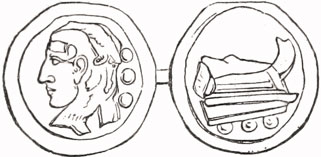
Fig. 255—Roman Quadrans
Mite, a small piece of money, two of which made a quadrans—four of the latter being equal to the Roman as. The as was of less weight and value in later than in early times. Its original value was 3.4 farthings, and afterwards 21/8 farthings. The latter was its value in the time of Christ, and the mite being one-eighth of that sum, was little more than one-fourth of an English farthing. It was the smallest coin known to the Hebrews (Luk 12:59).
A small piece of money, two of which made a kodrantes, or the fourth part of the Roman as. The as was equal to three and one-tenth farthings sterling, or about one and one-half cents. The mite, therefore, would be equal to about two mills, Luk 12:59 ; 21:2.\par
Mite. A coin, current in Palestine, in the time of our Lord. Mar 12:41-44; Luk 21:1-4. It seems, in Palestine, to have been the smallest piece of money, (worth about one-fifth of a cent), being the half of the farthing, which was a coin of very low value. From St. Mark’s explanation, "two mites, which make a farthing," Mar 12:42, it may, perhaps, be inferred that the farthing was the commoner coin.
Mite. A coin of Palestine in the time of our Lord. Mar 12:41-44; Luk 21:1-4. It was the smallest piece of money and worth about one-fifth of a cent—two mites making a farthing. See Farthing.
See WEIGHTS AND MEASURES.
MITE.—See Money.
MITE.—See Money, § 7.