
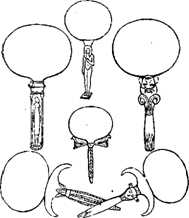
Fig. 254—Egyptian Metal Mirrors
Mirror (Exo 38:8; Job 37:18). In the first of these passages the mirrors in the possession of the women of the Israelites, when they departed from Egypt, are described as being of brass; for ’the laver of brass, and the foot of it,’ are made from them. In the second, the firmament is compared to ’a molten mirror.’ In fact, all the mirrors used in ancient times were of metal; and as those of the Hebrew women in the wilderness were brought out of Egypt, they were doubtless of the same kind as those which have been found in the tombs of that country, and many of which now exist in our museums and collections of Egyptian antiquities. These are of mixed metals, chiefly copper, most carefully wrought and highly polished; and so admirably did the skill of the Egyptians succeed in the composition of metals, that this substitute for our modern looking-glass was susceptible of a luster which has even been partially revived at the present day in some of those discovered at Thebes, though buried in the earth for so many centuries. The mirror itself was nearly round, and was inserted in a handle of wood, stone, or metal, the form of which varied according to the taste of the owner.
See LOOKING GLASS.\par
See GLASS.
By: Joseph Jacobs
An object having a nearly perfect reflecting surface. In ancient times mirrors were invariably made of metal; in Egypt, of polished brass. It is no doubt this kind of mirror to which reference is made in Ex. xxxviii. 8 and in Job xxxvii, 18. Reflections might also be seen in still water (Prov. xxvii. 19). In the enumeration of women's ornaments in Isa. iii. 23, hand-mirrors seem to be included; but this is somewhat doubtful. References to mirrors occur in the Apocrypha (Ecclus. [Sirach] xxii. 11) and in the New Testament (I Cor. xxxiii. 12).
The Rabbis were acquainted with the use of mirrors, sometimes employing metal (Kelim xxx. 2). On the Sabbath it was not allowable to look into a mirror unless it was fixed on a wall (Shab. 149a). It would appear that later there was a tendency to forbid men to view themselves in mirrors, as this was regarded as effeminate (see Levy, "Neuhebr. Wörterb." i. 236). Nevertheless, the members of Rabbi's family were allowed to do so (Yer. Shab. vi. 7) because they were "close to the government."
The modern Jews of eastern Europe have a number of superstitions in regard to mirrors the exact origin of which it is difficult to trace. Mirrors are covered when a person dies. The angel of death will be seen if one looks into a mirror at such a time. If a mirror is broken, seven years of poverty will result; this is a general superstition, and not confined to Jews. In Galicia it is supposed that if one puts a mirror in front of a sleeping man with a candle between them, the sleeper will follow a person whither the latter wills. If the sleeper strikes one under these circumstances, the person stricken will not live more than a year.
MIRROR.—See Glass.
(ἕóïðôñïí, 1Co_13:12, Jam_1:23; the classical word was êÜôïðôñïí, whence êáôïðôñßæåóèáé, in 2Co_3:18; Lat. speculum, late Lat. miratorium, from mirari, whence Fr. miroir)
The mirrors of the ancients consisted of a thin disk of metal-usually bronze, more rarely silver-slightly convex and polished on one side. Glass mirrors coated with tin, of which there was a manufactory at Sidon (Pliny, Historia Naturalis (Pliny) xxxvi. 66, 193), were little used, and the art of silvering glass was not discovered till the 13th century. Corinthian mirrors were considered the best, and it is interesting that St. Paul’s two figurative uses of the word occur in his letters to Corinth.
1. To bring home to the imagination the limitations of human knowledge, he says that in the present life we see only by means of a mirror darkly (äéʼ ἐóüðôñïõ ἐí áἰíßãìáôé, 1Co_13:12). In a modern mirror the reflexion is perfect, but the finest burnished metal gave but an indistinct image. To see a friend in a mirror, and to look at his own face, was therefore to receive two different impressions. So this world of time and sense, as apprehended by the human mind, imperfectly mirrors the true and eternal world, leaving many things ‘enigmatic.’ Mediate knowledge can never be so sure and satisfying as immediate. Plato (Rep. vii. 514) in his well-known simile of the cave compares our sense-impressions to shadow-shapes that come and go, giving but hints of the real world beyond; and the figure of the mirror is found in such Platonists as the writer of Wisdom (Wis_7:26) and Philo (de Decal. 21). J. H. Newman directed that his memorial tablet at Edgbaston should bear the words-Ex umbris et imaginibus in veritatem. Many writers have supposed that St. Paul refers not to a mirror but to a semi-transparent window-pane: ‘velut per corneum specular obsoletior lux’ (Tertullian, de An. 53). But a window of talc would be äßïðôñïí (Lat. speculare), not ἔóïðôñïí. Tertullian has indeed the right interpretation in adv. Prax. 16, ‘in imagine et speculo et aenigmate.’
2. St. Paul says that we all, with unveiled face mirroring (êáôïðôñéæüìåíïé) the glory of the Lord, are transfigured (cf. Mar_9:2) into the same image (2Co_3:18). While Moses, who saw God and for a little while outwardly reflected His glory, gradually lost the supernatural radiance, the disciples of Christ steadily beholding (cf. Joh_1:14) and reflecting His moral glory, become daily more like Him: ‘the rays of Divine glory penetrate their innermost being and fashion them anew’ (Bousset, Die Schriften des NT, 1908, ii. 179). The older interpretation-‘beholding as in a mirror’-loses the parallel between Moses’ direct vision of God and ours (by faith) of Christ, and fails to do justice to the ‘unveiled face.’
3. James (Jam_1:23-25) compares the law of liberty-a splendid paradox-to a mirror in which a man sees himself as he is. The mere hearer of the law is like a person who gives a hasty glance at his face in a mirror and then turns his attention to other things; but he who continues to look into the mirror of the law till the moral ideal fascinates him and the categorical imperatives win his passionate assent, so that his own will is more and more conformed to the will of God-that man shall learn the secret of true happiness.
James Strahan.