
The sister of Moses and Aaron, and daughter of Amram. She was older than Moses, for she watched over him when placed in the ark on the river, and it is probable that she was older than Aaron. Her name is derived from Mara, which signifies bitterness. But if, as is more generally supposed, the name is derived from her father’s, Amram signifies exalted. (See Exod. 2: 4, &c.)
sister of Moses and Aaron, and daughter of Amram and Jochebed, was born about A.M. 2424. She might be ten or twelve years old when her brother Moses was exposed on the banks of the Nile, since Miriam was watching there, and offered herself to Pharaoh’s daughter to fetch her a nurse. The princess accepting the offer, Miriam fetched her own mother, to whom the young Moses was given to nurse, Exo 2:4-5, &c. It is thought that Miriam married Hur, of the tribe of Judah; but it does not appear that she had any children by him, Exo 17:10-11. Miriam had the gift of prophecy, as she intimates, Num 12:2: “Hath the Lord indeed spoken only by Moses? hath he not spoken also by us?” After the passage of the Red Sea, Miriam led the choirs and dances of the women, and sung with them the canticle, “Sing ye to the Lord, for he hath triumphed gloriously; the horse and his rider hath he thrown into the sea:” while Moses led the choir of men, Exo 15:21. When Zipporah, the wife of Moses, arrived in the camp of Israel, Miriam and Aaron disputed with her, speaking against Moses on her account, Numbers 12. This conduct the Lord punished by visiting Miriam with a leprosy. Aaron interceded with Moses for her recovery, and besought the Lord, who ordered her to be shut out of the camp seven days. We are acquainted with no subsequent particulars of the life of Miriam. Her death happened in the first month of the fortieth year after the exodus, at the encampment of Kadesh in the wilderness of Zin, Num 20:1. The people mourned for her, and she was there buried.
Mir´iam (bitterness), sister of Moses and Aaron, and supposed to be the same that watched her infant brother when exposed on the Nile; in which case she was probably ten or twelve years old at the time (Exo 2:4, sq.). When the Israelites left Egypt, Miriam naturally became the leading woman among them. She is called ’a prophetess’ (Exo 15:20). After the passage of the Red Sea, she led the music, dance, and song, with which the women celebrated their deliverance (Exo 15:20-22). The arrival of Moses’ wife in the camp seems to have created in her an unseemly dread of losing her influence and position, and led her into complaints of and dangerous reflections upon Moses, in which Aaron joined. For this she was smitten with leprosy, and, although healed at the intercession of Moses, was excluded for seven days from the camp (Numbers 12; Deu 24:9). Her death took place in the first month of the fortieth year after the Exodus, at the encampment of Kadesh-barnea (Num 20:1), where her sepulcher was still to be seen in the time of Eusebius.
The sister of Moses and Aaron, probably the one who watched over Moses in the ark of bulrushes, Exo 2:4,5 Nu 26 59 Mic 6 4. As a prophetess, she led the women of Israel in their song of worship and thanksgiving to God on the drowning of the Egyptians, Exo 15:20,21 . Her jealous murmurs against Moses and his Cushite wife were punished by a temporary leprosy, Num 12:1-16 Deu 24:9 ; but she was forgiven and restored, and near the close of the wandering of Israel, died at Kadwshbarnea, Num 20:1 .\par
Mir’iam. (rebellion). The sister of Moses, was the eldest of that sacred family; and she first appears, probably as a young girl, watching her infant brother’s cradle in the Nile, Exo 2:4, and suggesting her mother as a nurse. Exo 2:7.
After the crossing of the Red Sea, "Miriam, the prophetess," is her acknowledged title. Exo 15:20. The prophetic power showed itself in her, under the same form as that which it assumed, in the days of Samuel and David, -- poetry, accompanied with music and processions. Exo 15:1-19.
She took the lead, with Aaron, in the complaint against Moses, for his marriage with a Cushite, Num 12:1-2, and for this, was attacked with leprosy. This stroke and its removal, which took place at Hazeroth, form the last public event of Miriam’s life. Num 12:1-15. She died toward the close of the wanderings at Kadesh, and was buried there. Num 20:1. (B.C. about 1452).
The Old Testament Hebrew equates to Mary in New Testament and Mariamne, Herod’s wife and victim.
1. Sister of Aaron and Moses, oldest child of Amram and Jochebed. At least 12 or 13 at Moses’ birth, for she is called (Exo 2:8) "the maid,"
Her prophetic gift was perverted into a ground of jealousy of Moses, whose foreign Ethiopian wife, just espoused, to Miriam’s disappointment had supplanted her from the influence which she had with Moses after Zipporah’s death. "Miriam and Aaron spake against Moses because of the Ethiopian woman whom he had married (Numbers 12) ... Hath the Lord indeed spoken only by Moses? Hath He not spoken also by us?" But the phrase "sister of Aaron" (a phrase not likely to have been applied to Miriam by a later writer than Moses) marks her as ranking, not with Moses but with Aaron, and like him subordinate to Moses, the mediator of the Old Testament, and standing to Aaron "instead of God" (Exo 4:16). God’s reply implies that, though receiving prophetical revelations, she did not receive them "mouth to mouth apparently" and immediately as Moses, who "beheld the similitude of the Lord," whereas she and others saw only in a "vision" or "dream."
In wrath God withdrew the cloud from off the tabernacle, and behold the proud prophetess had the most humiliating of diseases, leprosy white as snow. Miriam was the instigator, therefore on her alone fell the punishment. Aaron was influenced to evil by his sister, as before by the people (Exodus 32), with characteristic pliability. Leprosy was the penalty of sin against the theocracy, as in Uzziah’s and Gehazi’s case. Miriam became in a state of living death. Aaron interceded with Moses piteously for her: "let her not be as one dead, of whom the flesh is half consumed when he cometh out of his mother’s womb." So Moses interceded with God: "heal her now, O God, I beseech Thee."
The Lord hearkened, but excluded her from the camp seven days; and such was her popularity, "the people journeyed not (from Hazeroth) until Miriam was brought in again." Her death was at Kadesh Barnea, the first month of the 40th year (Num 20:1). Her sepulchre was shown in Eusebius’ (Onom. in Jerome) time at Petra; but Josephus Ant. 4:4, section 6; 3:2, section 4, 6 section 1) places it on Mount Zin, and makes her wife of Hur and grandmother of the architect Bezaleel. Feminine jealousy and ambition were the drawbacks to her otherwise commanding character.
2. 1Ch 4:17. Berheau by transposition reads, "and these are the sons of Bithiah the daughter of Pharaoh, whom Mered had taken" immediately after "and Jalon, ... and she (Bithiah) conceived and bore) Miriam," etc. Miriam is here a man.
Miriam (mĭr’i-am), rebellion. 1. The daughter of Amram, and the sister of Moses and Aaron, 1Ch 6:3, appointed to watch the ark of bulrushes in which her infant brother was laid among the flags of the river. She was there when Pharaoh’s daughter came down and discovered it, and proposed to go for a nurse. She immediately called her mother as the nurse, and the infant was placed under her care. Exo 2:4-10. After the passage of the Red Sea, she led the choir of the women of Israel in the sublime song of deliverance, Exo 15:20, but afterward, having joined Aaron in murmuring against Moses, she was smitten with leprosy, and restored only in answer to the prayers of Moses. Num 12:1-15. She died and was buried at Kadesh. Num 20:1. 2. A descendant of Judah. 1Ch 4:17.
[Mir’iam]
1. Sister of Aaron and Moses: she is emphatically called ’Miriam the prophetess.’ She was probably the sister who watched the ark in which her brother Moses was laid. In after years she headed the procession of women, when, with timbrels and dances, they answered the song of Moses, on their deliverance out of Egypt and through the Red Sea. With Aaron she took the lead in murmuring against Moses, on the plea that he had married an Ethiopian woman. Moses was very meek, but the Lord did not allow His servant, who was faithful in all God’s house, and to whom He spake mouth to mouth, to be spoken against. God was angry with them and Miriam was smitten with leprosy, white as snow. Aaron humbled himself and confessed their sin, and Moses prayed for the restoration of Miriam. She was made to go outside the camp seven days. This rebellion was typical of Israel in the character of prophet and priest uniting against Christ as King. Miriam died at Kadesh and was buried there. Exo 15:20-21; Num 12:1-15; Num 20:1; Num 26:59; Deu 24:9; Mic 6:4.
2. Son or daughter of one in the tribe of Judah. 1Ch 4:17.
By: Isidore Singer, Jacob Zallel Lauterbach
—Biblical Data:
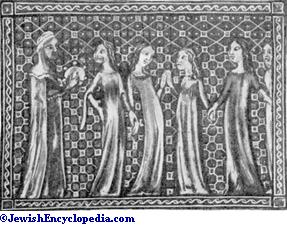
Prophetess; daughter of Amram and sister of Moses and Aaron (I Chron. vi. 3; Ex. xv. 20; Num. xxvi. 59). When Moses was left at the river Miriam watched from a distance until Pharaoh's daughter took him up, whereupon she proposed to the princess to find a Hebrew nurse; the princess assenting to this, Miriam returned with her mother (Ex. ii. 4-7). After the Israelites had crossed the Red Sea Miriam sang a song of triumph, in which all the women joined (Ex. xv. 20-21). Miriam and Aaron spoke against Moses on account of the Cushite woman whom he had married, whereupon God summoned Moses, Aaron, and Miriam to the tabernacle of the congregation, reproved her, and punished her with leprosy. She was healed through the prayers of Moses, but was obliged to remain without the camp of the Israelites for seven days, although the people did not proceed until she had returned (Num. xii.). Miriam died in the desert at Kadesh, where she was buried (Num. xx. 1). In Micah vi. 4 she is mentioned, with Moses and Aaron, as a leader of the people.
Miriam.(From the Sarajevo Haggadah of the fourteenth century.)
—In Rabbinical Literature:
Miriam was born at the time when the Egyptians began to embitter the lives of the Israelites by imposing arduous tasks upon them (comp. Ex. i. 14), and for this reason she was called "Miriam," since the consonants in the word "Miriam" ( ) may also read "marim" (="bitter"; Cant. R. ii. 11). She was called also "Puah," and was, like her mother, a midwife (comp. Ex. i. 15). When only five years of age she was skilful enough to help her mother (Ex. R. i. 17; see Jochebed). She had the courage to tell Pharaoh that he would be punished by God for his cruelty to Israel, and almost lost her life in consequence (ib.). When her father, Amram, had divorced her mother as a result of the cruel edict referring to the exposure of the children, she induced him to take her mother back (ib.; Soṭah 12a), and she sang and danced on the day of the remarriage of her parents (Ex. R. i. 23; B. B. 120a). She predicted to her father that a son would be born to him who would liberate Israel from the Egyptian yoke. When Moses was born her father kissed her and said, "Your prophecy, my daughter, is fulfilled." But when subsequently the child had to be cast awayher parents upbraided her and asked what would now be the outcome of her prophecy. Miriam therefore went to the river (Ex. ii. 4) to see how her prophecy would be fulfilled (Ex. R. i. 26; Soṭah 12b-13a).
Her Names.
Miriam is said to have had also the following names: Ephrath, Helah, Naarah, Azubah, Jerioth, Zohar, Zereth, Ethan, and Aharhel (comp. I Chron. ii. 18, iv. 5-8), which were given to her on special occasions (Ex. R. i. 21; Soṭah 11b-12a). She was married to Caleb b. Jephunneh, or b. Hezron, to whom she bore Hur (comp. I Chron. ii. 18-21). Then she fell ill (hence her name "Helah") and was thereupon left by her husband (hence the name "Azubah"). Subsequently she regained her health, became again like a young woman (hence the name "Naarah"), and was taken back by her husband (Ex. R. l.c.). Miriam was the ancestress of King David, and of Bezaleel, who made the Tabernacle and its vessels. Bezaleel's wisdom (comp. Ex. xxxi. 3) is said to have been due to his grandmother Miriam (Ex. R. xlviii. 6). To have so illustrious a descendant was Miriam's reward for not obeying Pharaoh (comp. Ex. i. 21; Ex. R. l.c.). When Miriam talked against Moses (comp. Num. xii.) she did not intend to slander him; she wished him to live with his wife and raise children (Deut. R. vi. 6). But when she was punished with leprosy, and had to remain without the camp, God honored her by officiating as priest Himself (Zeb. 102a). The Israelites waited for her seven days (Num. xii. 15; Soṭah 9b), for she had once waited for Moses by the river (Ex. ii. 4).
Miriam is regarded as the savior of Israel (Ex. R. xxvi. 1). For her sake a marvelous well accompanied the Israelites, a rock from which water flowed. This well disappeared after Miriam's death (Ta'an. 9a). It was subsequently shown in the sea (Shab. 35a). Miriam, like Moses and Aaron, died by a kiss from God (M. Ḳ. 28a), for the angel of death could not take her; and worms did not touch her body (B. B. 17a). Another legend says that Miriam, like Moses and Aaron, died on account of the water of strife ("me meribah"; comp. Num. xx. 7-13). This seems inconsistent, for, according to the Bible as well as the legends, water became scarce only after Miriam's death, with the disappearance of the well (Lev. R. xxxi. 5 and commentaries ad loc.).
MIRIAM.—1. The sister of Moses and Aaron, probably older than either. It was she who watched Moses in the ark of bulrushes (Exo 2:4 ff.). She is called ‘the prophetess,’ and led the women in the song of victory at the Red Sea (Exo 15:20 f.). In the course of the wilderness wanderings she combined with Aaron against Moses, and was punished by leprosy, which was healed in answer to the prayer of Moses (Num 12:1-15). She died in Kadesh towards the end of the wilderness journey (Num 20:1). Her story is referred to in Deu 24:8-9 in connexion with the ceremonial law of leprosy, and in Mic 6:4 she is spoken of along with Moses and Aaron as a leader of the people.
The name Miriam becomes in Greek Mariam and Mariamne, also Maria, our Mary and is probably of Egyptian derivation (mer Amon, ‘beloved of Amon’).
2. A man (or woman) of the family of Caleb (1Ch 4:17).
W. F. Boyd.
(1) Daughter of Amram and Jochebed, and sister of Aaron and Moses. It is probable that it was she who watched the ark of bulrushes in which the child Moses was laid (Exo 2:4). She associated herself with her brothers in the exodus, is called “the prophetess,” and led the choir of maidens who sang the triumph-song after the crossing of the Red Sea (Exo 15:20 f). Along with Aaron, she opposed Moses at Hazeroth (Num 12:1-5). She was smitten with leprosy in punishment, but on Aaron’s intercession was pardoned and healed (Num 12:10-15). She died and was buried at Kadesh (Num 20:1). In the Deuteronomic Law respecting leprosy, Miriam is mentioned as a warning to the Israelites (Deu 24:8 f). In Mic 6:4, she is referred to along with Moses and Aaron as a leader of God’s people.
(2) Son (or daughter) of Jether (1Ch 4:17). The latter half of the verse is in its present situation unintelligible; it should probably follow verse 18 (see Curtis, Chronicles, in the place cited.).
Older sister of Moses and Aaron, and a prophetess in her own right. She helped Moses and Aaron lead the Children of Israel out of Egyptian bondage.
Most likely the unnamed sister who looked after the baby Moses was Miriam (Exo 2:1-8). She was the eldest of three children who grew up to play a leading part in the establishment of Israel as a new and independent nation (1Ch 6:3; Mic 6:4). She was a prophetess, and led the celebration that followed Israel’s victory over Egypt at the Red Sea (Exo 15:19-21).
Later, Miriam and Aaron became jealous of Moses because of the supreme power he exercised in Israel (Num 12:1-2). Miriam was chiefly to blame, and God punished her with a sudden outbreak of leprosy; but when Moses prayed for her, she was healed. However, just as a daughter who had been publicly rebuked by her father had to spend seven days in shame, so did Miriam. Seven days was also the normal period of isolation for the cleansed leper (Num 12:9-15; cf. Lev 14:8).
Miriam died in the wilderness between Egypt and Canaan. She was buried at Kadesh-barnea (Num 20:1).