
The use of the mill in the eastern world was very ancient, and peformed by the lowest of the people, So that when describing the different ranks whom the Lord would destroy in the general destruction of the firstborn in Egypt, the phrase is, "from the first - born of Pharoah that sitteth upon his throne, even unto the first born of the maid servant that is behind the mill." (Exod. xi. 5.) Hence when the Philistines had put out Samson’s eyes, they bound him in fetters of brass, and compelled him "to grind in the prison - house." (SeeJudges 16. 21.)
There is a very gracious precept in the law of Moses on the subject of grinding, which serves to shew the Lord’s tender compassion over his people. "No man shall take the nether or the upper millstone to pledge, for he taketh a man’s life to pledge." (Deut. 24. 6.) In what a very sweet and engaging point of view doth this represent the Lord! And when the precept is heightened in relation to spiritual bread, with what affection may the poor look unto Jesus, the bread of life, concerning it!
In the first ages they parched or roasted their grain; a practice which the people of Israel, as we learn from the Scriptures, long continued: afterward they pounded it in a mortar, to which Solomon thus alludes: “Though thou shouldest bray a fool in a mortar among wheat with a pestle, yet will not his foolishness depart from him,” Pro 27:22. This was succeeded by mills, similar to the hand mills formerly used in this country, of which there were two sorts; the first were large, and turned by the strength of horses or asses; the second were smaller, and wrought by men, commonly by slaves condemned to this hard labour, as a punishment for their crimes. Chardin remarks, in his manuscript, that the persons employed are generally female slaves, who are least regarded, or are least fitted for any thing else; for the work is extremely laborious, and esteemed the lowest employment about the house. Most of their corn is ground by these little mills, although they sometimes make use of large mills, wrought by oxen or camels. Near Ispahan, and some of the other great cities of Persia, he saw water mills; but he did not meet with a single wind mill in the east. Almost every family grind their wheat and barley at home, having two portable mill stones for that purpose; of which the uppermost is turned round by a small handle of wood or iron that is placed in the rim. When this stone is large, or expedition is required, a second person is called in to assist; and as it is usual for the women only to be concerned in this employment, who seat themselves over against each other, with the mill stone between them, we may see the propriety of the expression in the declaration of Moses: “And all the first-born in the land of Egypt shall die, from the first-born of Pharaoh that sitteth upon his throne even unto the first-born of the maid-servant that is behind the mill,” Exo 11:5. The manner in which the hand mills are worked is well described by Dr. E. D. Clarke, in his Travels: “Scarcely had we reached the apartment prepared for our reception, when, looking from the window into the court yard belonging to the house, we beheld two women grinding at the mill, in a manner most forcibly illustrating the saying of our Saviour: ‘Two women shall be grinding at the mill, the one shall be taken and the other left.’ They were preparing flour to make our bread, as it is always customary in the country when strangers arrive. The two women, seated upon the ground opposite to each other, held between them two round flat stones, such as are seen in Lapland, and such as in Scotland are called querns. In the centre of the upper stone was a cavity for pouring in the corn, and by the side of this an upright wooden handle for moving the stone. As this operation began, one of the women opposite received it from her companion, who pushed it toward her, who again sent it to her companion; thus communicating a rotatory motion to the upper stone, their left hand being all the while employed in supplying fresh corn, as fast as the bran and flour escaped from the sides of the machine.” When they are not impelled, as in this instance, to premature exertions by the arrival of strangers, they grind their corn in the morning at break of day: the noise of the mill is then to be heard every where, and is often so great as to rouse the inhabitants of the cities from their slumbers; for it is well known they bake their bread every day, and commonly grind their corn as it is wanted. The noise of the mill stone is therefore, with great propriety, selected by the prophet as one of the tokens of a populous and thriving country: “Moreover, I will take from them the voice of mirth, and the voice of gladness, the voice of the bridegroom and the voice of the bride, the sound of mill stones and the light of a candle, and their whole land shall be a desolation,” Jer 25:10. The morning shall no more be cheered with the joyful sound of the mill, nor the shadows of evening by the light of a candle; the morning shall be silent, and the evening dark and melancholy, where desolation reigns. “At the earliest dawn of the morning,” says Mr. Forbes, “in all the Hindoo towns and villages, the hand mills are at work, when the menials and widows grind meal for the daily consumption of the family: this work is always performed by women, who resume their task every morning, especially the forlorn Hindoo widows, divested of every ornament, and with their heads shaved, degraded to almost a state of servitude.” How affecting, then, is the call to the daughter of Babylon!—”Come down, and sit in the dust, O daughter of Babylon, sit on the ground: there is no throne, O daughter of the Chaldeans; for thou shalt no more be called tender and delicate. Take the mill stones, and grind meal; uncover thy locks, make bare the leg, uncover the thigh, pass over the rivers,”
The custom of daily grinding their corn for the family, shows the propriety of the law: “No man shall take the nether or the upper mill stone to pledge, for he taketh a man’s life to pledge;” because if he take either the upper or the nether mill stone, he deprives him of his daily provision, which cannot be prepared without them. That complete and perpetual desolation which, by the just allotment of Heaven, is ere long to overtake the mystical Babylon, is clearly signified by the same precept: “The sound of the mill stone shall be heard no more at all in thee,” Rev 18:22. The means of subsistence being entirely destroyed, no human creature shall ever occupy the ruined habitations more. In the book of Judges, the sacred historian alludes, with characteristic accuracy, to several circumstances implied in that custom, where he describes the fall of Abimelech. A woman of Thebez, driven to desperation by his furious attack on the tower, started up from the mill at which she was grinding, seized the upper mill stone,
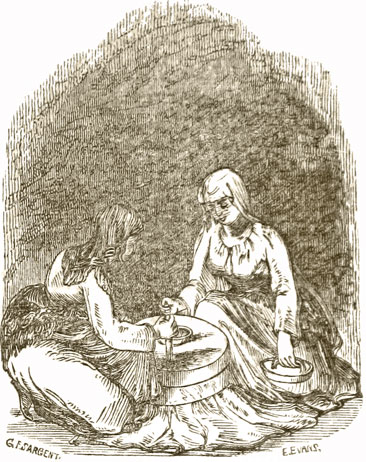
Fig. 252—Woman grinding with a mill
The mill for grinding corn had not wholly superseded the mortar for pounding it in the time of Moses. The mortar and the mill are named together in Num 11:8. But fine meal, that is, meal ground or pounded fine, is mentioned so early as the time of Abraham (Gen 18:6): hence mills and mortars must have been previously known. The mill common among the Hebrews differed little from that which is in use to this day throughout Western Asia and Northern Africa. It consisted of two circular stones two feet in diameter, and half a foot thick. The lower is called the ’nether millstone,’ Job 41:24, and the upper the ’rider’ (Jdg 9:53; 2Sa 11:21). The former was usually fixed to the floor, and had a slight elevation in the center, or, in other words, was slightly convex in the upper surface. The upper stone had a concavity in its under surface fitting to, or receiving, the convexity of the lower stone. There was a hole in the top, through which the corn was introduced by handfuls at a time. The upper stone had an upright stick fixed in it as a handle, by which it was made to turn upon the lower stone, and by this action the corn was ground, and came out at the edges. As there were neither public mills nor bakers, except the king’s (Gen 40:2; Hos 7:4-8), each family possessed a mill; and as it was in daily use, it was made an infringement of the law for a person to take another’s mill or millstone in pledge (Deu 24:6). The mill was, as now, commonly turned by two persons, usually women, and these, the work being laborious, the lowest maid-servants in the house. They sat opposite each other. One took hold of the mill-handle, and impelled it half way round; the other then seized it, and completed the revolution (Exo 11:5; Job 31:10-11; Isa 47:2; Mat 24:41). As the labor was severe and menial, enemies taken in war were often condemned to perform it (Jdg 16:21; Lam 5:13). It will be seen that this millstone does not materially differ from the Highland quern; and is, indeed, an obvious resource in those remote quarters, where a population is too thin or too scattered to afford remunerative employment to a miller by trade. In the East this trade is still unknown, the hand-mill being in general and exclusive use among the corn-consuming, and the mortar among the rice-consuming, nations [BREAD].
See CORN.\par
Mill. The mills of the ancient Hebrews probably differed but little from those at present in use in the East. These consist of two circular stones, each about eighteen inches or two feet in diameter, the lower of which is fixed, and has its upper surface slightly convex, fitting into a corresponding concavity in the upper stone. In the latter is a hole thorough which the grain passes, immediately above a pivot or shaft which rises from the centre of the lower stone, and about which the upper stone is turned by means of an upright handle fixed near the edge.
It is worked by women, sometimes singly and sometimes two together, who are usually seated on the bare ground, Isa 47:1-2, "facing each other; both have hold of the handle by which the upper is turned round on the ’nether’ millstone. The one whose right hand is disengaged throws in the grain as occasion requires, through the hole in the upper stone. It is not correct to say that one pushes it half round and then the other seizes the handle. This would be slow work, and would give a spasmodic motion to the stone. Both retain their hold, and pull to or push from, as men do with the whip or cross-cut saw. The proverb of our Saviour, Mat 24:41 is true to life, for women only grind.
I cannot recall an instance in which men were at the mill." -- Thomson, "The Land and the Book," c.34. So essential were millstones for daily domestic use that they were forbidden to be taken in pledge. Deu 24:6. There were also larger mills that could only be turned by cattle or asses. Allusion to one of these is made in Mat 18:6. With the movable upper millstone of the hand-mill the woman of Thebez broke Abimelech’s skull. Jdg 9:53.
In the East two "circular stones" (
Two women (Mat 24:41) facing one another, seated on the ground, both turned it round by the handle, the one supplying the grain through the hole. It was hard servile labor (Exo 11:5; Jdg 16:21; Isa 47:1-2; Lam 5:18). The mill stones were so essential for preparing food that they were forbidden to be taken in pledge (Deu 24:6). The cessation of the sound of grinding was a sign of desolation (Jer 25:10; Rev 18:22; Ecc 12:3-4, "the grinders cease because they are few ... the sound of the grinding is low".) Larger millstones were turned by asses; Mat 18:6 "a donkey millstone" (Greek).
Mill. Mat 24:41. The Jewish hand-mill consisted of two circular stones, each about 18 inches or two feet in diameter, the lower of which is fixed, and has its upper surface slightly convex, fitting into a corresponding concavity in the upper stone. In the latter is a hole through which the grain passes, immediately above a pivot or shaft which rises from the centre of the lower stone, and about which the upper stone is turned by means of an upright handle fixed near the edge. It is worked by women, sometimes singly and sometimes two together, who are usually seated on the bare ground, Isa 47:1-2, facing each other; both have hold of the handle by which the upper is turned round on the "nether" millstone. The one whose right hand is disengaged throws in the grain as occasion requires through the hole in the upper stone. It is not correct to say that one pushes it half round and then the other seizes the handle. This would be slow work, and would give a spasmodic motion to the stone. Both retain their hold; and pull to or push from, as men do with the whip or cross-cut saw. The proverb of our Saviour, Mat 24:41, is true to life, for women only grind. So essential were millstones for daily domestic use that they were forbidden to be taken in pledge. Deu 24:6. There were also larger mills driven by cattle or asses. Mat 18:6. With the movable upper millstone of the hand-mill the woman of Thebez broke Abimelech’s skull. Jdg 9:53.
MILL (
Two large, flat rocks used for grinding
grain to make flour.