
MANUSCRIPTS.—The aim of the present article is to give a select list of the more ancient or interesting Manuscripts of the Gospels, with a description of the most important or interesting of these. The simplest course will be to divide them into the languages in which they are written, premising that the Gospels were originally written in Greek, and that the versions in other languages are translations, generally direct, from the Greek. The symbols employed to indicate these manuscripts, whether letters or numbers, were invented for the sake of brevity, when they are referred to in an apparatus of variant readings. The standard collection of variants contained in Gospel manuscripts is that of C. Tischendorf (Novum Testamentum Graece: Editio Octava Critica Maior, vol. i., Lipsiae, 1869), and the standard lists of Manuscripts are those contained in the Textkritik des Neuen Testamentes (2 vols., Leipzig, 1900, 1902) of C. R. Gregory, an American scholar domiciled in Germany. The new numbers which von Soden (Die Schriften des Neuen Testaments, Band i., Berlin, 1902) has given to the Greek Manuscripts are added for the sake of completeness, but it is very doubtful whether they will gain wide currency. Capital letters are used to indicate Manuscripts with uncial writing, which is never later than the 10th cent.; numbers, for those in minuscule writing (9th to 15th centuries and later).
I. Greek Manuscripts :
(a) Uncials:—
A (=
B (=
C (=
TX (=
1 (=
II. Syriac Manuscripts :—
(a) of the Old Syriae translation (Evangelion da-Mepharreshe, ‘Gospel of the Separated Ones’):—
1. London, British Museum, Additional Manuscripts , No. 14,451 (No. 119 in Wright’s catalogue), and Berlin, Royal Library, Orient. Quart. No. 528. This MS, Codex Nitriensis Curetonianus (Burkitt’s C), consists of 82½ leaves in the British Museum and 3 leaves in Berlin; and came from the great Library of the Convent of St. Mary Deipara in the Nitrian Valley, west of Cairo. The greater portion of the MS reached England in 1842. In its original state it contained Mt., Mk., Jn., Lk. (in this unusual order). The portions still extant are Mat 1:1 to Mat 8:22; Mat 10:32 to Mat 23:25, Mar 16:17-20, Joh 1:1-42; Joh 3:5 to Joh 8:19; Joh 14:10-12; Joh 14:15-19; Joh 14:21-24; Joh 14:26-29, Luk 2:48 to Luk 3:16, Luk 7:33 to Luk 16:12; Luk 17:1 to Luk 24:44. The early part of the 5th cent. is the latest possible date for it. Each page has two columns, each with lines varying from 22 to 26. Each leaf measures 30 by 24 cm. The first edition of this MS is that of Cureton (London, 1858) supplemented by Rödiger (Berlin, 1872), but the definitive edition is that of F. C. Burkitt, who has edited this MS and the following together, the only representatives of the Old Syriac version, with an English translation, copious Introduction and Notes (Evangelion da-Mepharreshe, etc., 2 vols., Cambridge, 1904). From this work the details here are taken. A photograph of a page of C is in vol. ii. opposite p. 7, also p. 38 two pages; also in Kenyon’s Our Bible and the Ancient Manuscripts , facing p. 155.
2. Sinai, Monastery of St. Catharine; Syr.
The Evangelion da-Mepharreshe was so called to distinguish it from Tatian’s Diatessaron or Harmony, in which form the Gospels were regularly read in the Syrian Church at first. This Church had its centre at Edessa near the Euphrates, and its language must not be identified with the Aramaic our Lord spoke. The value of the Old Syriac Version consists in the fact that it reproduces the Greek text current in Antioch at the end of the 2nd cent., with a certain amount of contamination from the use of the Diatessaron, which is in origin Italian. It is of the first authority for the constitution of the text of the Greek Gospels. For all problems connected with it the reader is referred to Burkitt’s second volume.
(b) of the Peshitta (‘simple’) translation:
2. Earl of Crawford’s MS 1, now Rylands’ Library, Manchester, of the 6th cent. (Gwilliam, No. 11).
13. London, British Museum, Addit. Manuscripts 14,470, of the 5th or 6th cent. (Gwilliam, No. 17).
15. London, British Museum, Addit. Manuscripts 14,453, of the 5th or 6th cent. (Gwilliam, No. 14).
22. London, British Museum, Addit. Manuscripts 12,140, of the 6th cent. (Gwilliam, 31).
There are many other codices, complete or incomplete, of equal antiquity, in other libraries. See Gwilliam’s list of 42 Manuscripts in the Tetraeuangelium Sanctum by Pusey and Gwilliam (Oxonii, 1901), which is the best edition of the Peshitta, and is provided with a literal Latin translation. As to the date of the Peshitta itself, Burkitt’s view that it was prepared by Rabbula, bp. of Edessa from 411 to 435 a.d., has gained wide acceptance. He regards it as ‘a revision of the Evangelion da-Mepharreshe, undertaken mainly with the object of conforming the translation more closely to the Greek text as read at Antioch early in the 5th century’ (Evangelion da-Mepharreshe, vol. ii. p. 5).
(c) of the Palestinian or Jerusalem translation:
1. Rome, Vaticanus Syr.
6. Sinai, Monastery of St. Catharine, of the year 1104 (Codex B, Lewis-Gibson).
7. Sinai, Monastery of St. Catharine, of the year 1118 (Codex C, Lewis-Gibson).
Edited by Mrs. Lewis and Mrs. Gibson in the Palestinian Syriac Lectionary of the Gospels (London, 1899). This version is perhaps more closely related to the Old Syriac than to the Peshitta, and may be a revision of the former.
(d) of the Philoxenian-Harklean translation:
1. Belonging to the Syrian Protestant College in Beirut, but lent to the Union Theological Seminary of New York. Of the 9th cent., and somewhat defective.
22. Florence, Laur. i. 40 (Assem. 3). Of date 757.
25. Rome, Vat. Syr.
26. Rome, Vat. Syr.
This, the youngest of the Syrian versions, is a revision by Thomas of Harkel (Heraclea) in the first half of the 7th cent. of an earlier version made at the instance of Philoxenus, Monophysite bp. of Hierapolis (Mabog) in the early 6th century. The earlier translation was perhaps made from the Peshitta by reference to the ‘corrected’ form of the Greek text, and Thomas found in Egypt older Greek Manuscripts , which had escaped the enthusiasm of the destroyers, who favoured the ‘corrected’ text, and inserted some readings from them, adding others in the margin.
III. Egyptian (Coptic) Manuscripts :
(a) of the Bohairic translation:
Complete manuscripts are all of late date, none being earlier apparently than the 12th century. On all questions connected with this translation and its Manuscripts , see The Coptic Version of the New Testament in the Northern Dialect [ed. G. Horner]; 4 vols. (Oxford, 1898–1905).
1. Oxford, Bodleian Library, Huntington, 17,*
21. Paris, Bibl. Nat., copt. 16, Horner’s C. The MS was written in 1196, and contains the Gospels almost complete, both in Bohairic and Arabic. It is on paper, contains 369 (+2) leaves, and 2 columns to the page, with 26 lines each. It measures 28.5 by 21 cm. The text is perfect, with the exception of a small lacuna, Joh 16:6-18.
33. Paris, Institut Catholique, Horner’s H. This MS was written in 1250, and contains the Gospels complete, both in Bohairic and Arabic. It is on paper, contains 235 (+2) leaves, and 2 columns to the page, with 33 lines each. It measures 25 by 17.5 cm., and contains some beautiful pictures.
(b) of the Sahidic translation:
Of this there exists only a considerable quantity of short fragments (Gregory gives 91). Some are as old as the 5th century. One is still older (No. 48 Rome, Propag. 65).
(c) of the Fayyum translation:
Gregory gives fragments of 5 Gospel Manuscripts only, one (No. 2), in the possession of Flinders Petrie, of the 4th century. Of (b) and (c) there is as yet neither a comprehensive edition nor a complete study. Further fragments of both are certain to be discovered.
The Ethiopic, Armenian, Georgian, Persian, and Arabic translations may be here passed over.
IV. Latin Manuscripts :—
(a) of the pre-Vulgate (otherwise called ‘Old Latin,’ or ‘Itala’) translation(s):—
a: Vercelli, Cathedral. This MS is of the 4th cent., measures 25.5 by 16 cm., has 2 columns to the page, and 24 lines to the column. The order of the Gospels is Mt., Jn., Lk., Mk., the regular Old Latin order. Much is wanting in Matthew 20-27; Jn. is slightly defective; in Lk. much of chs. 1, 11 and 12 has disappeared; in Mk. chs. 1, 4, 5, 15, 16 have suffered greatly; a second but ancient hand has supplied Mar 16:7-20. The text is good, and was, according to tradition, copied by the famous bishop Eusebius of Vercelli, martyred in 371. The book has suffered greatly from neglect and bad treatment. Editions by G. A. Irico (Sacrosanctus Evangeliorum Codex S. Eusebii Magni, Milan, 1748), J. Bianchini (Evangeliarium Quadruplex, Rome, 1749; very accurately reprinted in Migne’s Patrologia Latina, vol. xii.), and J. Belsheim (Codex Vercellensis, Christiania, 1894).
b: Verona, Cathedral Library (Biblioteca Capitolare). The MS is of the early part of the 5th cent. (or of the end of the 4th), and is written in silver. The following parts are wanting: Mat 1:1-11; Mat 15:12-23; Mat 23:18-27, Joh 7:44 to Joh 8:12, Luk 19:26 to Luk 21:29, Mar 13:9-19; Mar 13:24 to Mar 16:20. Edited by Bianchini (see under a) and by J. Belsheim (Codex Veronensis Quattuor Euangelia, Prag, 1904). It was probably a MS like this which was the chief basis of Jerome’s revision known as the Vulgate. It is perhaps the best representative of the European Latin versions of the 4th century. There is a photograph of one page in Monumenta Palœographica Sacra (Turin, 1899).
c: Paris, Bibl. Nat. 254 (Colb. 4051), of the 12th century. Edited by P. Sabatier (Bibliorum Sacrorum Latinœ Versiones Antiquœ, vol. iii., Paris, 1751; there is also an edition with ‘Reims’ on the title-page), and by J. Belsheim (Codex Colbcrtinus Parisiensis, Christiania, 1888). The work of P. Sabatier is still unsuperseded as the most complete repertory of the readings of the Old Latin Bible.
d: This symbol indicates the Latin side of Codex Bezae (D).
e: Palatinus; all that is left is in Vienna (Kais. Lat. 1185) except one leaf, which is in the Library of Trinity College, Dublin (N. 4, 18). The MS is of the 5th cent., and is, with k (see below), representative of a form of text used in the Roman province of Africa (corresponding to modern Tunis). It is very defective, containing about half of Mt., nearly the whole of Jn. and Lk., and about half of Mark. A copy of the MS made before its present mutilation exists in the Vallicellian Library, Rome, as U. 66. The Vienna part was edited by Tischendorf (Evangelium Palatinum, Leipzig, 1847), the Dublin leaf by T. K. Abbott (Par Palimpsestorum Dublincnsium, etc., London, 1880); reports on the copy in the Vallicellian Library were published by H. Linke (Sitzungsberichte der Königl. bayer. Akad. der Wissenschaften [Phil-Philolog. und Hist. Classe], Munich, 1893, Heft 2, pp. 281–287). See also Belsheim (Evangelium Palatinum, Christiania, 1896), and Old-Latin Biblical Texts, vol. ii. (Oxford, 1886), pp. lxvii–lxxxv, by W. Sanday.
f: Brixianus; in the Capitular Library of Brescia. It is of the 6th cent., and is written in silver. It lacks the last quarter or so of Mark. It was edited by Bianchini (see under a), and is also printed under the Vulgate in Wordsworth and White’s edition (Oxford, 1889–1898), as in the opinion of these editors and Hort the type of text which Jerome used as the basis of his revision. The other view with regard to it, namely, that of Burkitt, is that it is an Old Latin text deeply contaminated with the Vulgate (see JThSt
ff1 [Note: designates the particular edition of the work referred] : St. Petersburg, Imperial Library, formerly Corbeiensis 21 (10th cent.): Matthew.
ff2 [Note: designates the particular edition of the work referred] : Paris, Bibl. Nat. 17225, formerly Corbeiensis 195. It is of the 5th cent. (C. H. Turner in JThSt
g1 [Note: designates the particular edition of the work referred] : Paris, Bibl. Nat. 11553, formerly Sangermanensis 15, of the 8th cent., edited by the Bishop of Salisbury (Dr. John Wordsworth) in Old-Latin Biblical Texts, No. I. (Oxford, 1883).
k: Turin, Nat. G. vii. 15 (formerly of the Irish monastery of Bobbio). This, perhaps the most precious of all Old Latin Manuscripts , is of the 4th (Burkitt) or 5th cent., and represents the text habitually used by St. Cyprian in the early 3rd century. The MS measures 18.7 by 16.7 cm., and consists now of 96 leaves. It contains Mar 8:8-11, Mar 8:14-16; Mar 8:19 to Mar 16:8; Mat 1:1 to Mat 3:10; Mat 4:2 to Mat 14:17; Mat 15:20-36. The only reliable edition is that of Wordsworth, Sanday, and White (Old-Latin Biblical Texts, No. II., Oxford, 1886), which is enriched by discussions of the greatest value for the study of all Biblical texts. Side by side with this edition should be consulted the article of Turner and Burkitt, ‘A Re-Collation of Codex k of the Old-Latin Gospels’ (JThSt
m: Rome, Sessorianus lviii. This MS, of the 8th or 9th cent., contains the so-called Speculum, falsely attributed to St. Augustine, a series of extracts from nearly all the books of the NT. The compilation appears to be of Spanish origin, as the text closely resembles that used by the Spanish heretic Priscillian. Edited by F. Weihrich in the Corpus Scriptorum Ecclesiasticorum Latinorum, vol. xii. (Vienna, 1887).
q: Munich, Lat. 6224, formerly of Freising. It is of the 6th cent., and contains the Gospels, except Mat 3:15 to Mat 4:2; Mat 5:25 to Mat 6:4; Mat 6:28 to Mat 7:8, Joh 10:11 to Joh 12:39, Luk 23:22-36; Luk 24:11-39, Mar 1:7-22; Mar 15:5-36. This, like f, belongs to Hort’s ‘Italian’ class, and stands or falls with f (see above). Edited by H. J. White as Old-Latin Biblical Texts, No. III. (Oxford, 1888).
(b) of the Vulgate revision (made by St. Jerome in 383), the two best Manuscripts out of thousands which exist are:—
am: in the Laurentian Library, at Florence, formerly in the monastery of Monte Amiata, No. 1. This MS was written about the year 700 in the North of England, probably by an Italian scribe, and was taken by Ceolfrid, the abbot of Jarrow, to the Continent as a present to the Pope in the year 716. It measures 50 by 34 by 20 cm. (without the cover), and comprises 1029 leaves, with 2 columns to the leaf, and 43 or 44 lines to the column. It contains the whole Bible. The NT was published by Tischendorf (Leipzig, 1850, and again 1854), but not with perfect exactness. (See Nouum Testamentum Domini Nostri lesu Christi Latine, rec. Wordsworth and White, Pars Prior, Oxonii, 1889–1898, p. xi; and Studia Biblica et Ecclesiastica, vol. ii., Oxford, 1890, pp. 273–324). Wordsworth and White’s A.
fuld: in the library of Fulda, Prussia. The MS was written about the year 540 at the wish of Victor, bishop of Capua. The Gospels are written in the form of a harmony. Edited by E. Ranke (Codex Fuldensis, Marburg and Leipzig, 1868), with specimens of the handwriting. (See Nov. Test. etc. Latine, rec. Wordsworth and White, Pars Prior, p. xii). Wordsworth and White’s F.
V. Gothic Manuscripts :—
1. Upsala University, the ‘Codex Argenteus.’ The MS is of the 6th cent., and now consists of 187 leaves, which are stained with purple and bear silver writing. The contents are fragments of Mt., Jn., Lk., Mark. (The translation was made by Ulfilas (Wulfila) in the 4th cent., and all surviving fragments are collected in Gabelentz and Loebe’s Ulfilas (Altenburg and Leipzig, 1836–1843).
Literature.—Most of the important literature has already been indicated in the course of the article. Reference should also be made to The NT in the Original Greek: The Text revised by westcott and Hort, vol. ii. Introduction and Appendix (London, 1881 and 1896); Kenyon, Handbook to the Textual Criticism of the NT (London, 1901); Nestle, Introduction to the Textual Criticism of the Greek NT (London, 1901); Hammond, Outlines of Textual Criticism applied to the NT (Oxford, 1902).
Alex. Souter.
By: Joseph Jacobs, Ludwig Blau, Richard Gottheil, G. Margoliouth
Writing Material.
The first materials used for writing were such substances as stone, wood, and metal, upon which the characters were engraved with a stylus. At a very early time, however, animal substances were employed, and letters were written upon them with various liquid preparations. The usual word for a written document, "sefer," which occurs 182 times in different forms in the Bible, and is to be supplied in many places, as, for instance, with "Torah," designates the skin of an animal, the writing material anciently employed by the Orientals, and not papyrus. The usual word for writing, "katab," the fundamental meaning of which is "to place signs in succession," is found in the Bible 220 times (Blau, "Studien zum Althebräischen Buchwesen," pp. 9 et seq.). For private writing in the first centuries of the common era various materials were used, including clay tablets for bills. Books might be written only on skins of animals, of which three kinds were prepared—"gewil," "ḳelaf," and "doksosṭos." Gewil is the plain hide with the hair scraped off (i.e., leather); ḳelaf is parchment, made by paring away the skin, and which received the writing upon the flesh side (i.e., a membrane); doksosṭos is another form of parchment (ib. pp. 22 et seq.).
Parchment.
Copies of the Bible were, as a rule, made from whole skins, as at the present day, which were prepared from clean animals. To this the copyist ("sofer") himself generally attended. A gaon says, "We have never seen a Torah scroll which was written on parchment." There is a possibility, however, that in ancient times there were Biblical books written on papyrus; in regard to non-Biblical writings this supposition is even probable. The skin used for writing was ruled, and there were special regulations for margins and for the number of lines. Only black, effaceable ink, which was renewed when necessary, might be used for Biblical works. Metallic ink was known, but was forbidden. The Letter of Aristeas (§§ 176-179), however, relates that the copy of the Bible sent by the high priest to the Egyptian king Ptolemy was written in gold, and the Talmud also speaks of gold-writing, which may have been a Jewish invention (Blau, l.c. pp. 13, 150 et seq.; see Index).
Scroll and Codex.
Both the Jewish and the non-Jewish world in antiquity had books in the form of scrolls (Isa. xxxiv. 4; Job xxxi. 35-36; Jer. xxxvi.; Ezek. ii. 8-9; Ps. xl. 8; Zech. v. 1). In post-Biblical times the employment of such scrolls may be traced for a thousand years, and in copies of the Pentateuch for the synagogue this usage has survived until the present time. Both the Letter of Aristeas (l.c.) and I Macc. iii. 48 speak of scrolls. On the arch of Titus a man is depicted carrying on his back a long roll, undoubtedly a representation of the Torah scroll of the Temple of Jerusalem, which was taken to Rome (see Josephus, "B. J." vii. 5, § 5). The Talmud and Midrash know books only in this form (Blau, l.c. pp. 40-43), and the Christian documents of the first three centuries testify also to the use of rolls (Schulze, in "Greifswalder Studien Hermann Cremer Dargebracht," pp. 148-158). When and where the codex form first appeared among the Jews is as yet unknown. It is not impossible that the word "diftera," in Soferim iii. 6, designates a codex. The oldest complete and dated manuscript of the Bible, the codex of the Prophets at St. Petersburg, was written in 916. In ancient times school children had tablets for their first lessons in reading and writing, while wax tablets (
Size, Compass, and Distribution.
The books of antiquity were always of small size (II Kings xxii. 8-10; II Chron. xxxiv. 15 et seq.; Neh. viii. 1 et seq.; see references from the Talmud, Midrash, and classic literature in Blau, l.c. pp. 72 et seq.), and people sat cross-legged when reading them.The largest scroll, the official copy of the Torah, which was used in the Second Temple had at most a height of six and a diameter of two handbreadths (ib. pp. 76 et seq.). The smallness of the books was compensated by the minuteness of the characters (ib. p. 79 et seq.). The contents of a manuscript might be very small, as, for example, one of the Book of Obadiah, or the original roll of fasts (c. 100 C.E.), while the normal size probably never exceeded that of the collection of the Twelve Prophets. At the time of the first selection of the canon (c. 4th cent. B.C.) large scrolls could not have been popular, as is shown by the division of the Torah into five parts, by the division of the Book of the History of the Kings into the books of Samuel and Kings, by the separation of the books of Ezra and Nehemiah from the Chronicles, and by other instances. About the year 100 C.E., however, there were certainly collective scrolls which contained the three sections of the Bible in one roll each, while there were even some which included all the books of the Scriptures in one large roll. Such a one, probably, was the Hexapla of Origen. There was, moreover, no lack of copies of single portions, which contained a section of a book, such as the Roll of Jealousy (= Num. v. 11-23, etc.; Blau, l.c. pp. 46-70).
Book-Trade.
The preparation of books has had an eventful history. At the time of the chroniclers (c. 3d cent. B.C.) Bible copies were rare; they had been almost entirely destroyed by the Syrians before the Maccabean revolt. Afterward, however, their number increased steadily, since it was made incumbent on every one to write a copy of the Torah for himself, and each congregation owned at least one. In the Talmudic period there was an enormous number of copies, especially as it was customary to wear portions of the Bible (chiefly Torah rolls) around the arm as amulets. Manuscripts of the Bible were found also in heathen families, and pagans even liked to trade in these books, which they were able to write themselves. Christians converted from Judaism or paganism owned many Hebrew writings (ib. pp. 84-97). In consequence of the ever-increasing demand a kind of book-trade developed as early as the first century. In general, however, people ordered their manuscripts direct from the copyist, according to ancient custom. The Apocrypha, the original of which has been lost, and other non-Biblical Hebrew books, were not in special demand and did not circulate in large numbers.
Oldest Codices.
The high value placed upon the Scriptures is evidenced by the great care taken for their preservation. The scrolls were wound on a stick, the Torah on two sticks. Coverings of various kinds served to protect them, and cases of various forms were used for keeping them. The rolls were firmly tied with a cord, and sometimes they were sealed to prevent any one from reading them without permission (ib. pp. 173-188 et seq.). When worn out the manuscripts of the Bible were protected against profanation by being placed in the coffins of dead scribes. In consequence of this custom not a single Biblical manuscript has been preserved from ancient times, nor is there any hope that one will ever come to light. Nevertheless, a few archetypes which existed in antiquity are mentioned. In the first rank among these stands the copy of the Torah of the Second Temple, already noted (I Macc., Introduction; II Macc. ii. 14; Josephus, "Ant." v. 1, § 17; Blau, l.c. pp. 99 et seq.). "The Book of the Court" (M. Ḳ. iii. 4a et al.) was the copy from which the high priest read on the Day of Atonement and which served as a model (Blau, l.c. p. 107).
Three other codices from the Temple court are mentioned: "Sefer Me'on," "Sefer Za'aṭuṭe," and "Sefer Hi," and they still served as models at the beginning of the fourth century (ib. p. 104). After the destruction of the Temple the Torah of the celebrated copyist R. Meïr, the codex of Emperor Severus, and others (ib. p. 111) are mentioned, while from post-Talmudic times date the codices of Hillel, Sanbuki, and others. The most celebrated was the codex of Ben Asher, used by Maimonides (H. L. Strack, "Prolegomena Critica in Vetus Testamentum Hebraicum"). See Bible Manuscripts.
Bibliography:
L. Löw, Graphische Requisiten bei den Juden, Leipsic, 1870-71;
L. Blau, Studien zum Althebräischen Buchwesen und zur Biblischen Litteratur- und Textgeschichte, Budapest and Strasburg, 1902 (where a full bibliography is given);
idem, Ueber den Einfluss des Althebräischen Buchwesens, in Berliner Festschrift, Frankfort-on-the-Main, 1903 (also printed separately).
It is now necessary to inquire how the Hebrew manuscripts collected in various public and private libraries were written, and in what form the material of which they consist was presented. The time over which the inquiry extends ranges, roughly speaking, from about the year 900 of the common era down to the present day, though in some instances, notably in the case of papyri, an earlier period is referred to. For inscriptions on stone, metal, and other hard substances see Paleography.
I. Materials Used to Receive Writing.— Earliest Papyri.
Papyrus(Greek,
Skins (Hebrew, "'or," known also as "gewil"; Greek,  ) are indeed all of red skin; and the Pentateuch rolls written in the eighteenth century for the Jews of K'ai-Fung-Foo, China (e.g., Brit. Mus. MS. Add. 19,250), are of white leather. The oldest Pentateuch roll (14th cent., Spanish origin) in the British Museum is also of leather; but there are many specimens on vellum belonging to the sixteenth century and onward. Of the forty-seven Karaite Pentateuch rolls in the Imperial Library, St. Petersburg, only five are of leather, the remaining forty-two being of vellum. This proportion no doubt represents the greater deviation among the Karaites from the old synagogue rolls. For the Book of Esther vellum appears to have been more largely used than for the Torah. A roll of the Hafṭarot on leather, written in Corfu in 1560, found its way into Europe a few years ago. For manuscripts in book form skins would in early times have been naturally superseded by parchment or vellum as material fitted for receiving writing on both sides.
Parchment and Vellum (Hebrew, "ḳelaf" and "doksosṭos," for the exact meaning of which see above): For practical purposes, that is to say, so far as the manuscripts now under consideration are concerned, it is enough to remark that "ḳelaf," not unlike the term "parchment" in its more restricted sense, signifies the rougher article, while by "doksosṭos," as by the term "vellum," the finer variety is meant. The Jews were no doubt at all times adepts in the art of producing parchment and vellum, as they had so much need of the materials, and as a religious intention during the manufacture was considered important; but their art would naturally be conditioned, to a large extent at any rate, by the degree of perfection attained in it in the countries where they were domiciled. The finest kinds of vellum used for Hebrew manuscripts were of Spanish and Italian origin. As examples of the former may be mentioned Brit. Mus. MS. Or. 5866 (liturgy, middle of 15th cent.: thin vellum, delicately worked, smooth surface), and Brit. Mus. MSS. Or. 2626-2628 (Bible, 1482-1483: stout, crisp, and pretty smooth). A fine specimen of Italian vellum of about the middle of the same century is furnished by Brit. Mus. MSS. Add. 19,444-19,445 (Florentine liturgy: material very carefully prepared and slightly tinted). Rougher sorts of material were to be found by the side of the finer kind in both countries.
Examples of Old Vellum.
Among representative codices of earlier times, the British Museum Pentateuch dating from the ninth century (MS. Or. 4445, apparently of Babylonian origin) consists of strong, crisp, and very smooth vellum. Brit. Mus. MS. Harley 5720 (probably of early part of 12th cent.; also of Eastern origin) is hard and strong, with surface not very smooth. The British Museum copy of the Maḥzor Vitry (MSS. Add. 27,200-27,201: 12th cent.; French origin) is written on a very inferior sort of material. French as well as German vellum employed for Hebrew in the Middle Ages is, in fact, as a rule coarse as compared with the Spanish and Italian kinds; but Brit. Mus. MS. Add. 11, 639 (collection of works, 12th cent.), from the south of France, is an example of exceedingly fine, smooth vellum. The vellum used for Hebrew charters in England in the twelfth and thirteenth centuries (note especially the large collection belonging to Westminster Abbey) is fairly good, though fineness of manufacture can not be expected in material used for this particular purpose. Some of the early examples of vellum (11th and 12th cent.) found in the Cairo Genizah are stout and smooth; other specimens are of a rougher manufacture. No example of purple-stained vellum, of which there are fair numbers among Greek and Latin manuscripts, has so far come to light among Hebrew ones. On the comparative use of vellum and paper see below.
Paper (Greek,  , also taken over from the Hebrew name for papyrus): This material was known to the Chinese at a very early period; and the Arabs are said to have first learned its use at Samarcand about the middle of the eighth century (for an account of recent researches on this matter see "J. R. A. S." Oct., 1903, first article, where further references will be found). A Judæo-Persian document lately brought from Khotan, written (in Persian in Hebrew characters) on paper, appears to belong to the eighth century (see "J. R. A. S." Oct., 1903, fifth article). Another extant example of a Judæo-Persian document is dated 1020 ("J. Q. R." 1899, pp. 671 et seq.).
Karaite Manuscripts.
The Karaites, standing as they did in very close connection with the Arab world, and being also less tied by this kind of conservatism, appear to have used no other material than paper for their manuscripts in book form. Karaite collections of manuscripts are, therefore, an excellent means of studying the kinds of paper made in Palestine, Egypt, and Turkey during a practically uninterrupted period from the tenth century onward. Thus Brit. Mus. MS. Or. 2540 (Exodus: Hebrew text in Arabic characters; see the first two specimens on Pl. IV., col. 2) belongs to the tenth century. Among the dated Karaite manuscripts are found specimens belonging to 1004, 1024, 1027, 1211, 1331, 1564, 1614, 1700, 1744, and 1869. Like early Oriental paper generally, the older kind of Karaite paper (apparently made for the most part of fine linen rag) is stout, of a yellowish tint, and with a glossy surface. In later times the yellowish tint gradually disappears, the texture becomes rougher, and the surface less smooth. The early specimens of paper used by the Karaites are, moreover, much finer than the Khotan Hebræo-Persian document (probably Chinese paper) already referred to. An early dated example of a Rabbinite manuscript on paper is Brit. Mus. MS. Or. 73 (1192; Rashi's commentaryon Baba Meẓi'a, written in the East). A British Museum copy of the "Taḥkemoni" (MS. Add. 27,113; Spanish Oriental writing) is dated 1282. The last-named two manuscripts show the same kind of slight yellowish tint; but the paper of the second is thicker than that of the first. A specimen of Italian paper of 1363-64 is furnished by Cambridge University Library MSS. Dd. 11, 12; and Brit. Mus. MS. Add. 27,293 (also of about the middle of the 14th cent.) is a specimen of fairly early Spanish paper.
The European Jews were slow in allowing paper to displace vellum; for though several paper-factories are known to have existed in the thirteenth and fourteenth centuries (indeed, the earliest known mention of paper made in Europe occurs in the tract of Peter, Abbot of Cluny, 1122-50), there are comparatively few Hebrew paper manuscripts of the fourteenth century. There is a fair number of the following century; and the proportion kept on growing until the use of paper became quite common among the Jews from the seventeenth century onward.
Paper in Egypt.
Egypt as a center of Arab life would naturally abound in paper manuscripts fairly early; and the contents of the Cairo Genizah accordingly include specimens dated 832 (in the possession of E. N. Adler), 977, 1005, etc. (at the British Museum and elsewhere). In Yemen paper was used by the Jews pretty freely side by side with vellum from the fifteenth century and probably earlier. The older specimens of Yemenite paper often show an exaggerated kind of yellow tint. For the rest, the Jews of the different countries would naturally depend on the paper manufactured there; and the information contained, e.g., in Sir E. M. Thompson's "Greek and Latin Palæography," will, therefore, be found to apply to Hebrew manuscripts also in so far as vellum can be shown to have in some degree given place to paper.
II. Writing-Fluids, etc.: Kinds of Ink.
The ink (Hebrew, "deyo"; Arabian variety, "ḥibr") used by the Jews during the period here considered would naturally be much the same as that used by their Gentile neighbors in different countries. On the manufacture of ink generally see Thompson, l.c. pp. 50, 51. The ink sanctioned by Maimonides, and no doubt used by him for writing his own scroll of the Law, was, according to a responsum discovered a few years ago, made of oil, pitch, resin, gum arabic, etc. By burning these substances a soot was formed which was mixed with gum and honey, and the thin slices formed of it were finally dissolved in an infusion of galls (see "J. Q. R." July and Oct., 1899). Vitriol ( ;
;
With regard to the appearance of the ink actually used in the manuscripts now under observation, it should be noted that Torah rolls are all written with black ink (though early Samaritan scrolls are written with ink of a reddish hue). Brit. Mus. MS. Or. 4445 (9th cent.) and in fact many of the early manuscripts written in the East are in black or bluish black. Several of the finest Spanish codices show a yellow tint, while the finer sort of Italian manuscripts present a more or less violet one. German ink is generally black, though not very pronouncedly so. Early Cairo Genizah fragments often show a yellow tint; but Yemenite ink is usually black.
Red ink is sometimes, though but rarely, used alternately with the usual writing-fluid. Pigments of different kinds, though generally red, are sometimes used for initial words, etc. On the use of gold as a writing-fluid see p. 313 under "Illuminations."
Kinds of Pens.
With regard to writing-instruments, only the reed ("ḳulmos";
III. Forms of Books:
Apart from contracts of small size ("geṭ," "sheṭarḥaliẓah," etc.), which would naturally be preserved flat, there call for consideration (1) the roll and (2) manuscripts in book form.
Size of Rolls.
The Roll (Hebrew, "megillah"; Latin, "volumen"; used only for the five scrolls, the Torah roll itself being always called "Sefer Torah"): This consists of a number of strips of leather or vellum sewed together to form a continuous whole. It is, at one end, fixed to a stick round which it is rolled; and it is usually provided with a flat, round border-piece at top and bottom to keep the roll even. The number of columns to a strip varies considerably; and there is also great diversity in the height of rolls. Brit. Mus. MS. Harley 7619, which is about 26¾ ins. high, is probably one of the largest extant. Esther rolls are sometimes of very diminutive dimensions. A very remarkable and perhaps unique specimen of a roll is Brit. Mus. MS. Add. 26,883 (containing cabalistic prayers written in Italy in the 15th cent.), which, though measuring about 125 ins. from end to end (the height being about 4½ ins.), is all of one piece instead of consisting of strips sewed together. The vellum of this roll is very fine; and the workmanship in straightening out so long a piece must have been exceedingly elaborate. Rolls of Ruth, Lamentations, the Song of Solomon, and Ecclesiastes are far less frequent than those of Esther. The Yemenite rolls of the  (to which the hafṭarah for the Ninth of Ab is found attached), as also a leatherroll of 1560 containing the hafṭarot, have already been mentioned. For Karaite Torah rolls consult Harkavy and Strack, "Catalog der Hebräischen Bibelhandschriften zu St. Petersburg," Nos. 1-47. For Samaritan rolls see Harkavy, "Catalog der Hebräischen und Samaritanischen Handschriften der Kaiserlichen Oeffentlichen Bibliothek" (in Russian), St. Petersburg, 1875.
Size of Books.
Manuscripts in Book Form: Manuscripts in book form date from the whole period under consideration, and were doubtless in use for a number of centuries before. Most of the early codices that have been preserved are very large. Thus Brit. Mus. MS. Or. 4445 measures about 16½ ins. by 13 ins.; the St. Petersburg codex of 916, about 14¾ ins. by 12⅙ ins.; the Vatican codex of the Sifra, dating from 1073, about 12¾ ins. by 10 ins.; the British Museum copy of the Maḥzor Vitry, about 15½ ins. by 12 ins. Small sizes are, however, not wanting. German codices of the Bible and liturgy written in the thirteenth and fourteenth centuries are generally very large. Among manuscripts written in Italy the quarto and octavo sizes are much more common than in Germany. Spanish Bible codices of the thirteenth to the fifteenth century are as a rule handsome quartos; but the comparatively few Spanish service-books extant are usually very small, probably on account of the proscription under which Jewish worship lay in Spain, and owing to the fact that small volumes could be more easily hidden away. North-African manuscripts of the fourteenth and fifteenth centuries are more often octavos than quartos. Yemenite Bible codices are generally folios, and liturgies either folios or quartos. The Karaites had a great predilection for the octavo size.
In the arrangement of quires (generally 8 or 10 leaves to a gathering), etc., Hebrew manuscripts do not differ from contemporary Latin and Greek ones; and the student may, therefore, be referred to general works on paleography. When a Hebrew vellum manuscript is opened, "the two pages before the reader have the same appearance, either the yellow tinge of the hair side or the whiter surface of the flesh side" (Thompson, l.c. pp. 62-63). There is usually at the end of each quire a catchword indicating the first word of the next quire. Signatures in Hebrew letters—in the case of Hebrew-Arabic works, sometimes in either Arabic letters or numerals—were generally placed in the left-hand lower corner on the last page of a quire, but occasionally in the right-hand upper corner of the first page. In some cases both methods were adopted. In Karaite manuscripts the signatures are often in the left-hand upper corner of the first page.
Ruling of Manuscripts.
The ruling of Hebrew manuscripts is not different from that observable in contemporary classical ones. There are usually perpendicular lines to mark off the columns, besides the horizontal ruling. The prickings in the margin made to mark the distances between the horizontal lines have in many cases been cut away in the process of binding. The writing sometimes depends from the ruled line instead of standing on it; so, e.g., Brit. Mus. MS. Or. 4445 (9th cent.; comp. Blau, "Studien zum Althebräischen Buchwesen," p. 147).
The earlier codices of large size have usually either two (e.g., St. Petersburg codex of the year 916) or three columns (e.g., Brit. Mus. MS. Or. 4445) (see Blau, l.c. pp. 138-139). Manuscripts of small size generally exhibit but one column to a page. In later times the single column became much more frequent even in manuscripts of larger size.
IV. Styles of Writing: Copying from Printed Forms.
The style of writing Hebrew has in each country been influenced more or less by causes similar to those which produced what may fairly be called national differences in calligraphy generally. So far as Europe is concerned, Hebrew penmanship most probably was brought first to the countries of the southern coast, more especially to Spain and Italy; and spread thence into France, Germany, and divers other countries, assuming various modifications in its course. The locality in which a manuscript was written is, however, not always a safe guide to the kind of calligraphy used, as it sometimes happened that a scribe belonging to one part of the world prosecuted his profession for a longer or shorter time in a different country. It should also be remarked that after the introduction of printing there arose a tendency to copy from printed forms; so that, in Europe at any rate, the square character has for several centuries past been almost everywhere conforming to one particular form of calligraphy. The earlier printed books were, it is true, set up in types that were cut differently in different countries (compare especially the early Spanish with the early Italian printed books); but the Spanish forms soon superseded all the others, and they have on account of their greater regularity ever since maintained their ground both in printing and in writing.
In the following observations the specimens of writing given in the accompanying four plates are referred to their sources and localities, and attention is occasionally directed to some peculiarities of penmanship. As a rule, however, the specimens are left to speak for themselves.
A. Square Writing: This series is, for the sake of completeness, preceded by two lines taken from the above-mentioned British Museum papyrus No. cvi.* (belonging to the late Ptolemaic or early Roman period), as the Hebrew-Aramaic writing then used exhibits a close affinity with the Palmyrene character, and thus forms an important link in the transition to the square character. Then follow specimens of:Plate I.V08p308001.jpgPlate II.V08p309001.jpgPlate III.V08p310001.jpgPlate IV.V08p311001.jpgEarly Oriental (Nos. 2-8): No. 2 is taken from an Oxford papyrus belonging to the sixth or seventh century ("J. Q. R." xvi., No. 61); No. 3, from the Hebræo-Persian document (apparently of the 8th cent.) lately brought from Khotan in central Asia and already referred to; No. 4, from Brit. Mus. MS. Or. 4445 (9th cent.); No. 5, from the St. Petersburg codex of the Later Prophets (dated 916); No. 6, from Codex Gaster No. 150 (belonging to about the same period); No. 7, from a contract (dated 980) on vellum, brought to the British Museum from the Cairo Genizah; No. 8, from Brit. Mus. MS. Or. 1467 (Persian origin, probably 11th cent.). With regard to No. 3 it should be noted that though the final "nun" (of which, however, no instance appears in the specimen) is long in the document, this is no mark of later date; for the long form of the letter appears in early papyri (as in specimen No. 2). In Nos. 4-6 the final "nun" is uniformly short. No. 8 shows the superlinear punctuation combined with the ordinary mode of accentuation.Syro-Egyptian (Nos. 9-11): No. 9 is taken from a Hebrew letter, dated 1055, brought to the British Museum from the Cairo Genizah; No. 10, from the text of the Hebrew Ecclesiasticus (Sirach), also from the Cairo Genizah (11th-12th cent.); No. 11, from Pl. I. of Neubauer's portfolio of facsimiles (referred to hereafter as "Neubauer") printed to illustrate his catalogue of Oxford manuscripts (12th-13th cent.). In No. 9 note the peculiar combined form of  (which is really Rabbinic). The mark over the second word of line 2 in No. 10 refers to a marginal note in the original. In No. 11 both the punctuation and the accentuation are superlinear.Spanish (Nos. 12-15): No. 12 is taken from the Brit. Mus. MS. Harley 5720 (11th cent.); No. 13, from Brit. Mus. MS. Or. 2201 (dated 1246); No. 14, from a Bible codex belonging to the Earl of Leicester (13th cent.; see C. D. Ginsburg, "Facsimiles," London, 1898); No. 15, from Brit. Mus. MS. Or. 2626 (dated 1483). No. 12 may fairly be described as representing a transition stage from the early Oriental square writing to the Spanish.Italian (Nos. 16-18): No. 16 is taken from Brit. Mus. MS. Arundel Or. 2 (dated 1216); No. 17, from Brit. Mus. MS. Or. 2736 (dated 1390); No. 18, from Brit. Mus. MS. Add. 18,692 (handwriting of Abraham Farissol, dated 1478). It should here be remarked that instead of the square writing in the proper sense of the word, Italian scribes often employ for Bible codices the semi-Rabbinic character exemplified in No. 45 (see below).Franco-German (Nos. 19-21): No. 19 is taken from Brit. Mus. MS. Add. 10,455 (dated 1310); No. 20, from Cambridge University Library MSS. Ee, 8, 9 (dated 1347; see the "Oriental Series of the Palæographical Society" [hereafter referred to as "O. S."], Pl. XLI.); No. 21, from Neubauer, Pl. XI. (written before 1471). Note especially the sloping character of No. 20, a peculiar mark of German writing.Greek (Nos. 22-24): No. 22 is taken from the Carlsruhe codex of the Prophets (dated 1105-6; "O. S." Pl. LXXVII.); No. 23, from Brit. Mus. MS. Add. 27,205 (dated 1179); No. 24, from Neubauer, Pl. XXI. (written before 1263).Yemenite (Nos. 25-28): No. 25 is taken from Brit. Mus. MS. Or. 2373 (13th-14th cent.); No. 26, from Brit. Mus. MS. Or. 2370 (dated 1460-61); No. 27, from Brit. Mus. MS. Or. 2210 (dated 1468); No. 28, from Neubauer, Pl. XXXI. (dated 1561).Varia (Nos. 29-31): No. 29 is taken from Brit. Mus. MS. Or. 2496, showing Karaite square writing of apparently the thirteenth century; No. 30, from a Pentateuch roll written for the Jews of K'ai-Fung-Foo, China (18th cent.; Brit. Mus. MS. Add. 19,250; showing the dependence of Chinese on Persian writing); No. 31, from Neubauer, Pl. XXXIX. (see Harkavy, "Neuaufgefundene Bibelhandschriften," Table II.—perhaps a forgery).
B. Square Rabbinic or Semi-Rabbinic Writing: This series shows an approximation in greater or less degree to the freer Rabbinic style of writing.Syro-Egyptian (Nos. 32-38): No. 32 is taken from an Oxford papyrus of the sixth or seventh century (see "J. Q. R." xvi., No. 61); No. 33, from a manuscript of the above-mentioned Hebrew Ecclesiasticus (perhaps 9th cent.) belonging to E. N. Adler; No. 34, from the Genizah document Brit. Mus. MS. Or. 5538 (dated 1003); No. 35, from the Genizah document Brit. Mus. MS. Or. 5536 (dated 1015); No. 36, from the Genizah document Brit. Mus. MS. Or. 5545 (dated 1089); No. 37, from the Genizah document Brit. Mus. MS. Or. 5551 (dated 1151); No. 38, from Neubauer, Pl. IV. (signature of Maimonides). The Rabbinic tendency in No. 35 is only slight; but the
C. Rabbinic Writing: This series exhibits various styles of writing of a decided Rabbinic character.Early Oriental (Nos. 59-60): No. 59 is taken from the Decalogue papyrus referred to above (probably 6th or 7th cent.); No. 60, from Brit. Mus. MS. Or. 73 (perhaps written at Mosul; dated 1190).Syro-Egyptian (Nos. 61-63): No. 61 is taken fromBrit. Mus. MS. Or. 5519 (12th cent.); No. 62, from Neubauer, Pl. III. (13th-14th cent.); No. 63, ib. Pl. VI. (14th cent.?).Spanish (Nos. 64-65): No. 64 is taken from Brit. Mus. MS. Add. 14,763 (dated 1273); No. 65, from Brit. Mus. MS. Or. 5866 (middle of 15th cent.; for semi-Rabbinic forms from the same manuscripts see No. 40).North-African, etc. (Nos. 66-68): No. 66 is taken from Brit. Mus. MS. Add. 27,113 (dated 1282); No. 67, from Neubauer, Pl. VII. (dated 1480; described as Syrian Rabbinic Maghrebi character); No. 68, ib. Pl. XIII. (15th cent.; described as Oriental Provençal).Italian (No. 69): Specimen taken from Brit. Mus. MS. Or. 5024 (dated 1374).Franco-German (Nos. 70-72): No. 70 is taken from Brit. Mus. MS. Add. 17,049 (dated 1394); No. 71, from Cambridge University Library MS. Add. 560 (dated 1401; see "O. S." Pl. LXVIII.); No. 72, from Brit. Mus. MS. Add. 27,199 (Elijah Levita's autograph; dated 1515).Greek (Nos. 73-74): No. 73 is taken from Neubauer, Pl. XXIII. (written before 1184); No. 74, ib. Pl. XXV. (dated 1375).
Specimens of Cursive.
D. Cursive Writing: This series is preceded by two specimens (Karaite) of writing in which the Hebrew text is written in the Arabic character and provided with Hebrew punctuation. No. 75 is taken from Brit. Mus. MS. Or. 2540 (10th cent.), and No. 76 from Brit. Mus. MS. Or. 2549 (11th cent.). No. 77 (Neubauer, Pl. XIX.; dated 1506) is Oriental. No. 78 (ib. Pl. X.; handwriting of Jacob b. Ḥayyim, early 16th cent.) is a specimen of Spanish cursive. Nos. 79-83 are Italian. No. 79, from Neubauer, Pl. XXIX., is old Italian; No. 80, from Brit. Mus. MS. Add. 27,096, is Mordecai Dato's writing (16th cent.). No. 81, from Brit. Mus. MS. Add. 27,148, is Judah Modena's autograph (1648); No. 82, from Brit. Mus. MS. Add. 26,991, is Solomon Portaleone's autograph (17th cent.); and No. 83, from Brit. Mus. MS. Add. 27,103, is Joseph Almanzi's autograph. Nos. 84 and 85 are German, the former being taken from Brit. Mus. MS. Add. 18,695 (a Maḥzor in a Judæo-German translation, dated 1504), and the latter from Neubauer, Pl. XVII. (Heidenheim's autograph). No. 86 is Karaite German cursive writing, dated 1826 (Neubauer, Pl. XXXVII.).Here may fitly be added a specimen of writing from V08p313001.jpg Codex Gaster 80, fol. 23b, which contains forms rarely found elsewhere. Remarkable is the abbreviation of  in line 2. The manuscript contains Maimonides' "Sefer ha-Madda'," and may belong to the fourteenth or to the thirteenth century. The writing appears to combine Yemenite with Persian characteristics (perhaps displaying the former more than the latter).
V. Illuminations: Comparative Frequency of Illuminations.
Illuminations in Hebrew manuscripts are far from being rare. Roughly speaking, the proportion of illuminated codices in a large and representative collection of Hebrew manuscripts would probably be found to be about seven or eight, if not more, in every hundred. On some early Eastern illuminations of Biblical codices (mostly in gold) see M. Gaster, "Hebrew Illuminated Bibles of the IXth and Xth Centuries (Codices Gaster 150, 151)." A fair specimen of early Persian chain-like ornamentation can be seen in "O. S." Pl. LIV. (Brit. Mus. MS. Or. 1467). Fine specimens of arabesque border illumination are found, e.g., in Brit. Mus. MSS. Or. 2626-2628 of the year 1483-84, and in Brit. Mus. MSS. Harley 5698 and 5699, a page of which has been reproduced in colors for the present article (see frontispiece). In this instance, however, the arabesque form has been much modified. On Haggadah illuminations see Haggadah.
Spain and Provence seem to have been foremost in the last-named branch of illustration. Fine German illuminations are comparatively rare. The ornamentations, or what were meant for such, found in German copies of the Bible, etc., are as a rule grotesque rather than appropriate. Very interesting specimens of French illuminations, however, are found in Brit. Mus. MS. Add. 11,639 (12th and 13th cent.), containing a collection of Biblical, liturgical, and other texts. A finely ornamented page of an early Karaite Biblical text (10th cent.) has been reproduced in colors in G. Margoliouth, "Catalogue of the Hebrew and Samaritan MSS. in the British Museum," vol. i, Pl. V. (Brit. Mus. MS. Or. 2540).
VI. Palimpsests: Palimpsests and Colophons.
Hebrew palimpsests, i.e., manuscripts showing Hebrew written over erased or partly erased earlier writing, are rare. The Jews, as was only natural, did not, as a rule, like to utilize for sacred purposes material that had been used for other objects. Some notable examples of Hebrew palimpsests have, however, been found in the Cairo Genizah. From this source come the Oxford fragments containing Hebrew writing of apparently the twelfth century over Palestinian Syriac of the sixth and seventh, and eighth and ninth centuries (see Gwilliam and others in "Anecdota Oxoniensia," Semitic Series, 1893-96). More interesting still are the Cambridge palimpsests which contain Hebrew of the eleventh and twelfth centuries written over portions of Aquila's Greek version of the Old Testament and Origen's Hexapla (see F. C. Burkitt, "Fragments of the Books of Kings According to the Translation of Aquila," 1897; and C. Taylor, "Hebrew-Greek Cairo-Genizah Palimpsests," 1900). A page of palimpsest in which a Hebrew liturgical text of 1179 was written over Latin writing of the tenth century can be seenin "O. S." Pl. LXXVIII. (Brit. Mus. MS. Add. 27,205); see also Jew. Encyc. s.v. Aquila.
VII. Colophons:
At the end of a manuscript, and sometimes also at the conclusion of parts of the same, a colophon (Greek,
The mention of the title in a colophon is, in the case of unknown or little-known works, helpful for identification, if, as not infrequently happens, the beginning of the manuscripts has been lost. The entries of scribes' names at times reveal long genealogies of families among which the profession of copying had descended from father to son for a number of generations. Scribes sometimes mark off their names also in the initial letters of one or more pages of the manuscripts. The complimentary epithets lavished by the scribe on his rich, or comparatively rich, employer are often conspicuous enough; but the more important references to descent and position are not wanting. There are also cases in which the scribe writes his manuscript for himself or for one or other of his children. The mention of the place of writing is, of course, useful for localizing the different styles of writing, though, as has already been mentioned, caution has to be exercised in this respect.
The manner of dating a manuscript demands special notice. For some points connected with the subject see Chronology and Era. Mention should be made first of the two specifically Jewish modes of dating, and then of eras borrowed from other nations.
Methods of Dating Manuscripts.
(1) The era of the Creation is in common use in manuscripts written in most parts of Europe; and as it appears to have been generally adopted about the middle of the tenth century of the common era, it was used in the entire period here dealt with. If the full number of years from the Creation is given, the reckoning is styled "peraṭ gadol" (abbreviated  ); and the year of the common era is obtained by subtracting the number 3760 (or 3761, if the manuscript was written, or rather finished, in the first three months of the Jewish year). But the thousands are often omitted; and the reckoning is then called "peraṭ ḳaṭon" (abbreviated
  ). In such cases the number 1240 (or 1241) has to be added in order to obtain the date of the common era.
(2) Dating from the destruction of the Second Temple (i.e., from the year 68) is comparatively rare in manuscripts, but it is not, as has been thought, strictly confined to Greece; for this mode of dating is found not only in the Carlsruhe copy of the Prophets, which was written in a Greek Ashkenazic hand in 1105-6 (
 = 4866 of the Creation or 1038 from the destruction of the Temple), but also in the Vatican copy of the Sifra written in a French hand in 1073, and (see below) in a manuscript from Yemen.
"Minyan Sheṭarot."
A very common mode of dating manuscripts written in the East is
(3) by the Seleucidan or Greek era ("le-ḥeshbon ha-Yewanim," "le-minyan sheṭarot," or simply "li-sheṭarot"; sometimes considered to synchronize with the cessation of prophecy). In order to obtain the corresponding C.E. date, 311 (or 312 if the manuscript is dated within the first three months of the Jewish year) has to be subtracted. This era is by far the most common in Hebrew manuscripts written in Yemen, though the era of the Creation as well as the Mohammedan era is also occasionally met with, one era being sometimes followed by another. The Karaites use also the Greek era; but the reckoning from the Creation is more common in their colophons. The Karaites add the Mohammedan era more frequently than do the Jews of Yemen.
(4) The Mohammedan era just referred to is generally introduced under the designation "ḥeshbon ha-Yishme'elim"; but the expression "le-ḳeren ze'era" (in allusion to Dan. vii. 8) is also found.
(5) The common era is of very rare occurrence in Hebrew colophons; and it then only follows the year of the Creation previously given. Thus Brit. Mus. MS. Harley 5704 (containing a unique copy of the Yalḳuṭ Makiri on the Minor Prophets, written for Cardinal Ægidius) is dated "Tuesday, the 16th day of Ab, in the year 274 of the 'small reckoning' [ : this being at the same time an example of utilizing the numerical value of a Scriptural phrase for dating], and according to their reckoning 1514" (the term "li-yeẓirah" being then added by mistake). There are some instances where the Christian month is given side by side with the year of the Creation.
Multiple Dating.
A remarkable instance of multiple dating (though given at the beginning of the manuscript, and, therefore, not in the form of a colophon) is found in Brit. Mus. MS. Add. 27,294 (containing an Arabic commentary in Hebrew characters on Maimonides' Mishneh Torah, ch. i.-iv.; see "J. Q. R." xiii. 488), which was written by the scholarly Yemenite compiler Sa'id ibn Daud. It contains the following datings: (1)  (1889 years since the destruction of the First Temple); (2)
  (1398 since the destruction of the Second Temple); (3) . . .
  (date of Exodus no longer legible); (4)
  (1778, according to the era of contracts); (5) . . .
  (date of the Creation no longer legible); (6)
 (1778 since the cessation of prophecy; the same as No. 4).
It should here be remarked that the date of a manuscript may, in the absence of a colophon, be computed from the table of calendar cycles of nineteen years that is sometimes (more especially in liturgical manuscripts) added to the text. Thus Brit. Mus. MS. Add. 27,205 must have been written about 1180; for the table of cycles commences with  , the two hundred and sixty cycles past yielding 260 × 19 = 4940 A.M. = 1180 C.E. In manuscripts containing digests of Talmudical law, the date maysometimes be gathered from the year given in the form of the letter of divorcement ("geṭ"), etc.
A curious addition, sometimes attached to colophons (in certain cases standing by itself), is the precative phrase that the scribe should suffer no injury ( ) "until an ass should mount on the ladder [dreamed of by Jacob]" (
 [
[ ]; see "O. S." description of Pl. LXVIII).
VIII. Owners, etc.:
A large number of manuscripts contain the names of those who at one time or another owned them. These are generally found on fly-leaves at the beginning or at the end, but sometimes also in the margin of inner leaves. Occasionally owners record the births of their children on the fly-leaves, more rarely deaths and other events. In a number of instances manuscripts are marked as having been obtained by an owner at the division of his late father's or another testator's property. Contracts of transfer of manuscripts by sale are also often found; and occasionally the pawning of a manuscript is recorded on one of its fly-leaves. The money value that was at the time attached to the manuscript is sometimes stated in the notices of sale.
IX. Censors:
On this subject see Censorship of Hebrew Books. The following few remarks may, however, be added to what is said in that article: An instance of self-imposed censorship in France, about 1291, is found in a Hebrew manuscript at the British Museum (Add. 19,664). Brit. Mus. MS. Add. 17,050 contains (in the form of a fly-leaf) a document, dated Lugo, Feb. 16, 1610, by which permission was given to carry the codex to Modena. Brit. Mus. MS. Or. 74 contains an entry made for the censor by his notary. Very often the entries of several censors are found on the same page, the manuscript having been from time to time subjected to fresh examinations.
Bibliography:
In addition to the sources given in the article the following may be cited: On papyri: Steinschneider, in Zeitschrift für Aegyptische Sprache, xvii. 93;
Chwolson, C. I. H. cols. 120-125;
Erman and Krebs, Aus den Papyri des Königlichen Museums, p. 290;
Mittheilungen aus der Sammlung des Erzherzog Rainer, i. 38-44. Catalogues: See list in Jew. Encyc. iii. 618 et seq. Facsimiles: Neubauer, Facsimiles of Hebrew MSS. in the Bodleian Library, Preface, 1886 (which has been largely drawn upon in the accompanying plates);
C. D. Ginsburg, Series of XVIII. Facsimiles of MSS. of the Hebrew Bible, London, 1898;
The Haggadah of Sarajevo, Vienna, 1898;
and The Fragments Hitherto Recovered of the Hebrew Text of Ecclesiasticus, Oxford and Cambridge, 1901.
The following list gives the number of known Hebrew manuscripts in existence with the names of libraries or private owners possessing them. The dates in parentheses are those of the printed catalogues of the collections.
|
England. |
|
Bodleian, Oxford (1886). |
2,511 |
|
E. N. Adler |
1,476 |
|
British Museum (1893) |
1,196 |
|
Cambridge University |
762 |
|
Jews' College (1903) |
580 |
|
Beth-Hamedrash (1884) |
147 |
|
C. D. Ginsburg |
80 |
|
Trinity College, Cambridge |
29 |
|
Christ Church, Oxford |
13 |
|
France and Switzerland. |
|
Paris, Bibliothèque Nationale (1866) |
1,313 |
|
Baron Günzburg |
900 |
|
Basel |
20 |
|
Bern |
20 |
|
Nïmes |
15 |
|
Lyons |
12 |
|
Elsewhere |
9 |
|
Russia. |
|
St. Petersburg |
880 |
|
Friedlandiana |
300 |
|
Germany and Austria-Hungary. |
|
Munich (1897) |
408 |
|
Hamburg (1878) |
355 |
|
Berlin (1897) |
259 |
|
Vienna (1847) |
257 |
|
Breslau Seminary |
190 |
|
Strasburg (1881) |
51 |
|
Leipsic, Ratsbibliothek (1838) |
43 |
|
Erfurt (1863) |
17 |
|
Budapest Seminary |
12 |
|
Geiger (Hochschule), Berlin |
12 |
|
Italy. |
|
Parma (1803, 1880) |
1,634 |
|
Vatican, Rome (1756) |
580 |
|
Turin (1874) |
294 |
|
Mantua (1878) |
178 |
|
Florence |
130 |
|
Angelica, Rome (1878) |
54 |
|
Bologna (1887) |
28 |
|
Vittorio Emanuele, Rome (1878) |
28 |
|
Modena |
27 |
|
Venice (1886) |
19 |
|
Spain and Portugal. |
|
Escurial |
75 |
|
Toledo |
42 |
|
Elsewhere |
27 |
|
United States. |
|
Jewish Theological Seminary, New York. |
750 |
|
Columbia University |
100 |
|
Sutro, San Francisco |
135 |
|
Holland and Scandinavia. |
|
Leyden (1858) |
116 |
|
Upsala (1893) |
38 |
|
Rosenthal |
32 |
|
Copenhagen (1846) |
16 |
|
Lund (1850) |
6 |
Besides these there are other collections not yet catalogued; some in private hands, e.g., those of Dr. M. Gaster of London, and of the late D. Kaufmann at Budapest, others in public libraries, as, for example, the Alliance Israélite Library. The fragments of the Cairo Genizah, numbering many thousands, and scattered in Cambridge, Oxford, London, and Paris, are not included. Many libraries, as the Bodleian and Bibliothèque Nationale, have received notable accessions since their catalogues were printed.
Bibliography:
Steinschneider, Vorlesungen über die Kunde Hebräischer Handschriften, pp. 68-90.
MANUSCRIPTS.—See Text and Writing.
Every book written by hand on flexible material and intended to be placed in a library is called a manuscript. We must therefore set aside from the study of manuscripts (1) books graven on stone or brick (Library of Assurbanipal at Ninive; graven documents discovered at Cnossus or Phæstos in Crete); (2) all public acts (diplomas, charters, etc.), the study of which constitutes the object of diplomatics. Manuscripts have been composed from the most remote antiquity (Egyptian papyri of the memphite epoch) down to the period of the invention of printing. However, Greek manuscripts were still copied until the end of the sixteenth century, and in the monasteries of the East (Mount Athos, Syria, Mesopotamia, etc.), the copying of manuscripts continued well into the nineteenth century. On the other hand the most recent Western manuscripts date from the last years of the fifteenth century. I. MATERIALS AND FORM OF MANUSCRIPTSThe principal materials employed in the making of manuscripts have been papyrus, parchment, and paper. In exceptional cases other materials have been used (e.g. the linen books of Etruria and Rome, a specimen of which was found on an Egyptian mummy in the museum of Agram; the silken books of China, etc.). Besides, in ancient time and during the Middle Ages tablets dipped in wax on which characters were traced with a stylus were made us of for fugitive writings, accounts, etc.; these might be folding in two (diptychs), or in three (triptychs), etc. Papyrus (charta ægyptica) was obtained from a long-stemmed plant terminating in a large and elegant umbrella; this was the Cyperus Papyrus, which grew in the marshes of Egypt and Abyssinia. The stem was cut in long strips which were placed one beside the other. On the vertical strips others were placed horizontally; then after they had been wet with the water of the Nile they were submitted to strong pressure, dried in the sun, and rubbed with shells to render them solid. To make a book the separate pages (selides, paginæ) were first written on, then they were put end to end, the left margin of each page being made to adhere to the right margin of the preceding page. A roll (volumen) was thus secured, of which the dimensions were sometimes considerable. Some Egyptian rolls are forty-six feet long by nine or ten inches wide, and the great Harris papyrus (British Museum) is one hundred and forty-one feet long. The end of the last page was fastened to a cylinder of wood or bone (omphalos, umbilicus), which gave more consistency to the roll. The page having been ruled, the writing was done with a sharpened reed on the horizontal portion of the fibres. From being almost exclusively used in Egypt, the use of papyrus spread to Greece about the fifth century, then to Rome and throughout the West. Its price remained very high; in 407 B.C. a roll of twenty leaves was worth twenty-six drachmas, or about five dollars (Corp. Insc. Attic., I, 324). Pliny the Elder (Hist. Nat., XIII, 11-13) gives a list of its various grades (charta Augusta, Liviana, etc.). Egypt retained the monopoly of the manufacture, which furthermore belonged to the State. Alexandria was the principal market. In the first centuries of the Middle Ages it was exported to the West by the "Syrians", but the conquest of Egypt by the Arabs (640) stopped the trade. However it still continued to be used for diplomas (at Ravenna until the tenth century; in the papal chancery until 1057). The Arabs had attempted to cultivate the plant in Sicily.Parchment (charta pergamena), made of the skin of sheep, goats, calves (vellum), asses, etc., was used by the Ionians and the Asiatics as early as the sixth century B.C. (Herodotus, V, 58); the anecdote related by Pliny (Hist. Nat., XIII, 11), according to which it was invented at Pergamus, seems legendary; it would seem that its manufacture was simply perfected there. Imported to Rome in ancient times, parchment supplanted papyrus but slowly. It was only at the end of the third century A.D. that it was preferred to papyrus for the making of books. Once prepared, the parchment (membrana) was cut into leaves which were folded in two; four leaves together formed a book of eight folios (quaternio); all the books formed a codex. There was no paging before the fifteenth century; writers merely numbered first the books (signature), then the folios. The dimensions of the leaves varied; the most in use for literary texts was the large quarto. An Urbino catalogue (fifteenth century) mentions a manuscript so large that it required three men to carry it (Reusens, "Paléographie", 457); and there is preserved at Stockholm a gigantic Bible written on ass-skin, the dimensions of which have won for it the name of "Gigas librorum". The page was ruled in dry point so deeply that the mark was visible on the other side. Parchments were written on both sides (opistographs). As parchment became very rare and costly during the Middle Ages, it became the custom in some monasteries to scratch or wash out the old text in order to replace it with new writing. These erased manuscripts are called palimpsests. With the aid of reacting chemicals the old writing has been made to reappear and lost texts have been thus discovered (the Codex Vaticanus 5757 contains under a text of St. Augustine the "De Republica" of Cicero; recovered by Cardinal Mai). Manuscripts thus treated have been nearly always incomplete or mutilated; a complete work has never been recovered on a palimpsest. Finally, by sewing strips of parchment together, rolls (rotuli) were made similar to those formed of papyrus (e.g. Hebrew Pentateuch of Brussels, ninth century, on fifty-seven sewn skins, forty yards in length; "rolls of the dead", used by the associations of prayer for the dead in the abbeys; administrative and financial rolls used especially in England to transcribe the decrees of Parliament, etc.)Paper is said to have been invented in China in A.D. 105 by a certain Tsai-Louen (Chavannes, "Jounr. Asiatique", 1905, 1). Specimens of paper of the fourth century A.D. have been found in Eastern Turkestan (expeditions of Stein and Sven Hedin). It was after the taking of Samarkand (704) that the Arabs learned to make paper, and introduced it to Bagdad (795), and to Damascus (charta damascena). It was known in Europe as early as the end of the eleventh century, and at this early date it was used in the Norman chancery of sicily; in the twelfth century it began to be used for manuscripts. It was sold even then in quires and reams (Arabic, razmah) and in the thirteenth century appeared the filigranes or watermarks. According to chemical analyses, the paper of the Middle Ages was made of hempen or linen rags. The expression "charta Bombycina" comes from the Arab manufactory of Bombyce, between Antioch and Aleppo. The copyist of the Middle Ages used chiefly black ink, incaustum, composed of a mixture of gall nuts and vitrol. Red ink was reserved from ancients times for titles. Gold and silver ink were used for manuscripts de luxe (see EVANGELIARIA). The method of binding codices has varied little since ancient times. The books were sewn on ox sinews placed in rows of five or six on the back. These sinews (chordæ) served to attach to the volume wooden covers, which were covered with parchment or dyed skin. Covers of the manuscripts de luxe were made of ivory or brass, ornamented with carvings, precious stones, cut and uncut. II. PAPYRIMontfaucon (Palæographia græca, 15) confesses that he never saw a papyrus manuscript. There were such, nevertheless, in some archives, but it was only in the eighteenth century, after the discover of the papyri of Herculaneum (1752) that attention was devoted to this class of documents. The first discovery took place in Egypt at Gizeh in 1778, then from 1815 the discoveries in the tombs have succeeded one another without interruption, especially since 1880. The hieroglyphic, demotic, Greek, and Latin papyri are at present scattered among the great libraries (Turin, Rome, Paris, Leyden, Strasburg, Berlin, London, etc.). The publication of the principal collections has been begun (see below) and the edition of a "Corpus papyrorum" is projected, which my be one of the greatest undertakings of erudition of the twentieth century. The importance of these discoveries may be estimated from the consideration of the chief kinds of papyrus published to-day.(1) Egyptian PapyriThe greater number are religious documents relating to the veneration of the dead and the future life. The most ancient date from the epoch of Memphis (2500-2000 B.C.), the most recent belong to the Roman period. One of the most celebrated is the "Book of the Dead", of which several copies have been recovered. Moral and philosophical treatises have also been found (the Prisse Papyrus, in the Bibliothèque Nat., Paris) as well as scientific treatises, romances and tales, and popular songs.(2) Greek PapyriThey are distributed over ten centuries (third century B.C.-seventh century A.D.) and contain registers from archives (giving a very exact idea of the administration of Egypt under the Ptolemies and the Roman and Byzantine emperors; their study has given rise to a new diplomatic science), literary works (the finest discovered are the orations of Hyperides found on papyri in the British Museum in 1847, 1858, 1891, and in the Louvre in 1889; Aristotle’s "Republic of Athens" on a papyrus of the British Museum in 1891; the "Mimes" of Herondas, lyric poems of Bacchylides and Timotheus; and lastly, in 1905, 1300 verses by Menander at Kom Ishkaou by G. Lefebvre), and religious documents (fragments of Gospels, of which some remain unidentified, religious poems, hymns, edifying treatises, etc., e.g.: the Greek Psalter of the British Museum, of the third century A.D., which is one of the most ancient Biblical manuscripts we possess; the "Logia" of Jesus, published by Grenfell and Hunt; a hymn in honour of the Holy Trinity similar to the "Te Deum", discovered on a papyrus of the sixth century; etc.).(3) Latin PapyriThese are rare, at Herculaneum as well as in Egypt, and we possess only fragments. A papyrus of Ravenna dated 551 (Library of Naples) is in Ostragothic writing (Catal. of Latin papyri in Traube, "Biblioth. Ecole des Chartes", LXIV, 455).Chief CollectionsLouvre (Brunet de Presle, "Not. et ext. des MSS.", XVIII), Turin (ed. Peyron, 1826-27); Leyden (ed. Leemans, 1843); British Museum (ed. Kenyon, 1898); Flinders Petrie (ed. Mahaffy, Dublin, 1893-94); University of California (Tebtunis Papyrus, ed. Grenfell and Hunt, London and New York, 1902); berlin (Berlin, 1895-98); Archduke Renier (ed. Wessely, Vienna, 1895); Strasburg (ed. Keil, 1902); Oxyrhyncos excavations (Grenfell and Hunt, London, since 1898); Th. Reinach (Paris, 1905). III. THE MAKING OF MANUSCRIPTSIn ancient times the copyists of manuscripts were free workmen or slaves. Athens, which was before Alexandria a great library center, had its Bibliographos, copyists, who were at the same time librarians. At Rome Pomponius Atticus thought of competing with booksellers by training slaves, for the most part Greeks, to copy manuscripts, their work to be afterwards sold. Some booksellers were at once copyists, calligraphers, and even painters. to the great libraries founded by the emperors were attached rooms for copyists; in 372 Valens attached to that of Constantinople four Greek and three Latin copyists (Theod. code, XIV, ix, 2). The edict of Diocletian fixing the maxima of prices sets down the monthly salary of the librarius at fifty denarii (Corp. Inscript. Latin, III(2) 831). Unfortunately, except for the Egyptian papyri, none of the works copied in ancient times has come down to us, and our oldest manuscripts date only from the beginning of the fourth century. The copyists of this century, several of whom were Christian priests, seem to have displayed great activity. It was by transcribing on parchment the works hitherto written on papyrus and in danger of being destroyed (Acacius and Euzoïus at Cæsarea; cf. St. Jerome, "Epist.", cxli), that they assured the preservation of ancient literature and prepared the work of the copyists of the Middle Ages. The most ancient and the most precious manuscripts of our collection date from this period; Biblical manuscripts: Codex Sinaiticus, a Greek fourth century manuscript discovered by Tischendorf at the monastery of St. Catherine of Sinai (1844-59), now at St. Petersburg; Codex Alexandrinus, a Greek Bible executed at Alexandria in the beginning of the fifth century, now in the British Museum; Codex Ephræmi Rescriptus, a palimpsest of the Bibliothèque Nationale of Paris, containing fragments of a New Testament written in the fifth century; Latin Bible of Quedlinburg, fourth century, in the Library of Berlin; Fragments of the Cotton Latin Bible (Brit. Mus.), fifth century. Profane authors: The seven manuscripts of Virgil in capitals [the most famous is that of the Vatican (Lat. 3225), fourth century]; the "Iliad" of the Ambrosian Library, fifth century; the Terence of the Vatican (Lat. 3226) in capitals, fifth century, the "Calendar" of Philocalus written in 354, known only by modern copies (Brussels, Vienna, etc.).The barbarian invasions of the fifth and sixth centuries brought about the destruction of the libraries and the scattering of the books. However, in the midst of barbarism, there were a certain number of privileged refuges, in which the copying of books went on. It is to these copyists of the Middle Ages that moderns owe the preservation of the Sacred Books as well as the treasures of classical antiquity; they veritably saved civilization. The chief of these copying centres were: Constantinople, where the library and schools continued to exist; the monasteries of the East and West, where the copying of books was regarded as one of the essential labours of monastic life; the synagogues and schools of the Jews, to which we owe the Hebrew manuscripts of the Bible, the most ancient of which date only from the ninth century (British Museum, MSS. Orient, 4445, ninth century; Codex Babylonicaus of St. Petersburg, copied in 916); the Mussulman schools (Medressehs), provided with large libraries (that at Cordova had 400,000 vols.) and copying rooms, in which were transcribed not only the Koran but also theological works and Arabic translations of Greek authors (Aristotle, Ptolemy, Hippocrates, etc.). The most important works undoubtedly was done by the monasteries; its history is identical with the history of the transmission of sacred and profane texts of antiquity.(1) Oriental ChristendomFrom the very beginning of Egyptian monasticism copying rooms were installed in the monasteries, as is shown by the Coptic chronicle on papyrus studied by Strzygowski ("Eine Alexandrinische Weltchronik", Vienna, 1905). In Palestine, Syria, Ethiopia, and Armenia, in Melchite, Jacobite, or Nestorian monasteries, the copying of manuscripts was held in esteem. We know the name of one scribe, Emmanuel, of the monastery of Qartamin on the Tigris, who copied with his own hand seventy manuscripts (one of them the Berlin Nestorian Evangeliarium; Sachau, 304, tenth century). At the Nestorian school of Nisibis the students copied the Holy Scriptures, the text of which was afterwards explained to them. Indeed the Bible was copied by preference, hence the numerous Biblical manuscripts, whether Syriac (text of the "Peshitto" preserved at Milan; end of the fifth century), Coptic (fragments discovered by Maspero at Akhmin; see "Journal Asiatique", 1892, 126), Armenian (Gospel in capitals, Institute Lazarev of Moscow, dated 887; the most ancient complete Bible belongs to the twelfth century), Ethiopian, etc. Commentaries on Holy Scripture, liturgical books, translations from the Greek Fathers, theological or ascetical treatises, and some universal chronicles constitute the greater number of these manuscripts, from which the classic writers are excluded.(2) Greek ChurchIn the Greek monasteries St. Basil also recommended the copying of manuscripts and his treatise "On the usefulness of reading profane authors" bears sufficient witness that side by side with the religious texts the Basilian monks assigned an important place to the copying of classical authors. That a large number of texts have perished is not the fault of the monks, but is due to the custom of Byzantine scholars of composing "Excerpta" from the principal authors, and afterwards neglecting the originals (e.g. Encyclopedia of Constantine Porphyrogenitus, in the library of Photius. See Krumbacher, "Gesch. der Syzant. litter.", p. 505). Wars, and especially the taking of Constantinople in 1204 also brought about the destruction of a great number of libraries. The work of the Byzantine copyists from the sixth to the fifteenth centuries was considerable; and to convince ourselves it is enough to peruse the list of three thousand names of known copyists recovered by Maria Vogel and Gardthausen from Greek manuscripts ("Beihefte zum Zentralblatt für Bibliothekwesen", XXXIII, Leipzig, 1909). It will be seen that the greater number of copyists are monks; at the end of the manuscript they often place their signature and the name of their monaster. Some of them through humility preserve anonymity: Graphe tis; oide theos ("Who wrote this? God knows"). Others on the contrary inform posterity concerning the rapidity with which they have completed their task. The scribe Theophilus wrote in thirty days the Gospel of St. John (985). A manuscript of St. Basil begun on Pentecost (28 May) of 1105 was ended 8 August of the same year. With the monks there were some secular copyists known as notarii, tabularii, among them a tax collector of the eleventh century (Montfaucon, "Palæog. gr.", 511), a judge of the Morea (Cod. paris, gr. 2005, written at Mistra in 1447), and even emperors. Theodosius II (408-450) had earned the surname of "Calligrapher" (Codinus ed. of Bonn, 151) and John V Cantacuzenus, having in 1355 retired to a monastery, copied manuscripts. Among copyists is also mentioned the Patriarch Methodius (843-847), who in one week copied seven psalters for the seven weeks of Lent (Pat. Gr. G. 1253).The monasteries of Constantinople remain the chief centres for the copying of manuscripts. From them perhaps proceeded in the sixth century the beautiful Gospels on purple parchment in letters of gold (see MANUSCRIPTS, ILLUMINATED). In the ninth century the reform of the Studites was accompanied by a veritable renascence of calligraphy. St. Plato, uncle and master of Theodore of Studion, and Theodore himself copied many books, and their biographies extol the beauty of their writing. Theodore installed at Studion a scriptorium, at the head of which was a "protocalligrapher" charged with preparing the parchment and distributing to each one his task. In Lent the copyists were dispensed from the recitation of the Psalter, but rigorous discipline reigned in the work-room. A stain on a manuscript, an inexactness in copy was severely punished. All the monasteries which came under the influence of Studion also adopted its method of copying; all had their libraries and their copying rooms. In the eleventh century St. Christodoulos, another monastic reformer, found of the convent of St. John of Patmos, ordained that all monks "skillful in the art of writing should with the authorization of the hegoumenos make use of the talents with which they had been endowed by nature". There has been preserved a catalogue of the library of Patmos, dated 1201; it comprised two hundred and sixty-seven manuscripts on parchment, and sixty-three on paper. The majority are religious works, among them twelve Evangeliaries, nine Psalters, and many Lives of the saints. Among the seventeen profane manuscripts are works on medicine and grammar, the "Antiquities" of Josephus, the "Categories" of Aristotle, etc.In the monasteries located at the extremities of the Hellenic world are found the same occupations. The monastic colony of Sinai, which has existed since the fourth century, formed an admirable library, of which the present remains (1220 manuscripts) afford but a faint idea. In Byzantine Italy from the tenth to the twelfth century, the Basilian monks also cultivated calligraphy at Grottaferrata, at St. Salvatore at Messina, at Stilo in Calabria, at the monastery of Cassola, near Otranto, at St. Elias at Carbone, and especially at the Patir of Rossano, founded in the eleventh century by St. Bartholomew, who bought books at Constantinople and copied several manuscripts. The library of Rossano became one of the sources from which the manuscripts of the Vatican library were drawn. Besides, from the end of the tenth century the great monasteries of Mt. Athos, the great laura of St. Athanasiu, Vatopedi, Esphigmenou, etc., became most important centres for the copying of manuscripts. Without speaking of the treasures of sacred and profane literature which are still preserved there, there is not a library of Greek manuscripts which does not possess some examples of their work. Finally the monasteries founded in the Slav countries, in Russia, Bulgaria, Servia, on the model of the Greek convents, also had their copying rooms, in which were translated into the Slavonic language, with the help of the alphabet invented in the ninth century by St. Cyril, the Holy Scriptures and the most important works of the ecclesiastical literature of the Greeks. It was also in these monastic study halls that the first monuments of the national literature of the Slavs were copied, such as the "Chronicle of Nestor", the "Song of Igor", etc.(3) The WestThe work of the Western copyists begins with St. Jerome (340-420), who in his solitude of Chalcis and later in his monastery of Bethlehem, copied books and commended this exercise as one most becoming to monastic life (Ep. cxxiii). At the same time St. Martin of Tours introduced this rule into his monastery. The copying of manuscripts appears as one of the occupations of all the founders of monastic institutions, of St. Honoratus and St. Capresius at Lérins, of Cassian at St. Victor’s at Marseilles, of St. Patrick in the monasteries of Ireland, of Cassiodorus in his monasteries of Scyllacium (Squillace). In his treatise "De Institutione divinarum litterarum" (543-545) Cassiodorus has left a description of his library with its nine armaria for manuscripts of the Bible; he also describes the copying room, the scriptorium, directed by the antiquarius. He himself set the example by copying the Scriptures and he believed that "each word of the Saviour written by the copyist is a defeat inflicted on Satan" ("De Institut.", I, 30). The work of the copyists was also considered meritorious by St. Benedict. In the sixth century copying rooms existed in all the monasteries of the West.Since the time of Damasus, the popes had a library which was probably provided with a copying room. The missionaries who left Rome to evangelize the Germanic peoples, such as Augustine in 597, brought with them manuscripts which they were to reproduce in the monasteries founded by them. In the seventh century Benedict Biscop made four journeys to Rome and brought thence numerous manuscripts; in 682 he founded the monastery of Jarrow which became one of the chief intellectual centres of England. Theodore of Tarsus (668-680) accomplished a similar work when he reorganized the Anglo-Saxon Church. The first period of monastic activity (sixth-seventh centuries) is represented in our libraries by a large number of Biblical manuscripts, many of which come from Ireland ("Liber Armachanus" of Dublin), England ("Codex Amiatinus" of Florence, copied at Wearmouth under Wilfred, and offered to the pope in 716; "Harley Evangeliary", Brit. Mus., seventh century), some from Spain ("Palimpsest of Leon", cathedral archives, seventh century). Finally the library of the University of Upsala possesses the "Codex Argenteus", on purple parchment, written in the fifth century, which contains the Bible of Ulphilas, the first translation into a Germanic language of the Holy Scriptures.At the end of the seventh and during the eighth century Gaul became more and more barbarous; monasteries were destroyed or ravaged, culture disappeared, and when Charlemagne undertook the reorganization of Europe he addressed himself to the countries in which culture was still flourishing in the monasteries, to England, Ireland, Lombardy. The Carolingian renaissance, as the movement has been called, had as its principle, the establishment of copying rooms at the imperial court itself and in the monasteries. One of the most active promoters of the movement was Alcuin (735-804), who after having directed the library and school of York, became in 793 Abbot of St. Martin of Tours. Here he founded a school of calligraphy which produced the most beautiful manuscripts of the Carolingian epoch. Several specimens distributed by Charlemagne among the various monasteries of the empire became the models which were imitated everywhere, even in Saxony, where the new monasteries founded by Charlemagne became the foremost centres of Germanic culture. M.L. Delisle (Mém. de l’Acad. des Inscript., XXXII, 1) has compiled a list of twenty-five manuscripts which proceeded from this school of Tours (Bible of Charles the Bald, Paris, Bib. Nat., Lat. No. 1; Bible of Alcuin, Brit. Mus., 10546; manuscripts at Quedlinburg relating to the life of St. Martin; Sacramentaries of Metz and Tours of the Paris Bibliothèque Nationale, etc.)Among the works proceeding from the imperial scriptorium attached to the Palatine School is mentioned the Evangeliary copied for Charlemagne by the monk Godescalc in 781 (now at the Bibliothèque Nationale), and the Psalter of Dagulf presented to Adrian I (now at the Imperial Library of Vienna). Other important scriptoria were established at Orléans by Bishop Theodulfe (whence issued the two beautiful Bibles now kept in the treasury of the cathedral of Puy Amand (where the copyist Hucbald contributed eighteen volumes to the library), at St. Gall, under the Abbots Grimaldus (841-872) and Hardmut (872-883), who caused the making of a complete Bible in nine volumes; there are extant ten Biblical manuscripts written or corrected by Hardmut. At St. Gall and in many other monasteries the influence of Irish monks is very marked (manuscripts of Tours, Würzburg, Berne, Bobbio, etc.). Besides numerous Biblical manuscripts there are found among the works of the Carolingian epoch many manuscripts of the classical authors. Hardmut had had copied Josephus, Justin, Martianus Capella, Orosius, Isidore of Seville; one of the most beautiful manuscripts of the school of Tours is the Virgil of the library of Berne, copied by the deacon Bernon. Many of these works were even translated into the vulgar tongue: at St. Gall there were Irish translations of Galen and Hippocrates, and at the end of teh ninth century King Alfred (849-900) translated into English the works of Boethius, Orosius, Bede, etc. At this epoch many monasteries possessed libraries of considerable size; when in 906 the monks of Novalaise (near Susa) fled before the Saracens they carried to Turin a library of six thousand manuscripts.The period of the eleventh and twelfth centuries may be considered as the golden age of monastic manuscript writing. In each monastery there was a special hall, called the "scriptorium", reserved for the labours of the copyists. On the ancient plan of St. Gall it is shown beside the church. In the Benedictine monasteries there was a special benediction formula for this hall (Ducange, Glossar. mediæ et inf. latin.", s.v. Scriptorium). Absolute silence reigned there. At the head of the scriptorium the bibliothecarius distributed the tasks, and, once copied, the manuscripts were carefully revised by the correctores. In the schools the pupils were often allowed as an honour to copy manuscripts (for instance at Fleury-sur-Loire). Everywhere the monks seem to have given themselves with great ardour to the labour which was considered one of the most edifying works of the monastic life. At St. Evroult (Normandy) was a monk who was saved because the number of letters copied by him equalled the number of his sins (Ordericus Vitalis, III, 3). In the "explicit" which concluded the book the scribe often gave his name and the date on which he wrote "for the salvation of his soul" and commended himself to the prayers of the reader. Division of labour seems as yet not to have been fully established, and there were monks who were both scribes and illuminators (Ord. Vital., III, 7). The Bible remained the book which was copied by preference. The Bible was copied either entire (bibliotheca) or in part (Pentateuch, the Psalter, Gospels and Epistles, Evangeliaria, in which the Gospels followed the order of the feasts). Then came the commentaries on the Scriptures, the liturgical books, the Fathers of teh Church, works of dogmatic or moral theology, chronicles, annals, lives of the saints, histories of churches or monasteries, and lastly profane authors, the study of which never ceased entirely. Rather a large number of them are found among the ne thousand manuscripts in the library of Cluny. At St. Denis even Greek manuscripts were copied (Paris, Bib. Nation., gr. 375, copied in 1033). The newer religious orders, Cistercians, Carthusians, etc., manifested the same zeal as the Benedictines in the copying of manuscripts.Then beginning with the thirteenth century the labour of copyists began to be secularized. About the universities such as that of Paris were a large number of laymen who gained a livelihood by copying; in 1275 those of Paris were admitted as agents of the university; in 1292 we find at Paris twenty-four booksellers who copied manuscripts or caused them to be copied. Colleges such as the Sorbonne also had their copying rooms. On the other hand at the end of the thirteenth century in the greater number of monasteries the copying of manuscripts ceased. Although there were still monks who were copyists, such as Giles of Mauleon, who copied the "Hours" of Queen Jeanne of Burgundy (1317) at St. Denis, the copying and the illumination of manuscripts became a lucrative craft. At this juncture kings and princes began to develop a taste for books and to form libraries; that of St. Louis was one of the earliest. In the fourteenth and fifteenth centuries these amateurs had in their pay veritable armies of copyists. Thenceforth it was they who directed the movement of the production of manuscripts. The most famous were Popes John XXII (1316-34), Benedict XII (1334-42); the poet Petrarch (1304-74), who was not satisfied with purchasing the manuscripts in convents but himself formed a school of copyists in order to have accurate texts, the King of France, Charles V (1364-1380), who collected in the Louvre a library of twelve hundred volumes, the French princes Jean, Duke of Berry, a forerunner of modern bibliophiles (1340-1416), Louis Duke of Orléans (1371-1401) and his son Charles of Orléans (d. 1467), the dukes of Burgandy, the kings of Naples, and Matthias Corvinus. Also worthy of mention are Richard of Bury, Chancellor of England, Louis of Bruges (d. 1492), and Cardinal Georges d’Amboise (1460-1510).The copying rooms were made more perfect, and Trithemius, Abbot of Spanheim (1462-1513), author of "De laude scriptorum manualium", shows the well-established division of labour in a studio (preparation and polishing of parchment, ordinary writing, red ink titles, illumination, corrections, revision, each task was given to a specialist). Among those copies religious manuscripts, Bibles, Psalters, Hours, lives of the saints, were always represented, but an increasingly important place was accorded the ancient authors and the works of national literature. In the fifteenth century a great many Greek refugees fleeing before the Turks came to Italy and copied the manuscripts they brought with them to enrich the libraries of the collectors. A number of them were in the service of Cardinal Bessarion (d. 1472), who after collecting five hundred Greek manuscripts, bequeathed them to the Republic of Venice. Even after the invention of printing, Greek copyists continued to work, and their names are found on the most beautiful Greek manuscripts of our libraries, for instance Constantine Lascaris (1434-1501), who lived a long time at Messina; John Lascaris (1445-1535), who came to France under Charles VIII; Constantine Palæocappa, a former monk of Athos, who entered the service of Cardinal de Lorraine; John of Otranto, the most skilful copyist of the sixteenth century.But the copying of manuscripts had ceased long before in consequence of the invention of printing. The copyists who had toiled for long centuries had completed their tasks in bequeathing to the modern world the sacred and profane works of antiquity. IV. PRESENT LOCATION OF MANUSCRIPTSSave for some exceptions, which are becoming more and more rare, the manuscripts copied during the Middle Ages are at present stored in the great public libraries. The private collections which have been formed since the sixteenth century (Cotton, Bodley, Christina of Sweden, Peiresc, Gaignières, Colbert, etc.) have eventually been fused with the great repositories. The suppression of a great number of monasteries (England and Germany in the sixteenth century, France in 1790) has also augmented the importance of storehouses of manuscripts, the chief of which are, Italy: Rome, Vatican Library, founded by Nicholas V (1447-55), which has acquired successively the manuscripts of the Elector Palatine (given by Tilly to Gregory XV), of the Duke of Urbino (1655), of Christina of Sweden, of the Houses of Caponi and Ottoboni, in 1856 the collections of Cardinal Mai, and in 1891 of the Borghese library: 45,000 manuscripts (codices Vaticani and according to their particular foundation, Palatini, Urbinates, etc.); Florence: Laurentian Library, ancient collection of the Medici; 9693 manuscripts largely of the Greek and Latin classical authors (Codices Laurentiani); National Library (formerly the Uffizi), founded in 1860, 20,028 manuscripts; Venice, Marcian Library (collection of Petrarch, 1362, of Bessarion, 1468, etc.), 12,096 manuscripts (Codices Marciani); Verona: Chapter Library, 1114 manuscripts; Milan, Ambrosian Library, founded 1609 by Cardinal Federigo Borromeo, 8400 manuscripts (Codices Ambrosiani); Turin, National Library, founded in 1720, collection of the Dukes of Savoy. In Jan. 1904 a fire destroyed most of its 3979 manuscripts, nearly all of them of the first rank (Codices Taurienses); Naples, National Library (ancient collection of the Bourbon family), 7990 manuscripts. Spain: Library of the Escorial, founded in 1575 (one of the principal constituents is the collection of Hurtado de Mendoza, formed at Venice by the ambassador of Philip II), 4927 MSS. (Codices Escorialenses). France: National Library (had its origin in the royal collections gathered at Fontainebleau as early as Francis I, and contains the libraries of Mazarin, Colbert, etc., and those of the monasteries confiscated in 1790), 102,000 MSS. (Codices Parisini). England: British Museum (contains the collections of Cotton, Sloane, Harley, etc.), founded in 1753, 55,000 manuscripts; Oxford, Bodleian Library, founded in 1597 by Sir Thomas Bodley, 30,000 MSS. Belgium: Brussels, Royal Library, founded in 1838 (the principal basis is the library of the Dukes of Burgandy), 28,000 MSS. Holland: Leyden, Library of the University, founded in 1575, 6400 MSS. Germany: Berlin Royal Library, 30,000 manuscripts; Göttingen University, 6000 manuscripts; Leipzig, Albertina Library, founded in 1543, 4000 manuscripts; Dresden, Royal Library, 60,000 MSS. Austria: Vienna, Imperial Library, founded in 1440 (collections of Matthias Corvinus and of Prince Eugene), 27,000 MSS. Scandinavian countries: Stockholm, royal Library, 10,435 manuscripts; Upsala, University, 13,637 manuscripts; Copenhagen, Royal Library, 20,000 MSS. Russia: St. Petersburg, Imperial Library, 35,350 manuscripts; Moscow, Library of the Holy Synod, 513 Greek manuscripts, 1819 Slavic MSS. United States: New York Public Library, founded 1850 (Astor collection, 40 manuscripts; Lenox collection 500 manuscripts); Pierpont Morgan collection, 115 manuscripts, illuminated miniatures. Orient: Constantinople, Library of the Seraglio (cf. Ouspensky, Bulletin of the Russian Archeological Institute, XII, 1907); Monasteries of Athos (13,000 manuscripts), of Smyrna, of St. John of Patmos at Athens, the Library of the Senate -- at Cairo, the Library of the Khedive (founded in 1870, 14,000 Arabic manuscripts) and the Patriarchal Library (Greek and Coptic manuscripts). The Library of the Monastery of St. Catherine of Sinai, the patriarchal libraries of Etschmaidzin (Armenian manuscripts) and of Mossoul (Syriac manuscripts). The dangers of all kinds which threaten manuscripts have induced the greater number of these libraries to undertake the reproduction in facsimile of their most precious manuscripts. In 1905 an international congress assembled at Brussels to study the best practical means of reproduction. This is a great undertaking, the accomplishment of which depends on the progress of photography and of colour photography. By this means will the works of the copyists of the Middle Ages be preserved. (See LIBRARIES.)-----------------------------------Revue des bibliothèques (Paris, since 1890), a periodical devoted to bibliography, contains numerous unedited catalogues, and critical studies of manuscripts; Zentralblatt für Bibliothekwesen (Leipzig, since 1884), treats of periodical bibliography in the supplement; GRAESEL, Fr. tr. LAUDE, Manuel de Bibliothéconomie (Paris, 1897) deals with the material arrangements of manuscript cabinets; EHRLE (prefect of the Vatican), Sur la conservation et restauration des anciens MSS. in Rev. des Biblioth. (1898), 152; OMONT, Liste des recueils de fac-similes conservés à la Bibliothèque nationale (Paris, 1903); GILBERT, The National manuscripts of Ireland (Southampton, 1874), 3 vols.; KOENNECKE, Bilderatlas der deutschen Nationalliteratur (Marburg, 1894).On the history of copyists and the production of MSS.: Bibliothèque de l’Ecole des Chartes (Paris, since 1839), contains numerous bibliographical articles; LECOY DE LA MARCHE, L’art d’écrire et les calligraphes in Revue des questions historiques (1884); DELISLE, Le Cabinet des manuscrits de la Bib. Nat. (Paris, 1868-81), 3 vols. and album, a fundamental work for the history of medieval libraries; GARDTHAUSEN, Griechischen Schreiber des Mittelalters under der Renaissance (Leipzig, 1909); BERGER, Histoire de la Vulgate pendant les premiers siècles du moyen Age (Nancy, 1893); FAUCON, La librairie des papes d’Avignon (Biblioth. Ecole Franc. de Rome, XLIII and L); MÜNTZ, La bibliothèque du Vatican au XVe siècle (ibid., XLVIII). A large amount of information concerning papyri will be found in Archiv für Papyrusforschung (Leipzig, since 1900). See also HOHLWEIN, La papyrologie grècque (Louvain, 1905), Studien zur Palaeographie und papyrusurkunde (Leipzig, since 1901, edited by WESSELY).LOUIS BRÉHIER Transcribed by Bryan R. Johnson The Catholic Encyclopedia, Volume IXCopyright © 1910 by Robert Appleton CompanyOnline Edition Copyright © 2003 by K. KnightNihil Obstat, October 1, 1910. Remy Lafort, CensorImprimatur. +John M. Farley, Archbishop of New York
The Hebrew and Greek manuscripts of the Old Testament and New Testament, respectively, form the primary sources for establishing the text or true original words of the respective authors. The subordinate sources, versions and quotations have also their text problem, and manuscripts of the versions and of the church Fathers, and other ancient writers who refer to Biblical matters, play the same part in establishing the true words of the version or the writer that the Hebrew and Greek manuscripts play in establishing the original of Scripture. For discussion of the textual aspects, see the articles on TEXT AND MANUSCRIPTS OF THE NEW TESTAMENT, TEXT OF THE OLD TESTAMENT, on VERSIONS, and especially the SEPTUAGINT. For the material, writing instruments, form of manuscripts, etc., see BOOK; and especially the literature under WRITING.
It appears that the books of the Bible were written originally on scrolls of papyrus, a material made from dried and flattened strips of papyrus reed (see WRITING). Papyrus did not last well, and the original writings all perished long ago. But from the beginning people had made copies of the original writings, and others continued to make copies down through the centuries. These copies are known as manuscripts (abbreviated MS in the singular, MSS in the plural).
Although the original writings were written by ordinary people in ordinary human language, they were at the same time written under the special direction of the Spirit of God. They expressed the truth as God wanted it expressed (see INSPIRATION). The copies that have survived, however, have suffered some damage from people who have copied or used them.
Because methods of mechanical printing were unknown in ancient times, people who made copies of the Scriptures had to write them out by hand. Writing skills varied and copyists at times made errors. Some of the common errors were to misread the master copy, misspell words, or misplace, omit, or repeat words or lines. There were also cases where copyists deliberately changed the wording to make a sentence mean what they thought it should mean. Yet, in spite of human failings, God has preserved his Word. There are so many good manuscripts in existence that people with the necessary skills are able to determine the original wording fairly accurately.
Old Testament manuscripts
The language of the Old Testament, Hebrew, reads from right to left and was written originally with consonants only. The absence of vowels caused no problem to the readers, as they could mentally put in the vowels as they read. But with the spread of the Aramaic language and then Greek during the latter centuries BC (see ARAM; GREECE), Hebrew had become less widely known in Palestine in New Testament times. After the destruction of the Jewish state in AD 70, the use of Hebrew declined even further. This decline continued, till Hebrew ceased to be a commonly spoken language.
Over an extended period from the sixth to the eleventh centuries AD, Hebrew scholars called Massoretes introduced a system of vowel signs, or ‘points’, to ensure that the meaning of the original writing was not lost. These vowel points were dots and other symbols placed below or above the consonants to show what the word was and how it should be pronounced. The version of the Old Testament that the Massoretes established is commonly called the Massoretic Text (MT).
Until the discovery of the Dead Sea Scrolls in 1948, the oldest known manuscripts of the Old Testament were from the ninth to the eleventh centuries AD. The reason why no earlier manuscripts survived was that when manuscripts became too old or worn to use, the Hebrew scholars buried them, rather than let them fall into dishonourable use. In making fresh manuscripts, the Hebrew copyists were almost fanatical at preserving every letter exactly as it was in the former manuscripts. As a result they made few errors.
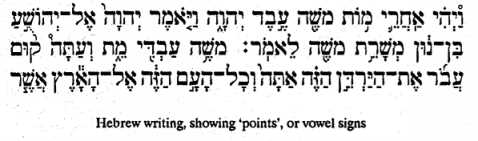
Versions and translations from the ancient past confirm the general reliability of the Hebrew manuscripts. Among the most important of these are the Dead Sea Scrolls, a collection of Old Testament and other writings belonging to a Jewish community that lived in the region of the Dead Sea about 130 BC to AD 70.
There is added confirmation of this reliability in the copies of early translations that were based on Old Testament manuscripts older than any available today. These include translations into Greek in the second century BC, into Syriac in the first century AD, and into Latin in the fifth century AD. Further confirmation comes from the Samaritan version of the Pentateuch and from quotations from the Old Testament found in Jewish writings of the first five centuries AD. (See also SEPTUAGINT.)
New Testament manuscripts
In New Testament times Greek was the language commonly spoken throughout the lands of the Bible story. The books of the New Testament were written in Greek – not classical Greek, but the everyday language spoken by ordinary people. From the beginning, people made copies of letters that Paul and others had written, as well as copies of the Gospel records, and sent them to churches far and near. All this took time, and many years passed before all the writings were gathered together to form the complete New Testament as we know it today (see CANON).
Greek manuscripts were of two kinds, those written entirely in uncial (or capital) letters, and those written in minuscule (or lower case) letters. Writing in uncials was more common in the earlier centuries, but it was gradually replaced by the more convenient minuscule script.
Copyists’ errors are more common in the Greek manuscripts of the New Testament than in the Hebrew manuscripts of the Old Testament. But the variations in the Greek manuscripts do not seriously affect our understanding of what the New Testament writers wrote. There are in existence over five thousand manuscripts of the Greek New Testament (in part or in whole), and although these increase the number of variations, they also increase the possibility of eliminating the errors.
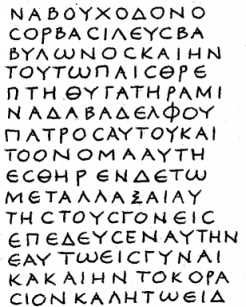
The most valuable manuscripts come from the period of the fourth to the sixth centuries AD, though there are earlier ones. As a rule, the earlier the manuscript, the more likely it is to be correct. On the other hand a more recent manuscript could be more accurate if it was copied from a much earlier and more reliable manuscript. One way of checking the accuracy of manuscripts is to compare them with early translations of the New Testament, or with quotations from the New Testament in the writings of early authors.
As they study all this evidence, experts are able to assess the value of manuscripts and arrange them in groups according to their common features. It has become apparent that different groups of manuscripts belonged originally to different regions (e.g. Rome, Alexandria, Byzantium). This gives scholars an indication of the kinds of manuscripts that were in use at various stages of the early church’s history, and so helps towards determining the exact wording of the original writing.
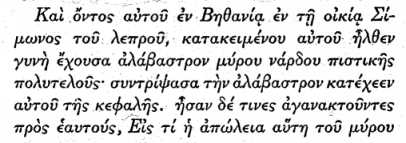
A reliable text
Using all the material available to them, those skilled in the processes outlined above can prepare accurate editions of the Hebrew Old Testament and the Greek New Testament. These books are called texts. Modern translations of the Bible are made from these texts, not from the ancient manuscripts. Most of the manuscripts are carefully preserved in museums or places of learning around the world.
No doubt as there are further discoveries and further insights into ancient languages and practices, there will be further revisions of the Hebrew and Greek texts. Any changes will probably be only minor, as history has shown that changes made to the text through fresh discoveries have been comparatively few and unimportant. In spite of damage to the ancient manuscripts through wear and tear, misuse, copyists’ errors and government opposition, the Scriptures have remained intact, essentially as they were when first written. God has preserved his Word in such a way that no important teaching is anywhere affected.