
Targums, in Gen 30:14. It appears from Scripture, that they were in perfection about the time of wheat harvest, have an agreeable odour, may be preserved, and are placed with pomegranates. Hasselquist, the pupil and intimate friend of Linnaeus; who travelled into the Holy Land to make discoveries in natural history, imagines that the plant commonly called mandrake, is intended. Speaking of Nazareth, in Galilee, he says, “What I found most remarkable at this village was the great number of mandrakes which grew in a vale below it. I had not the pleasure to see this plant in blossom, the fruit now (May 5th, O. S.) hanging ripe on the stem, which lay withered on the ground. From the season in which this mandrake blossoms and ripens fruit, one may form a conjecture that it was Rachel’s dudaim. These were brought her in the wheat harvest, which in Galilee is in the month of May, about this time, and the mandrake was now in fruit.
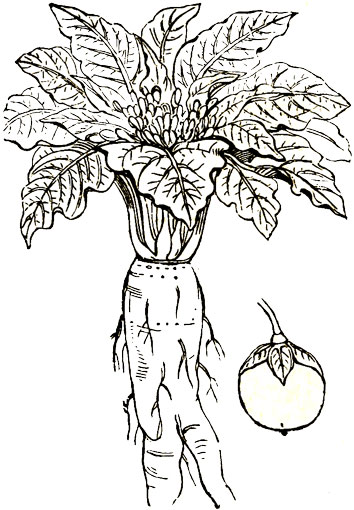
Fig. 250—Mandrake—Atropa Mandragora
This word only occurs in two places of Scripture; first in Gen 30:14-16; and secondly, in Son 7:13. From the notices given in these passages of their qualities it is evident that mandrakes were collected in the fields, that they were fit for gathering in the wheat harvest in Mesopotamia, where the first occurrence took place; that they were found in Palestine; that they or the plants which yielded them diffused a peculiar odor, and that they were supposed to be possessed of aphrodisiac powers, or of assisting in producing conception.
The plant referred to is probably mandragora. ’At the village of St. John in the mountains,’ says Mariti, ’about six miles south-west from Jerusalem, this plant is found at present, as well as in Tuscany. It grows low, like lettuce, to which its leaves have a strong resemblance, except that they have a dark green color. The flowers are purple, and the root is for the most part forked. The fruit, when ripe in the beginning of May, is of the size and color of a small apple, exceedingly ruddy, and of a most agreeable odor; our guide thought us fools for suspecting it to be unwholesome.’ Maundrell was informed by the chief priest of the Samaritans that it was still noted for its genial virtue. Hasselquist also seems inclined to consider this the plant referred to, for, when at Nazareth, he says, ’what I found most remarkable in their villages was the great quantity of mandrakes that grew in a vale below it. The fruit was now (May 16) ripe. From the season in which this mandrake blossoms and ripens its fruit, one might form a conjecture that it is Rachel’s dudaim(mandrakes). These were brought her in the wheat harvest, which in Galilee is in the month of May, about this time, and the mandrake was now in fruit.’
MANDRAKE (dûdâ’îm, Gen 30:14 f., Son 7:13; RVm
E. W. G. Masterman.
Mandrake. A fruit-producing plant with dark green leaves and small bluish-purple flowers. The mandrake is a relative of the potato family which grew abundantly throughout Palestine and the Mediterranean region.
The yellow fruit of the mandrake was small, sweet-tasting, and fragrant. It had narcotic qualities and may have been used medicinally. The fruit of the mandrake was also referred to as the "love apple." It was considered a love potion.