
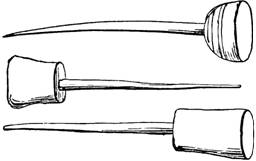
Fig. 76—Awls
The Hebrew word which denotes an awl or other instrument for boring a small hole, occurs in Exo 21:6; Deu 15:17. Considering that the Israelites had at that time recently withdrawn from their long sojourn in Egypt, there can be no doubt that the instruments were the same as those of that country, the forms of which, from actual specimens in the British Museum, are shown in the annexed cut. They are such as were used by the sandal-makers and other workers in leather.
The boring of a slave’s ear with it was the token of his volunteering perpetual service, when he might be free at the year of release (Exo 21:6; Deu 15:17). So Messiah, volunteering to become God’s servant by taking man’s nature; "Mine ears hast Thou opened" (Psa 40:6); Isa 1:5, "the Lord God hath opened Mine ear," i.e., hath made Me obediently attentive as a servant to his master. Heb 10:5-10 quotes it as Septuagint renders it: "a body hast Thou prepared Me," the strongest proof of willing obedience. The ear symbolizes obedience.
(
Exo 21:6 (c) This may be taken to represent the permanent attaching of the saved sinner to the purposes, the person, and the service of JESUS CHRIST, his new Lord and Master. The ear represents the hearing or the listening for commands. There surely comes a time in the life of the believer when he decides definitely to give his whole attention, effort and work to the Master who has purchased him with His Blood. (See also Psa 40:6)