
I have thought it worth while, to stop the reader in this place, in order to make an observation or two on the condescension of the Lord Jesus, respecting his use of this animal, in the unequalled humility of our Lord’s character. We read (Matt. xxi. 2, &c.) that the Lord Jesus, to fulfil the prophecy of one of his servants the prophets, made his entry into Jerusalem on an ass. But there seems to be a general mistake in respect to the humbleness of Christ, in what it consisted. Not, I apprehend, in riding on the ass, but in the personof the rider. White asses were among very noble animals in the estimation of the people of the East. Witness? what Deborah said of them in her song of triumph, (Judges v. 10.) "Speak ye that ride on white asses, ye that sit in judgment. (Judges x2: 14.) And Jacob, in his prophecy concerning Judah evidently had an eye to Christ: "Binding his foal (said Jacob) unto the vine, and his ass’s colt unto the choice vine; he washed his garments in wine, and his clothes in the blood of grapes." (Gen. xlix. 11.) The humbleness of Christ, on this occasion, was the meekness and lowliness of his person, not from the noble beast he rode on. But I will beg to detain the reader with another thought upon the subject, which hath not, as far as I have ever read or heard, been noticed; and yet may be after all, for aught I know, the chief circumstance for which the prophet predicted, and Jesus fulfilled, the prophecy. (Zech. ix. 9.) The ass, though a noble animal, was deemed by the Levitical law, unclean, for it chewed not the cud. (Lev. xi. 26.) And the same law declared, that whosoever touched such, should be deemed unclean. It was on this beast the Lord Jesus was pleased to make his entrance into Jerusalem. And was it not meant [I do not decide the point, but merely ask the question] to shew, that he came to take away the defilements and uncleanness of his people? If Christ became both a sin and a curse for his people, (2 Cor. v. 21. Gal. 3: 13.) might there not be somewhat significant and typical in thus riding upon a beast deemed by the law unclean? I leave the reader to hisown determination on the point, under the grace of God.
such as is employed in labour, carriage, and domestic services.
3.
2Co 6:14: “Be ye not unequally yoked with unbelievers;” which are simply to be understood as prohibiting all intercourse between Christians and idolaters, in social, matrimonial, and religious life. To teach the Jews the propriety of this, a variety of precepts relative to improper and heterogeneous mixtures were interspersed through their law; so that in civil and domestic life they might have them ever before their eyes.
The wild ass, called PARA, is probably the onager of the ancients. It is taller and a much more dignified animal than the common or domestic ass; its legs are more elegantly shaped; and it bears its head higher. It is peculiarly distinguished by a dusky woolly mane, long erect ears, and a forehead highly arched. The colour of the hair, in general, is of a silvery white. These animals associate in herds, under a leader, and are very shy. They inhabit the mountainous regions and desert parts of Tartary, Persia, &c. Anciently, they were likewise found, in Lycaonia, Phrygia, Mesopotamia, and Arabia Deserta. They are remarkably wild; and Job 39:5-8, describes the liberty they enjoy, the place of their retreat, their manners, and wild, impetuous, and untamable spirit. “Vain man would be wise, though he be born a wild ass’s colt,” Job 11:12;
Thus we find that these atonoth are mentioned in Scripture, only in the possession of judges, patriarchs, and other great men; insomuch that where these are there is dignity, either expressed or implied. They were also a present for a prince; for Jacob presented Esau with twenty, Gen 32:15. What then shall we say of the wealth of Job, who possessed a thousand? Another word which is rendered “wild ass” by our translators, Job 39:5, is ORUD; which seems to be the same, that in the Chaldee of Daniel, 5:21, is called oredia. Mr. Parkhurst supposes that this word denotes the brayer, and that PARA and ORUD are only two names for the same animal. But these names may perhaps refer to different races, though of the same species: so that a description of the properties of one may apply to both, though not without some variation.
Who sent out the para free?
Or who hath loosed the bands of the orud? Whose dwelling I have made the wilderness, And the barren land (salt deserts) his resort: The range of open mountains are his pasture, And he searcheth after every green thing.
Gmelin observes that the onager is very fond of salt. Whether the “deserts” of the above text were salt marshes, or salt deserts, is of very little consequence; the circumstance shows the correctness of the Hebrew poet. In Daniel we read that Nebuchadnezzar dwelt with the OREDIA. We need not suppose that he was banished to the deserts, but was at most kept safely in an enclosure of his own park, where curious animals were kept for state and pleasure. If this be correct, then the ORUD was somewhat, at least, of a rarity at Babylon; and it might be of a kind different from the PARA, as it is denoted by another name. May it not be the Gicquetei of Professor Pallas, the wild mule of Mongalia? which surpasses the onager in size, beauty, and perhaps in swiftness.
Common Ass
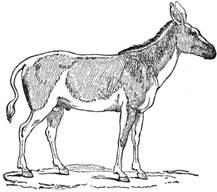
Fig. 63—Domestic Ass of Western Asia
The common working ass of Western Asia (called in the Hebrew Chamor), is an animal of small stature, frequently represented on Egyptian monuments with panniers on the back, usually of a reddish color. It appears to be a domesticated race of the wild ass of Arabia, Mesopotamia, and Southern Persia.
In its natural state it never seeks woody, but upland pasture, mountainous and rocky retreats; and it is habituated to stand on the brink of precipices (a practice not entirely obliterated in our own domestic races), whence, with protruded ears, it surveys the scene below, blowing and at length braying in extreme excitement. This habit is beautifully depicted by Jeremiah (Jer 17:6; Jer 48:6).
The Authorized Version translates the Hebrew words Oir, Oirim, ’young ass,’ ’colt;’ but this rendering does not appear on all occasions to be correct, the word being sometimes used where the Oirim or Ourim carry loads and till the ground, which seems to afford evidence of, at least, full growth (Isa 30:6; Isa 30:24). The word Aton, Atunuth, is unsatisfactorily rendered ’she-ass,’ unless we suppose it to refer to a breed of greater beauty and importance than the common, namely, the silver grey of Africa; which being large and indocile, the females were anciently selected in preference for riding, and on that account formed a valuable kind of property. It is now the fashion, as it was during the Parthian empire, and probably in the time of the Judges, to dapple this breed with spots of orange or crimson, or of both colors together; and although the taste may be puerile, we conceive that it is the record of remote conquest achieved by a nation of Central Asia mounted on spotted or clouded horses, and revived by the Parthians, who were similarly equipped.
As this animal was most serviceable to man, its name was held in respect rather than contempt. It is alleged, indeed, that the ass was held in contempt in Egypt; but among the Arabs and Jews we have ’the voice of one crying in the wilderness,’ a solemn allusion derived from the wild ass, almost the only voice in the desert; and in the distinguishing epithet of Mirvan II, last Ommiad caliph, who was called the wild ass of Mesopotamia—proofs that no idea of contempt was associated with the prophet’s metaphor, and that, by such a designation, no insult was intended to the person or dignity of the prince.
Wild Ass
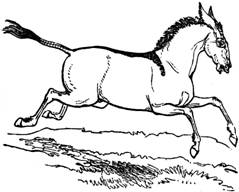
Fig. 64—Wild Ass
By this term the Scripture seems to intend the horse-ass, or wild mule. The species is first noticed by Aristotle, who mentions nine of these animals as being brought to Phrygia by Pharnaces the satrap, whereof three were living in the time of his son Pharnabazus. The allusion of Jeremiah, in speaking of the wild ass (Jer 14:6), most forcibly depicts the scarcity of food when this species, inured to the desert and to want of water, are made the prominent example of suffering. They were most likely used in traces to draw chariots (Isa 21:7). The wild ass is little inferior to the wild horse; in shape it resembles a mule, in gracefulness a horse, and in color it is silvery, with broad spaces of flaxen or bright bay on the thigh, flank, shoulder, neck, and head; the ears are wide like the zebra’s, and the neck is clothed with a vertical dark mane prolonged in a stripe to the tuft of the tail. The company of this animal is liked by horses, and, when domesticated, it is gentle: it is now found wild from the deserts of the Oxus and Jaxartes to China and Central India. In Cutch it is never known to drink, and in whole districts which it frequents water is not to be found. Though the natives talk of the fine flavor of the flesh, and the Gour in Persia is the food of heroes, to an European its smell is abominable.
Mule
Mule occurs in 2Sa 13:29; 1Ki 1:33; 1Ki 10:25; and in other places. This animal is sufficiently well known to require no particular description. Where, or at what period, breeding mules was first commenced is totally unknown, although, from several circumstances, Western Asia may be regarded as the locality; and the era as coinciding with that of the first kings of Israel. In the time of David, to be allowed to ride on the king’s own mule was an understood concession of great, if not sovereign authority, and several years before the mention of this event all the king’s sons already rode upon mules. It does not appear that the Hebrew people, at this early period at least, bred mules; they received them from Armenia; but the most beautiful were no doubt brought from the vicinity of Bassora.
An animal well known for domestic uses; and frequently mentioned in Scripture. People of the first quality in Palestine rode on asses. Deborah, in her song, describes the nobles of the land as those who "ride on white asses," Jdg 5:10 . Compare Jdg 10:4 ; 12:14. The oriental asses are not to be compared with those of northern countries; but are far more stately, active, and lively. Indeed, they were anciently, as still, highly prized; and were also preferred for riding, especially the she-asses, on account of their sure- footedness. Hence we so often find mention of she-asses alone.\par The Wild Ass is a well-known oriental animal, often mentioned in Scripture, and is a much handsomer and more dignified animal than the common ass. These animals were anciently found in Palestine, Syria, Arabia Deserta, Mesopatamia, Phrygia, and Lycaonia; but they rarely occur in those regions at the present time, and seem to be almost entirely confined to Tartary, some parts of Persia, and India, and Africa. Their manners greatly resemble those of the wild horse. They assemble in troops under the conduct of a leader or sentinel, and are extremely shy and vigilant. They will, however, stop in the midst of their course, and even suffer the approach of man for an instant, and then dart off with the utmost rapidity. They have been at all times celebrated for their swiftness. Their voice resembles that of the common ass, but is shriller. Mr. Morier says, "We gave chase to two wild asses, which had so much more speed than our horses, that when they had got at some distance, they stood still and looked behind at us, snorting with their noses in the air, as if in contempt of our endeavors to catch them."\par
Ass. Five Hebrew names of the genus Asinus occur in the Old Testament.
1. Chamor denotes the male domestic ass.
2. Athon, the common domestic she-ass.
3. Air, the name of a wild ass, which occurs Gen 32:15; Gen 49:11.
4. Pere, a species of wild ass mentioned Gen 12:16.
5. Arod occurs only in Job 39:5, but in what respect it differs from the Pere is uncertain.
The ass in eastern countries is a very different animal from what he is in western Europe. The most noble and honorable amongst the Jews were wont to be mounted on asses. (With us, the ass is a symbol of stubbornness and stupidity, while in the East it is especially remarkable for its patience, gentleness, intelligence, meek submission and great power of endurance." -- L. Abbott.
(The color is usually a reddish brown, but there are white asses, which are much prized. The ass was the animal of peace as the horse was the animal of war; hence the appropriateness of Christ in his triumphal entry riding on an ass. The wild ass is a beautiful animal. -- Editor).
Mr. Lavard remarks that in fleetness the wild ass (Asinus hemippus) equals the gazelle and to overtake it is a feat which only one or two of the most celebrated mares have been known to accomplish.
Hebrew
1. The domestic she ass, named so from its slowness.
2. The
The bearing of the Arab donkey is erect, the limbs well formed and muscular, and the gait graceful. It is spirited, and withal docile. The upper classes, judges, (as Jair’s 30 sons, and Abdon’s 40 sons and 30 nephews,) and kings, (as David and Solomon,) rode upon donkeys or mules (Jdg 5:10; Jdg 10:4; Jdg 12:14; 1Ki 1:33). The white ass, combining symmetry with color, is especially esteemed. The ass, by its long hollow sharp-edged hoofs, is more sure footed than the flat hoofed horse; it suffers little from thirst, and is satisfied with prickly herbs, scarcely sweats at all, and so is best suited for the arid hilly regions of western Asia. It is lowly as compared with the horse; it symbolizes peace, as the horse does war, and as such bore the meek and lowly yet divinely royal Savior, the Prince of peace, in His triumphal entrance into His own capital (Zec 9:9); the young untamed colt bearing Him quietly marks His universal dominion over nature as well as spirit.
It was not to be yoked with the ox (Deu 22:10); for the distinctions which God has fixed in nature are to be observed; humanity would forbid animals of such different size and strength being yoked together. Spiritually see 2Co 6:14; Lev 19:19. As it did not chew the end (Lev 11:26), it was unclean; hence is marked the extremity of the famine in Samaria (2Ki 6:25), when "an ass’ head (an unclean beast from which they would ordinarily shrink) was sold for fourscore pieces of silver." "Balsam was rebuked for his iniquity, the voiceless beast of burden (ass) speaking with man’s voice forbade the madness of the prophet" (2Pe 2:16). It turned aside at the sight of the angel; but he, after God’s express prohibition, wished to go for gain, a dumb beast forbidding an inspired prophet! The brute’s instinctive obedience rebukes the gifted seer’s self willed disobedience. Hosea (Hos 8:9) compares Israel to a wild ass: "they are gone up to Assyria, (whereas he ought to dwell) a wild donkey alone by himself" (Num 23:9).
The stubborn wild donkey is wiser than Ephraim, for it avoids intercourse with others through love of freedom, whereas Ephraim courts alliances fatal to his freedom. (Maurer.) In Jer 2:24 headstrong, undisciplinable obstinacy, and untamable perversity, and lust after the male, answering to Israel’s spiritual lust after idols and alliances with pagan, are the point (Hos 2:6-7): "all they (the males) that seek her will not (have no need to) weary themselves in searching for her, in her month (the season when sexual impulse is strongest), they shall find her" putting herself in their way, and not needing to be sought cut by the males.
3. The
4.
5.
(properly
(II.) The ass is the Equus Asinus of Linnaeus; Some formed into a sub- genus, containing that group of the Equidae which are not striped like zebras, and have forms and characters distinguishable from true horses, such as a peculiar shape of body and limbs, long ears, an upright mane, a tail only tufted at the end, a streak along the spine, often crossed with another on the shoulders, a braying voice, etc. To designate these animals the Hebrews used various terms, by which, no doubt, though not with the strict precision of science, different species and distinct races of the group, as well as qualities of sex and age, were indicated; but the contexts in general afford only slight assistance in discriminating them; and reliance on cognate languages is often unavailing, since we find that similar words frequently point to secondary and not to identical acceptations. The name is assigned by the’ Auth. Vers. to several distinct Heb. words, viz.
Supplementary Ass Information ("Ass" entry from Volume 11: entries consolidated):
We give the following additional particulars on this animal:
The Jews were accused of worshipping the head of an ass.- Josephus (Contr. Apion. ii, 7) very indignantly blames Apion for having the impudence to pretend that the Jews placed an ass’s head of gold in their holy place, which the grammarian asserted Antiochus Epiphanes discovered when he spoiled the Temple. Plutarch (Sympos. 4:5) and Tacitus (Hist. v, 3,4) seem to have believed in this slander. It would be out of place here to enter further into this question, as it has no scriptural bearing; but the reader may find much curious matter relating to this subject in Bochart (Hieroz. iii, 199 sq.). SEE ASS-WORSHIP.
2. Athon (
3. Ayir (
Ass. Five Hebrew names of the animals of this family occur in the Old Testament. 1. Chamôr denotes the male domestic ass. 2. Athôn, the common domestic she-ass. 3. Aîr, the name of a wild ass, which occurs Gen 32:15; Gen 49:11. 4. Pere, a species of wild ass mentioned Gen 12:16. 5. Arôd occurs only in Job 39:5; but in what respect it diners from the former is uncertain. The ass in eastern countries is a very different animal from what he is in western Europe. The most noble and honorable amongst the Jews were wont to be mounted on asses. The ass to us is a symbol of stubbornness and stupidity, while in the East it is remarkable for its patience, gentleness, intelligence, and great power of endurance. The color is usually a reddish brown, but there are white asses, much prized. The ass was used in peace as the horse was in war; hence the appropriateness of Christ in his triumphal entry riding on an ass. Mr. Layard remarks that in fleetness the wild ass equals the gazelle.
In the East the ass takes the place which the horse has among European nations. It is there a much more noble animal, and is declared to be a very intelligent one: cf. Isa 1:3. It is highly valued there and is well treated. It was used for riding both by men and women, and for carrying burdens. Among a man’s property the asses are often enumerated. Gen 12:16; Job 1:3; Job 42:12; Ezr 2:67; Neh 7:69. There are five Hebrew words used for the domestic and the wild ass, referring to its strength or to its colour.
The ’white asses’ mentioned in Jdg 5:10 are still greatly prized in the East. In some parts the flesh of the ass is highly esteemed for food, but it was forbidden as unclean to the Jews: it was however eaten in the dire famine at the siege of Samaria. 2Ki 6:25.
THE WILD ASS is very wild and very swift. It is seldom tamed. It is thus a fit emblem of man’s natural birth. Job 11:12. Jehovah demanded of Job "Who hath sent out the wild ass free? or who hath loosed the bands of the wild ass?" Job 39:5: cf. Jer 7:24; Dan 5:21.
ASS.—See Animals, p. 63a.
By: Morris Jastrow, Jr., Gerson B. Levi, Louis Ginzberg
—Biblical Data:
The Bible knows both the wild and the domestic Ass. (1) The wild Ass ("pere" or "'arod") generally roamed about in herds, and is associated with the wilderness (Job xxiv. 5). The character of the wild Ass gave occasion for applying the term figuratively ("wild ass") to one who in unbridled opposition had his hands ever turned against his fellows (Gen. xvi. 12, R. V.).
(2) The domesticated Ass ("Ḧamor," "aton" [fem.], "'ayir" [young Ass]) was put to various uses; (a) for riding (Num. xxii. 21; II Kings iv. 24; Judges x. 4, xii. 14), in which the young Ass andshe-ass were mainly employed; (b) for carrying burdens (Gen. xxii. 3, xlii. 26); and (c) for plowing (Isa. xxx. 24; Deut. xxii. 10), in which the young Ass and he-ass were utilized. The Deuteronomic code forbids the harnessing of the Ass with the ox (Deut. xxii. 10); the explanation usually offered being that as their strength and weight are so unequal, the harnessing of the two would entail annoyance and suffering on both. It may be, however, that back of the curious prohibition lies some obsolete superstition, the injunction resting on an omen that was no longer intelligible to the compiler of the code.
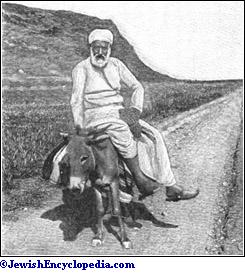
Syrian Ass, Showing Manner of Riding.(From a photograph by Bonfils.)
—In Rabbinical Literature:
"The ox for plowing, the ass for carrying burdens," is the reason given in the Talmud for the creation of these animals ('Ab. Zarah 5b; Tanna debe Eliyahu R. ii.). As regards species, a distinction is drawn between the wild and the domesticated Ass, the former, "'arud," being reckoned among the wild beasts of the field (Kil. viii. 6); hence the Biblical precept is applied to it (Kil. i. 6) forbidding it to be crossed with the domestic variety. The most valuable species is declared to be the Libyan, distinguished for its size and strength (Bek. 5b); but which, on account of its fiery character, must be driven with a powerful bit (Shab. 51b). However, Immanuel Löw asserts that this description applies not to the Libyan Ass, but to the Lycaonian variety, which is mentioned in old sources (Mishnah Shab. v. 1), and which, according to the testimony of Greek and Latin writers, was frequently partially tamed for crossing with the mare (Krauss, "Lehnwörter," ii. 3017). The meat of the Ass is said to have the same specific gravity as human flesh ('Ar. 19b); and the blood of a foal is held to be a remedy for jaundice (Shab. 110b). The bite of an Ass was accounted more dangerous than that of a dog, for it might break a bone (Pes. 49b), a case being cited where an Ass completely crushed with its bite the arm of a child (B. Ḳ. 84a). The Ass is not particular in its food, eating such things as brush and thistles, and when hungry it has been known to eat fish (B. Ḳ. 19b); nevertheless, baled provender for a young Ass should be opened out, a labor permissible on the Sabbath (Shab. 155a). The she-ass produces no young before her third year (Bek. 19b). A strap made either from ass-hide or calf-hide was employed in judicial scourgings, a fact which was thus wittily applied by an itinerant preacher in expounding the well-known words of Isaiah (i. 3): "The ass knoweth his master's crib, but Israel doth not know; therefore, let him that doth not know be chastised by the hide of him that doth know" (Mak. 23a).
In Proverbial Use.
No other animal is perhaps so frequently mentioned in popular proverbs as the Ass. "Where our forefathers were angels, we are but men; where they were men, we are only asses" (Shab. 112b and often elsewhere), a saying which shows that even in those days the Ass was considered an example of stupidity (B. B. 74a). Its stupidity and insensibility are expressed in the proverb, "The ass freezes even in July" (Shab. 53a). To be called "an ass" was therefore an insult: "If one hath called thee ass, go and get a halter for thyself" (B. Ḳ. 92b). A variation of this is found in the Palestinian saying, "If a man say unto thee, thou hast asses' ears, pay no heed to him; but if two say it to thee, go and get thee a saddle right away" (Gen. R. xlv. 7). Other proverbs are, "The pace of the ass depends upon its barley [its food]" (Shab. 51b); and "Many young asses die and their skins serve as trappings for their mother" (Lev. R. xx. 10; Gen. R. lxvii. 8). Concerning the color of asses, the following is found: "Thou sayest thou hast seen a black ass ? Then thou hast seen neither a black one nor a white one, for there are no black asses" ("Alphabet" of Ben Sira, letter 8).
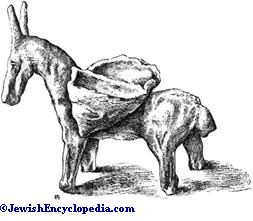
Ass with Panniers.(From a Phenician terra-cotta in the Metropolitan Museum of Art, New York.)
The Ass employed by Abraham when he traveled to the sacrifice of Isaac was declared to be the same animal which later bore Moses' wife and her sons into Egypt (Ex. iv. 20); and it is declared that the same animal is also to serve the Messiah, who is to come "riding upon an ass" (Zech. ix. 9). The mother of this Ass is said to have been the one upon which Balaamrode, and which was created at the close of the sixth day of Creation at dusk (Pirḳe R. El. xxxi.). The old sources, as Abot v. 6, speak only of the creation of the "mouth of the ass" (Ginzberg, "Die Haggada bei den Kirchenvätern," pp. 49, 50; see Balaam).
When the Ass of Phinehas b. Jair, or, some say, of Hanina b. Dosa, was once stolen, she refused to eat the fodder laid before her because the tithe upon it had not been paid to the priest, whereupon the thieves set her free and she returned to her master (Yer. Dem. i. 21d, below; compare also Ḥul. 7b; Ab. R. N. viii. for variations of the legend). The Ass of Rabbi Jose would not enter his stall until a pair of shoes which were lying upon his back, and which did not belong to his master, had been removed (Ta'an. 24a).
Ass-drivers were held in small repute; the current opinion being that the majority of them were rascals (Ḳid. iv. 14, 82a; but see Niddah 14a). An "assdriver's question" is equivalent to a "stupid question" (Yer. Sanh. vi. 23b).
Bibliography:
Lewysohn, Die Zoologie des Talmuds, pp. 22, 23, 140-143;
Rubin, Tehillat ha-Kesilim, pp. 47-53.
ASS (hamôr; ‘she-ass,’ ’âthon [Gr. onos of both sexes]; ‘young ass’ or ‘colt,’ ‘ayir [Gr. pôlos]; ‘wild ass,’ pere’ and ‘ârôdh).—The ass (Arab.
The young ass (Isa 30:5; Isa 30:24) or colt (Job 11:12, Zec 9:9, Luk 19:33 etc.), the Arab.
Wild asses are not to-day found in Palestine, though, it is said, plentiful in the deserts to the East (Job 24:5), where they roam in herds and run with extraordinary fleetness (Job 39:5). Ishmael is compared in his wildness and freedom to a wild ass (Gen 16:12), while Issachar is a wild ass subdued (Gen 49:14; Gen 49:16).
E. W. G. Masterman.
Animal mentioned over 130 times in Holy Scripture. It was popular for riding in the Holy Land because of even gait and surefootedness, and was ridden not only by the common people but also by those of highest rank. The triumphant entrance of Our Lord into Jerusalem on the first Palm Sunday was upon an ass: "Fear not, daughter of Sion: behold, thy king cometh, sitting on an ass’s colt." (John 12.)
1. Names
The name
2. Meaning
(1)
(2)
(3)
(4)
(5)
3. Uses
From the references to these various names in the Old Testament it is clear that (1)
4. As a Domestic Animal
Besides the use of the ass in agriculture and riding it was employed in the caravans of commerce, and sent even upon long expeditions through the desert. The ass is and always has been one of the most common domestic animals. It is a much more important animal in Bible lands than in England and America. The humblest peasant owned his own ass. It is associated throughout the Bible with peaceful pursuits (Gen 42:26 f; Gen 22:3; 1Sa 16:20; 2Sa 19:26; Neh 13:15), whereas the horse is referred to in connection with war and armies. Reference is also made to the use of the flesh of the ass in time of famine (2Ki 6:25). The origin of the ass like that of most domestic animals is lost in antiquity and it cannot be confidently stated from what species of wild ass it was derived. There are three races of wild asses in Asia, one of which is found in Syria, but they may all be referred to one species, Equus hemionus. The African species is E. asinus, and good authorities consider our domestic asses to have descended from this, and to have been introduced at an early period into the entire Orient. The
As a domestic animal it preceded the horse, which was first introduced into Egypt by the Hyksos about 1800 bc. See HORSE.
5. Figurative Uses in the Old Testament
(1)
(2)
6. Wider Use in Literature
The ass (
Literature
G. A. Smith, Jerusalem, I, 307ff; Gesenius’ and Fürst’s Lexicons to the Old Testament; articles in Encyclopedia Biblica and HDB.
Gen 49:14 (a) Here we have a type of the consecrated believer who is willing to be a burden bearer for GOD and for man. He bears the burdens of GOD’s people, and carries them to GOD. He bears the burden of GOD’s message, and carries it to the people. He realizes that a path of rest and peace is good for GOD’s. people, and he wants to share in the work of making it possible.
This may also be a type of the Lord JESUS Himself. Certainly He is our burden bearer; he bears the burden of our relationship to GOD, and also our relationship to other people. He too sees that rest is good, and calls on us to cast every burden upon Him, so that we may be free ourselves to carry the burdens of others. Certainly this is a wonderful picture of the ministry of CHRIST JESUS, our Lord. (See Mat 11:28).
Exo 13:13 (c) The ass in this passage is typical of the sinner who must be redeemed by the death of the Lamb of GOD, or else be himself lost under the judgment of GOD.
Job 11:12 (a) The ass represents the unsaved parent who gives birth to on unsaved child (the colt). The thought of being "wild" is that the natural man wants no restraint nor does he want to be hindered in his movements. We see this plainly in the little child who wants to do as he pleases on his earliest days. It is carried out through life unless the restraining power of GOD is brought to bear upon him.
Isa 1:3 (b) This ass is a type of the unsaved person and of any who are not interested in GOD but only want His blessings and His gifts. The ox in the passage is a type of the believer who loves the Lord and cares more for the giver than for the gift.
Zec 9:9 (c) This ass, as the one in Joh 12:14, represents the believer, who being set free from his old bondage carries the Lord JESUS about wherever he goes so that others may see and know Him.
(taken from "Number in Scripture")
"The ’ass’ is the only animal that man is compared to: see Job 11:12, "For vain man would be wise, though man be born a wild ass’s colt."
In Exo 13:13, the first-born of man is classed with the firstling of an ass. Both must be redeemed with a lamb. This is repeated in Exo 34:20. Nothing less than a sacrificial redemptive act could bring such a being to GOD.
There are 28 (4 x 7) asses separately spoken of, and with these may be compared the 28 (4 x 7) ’times’ connected with ’vain man’ in Ecc 3:1-8.
1. Balaam’s ass (Num 22:21), "a time to speak."
2. Achsah’s ass (Jos 15:18), "a time to get," when she lighted off her ass to make her request and get what she asked.
3. Samson’s (Jdg 15:15), "a time to war."
4. The Levite’s (Jdg 19:28), "a time to be silent," when "none answered," and he sent his desperate, silent message throughout Israel.
5. Abigail’s (1Sa 25:20), "a time of peace," when she met David and made peace for Nahal.
6. Her second ass (1Sa 25:42), "a time to love," when she went to meet David and became his wife.
7. Ahithophel’s (2Sa 17:23), "a time to die," when he saddled his ass and went and hanged himself.
8. The "old prophet’s" ass (1Ki 13:23-24), "a time to kill," when he found "the man of God" killed by the lion.
9. The "man of God’s" ass (1Ki 13:29), "a time to mourn," when the old prophet laid him thereon "to mourn and to bury him."
10. The Shunamite’s ass (2Ki 4:24-37), "a time to heal," when she rode to Elisha, who restored her son.
11. Mephibosheth’s (2Sa 19:26), "a time to embrace," when he would go and salute David.
12. Shimei’s (1Ki 2:40-46), "a time to die."
13. Jesse’s (1Sa 16:20), "a time to live" (21).
14. Moses’ (Exo 4:20-26), "a time to kill," when he incurred the judgment of Gen 17:14, and fulfilled the truth.
15. Abraham’s (Gen 22:3), "a time to get and a time to lose," when GOD demanded back the son He had given.
16. The Saviour’s ass (Mat 21:5, Mat 21:9), "a time to laugh," when the daughter of Jerusalem rejoiced.
17. The young, its foal (Mat 21:5).
18-28. The asses of Jacob’s sons (Gen 44:13), filling up the other "times."
See also Donkey