
Are´tas, the common name of several Arabian kings.
1. The first of whom we have any notice was a contemporary of the Jewish high-priest Jason and of Antiochus Epiphanes about B.C. 170 (2Ma 5:8).
2. Josephus mentions an Aretas, king of the Arabians contemporary with Alexander Jannæus (died b.c 79) and his sons. After defeating Antiochus Dionysus, he reigned over Cœle-Syria, ’being called to the government by those that held Damascus by reason of the hatred they bore to Ptolemy Mennæus.’ He took part with Hyrcanus in his contest for the sovereignty with his brother Aristobulus, and laid siege to Jerusalem, but, on the approach of the Roman general Scaurus, he retreated to Philadelphia. Hyrcanus and Aretas were pursued and defeated by Aristobulus, at a place called Papyron, and lost above 6000 men. Three or four years after, Scaurus, to whom Pompey had committed the government of Cœle-Syria, invaded Petræa, but finding it difficult to obtain provisions for his army, he consented to withdraw on the offer of 300 talents from Aretas.
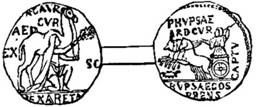
Fig. 47—Coin displaying the name Aretas
3. Aretas, whose name was originally Æneas, succeeded Obodas. He was the father-in-law of Herod Antipas. The latter made proposals of marriage to the wife of his half-brother Herod-Philip, Herodias, the daughter of Aristobulus their brother, and the sister of Agrippa the Great. In consequence of this, the daughter of Aretas returned to her father, and a war (which had been fomented by previous disputes about the limits of their respective countries) ensued between Aretas and Herod. The army of the latter was totally destroyed, and on his sending an account of his disaster to Rome, the emperor immediately ordered Vitellius to bring Aretas prisoner alive, or, if dead, to send his head. But while Vitellius was on his march to Petra, news arrived of the death of Tiberius, upon which, after administering the oath of allegiance to his troops, he dismissed them to winter-quarters and returned to Rome. It must have been at this juncture that Aretas took possession of Damascus, and placed a governor in it with a garrison. For a knowledge of this fact we are indebted to the apostle Paul.
The name of several kings of northwestern Arabia. The only one mentioned in Scripture gave his daughter in marriage to Herod Antipas; but she being repudiated by Herod, Aretas made war upon him and destroyed his army. In consequence of this, the emperor Tiberius directed Vitellius, then proconsul of Syria, to make war upon or dead to Rome. But while Vitellius was in the midst of preparation for the war, he received intelligence of the death of Tiberius, A. D. 37; on which he immediately recalled his troops, dismissed them into winter quarters, and then left the province. Aretas, taking advantage of this supineness, seems to have made an incursion and got possession of Damascus, over which he appointed a governor or ethnarch, who, A. D. 39, at the instigation of the Jews, attempted to put Paul in prison, 2Co 11:32 . Compare Mal 9:24,25 .\par
A common name of many Arabian kings. 2Co 11:32; "in Damascus the governor
But Tiberius, at Antipas’ entreaty, commanded Vitellius, governor of Syria, to take Aretas dead or alive. Before the order was executed Tiberius himself was dead. Then all was reversed. Antipas was banished by Caligula to Lyons, and his kingdom given to Agrippa, his nephew and his foe. It seems therefore to harmonize with history, as well as with Scripture, to assume that in A.D. 38 or 39, when Caligula made several changes in the E., he also granted Damascus to Aretas. The incidental way in which Paul alludes to Aretas’ kingship over Damascus at the time of his escape from the ethnarch under him, by being let down in a basket from a house on the city wall (compare Act 9:23-25), is a strong presumption for the truth of the Acts and Second Epistle to Corinthians. This was three years after Paul’s conversion; so that A. D. 36 will be the date of his conversion.
(
2. Josephus (Ant. 13, 13, 3) mentions an Aretas, king of the Arabians
(surnamed Obedas,
3. Aretas, whose name was originally AEneas (
4. One or more other kings of Arabia by the same name are mentioned in history (Strabo, 16:781; Dio Cass. 37:15; comp. Assemani, Bibl. Orient. 1, 367; 2, 331; 3, 1, 139; and a coin of one of them is extant (Mionet, Desc. des medailles antiques, p. 284, 285; comp. Conybeare and Howson, St. Paul, 1, 107); but it is not clear that the Aretas whom Josephus names as having a contest with Syllaeus (Ant. 17, 3, 2; War, 1, 29, 3) was different from the preceding, and the succeeding kings of that name are unimportant in any Scriptural relation (see Anger, De tempor. ratione, p. 173; Heyne, De Areta Arabum rege, Viteb. 1775; Heinold, De ethnarcha Jeudeorum Paulo obsidiante, Jen. 1757).
Aretas (ăr’e-tâs), virtuous. 2Co 11:32. The king of Arabia Petræa at the time the governor of Damascus attempted to apprehend Paul. Act 9:24-25. His daughter married Herod Antipas, but was afterward divorced to allow him to marry Herodias. In consequence of this insult, Aretas made war upon Antipas and defeated him. Antipas was soon after banished and his kingdom given to Agrippa. It is likely that Aretas was restored to the good graces of the Romans, and that Caligula granted him Damascus, which had already formed part of his predecessor’s kingdom. In this way we can account for the fact in Paul’s life stated above.
[Ar’etas]
The common appellation (like Pharaoh for Egyptian kings) of the Arabian kings of the northern part of Arabia. The deputy of Aretas in Damascus sought to arrest Paul. 2Co 11:32. This king, who was father-in-law to Herod Antipas, made war against him for divorcing his daughter, and defeated him. Vitellius, governor of Syria was ordered to take Aretas dead or alive; but Tiberius died before this was accomplished. Caligula, who succeeded to the empire, banished Antipas. He made certain changes in the East, and it is supposed that Damascus was detached from the province of Syria and given to Aretas.
( in Aramaic  ) IV.:
By: Richard Gottheil, Louis Ginzberg
Nabatæan king; reigned from 9 B.C. to 40 of the common era. His full title, as given in the inscriptions, was "Aretas, King of the Nabatæans, Friend of his People." Being the most powerful neighbor of Judea, he frequently took part in the state affairs of that country, and was influential in shaping the destiny of its rulers. While on not particularly good terms with Rome—as intimated by his surname, "Friend of his People," which is in direct opposition to the prevalent
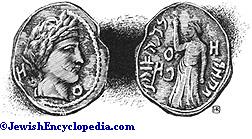
Bronze Coin of Aretas IV. Philodeme of Nabathæa, with Inscription—. . .  . . .
. . .  —"Aretas King of Nabathæa . . . Year . . . "(After Vigouroux, "Dictionnaire de la Bible.")
Aretas IV. is probably identical with the Aretas whose governor at Damascus attempted to imprison Paul the apostle while the latter was on his missionary journey (II Cor. xi. 32). Since in a parallel passage (Acts ix. 23 et seq.) the Jews of Damascus are mentioned as lying in wait for Paul, it is very probable that Aretas made the attempt to capture Paul at the request of the Jews. From this it follows that the Jews must have been influential in the Nabatæan kingdom; otherwise the Nabatæans would have been careful to avoid any interference with Paul, who was a Roman citizen.
Bibliography:
A. von Gutschmid, in Euting, Nabatäische Inschriften, p. 84, Berlin, 1885;
Schürer,Gesch. i. 617-619, and the bibliography cited;
Paul Ewald, in Realencyclop. für Protest. Theologie, 3d ed., i. 795 et seq.;
Wilcken, in Pauly-Wissowa, Real-Encyclopädie, s.v.;
and the commentaries upon the New Testament passages quoted.
ARETAS.—This is the dynastic name (Aram.
A. J. Maclean.
1. 2 Macc 5:8
It is mentioned several times in Biblical literature and in Josephus. Here it refers to an Arabian king, who was a contemporary of Antiochus Epiphanes (circa 170 bc), before whom Jason the high priest was accused.
2. Obodas
Another Arabian prince of this name, surnamed Obodas (Ant., XIII, xv, 2; xvi, 2; XVI, ix, 4) defeated Antiochus Dionysius and reigned over Coele-Syria and Damascus. He participated with Hyrcanus in the war for the Jewish throne against his brother Aristobulus, but the allies were completely defeated at Papyron, by Aristobulus and Scaurus, the Roman general. The latter carried the war into Arabia and forced Aretas to make an ignominious peace, at the price of three hundred talents of silver. Of that event a memorial denarius still exists, with a Roman chariot in full charge on the one side and a camel on the other, by the side of which an Arab is kneeling, who holds out a branch of frankincense.
3. Aeneas
The successor of Obodas was apparently surnamed Aeneas and this is the Arabian king who figures in the New Testament (2Co 11:32; compare Act 9:24). The Aretas, here mentioned, is the father-in-law of Herod Antipas, who divorced his wife to marry Herodins, the wife of his brother Philip (Mat 14:3; Mar 6:17; Luk 3:19). Josephus (Ant., XVIII, v, 1, 3) gives us a circumstantial narration of the events leading up to and following the conduct of Antipas. Coupled with a boundary dispute, it occasioned a bitter w ar between the two princes, in which Antipas was completely overwhelmed, who thereupon invoked the aid of the Romans. Tiberius ordered Vitellius, proconsul of Syria, to make war on Aretas and to deliver him dead or alive into the hands of the emperor. On the way, at Jerusalem, Vitellius received intelligence of the death of Tiberius, March 16, 37 ad, and stopped all warlike proceedings (Ant., XVIII, v, 1, 3). According to 2Co 11:32, Damascus, which had formerly belonged to the Arabian princes, was again in the hands of Are tas, when Paul escaped from it, not immediately after his conversion, but on a subsequent visit, after his Arabian exile (Gal 1:16, Gal 1:17). It is inconceivable that Aretas should have taken Damascus by force, in the face of the almost omnipotent power of Rome. The picture moreover, which Josephus draws of the Herodian events, points to a passive rather than an active attitude on the part of Aretas. The probability is that Cajus Caligula, the new emperor, wishing to settle the affairs of Syria, freely gave Damascu s to Aretas, inasmuch as it had formerly belonged to his territory. As Tiberius died in 37 ad, and as the Arabian affair was completely settled in 39 ad, it is evident that the date of Paul’s conversion must lie somewhere between 34 and 36 ad. This date is further fixed by a Damascus coin, with the image of King Aretas and the date 101. If that date points to the Pompeian era, it equals 37 ad, making the date of Paul’s conversion 34 ad (Mionnet, Descript. des médailles antiques, V, 284-85).
(ἈñÝôáò, Arab, Ḥâritha)
The Gr. form of a name borne by several rulers of the Nabataean Arabs, whose capital was Petra in Arabia.
1. The first known to history, ‘Aretas, prince of the Arabians,’ is said to have had the fugitive high-priest Jason shut up at his court (2Ma_5:8; the Gr. text is doubtful). His designation as ‘prince’ (ôýñáííïò) indicates that the hereditary chieftain of the tribe had not yet assumed the dignity of king-ship. The royal dynasty was founded by Erotimus about 110-100 b.c., when the Greek kings of Syria and Egypt had lost so much of their power, ‘ut adsiduis proeliis consumpti in contemptum finitimorum vencrint praedaeque Arabum geuti, imbelli antea, fuerint’ (Trog. Pomp. ap. Justin., xxxix. 5. 5-6).
2. The second Aretas, called äʼ ÁñÜâùí âáóéëåýò, is mentioned by Josephus (Ant. xiii. xiii. 3) in connexion with the siege of Gaza by Alexander Jannaeus in 96 b.c.
3. Aretas iii., who reigned from about 85 to 60 b.c., is known as ‘Aretas the Philhellene,’ this being the superscription of the earliest Nabataean coins that are known. Under him the mountain fortress of Petra began to assume the aspect of a Hellenistic city, and the Nabataean sway was extended as far as Damascus. He incurred the displeasure of the Romans by interfering in the quarrel of Hyrcanus and Aristobulus, but the war which Scaurus waged against him left his power unbroken (Ant. xiv. v. i.; Bellum Judaicum (Josephus) i. viii. 1). He could not, however, prevent Lollius and Metellus from taking possession of Damascus (Ant. xiv. ii. 3; Bellum Judaicum (Josephus) i. vi. 1), which thereafter was permanently under the suzerainty of Rome.
4. Aretas IV., Philopatris, the last and best-known, had a long and successful reign (circa, about 9 b.c.-a.d. 40). He was originally called aeneas, but on coming to the throne he assumed the favourite name of the Nabataean kings. He soon found it necessary to ingratiate himself with Rome.
Augustus ‘was angry that Aretas had not sent to him first before he took the kingdom; yet did aeneas send an epistle and presents to Caesar, and a crown of gold of the weight of many talents.’ … The Emperor ‘admitted Aretas’s ambassadors, and after he had just reproved him for his rashness in not waiting till he had received the kingdom from him, he accepted his presents, and confirmed him in the government’ (Jos. Ant. xvi. ix. 4, x. 9).
This Aretas’ daughter became the wife of Herod Antipas, who divorced her in order to marry Herodias (Mar_6:17). Border disputes gave the injured father an opportunity of revenge. Again acting, at this new juncture, without consulting Rome, he attacked and defeated Antipas (a.d. 28); and again fortune smiled on his daring disregard of consequences. The belated expedition which Vitellius, governor of Syria, at Tiberius’ command, led against Petra, had only got as far as Jerusalem, when the tidings of the Emperor’s death (a.d. 37) caused it to be abandoned.
There is circumstantial evidence, though perhaps too slender to be quite convincing, that Tiberius’ successor Caligula favoured the cause of Aretas. St. Paul was converted probably about a.d. 36 (so Turner), and, some time after, the Jews of Damascus conspired to kill him (Act_9:22 f.). In recalling this fact he mentions a detail (2Co_11:32) which the writer of Acts omits, namely, that it was the governor (ἐèíÜñ÷çò) under Aretas the king who-doubtless at the instigation of the Jews-guarded the city to take him. The question is thus raised when and how Aretas became overlord of Damascus. It is inconceivable either that he captured the city in face of the Roman legions in Syria, or that Tiberius, who in the end of his reign was strongly hostile, ceded it to him. But it is probable that Caligula favoured the enemy of Herod Antipas. One of his first imperial acts was to give the tetrarchy of Philip and Lysanias to Agrippa (Ant. xviii. vi. 10), and he may at the same time have given Damascus to Aretas as a peace-offering. It was better policy to befriend than to crush the brave Nabataeans. Antipas was ultimately deposed and banished in 39.
It was only for a short time, however, that Rome relaxed her direct hold upon the old Syrian capital. There are Damascene coins with the figure of Tiberius down to a.d. 34, and the fact that none has been found with the image of Caius or Claudius is significant of a change of régime; but the image of Nero appears from 62 onwards. To the view of Marquardt (Röm. Staatsverwaltung, 1885, i. 405) and Mommsen (Provinces2, 1909, ii. 149), based on 2Co_11:32, that Damascus was continuously in subjection to the Nabataean kings from the beginning of the Roman period down to a.d. 106, there are the strongest objections (see Schürer, History of the Jewish People (Eng. tr. of GJV).] i. ii. 354). Cf. article Arabia.
More coins and inscriptions date from the time of Aretas IV. than from any Nabataean reign. While the standing title of Aretas III. was öéëÝëëçíïò, that which the last chose for himself was øçí òîä, ‘Lover of his people.’ He set country above culture; he was a Nabataean patriot first and a Hellenist afterwards. It was probably this successful reign that Josephus had in view when he wrote of the extension of the Nabataean kingdom from the Euphrates to the Red Sea (Ant. i. xii. 4).
Literature-In addition to the authorities cited in the body of the article , see Literature appended to article Arabia, and P. Ewald, article ‘Aretas,’ In Realencyklopädie für protestantische Theologie und Kirche 3.
James Strahan.
(2 Corinthians 11)
- King of Nabatea (9BC-AD40), capital Petra, apparently ruled Damascus even though it was a city of the Decapolis. His daughter was the first wife of Herod Antipas. Antipas divorced her for his niece Herodias, the mother of Salome who was responsible for the death of John the Baptist. King Aretas avenged his daughter’s treatment by going to war against Antipas, who only survived with Roman help.