
son of Herod the Great, and Maltace, his fifth wife. Herod having put to death his sons Alexander, Aristobulus, and Antipater, and expunged out of his will Herod Antipas, whom he had declared king, he substituted Archelaus, and gave Antipas the title of tetrarch only. After the death of Herod, Archelaus ordered that king’s will to be read, wherein he, Archelaus, was declared king, on condition that Augustus consented. Hereupon the assembly cried, “Long live king Archelaus!” and the soldiers promised the same fidelity to him as they had shown to his father.
Archelaus buried his father magnificently, came to Jerusalem, and there mourned seven days, according to custom. He then gave a splendid entertainment to the people, went to the temple, harangued the multitude, promised them good treatment, and declared he would not assume the title of king till the emperor had confirmed it, A.M. 4001; B.C. 3. The people, notwithstanding, tumultuously demanded the execution of those who advised Herod to slay certain zealots, who had pulled down a golden eagle from one of the temple gates. They also required Archelaus to divest Joazar of the high priesthood; and they vehemently reproached the memory of the late king. Archelaus sent troops to suppress the mutineers, and killed near three thousand of them about the temple. After this he embarked at Caesarea for Rome, to procure from Augustus the confirmation of Herod’s will. Antipas, his brother, went to Rome likewise, to dispute his title, pretending that Herod’s first will should be preferred to his last, which he alleged to have been made by him when his understanding was not sound.
The two brothers, Archelaus and Antipas, procured able orators to display their pretensions before the emperor; and when they had done speaking, Archelaus threw himself at Augustus’s feet. Augustus gently raised him, said he would do nothing contrary to Herod’s intention or his interest, but refused to decide the affair at that time. Some time afterward, the Jews sent a solemn embassy to Rome, to desire Augustus would permit them to live according to their own laws, and on the footing of a Roman province, without being subject to kings of Herod’s family, but only to the governors of Syria. Augustus heard them, and likewise heard Archelaus in reply; then broke up the assembly without declaring himself. After some days, he sent for Archelaus, gave him the title, not of king, but of ethnarch, with one moiety of the territories which his father Herod had enjoyed; promising him the crown likewise, if his good conduct deserved it. Archelaus returned to Judea, and, under pretence that he had countenanced the seditions against him, he deprived Joazar of the high priesthood, and gave that dignity to his brother Eleazar. He governed Judea with so much violence, that, after seven years, the chiefs of the Samaritans and Jews accused him before Augustus. The emperor immediately sent for his agent at Rome, and without condescending to write to Archelaus he commanded the agent to depart instantly for Judea, and order Archelaus to Rome, to give an account of his conduct. On his arrival at Rome, the emperor called for his accusers, and permitted him to defend himself; which he did so insufficiently, that Augustus banished him to Vienne, in Gaul, where he continued in exile to the end of his life. See ANTIPAS.
Archela´us, son of Herod the Great, and his successor in Idumaea, Judea, and Samaria (Mat 2:22) [HERODIAN FAMILY].
Archela’us. (prince of the people). Son of Herod the Great, by a Samaritan woman, Malthake, and, with his brother, Antipas, brought up at Rome. At the death of Herod, (B.C. 4), his kingdom was divided between his three sons, Herod Antipas, Archelaus and Philip. Archelaus never properly bore the title of king, Mat 2:22, but only that of ethnarch.
In the tenth year of his reign, or the ninth according to Dion Cassius, that is, A.D. 6, a complaint was preferred against him by his brothers and his subjects on the ground of his tyranny, in consequence of which he was banished to Vienne in Gaul, where he is generally said to have died.
Son of Herod the Great by Malthake, a Samaritan. Brought up at Rome with his brother Antipas. Originally Herod excluded him from any share in his dominions, because of his elder brother Antipater’s accusations. But at Herod’s death the kingdom, by a change in the will, was divided between his three sons, Antipus, Archelaus, and Philip. Archelaus received Idumea, Judaea, Samaria, and the cities Caesarea, Sebaste, Joppa, and Jerusalem, which yielded 600 talents income. Augustus refused him the title "king," and only allowed him the title "ethuarch"; but he had the reality of kingship (Mat 2:22), "did reign." For the short time only between his father’s death and his going to Rome, to seek confirmation of the kingship from Augustus, had he the title. Josephus (Ant. 17:9, sec. 2) at this period calls him "king." How seemingly near to error, yet how accurately Matthew expresses himself.
In the tenth year of his reign (A.D. 6) his brothers and his subjects complained of his tyranny. So he was dethroned, and exiled to Vienne in Gaul, where he died; but Jerome says his sepulchre was near Bethlehem. When Joseph, at Herod’s death, was about to return with the child Jesus from Egypt to the Holy Land, "he heard that Archelaus did reign in Judaea;" and "he was afraid to go thither" (Mat 2:22). Archelaus must therefore have given at the outset of his reign some notorious specimen of his cruelty. Josephus undesignedly supplies this confirmation of Scripture. One of Herod’s last deeds was the putting Judas and Matthias to death for instigating young men to pull down a golden eagle set up contrary to Moses’ law over the temple gate by Herod; at the Passover which succeeded Herod’s death, before Archelaus had as yet the emperor’s ratification of his accession, Archelaus, finding several commiserating the martyrs, caused his cavalry to inclose at the temple and slay 3,000 men.
The rest fled to the mountains; and all by Archelaus’s command "left the feast, fearing lest something worse should ensue." A deputation of Jews in consequence went to Rome to beg Augustus not to ratify his appointment; but the emperor confirmed Herod’s will (Ant. 17:9, sec. 3). That this cruel act was what made Joseph afraid of him is the more likely, as before his accession he had no public post whereby men might have known his character. Joseph turned to Galilee, where the less cruel brother Antipas reigned. The kingdom was originally designed for Antipas; its unexpected transference to Archelaus made Joseph change his direction. The fact of Joseph’s fear is stated, the cause is not; but Archelaus’s character otherwise known accounts for it. He wedded illegally his brother Alexander’s former wife, Glaphyra, who had children by Alexander, thereby giving much offense to the Jews.
(
Archelaus
is also the name of several other persons mentioned by Josephus.
1. The last of the kings of Cappadocia by that name, who received the throne (B.C. 34) from Marc Antony, and was afterward held in great esteem by Augustus and the succeeding emperors, but at length fell under the displeasure of Tiberius, and died at Rome, A.D. 17. (See Smith’s Dict. of Class. Biog. s.v.) He was on intimate terms with Herod the Great (Josephus, Ant. 16, 10, 6, 7), whose son Alexander married his daughter Glaphyra (ib. 8, 6), and his intervention was of service in reconciling Herod with his sons and brother (ib. 4, 6; War, 1, 25). SEE ALEXANDER.
2. Julius Archelaus Epiphanes, son of Antiochus and grandson of Chelcias; he espoused Mariamne, the young daughter of Herod Agrippa I, while yet a girl of ten years; but before she became marriageable she was shamefully deflowered by the soldiery (Josephus, Ant. 19, 9, 1).
3. Son of Magadotus, and one of the deserters to the Romans during the final siege of Jerusalem (Josephus, War, 6, 4, 2).
Archelaus (är-ke-lâ’us), chief, or prince of the people. A son of Herod the Great, by Malthace his Samaritan wife. Herod bequeathed to him his kingdom, but Augustus confirmed him in the possession of only half of it—Idumea, Judea, and Samaria, with the title of ethnarch, or chief of the nation. After about ten years, on account of his cruelties, he was banished to Vienne in Gaul; and his territories were reduced to the form of a Roman province under the procurator Coponius. In Mat 2:22, he is said to be king, referring to the interval immediately after the death of Herod, when he assumed the title of king.
[Archela’us]
Son of Herod the Great by Malthace, a Samaritan. He succeeded his father as Ethnarch of Idumea, Judaea, Samaria, and the maritime cities of Palestine. From his known oppressive character Joseph feared to bring back the infant Jesus into his territory, and turned aside to Galilee, which was under the jurisdiction of his brother Antipas. Mat 2:22. He reigned 10 years. Josephus relates that soon after his accession he put to death 3,000 Jews: eventually, for his tyranny to the Jews and the Samaritans he was deposed and banished to Vienne in Gaul.
ARCHELAUS (
After the rebellion, Archelaus proceeded to Rome (Ant. xvii. ix. 3–7, cf. Luk 19:12). Augustus, dealing with Herod’s will, received a deputation from the people of Judaea, who begged that neither Archelaus nor any of his brothers should be appointed king (cf. Luk 19:14). The emperor finally decided that Archelaus should receive Judaea, Samaria, and Idumaea, with the title not of ‘king,’ but of ‘ethnarch’ (Ant. xvii. xi. 1–4; BJ ii. vi. 3). On his return from Rome the ethnarch sought vengeance against his enemies (cf. Luk 19:27) in Judaea and Samaria. In the ninth or tenth year of his reign, after many acts of tyranny and violence, he was banished by the emperor to Vienne in Gaul (Ant. xvii. xiii. 2). According to Jerome, the tomb of Archelaus was pointed out near Bethlehem (de Situ et Nomin. Loc. Hebraic. 101. 11).
Literature.—Josephus, Antiquities of the Jews, Wars of the Jews [BJ], as cited above; references s. ‘Archelaus’ in Index to Schürer’s Geschichte des Judischen Volkes im Zeitalter Jesu Christi, 1898–1901 [English translation of 2nd ed. 1885–90]; and Hausrath’s Neutestamentliche Zeitgeschichte, 1873–77 [English translation in 2 vols. 1878–80]. Of the last named work, vol. i. [German] was published in a 3rd ed. in 1879.
J. Herkless.
By: Richard Gottheil, Louis Ginzberg
Son of Herod I.; king of Judea; born about 21 B.C., his mother being the Samaritan Malthace. At the age of fourteen he was sent to Rome for education, and, after a stay of two or three years, returned home with his brothers Antipas and Philip, who likewise had attended the schools of the Imperial City. His return was possibly hastened by the intrigues of Antipater, who by means of forged letters and similar devices calumniated him to his father, in the hope of insuring for him the same sanguinary fate he had prepared for his brothers Aristobulus and Alexander. As a result of these slanders, Herod designated Antipas, his youngest son, as his successor, changing his will to that effect. On his death-bed, however, four days before his demise, the king relinquished his determination and appointed Archelaus to the throne, while Antipas and Philip were made tetrarchs merely. Nothing is known definitely of the occasion for this change, though there may be some foundation for the statement of Archelaus' opponents, that the dying king, in his enfeebled condition, had yielded to some palace intrigue in the latter's favor.
Copper Coin of Herod Archelaus. Obverse:
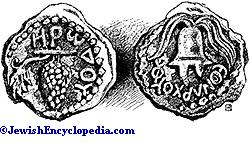
Archelaus thus attained the crown with little difficulty at the early age of eighteen. That aged plotter Salome found it convenient to abet Archelaus, and secured for him the adherence of the army; hence there was no opposition when he figured as the new ruler at the interment of Herod. The people, glad of the death of the tyrant, were well disposed toward Archelaus, and in the public assembly in the Temple the new king promised to have regard to the wishes of his subjects. It very soon became manifest, however, how little he intended to keep his word. Popular sentiment, molded by the Pharisees, demanded the removal of the Sadducean high priest Joezer (of the Boethus family), and the punishment of those former councilors of Herod who had brought about the martyrdom of the Pharisees Mattathias and Judas. Archelaus, professing always profound respect for the popular demand, pointed out that he could not well take any such extreme measures before he had been confirmed by the Roman emperor, Augustus, in his sovereignty: just as soon as this confirmation should be received, he declared himself willing to grant the people's desire. His subjects, however, seem not to have had confidence in his assurances; and when, on the day before Passover—a day when all Palestine, so to speak, was in Jerusalem—they became so insistent in their demand for immediate action, that theking felt himself compelled to send a detachment of the Herodian soldiery against them into the Temple courts; and when this detachment proved unable to master the enraged populace, he ordered out the whole available garrison. In the massacre that ensued, three thousand were left dead upon the Temple pavements.
Division of the Kingdom by Rome.
As soon as the tumult had been somewhat allayed, Archelaus hastened to Rome to secure the required confirmation of his succession from Augustus. He found that he had to encounter opposition from two sides. His brother Antipas, supported by many members of the Herodian house resident in Rome, claimed formal acknowledgment for Herod's second will, that nominated him king. Besides, the Jews of Palestine sent a deputation of fifty persons—who were supported by about 8,000 Jewish residents of Rome—and petitioned for the exclusion of the Herodians from any share whatever in the government of the land, and for the incorporation of Judea in the province of Syria. Such was the disloyalty among the Herodians, that many members of the family secretly favored this latter popular demand. But Augustus, with statesman-like insight, concluded that it was better for Roman interests to make of Judea a monarchy, governed by its own kings tributary to Rome, than to leave it a Roman province administered by Romans, in which latter case there would certainly be repeated insurrections against the foreign administration. As it would be more prudent to make such a monarchy as small and powerless as possible, he decided to divide Herod's somewhat extensive empire into three portions. Archelaus was accordingly appointed ethnarch—not king—of Judea, Samaria, and Idumea, with the exception of the important cities of Gaza, Gadara, and Hippus, which latter were joined to the province of Syria. Antipas and Philip were made tetrarchs of the remaining provinces, the former receiving Galilee and Perea, and the latter the other lands east of the Jordan.
Insurrectionary Outbreaks.
While these negotiations were pending in Rome, new troubles broke out in Palestine. The people, worked up almost into a state of frenzy by the massacres brought about by Herod and Archelaus, broke into open revolt in the absence of their ruler. The actual outbreak was without doubt directly caused by Sabinus—the procurator appointed by Augustus to assume charge pending the settlement of the succession—owing to his merciless oppression of the people. On the day of Pentecost in the year 4 B.C., a collision took place in the Temple precincts between the troops of Sabinus and the populace. Sabinus utilized his initial success in dispersing the people by proceeding to rob the Temple treasury. But disorders broke out all over the province, and his forces were not sufficient to repress them. Judas, son of the revolutionary Hezekiah in Galilee, a certain Simon in Perea, Athronges and his four brothers in other parts of the land, headed more or less serious uprisings. It was only when charge was assumed by Varus, the Roman legate in Syria, with his numerous legions, assisted, moreover, by Aretas, king of the Arabs, and his auxiliaries, that any measure of peace was restored to the land, and this not without the loss of several thousand Roman troops. What the loss on the Jewish side must have been may perhaps be surmised from the rabbinical tradition that the outbreak under Varus was one of the most terrible in Jewish history.
Banishment and Death.
Archelaus returned to Jerusalem shortly after Varus suppressed the insurrection. Very little is known of the further events of his reign, which lasted ten years; but so much is clear, that instead of seeking to heal the wounds brought upon the country by himself and his house, he did much to accelerate the ultimate overthrow of Judean independence. In the year 6 of the common era, a deputation of the Jewish and Samaritan aristocracy waited upon Augustus in Rome, to prefer charges against Archelaus, with the result that he was immediately summoned to Rome, deprived of his crown, and banished to Vienne in Gaul, where—according to Dion Cassius Cocceianus, "Hist. Roma," lv. 27—he lived for the remainder of his days.
Archelaus was a veritable Herodian, but without the statesman-like ability of his father. He was cruel and tyrannical, sensual in the extreme, a hypocrite and a plotter. He observed the customary seven days of mourning for his father, but in the midst of them gave to his boon companions a congratulatory banquet upon his accession. He carefully avoided placing his image upon his coinage in deference to pharisaic susceptibilities; but he nevertheless allowed his passion for his widowed sister-in-law, Glaphyra, to master him, and married her in defiance of the sentiment of the people and the Pharisees, who regarded the union as incestuous (Lev. xviii. 16, xx. 21). He deposed the high priest Joezer on his return from Rome, not in obedience to popular complaint, but for a money consideration. Joezer's brother was his successor, although the latter was of exactly the same type. Indeed, Archelaus, in his short reign, deposed three high priests for purposes of profit. Against this serious list of evils there is hardly anything good to set in contrast, beyond perhaps the fact that he inherited from his father a certain love of splendor and a taste for building. He restored the royal palace at Jericho in magnificent style, surrounding it with groves of palms; and also founded a city, that he called in his own honor Archelais.
Bibliography:
Grätz, Gesch. d. Juden, iii. passim;
Ewald, Gesch. des Volkes Israel, iv. passim;
Hitzig, Gesch. des Volkes Israel, ii. passim;
Schuuml;rer, Gesch. i. passim, and the literature therein indicated. On coinage, see Schürer, ib. p. 375, note 4; and Madden, Coins of the Jews, pp. 114-118.
(Herod)
- see Herod Family