
a mountain of Asia, in Armenia, on which the ark of Noah rested after the cessation of the deluge. Concerning the etymology of the name, Dr. Bryant observes; that it is a compound of Ar-Arat, and signifies “the mountain of descent, being equivalent to
The mountain which has still the name of Ararat, has retained it through all ages. Tournefort has particularly described it, and from his account it seems to consist chiefly of freestone, or calcareous sandstone. It is a detached mountain in form of a sugar loaf, in the midst of a very extensive plain, consisting of two summits; the lesser, more sharp and pointed; the higher, which is that of the ark, lies north-west of it, and raises its head far above the neighbouring mountains, and is covered with perpetual snow. When the air is clear, it does not appear to be above two leagues from Erivan, and may be seen at the distance of four or five days’ journey. Its being visible at such a distance, however, is ascribed not so much to its height, as to its lonely situation, in a large plain, and upon the most elevated part of the country. The ascent is difficult and fatiguing. Tournefort attempted it; and, after a whole day’s toil, he was obliged, by the snow and intense cold, to return without accomplishing his design, though in the middle of summer. On the side of the mountain that looks toward Erivan, is a prodigious precipice, very deep, with perpendicular sides, and of a rough, black appearance, as if tinged with smoke.
The separate peaks are called Great and Little Ararat, and the space between them is about seven miles. “These inaccessible summits,” continues Sir R. K. Porter, “have never been trodden by the foot of man since the days of Noah, if even then; for my idea is, that the ark rested in the space between these heads, and not on the top of either. Various attempts have been made in different ages to ascend these tremendous mountain pyramids, but in vain: their form, snows, and glaciers, are insurmountable obstacles: the distance being so great from the commencement of the icy region to the highest points, cold alone would be the destruction of any person who should have the hardihood to persevere. On viewing mount Ararat from the northern side of the plain, its two heads are separated by a wide cleft, or rather glen, in the body of the mountain. The rocky side of the greater head runs almost perpendicularly down to the north-east, while the lesser head rises from the sloping bottom of the cleft, in a perfectly conical shape. Both heads are covered with snow. The form of the greater is similar to the less, only broader and rounder at the top; and shows to the northwest a broken and abrupt front, opening, about half way down, into a stupendous chasm, deep, rocky and peculiarly black. At that part of the mountain, the hollow of the chasm receives an interruption from the projection of minor mountains, which start from the sides of Ararat like branches from the root of a tree, and run along, in undulating progression, till lost in the distant vapours of the plain.” Dr. Shuckford argues that the true Ararat lies among the mountains of the north of India; but Mr. Faber has answered his reasoning, and proved by a comparison of geographical notices incidentally mentioned in the Old Testament, that the Ararat of Armenia is the true Ararat.
Ar´arat occurs nowhere in Scripture as the name of a mountain, but only as the name of a country, upon the ’mountains’ of which the ark rested during the subsidence of the flood (Gen 8:4).
The only other passages where ’Ararat’ occurs are 2Ki 19:37 (Isa 37:38) and Jer 51:27. In the former it is spoken of as the country whither the sons of Sennacherib, king of Assyria, fled, after they had murdered their father. This points to a territory which did not form part of the immediate dominion of Assyria, and yet might not be far off from it. The description is quite applicable to Armenia, and is supported by the tradition of that country. The other Scripture text (Jer 51:27) mentions Ararat, along with Minni and Ashkenaz, as kingdoms summoned to arm themselves against Babylon. In the parallel place in Isa 13:2-4, the invaders of Babylonia are described as ’issuing from the mountains;’ and if by Minni we understand the Minyas in Armenia, and by Ashkenaz some country on the Euxine Sea, which may have had its original name, Axenos, from Ashkenaz, a son of Gomer, the progenitor of the Cimmerians (Gen 10:2-3)—then we arrive at the same conclusion, viz., that Ararat was a mountainous region north of Assyria, and in all probability in Armenia. In Eze 38:6, we find Togarmah, another part of Armenia, connected with Gomer, and in Eze 27:14, with Meshech and Tubal, all tribes of the north. With this agree the traditions of the Jewish and Christian churches, and likewise the accounts of the native Armenian writers.
But though it may be concluded with tolerable certainty that the land of Ararat is to be identified with a portion of Armenia, we possess no historical data for fixing on any one mountain in that country as the resting-place of the ark.
The earliest tradition fixed on one of the chain of mountains which separate Armenia on the south from Mesopotamia, and which, as they also enclose Kurdistan, the land of the Kurds, obtained the name of the Kardu, or Carduchian range, corrupted into Gordiaean and Cordyaean. This was at one time the prevalent opinion among the Eastern churches, but it has now declined in credit and given place (at least among the Christians of the West) to that which now obtains, and according to which the ark rested on a great mountain in the north of Armenia—to which (so strongly did the idea take hold of the popular belief) was, in course of time, given the very name of Ararat, as if no doubt could be entertained that it was the Ararat of Scripture. We have seen, however, that in the Bible Ararat is nowhere the name of a mountain, and by the native Armenians the mountain in question was never so designated. Still there is no doubt of the antiquity of the tradition of this being (as it is sometimes termed) the ’Mother of the World.’ The Persians call it Kuhi Nuch, ’Noah’s Mountain.’
The mountain thus known to Europeans as Ararat consists of two immense conical elevations (one peak considerably lower than the other), towering in massive and majestic grandeur from the valley of the Aras, the ancient Araxes. Smith and Dwight give its position N. 57° W. of Nakhchevan, and S. 25° W. of Erivan; and remark, in describing it before the recent earthquake, that in no part of the world had they seen any mountain whose imposing appearance could plead half so powerfully as this a claim to the honor of having once been the stepping-stone between the old world and the new. ’It appeared,’ says Ker Porter, ’as if the hugest mountains of the world had been piled upon each other to form this one sublime immensity of earth and rocks and snow. The icy peaks of its double heads rose majestically into the clear and cloudless heavens; the sun blazed bright upon them, and the reflection sent forth a dazzling radiance equal to other suns. My eye, not able to rest for any length of time upon the blinding glory of its summits, wandered down the apparently interminable sides, till I could no longer trace their vast lines in the mists of the horizon; when an irrepressible impulse immediately carrying my eye upwards, again refixed my gaze upon the awful glare of Ararat.’ To the same effect Morier writes:—Nothing can be more beautiful than its shape, more awful than its height. All the surrounding mountains sink into insignificance when compared to it is perfect in all its parts; no hard rugged feature, no unnatural prominences, everything is in harmony, and all combines to render it one of the sublimest objects in nature.’
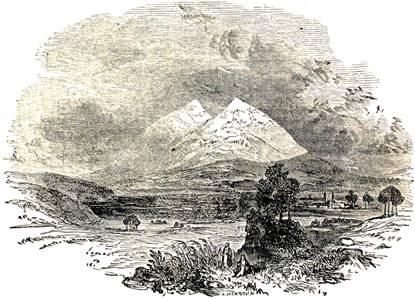
Fig. 46—Mount Ararat
Several attempts had been made to reach the top of Ararat, but few persons had got beyond the limit of perpetual snow. The honor was reserved to a German, Dr. Parrot, in the employment of Russia, who, in his Journey to Ararat, gives the following particulars:—’The summit of the Great Ararat is in 39° 42′ N. lat., and 61° 55′ E. long., from Ferro. Its perpendicular height is 16,254 Paris feet above the level of the sea, and 13,350 above the plain of the Araxes. The Little Ararat is 12,284 Paris feet above the sea, and 9561 above the plain of the Araxes.’ After he and his party had failed in two attempts to ascend, the third was successful, and on the 27th September (O.S.), 1829, they stood on the summit of Mount Ararat. It was a slightly convex, almost circular platform, about 200 Paris feet in diameter, composed of eternal ice, unbroken by a rock or stone: on account of the immense distances, nothing could be seen distinctly.
Since the memorable ascent of Dr. Parrot, Ararat has been the scene of a fearful calamity. An earthquake, which in a few moments changed the entire aspect of the country, commenced on the 20th of June (O.S.), 1840, and continued, at intervals, until the 1st of September. The destruction of houses and other property in a wide tract of country around was very great; fortunately, the earthquake having happened during the day, the loss of lives did not exceed fifty. The scene of greatest devastation was in the narrow valley of Akorhi, where the masses of rock, ice, and snow, detached from the summit of Ararat and its lateral points, were thrown at one single bound from a height of 6000 feet to the bottom of the valley, where they lay scattered over an extent of several miles.
The name of a province in the center of Armenia, between the river Araxes and the lakes Van and Ooroomiah. 2Ki 19:37 ; Isa 37:38, and sometimes used to denote the whole country, Jer 51:27 . On the mountains of Ararat the ark rested, Gen 8:4 . In 1831, Messrs. Smith and Dwight, American missionaries, visited Armenia, and traversed the province of Ararat. Mr. Smith describes the mountains as follows:\par "We passed very near the base of that noble mountain, which is called by the Armenians Masis, and by Europeans generally Ararat; and for more than twenty days had it constantly in sight, except when obscured by clouds. It consists of two peaks, one considerably higher than the other, and is connected with a chain of mountains running off to the north-west and west, which, though high, are not of sufficient elevation to detract at all from the lonely dignity of this stupendous mass. From Nakchewan, at the distance of at least 100 miles to the southeast, it appeared like an immense isolated cone, of extreme regularity, rising out of the valley of the Araxes. Its height is said to be 16,000 feet. The eternal snows upon its summit occasionally from vast avalanches, which precipitate themselves down its sides with a sound not unlike that of an earthquake. When we saw it, it was white to its very base with snow. And certainly not among the mountains of Ararat or of Armenia generally, nor those of any part of the world where I have been, have I ever seen one whose majesty could plead half so powerfully its claims to the honor of having once been the stepping-stone between the old world and the new. I gave myself up to the feeling, that on its summit were once congregated all the inhabitants of the earth, and that, while in the valley of the Araxes, I was paying a visit to the second cradle of the human race."\par Mount Ararat was visited in 1829 by Prof. Parrot, who after several attempts reached the summit, more than 17,200 feet above the level of the sea. It bears traces of volcanic action, and in 1840 was shaken by a disastrous earthquake.\par
(Sanskrit; "holy ground".) A mountainous district in Armenia; the resting place of the ark after the deluge (Gen 8:4). (But see NOAH.) Thither Sennacherib’s sons fled after murdering their father (2Ki 19:37). The ally of Minni and Ashchenaz (Jer 51:27). In Gen 11:2 translate "they journeyed eastward," Mesopotamia being described relatively to the writer’s country, rather than to Ararat, which is N. of Mesopotamia. It overlooks the plain of the Araxes on the N. Berosus the Chaldaean, in Alexander the Great’s time, makes the Kurdistan mountains, on the S. frontier of Armenia, the ark’s resting place: Nachdjevan, on the Araxes, is thought to be Noah’s place of landing, from Josephus’ statement (Ant. 1:3), as also his place of burial. The mountain there, the loftiest in the district, is called Massis by the Armenians, Kuh-i-Nuh, i.e. "Noah’s mountain," by the Persians.
There are two conical peaks, the greater and the less, seven miles apart; the former 17,300 feet above the sea, and 14,300 above the plain of the Araxes; the latter 4,000 feet lower; 3000 feet of the greater covered with perpetual snow. Lava, cinders, and porphyry cover the middle region, marking the vol. came origin of the mountain. A second summit is about 400 yards from the highest; and on the slope between the two the ark is surmised to have rested. On the side of the greater is a chasm, probably once the crater of the volcano; silence and solitude reign all around; Arguri, the only village on the descent, is the traditional site of Noah’s vine. yard. In the wide sense Ararat comprises the whole Armenian range in the N. to the Kurdistan range in the S. The plateau of Armenia is a vast extent of plains rising high above the surrounding plain; and from that plateau, as a fresh base, mountain ranges spring, running generally from E. to W.; transverse ridges connect these.
The whole stands in the central point between the Euxine and Caspian on the N., and the Mediterranean and the Persian gulf on the S. The Acampsis, the Araxes, the Euphrates, and the Tigris connect it respectively with the four great seas. The greatest nations, the Assyrians, the Babylonians, the Medes, and the Colchians, lay along these routes. Ararat even now is the central boundary between Russia, Turkey, and Persia. The Armenian plateau, from the longer period of action of the volcanic powers, and from there being room for the expansion of the molten masses in the region around, is far more accessible than the neighboring region of Caucasus.
At Erzroom, 6000 feet above the sea, crops appear in June and are cut in August. The vine ripens at 5000 feet, but in Europe at not higher than 2,650 feet. Thus it appears the Ararat plateau was one especially suited for being the ark’s appointed resting place, and its geographical and physical features fitted it as the center for the even distribution of the human race. The severe climate would drive them after a time to the milder plains below; and in the meantime the grass such as feeds now the flocks of nomad Kurds, in the same region, would meet the wants of Noah’s descendants in their nomad life. However, in the Babylonian legend of the Flood deciphered by Mr. G. Smith, Nizir answers to Ararat, not the northern mountain near Erivan, but the Ararat of Assyrian and Armenian geography, the precipitous range overlooking the Tigris N.E. of Mosul. Arabic Judi, Assyrian Guli.
(Heb. Ararat’,
The only other Scripture text where the word occurs (Jer 51:27) mentions Ararat, along with Minni and Ashkenaz, as kingdoms summoned to arm themselves against Babylon. In the parallel place in Isa 13:2-4, the invaders of Babtylonia are described as “issuing from the mountains;” and if by Minni we understand the Minyas in Armenia, mentioned by Nicholas of Damascus (Josephus, Ant. 1:3, 6), and by Ashkenaz some country on the Euxine Sea, which may have had its original name, Axenos, from Ashkenaz, a son of Gomer, the progenitor of the Cimmerians (Gen 10:2-3), then we arrive at the same conclusion, viz. that Ararat was a mountainous region north of Assyria, and in all probability in Armenia. In Eze 38:6, we find Togarmah, another part of Armenia, connected with Gomer, and in Eze 27:14, with Meshech and Tubal, all tribes of the north. With this agree the traditions of the Jewish and Christian churches (Josephus, Ant. 1:3, 5; Euseb. Praep, Evang. 9:12, 19; Jerome on Isaiah 1. c.), and likewise the accounts of the native Armenian writers, who inform us that Ararad was the name of one of the ancient provinces of their country, supposed to correspond to the modern pachalics of Kars and Bayazid, and part of Kurdistan. According to the tradition preserved in Moses of Chorene (in his Histor. Armen. p. 361, ed. Whiston, Lond. 1736), the name of Ararat was derived from Arai, the eighth of the native princes, who was killed in a battle with the Babylonians about B.C. 1750; in memory of which the whole province was called Aray-iarat, i.e. the ruin of Arai. (See Michaelis, Suppl. 1:130 sq.; Tuch, Gen. p. 170 sq.) Rev. E. Smith, who made an exploring tour in Persia and Armenia in 1830 and 1831, remarks in the Biblical Repository, 1832, p. 202, “The name of Ararat occurs but twice in the Old Testament (Gen 8:1, and Jer 51:27), and both times as the name of a country, which in the last passage is said to have a king.
It is well known that this was the name of one of the fifteen provinces of Armenia. It was situated nearly in the center of the kingdom; was very extensive, reaching from a point above seven or eight miles east of the modern Erzroom, to within thirty or forty miles of Nakhchewan; yielded to none in fertility, being watered from one extremity to the other by the Araxes, which divided it into two nearly equal parts; and contained some eight or ten cities, which were successively the residences of the kings, princes, or governors of Armenia from the commencement of its political existence, about 2000 years B.C. according to Armenian tradition, until the extinction of the Pagratian dynasty, about the middle of the eleventh century; with the exception of about 230 years at the commencement of the Arsacian dynasty, when Nisibis and Oria were the capitals. It is therefore not unnatural that this name should be substituted for that of the whole kingdom, and thus become known to foreign nations, and that the king of Armenia should be called the king of Ararat.” SEE CUNEIFORM INSCRIPTIONS.
But though it may be concluded with tolerable certainty that the land which has thus become intimately connected with the name Ararat is to be identified with a portion of Armenia, we possess no historical data for fixing on any one mountain in that country as the resting-place of the ark. It probably grounded on some of the lower peaks of the chain of mountains encircling that region. This supposition best accords with the nature of the circumstances, and does not conflict with the language of the text when properly weighed. SEE DELUGE.
If our supposition be correct, then, for any thing that appears to the contrary, the ark did not touch the earth until the waters were abated to a level with the lower valleys or plains, and, consequently, the inmates were not left upon a dreary elevation of 16,000 or 17,000 feet, never till of late deemed accessible to human footsteps, and their safe descent from which, along with all the “living creatures” committed to their care, would have been a greater miracle than their deliverance from the flood. By this explanation also we obviate the geological objection against the mountain, now called Ararat, having been submersed, which would imply a universal deluge, whereas by the “mountains of Ararat” may be understood some lower chain in Armenia, whose height would not be incompatible: with the notion of a partial flood. Finally, we on this hypothesis solve the question: If the descendants of Noah settled near the resting-place of the ark in Armenia, how could they be said to approach the plain of Shinar (Gen 11:2), or Babylonia, from the East? For, as we read the narrative, the precise resting-place of the ark is nowhere mentioned; and though for a time stationary “over” the mountains of Ararat, it may, before the final subsidence of the waters, have been carried considerably to the east of them. (See Raumer, in the Hertha, 1829, 13:333 sq.; comp. Hoff, Gesch. d. Erdoberflache, Gotha, 1834, 3:369.) SEE ARK.
The ancients, however, attached a peculiar sacredness to the tops of high mountains, and hence the belief was early propagated that the ark must have rested on some such lofty eminence. The earliest tradition fixed on one of the chain of mountains which separate Armenia on the south from Mesopotamia, and which, as they also enclose Kurdistan, the land of the Kurds, obtained the name of the Kardu or Carduchian range, corrupted into Gordiaean and Cordymean. This opinion prevailed among the Chaldieans, if we may rely on the testimony of Berosus as quoted by Josephus (Ant. 1:3, 6): “It is said there is still some part of this ship in Armenia, at the mountain of the Cordyaeans [
The historian Elmacin mentions that the Emperor Heraclius went up, and visited this as “the place of the ark.” Here, or in the neighborhood, was once a famous Nestorian monastery —” the Monastery of the Ark,” destroyed by lightning in A.D. 776 (see Assemani, Bibl. Or. 2, 111). The credulous Jew, Benjamin of Tudela, says that a mosque was built at Mount Judi, “of the remains of the ark,” by the Caliph Omar. Kinneir, in describing his journey from Jezirah along the left bank of the Tigris to Nahr Van, says (Trav. p. 453), “We had a chain of mountains running parallel with the road on the left hand. This range is called the Juda Dag (i.e. mountain) by the Turks, and one of the inhabitants of Nahr Van assured me that he had frequently seen the remains of Noah’s ark on a lofty peak behind that village.” (Comp. Rich’s Kurdistan, 2, 124.) A French savant, Eugene Bore, who visited those parts, says the Mohammedan dervishes still maintain here a perpetually burning lamp in an oratory (Revue Francaise, vol. 12; or the Semeur of October 2, 1839). The selection of this range was natural to an inhabitant of the Mesopotamian plain; for it presents an apparently insurmountable barrier on that side, hemming in the valley of the Tigris with abrupt declivities so closely that only during the summer months is any passage afforded between the mountain and river (Ainsworth’s Travels in track of the Ten Thousand, p. 154). Josephus also quotes Nicolaus Damascenus to the effect that a mountain named Baris, beyond Minyas, was the spot. This has been identified with Varaz, a mountain mentioned by St. Martin (Mem. sur ’Armenie, 1:265) as rising to the north of Lake Van; but the only important mountain in the position indicated is described by recent travelers under the name Seiban Tagh; and we are therefore inclined to accept the emendation of Schroeder, who proposes to read
The French traveler Tournefort, in the year 1700, long persevered in the face of many difficulties, but was foiled in the end. About a century later the Pacha of Bayazid undertook the ascent with no better success. The honor was reserved to a German, Dr. Parrot, in the employment of Russia, who (in his Reise zum Ararat, Berl. 1834; translated by W. T. Cooley, Lond. and N. Y.) gives the following particulars: “The summit of the Great Ararat is in 39º 42’ north lat., and 61º 55’ east long. from Ferro. Its perpendicular height is 16,254 Paris feet above the level of the sea, and 13,350 above the plain of the Araxes. The Little Ararat is 12,284 Paris feet above the sea, and 9561 above the plain of the Araxes.” After he and his party had failed in two attempts to ascend, the third was successful, and on the 27th of September (O. S.), 1829, they stood on the summit of Mount Ararat. It was a slightly convex, almost circular platform, about 200 Paris feet in diameter, composed of eternal ice, unbroken by a rock or stone; on account of the great distances, nothing could be seen distinctly. The observations effected by Parrot have been fully confirmed by another Russian traveler, H. Abich, who, with six companions, reached the top of the Great Ararat without difficulty, July 29, 1845. He reports that, from the valley between the two peaks, nearly 8000 feet above the level of the sea, the ascent can with facility be accomplished. It would appear even that the ascent is easier than that of Mont Blanc; and the best period for the enterprise is the end of July or beginning of August, when there is annually a period of atmospheric quiet, and a clear unclouded sky. Another Russian, M. Antonomoff, has also ascended to the top; and an Englishman, named Seymour, accompanied by a guide to tourists named Orvione, and escorted by four Cossacks and three Armenians, claims likewise to have ascended the mountain, and, to have reached the level summit of the highest peak on the 17th September, 1846. (See extract from a letter in the Caucase, a St. Petersburg Journal, Athenceum, No. 1035, p. 914.) That the mountain is of volcanic origin is evidenced by the immense masses of lava, cinders, and porphyry with which the middle region is covered; a deep cleft on its northern side has been regarded as the site of its crater, and this cleft has been the scene of a terrible catastrophe.
An earthquake, which in a few moments changed the entire aspect of the country, commenced on July 2, 1840, and continued, at intervals, until the 1st of September. Traces of fissures and land-slips have been left on the surface of the earth, which the eye of the scientific observer will recognize after many ages. Clouds of reddish smoke and a strong smell of sulphur, which pervaded the neighborhood after the earthquake, seem to indicate that the volcanic powers of the mountain are not altogether dormant. The destruction of houses and other property in a wide tract of country around was very great; fortunately, the earthquake having happened during the day, the loss of lives did not exceed fifty. The scene of greatest devastation was in the narrow valley of Akorhi, where the masses of rock, ice, and snow, detached from the summit of Ararat and its lateral points, were thrown at one single bound from a height of 6000 feet to the bottom of the valley, where they lay scattered over an extent of several miles. (See Major Voskoboinikof’s Report, in the Athenceum for 1841, p. 157.) Parrot describes the secondary summit about 400 yards distant from the highest point, and on the gentle depression which connects the two eminences he surmises that the ark rested (Journey to Ararat, p. 179). The region immediately below the limits of perpetual snow is barren, and unvisited by beast or bird. Wagner (Reise. p. 185) describes the silence and solitude that reign there as quite overpowering. Arguri, the only village known to have been built on its slopes, was the spot where, according to tradition, Noah planted his vineyard. Lower down, in the plain of Araxes, is Nakhchevan, where the patriarch is reputed to have been buried (see Am. Bibl. Repos. April, 1836, p. 390-416). SEE NOAH.
2. Returning to the broader signification we have assigned to the term “the mountains of Ararat,” as co-extensive with the Armenian plateau from the base of Ararat in the north to the range of Kurdistan in the south, we notice the following characteristics of that region as illustrating the Bible narrative:
(1.) Its elevation. It rises as a rocky island out of a sea of plain to a height of from 6000 to 7000 feet above the level of the sea, presenting a surface of extensive plains, whence, as from a fresh base, spring important and lofty mountain-ranges, having a generally parallel direction from east to west, and connected with each otherly transverse ridges of moderate height.
(2.) Its geographical position. The Armenian plateau stands equidistant from the Euxine and the Caspian seas on the north, and between the Persian Gulf and the Mediterranean on the south. With the first it is connected by the Acampsis, with the second by the Araxes, with the third by the Tigris and Euphrates, the latter of which also serves as an outlet toward the countries on the Mediterranean coast. These seas were the high roads of primitive colonization, and the plains watered by these rivers were the seats of the most powerful nations of antiquity, the Assyrians, the Babylonians, the Medes, and the Colchians. Viewed with reference to the dispersion of the nations, Armenia is the true center (
Ararat
Ararat (ăr’a-răt), holy land, or high land. A mountainous region of Asia which borders on the plain of the Araxes, and is mentioned (1) as the resting-place of Noah’s ark. Gen 8:4; (2) as the refuge of the sons of Sennacherib, 2Ki 19:37, R. V., or margin, A V.; Isa 37:1-38; Isa 38:1-22, R. V., or margin, A. V.; (3) as a kingdom with Minni and Ashchenaz. Jer 51:27. The mountains of Ararat, Gen 8:4, properly refer to the entire range of elevated table land in that portion of Armenia; and upon some lower part of this range, rather than upon the high peaks popularly called Ararat, the ark more probably rested. For (1) this plateau or range is about 6000 to 7000 feet high; (2) it Is about equally distant from the Euxine and the Caspian Seas, and between the Persian Gulf and the Mediterranean, and hence a central point for the dispersion of the race; (3) the region is volcanic in its origin; it does not rise into sharp crests, but has broad plains separated by subordinate ranges of mountains; (4) the climate is temperate, grass and grain are abundant, the harvests quick to mature. All these facts illustrate the biblical narrative. George Smith, however, places Ararat in the southern part of the mountains east of Assyria. Chaldean Account of Genesis, p. 289.
[Ar’arat]
A kingdom which was called upon by God, in conjunction with Medes, Persians, and others, under one captain, Cyrus, to punish Babylon in revenge of Israel. Jer 51:27. It is identified with Urartu or Urardhu of the Assyrian inscriptions, a district in Armenia, in which is Mount Ararat, on some part of which the ark of Noah rested. Gen 8:4. The mount is situate 39° 45’ N, 44° 28’ E, and its extreme height is about 17,000 feet above the sea, covered with perpetual snow. Objection has been taken to its great height, but it may not have been on its highest part that the ark rested.
By: Morris Jastrow, Jr., Charles Foster Kent
A district in eastern Armenia lying between the lakes Van and Urmia and the river Araxes. The Biblical name corresponds to the Assyrian Urarṭu, a land invaded and partially conquered by Asshurnazir-pal and Shalmaneser II. The Assyrian cuneiform characters were introduced into the land of Urarṭu as early as the ninth century B.C., and many monumental inscriptions have been discovered within its boundaries. About the middle of the ninth century a strong native dynasty was established, and continued to rule until the Assyrian power was revived by Tiglath-pileser III., about 740 B.C. For a generation Urarṭu was invaded by Assyrian armies, until at last it again attained independence. This it retained until it was overrun by the Scythians about the end of the seventh century. Thus from the ninth to the sixth century B.C., the land of Urarṭu or Ararat occupied a prominent place among the minor states of southwestern Asia, and is referred to four times in the Biblical narrative. In II Kings xix. 37 (= Isa. xxxvii. 38) the fact is recorded that the assassins of the Assyrian king Sennacherib fled to the land of Ararat, where they found refuge with the reigning king Erimenas. In Jer. li. 27, Ararat is mentioned first among the hostile nations which are called upon to advance from the north and overthrow the power of Babylon. The most familiar reference, however, is that of Gen. viii. 4: "In the seventh month, on the seventeenth day of the month, the ark rested upon the mountains of Ararat."
Mount Ararat.(From a photograph taken by special permission of the Russian government.)
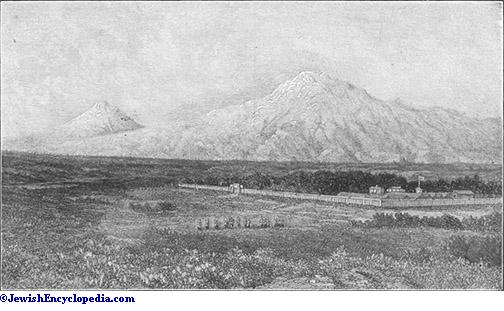
In the older Babylonian story of the flood the ark (or "ship") is represented as resting on a peak of "the mountain of Nizir," situated east of the land of Assyria. Berosus, the Chaldean priest, in his history fixes the site in "the mountain of the Kordyaeæans" or Kurds, northeast of Mosul, in the direction of Urumiah (Josephus, "Ant." i. 3, § 6); and Nicolaus of Damascus states that the ark rested on a great mountain in Armenia, somewhere near the boundary between that land and Kurdistan. The principle determining these various identifications seems to have been that the ark rested on the highest point on the earth, which was, therefore, the first to emerge from the waters of the flood. Thus the peoples living between the Tigris and the Euphrates naturally decided that it was on the lofty mountains to the north-east in the land of the Kurds. This belief of the Babylonians, quoted by Josephus, is still held by the Nestorians and Moslems. The Biblical reference is indefinite; but of all the mountains in the ancient land of Ararat, the lofty peak which towers 14,000 feet above the encircling plain, reaching a total height of 17,000 feet above sea-level, is without a rival. Its steepness emphasizes its great elevation, and may well have impressed upon the minds of travelers of antiquity the fact that it was higher than the Kurdish mountains two hundred miles away. It may also explain why the writer in Genesis apparently abandoned the older conflicting Babylonian traditions and fixed upon this imposing, solitary peak far to the northwest.
The mountain itself is known as Ararat only among Occidental geographers. The Armenians call it Massis, the Turks Aghri Dagh, and the Persians Koh i Nuh, or "the mountain of Noah." Thus far it has been impossible to trace back to an early date an independent native tradition. Apparently the local legends which have clothed it with mystery, and which would place upon it the remains of the original ark, are based upon the passage in Genesis, and have been largely induced in comparatively recent times by the influence of Western Christianity. Superstitious fear and natural difficulties prevent the natives from attempting the ascent of the mountain; but its top has repeatedly been reached by Europeans, and its geological peculiarities have been noted. Its cone is the crater of an extinct volcano, and because of its great height it is snow-capped throughout the year.
Bibliography:
For the geography of Urarṭu see Sayce, Cuneiform Inscriptions of Van, in Journal Royal Asiatic Society, vol. xiv.;
Schrader, C. I. O. T., Index, s.v.; idem, K. G. F., Index, s.v.
ARARAT (Gen 8:4, 2Ki 19:37 [|| Isa 37:38], Jer 51:27) is the Hebrew form of the Assyrian Urartu, which on the monuments from the 9th cent. downwards designates a kingdom in the N. of the later Armenia. The extension of the name naturally varied with the political limits of this State; but properly it seems to have denoted a small district on the middle Araxes, of which the native name Ayrarat is thought to be preserved in the Alarodioi of Herodotus (iii. 94, vii. 79). Jerome describes it as ‘a level region of Armenia, through which the Araxes flows, of incredible fertility, at the foot of the Taurus range, which extends thus far.’ The Araxes (or Aras), on its way to the Caspian Sea, forms a great elbow to the S.; and at the upper part of this, on the right (or S.W.) bank of the river, the lofty snowclad summit of Massis (called by the Persians the ‘mountain of Noah’) rises to a height of nearly 17,000 ft. above sea-level. This is the traditional landing-place of the ark; and, through a misunderstanding of Gen 8:4 (‘in [one of] the mountains of Ararat’), the name was transferred from the surrounding district to the two peaks of this mountain, Great Ararat and Little Ararat,—the latter about 7 m. distant and 4000 ft. lower.
Whether this is the site contemplated by the writer in Genesis (P
J. Skinner.
The original name of the kingdom occupying Armenia was Bianias, which Ptolemy transliterated Byana. Later the “B” was modified into “V” and we have the modern Van, the present capital of the province. The “mountains of Ararat” on which the ark rested were probably those of the Kurdish range which separates Armenia from Mesopotamia and Kurdistan. In the Babylonian account the place is called “the mountain of Nizir” which is east of Assyria. Likewise Berosus locates the place “in the mountain of the Kordyaeans” or Kurds (Ant., I, iii, 6), while the Syriac version has Hardu in Gen 8:4 instead of Ararat. The Kurds still regard Jebel Judi, a mountain on the boundary between Armenia and Kurdistan, as the place where the ark rested.
This elevated plateau of Armenia has still many attractions, and is eminently suited to have been the center from which the human race spread in all directions. Notwithstanding its high elevation the region is fertile, furnishing abundant pasture, and producing good crops of wheat and barley, while the vine is indigenous. Moreover there are unmistakable indications that in early historic times there was a much more abundant rainfall in all that region than there is now, so that the climate was then better adapted to the wants of primitive man. This is shown by the elevated beaches surrounding lakes Van, Urumiah, and, indeed, all the lakes of central Asia. Great quantities of mammoth bones have been found in these bordering lacustrine deposits corresponding to those found in the glacial and postglacial deposits of Europe and America. It should, also, be remembered that the drying up of the waters of the flood is represented to have been very gradual - it being 170 days from the time the waters began to subside before Noah could disembark. It may have been many centuries before the present conditions were established, the climate, meanwhile, being modified to a corresponding degree by the proximity of vast surrounding bodies of water.
Armenia abounds in inscriptions carved on the rocks, altar stones and columns, but they have been only imperfectly translated. The script is cuneiform and each letter has only a single phonetic character attached to it. But there are introduced a good many borrowed ideographs which have assisted in the decipherment. According to Sayce this cuneiform syllabary was introduced from Assyria after the conquest of Shalmaneser II in the 9th century bc.
The ancient country of Urartu, an
area in eastern Turkey.