
This person was a native of Pontus in Asia Minor, and was converted by St. Paul, together with his wife Priscilla, to the Christian religion. As Aquila was by trade a tentmaker, Act 18:2-3, as St. Paul was, the Apostle lodged and wrought with him at Corinth. Aquila came thither, not long before, from Italy, being obliged to leave Rome upon the edict which the emperor Claudius had published, banishing the Jews from that city. St. Paul afterward quitted Aquila’s house, and abode with Justus, near the Jewish synagogue at Corinth; probably, as Calmet thinks, because Aquila was a converted Jew, and Justus was a convert from Paganism, that in this case the Gentiles might come and hear him with more liberty. When the Apostle left Corinth, Aquila and Priscilla accompanied him as far as Ephesus, where he left them with that church while he pursued his journey to Jerusalem. They rendered him great service in that city, so far as to expose their own lives to preserve his. They had returned to Rome when St. Paul wrote his Epistle to the Rom 16:4, wherein he salutes them with great kindness. Lastly, they were come back to Ephesus again, when St. Paul wrote his Second Epistle to Timothy, 2Ti 4:19, wherein he desires him to salute them in his name. What became of them after this time is not known.
Aq´uila, a Jew with whom Paul became acquainted on his first visit to Corinth; a native of Pontus, and by occupation a tent-maker. He and his wife Priscilla had been obliged to leave Rome in consequence of an edict issued by the Emperor Claudius, by which all Jews were banished from Rome. Whether Aquila and Priscilla were at that time converts to the Christian faith cannot be positively determined; but at all events, they had embraced Christianity before Paul left Corinth; for we are informed that they accompanied him to Ephesus, and meeting there with Apollos, who ’knew only the baptism of John,’ they ’instructed him in the way of God more perfectly’ (Act 18:25-26). From that time they appear to have been zealous promoters of the Christian cause. Paul styles them his ’helpers in Christ Jesus,’ and intimates that they had exposed themselves to imminent danger on his account (Rom 16:3-4). When Paul wrote his epistle to the Romans they were at Rome; but some years after they returned to Ephesus, for Paul sends salutations to them in his Second Epistle to Timothy (2Ti 4:19). Their occupation as tent-makers probably rendered it necessary for them to keep a number of workmen constantly resident in their family, and to these (to such of them at least as had embraced the Christian faith) may refer the remarkable expression, ’the Church that is in their house.’
A Jew born in Pontus, a tent-maker by occupation, who with his wife Priscilla joined the Christian church at Rome. When the Jews were banished from that city by the emperor Claudius, Aquilla and his wife retired to Corinth. They afterwards became the companions of Paul in his labors, and are mentioned by him with much commendation, Mal 18:2,3,24 -26 Ro 16:3,4 1Co 16:19 2Ti 4:19 .\par
Aq’uila. (an eagle). A Jew whom St. Paul found at Corinth on his arrival from Athens. Act 18:2. (A.D. 52). He was a native of Pontus, but had fled with his wife Priscilla, from Rome, in consequence of an order of Claudius commanding all Jews to leave the city. He became acquainted with St. Paul, and they abode together, and wrought at their common trade of making the Cilician tent or hair-cloth.
On the departure of the apostle from Corinth, a year and eight months after, Priscilla and Aquila accompanied him to Ephesus. There they remained and there they taught Apollos. At what time they became Christians is uncertain.
(
He became acquainted with Paul, and they abode together, and wrought at their common trade of making the Cilician tent or hair-cloth. — See PAUL. This decree was made, not by the senate, but the emperor (A.D. 50 or 51), and lasted only during his life, if even so long. Comp. Neander, Planting and Training, 1, 231; Lardner, Testimonies of Heathen Authors, ch. 8. Whether Aquila and Priscilla were at that time converts to the Christian faith cannot be positively determined; Luke’s expression, “came unto them” (
Aquila (ăk’wĭ-lah), an eagle. A Jew of Pontus whom Paul found at Corinth on his arrival from Athens. Act 18:2. He had fled, with his wife Priscilla, from Rome, in consequence of an order of Claudius commanding all Jews to leave the city. He became acquainted with Paul, and they abode together, and wrought at their common trade of making the Cilician tent or hair cloth. On the departure of the apostle from Corinth, a year and six months after, Priscilla and Aquila accompanied him to Ephesus. There they remained, and there they taught Apollos. Act 18:18-19; Act 18:24-26. At what time they became Christians is uncertain, but they appear to have specially helped Paul, and to have labored in Rome. Rom 16:3-5.
[Aq’uila]
A converted Jew of Pontus, husband of Priscilla, whom Paul first met at Corinth. Act 18:2. He and Paul worked together as tent-makers. Aquila and Priscilla had been driven from Rome as Jews by an edict of the emperor Claudius. They travelled with Paul to Ephesus, where they were able to help Apollos spiritually. Act 18:18-26. They were still at Ephesus when Paul wrote 1 Corinthians (1Co 16:19); and were at Rome when the epistle to the saints there was written, in which Paul said they had laid down their necks for his life, and that to them all the churches, with Paul, gave thanks. Rom 16:3-4. In Paul’s last epistle he still sends his greeting to them. 2Ti 4:19.
Translator of the canonical Scriptures from Hebrew into Greek. He was by birth a Gentile from Pontus, and is said by Epiphanius to have been a connection by marriage of the emperor Hadrian and to have been appointed by him about the year 128 to an office concerned with the rebuilding of Jerusalem as "Ælia Capitolina." At some unknown age he joined the Christians, but afterward left them and became a proselyte to Judaism. According to Jerome he was a disciple of Rabbi Akiba. The Talmud states that he finished his translations under the influence of R. Akiba and that his other teachers were Eliezer ben Hyrcanus and Joshua ben Hananiah. It is certain, however, that Aquila's translation had appeared before the publication of Irenæus' "Adversus Hæreses"; i.e., before 177.
The work seems to have been entirely successful as regards the purpose for which it was intended (Jerome speaks of a second edition which embodied corrections by the author), and it was read by the Greek-speaking Jews even in the time of Justinian (Novella, 146). It was used intelligently and respectfully by great Christian scholars like Origen and Jerome, while controversialists of less merit and learning, such as the author of the "Dialogue of Timothy and Aquila" (published in 1898 by F. C. Conybeare), found it worth their while to accuse Aquila of anti-Christian bias, and to remind their Jewish adversaries of the superior antiquity of the Septuagint. But no manuscript until quite recently was known to have survived, and our acquaintance with the work came from the scattered fragments of Origen's "Hexapla." The reason of this is to be found in the Mohammedan conquests; the need of a Greek version for Jews disappeared when Greek ceased to be the lingua franca of Egypt and the Levant.
Fragments in the "Hexapla."
The "Hexapla"—a colossal undertaking compiled by Origen (died about 254) with the object of correcting the text of the Septuagint—consisted of the Hebrew text of the Old Testament, the Hebrew text in Greek letters, the Septuagint itself as revised by Origen, and the Greek versions of Aquila, Symmachus, and Theodotion, all arranged in six parallel columns. With the exception of two recently discovered fragments of the Psalms, one coming from Milan, the other from Cairo,The Milan fragments, discovered by Dr. Mercati, are described by Ceriani in "Rendiconti del Real Istituto Lombardo di Scienze e Letteratura," 1896, series ii., vol. xxix. The Cairo fragment (now at Cambridge) was edited by Charles Taylor in 1901. the "Hexapla" itself is no longer extant, but a considerable number of extracts, including many readings from Aquila, are preserved in the form of marginal notes to certain manuscripts of the Septuagint. These have been carefully collected and edited in Field's great work ("Origenis Hexaplorum quæ Supersunt," Oxford, 1875), which still remains the chief source of information about Aquila's version.
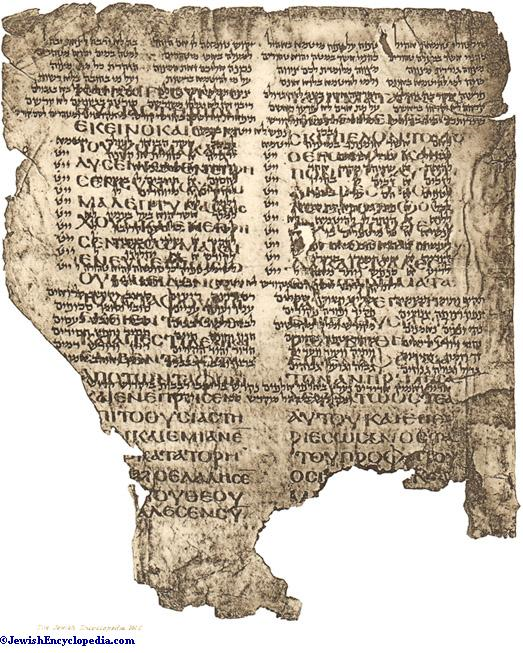
Contrary to expectation, the readings of Aquila derived from the "Hexapla" can now be supplemented by fragmentary manuscripts of the translation itself. These were discovered in 1897, partly by F. C. Burkitt, among the mass of loose documents brought to Cambridge from the geniza of the Old Synagogue at Cairo through the enterprise of Dr. S. Schechter and Dr. C. Taylor, master of St. John's College, Cambridge. Three of the six leaves already found came from a codex of Kings (i.e., they probably formed part of a codex of the Former Prophets), and three came from a codex of the Psalms. The portions preserved are I Kings xx 7-17; II Kings xxiii. 11-27 (edited by F. C. Burkitt, 1897); Ps. xc. 17, ciii. 17 with some breaks (edited by Taylor, 1900). The numbering is that of the Hebrew Bible, not the Greek. The fragments do not bear the name of the translator, but the style of Aquila is too peculiar to be mistaken. The handwriting is a Greek uncial of the sixth century. Dr. Schechter assigns the later Hebrew writing to the eleventh century. All six leaves are palimpsests, and in places are somewhat difficult to decipher.
The special value of the Cairo manuscripts is that they permit a more just conception of the general effect of Aquila's version, where it agrees with the Septuagint as well as where it differs. It is now possible to study the rules of syntax followed by Aquila with far greater precision than before. At the same time the general result has been to confirm what the best authorities had already reported.
Character of Aquila's Version. FRAGMENT OF AQUILA'S GREEK TRANSLATION OF II, KINGS (xxiii 15-19).A Palimpsest with Hebrew written over the GreeK, the Tetragrammaton is written in archaic Hebrew script.By permission of the Cambridge University Press.
The main feature of Aquila's version is its excessive literalness. His chief aim was to render the Hebrew into Greek word for word, without any regard for Greek idiom. The same Greek word is regularly used for the same Hebrew, however incongruous the effect. Thus  , wherever
  (i.e., "and also") occurs, Aquila has
  means "with," and is translated by Aquila
  is also used before the object of the verb when the object is defined, an idiom rendered by Aquila, where possible, by the Greek article, so that
  . But this can not be done where the Hebrew article and
  stand together, or where the object is a detached pronoun. Aquila follows here Nahum of Gimzo and R. Akiba, who insisted on the importance of particles, especially
  . In such cases he translates this
  also by
  (Ps. xcii. 7). Apparently
  , and
, and  (Ps. cii. 26).It will be noted that Aquila uses the Greek article somewhat freely to express
The general effect of this pedantry may be seen from the following specimen (II Kings xxiii. 25):
|
Masoretic Text. |
|
Aquila. |
|
|
|
|
|
|
|
|
|
|
|
|
|
|
— |
|
|
|
|
|




 .
.

In both the Cairo manuscripts the Tetragrammaton is not translated, but is transcribed in letters similar to those used in the Siloam inscription and on Jewish coins.See plate, left-hand column, three lines from bottom. It will be noticed that the same corrupt form is used both for yod and for waw, just as in the Hexaplar form HIHI, i.e.,  , written in the square character.This quite unexpected feature is in full accord with the express statement of Origen who says in his comments on Ps. ii. 2 (Benedictine ed; ii. 539 = Lommatzsch, xi. 36): "There is a certain word of four letters which is not pronounced by them [the Jews], which also was written on the gold breastplate of the high priest; but it is read as Adonai, not as it is really written in the four letters, while among Greeks it is pronounced K
Literal Transmitter.
It would be a mistake to put down the harshness of Aquila's translation to ignorance of Greek. He resorted to mere transliteration less than any other ancient translator, and had command of a large Greek vocabulary. Field (introduction, xxiii. et seq.) has collected a number of expressions that show Aquila's acquaintance with Homer and Herodotus. It was no doubt from classical Greek literature that Aquila borrowed the use of the enclitic  (Gen. xii. 9),
  (I Kings xxii. 49). The depth of his Hebrew knowledge is more open to question, if judged by modern standards. But it is the special merit of Aquila's renderings that they represent with great fidelity the state of Hebrew learning in his own day. "Aquila in a sense was not the sole and independent author of his version, its uncompromising literalism being the necessary outcome of his Jewish teacher's system of exegesis" (C. Taylor, in Burkitt's "Fragments of Aquila," p. vi.).
Illustrations of Aquila's dependence on Jewish tradition are to be found in the Ḳeri readings adopted by him; e.g.,  for
for  , Gen. xxx. 11, and the euphemism in Isa. xxxvi. 12. The scrupulous exactness with which Aquila translates the particles is to be explained by his having been a disciple of Akiba, whose method of exegesis was to lay great stress upon the meanings hidden in the lesser parts of speech. Instances are
  , Gen. ii. 18; and
  , Deut. iv. 3. This scrupulosity may be contrasted with the Targumic freedom of Aquila's
  Jer. li. 34, where the metaphor that Nebuchadnezzar had "eaten" Jerusalem has been turned into prose.
Aquila as a Witness:
1. Consonantal Text.—The extreme literalness of Aquila's methods enables the reader to restore with confidence the Hebrew from which he translated. There are a few instances where he preserves old readings found also in the Septuagint; e.g.,  for
for  (Symmachus and Masoretic Text) in Ezek. xxvii. 16, and
  for
for  (Masoretic Text) in Zeph. iii. 18. But as a rule he supports the ordinary Masoretic Text; e.g.,
  as in the Masoretic Text, and
 attested by the Septuagint. The numeration of the Psalms agrees with the Hebrew against the Greek; in this article, therefore, Aquila is uniformly quoted by the Hebrew reckonings.
Vocalization and Interpretation.
2. Aquila represents a period in Jewish exegesis anterior to the Masoretic vocalization. Here priority in time does not invariably mean superiority of reading: where it is a question of knowledge of Hebrew rather than of purity of transmitted text, the later scholars often do better than their predecessors. Thus Aquila can hardly have been right in connecting  in Hab. i. 10 with
  in II Kings xxiii. 12 as the Hiphil of
  ("to run"). Aquila also has an unfortunate habit of dividing rare Hebrew words. into their real or imagined component parts; e.g., in Isa. xviii. 1 he renders
  ("a rustling") by
  of the Masoretic Text he has
  On the other hand, there is much to be said for his division of
  (Ex. xxxii. 25) into two words.
  ("for a name of filth") is read or implied by the Targum, by the Peshiṭta, and by Symmachus, as well as by Aquila (compare Isa. xxviii. 8, 13; xxx. 22). The Samaritan has
  . In Deut. xxxiii. 2 Aquila has
  .
.
It is interesting to note that Aquila does not agree with the Masoretic punctuation in pointing the names of heathen gods (e.g.,  and
and  , Amos v. 26) with the vowels of
  ("abomination").
Aquila's renderings of the Hebrew tenses are often most inadequate. It is only on grounds of imperfect knowledge that the aorists can be defended in passages like 
 in Gen. ii. 6. Examples of pedantic mistranslation such as this suggest that Old Hebrew was very imperfectly understood when Akiba revived philological study by his allegorizing exegesis of the particles.
Transliterations.
The transliterations of Hebrew words into Greek letters are of some interest as showing the pronunciation current in Palestine about the middle of the second century. The most noticeable points are the complete disappearance of all four gutturals and therepresentation of  . This feature reappears in the names of the Hebrew letters attached to the Book of Lamentations by the original scribe of "Cod. Vaticanus (B)." It may be conjectured that the scribe of the Vatican MS. took them through the "Hexapla" from Aquila's version. In some points Aquila agrees rather with the New Testament than with the older forms found in the Septuagint; e.g., for
  he has
  , but Symmachus and Theodotion have
Aquila's translation occupied one of the columns of Origen's "Hexapla," and so was accessible to Christian scholars. Very considerable use of it was made by Jerome in preparing the Latin version now known as the Vulgate, though (as we might expect) the more pedantic features are dropped in borrowing. Thus in Ex. xxxii. 25 Jerome's propter ignominiam sordis comes from Aquila's  ), and for "Selah" in the Psalms his semper follows Aquila's
Original Text of the Septuagint.
More important for modern scholars is the use made of Aquila's version in Origen's revision of the Septuagint. The literary sources of the Latin Vulgate are merely a point of Biblical archeology, but the recovery of the original text of the Septuagint is the great practical task which now lies before the textual critic of the Old Testament. Recent investigation has made it clear that Origen's efforts to emend the Greek from the Hebrew were only too successful, and that every known text and recension of the Septuagint except the scanty fragments of the Old Latin have been influenced by the Hexaplar revision. One must learn how to detect Origen's hand and to collect and restore the original readings, before the Septuagint is in a fit state to be critically used in emending the Hebrew. The discussion of this subject belongs rather to the criticism of the "Hexapla" than to a separate article on Aquila. It will suffice here to point out that Aquila's version is one of the three sources by the aid of which the current texts of the Septuagint have been irregularly revised into conformity with a Hebrew text like that of our printed Bibles. For the association of the Targum of the Pentateuch with his name see Onkelos. See also Bible.
Bibliography:
Field, Origenis Hexaplorum quœ Supersunt, Oxford, 1875;
Wellhausen and Bleek, Einleitung in das Alte Testament, 4th ed., pp. 578-582, Berlin, 1878;
Burkitt, Fragments of the Books of Kings According to the Translation of Aquila, Cambridge, 1897;
Taylor, Origen's Hexapla (part of Ps. xxii.), Cambridge, 1901;
S. Krauss, in the Steinschneider-Zeitschrift, 1896, pp. 148-163.
[See also Taylor's Sayings of the Jewish Fathers, 2d ed., pp. viii. et seq.]
—In Rabbinical Literature:
"Aquila the Proselyte" ( ) and his work are familiar to the Talmudic-Midrashic literature. While "the Seventy" and their production are almost completely ignored by rabbinical sources, Aquila is a favorite personage in Jewish tradition and legend. As historical, the following may be considered. "Aquila the Proselyte translated the Torah (that is, the whole of Scripture; compare Blau, "Zur Einleitung in die Heilige Schrift," pp. 16, 17) in the presence of R. Eliezer and R. Joshua, who praised him and said, in the words of Ps. xlv. 3 [A. V. 2], 'Thou art fairer than the children of men: grace is poured into thy lips; therefore God hath blessed thee for ever.'" This contains a play upon the Hebrew word "Yafyafita" (Thou art fairer) and the common designation of Greek as "the language of Japhet" (Yer. Meg. i. 71c). In another place similar mention is made that Aquila announced his translation of the word
  in Lev. xix. 20 in the presence of R. Akiba (Yer. Ḳid. i. 59a). The parallel passage in the Babylonian Talmud to the first-cited passage (Meg. 3a) shows that by "translated in the presence of" is to be understood "under the guidance of"; consequently, Eliezer, Joshua, and Akiba must be regarded as the three authorities by whom Aquila governed himself. This agrees with what Jerome says (in his commentary on Isa. viii. 11); viz., that, according to Jewish tradition, Akiba was Aquila's teacher—a statement which was also borne out by the fact that Aquila carefully rendered the particle
  every time by the Greek
This accords with the date which Epiphanius ("De Ponderibus et Mensuris, " chap. xiii-xvi.; ed. Migne, ii. 259-264) gives when he places the composition of Aquila's translation in the twelfth year of Hadrian (129). A certain Aquila of Pontus is mentioned in a tannaite source (Sifra, Behar I. 1 [ed. Weiss, 106b; ed. Warsaw, 102a]). And, seeing that Irenæus (l.c. iii. 21) and Epiphanius (l.c.) agree that Aquila came from that place, it is quite probable that the reference is to the celebrated Aquila, although the usual epithet, "the Proselyte," is missing. Aquila of Pontus is mentioned three times in the New Testament (Acts xviii. 2; Rom. xvi. 3; II Tim. iv. 19), which is only a mere coincidence, as the name "Aquila" was no doubt quite common among the Jews, and a haggadist bearing it is mentioned in Gen. R. i. 12. Zunz, however, identifies the latter with the Bible translator. Friedmann's suggestion that in the Sifra passage a place in the Lebanon called "Pontus" is intended has been completely refuted by Rosenthal ("Monatsschrift," xli. 93).
Relation to Onkelos.
A more difficult question to answer is the relationship of Aquila to the "proselyte Onkelos," of whom the Babylonian Talmud and the Tosefta have much to relate. There is, of course, no doubt that these names have been repeatedly interchanged. The large majority of modern scholars consider the appellation "Targum of Onkelos," as applied to the Targum of the Pentateuch, as a confusion (originating among the Babylonians) of the current Aramaic version (attributed by them to Onkelos) with the Greek one of Aquila. But it will not do simply to transfer everything that is narrated of Onkelos to Aquila, seeing that in the Tosefta (see index to Zuckermandel's edition) mention is made of the relation of Onkelosto Gamaliel, who (if Gamaliel II. is meant) died shortly after the accession of Hadrian, while it is particularly with the relations between the pious proselyte and the emperor Hadrian that the Haggadah delights to deal. It is said that the emperor once asked the former to prove that the world depends, as the Jews maintain, upon spirit. In demonstration Aquila caused several camels to be brought and made them kneel and rise repeatedly before the emperor. He then had them choked, when, of course, they could not rise. "How can they rise?" the emperor asked. "They are choked." "But they only need a little air, a little spirit," was Aquila's reply, proving that life is not material (Yer. Hag. ii. V. beginning 77a; Tan., Bereshit, ed. Vienna, 3b).
Concerning Aquila's conversion to Judaism, legend has the following to say: Aquila was the son of Hadrian's sister. Always strongly inclined to Judaism, he yet feared to embrace it openly in the emperor's proximity. He, therefore, obtained permission from his uncle to undertake commercial journeys abroad, not so much for the sake of profit as in order to see men and countries, receiving from him the parting advice to invest in anything the value of which was temporarily depreciated, as in all probability it would rise again. Aquila went to Palestine, and devoted himself so strenuously to the study of the Torah that both R. Eliezer and R. Joshua noticed his worn appearance, and were surprised at the evident earnestness of the questions he put to them concerning Jewish law. On returning to Hadrian he confessed his zealous study of Israel's Torah and his adoption of the faith, surprising the emperor, however, by stating that this step had been taken upon his, the emperor's, advice. "For," said he, "I have found nothing so deeply neglected and held in such depreciation as the Law and Israel; but both, no doubt, will rise again as Isaiah has predicted" (Isa. xlix. 7, "Kings shall see and arise, princes also shall worship"). Upon Hadrian's inquiry why he embraced Judaism, Aquila replied that he desired very much to learn the Torah, and that he could not do this without entering the Abrahamic covenant: just as no soldier could draw his pay without bearing arms, no one could study the Torah thoroughly without obeying the Jewish laws (Tan., Mishpaṭim, V. ed. Buber, with a few variations, ii. 81, 82; Ex. R. xxx. 12). The last point of this legend is no doubt directed against Christianity, which acknowledges the Law, but refuses obedience to it, and is of all the more interest if taken in connection with Christian legends concerning Aquila. Epiphanius, for instance, relates that Aquila was by birth a Greek from Sinope in Pontus, and a relation (
A reflection of the alleged adoption of Christianity by Aquila, as related by Epiphanius, may be discerned in the following legend of the Babylonian Talmud in reference to the proselyte Onkelos, nephew of Titus on his sister's side. According to this, Onkelos called up the shade of his uncle, then that of the prophet Balaam, and asked their counsel as to whether he should become a Jew. The former advised against it, as the Jews had so many laws. and ceremonies; the latter, with characteristic spitefulness, replied in the words of Scripture, "Thou shalt not seek their peace nor their prosperity" (Deut. xxiii. 7 [A. V. 6]). He then conjured up the founder of the Church, who replied, "Seek theirpeace, seek not their harm; he who assails them touches the apple of God's eye." These words induced him to become a Jew (Giṭ. 56b, 57a). The founder of the Church (according to the Jewish legend) and the mother-church in Jerusalem (according to the Christian version) were the means of Aquila's becoming a Jew.
The traces of the legend concerning Flavius Clemens, current alike among Jews and Christians, seem to have exerted some influence upon this Onkelos-Aquila tradition; but Lagarde goes so far as to explain Sinope in Pontus as being "Sinuessa in Pontia," where Dimitilla, the wife of Flavius Clemens, lived in exile. Irenæus, who wrote before 177, states that Pontus was Aquila's home. It is very questionable whether the account of Aquila in the Clementine writings ("Recognitiones," vii. 32, 33)—an imperial prince who first embraced Judaism, and then, after all manner of vagaries, Christianity—was merely a Christian form of the Aquila legend, although Lagarde supports the assumption. The following Midrash deserves notice: Aquila is said to have asked R. Eliezer why, if circumcision were so important, it had not been included in the Ten Commandments (Pesiḳ. R. xxiii. 116b et seq.; Tan., Lek Leka, end; ed. Vienna, 20b, reads quite erroneously "Agrippa" in place of "Aquila"), a question frequently encountered in Christian polemic literature. That Aquila's conversion to Judaism was a gradual one appears from the question he addressed to Rabbi Eliezer: "Is the whole reward of a proselyte to consist in receiving food and raiment?" (see Deut. x. 18). The latter angrily answered that what had been sufficient for the patriarch Jacob (Gen. xxviii. 20) should be sufficient for Aquila. When Aquila put the same question to Rabbi Joshua, the latter reassured him by expounding "food and raiment" as meaning metaphorically "Torah and ṭallit." Had not Joshua been so gentle, the Midrash adds, Aquila would have forsaken Judaism (Eccl. R. to vii. 8; Gen. R. lxx. 5; Ex. R. xix. 4, abbreviated). The purport of this legend is to show that at the time Aquila had not been firmly convinced.
His Work.
His work is less familiar in Rabbinical Literature than his personality; for not more than a dozen quotations from his translation are mentioned. The following are interesting evidences of its general character. He translates  , the name of God, by
  in Lev. xxiii. 40 he translates by
  Ezek. xvi. 10 by
  , probably corrupted from
The Midrash expounds the words  as meaning the heavenly adornments which Israel received from the angels at Mount Sinai, and which were designed as amulets (
Aquila's theology is illustrated by his translation of  (Dan. viii. 13) as "the inward spirit," agreeing herewith partially with Polychronius, who also takes the word for the name of an angel (Theodoretus on the passage). But that this spirit meant Adam, as the Midrash further interprets Aquila (Gen. R. xxi. 1; rightly explained by Jastrow, "Dictionary," s. v.
  ), is highly improbable; the reference is rather to Michael or Meṭaṭron, who stands in God's presence (compare Tan., ed. Buber, i. 17), like the later Hebrew
  .
.
Whether Greek words found in Talmud and Midrash, other than those specifically stated to have been introduced by Aquila, really originated with him, as Krauss maintains, is more than doubtful. In Palestine there was little demand for a Greek Bible, in Babylonia absolutely none at all. Therefore all Greek expressions found in Jewish writings must have emanated from popular usage and not from literary sources. See Flavius Clemens; Clementina; Onkelos; Targum.
Bibliography:
Anger, De Onkelo Chaldaico, 1845;
Brüll, Aquila's Bibelübersetzung, in Ben Chananja, vi. 233 et seq., 299 et seq.;
Friedmann, Onkelos und Akylas, passim;
S. Krauss, Akylas, in Festschrift zum 80. Geburtstage Steinschneiders, pp. 148-163;
Azariah dei Rossi, Meör 'Enayim, ed. Benjacob, xlv. 112-121;
Schürer, Geschichte des Jüdischen Volkes, 3d ed., iii. 317-321 (the list of literature given by Schürer may be supplemented from Friedmann's book);
P. de Lagarde, Mittheilungen, i. 36-40.
Aquila (
The object of Aquila was to furnish a translation on which the Jews could rely as a more accurate rendering of the Hebrew than that of the Septuagint, which not only was in many instances loose and incorrect from the first, but had also in the course of four centuries undergone change and corruption. With this view he made his version strictly literal, striving to provide a Greek equivalent for every Hebrew word and particle, in frequent disregard of the rules of grammar and of idiom, and with the result of often rendering his meaning hardly intelligible to those who were not acquainted with Hebrew (as in Job 30:1,
Several scholars of eminence have recently maintained that Aquila is to be identified not only with the Akilas of the Talmud, but also with Onkelos, whose name is associated with the well-known Targum on the Pentateuch; holding that the latter is merely an altered form of the name, and that the Chaldee version came to receive what is now its ordinary designation from its being drawn up on the model, or after the manner, of that of Aquila. The arguments in support of this view, which appear to have great weight, are set forth with much clearness and force by Mr. Deutsch in his article on "Versions, Ancient, (Targum)," in Smith’s D. B. iii. 1642–1645.
The fragments of the version of Aquila—first collected by Morinus for the Sixtine edition of the Septuagint, Rome, 1587, and subsequently by Drusius, in his Veterum interp. Graec. in V. T. Fragmenta, Arnb. 1622—are more fully given in the edition of the Hexapla by Montfaucon, Paris 1714, and its abridgment by Bahrdt, 1769–1770. A most complete and valuable edition is that by Mr. Frederick Field: Oxf. 1867–1870 (see Field, Hexapla [1875], xvi–xxvii). The chief questions connected with Aquila are discussed by Montfaucon, and by Hody (de Bibliorum Textibus Originalibus, Oxf. 1705).
[W.P.D.]
An Italian archdiocese in the Abruzzi, directly dependent on the Holy See. The See of Forconium preceded it, in 680. The Diocese of Aquila was erected by Alexander IV, 20 February, 1257. Pius VII joined to it the suppressed See of Cittàducale in 1818, and Pius IX raised it to an archiepiscopal see, 23 January, 1876. It has 107,800 Catholics; 135 parishes; 217 secular priests; 29 regulars; 130 seminarists; 264 churches or chapels. Aquila is on a high mountain, with broad, straight streets, and fine churches. The cathedral is dedicated to Sts. Maximus and George, martyrs. The body of St. Bernardine of Sienna, who died in Aquila, is preserved in a church erected there in his honor. St. Celestine V was also buried there in 1296 in the monastery of Collemaggio, where he was made Pontiff. Aquila has suffered from three earthquakes, and in that of 2 February, 1703, over two thousand persons perished, eight hundred of whom were in the church of St. Dominic, where Communion was being given. The priest was found in the ruins, still holding in his hand the ciborium containing two hundred particles, perfectly whole.-----------------------------------BATTANDIER, Ann. pont. cath., 1906. JOHN J.A. BECKET Transcribed by the Cloistered Dominican Nuns of the Monastery of the Infant Jesus, Lufkin, Texas Dedicated to an increase in vocations to the religious life The Catholic Encyclopedia, Volume ICopyright © 1907 by Robert Appleton CompanyOnline Edition Copyright © 2003 by K. KnightNihil Obstat, March 1, 1907. Remy Lafort, S.T.D., CensorImprimatur. +John Cardinal Farley, Archbishop of New York
The fact that Priscilla’s name is mentioned several times before that of her husband has called forth a number of conjectures. The best explanation seems to be that she was the stronger character.
Born of Jewish parents in Asia Minor, Aquila grew up to learn the trade of tentmaker. In due course he married a woman named Priscilla. In every place where the Bible refers to Aquila or Priscilla it speaks of them together, suggesting that they formed a useful and well respected partnership.
Aquila and Priscilla were living in Rome at the time of an outbreak of anti-Jewish feeling when the Emperor expelled all Jews from the city. They moved to Corinth in Achaia, the southern part of Greece, where they met Paul. Possibly at this time they became Christians (Act 18:1-3). (For a map covering the area of their travels see ACHAIA.)
When Paul left Corinth for Ephesus eighteen months later, Aquila and Priscilla went with him, and remained in Ephesus when Paul moved on (Act 18:11; Act 18:18-19). They probably helped to establish the church in Ephesus. In particular they helped Apollos, a newly converted Jewish teacher who had come to Ephesus from Egypt (Act 18:24-26; see APOLLOS). They remained in Ephesus to help Paul when he returned to the city for a three-year stay (Act 19:1; cf. Act 20:31), during which he wrote the letter known to us as 1 Corinthians. At this time the church in Ephesus used the house of Aquila and Priscilla as a meeting place (1Co 16:19).
Some time after this, when Jews were allowed back in Rome, Aquila and Priscilla returned to live there for a time. They continued to serve God wholeheartedly, and their house in Rome, like their house in Ephesus, became a church meeting place (Rom 16:3-5).
Many years later Aquila and Priscilla were living back in Ephesus, no doubt helping Timothy in the difficult work Paul had given him to do there. Paul’s greeting to them just before his execution is the final reference to them in the New Testament (2Ti 4:19; cf 1Ti 1:3).