
an annual umbeliferous plant, the seeds of which have an aromatic smell, a pleasant warm taste, and a carminative quality, But by
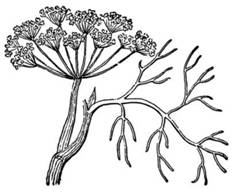
Fig. 38—Anethum graveolens
The original Greek word Anethon which occurs in Mat 23:23, was commonly employed by the Greek and Roman writers to designate a plant used both medicinally and as an article of diet. In Europe the word has always been used to denote a similar plant, which is familiarly known by the name of Dill, and there is no doubt that in the above passage it should have been so rendered. The common dill is an annual plant, growing wild among the corn in Spain and Portugal; and on the coast of Italy, in Egypt, and about Astracan. It resembles fennel, but is smaller, has more glaucous leaves, and a less pleasant smell: the fruit or seeds, which are finely divided by capillary segments, are elliptical, broader, flatter, and surrounded with a membranous disk. They have a warm and aromatic taste, owing to the presence of a pale yellow volatile oil, which itself has a hot taste and a peculiar penetrating odor.
The error in translation here pointed out is not of very great consequence, as both the anise and the dill are umbelliferous plants, which are found cultivated in the south of Europe. The seeds of both are employed as condiments and carminatives, and have been so from very early times; but the anethon is more especially a genus of Eastern cultivation, since either the dill or another species is reared in all the countries from Syria to India. Jewish authorities state that the seed, the leaves, and the stem of dill were ’subject to tithe,’ which indicates that the herb was eaten, as is indeed the case with the Eastern species in the present day.
A well-known plant, resembling dill, caraway, etc., but more fragrant. The seeds are kept by apothecaries. The plant mentioned in Mat 23:23 was no doubt the dill, which grows in Palestine, and was tithed by the Jews.\par
Anise. This word occurs only in Mat 23:23. It is by no means a matter of certainty whether the anise (Pimpinella anisum) or the dill (Anethum graveolens) is here intended, though the probability is more in favor of the latter plant.
"Anise is an annual plant growing to the height of one foot, carries a white flower, and blooms from June till August. The seeds are imported and used in large quantities on account of their aromatic and carminative properties. It grows wild in Egypt, in Syria, Palestine and all parts of the Levant. Among the ancients anise seems to have been a common pot-herb in every garden.
Although it is less used in medicine by the moderns than by the ancients, it still retains its former reputation as an excellent stomachic, particularly for delicate women and young children. The Romans chewed it in order to keep up an agreeable moisture in the mouth and to sweeten the breath, while some Orientals still do the same." Dill, a somewhat similar plant, is an annual, bearing small aromatic seeds, used also for cookery and medicine.
Some think the Pimpinella anisum, others more probably the dill, Anethrum graveolens, of the order Umbelliferae; the seeds used in medicine as carminatives, in cookery as condiments, like caraway seed. "Anise" is from the Greek not conquerable (
(
The proper anise (Gr.
Anise, a well-known annual herb, resembling caraway, etc., but more fragrant. The plant mentioned in Mat 23:23 was no doubt the dill, which grows in Palestine, and was tithed by scrupulous Jews.
Probably
ANISE.—‘Anise’ is the translation given in Authorized Version and Revised Version NT 1881, OT 1885 of
By the Jews dill was cultivated as a garden plant, but in Egypt and Southern Europe, to which it was indigenous, it is often found growing wild in the cornfields. It possesses valuable carminative properties, and in the East the seeds are eaten with great relish as a condiment. It is a hardy annual or biennial umbellifer, and grows to a height of one, two, or even three feet. The stem is round, jointed, and striated; the leaves are finely divided; the flowers, which are small, are yellow; the fruits are brown, oval, and flat.
In Mat 23:23 dill is represented as subject to tithe. That is in strict accord with the provision of the Law (Lev 27:30, Deu 14:22), and is corroborated by the express statement of the Mishna (Ma‘ascroth iv. 5). See, further, art. Rue; and cf. note by Nestle in Expos. Times, Aug. 1904, p. 528b.
Hugh Duncan.
See Dill.
ANISE (RV
E. W. G. Masterman.
Plant mentioned by Our Lord (Matthew 23:23) as subjected to tithe by the Pharisees; a mis-translation for dill, which was made originally in the Wycllif version and let pass since, as of no consequence, dill and anise being of the same parsley family.
Anise (Matthew 23:23) has been, since Wyclif, the rendering of anethon in the English Versions, But this is not accurate. The exact equivalent of the plant anethon is dill (anethum graveolens), while anise corresponds to the pimpinella anisum. The error in translation, however, is of no great importance, both plants belonging to the parsley family (umbelliferoe), and sharing many properties in common. The dill is an annual plant, "with finely striated stems, usually one foot to one foot and a half in height, pinnate leaves with setaceous linear segments, and yellow flowers" (Enc. Bib.). The Jews used it as a condiment. It is mentioned several times in Rabbinic literature, especially in connection with the question of tithes. Beside the articles specified in the Mosaic Law, the Rabbis had, in course of time, subjected to tithe many other objects, extending the prescription to all products of the earth that were esculent and could be preserved.-----------------------------------WUNSCHE, Neue Beiträge zur Erläuterung der Evangelien aus Talmud und Midrasch (Göbttingen, 1878), 291-292; SCHANZ, Matthäus-Evangelium, 469-470; ZAHN, Ev. das Matthäus, (2d ed.) 645, note 75; EDERSHEIM Life and T. of J. M., II, 412; Nouveau Larousse illustré (Paris), s. v. Aneth, Anis, Peucedan; NESTLE, Anise and Rue, in Expository Times (Aug., 1904), 528; WEISS, PLUMMER, SCHANZ, on Luke, xi, 42.EDWARD ARBEZ Transcribed by Douglas J. Potter Dedicated to the Immaculate Heart of the Blessed Virgin Mary The Catholic Encyclopedia, Volume ICopyright © 1907 by Robert Appleton CompanyOnline Edition Copyright © 2003 by K. KnightNihil Obstat, March 1, 1907. Remy Lafort, S.T.D., CensorImprimatur. +John Cardinal Farley, Archbishop of New York
Anise. An annual herb which bears yellow flowers and fragrant seeds. The anise mentioned in the Bible is generally thought to be dill. Anise (dill) was used as medicine and for cooking. It grows in Palestine today both cultivated and wild.
Jesus used the anise as an illustration when He scolded the Pharisees for keeping part of the law in detail while ignoring the rest ( Mat 23:23); (also Deu 14:22).