
the descendants of Amori, or Haemorri, or Amorrhaeus, Gen 10:16, the fourth son of Canaan, whose first possessions were in the mountains of Judea, among the other families of Canaan: but, growing strong above their fellows, and impatient of confinement within the narrow boundaries of their native district, they passed the Jordan, and extended their conquests over the finest provinces of Moab and Ammon; seizing and maintaining possession of that extensive and almost insulated portion of country included between the rivers Jordan, Jabbok, and Arnon. This was the kingdom, and Heshbon the capital, of the Amorites, under Sihon their king, when the Israelites, in their way from Egypt, requested a passage through their country. This request, however, Sihon refused; and came out against them with all his force, when he was slain, his people extirpated, and his kingdom taken possession of by the Israelites. It was subsequently divided between the tribes of Reuben and Gad, Num 13:29; Num 21:13; Num 21:25; Jos 5:1; Jos 11:3; Jdg 11:19; Jdg 11:22.
Am´orites, the descendants of one of the sons of Canaan. They were the most powerful and distinguished of the Canaanitish nations. We find them first noticed in Gen 14:7. In the promise to Abraham (Gen 15:21), the Amorites are specified as one of the nations whose country would be given to his posterity. But at that time three confederates of the patriarch belonged to this tribe; Mamre, Aner, and Eshcol (Gen 14:13; Gen 14:24). When the Israelites were about to enter the Promised Land, the Amorites occupied a tract on both sides of the Jordan. That part of their territories which lay to the east of the Jordan was allotted to the tribes of Reuben, Gad, and half the tribe of Manasseh. They were under two kings—Sihon, king of Heshbon, and Og, king of Bashan (Deu 1:4; Jos 12:4; Jos 13:12). Before hostilities commenced messengers were sent to Sihon, requesting permission to pass through his land; but Sihon refused, and came to Jahaz and fought with Israel; and Israel smote him with the edge of the sword, and possessed his land from Arnon (Modjeb) unto Jabbok (Zerka) (Num 21:24). Og also gave battle to the Israelites at Edrei, and was totally defeated. After the capture of Ai, five kings of the Amorites, whose dominions lay within the allotment of the tribe of Judah, leagued together to wreak vengeance on the Gibeonites for having made a separate peace with the invaders. Joshua, on being apprised of their design, marched to Gibeon and defeated them with great slaughter (Jos 10:10). Another confederacy was shortly after formed on a still larger scale; the associated forces are described as ’much people, even as the sand upon the sea-shore in multitude, with horses and chariots very many’ (Jos 11:4). Joshua came suddenly upon them by the waters of Merom (the modern lake Huleh), and Israel smote them until they left none remaining (Jos 11:8). Still, after their severe defeats, the Amorites, by means of their war-chariots and cavalry, confined the Danites to the hills, and would not suffer them to settle in the plains: they even succeeded in retaining possession of some of the mountainous parts (Jdg 1:34-36). It is mentioned as an extraordinary circumstance that in the days of Samuel there was peace between Israel and the Amorites (1Sa 7:14). In Solomon’s reign a tribute of bond-service was levied on the remnant of the Amorites and other Canaanitish nations (1Ki 9:21; 2Ch 8:8).
A people descended from Emer, the fourth son of Canaan, Gen 10:16 . They first peopled the mountains west of the Dead sea, near Hebron; but afterwards extended their limits, and took possession of the finest provinces of Moab and Ammon, on the east between the brooks Jabbok and Arnon, Num 13:29 21:21-31 Jos 5:1 Jdg 11:13 . Moses took this country from their king, Sihon. The lands which the Amorites possessed on this side Jordan were given to the tribe of Judah, and those beyond the Jordan to the tribes of Reuben and Gad. The name Amorite is often taken in Scripture for Canaanite in general, Gen 15:16 1Sa 2:9 . See CANAANITES.\par By the expression, "Thy father was an Amorite and thy mother a Hittite." Eze 16:3, God reminds the Jews that they were naturally no more worthy of divine favor than the worst of the heathen Canaanites.\par
Amorites (ăm’o-rîtes), mountaineers. Gen 10:16. A Syrian tribe descended from Canaan, and among the most formidable of the tribes with whom the Israelites contended. They were of gigantic stature and great courage, Amo 2:9, and inhabited one of the most fertile districts of the country, being bounded on three sides by the rivers Amon, Jabbok, and Jordan. The Israelites asked permission of the king to travel through their territory, promising to injure nothing, not even to draw water from their wells; but the request was refused. The Amorites collected and attempted to oppose their progress, but were totally defeated, and their territory taken and divided between the tribes of Reuben and Gad.
[Am’orites]
A people descended from Canaan, son of Ham. Gen 10:16, They dwelt in the mountains, as their name signifies, and were apparently at times in the mountains both east and west of the Jordan. Num 13:29; Jos 5:1; Jdg 1:34-36; Jdg 10:8; 1Ki 4:19. Being the most dominant and the most corrupt people or tribe they sometimes represent the Canaanites generally. Gen 15:16; 1Ki 21:26. When Abraham was at Hebron some confederated with him. Gen 14:13. A remnant out of the Gentile nations was thus associated with the heir of promise, though Lot (a type of Israel after the flesh) had separated from him.
When Israel approached the promised land, they were in the east, and refused to let Israel pass; but they were overcome, their cities taken, and the people slain, with Sihon their king. Num 21:21-26; Deu 2:24; Amo 2:9-10. Some must have escaped, for we read of them later, and one of the controversies Jehovah had with Israel was for worshipping their gods. Ezr 9:1-2. Solomon made them tributary. 1Ki 9:20-21; 2Ch 8:7-8. The Gibeonites were a remnant of the Amorites. 2Sa 21:2. After this nothing is heard of them. The low state of Jerusalem (Judah) by nature is described by stating her origin, her father being an Amorite and her mother a Hittite, but God in grace had compassion upon her in her degradation, and raised her into great glory; though, alas, she was shamefully unfaithful. Eze 16:3-43.
By: W. Max Muller, Kaufmann Kohler
—Biblical Data:
The descendants of the fourth son of Canaan (Gen. x. 16, I Chron. i. 14). They form part of the ancient inhabitants of Palestine (Gen. xv. 21; Ex. iii. 8, 17, xxiii. 23; Joshua, iii. 10, xxiv. 11; I Kings, ix. 20; Ezek. xvi. 3, 45; also Isa. xvii. 9, where we ought probably to follow the Septuagint reading, "the forsaken places of the Amorites and the Hivites"). As representatives of the whole pre-Israelitish population, they are mentioned in Gen. xv. 16, xlviii. 22; Joshua, v. 1, xxiv. 15, 18; Judges, x. 11; I Sam. vii. 14; I Kings, xxi. 26; II Kings, xxi. 11; Amos, ii. 9, etc.
Geographical Distribution.
Some scholars claim that (I Sam. vii. 14) Philistines and Amorites are synonymous, so that the latter expression would include all non-Israelitish inhabitants of Palestine. Usually, however, the passage in question is interpreted to mean the isolated remnants of the Amorites, who in pre-Philistine and pre-Israelitish times had occupied a large part of the country west of the Jordan. Their territory is more exactly defined as follows:
(a) In the south they inhabit the hill-country ofthe Amorites (Deut. i. 7, 19) on one side of the Canaanites (ibid. verses 27, 44), north of Kadeshbarnea. The Amorites in Hazezon-tamar (Gen. xiv. 7) and Mamre (ver. 13) belong to the same region.
(b) More to the north Joshua, x. 5, mentions five kings of the Amorites; namely, in Jerusalem, Hebron, Jarmuth, Lachish, and Eglon, as "all the kings of the Amorites that dwell in the hill-country"; compare ver. 12. According to II Sam. xxi. 2, Gibeon also was Amoritish (Joshua, xi. 19: Hivitish), although it is more probable that the name Amorite has there the vague meaning discussed above, without precise ethnological signification. We find the "Amorites which were beyond Jordan, westward" (Joshua, v. 1, xxiv. 8), distinguished from the "Canaanites which were by the sea" (ibid. v. 1); Joshua, xi. 3, apportions the hill-country to the Amorites, together with three other nations, distinguishing them from "the Canaanites on the east and on the west." According to Judges, i. 34 [A. V. 35], however, at a somewhat later period, the Amorites dwelling "in Mount Heres, in Aijalon, and in Shaalbim," whose border began "from the ascent of Akrabbim," did not allow the Danites "to come down to the valley" and "forced them into the hill-country," although the Amorites afterward became subject to Israel. It is questionable if a remnant of the Amoritish territory properly speaking is meant; more probably the name Amorite has again the general meaning. One is even tempted to understand it as used of the Philistines (as I Sam. vii. 14; see above).
(c) Amorites dwell east of the Jordan (Num. xxi. 13): the Arnon is the frontier between Moab and the Amorites. This land of the Amorites reaching "from Arnon to Jabbok, even unto the children of Ammon" (ibid. 24), had been taken away from Moab by Sihon (ibid. 24, 26, 29), who built Heshbon to be his residence (ibid. 26, 27) directly before the immigration of Israel. Amorites dwelling in Jazer are specially mentioned (ibid. 32). These Amorites "which dwelt beyond Jordan" are also referred to (Deut. i. 1, 4, iii. 2; I Kings, iv. 19; Ps. cxxxv. 11, cxxxvi. 19; Josh. ii. 10, ix. 10). Og, king of Bashan in Ashtaroth, is also called an Amorite in Deut. iii. 8, iv. 47, where we learn that Og's territory extended "from the river of Arnon unto Mount Hermon." So the land of the Amorites, which is in Gilead (Judges, x. 8), seems to have embraced all the territory afterward owned by Israel, east of the Jordan. Deut. iii. 9 informs us that the name of Mount Hermon in the language of the Amorites was Shenir.
Masters of Witchcraft. —In Rabbinical and Apocryphal Literature:
Amorites.(From the pylon of the Ramesseum.)
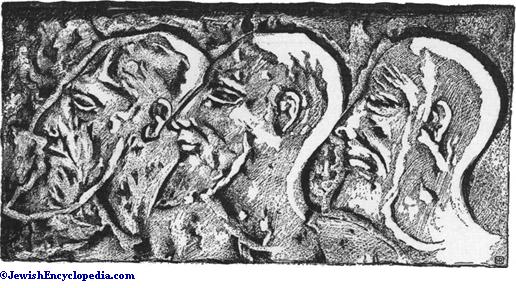
In Tosef., Shab. (vii. [viii.] 23), and generally in post-Biblical literature, the Canaanites are usually spoken of as the Amorites (compare Assumptio Mosis, xi. 16; B. M. 25b); and they were characterized by R. Jose, the chronicler, as the most intractable of all nations. To the apocryphal writers of the first and second pre-Christian century they are the main representatives of heathen superstition, loathed as idolaters, in whose ordinances Israelites may not walk (Lev. xviii. 3). A special section of the Talmud (Tosef., Shab. vi.-vii. [vii.-viii.]; Bab. Shab. 67a et seq.) is devoted to the various superstitions called "The Ways of the Amorites." According to the Book of Jubilees (xxix. [9] 11), "the former terrible giants, the Rephaim, gave way to the Amorites, an evil and sinful people whose wickedness surpasses that of any other, and whose life will be cut short on earth." In the Syriac Apocalypse of Baruch (lx.) they are symbolized by "black water" on account of "their black art, their witchcraft and impure mysteries, by which they contaminated Israel in the time of the Judges." This refers to the strange story of Kenaz, preserved in the "Chronicle of Jerahmeel" (Cohn in "Jew. Quart. Rev." 1898, pp. 294 et seq., and translation of Gaster, p. 166), which relates how the tribes of Israel learned all their wickedness from the Amorites, the masters of witchcraft, whose books they kept hidden under Mount Abarim, and whose wonder-working idols—seven holy nymphs—they had concealed beneath Mount Shechem. Each of these idols was adorned with precious stones, which shone at night like the light of day, and by their power sight was restored to the blind. Kenaz, the son of Caleb and father of Othniel, when hearing of this, forthwith destroyed the idolatrous Israelites by fire, but tried in vain to destroy either the magic-books or thestones. So he buried the books, but in the morning found them transformed into twelve precious stones, with the names of the twelve tribes of Israel engraved thereon, and later they were used in Solomon's Temple. Then, with the help of the angel Gabriel, he smote the Amorites with blindness and destroyed them with his sword.
These legends may be regarded as reflecting the prevalent belief of the Jewish people in Amorite witchcraft. But the ancient midrashic and apocryphal narratives of battles fought by the sons of Jacob with the Amorites seem likewise to rest upon the actual warfare which took place between the Jews and the surrounding nations during the second Temple. According to the Book of Jubilees, § xxxiv.; Testament of Patriarch Judah, 3-7; Midrash Wayis'u, in Jellinek, "B. H." iii. 1-5; "Chron. of Jerahmeel," ed. Gaster, §§ xxxvi., xxxvii., and Sefer ha-Yashar, xxxvii.-xl., the sons of Jacob fought with the sons of Esau, while the Amorites sided with the latter and were defeated. The battlefield described in the various sources being almost identical with the battle-place of the Maccabean heroes, it is much more likely that the story originated in the time of John Hyrcanus, when war was successfully waged against the Idumeans and other nations, than that it arose in the time of King Herod, as Gaster thinks ("Chronicle of Jerahmeel," preface and lxxxii.; compare Book of Jubilees and Edom).
K.In Monumental Inscription. —Critical View:
The monumental evidence is as follows: Egyptian inscriptions (see W. M. Müller, "Asien und Europa," p. 218) call the land east of Phenicia and north of Palestine "the land of the A-ma-ra." The Amar, or Amor, of the texts is chiefly the valley between the Lebanon and Antilebanon mountains, the modern Beka'a. In the El-Amarna tablets (Winckler, Nos. 42, 44, 50), Aziru, the prince of the same region, is called "Prince of Amurru." The latter name does not seem to be much more comprehensive than in the Egyptian texts, and certainly does not apply to Palestine. Only in the later cuneiform texts the old expression Amurru (not to be read "AḦarru") is used so vaguely that Phenicia and even neighboring countries are included (Delitzsch, "Paradies," p. 271). The Babylonian letter-group Im-martu, or Mar-tu for "West," hardly belongs here, but because of the similar sound in its earlier form it was written for Amurru in the Amarna tablets and still more frequently afterward in the extended signification of Amurru. At present it is not very easy to show the connection between the monumental Amorites and the Palestinian Amorites of the Bible. Winckler ("Gesch. Israels," i. 52) assumes that the Amorites, somewhere about the time of the El-Amarna tablets (after 1400 B.C.), descended into Palestine from their original northern habitations. He supports this by the fact that only those of the earlier Biblical traditions, which belong to the northern kingdom, contain the name Amorites; namely, the prophet Amos and those parts of the Pentateuch which the critics assign to E., the Elohistic or Ephraimitic writer (followed by Deuteronomy). For this critical distinction in the use of the name see E. Meyer, in Stade's "Zeitschrift," i. 122. Budde, in "Richter and Samuel," xvii. ascribes Judges, i. 34, to the Judaic or Yahwistic writer, but see above on the probably indistinct and not very archaic use of the name in that passage. Wellhausen ("Die Composition des Hexateuchs," ii. 341) assumes that Amorites and Canaanites are synonymous expressions, only that the former is used of the Canaanites exterminated by Israel, the latter to distinguish them from those living among the Israelites at the time of the kings. These conclusions are suggested by the circumstance that the territory of the Amorites as described above leaves very little room for the Canaanites in the territory occupied by Israel, and that both terms sometimes seem to be used interchangeably (compare Gen. xiv. 13 with Judges, i. 10; Num. xiv. 45 with Deut. i. 44 et seq.).
Thus Amorite would be the more ancient name, obscure even to the earliest writers. It is not certain that these writers were influenced by the etymology of the word. If Amorites were equivalent to "highlanders," we should have to compare the application of the name to the highland of Judah (Num. xiii. 29; Deut. i. 7, 19, 20; Josh. v. 1, x. 6, xi. 32) as a secondary use or as a mere inference from the etymology. At present, however, that etymology has been discarded, as amir means "summit," not "mountains" or "highland." The Egyptian inscriptions, indeed, seem to treat the name of the original country Amor as a geographical term, always connecting it with the article, while Amorite is in the Bible an ethnic name. How the Amorites, or at least their name, came to Palestine, still awaits plausible explanation.
Race and Language.
Gen. x. 16 calls the Amorites a branch of the Canaanites. Amoritish names like Adoni-zedek (Josh. x. 3; compare verse 5) seem, indeed, to point to full identity in language with those tribes. The question, why the Amorites, with the rest of the pre-Israelitic population of Palestine, are (Gen. x.) classed among the Hamites, can not be discussed here. Sayce ("Races of the Old Testament," pp. 100 et seq.) has tried to explain this by assuming a connection between the Amorites (and the Canaanites in general!) with the ancient Libyans, entirely on the basis of a certain similarity of the facial type in one Egyptian sculpture of Rameses III. The numerous other Egyptian pictures of these nations, however, do not confirm this, and a linguistic comparison of Canaanitish (see above on its identity with Amoritish) and Libyan is impossible. The remote relationship between all Hamites and the Proto-Semites in race and language does not belong here.
Bibliography:
Sayce, Races of the Old Testament, 1891, pp. 100 et seq.
AMORITES.—An ancient people whose presence can be traced in Palestine and Syria and also in Babylonia. From Deu 3:9 it appears that their language differed only dialectically from Canaanite, which was Hebrew. This view is confirmed by many proper names from the monuments. They were accordingly of the same race as the Canaanites. Contract tablets of the time of Hammurabi (b.c. 2250) show that Amorites were in Babylonia at that time (cf. Meissner, Altbab. Privatrecht, No. 42). At this period their country was designated by the ideogram MAR-TU. It has long been known that this ideogram stood for Palestine and Syria. At that time, then, the Amorites were already in the West.
Because of the identity of their proper names, it is believed that the Amorites were identical in race with that Semitic wave of immigration into Babylonia which produced the first dynasty of Babylon, the dynasty of Hammurabi (cf. Paton, Syria and Palestine, 25–29). Paton holds that an Amoritic wave of migration overran Babylonia and the Mediterranean coast about b.c. 2500, but Johns (Expos., April, 1906, p. 341) holds it probable, also on the basis of proper names, that the Amorites were in both Babylonia and the West before the time of Sargon, b.c. 3800.
About b.c. 1400 we learn from the el-Amarna tablets that the great valley between the Lebanon and Anti-Lebanon ranges, which was afterwards called Cœle-Syria, was inhabited by Amorites, whose prince was Aziru (cf. KIB
George A. Barton.
1. Varying Use of the Name Explained
2. The Amorite Kingdom
3. Sihon’s Conquest
4. Disappearance of the Amorite Kingdom
5. Physical Characteristics of the Amorites
The name Amorite is used in the Old Testament to denote (1) The inhabitants of Palestine generally, (2) The population of the hills as opposed to the plain, and (3) a specific people under a king of their own. Thus (1) we hear of them on the west shore of the Dead Sea (Gen 14:7), at Hebron (Gen 14:13), and Shechem (Gen 48:22), in Gilead and Bashan (Deu 3:10) and under Hermon (Deu 3:8; Deu 4:48). They are named instead of the Canaanites as the inhabitants of Palestine whom the Israelites were required to exterminate (Gen 15:16; Deu 20:17; Jdg 6:10; 1Sa 7:14; 1Ki 21:26; 2Ki 21:11); the older population of Judah is called Amorite in Jos 10:5, Jos 10:6, in conformity with which Ezek (Jos 16:3) states that Jerusalem had an Amorite father; and the Gibeonites are said to have been “of the remnant of the Amorites” (2Sa 21:2). On the other hand (2), in Num 13:29 the Amorites are described as dwelling in the mountains like the Hittites and Jebusites of Jerusalem, while the Amalekites or Bedouins lived in the south and the Canaanites on the seacoast and in the valley of the Jordan. Lastly (3) we hear of Sihon, “king of the Amorites,” who had conquered the northern half of Moab (Num 21:21-31; Deu 2:26-35).
1. Varying Use of the Name Explained
Assyriological discovery has explained the varying use of the name. The Hebrew form of it is a transliteration of the Babylonian
2. The Amorite Kingdom
The Amorite kingdom was of great antiquity. About 2500 bc it embraced the larger part of Mesopotamia and Syria, with its capital probably at Harran, and a few centuries later northern Babylonia was occupied by an “Amorite” dynasty of kings who traced theft descent from Samu or Sumu (the Biblical Shem), and made Babylon their capital. To this dynasty belonged Khammu-rabi, the Amraphel of Gen 14:1. In the astrological documents of the period frequent reference is made to “the king of the Amorites.” This king of the Amorites was subject to Babylonia in the age of the dynasty of Ur, two or three centuries before the birth of Abraham He claimed suzerainty over a number of “Amorite” kinglets, among whom those of Khana on the Euphrates, near the mouth of the Khabur, may be named, since in the Abrahamic age one of them was called Khammu-rapikh and another Isarlim or Israel. A payment of a cadastral survey made at this time by a Babylonian governor with the Canaanite name of Urimelech is now in the Louvre. Numerous Amorites were settled in Ur and other Babylonian cities, chiefly for the purpose of trade. They seem to have enjoyed the same rights and privileges as the native Babylonians. Some of them were commercial travelers, but we hear also of the heads of the great firms making journeys to the Mediterranean coast.
In an inscription found near Diarbekir and dedicated to Khammu-rabi by Ibirum (= Eber), the governor of the district, the only title given to the Babylonian monarch is “king of the Amorites,” where instead of
The Amorite kingdom continued to exist down to the time of the Israelite invasion of Palestine, and mention is made of it in the Egyptian records as well as in the cuneiform Tell el-Amarna Letters, and the Hittite archives recently discovered at Boghaz-keui, the site of the Hittite capital in Cappadocia. The Egyptian conquest of Canaan by the kings of the 18th Dynasty had put an end to the effective government of that country by the Amorite princes, but their rule still extended eastward to the borders of Babylonia, while its southern limits coincided approximately with what was afterward the northern frontier of Naphtali. The Amorite kings, however, became, at all events in name, the vassals of the Egyptian Pharaoh. When the Egyptian empire began to break up, under the “heretic king” Amenhotep IV, at the end of the 18th Dynasty (1400 bc), the Amorite princes naturally turned to their more powerful neighbors in the north. One of the letters in the Tell el-Amarna correspondence is from the Pharaoh to his Amorite vassal Aziru the son of Ebed-Asherah, accusing him of rebellion and threatening him with punishment. Eventually Aziru found it advisable to go over openly to the Hittites, and pay the Hittite government an annual tribute of 300 shekels of gold. From that time forward the Amorite kingdom was a dependency of the Hittite empire, which, on the strength of this, claimed dominion over Palestine as far as the Egyptian frontier.
The second successor of Aziru was Abi-Amurru (or Abi-Hadad), whose successor bore, in addition to a Semitic name, the Mitannian name of Bentesinas. Bente-sinas was dethroned by the Hittite King Muttallis and imprisoned in Cappadocia, where he seems to have met the Hittite prince Khattu-sil, who on the death of his brother Muttallis seized the crown and restored Bente-sinas to his kingdom. Bente-sinas married the daughter of Khattu-sil, while his own daughter was wedded to the son of his Hittite suzerain, and an agreement was made that the succession to the Amorite throne should be confined to her descendants. Two or three generations later the Hittite empire was destroyed by an invasion of “northern barbarians,” the Phrygians, probably, of Greek history, who marched southward, through Palestine, against Egypt, carrying with them “the king of the Amorites.” The invaders, however, were defeated and practically exterminated by Ramses III of the 20th Egyptian Dynasty (1200 bc). The Amorite king, captured on this occasion by the Egyptians, was probably the immediate predecessor of the Sihon of the Old Testament.
3. Sihon’s Conquest
Egyptian influence in Canaan had finally ceased with the invasion of Egypt by the Libyans and peoples of the Aegean in the fifth year of Meneptah, the successor of Ramses II, at the time of the Israelite Exodus. Though the invaders were repulsed, the Egyptian garrisons had to be withdrawn from the cities of southern Palestine, where their place was taken by the Philistines who thus blocked the way from Egypt to the north. The Amorites, in the name of their distant Hittite suzerains, were accordingly able to overrun the old Egyptian provinces on the east side of the Jordan; the Amorite chieftain Og possessed himself of Bashan (Deu 3:8), and Sihon, “king of the Amorites,” conquered the northern part of Moab.
The conquest must have been recent at the time of the Israelite invasion, as the Amorite song of triumph is quoted in Num 21:27-29, and adapted to the overthrow of Sihon himself by the Israelites. ’Woe unto thee,’ it reads, ’O Moab; thou art undone, O people of Chemosh! (Chemosh) hath given thy sons who escaped (the battle) and thy daughters into captivity to Sihon king of the Amorites.’ The flame that had thus consumed Heshbon, it is further declared, shall spread southward through Moab, while Heshbon itself is rebuilt and made the capital of the conqueror: “Come to Heshbon, that the city of Sihon (like the city of David, 2Sa 5:9) may be rebuilt and restored. For the fire has spread from Heshbon, the flame from the capital of Sihon, devouring as far as Moab (reading
4. Disappearance of the Amorite Kingdom
After the fall of Sihon the Amorite kingdom disappears. The Syrians of Zobah, of Hamath and of Damascus take its place, while with the rise of Assyria the “Amorites” cease to be the representatives in contemporary literature of the inhabitants of western Asia. At one time their power had extended to the Babylonian frontier, and Bente-sinas was summoned to Cappadocia by his Hittite overlord to answer a charge made by the Babylonian ambassadors of his having raided northern Babylonia. The Amorite king urged, however, that the raid was merely an attempt to recover a debt of 30 talents of silver.
5. Physical Characteristics of the Amorites
In Num 13:29 the Amorites are described as mountaineers, and in harmony with thins, according to Professor Petrie’s notes, the Egyptian artists represent them with fair complexions, blue eyes and light hair. It would, therefore, seem that they belonged to the Libyan race of northern Africa rather than to the Semitic stock. In western Asia, however, they were mixed with other racial elements derived from the subject populations, and as they spoke a Semitic language one of the most important of these elements would have been the Semites. In its general sense, moreover, the name “Amorite” included in the Babylonian period all the settled and civilized peoples west of the Euphrates to whatever race they might belong.
Literature
Hugo Winckler, Mitteilungen der deutschen Orient-Gesellschaft (1907), No. 35, Berlin; Sayce, The Races of the Old Testament, Religious Tract Soc., 1890.
There is some uncertainty concerning the identity of the Amorites mentioned in the Bible, for the name ‘Amorite’ had a variety of usages in early Bible times. Non-biblical records suggest that the word meant ‘westerner’ and referred to the early Semitic peoples who migrated to ancient Babylonia from Western Mesopotamia and Syria. They conquered the formerly powerful kingdom of Ur, and soon spread their rule throughout Lower, Upper and Western Mesopotamia.
Later these Amorites migrated down into Palestine, and were well established in certain areas by the time Abraham arrived (Gen 14:7; Gen 14:13). They intermarried so widely with the original Canaanites that it became common practice to use the words ‘Canaanite’ and ‘Amorite’ interchangeably as names for the whole mixed population of Canaan (Gen 15:16; Jos 24:15; Jos 24:18).
This intermarriage may explain why the biblical records indicate that the Amorites were descended from Ham, whereas non-biblical records suggest they were descended from Shem (Semites). Because most of the original Canaanites were descendants of Ham, the Amorites who later became Canaanites could regard both Ham and Shem as their ancestors (Gen 10:1; Gen 10:6; Gen 10:15-16). Nevertheless, some Amorite tribal groups in Canaan maintained their distinct identity, as did other tribal groups (Exo 3:8; Exo 13:5; Exo 23:23; Jos 9:1; Jos 12:8).
Israel and the Amorites
Prior to Israel’s migration from Egypt to Canaan, the Amorite king Sihon had conquered all the Ammonite and Moabite territory east of the Jordan River as far south as the Arnon River. He made the former Moabite town Heshbon his capital (Num 21:26). When Sihon went to war against the journeying Israelites, the Israelites overthrew his army and seized his territory (Num 21:21-25). They also seized the adjoining northern territory of Bashan, which was ruled by another Amorite king (Num 21:33-35). This combined Amorite territory east of Jordan later became the homeland of the Israelite tribes of Reuben, Gad and the eastern half of Manasseh (Num 32:33).
Amorite kings west of Jordan (i.e. in Canaan) likewise lost their territory to the conquering Israelites (Jos 5:1; Jos 10:5; Jos 11:1-8). This area became the homeland of the remaining nine and a half Israelite tribes.
At various times throughout their history, the Israelites obtained cheap labour by forcing the Amorites and other conquered peoples to work as slaves on government projects (Jdg 1:35; 1Ki 9:20-21). In time the Amorites were absorbed into Israel and so disappeared as a distinct race. But their name survived as a general term for all the former inhabitants of Canaan (1Ki 21:26; 2Ki 21:11; cf. Gen 15:16).