
Amon, 1
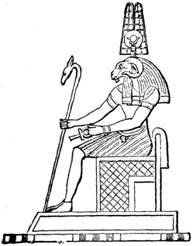
Fig. 34—Amon, an Egyptian god
A´mon (Jer 46:25) is the name of an Egyptian god, in whom the classical writers unanimously recognize their own Zeus and Jupiter. His chief temple and oracle in Egypt were at Thebes, a city peculiarly consecrated to him, and which is probably meant by the No and No Amon of the prophets. He is generally represented on Egyptian monuments by the seated figure of a man with a ram’s head, or by that of an entire ram, and of a blue color. In honor of him, the inhabitants of the Thebaid abstained from the flesh of sheep, but they annually sacrificed a ram to him and dressed his image in the hide.
As for the power which was worshipped under the form of Amon, it has been asserted that the Libyans adored the setting sun under that of their Ammon; others have endeavoured to prove that Amon represented the sun at the vernal equinox. But nothing very definite is known upon the subject, though the fact seems placed beyond a doubt that Amon bears some relation to the sun.
Amon, 2
Amon (artificer), son of Manasseh, and fourteenth king of Judah, who began to reign B.C. 641, and reigned two years. He appears to have derived little benefit from the instructive example which the sin, punishment, and repentance of his father offered; for he restored idolatry, and again set up the images which Manasseh had cast down. He was assassinated in a court conspiracy: but the people put the regicides to death, and raised to the throne his son Josiah, then but eight years old (2Ki 21:19-26; 2Ch 33:21-25).
The fourteenth king of Judah, son of Manasseh, began to reign B. C. 639, at the age of twenty-two, and reigned only two years at Jerusalem. He did evil in the sight of the Lord, as his father Manasseh had done, by forsaking Jehovah and worshipping idols. His servants conspired against him, and slew him in his own house; but the people killed all the conspirators, and established his son Josiah on the throne. He was buried in the garden of Uzzah, 2Ki 21:18-26 2Ch 33:21-25 .\par
A’mon. (the mysterious).
1. An Egyptian divinity, whose name occurs in that of No-amon. Nah 3:8. Amen was one of the eight gods of the first order and chief of the triad of Thebes. He was worshipped at that city as Amen-Ra, or "Amen the Sun".
(builder).
2. One of Ahab’s governors. 1Ki 22:26; 2Ch 18:25.
3. King of Judah, son and successor of Manasseh, reigned two years, from B.C. 642 to 640. Amon devoted himself wholly to the service of false gods, but was killed in a conspiracy, and was succeeded by his son Josiah.
(Nah 3:8). No-Amon, i.e. Thebes, or No, the city of Amon, an Egyptian god (Jer 46:25), "the multitude of No," else "Amon of No" ("the nourisher", Hebrew). The Egyptian name is Amen, "the hidden," or "mysterious"; one of the eight gods of the first order; thief of the Theban triad, worshipped as Amen-ra (i.e. the sun), represented as a man wearing a cap with two plumes, both male and female; accompanied with sacred trees, like the "groves" connected with Baal’s worship. In the great Oasis he was worshipped as the ram-headed god Num, and in Meroe as Kneph. The Greeks called him Jupiter Ammon.
(Heb., Amon’,
4. (Sept.
Amon (â’mon), an Egyptian divinity, whose name occurs in mat of No-amon, Nah 3:8 R. "V., but in A. V. "populous No," or Thebes, also called No. The Greeks called this divinity Ammon. The ancient Egyptian name is Amen. Amen was one of the eight gods of the first order, and chief of the triad of Thebes. He was worshiped at that city as Amen-ra, or "Amen the sun."
Amon (â’mon), builder. King of Judah, son and successor of Manasseh, reigned two years from b.c. 642 to 640. Following his father’s example, Amon devoted himself wholly to the service of false gods, but was killed in a conspiracy. The people avenged him by putting all the conspirators to death, and secured the succession to his son Josiah. To Amon’s reign we must refer the terrible picture which the prophet Zephaniah gives of the moral and religious state of Jerusalem. 2. A governor of Samaria. 1Ki 22:26. 3. A person also called Ami.
[A’mon]
1. The governor of Samaria in the time of Ahab. 1Ki 22:26; 2Ch 18:25.
2. Son and successor of Manasseh, king of Judah. He reigned but 2 years, B.C. 643-2. He did evil in the sight of the Lord, and served the idols which his father had set up. His servants conspired against him, and slew him in his own house. 2Ki 21:18-25; 1Ch 3:14; 2Ch 33:20-25; Jer 1:2; Jer 25:3; Zep 1:1; Mat 1:10.
3. Neh 7:59. See AMI
AMON.—A king of Judah (circa (about) 640 b.c.) mentioned in our Lord’s genealogy, Mat 1:10 (Gr.
By: Gerson B. Levi
1. Governor of Samaria during the reign of Ahab (I Kings, xxii. 26; II Chron. xviii. 25). To him Ahab handed over Micaiah, the prophet, on his prophesying unfavorably to the king. 2. The "children of Amon" are mentioned in the long list of those who returned from Babylon under Zerubbabel (Neh. vii. 59).
AMON.—1. Son and successor of Manasseh king of Judah. He reigned two years or parts of years. Our Biblical books know only that he carried on the religious practices of his father. He was put to death by a palace conspiracy, but the assassins were punished by the populace, who placed Josiah on the throne (2Ki 21:19 ff.). It has been suggested that his name is that of the Egyptian sun-god (see next art.). 2. A governor of Samaria (1Ki 22:26). 3. See Ami.
H. P. Smith.
AMON (Gr. Ammon, Egyp. Amûn).—An Egyptian divinity, who, primarily worshipped as the god of fertility, and later as Amen-ra-setn-nteru (‘Amon, the sun-god, the king of the gods’), was the local deity of Thebes. With the subjugation of the petty princes of lower Egypt by Aahmes I. of Thebes (c
N. Koenig.
(1) A king of Judah, son and successor of Manasseh; reigned two years and was assassinated in his own palace by the officials of his household. The story of his reign is told briefly in 2Ki 21:19-26, and still more briefly, though in identical terms, so far as they go, in 2Ch 33:21-25. His short reign was merely incidental in the history of Judah; just long enough to reveal the traits and tendencies which directly or indirectly led to his death. It was merely a weaker continuation of the régime of his idolatrous father, though without the fanaticism which gave the father positive character, and without the touch of piety which, if the Chronicler’s account is correct, tempered the father’s later years.
If the assassination was the initial act of a revolution the latter was immediately suppressed by “the people of the land,” who put to death the conspirators and placed Amon’s eight-year-old son Josiah on the throne. In the view of the present writer the motive of the affair was probably connected with the perpetuity of the Davidic dynasty, which, having survived so long according to prophetic prediction (compare 2Sa 7:16; Psa 89:36, Psa 89:37), was an essential guarantee of Yahweh’s favor. Manasseh’s foreign sympathies, however, had loosened the hold of Yahweh on the officials of his court; so that, instead of being the loyal center of devotion to Israel’s religious and national idea, the royal household was but a hotbed of worldly ambitions, and all the more for Manasseh’s prosperous reign, so long immune from any stroke of Divine judgment. It is natural that, seeing the insignificance of Amon’s administration, some ambitious clique, imitating the policy that had frequently succeeded in the Northern Kingdom, should strike for the throne. They had reckoned, however, without estimating the inbred Davidic loyalty of the body of the people. It was a blow at one of their most cherished tenets, committing the nation both politically and religiously to utter uncertainty. That this impulsive act of the people was in the line of the purer religious movement which was ripening in Israel does not prove that the spiritually-minded “remnant” was minded to violence and conspiracy, it merely shows what a stern and sterling fiber of loyalty still existed, seasoned and confirmed by trial below the corrupting cults and fashions of the ruling classes. In the tragedy of Amon’s reign, in short, we get a glimpse of the basis of sound principle that lay at the common heart of Israel.
(2) A governor of Samaria (1Ki 22:26); the one to whom the prophet Micaiah was committed as a prisoner by King Ahab, after the prophet had disputed the predictions of the court prophets and foretold the king’s death in battle.
(3) The head of the “children of Solomon’s servants” (Neh 7:59) who returned from captivity; reckoned along with the Nethinim, or temple slaves. Called also Ami (Ezr 2:57).