
Menu

Amber

12 sources
Biblical and Theological Dictionary by Richard Watson (1831)

חשמל , Eze 1:4; Eze 1:27; Eze 8:2. The amber is a hard inflammable bitumen. When rubbed it is highly endowed with that remarkable property called electricity, a word which the moderns have formed from its Greek name ηλεκτρον. But the ancients had also a mixed metal of fine copper and silver, resembling the amber in colour, and called by the same name. From the version of Eze 1:4, by the LXX, Και εν τω μεσω αυτου ως υρασις ηλεκτρου εν μεσψτον πυρος, “And in the midst of it as the appearance of electrum in the midst of the fire,” it appears that those translators by ηλεκτρον, could not mean amber, which grows dim as soon as it feels the fire, and quickly dissolves into a resinous or pitchy substance; but the mixed metal above mentioned, which is much celebrated by the ancients for its beautiful lustre, and which, when exposed to the fire like other metals, grows more bright and shining. St. Jerom, Theodoret, St. Gregory and Origen think, that, in the above cited passages from Ezekiel, a precious and highly polished metal is meant.

Popular Cyclopedia of Biblical Literature by John Kitto (1856)

The substance thus designated in the Authorized Version is in Hebrew called Chasmil and was probably a composition of several sorts of metal, since even the term by which the word is rendered by the Greeks frequently signifies a composition of gold and silver. The ancients were acquainted with the art of amalgamating various species of metal; and the Latin aurichalcum is said to have possessed the brightness of gold and the hardness of copper, and might not improbably have been our present platina, which has been re-discovered in the Ural mountains, after having long been known as an American fossil. It is not improbable that this was the metal termed ’fine copper’ (Ezr 8:27).

American Tract Society Bible Dictionary by American Tract Society (1859)

Is a yellow or straw-colored gummy substance, originally a vegetable production, but reckoned in the mineral kingdom. It is found in lumps in the sea and on the shores of Prussia, Sicily, Turkey, etc. Externally it is rough; it is very transparent, and on being rubbed, yields a fragrant odor. It was formerly supposed to be medicinal, but is now employed only in the manufacture of trinkets, ornaments, etc.\par The Hebrew word chasmil is translated by the Septuagint and Vulgate electrum, that is, amber, because the Hebrew denotes a very brilliant amber-like metal, composed of silver and gold, which was much prized in antiquity, Eze 1:4,27 ; 8:2. Others, as Bochart, refer here to the mixture of gold and brass, of which the ancients had several kinds, some of which exhibited a high degree of luster. Something similar to this was probably also the "fine brass," in Ezr 8:27 ; Jer 1:15 .\par

Smith's Bible Dictionary by William Smith (1863)

Amber. (Hebrew, chasmal), occurs only in Eze 1:4; Eze 1:27; Eze 8:2. It is usually supposed that the Hebrew word, chasmal (denotes a metal) and not the fossil resin called amber.

Fausset's Bible Dictionary by Andrew Robert Fausset (1878)

Hebrew; chasmal. Eze 1:4; Eze 1:27; Eze 8:2. Not our amber, a bituminous substance or fossil resin, but a metal. Smooth polished brass (Gesenius). Compare Eze 1:7, brass in a glow or white heat; Ezr 8:27 margin; Rev 1:15, "His feet like unto glowing brass" (chalcolibanus; from libben, "whiten;" brass in a white heat), "as if made red hot in a furnace.". Else a composed of gold and silver, symbolizing the dazzling brightness of God’s glory. From Hebrew mal (or else melala, "gold") nechash, "smooth brass."

Cyclopedia of Biblical, Theological and Ecclesiastical Literature by John McClintock & James Strong (1880)

(Hebrew חִשְׁמִל, chashmal’, Eze 1:4; Eze 1:27; Eze 8:2) is a yellow or straw- colored gummy substance, originally a vegetable production, but reckoned to the mineral kingdom. It is found in lumps in the sea and on the shores of Prussia, Sicily, Turkey, etc. Externally it is rough; it is very transparent, and on being rubbed yields a fragrant odor. It was formerly supposed to be medicinal, but is now employed in the manufacture of trinkets, ornaments, etc. (Penny Cyclopaedia, s. v).

In the above passages of Ezekiel, the Hebrew word is translated by the Sept. ἤλεκτρον, and Vulgate electrum, which signify not only “amber," but also a very brilliant metal, composed of silver and gold, much prized in antiquity (Pliny, 33, 4, p. 23). Others, as Bochart (Hieroz. 2, p. 877), compare here the mixture of gold and brass, aurichalcum, of which the ancients had several kinds; by which means a high degree of lustre was obtained; e.g. oes pyropum, ces Corinthium, etc. (Smith’s Dict. of Class. Antiq. s.v. Bronze). Something similar to this was probably also denoted by the difficult term χαλκολίβανον, fine brass," in Rev 1:15 (comp. Ezr 8:27). SEE BRASS. The Hebrew word chashmal probably signifies smooth (i.e. polished) brass. SEE METAL.

People's Dictionary of the Bible by Edwin W. Rice (1893)

Amber. Eze 1:4; Eze 1:27; Eze 8:2. Most likely the substance called "amber" in our versions is not that which is now known by that name. It is rather a metal. Some have believed it a mixture of brass (or copper) and gold, or brass with a gold-like brilliancy.

New and Concise Bible Dictionary by George Morrish (1899)

This probably refers, not to the mineral now called ’amber, which is highly electric, as its Greek and Latin names imply - ἤλεκτρον, electrum; but to a mixed metal, such as the ancients described as composed of four parts of gold and one of silver. The Hebrew word is chashmal, and is associated with fire, and refers simply to its colour and brightness. Eze 1:4; Eze 1:27; Eze 8:2.

Jewish Encyclopedia by Isidore Singer (ed.) (1906)

By: Gerson B. Levi

The Hebrew word Ḧashmal, rendered "amber" by the A. V., occurs only in Ezekiel (three times). Its meaning has puzzled commentators from Talmudic times to the present day. Ḥag. 13b gives the meaning as if it were a composite word, "beasts that utter fire." The Septuagint does not throw any light upon the subject, as its rendering, "elektron," is an ambiguous word, and may mean Amber or an alloy of silver and gold. Friedrich Delitzsch (in his notes to Baer and Delitzsch, text of Ezek. xii.) identifies "Ḧashmal" with the Assyrian "eshmaru," which was a shining metallic alloy. The Assyrian home of this compound would explain why the word is peculiar to Ezekiel. If "Amber" is the correct rendering of Ezek. i. 4, 27, viii. 2, it refers to a bituminous substance found in various parts of the world in two different varieties; in the Baltic district it is of a yellow color, while in the south of Europe it is red. Neither variety, however, fits the requirements of the passages in Ezekiel, where something metallic and shining is intended.

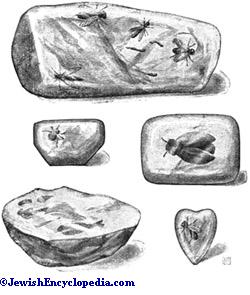
Specimens of Amber in the Mineralogical Museum of the Jardin des Plantes, Paris; exhibiting Flies, Spiders, and Beetles embedded.
amber

Dictionary of the Bible by James Hastings (1909)

AMBER (chashmal, Eze 1:4; Eze 1:27; Eze 8:2).—The translation ‘amber’ is much questioned, a metallic substance being generally considered more probable. Prof. Ridgeway (Encyc. Bibl., s.v.) has, however, shown that amber may well have been known to Ezekiel. The amber commonly seen is the opaque yellow variety from the Baltic, a resinous substance changed by long submersion in the sea. It is a favourite ornament, in necklaces and bracelets, in the Orient, especially among Jewesses, and is credited with medicinal virtues.

E. W. G. Masterman.

International Standard Bible Encyclopedia by James Orr (ed.) (1915)

am´bẽr. See STONES, PRECIOUS.

Wilson's Dictionary of Bible Types by Walter L. Wilson (1957)

Eze 1:4 (c) This seems to be a type of the golden glow which surrounds the person of GOD and presents to us in a graphic way the marvelous glory of His person. Human words do not very well describe divine glories.

Everything we make is available for free because of a generous community of supporters.

Donate