
Aloes, the two words which are so rendered occur in several passages of the Old Testament, as in Psa 45:8; Pro 7:17; Son 4:14, and evidently mean some odoriferous substance which ought not to be confounded with the bitter and nauseous aloes famed only as a medicine, and which is usually disagreeable in odor and nauseous in taste, and could never have been employed as a perfume. The words referred to seem to indicate a kind of fragrant wood called Agallochum, which was brought from India and Arabia. There can be little or no doubt that the same odoriferous wood is intended in Joh 19:39, where we are told that when the body of our Savior was taken down from the cross, Nicodemus brought myrrh and aloes for the purpose of winding up the body in linen clothes with these spices.
Or more properly, ALOE, and East Indian tree, that grows about eight or ten feet high, and yields a rich perfume, Psa 45:8 Pro 7:17 Son 4:14 . This tree or wood was called by the Greeks Agallochon, and has been known to moderns by the names of Lign-aloe, aloe-wood, paradise-wood, eagle-wood, etc. Modern botanists distinguish two kinds: the one grows in Cochin China, Siam, and China, is never exported, and is of so great rarity in India, as to be worth its weight in gold. The tree is represented as large, with an erect trunk and lofty branches. The other or more common species is called garo in the East Indies, and is the wood of a tree growing in the Moluccas, the Excoecaria Agallocha of Linnaeus. The leaves are like those of a pear-tree; and it has a milky juice, which, as the tree grows old, hardens into a fragrant resin. The trunk is knotty, crooked, and usually hollow. Aloe-wood is said by Herodotus to have been used by the Egyptians for embalming dead bodies, and Nicodemus brought it, mingled with myrrh, to embalm the body of our Lord, Joh 19:39 . This perfume, it will be seen, is something altogether different from the aloes of the apothecaries, which is a bitter resin, extracted from a low herb.\par
Aloes. (Hebrew , Ahalim, Ahaloth). The name of a costly and sweet-smelling wood which is mentioned in Num 24:6; Psa 45:8; Pro 7:17; Son 4:14; Joh 19:39. It is usually identified with the Aquilaria agollochum, an aromatic wood much valued in India. This tree sometimes grows to the height of 120 feet, being 12 feet in girth.
ALOES.—We have in the NT only one reference to aloes, Joh 19:39, where Nicodemus brings myrrh and aloes with him, when he joins Joseph of Arimathea in taking away the body of Jesus for burial. In English, ‘aloe’ is used to designate (1) Aloe vulgaris, A. spicata, etc., of the natural order Liliaceae, from which the medicine known as ‘bitter aloes’ is obtained; (2) Agave Americana, or American aloe, of the order Amaryllidaceae, a plant which is noted for its long delay in flowering, and for the rapidity with which it at length puts forth its flowering stalk; and (3) Aquilœria Agallocha, Aq. [Note: Aquila.] Seeundaria, etc., of the order Aquilariaceae, from which is obtained the aloes-wood or eagle-wood of commerce. The substance so named is the result of disease occurring in the wood of the tree. To obtain it, the tree has to be split, as it is found in the centre. With this eagle-wood are probably to be identified the aloes of the Bible.
The grounds on which this identification rests are chiefly these:—(1) Under the name
(2) It is practically certain that
(3) There was an active trade in spices carried on in ancient times, not only through Phœnicia but also through the Syrian and Arabian deserts, so that there is no great difficulty in supposing that ‘aloes’ were brought from India. These considerations seem to afford sufficient justification for the belief that eagle-wood was the aloes of the Biblical writers.
Hugh Duncan.
By: George A. Barton
Translation of  , occurring four times in the Old Testament (Num. xxiv. 6, Ps. xlv. 8, Prov. vii. 17, Cant. iv. 14), and of
  (compare Ex. xv. 27, Gen. xiv. 6).
  signifies also terebinth (compare Septuagint to Gen. xiv. 6), and this would accord with the context quite as well.
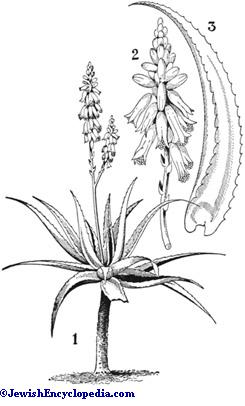
The Aloe.1. Plant showing method of growth. 2. Flower-stalk. 3. Leaf.
ALOES (’ahâlim, Pro 7:17, Num 24:6 [‘lign aloes’]; ’ahâloth, Psa 45:8, Son 4:14; also alǒç, Joh 19:39).—This is the modern eagle-wood (a name derived from the Skr. aguru); it has nothing to do with the familiar bitter aloes of medicine, or with the American aloe, now much cultivated in gardens in Palestine, but a recent importation. This eagle-wood is obtained from plants of the order Aquilariaceæ, but the fragrant parts are those which are diseased; the odoriferous qualities are due to the infiltration with resin, and the best kinds sink when placed in water. The development of this change in the wood is hastened by burying it in the ground. A trade in this wood has gone on from early times; it comes from India, the Malay Peninsula, etc., and has long been a favourite with the Arabs, who call it el ‘ud.
The use of the word (translated ‘lign aloes,’ Num 24:6) by Balaam creates a difficulty. Either he must have referred to the tree from mere hearsay, or some other plant of the same name may at that time have grown in the Jordan valley, or, as seems most probable, the Heb. word has been wrongly transcribed. Both ‘palms’ and ‘terebinths’ have been suggested as suitable alternatives.
E. W. G. Masterman.
Psa 45:8 (c) This perfume represents the worship and praise, the adoration and thanksgiving that emanates from a heart that has been touched by the love of GOD.
It probably was one of the constituents of the perfume which was placed in the alabaster boxes mentioned in the New Testament.
- It is that which makes the fellowship of the Lord so fragrant and sweet to both His heart and ours.
- It may have been a part of those spices brought by the wise men to make His baby garments sweet.
- It probably was a part of the perfume brought by the woman in Luke 7, who made His traveling garments fragrant.
- It may have been a part of the spices brought by Mary in John 12, when she made fragrant those garments which JESUS was to wear during His last week on earth before Calvary.
- No doubt it was a part of the perfume brought by the unnamed woman in Mark 14, when she anointed His head two days before the Passover and made those trial garments fragrant.
- It may have been in the mixture that Nicodemus brought to make His grave clothes fragrant.
- It probably is considered as part of those perfumes which we living saints may send up to Heaven as our praises to fill the golden vials in the hands of the four and twenty elders. (Rev 5:8)
Aloes. Two plants, one a tree and the other e flower
1. The aloes mentioned in ( Psa 45:8; Pro 7:17), and ( Son 4:14) came from a large tree known as "eaglewood," a plant native to India. The wood of the aloe tree is fragrant and highly valued for perfume and incense. Many authorities believe the lign aloe to be the same tree ( Num 24:6), Kjv.
2. The aloes brought by Nicodemus to wrap the body of Jesus ( Joh 19:39) were probably the true aloes of the lily family, a beautiful plant with thick, fleshy leaves and red flowers. The aloin derived from the pulp of the aloe leaf was an expensive product used in embalming.
The oil from a sweet-smelling wood
that was used to make perfume
(Ps. 45:8; Prov. 7:17) or the bitter juice
from a cactus-like plant that was used to
prepare bodies for burial (Jn. 19:39).