
It is probable that the rods which the princes of Israel bore, were scions of the almond tree, at once the ensign of their office, and the emblem of their vigilance. Such, we know from the testimony of Scripture, was the rod of Aaron; which renders it exceedingly probable, that the rods of the other chiefs were from the same tree.
The hoary head is beautifully compared by Solomon to the almond tree, covered in the earliest days of spring with its snow white flowers, before a single leaf has budded: “The almond tree shall flourish, and the grasshopper shall be a burden, and desire shall fail,” Ecc 12:5. Man has existed in this world but a few days, when old age begins to appear, sheds its snows upon his head, prematurely nips his hopes, darkens his earthly prospects, and hurries him into the grave.
Almond Tree (Gen 43:11; Num 17:8; Ecc 12:5; Jer 1:11). This tree is a native of Syria and Palestine, and is highly ornamental from the beauty of its blossoms.
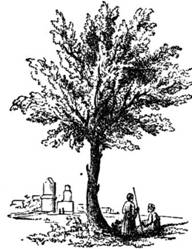
Fig. 27—Almond Tree
The form of the almond would lead to its selection for ornamental carved work (Exo 25:33-34; Exo 37:19), independently of its forming an esteemed esculent, as well as probably yielding a useful oil. In Ecc 12:5, it is said, ’The almond tree shall flourish, and the fruit of the caper droop, because man goeth to his long home.’ This evidently refers to the profuse flowering and white appearance of the almond tree when in full bloom, and before its leaves appear. It is hence adduced as illustrative of the hoary hairs of age, in the same way as the drooping of the fruit of the caper seems to refer to the hanging down of the head. Dr. Kitto mentions the almond among the first trees that flower in January. ’There are two species of Amygdalus in Palestine: the common almond tree, and the peach tree, and both are this month in blossom in every part of Palestine, on both sides of the Jordan. It was doubtless from this winter blossoming of the almond tree, not less than from the snowy whiteness of the blossoms, that the hoary head of the aged man is, by a beautiful metaphor, said in Scripture to flourish like the almond tree’ (Physic. Hist. of Palestine).
This tree resembles a peach-tree, but is larger. In Palestine, it blossoms in January, and in March has fruit. Its blossoms are white. Its Hebrew name signifies a watcher, and to this there is an allusion in Jer 1:11 . In Ecc 12:5, the hoary head is beautifully compared with the almond-tree, both on account of its snowy whiteness and its winter blossoming.\par
Almond Tree. See Almond.
(Jer 1:11-12; Hebrew "I see a rod of the wakeful tree (the emblem of wakefulness) ... Thou hast well seen: for I will be wakeful (Hebrew for "hasten") as to My word.") It first wakes out of the wintry sleep and buds in January. In Ecc 12:5, instead of "the almond tree shall flourish," Gesenius translates "(the old man) loathes (through want of appetite) even the (sweet) almond;" for the blossom is pink, not white, the color of the old man’s hair.
But as the Hebrew means "bud" or "blossom" in Son 6:11 it probably means here "the wakefulness of old age sets in." Or the color may not be the point, but the blossoms on the leafless branch, as the hoary locks flourish as a crown on the now arid body. Exo 25:33-34; in the tabernacle the candlesticks had "bowls made in the form of the almond flower" or "nut," most graceful in shape; perhaps the pointed nut within was the design for the cup, the sarcocarp containing the oil, and the flame shaped nut of gold emitting the light from its apex. Luz, the original name of Bethel, was derived from one species of almond (Gen 28:19; Gen 30:37), luz.
It was almond, not hazel, rods wherewith Jacob secured the ringstraked and speckled offspring from the flocks. Jordan almonds were famed. The almonds growing on Aaron’s rod, when laid up over night before the Lord, denote the ever wakeful priesthood which should continue until the Antitype should come; type also of the vigilance and fruitfulness which Christ’s ministers should exhibit;. also of the rod of Christ’s strength which shall finally destroy every adversary (Num 17:8; Psa 110:2; Psa 110:5-6).
the symbol of St. Mary, in allusion to Aaron’s rod, which blossomed in a night; but M. Montalembert conceives the plant to be dedicated to the Holy Trinity.
Almond Tree. Gen 43:11. This tree resembles a peach tree, but is larger. In Palestine it blossoms in January, and in March has fruit. Its blossoms are pinkish-white. Its Hebrew name signifies to watch and hasten, and to this there is an allusion in Jer 1:11-12. Aaron’s rod was from an almond. Num 17:8. In Ecc 12:5 the hoary head is beautifully compared with the almond tree, either on account of its whiteness, beauty and winter blossoming, or the hastening on of decay. The golden bowls of the sacred candlestick were made "like almonds, with their knops and their flowers." Exo 25:33-34.