
Al´gum, or Al´mug Trees (1Ki 10:11; 2Ch 9:10-11). With regard to Ophir, the place from which these trees were brought to us, there appears no doubt that it was to the southward of the Red Sea, and was most probably in some part of India. Various trees have been attempted to be identified with the almug, but the balance of evidence seems to be in favor of the sandal-wood, which is known and highly esteemed in India. The tree which produces it is a native of the mountainous parts of the coast of Malabar, where large quantities are cut for export to China, to different parts of India, and to the Persian and Arabian gulfs. The outer parts of this tree are white and without odor; the parts near the root are most fragrant, especially of such trees as grow in hilly situations and stony ground. The trees vary in diameter from 9 inches to a foot, and are about 25 or 30 feet in height, but the stems soon begin to branch. This wood is white, fine-grained, and agreeably fragrant, and is much employed for making rosaries, fans, elegant boxes, and cabinets.
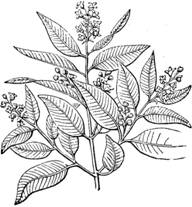
Fig. 26—Santalum album
As sandal-wood has been famed in the East from very early times, it is more likely than any other to have attracted the notice of, and been desired by, more northern nations.
That it, therefore, might have attained celebrity, even in very early ages, is not at all unlikely; that it should have attracted the notice of Phoenician merchants visiting the west coast of India is highly probable; and also that they should have thought it worthy of being taken as a part of their cargo on their return from Ophir. That it is well calculated for musical instruments is confirmed by the authority of Professor Wheatstone, who says, ’I know no reason why sandal-wood should not have been employed in ancient days for constructing musical instruments. It is not so employed at present, because there are many much cheaper woods which present a far handsomer appearance. Musical instruments would appear very unfinished to modern taste unless varnished or French-polished, and it would be worse than useless to treat fragrant woods in this way. Formerly perhaps it might have been more the fashion to delight the senses of smell and hearing simultaneously than it is with us, in which case odoriferous woods would be preferred for things so much handled as musical instruments are.’
The same as ALMUG, which see.\par
Algum or Almug Trees. Algum. Occurring in 2Ch 2:8; 2Ch 9:10-11 and Almug Trees appearing in 1Ki 10:11-12. These words are identical. From 1Ki 10:11-12; 2Ch 9:10-11, we learn that the almug was brought in great plenty from Ophir for Solomon’s Temple and house, and for the construction of musical instruments.
It is probable that this tree is the red sandal wood, which is a native of India and Ceylon. The wood is very heavy, hard and fine grained, and of a beautiful garnet color.
(2Ch 2:8; 2Ch 9:10-11) (ALMUG 1Ki 10:11). From the Arabic article
a transposed form (2Ch 2:8; 2Ch 9:10-11) of the Hebrew term ALMUG SEE ALMUG (q.v.).
ALGUM.—See Almug.
Algum, Almug. A large leguminous tree native to India and Ceylon. While its identity is uncertain, many consider it to be the red sandlewood. Its blossoms were pea-like, and its wood was close grained, dark outside, and red within. It was highly scented, making it resistant to insects. Most authorities believe that algum and almug are two forms of the same wood.
Solomon ordered the algum wood from Ophir and Lebanon ( 1Ki 10:11-12; 2Ch 9:10-11). The wood was well suited for making musical instruments, cabinet work, and pillars for the Temple.