
‘
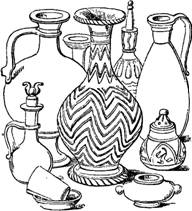
Fig. 22—Perfume containers
This word occurs in the New Testament only in the notice of the ’alabaster box,’ or rather vessel, of ’ointment of spikenard, very precious,’ which a woman broke, and with its valuable contents anointed the head of Jesus, as he sat at supper in Bethany in the house of Simon the leper (Mat 26:7; Mar 14:3). At Alabastron, in Egypt, there was a manufactory of small pots and vessels for holding perfumes, which were made from a stone found in the neighboring mountains. The Greeks gave to these vessels the name of the city from which they came. This name was eventually extended to the stone of which they were formed; and at length it was applied without distinction to all perfume vessels, of whatever materials they consisted. It does not, therefore, by any means follow that the alabastron which the woman used at Bethany was really of alabaster: but a probability that it was such arises from the fact, that vessels made of this stone were deemed peculiarly suitable for the most costly and powerful perfumes.
A sort of stone, of fine texture, either the white gypsum, a sulphate of lime, or the onyx-alabaster, a hard carbonate of lime, having the color of the human nail, and nearly allied to marble. This material being very generally used to fabricate vessels for holding unguents and perfumed liquids, many vessels were called alabaster though made of a different substance, as gold, silver, glass, etc. In Mat 26:6,7, we read that Mary, sister of Lazarus, Joh 12:3, poured as alabaster box of precious ointment on Christ’s head. Mark says "she brake the box," signifying probably, that the seal upon the box, or upon the neck of the vase of bottle, which kept the perfume from evaporating, had never been removed; it was on this occasion first opened. See SPIKENARD.\par
Alabaster. From the Arabic ’al bastraton’, a whitish stone or from Alabastron, the place in Egypt where it is found. It occurs only in Mat 26:7; Mar 14:3; Luk 7:37. The ancients considered alabaster to be the best material in which to preserve their ointments. The Oriental alabaster (referred to in the Bible) is a translucent carbonate of lime, formed on the floors of limestone caves by the percolation of water.
It is of the same material as our marbles, but differently formed. It is usually clouded or banded like agate, hence, sometimes called onyx marble. Our common alabaster is different from this, being a variety of gypsum or sulphate of lime, used in its finer forms for vases, etc.; in the coarser, it is ground up for plaster of Paris. The noted sculptured slabs from Nineveh are made of this material.
Not our gypsum, but the oriental alabaster, translucent, with red, yellow, and gray streaks clue to admixture of oxides of iron with a fibrouscarbonate of lime. A calcareous marble like spar, wrought into boxes or vessels, to keep precious ointments from spoiling (Pliny H. N., 13:8). Mar 14:3; "broke the box," i.e., broke the seal on the mouth of it, put there to prevent, evaporation of the odor (Luk 7:37).
(
Alabaster. What is usually called alabaster is a kind of soft gypsum, properly sulphate of lime. But the alabaster of which jars and vases were usually made was finer grained, opaque, and usually white, but frequently shaded with other soft colors; hence sometimes called onyx marble, which is properly a carbonate of lime. Several vases of alabaster have been found in Egypt, varying in form and size; one of which, bearing the name and title of the queen of Thothmes II., had ointment in it, which had retained its odor for several centuries. In Mar 14:3 the phrase "she brake the box," is simply, "she brake the alabaster," i.e., the vase so called; and merely refers to the breaking of the seal which closed the vase, and kept the perfume from evaporation. Mat 26:7; Luk 7:37.
ALABASTER (
This incident is the gospel protest against philanthropic utilitarianism. ‘Man shall not live by bread alone, but by every word that proceedeth out of the mouth of God.’ We have here the warrant for the expenditure of money on everything that makes for the higher life of man. Whatever tends to uplift the imagination, to ennoble and purify the emotions, to refine the taste, and thus to add to the spiritual value of life, is good, and is to be encouraged. Jesus claims our best. He inspires us to be and do our best, and the first-fruits of all the higher faculties of the soul are to be devoted to Him. See, further, art. Anointing i. 2.
A. Miller.
By: Gerson B. Levi
The Alabaster of the ancients was the stalagmitic variety of carbonate of lime, and differed from what now is commonly known as Alabaster, which is sulphate of lime. From this material vases were made to hold unguents (see Matt. xxvi. 7; Mark, xiv. 3; Luke, vii. 37). Gradually the vases themselves were called Alabasters; and this is the explanation of the Septuagint translation, alabastron, in II(IV) Kings, xxi. 13. Alabaster is still obtained from mines in the province of Oran in Algeria; it was found also in Thebes and on the western side of the Tigris. In Assyria it was used in bas-relief and was called pilu, though this term was a general one applied to various kinds of hard stones. Its employment can be traced back beyond the ninth century B.C.; and it may be assumed that even at an earlier period there was trade in Alabaster in Babylonia, since the mineral is not found in southern Mesopotamia. It was usually grayish and striated in appearance.
ALABASTER.—See Jewels and Precious Stones.
A fine-grained variety of gypsum, much used for ornamental articles. The ancients used it for vases which held unguents, in the belief that it preserved them; hence the vases were called "alabasters," even when made of other material. Such was the "alabaster box of ointments," with which Mary Magdalene anointed the Saviour.
(Greek alabastros, -on; Latin alabaster, -trum; of uncertain origin).The substance commonly known as alabaster is a fine-grained variety of gypsum (calcium sulphate) much used for vases and other ornamental articles. Oriental alabaster, the alabastrites of the classical writers, is a translucent marble (calcium carbonate) obtained from stalagmitic deposits; because of its usually banded structure, which gives it some resemblance to onyx, it is also called onyx marble, or simply, though incorrectly, onyx. From remote times it was highly esteemed for decorative purposes. Among the ancients Oriental alabaster was frequently used for vases to hold unguents, in the belief that it preserved them; whence the vases were called alabasters, even when made of other materials. Such was the "alabastrum unguenti" (Matthew 26:7; Mark 14:3, Luke 7:37), with which the sinful woman anointed the Saviour. The vase, however, though probably of alabaster, was not necessarily of that material, as our English translation "alabaster box of ointments" seems to imply.----------------------------------- THOMAS in VIG., Dict. de la Bible, I, 330. F. BECHTEL The Catholic Encyclopedia, Volume ICopyright © 1907 by Robert Appleton CompanyOnline Edition Copyright © 2003 by K. KnightNihil Obstat, March 1, 1907. Remy Lafort, S.T.D., CensorImprimatur. +John Cardinal Farley, Archbishop of New York
A beautiful kind of stone that
can be carved.