
One of the names of the Supreme Being in the Scriptures. The proper meaning of the word is "my Lords, " in the plural number; as Adoni is my Lord, in the singular. The Jews, who either out of respect or superstition do not pronounce the name of Jehovah, read Adonai in the room of it, as often as they meet with Jehovah in the Hebrew text. But the ancient Jews were not so scrupulous; nor is there any law which forbids them to pronounce the name of God.
This is one of the names peculiarly applied to the person of the Lord Jesus Christ. By way of distinguishing it from JEHOVAH, it is rendered Lord in our English Bibles, in smaller letters, while JEHOVAH, which is also translated Lord, is in capitals. The reader will find a striking proof of it. (Psalm cx. 1.) The Lord said unto my Lord. The words in the original are, JEHOVAH said unto my Adonai. It is a sweet and interesting name of the Lord Jesus. It carries with it the idea of a stay, or helper, security, confidence.
one of the names of God. This word in the plural number signifies my Lords. The Jews, who either out of respect or superstition, do not pronounce the name of Jehovah, read Adonai in the room of it, as often as they meet with Jehovah in the Hebrew text. But the ancient Jews were not so scrupulous. Neither is there any law which forbids them to pronounce any name of God.
(Heb. Adonay’,
Isa 8:7, where, however, the expression may be only the prophet’s); a circumstance that may have arisen from the superstition of the Jews, who always point the sacred name Jehovah with its vowels, and even substitute it for that name in reading, so that in some cases it appears to have supplanted it in the text (Dan 9:3; Dan 9:7-9; Dan 9:15-16; Dan 9:19). It seems to have been written peculiarly (
[Ad’onai] See GOD.
( , literally "my Lord," the plural form of Adon, that is, "Lord" or "Lordship"):
By: Kaufmann Kohler
Pronunciation.
This word occurs in the Masoretic text 315 times by the side of the Tetragram YHWH (310 times preceding and five times succeeding it) and 134 times without it. Originally an appellation of God, the word became a definite title, and when the Tetragram became too holy for utterance Adonai was substituted for it, so that, as a rule, the name written YHWH receives the points of Adonai and is read Adonai, except in cases where Adonai precedes or succeeds it in the text, when it is read Elohim. The vowel-signs e, o, a, given to the Tetragrammaton in the written text, therefore, indicate this pronunciation, Aedonai, while the form Jehovah, introduced by a Christian writer about 1520, rests on a misunderstanding. The translation of YHWH by the word Lord in the King James's and in other versions is due to the traditional reading of the Tetragrammaton as Adonai, and this can be traced to the oldest translation of the Bible, the Septuagint. About the pronunciation of the Shem ha-Meforash, the "distinctive name" YHWH, there is no authentic information. In the early period of the Second Temple the Name was still in common use, as may be learned from such proper names as Jehohanan, or from liturgical formulas, such as Halelu-Yah. At the beginning of the Hellenistic era, however, the use of the Name was reserved for the Temple. From Sifre to Num. vi. 27, Mishnah Tamid, vii. 2, and Soṭah, vii. 6 it appears that the priests were allowed to pronounce the Name at the benediction only in the Temple; elsewhere they were obliged to use the appellative name (kinnuy) "Adonai." Philo, too, in referring to it says ("Life of Moses," iii. 11): "The four lettersmay be mentioned or heard only by holy men whose ears and tongues are purified by wisdom, and by no other in any place whatsoever." According to Josephus ("Ant." ii. 12, § 4):
"Moses besought God to impart to him the knowledge of His name and its pronunciation so that he might be able to invoke Him by name at the sacred acts, whereupon God communicated His name, hitherto unknown to any man; and it would be a sin for me to mention it."
Pronunciation of the Name by the Temple priests also gradually fell into disuse. Tosef., Soṭah, xiii. 8, quoted Menaḥot, 109b, and Yoma, 39b, relates that "from the time Simon the Just died [this is the traditional expression for the beginning of the Hellenistic period], the priests refrained from blessing the people with the Name"—in other words, they pronounced it indistinctly, or they mouthed or mumbled it. Thus says Tosef., Ber. vi. 23: Formerly they used to greet each other with the Ineffable Name; when the time of the decline of the study of the Law came, the elders mumbled the Name. Subsequently also the solemn utterance of the Name by the high priest on the Day of Atonement, that ought to have been heard by the priests and the people, according to the Mishnah Yoma, vi. 2, became inaudible or indistinct.
ADONAI, ADONAI
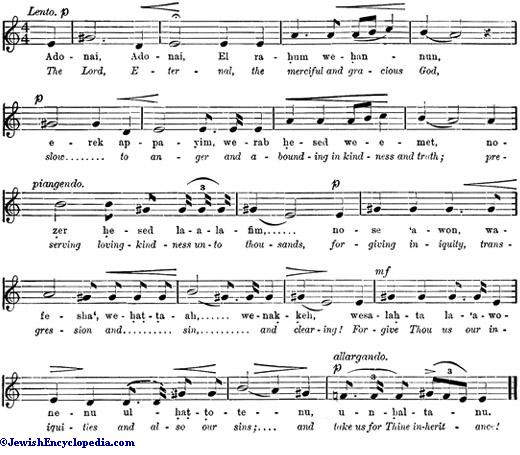
The Use of the Name.
. Ṭarfon (or Tryphon) relates (Yer. Yoma, iii. 40d): "I was standing in the row of young priests, and I heard the high priest mumbling the Name, while the rest of the priests were chanting." Thus the correct pronunciation became a secret, entrusted only to the kasherim (worthy ones) or the ẓenu'im (Essenes = "the humble or chaste ones"), but withheld from the frivolous, the Hellenists (peruẓim); and even the former were taught it only once every seven years, and then only after due purification and sanctification (see Ḳid. 71a; Yer. Yoma, l.c., and compare Tosef., Yadayim, at the close, in Simson of Sens' commentary). "Wo upon you, ye Pharisees, who pronounce the Holy Name each morning without due purification!" said the Hemerobaptists; whereupon the Pharisees sarcastically replied: "Wo upon you who pronounce the Holy Name with an organ of the body, while your body itself is unholy!" However, it appears from Ta'anit, 19a and 'Ab. Zarah, 18a, that the Essene saints made use of the Name in their invocations and miraculous cures, which was afterward declared to be a grievous sin (Sanh. x. 1; compare also Book of Wisdom, xiv. 21). But while even among these the right pronunciation was forgotten in the course of time, and the hope was expressed by Phinehas b. Jair, "the Saint," that the knowledge and the correct use of the Name, so wondrously efficacious in the blessed days long gone by, would again be restored in the Messianic age (see Pes. 50a, Midr. Teh. to Ps. xxxvi. and to Ps. xci.), according to R. Mana of the fourth century (Yer. Sanh. x. 28b), the Samaritans then used the Ineffable Name in their oath, and Theodoret, theChurch father, in the fifth century, tells us that he heard it pronounced by them as Yabe, which is the equivalent of Yahweh. Even in the writing of the Name scrupulous care had to be taken by the scribes (see Soferim, v. 6).
he day on which the Pharisees succeeded in abrogating the ancient Sadducean custom of having the Sacred Name written in public documents was celebrated as a great day of thanksgiving (explained correctly by Dalman, against R. H. 18b; compare with Yadayim, iv. 8, "Wo upon you, ye Sadducees, who write the name of the temporary ruler alongside of the Sacred Name!"). No wonder, then, that the Greek translators of the Bible, even though some scribe might now and then write the Tetragrammaton in the archaic Hebrew form on the margin,
ADONAI BEḲOL SHOFAR
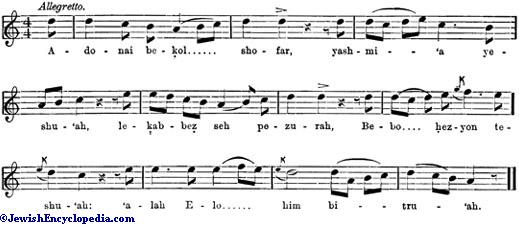
Bibliography:
Gustaf H. Dalman, Der Gottesname Adonai und seine Geschichte;
Hamburger, R. B. T. i. and ii.;
C. Taylo, Sayings of the Jewish Fathers, 1897, pp. 156 et seq.
Lord, ruler, lord of lords, a name bestowed upon God in the Old Testament. (Exodus 6) It is the perpetual substitute for the name Yahweh.
Adonai (Hebrew meaning "lord, ruler") is a name bestowed upon God in the Old Testament. It is retained in the Vulgate and its dependent versions, Exod., vi, 3; Judith, xvi, 16. No other name applied to God is more definite and more easily understood than this. Etymologically it is the plural of Adon, with the suffix of the possessive pronoun, first person, singular number. This plural has been subjected to various explanations. It may be looked upon as a plurale abstractum, and as such it would indicate the fullness of divine sway and point to God as the Lord of lords. This explanation has the endorsement of Hebrew grammarians, who distinguish a plurale virium, or virtutum. Others prefer to designate this form as plurale excellentiæ, magnitudinis, or plurale majestatis. To look upon it as a form of politeness such as the German Sie for du, or French volts for to is certainly not warranted by Hebrew usage. The possessive pronoun has no more significance in this word than it has in Rabbi (my master), Monsieur, or Madonna. Adonai is also the perpetual substitute for the ineffable Name Yahve, to which it lends its vowel signs. Whenever therefore, the word Yahve occurs in the text, the Jew will read Adonai.-----------------------------------KAUTZSCH-GESENTIUS Hebræische Grammatik (Leipzig, 1896), DALMAN Der Gottesname and seine Geschichte (Berlin l889); STADE, Biblische Theologie des Alten Testaments (Tübingen, 1905). E. HEINLEIN Transcribed by the Cloistered Dominican Nuns of the Monastery of the Infant Jesus, Lufkin, Texas Dedicated to God the Father The Catholic Encyclopedia, Volume ICopyright © 1907 by Robert Appleton CompanyOnline Edition Copyright © 2003 by K. KnightNihil Obstat, March 1, 1907. Remy Lafort, S.T.D., CensorImprimatur. +John Cardinal Farley, Archbishop of New York