
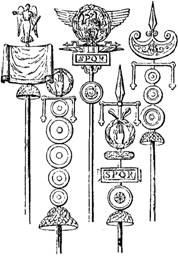
Fig. 1—Roman Standards
In Dan 9:27, literally, ’the abomination of the desolater,’ which, without doubt, means the idol or idolatrous apparatus which the desolater of Jerusalem should establish in the holy place. This appears to have been a prediction of the pollution of the temple by Antiochus Epiphanes, who caused an idolatrous altar to be built on the altar of burnt-offerings, whereon unclean things were offered to Jupiter Olympius, to whom the temple itself was dedicated. The phrase is quoted by Jesus (Mat 24:15), and is applied by him to what was to take place at the advance of the Romans against Jerusalem. They who saw ’the abomination of desolation standing in the holy place’ were enjoined to ’flee to the mountains.’ And this may with probability be referred to the advance of the Roman army against the city with their image-crowned standards, to which idolatrous honors were paid, and which the Jews regarded as idols. The unexpected retreat and discomfiture of the Roman forces afforded such as were mindful of our Savior’s prophecy an opportunity of obeying the injunction which it contained. Those however who suppose that ’the holy place’ of the text must be the temple itself, may find the accomplishment of the prediction in the fact that, when the city had been taken by the Romans, and the holy house destroyed, the soldiers brought their standards in due form to the temple, set them up over the eastern gate, and offered sacrifice to them, for almost the entire religion of the Roman camp consisted in worshipping the ensigns, swearing by the ensigns, and in preferring the ensigns before all the other gods.
Nor was this the last appearance of ’the abomination of desolation, in the holy place:’ for, not only did Hadrian, with studied insult to the Jews, set up the figure of a boar over the Bethlehem gate of the city which rose upon the site and ruins of Jerusalem; but he erected a temple to Jupiter upon the very site of the Jewish temple, and caused an image of himself to be set up in the part which answered to the sanctuary. This was a consummation of all the abominations which the iniquities of the Jews brought upon their holy place.
The ABOMINATION OF DESOLATION foretold by, {\cf11 \ul Dan 9:27} denotes, probably, the image of Jupiter, erected in the temple of Jerusalem by command of Antiochus Epiphanes. But by the Abomination of Desolation spoken of by our Lord, {\cf11 \ul Mat 24:15} {\cf11 \ul Rom 13:14}, and foretold as about to be seen at Jerusalem during the last siege of that city by the Romans under Titus, is probably meant the Roman army, whose standards had the images of their gods and emperors upon them, and were worshipped in the precincts of the temple when that and the city were taken. {\cf11 \ul Luk 21:20}. See ARMOR.\PAR
\PAR
Abomination of Desolation. Mentioned by our Saviour, Mat 24:15, as a sign of the approaching destruction of Jerusalem, with reference to Dan 9:27; Dan 11:31; Dan 12:11. The prophecy referred ultimately to the destruction of Jerusalem by the Romans, and consequently the "abomination" must describe some occurrence connected with that event.
It appears most probable that the profanities of the Zealots constituted the abomination, which was the sign of the impending ruin; but most people refer it to the standards or banners of the Roman army. They were abomination because there were idolatrous images upon them.
"The idol
The divine law is that where the church corrupts herself, the world, the instrument of her sin, is made also the instrument of her punishment (Mat 24:28; Rev 17:3; Rev 17:16). The bringing of the idolatrous, Roman, image crowned standards into the temple, where they were set over the E. gate, and sacrificed to, upon the destruction of Jerusalem under the Roman Titus, 37 years after Jesus’ prophecy (A.D. 70), is not enough to meet the requirements of the term "abomination," unless it were shown that the Jews shared in the idolatry. Perhaps the Zealots perpetrated some abomination which was to be the sign of the nation’s ruin. They had taken possession of the temple, and having made a profane country fellow, Phannias, their high priest, they made a mock of the sacred rites of the law.
Some such desecration within the city, "in the holy place," coinciding with Cestius Gallus’ encampment without, "in a holy place," was the sign foretold by Jesus; noting it, the Christians fled from the city to Pella, and all escaped. The final fulfillment is probably future. The last antichrist, many think, is about to set up an idol on a wing of the restored temple (compare Mat 4:5; Joh 5:43) in the latter half of the last, or 70th, of Daniel’s prophetic weeks; for the former three and a half days (years) of the prophetic week he keeps his covenant with the Jews; in the latter three and a half breaks it (Zec 11:16-17; Zec 11:12; Zec 11:13; Zec 11:14; Daniel 9; 11). The Roman emperor Hadrian erected a temple to Jupiter upon the site of the Jewish temple; but probably "the consummation to be poured upon the desolate" is yet future.
This exact expression occurs only in Mat 24:15 and Mar 13:14, referring to what had been revealed to Daniel in Dan 12:11, where it is connected with the great tribulation (ver. 1) spoken of by the Lord in those Gospels. Dan 9:27 shows that the time of the abomination is in the last half of the last of the seventy weeks of Daniel named in Dan 9:24. The person who makes a covenant with the Jews in those days and afterwards breaks it, we know to be the head of the future Roman empire. See SEVENTY WEEKS. Of this person an image will be made, and the people will be constrained to worship it, Rev 13:14-15; but we do not read that it will be carried into the future temple; whereas our Lord says that the abomination will stand in the holy place. On the other hand we read that the Antichrist "exalteth himself above all that is called God, or that is worshipped; so that he, as God, sitteth in the temple of God, showing himself that he is God." 2Th 2:4. The ’abomination of desolation’ is evidently connected with the trinity of evil spoken of in Rev 13 and will be the work of Satan, the Roman beast, and the false prophet. It will end in dire desolation. The desolator is the Assyrian, Isa 8:7-8; Isa 28:2; Isa 28:18 the northern king who will then hold the territory of Assyria. Dan 11:40.
ABOMINATION OF DESOLATION (
(3) Theodoret and other early Commentators refer the prophecy to the attempt of Pilate to set up effigies of the emperor in Jerusalem (BJ ii. ix. 2).
(4) Spitta (Offenb. des Joh. 493) thinks it has to do with the order of Caligula to erect in the Temple a statue of himself, to which Divine honours were to be paid (Ant. xviii. viii. 8). This order, though never executed, caused widespread apprehension among the Jews.
(5) Jerome (Commentary on Matthew 24) suggests that the words may be understood of the equestrian statue of Hadrian, which in his time stood on the site of the Holy of Holies. Similarly, Chrysostom and others refer them to the statue of Titus erected on the site of the Temple.
(6) Bousset treats the passage as strictly eschatological, and as referring to an Antichrist who should appear in the ‘last days.’* [Note: Some (Keim, Holtzmann, Cheyne) hold the passage to be part of an independent Jewish (or Jewish-Christian) Apocalypse inserted subsequently in the Gospels. But it occurs in all the Synoptists, and ‘it is difficult to think that even these words … are without a substantial basis in the words of Christ’ (Driver).]
Of these views (1) and (2) are the most probable. Considerations of chronology make (3), (4), and (5) more than doubtful, while the warnings that the events predicted should come to pass soon (Mat 24:33-34, Mar 13:28-30, Luk 21:29-33) and the command to flee ‘to the mountains’ seem fatal to (6). Between (1) and (2) the choice is not easy, though the balance of evidence is on the whole in favour of (1). St. Luke’s language (
Literature.—R. W. Newton on Matthew 24 (1879); Bousset, Der Antichrist (1885), English translation by A. H. Keane, 1896; J. H. Russell, The Parousia (1887); articles in Hasting’s Dictionary of the Bible (by S. R. Driver), Encyc. Bibl. (by T. K. Cheyne), Smith’s DB [Note: Dictionary of the Bible.] 2 [Note: designates the particular edition of the work referred] (by W. L. Bevan) the Commentaries of Bengel, Cornelius a Lapide, H. A. W. Meyer, Alford, Wordsworth, Mansel (in Speaker’s Commentary on NT, i. 139), H. B. Swete, St. Mark, ad loc.; A. A. Bevan, The Book of Daniel, ad loc.
H. W. Fulford.
By: Louis Ginzberg
An expression occurring in Matt. xxiv. 15 and Mark, xiii. 14 (A. V.), where the Greek text has  , found in Dan. ix. 27 (where the
  has been added, through a copyist's error, from the
The context of these passages leaves no room for doubt as to what was intended by this somewhat odd expression; namely, the transformation, by Antiochus Epiphanes, of the sacred Temple at Jerusalem into a heathen one. In both Biblical and rabbinical Hebrew abomination is a familiar term for an idol (I Kings, xi. 5; II Kings, xxiii. 13; Sifra, Ḳedoshim, beginning, and Mekilta, Mishpatim, xx. ed. Weiss, 107), and therefore may well have the same application in Daniel, which should accordingly be rendered, in agreement with Ezra, ix. 3, 4, "motionless abomination" or, also, "appalling abomination." The suggestion of many scholars-Hoffmann, Nestle, Bevan, and others—that  , as a designation for Jupiter is simply an intentional perversion of his usual appellation "Baal Shamem" (
 , "lord of heaven") is quite plausible, as is attested by the perversion of "Beelzebub" into "
According to most modern commentators, these passages are a Jewish apocalypse, somewhat tinged with Christianity, intended to prophesy the end of time, when the Antichrist, as the Abomination of Desolation, shall be enthroned as a ruler in God's Temple. The closely related "smaller Apocalypse" in II Thess. ii. 1-12 is a conclusive justification of this view; for it shows that neither the Romans (as Weiss in his commentary, ad loc., holds), nor the Zealots (Bleek, "Synoptische Erklärung," and others), nor Caligula with his self-deification (Spitta, in his "Offenbarung Johannis") can be intended.
—In Rabbinical Literature:
The rabbis as a whole consider that the expression  refers to the desecration of the Temple by the erection of a Zeus statue in its sacred precincts by Antiochus Epiphanes (see Apostemos). Some rabbis, however, see in it an allusion to Manasseh, who, as related in II Chron. xxxiii. 7, set up "a carved image . . . in the house of God" (Yer. Ta'anit, iv. 68a, and Rashi on the passage in Babli, ibid. 28b). The Haggadah narrates that two statues were erected, one of which fell over upon the other and broke off its hand. Upon the severed hand the following inscription was found engraved: "I sought to destroy God's house, but Thou didst lend Thy hand to its protection" (Ta'anit, 28b et seq.; compare Rabbinovicz, "Variæ Lectiones," on the passage for variant readings).
Bibliography:
Compare modern commentators—Meinhold, Bevan, Weiss, Prince—upon the passages in Daniel and Matthew;
also Bousset, Der Antichrist, English translation, 1896, especially index;
Spitta, Offenbarung Johannis, pp. 493-497;
Grätz, Gesch. d. Juden, iv. note 15;
Chajes, Markus-Studien, p. 72.
ABOMINATION OF DESOLATION.—A term found only in Mar 13:14 and its parallel Mat 24:15. It is obviously derived, as St. Matthew indicates, from Dan 11:31; Dan 12:11; cf. Dan 9:27. In these passages the most natural reference is to the desecration of the Temple under Antiochus Epihanes, when an altar to Olympian Zeus was erected on the altar of burnt sacrifices. As interpreted in the revision by St. Luke (Luk 21:20), the reference in the Gospel is to the encompassing of Jerusalem by the Roman army. It is very difficult, however, to adjust this interpretation to the expression of Mk. ‘standing where he ought not,’ and that of Mt. ‘standing in the holy place.’ Other interpretations would be: (1) the threatened erection of the statue of Caligula in the Temple; or (2) the desecration of the Temple area by the Zealots, who during the siege made it a fortress; or (3) the desecration of the Temple by the presence of Titus after its capture by that general. While it is impossible to reach any final choice between these different interpretations, it seems probable that the reference of Mar 13:14 is prior to the destruction of Jerusalem, because of its insistence that the appearance of the ‘abomination of desolation’ (or the ‘abomination that makes desolate’) is to be taken as a warning for those who are in Judæa to flee to the mountains. It would seem to follow, therefore, that the reference is to some event, portending the fall of Jerusalem, which might also be interpreted by the Christians as a premonition of the Parousia (2Th 2:1-12). It would seem natural to see this event in the coming of the Romans (Luk 21:20), or in the seizure of the Temple by the Zealots under John of Giscala, before the city was completely invested by the Romans. A measure of probability is given to the latter conjecture by the tradition (Eusebius, HE iii. v. 3) that the Jewish Christians, because of a Divine oracle, fled from Jerusalem during the early course of the siege.
Shailer Mathews.
A portent of the ruin of the House of God mentioned by Daniel, and referred to by Christ as a sign to the faithful to flee from Judea; commonly interpreted as a symbol of idolatry in the Temple.
1. The Historical Background
Since the invasion of the Assyrians and Chaldeans, the Jewish people, both of the Northern and of the Southern kingdom, had been without political independence. From the Chaldeans the rulership of Judea had been transferred to the Persians, and from the Persians, after an interval of 200 years, to Alexander the Great. From the beginning of the Persian sovereignty, the Jews had been permitted to organize anew their religious and political commonwealth, thus establishing a state under the rulership of priests, for the high priest was not only the highest functionary of the cult, but also the chief magistrate in so far as these prerogatives were not exercised by the king of the conquering nation. Ezra had given a new significance to the
2. Antiochus Epiphanes
Antiochus IV, son of Antiochus the Great, became the successor of his brother, Seleucus IV, who had been murdered by his minister, Heliodorus, as king of Syria (175-164 bc). He was by nature a despot; eccentric and unreliable; sometimes a spendthrift in his liberality, fraternizing in an affected manner with those of lower station; sometimes cruel and tyrannical, as witness his aggressions against Judea. Polybius (26 10) tells us that his eccentric ideas caused some to speak of him as a man of pure motive and humble character, while others hinted at insanity. The epithet Epiphanes is an abbreviation of
3. The Suppression of the Jewish Cult
Under these conditions it is not surprising that Antiochus should have had both the inclination and the courage to undertake the total eradication of the Jewish religion and the establishment of Greek polytheism in its stead. The observance of all Jewish laws, especially those relating to the Sabbath and to circumcision, were forbidden under pain of death. The Jewish cult was set aside, and in all cities of Judea, sacrifices must be brought to the pagan deities. Representatives of the crown everywhere enforced the edict. Once a month a search was instituted, and whoever had secreted a copy of the Law or had observed the rite of circumcision was condemned to death. In Jerusalem on the 15th of Chislev of the year 145 aet Sel, i.e. in December 168 bc, a pagan altar was built on the Great Altar of Burnt Sacrifices, and on the 25th of Chislev, sacrifice was brought on this altar for the first time (1 Macc 1:54, 59). This evidently was the “abomination of desolation.” The sacrifice, according to 2 Macc was brought to the Olympian Zeus, to whom the temple of Jerusalem had been dedicated. At the feast of Dionysus, the Jews were obliged to march in the Bacchanalian procession, crowned with laurel leaves. Christ applies the phrase to what was to take place at the advance of the Romans against Jerusalem. They who would behold the “abomination of desolation” standing in the holy place, He bids flee to the mountains, which probably refers to the advance of the Roman army into the city and temple, carrying standards which bore images of the Roman gods and were the objects of pagan worship.