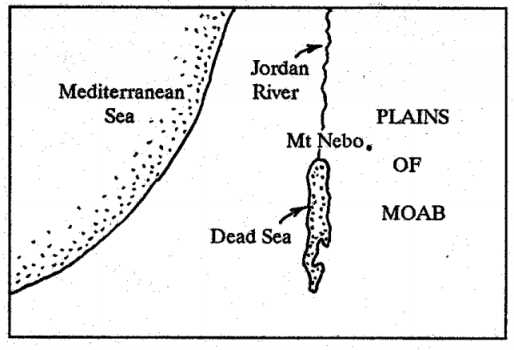
These were several smaller mountains, "Or hills, of rising ground, beyond Jordan, in the country of Moab; which went by the name of Abarim. Nebo, Pisgah, and Peor, were in the number. Nebo became ever - memorable, as being the sacred spot where Moses the man of God died. Num 33:48 Deu 32:49-50. Deu 34:1
Ab´arim, a mountain, or rather chain of mountains, which form or belong to the mountainous district east of the Dead Sea and the lower Jordan. It presents many distinct masses and elevations, commanding extensive views of the country west of the river. From one of the highest of these, called Mount Nebo, Moses surveyed the Promised Land before he died. From the manner in which the names Abarim, Nebo, and Pisgah are connected (Deu 32:49, ’Get thee up into this mountain Abarim, unto Mount Nebo;’ and Deu 34:1, ’Unto the mountain of Nebo, to the top of Pisgah’), it would seem that Nebo was a mountain of the Abarim chain, and that Pisgah was the highest and most commanding peak of that mountain. The loftiest mountain of the neighborhood is Mount Attarus, about ten miles north of the Arnon; and travelers have been disposed to identify it with Mount Nebo. It is represented as barren, its summit being marked by a wild pistachio-tree overshadowing a heap of stones.
Mountains east of the Dead Sea and the lower Jordan, "over against Jericho," within the territory of Moab and the tribe of Reuben. It is impossible to define exactly their extent. The mountains Nebe, Pisgah, and Peor were in the Abarim, {\cf11 \ul Num 27:12}; {\cf11 \ul Num 33:47-48}; Deu 32:49 ; 34:1. Ije-abarim, {\cf11 \ul Num 21:11}, seems to denote the southern part of the same chain.\PAR
\PAR
Ab’arim. (regions beyond). A mountain or range of highlands on the east of the Jordan, in the land of Moab, facing Jericho, and forming the eastern wall of the Jordan valley at that part. Its most elevated spot was "the Mount Nebo, ’head’ of ’the’ Pisgah," from which Moses viewed the Promised Land before his death. These mountains are mentioned in Num 27:12; Num 33:47-48; Deu 32:49.
Connected with Nebo and Pisgah in Deu 32:49; Deu 34:1. Abarim was probably the mountain chain, Nebo one mountain of it, and Pisgah the highest peak of Nebo. Peor also belonged to the range. The chain east of the Dead Sea and lower Jordan commands most extensive views of the country west of the river. It was from Pisgah that Moses took his view of the promised land just before he died.
Some identify mount Attarous, the loftiest hill in this region, ten miles north of the river Arnon, with Nebo. Its top is marked by a pistachio tree overshadowing a heap of stones. The Hebrew means "the mountains of the regions beyond," namely, the Jordan, or else "the mountains of the passages." They were in the land of Moab, opposite Jericho. Compare Num 27:12; Num 33:47-48; Deu 3:27. Dr. Tristram verified the observation of the landscape from Nebo, as seen by Moses according to the Scripture record. There is one isolated cone commanding a view of the valley where Israel’s battle was fought with Amalek, which may be the Pisgah of holy writ.
(Heb. Abarim’,
Abarim (ăb’a-rĭm or a-bä’rim), mountains beyond, or of the fords, a range of mountains east of the river Jordan, in the land of Moab, opposite Jericho. Num 27:12; Num 33:47; Deu 32:49. Nebo, Peor, and Pisgah belong to this range. In Jer 22:20 the word is translated "passages" in the Authorized Version, but the Revised Version reads Abarim.
Ije-abarim in Num 21:11 means heaps or ruins of Abarim, and was near the same range.
[Aba’rim]
Probably the chain of mountains that lie ’beyond’ or to the east of the Dead Sea and the lower Jordan. Num 33:47-48. Deu 32:49-50, shows that mount Nebo was connected with Abarim and that it was ’over against Jericho’ and also that it was where Moses viewed the land and died. Num 27:12-13. Deu 3:27 connects this with Pisgah; so that Pisgah and Nebo apparently formed part of Abarim, in the land of Moab. Abarim is translated ’passages’ in Jer 22:20.
("The Parts Beyond"; that is, beyond the Jordan).
By: Gerson B. Levi, Louis Ginzberg
—Biblical Data:
A term applied to the edge of the Moabite plateau. From its most prominent headland, Mount Nebo, the western part of Judea was plainly visible (Jer. xxii. 20; Num. xxvii. 12, xxiii. 47; Deut. xxxii. 49, and see Ezek. xlix. 11, revised text, "S. B. O. T.").
—In Rabbinical Literature:
The Midrash remarks that this mountain has four names: Abarim, Hor, Nebo, and the Heights of Pisgah. This is accounted for by the fact that the mountain was situated on the frontiers of four adjoining kingdoms. Since all were proud to have a share in Palestine, each regarded the mountain as belonging to itself and gave it a suitable name (Sifre, Deut. xxxvii; 76b, ed. Friedmann).
ABARIM (‘the parts beyond’).—A term used to describe the whole east-Jordan land as viewed from Western Palestine. From there the land beyond Jordan rises as a great mountain chain to a height of 3000 feet and more from the Jordan valley. Hence Abarim is joined with ‘mount’ (Num 27:12, Deu 32:49) and ‘mountains’ (Num 33:47); also with ‘Iyye, ‘heaps of’ (Num 21:11). See also Jer 22:20 and Eze 39:11 (RV
E. W. G. Masterman.
(Hebrew har ha’abharim, hare ha’abharim; Septuagint to oros to Abarim, en to peran tou Iordanou, mountain Abarim, mountains of Abarim).A mountain range across Jordan, extending from Mount Nebo in the north, perhaps to the Arabian desert in the south. The Vulgate (Deuteronomy 32:49) gives its etymological meaning as "passages." Its northern part was called Phasga, (or Pisgah) and the highest peak of Phasga was Mount Nebo (Deuteronomy 3:27; 34:1; 32:49; Numbers 23:14; 27:12; 21:20; 32:47). Balaam blessed Israel the second time from the top of Mount Phasga (Numbers 23:14); from here Moses saw the Land of Promise, and here Jeremias hid the ark (2 Maccabees 2:4-5).-----------------------------------A.J. MAAS Transcribed by Christine J. Murray The Catholic Encyclopedia, Volume ICopyright © 1907 by Robert Appleton CompanyOnline Edition Copyright © 2003 by K. KnightNihil Obstat, March 1, 1907. Remy Lafort, S.T.D., CensorImprimatur. +John Cardinal Farley, Archbishop of New York
When the people of Abraham lived in Canaan, before they went to Egypt to sojourn, they spoke of the region east of the Jordan as “beyond Jordan.” Looking across the Jordan and the Dead Sea they designated the mountain country they saw there as “the Beyond mountains.” They continued to use these geographical terms when they came out of Egypt. We have no means of knowing to how extensive a region they applied the name. The passages speak of the mountain country of Abarim where Moses died, including Nebo, as situated back from the river Jordan in its lowest reaches; and of the Mounds of the Abarim as farther to the southeast, so that the Israelites passed them when making their detour around the agricultural parts of Edom, before they crossed the Arnon. Whether the name Abarim should be applied to the parts of the eastern hill country farther to the north is a question on which we lack evidence.
Bordering the Jordan River on its eastern side was a region that in the south was commonly known as the Plains of Moab. Within this region was a mountainous area known as Abarim, which contained the prominent peak, Mt Nebo. Israel camped on the Plains of Moab while making final preparations to cross Jordan and conquer Canaan. From Mt Nebo Moses viewed the land on the other side of the river before he died (Num 33:47-48; Deu 32:49; Deu 34:1; Deu 34:7).