
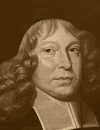
A Brief Life and Times of Samuel Rutherford
This sermon tells the story of Samuel Rutherford's life, highlighting his early life, ministry, exile, and influence on the Westminster Assembly.
Samuel Rutherford, a devoted pastor and theologian, faced numerous trials and hardships throughout his life, from personal losses to conflicts with Church authorities. Despite his exile to Aberdeen, Rutherford's letters to his congregation became a source of great blessing for the church worldwide. His influence extended beyond Scotland, as he played a significant role in the Westminster Assembly and the development of the Shorter Catechism, advocating for limited government and challenging the Divine Right of Kings. Rutherford's unwavering faith and commitment to his beliefs ultimately led to his refusal to appear in court on charges of treason, choosing to meet his Maker instead.
Text
Before and During his Exile
Rutherford was born about the year 1600 near Nisbet, Scotland. Little is known of his early life. In 1627 he earned a M.A. from Edinburgh College, where he was appointed Professor of Humanity. He became pastor of the church in Anwoth in 1627.
Anwoth was a rural parish, and the people were scattered in farms over the hills. He had a true pastor's heart, and he was ceaseless in his labours for his flock. We are told that men said of Rutherford, "He was always praying, always preaching, always visiting the sick, always catechising, always writing and studying." Of course it helps when you get up at 3:00 every morning!
His first years in Anwoth, though, were touched with sadness. His wife was ill for a year and a month, before she died in their new home. Two children also died during this period. Nevertheless God used this time of suffering to prepare Rutherford to be God's comforter of suffering people.
Rutherford's preaching was unparalleled. While he was not a good speaker, his preaching drew great attention. An English merchant said of him, "I came to Irvine, and heard a well-favoured, proper old man (Dickson) with a long beard, and that man showed me all my heart. Then I went to St. Andrews, where I heard a sweet, majestic-looking man (Blair), and he showed me the majesty of God. After him I heard a little, fair man (Rutherford), and he showed me the loveliness of Christ."
In 1636 Rutherford published a book defending the doctrines of grace (Calvinism) against Armininism. This put him in conflict with the Church authorities, which were dominated by the English Episcopacy. He was called before the High Court, deprived of his ministerial office, and exiled to Aberdeen.
This exile was a sore trial for the beloved pastor. He felt that being separated from his congregation was unbearable. However, because of his exile, we now have many of the letters he wrote to his flock, and so the evil of his banishment has been turned into a great blessing for the church worldwide.
After His Exile
In 1638 the struggles between Parliament and King in England, and Presbyterianism vs. Episcopacy in Scotland culminated in momentous events for Rutherford. In the confusion of the times, he simply slipped out of Aberdeen and returned to his beloved Anwoth. But it was not for long. The Kirk (Church of Scotland) held a General Assembly that year, restoring full Presbyterianism to the land. In addition, they appointed Rutherford a Professor of Theology of St. Andrews, although he negotiated to be allowed to preach at least once a week.
The Westminster Assembly began their famous meetings in 1643, and Rutherford was one of the five Scottish commissioners invited to attend the proceedings. Although the Scots were not allowed to vote, they had an influence far exceeding their number. Rutherford is thought to have been a major influence on the Shorter Catechism.
During this period in England, Rutherford wrote his best-known work, "Lex Rex," or "The Law, the King." This book argued for limited government, and limitations on the current idea of the Divine Right of Kings.
When the monarchy was restored in 1660, it was clear that the author of "Lex Rex" would could expect trouble. When the summons came in 1661, charging him with treason, and demanding his appearance on a certain day, Rutherford refused to go. From his deathbed, he answered, "I must answer my first summons; and before your day arrives, I will be where few kings and great folks come." He died on 30th March 1661.
Sermon Outline
- Introduction
- Early Life of Samuel Rutherford
- Education and Ministry
- Exile and Return
Key Quotes
“He was always praying, always preaching, always visiting the sick, always catechising, always writing and studying.” — Samuel Rutherford
“I must answer my first summons; and before your day arrives, I will be where few kings and great folks come.” — Samuel Rutherford
Application Points
- We can learn from Samuel Rutherford's example of perseverance and faithfulness in the face of adversity.
- The importance of standing up for one's convictions, even in the face of opposition, is a key takeaway from Rutherford's life.
- Rutherford's legacy continues to inspire and influence the church today, reminding us of the power of faith and perseverance.