
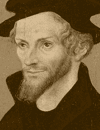
A History of the Life and Actions of the Very Reverend Dr. Martin Luther - Part 1
This sermon provides a biographical account of Martin Luther's life and actions, highlighting his intellectual development, theological contributions, and impact on the Protestant Reformation.
Philip Melancthon recounts the life and actions of the very reverend Dr. Martin Luther, highlighting his upbringing, education, entry into monastic life, and his pivotal role in the Reformation. Luther's journey from a diligent student to a reformer who challenged the errors and superstitions of the church is detailed, emphasizing his commitment to sound doctrine, faith, and prayer. Melancthon praises Luther's devotion to God, his efforts to restore the purity of Gospel truth, and his impact on the church. The sermon concludes with Luther's prayer for God's continued work in the church and the importance of upholding Christian doctrines.
Text
A HISTORY OF THE LIFE AND ACTIONS
OF THE VERY REVEREND DR. MARTIN LUTHER,
FAITHFULLY WRITTEN BY PHILIP MELANCTHON.
WITTEMBURG. 1549. (sic)
DR. MARTIN LUTHER.
That venerable man, Martin
Luther, whilst he was yet with us, gave us reason to hope that he might
himself, narrate the story of his life, with the circumstances of' conflict
attending it; and this he would undoubtedly have accomplished, had he not been
so soon called out of this mortal existence, onto the eternal fellowship of
God, and of his children in heaven.
Profitable indeed, would have been the contemplation of his private life,
clearly set forth, for it was full of examples calculated to confirm in after
times. the piety of the wise-hearted; and profitable also would have been the
recital of events which might tend largely to the information of posterity.
Such a work would also have refuted the calumnies of those who profess that
Luther, incited by the principal men of the day, or possibly by others, to
seek the downfall of episcopal power and dignity, or inflamed by personal
ambition, had become the instrument in loosing the bands of monastic thraldom.
Much advantage would have been derived from a copious and complete notice of
these incidents, illustrated and recorded by himself; and although malevolent
persons may object, that self-praise is an unworthy theme for a man to choose,
yet we well know the character of Luther to have been of such solidity, that
he would have written, even his own history, with the utmost good faith. We
may also assert, that many excellent and intelligent men are yet living, to
whom he could not but be aware, that the series of these events was well
known; it would then have been great folly, if as is sometimes done in works
of imagination, he had fabricated any other narrative; but since his lamented
death has deprived the world of his autobiography, we shall now, with
fidelity, relate those things connected with it which we have heard from his
own lips, and those to which we have ourselves been eyewitnesses.
The name of Luther is widely spread throughout the ramifications of an ancient
family within the Lordship of the illustrious Counts of Mansfield, but the
parents of Martin Luther originally resided in the town of Eisleben, where he
was born, subsequently they removed to Mansfield, where his father, John
Luther, filled the office of magistrate, and for his integrity of character,
was valued and beloved by all good men. In his mother, Margaret Luther, was
found a fair assemblage of domestic virtues; and a peculiar delicacy of mind
was conspicuous in her character, accompanied by the fear of God and the
spirit of prayer, so that many excellent women found in her a bright example
of Christian virtues. Her reply to questions which I have occasionally put to
her, respecting the time of her son's birth, was, that she clearly remembered
the day and the hour, but that she was doubtful as to the year; she said,
however, that he was born on the 10th of November, after eleven o'clock at
night; and that the name of Martin was given to the infant, because the
following day on which, by baptism, he was initiated into the church of God,
was dedicated to Saint Martin. But his brother James, a man of uprightness
and integrity, was accustomed to say, that the opinion of the family,
respecting Luther's age was, that he was born in the year of our Lord 1483.
When be had attained an age at which be was capable of receiving instruction,
his parents diligently accustomed their son Martin to the service and fear of
God, in connection with the performance of' social and family duties; and, as
is usual with good persons, they took care that he should receive literary
instruction, so that whilst yet quite young his education was entrusted to the
care of the father of George Emilius, who, as he is still living, can bear
witness to the truth of this relation. At that time the grammar-schools of
Saxony were not in a flourishing condition, and on this account, when Martin
had entered his fourteenth year, he was sent to Magdeburg, accompanied by John
Reineeke, whose character was afterwards of a shining order, and the influence
which he obtained in that neighbourhood consequently great. The affection
which subsisted between Luther and Reinecke, whether arising from a natural
accordance of mind, or from their companionship in youthful studies, was both
ardent and lasting. Luther, however, did not remain at Magdeburg longer than
twelve months.
During four succeeding years, passed in the school of Eisenach, he had an
opportunity of hearing a preceptor who illustrated grammatical studies with
greater accuracy and ability than he could have met with elsewhere; for I
remember to have heard his talents commended by Luther, who was sent to this
town from the circumstance of his mother's descent from an ancient and
honorable family in those parts.. Here he completed his grammatical studies.
The powers of his intellect being of a gigantic order and peculiarly adapted
to the science of eloquence, he speedily surpassed his contemporaries, both in
the copiousness of his language as a public speaker, and in prose composition;
whilst in poetry, be with ease excelled his competitors in the course of
learning.
Having thus tasted the sweets of literature, the soul of Luther ardently
thirsted for deeper draughts; and with this feeling he sought the University,
as being the fountain head of learning. The scope of so great a mind might
easily have embraced all the arts in succession, had it found teachers
competent to the work; and it is indeed possible that the calmer pursuits of
philosophy combined with oratory, would have proved advantageous in moderating
the impetuosity of his natural temperament. But at Erfurt, he was subjected
to the subtle dialectics prevalent at that time; these he readily embraced,
since by the acuteness of his understanding, he perceived with more facility
than other men, the causes and designs of those studies.
His spirit thus thirsting for knowledge, continually sought a more abundant
and better supply. He read many of the works of the ancient Latin authors, as
Cicero, Virgil, Livy and others; these he perused, not as schoolboys commonly
do, merely by gathering together a vocabulary of words, but for solid
instruction, and as mirrors of human life, by which means he gained a full
perception of the views and opinions of these writers, and as his memory was
both accurate and tenacious, much of what he read and heard was clearly placed
before his mental vision. Hence it was remarkable that even in his youth, the
talents of Luther were the admiration of the whole University.
Having attained the degree of Master in Philosophy, Luther now in his
twentieth year applied himself to the study of the law; and this he did by the
advice of his friends, who deemed that a mind of such large endowment, and of
such fertility in thought and diction ought by no means to be kept in the
shade, but to be called out for the benefit of the state. Soon afterwards
however, and when he had entered his one and twentieth year, suddenly, and in
a manner unexpected by his parents and other relatives, he went to the College
of Augustine monks, at Erfurt, and requested to be received into it. On his
entrance there, he not only applied with the closest diligence to
ecclesiastical studies; but also, with the greatest severity of discipline, he
exercised the government of himself, and far surpassed all others in the
comprehensive range of reading and disputation with a zealous observance of
fasting and prayer. He possessed a constitution at which I have often
marvelled, being of no small bodily stature, nor of a weekly (sic) habit
though very abstemious; I have seen him during four days successively, when in
perfect health, literally abstain from both meat and drink; at other times for
many days together, he has been satisfied with a small allowance of bread and
herring.
But the occasion of his entering on this course of life which he considered
more particularly adapted to the attainment of piety and the knowledge of God,
as he himself has related, and as many are already aware, was the following;
often when contemplating the wrath of God, as exhibited in striking instances
of His avenging hand, suddenly such terrors have overwhelmed his mind, as
almost to deprive him of consciousness; and I myself have seen him whilst
engaged in some doctrinal discussion, involuntarily affected in this manner,
when he has thrown himself on a bed in an adjoining room, and repeatedly
mingled with his prayers the following passage "God has concluded them all in
unbelief that he might have mercy upon all." These terrors he experienced
either for the first time, or in the most acute manner, during the year in
which he was deprived of a favorite friend, who lost his life by some accident
of which I am ignorant.
It was not therefore poverty, but religious zeal that led him to this kind of
monastic life, in which although he daily made himself acquainted with the
doctrine then taught in the schools, read "the Sententiaries," and in public
disputations, ably elucidated to admiring audiences, labyrinths of science,
inexplicable to others: yet, as in this course of life he sought, not the fame
of intellect, but an accession to his piety, he pursued these studies as a
recreation, and thus mastered with ease the systems of the schools. Meanwhile
he drank with avidity from those fountains of celestial wisdom, the prophetic
and apostolic scriptures, that he might acquaint himself with the will of God,
and that be might by the surest testimonies, increase his filial fear and
confirm his faith whilst the force of his mental anguish impelled him to
pursue with greater intensity, these devotional exercises.
He has often said that he was strengthened about this time by the discourses
of a certain aged man, in the college of Augustines at Erfurth, who, when he
disclosed to him the conflicts of his spirit, introduced his mind to new views
on the subject of faith; and he has told me that he led him to that article in
the creed, in which it is said " I believe in the remission of sins," which be
thus interpreted, "that it is necessary not only to believe in general terms,
that sins are remitted to some, as the devils also believe that they were
remitted to David or to Peter in particular, but that it is the command of God
that each individual man should realize the behest that his sins are forgiven
him.(") Luther said that this interpretation of his friend was confirmed by
the testimony of Bernardus, and that a passage in the discourse on the
Annunciation, has these words ; "but add, that then believe this also, that by
Him thy sins are forgiven thee." Such is the testimony which the Holy Ghost
speaketh in thine heart, saying, "thy sins are remitted unto thee;" and this
is in accordance with apostolic writ, being justified freely by his grace,
through the redemption that is in Christ Jesus." Luther was also established
in these opinions, not only by the above conversations, but also by the whole
tenor of the writings of the Apostle Paul, who uniformly inculcates the
doctrine that we are justified by faith. And when afterwards, he placed the
expositions of various authors on this subject, in comparison with the
preceding conversations, and with his own consoling experience of the work of
the Spirit, he evidently perceived the fallacy of the tenets supported by
these writers; and as he read and compared the precepts and examples recorded
by the Prophets and Apostles, and prayed daily for the establishment of his
faith, a clearer light by degrees, shone upon his way.
He now first directed his attention to the pages of Augustine, where both in
"The Interpretation of the Psalms," and in "The Treatise on the Letter and the
Spirit," he found many perspicuous sentiments which confirmed this doctrine of
faith, and fanned the flame of hope that had been kindled in his breast; nor
did he altogether relinquish the "Sententiaries.(") He could recite Gabrielis
and Cameracensis, almost verbatim; for a long time also, he applied closely to
the writings of Occam, the acumen of which author, he preferred to Thomas and
Scotus. He also read Gerson with diligence; but all the works of Augustine
were frequently read by him, and well stored in his memory. This rigid course
of application he commenced at Erfurt, in which town, at the Augustine
College, he remained four years.
At this time, in the year 1508 the Venerable Stupicius (sic) who had favored
the opening of the University at Wittenburg, and who was desirous of promoting
the study of Theology in that College, when he became acquainted with the
talent and erudition of Luther, then in the twenty-sixth year of his age,
invited him to that place, and there amid the daily literary exercises in the
schools, his intellectual powers gained still increasing brilliancy.
Luther was attentively listened to by men of high attainments, Doctor Martin
Mellerstadius and others; and Doctor M. has often said, that so great were the
energies of his mind, as to give clear evidence that he would one day, effect
the overthrow of the theories of learning which were then taught in the
schools. He now first expounded the Physics and Dialectics of Aristotle; at
the same time not forgetting his own favorite study, that of Theology.
After three years he went to Rome, on account of a monkish controversy, and
returning within a year, be was according to the custom of the schools,
presented to the Elector, Frederic, Grand Duke of Saxony, and dignified with
the degree of Doctor; for the Elector had heard him speak in public, and much
admired his lofty genius, his convincing eloquence, and the happy mode in
which he illustrated subjects brought forward in the assembly: but to form a
just estimate of his we should remember that the degree of Doctor was
conferred on Luther when only in the thirtieth year of his age. He has himself
told us, that when he strenuously declined accepting the degree, he received a
charge from Stupicius not to reject the honour conferred on him, adding in
pleasantry, that God had much work to be done in the church, for which purpose
at some future time, his labours would be called into action ; this although
uttered in jest, was realized in the event; as a host of presages often
indicates the approaching convulsions.
Luther now began his commentary on the Epistle to the Romans; then, that on
the Psalms; and he illustrated these writings in such a manner that, in the
opinion of the wise and good, the light of truth first dawned upon them after
a long night of darkness. He here shewed the distinction between the law and
the gospel; he refuted the error then reigning in the schools and councils,
which taught that men deserve the remission of their sins on account of their
own works, and the dogma of the Pharisees, that men are in themselves just
before God. In this manner Luther led the minds of men to the Saviour, and,
like John the Baptist, he pointed out "the Lamb of God who taketh away the
sins of the world".; he allowed that sins are freely remitted through the Son
of God, and that we must all receive this blessing by faith; these, with other
points of Christian doctrine, be set forth to them in a clear light.
A career of usefulness thus nobly begun, invested with no common authority, a
teacher whose practice so beautifully harmonized with his precepts, that his
appeals evidently arose, not from the lips only, but also from the heart. The
charm of so admirable a character won the affections of his hearers, as
according to the old proverb, "manner has more weight than words; " so that
when he afterwards effected a change in some of the established modes of
worship, men of rank who knew him well, were the less vehemently opposed to
him, on account of the ascendancy which he had gained over the public mind by
his elucidation of important theories, as well as by the sanctity of his life;
and united with him in lamenting the prevalence of opinions by which they saw
that the world was distracted.
Luther did not at this time make any alteration in the ceremonies of the
church; on the contrary, he still maintained a severe course of discipline
amongst his disciples, nor did he mingle therewith any of his own formidable
sentiments, but he explained to them, with renewed earnestness, the universal
and all-important doctrines of repentance, of the remission of sins, of faith,
and of the true consolation of the cross.
With so admirable a theology, the religious world was much captivated; and to
the learned also, it was not unwelcome, for they beheld, as it were, Christ,
the prophets and apostles brought out of darkness, the prison, and the prison
house; they perceived the distinction between the law and the gospel, between
the promises of the law and those of the gospel, and between philosophy and
the gospel; distinctions which certainly are not recognized in Thomas, Scotus,
and others of their school; he thus contrasted, spiritual Holiness with the
moral law.
At this time, the attention of the pupils in the university was directed to
the writings of Erasmus, as studies in the Latin and Greek languages; and thus
a more genial philosophy being exhibited to them, many who possessed sound and
liberal understandings, for the first time conceived a horror at the barbarous
sophistry of the monks.
Luther now began to devote himself more particularly to the acquirement of
Greek and Hebrew, in order that having made himself acquainted with the
properties and peculiarities of languages, and having drunk at the
well-springs of knowledge, he might attain a greater maturity of judgment.
When he entered on this course, venal indulgences were promulgated by Tetzel,
a friar of the Dominican order and a most audacious sycophant; at the same
time, Luther, who was ardent in the pursuit of holiness, being irritated by
his impious and nefarious harangues, published his own propositions on the
subject of indulgences, which are to be found in the first volume of his
works; these he affixed to the church contiguous to the castle of Wittemburg,
on the day before the festival of Allsaints, (sic) in the year 1517. Upon
this, Tetzel, acting by no means inconsistently with his character, and hoping
to ingratiate himself with the Roman Pontiff, called together, as his council,
certain monks and theologians imbued more or less with his own sophistry;
these men he directed to compose something against Luther, in the mean time,
that he might not appear to be silenced, he hurled not only declamations as
before, but thundering accusations against Luther, and vociferated on all
sides that this heretic would be destroyed by fire. His propositions also,
and his protest, were publicly consigned to the flames. These ravings of
Tetzel and his satellites, imposed on Luther the necessity of a more ample
discussion of these subjects, and a further vindication of the truth.
Such was the origin of a controversy, in which Luther, not as yet suspecting
or imagining the future overthrow of rites and ceremonies, forcibly enjoined
moderation, for he did not at that time himself entirely reject the
indulgences. He was, therefore, basely calumniated by those who said that he
had made a plausible beginning with an intention eventually, to overturn the
government, and this, by seeking power, either for himself or for others; so
little truth was there in the accusation of his having been suborned or
incited by courtiers, as the Duke of Brunswick expressed in writing, that even
the Elector Frederic was grieved by the report of these contests, foreseeing
as he did, that although they originated in a popular cause, yet that this
flame would gradually spread far and wide, as is said of the strife in Homer,_
"Soon grows the pigmy to gigantic size."
As Frederic, one of the greatest princes of our times, was particularly
anxious for the preservation of public tranquility, he was accustomed to refer
matters of debate which affected the common weal, to the States of the empire,
so that by many evidences, it was clear that he neither instigated nor
approved the proceedings of Luther, but he frequently manifested his regret at
the existing state of things, as he was apprehensive of stir greater
disturbances.
Frederic being a wise prince, and uninfluenced by that worldly policy which
hastens to extinguish every appearance of reform, and adhering in his councils
to the divine law, which commands its to listen to the voice of the Gospel,
which forbids us to resist acknowledged truth, and which calls that a
blasphemy under the awful condemnation of God, which pertinaciously withstands
it; he followed the course which many wise and learned men have done, he
yielded up the cause to God. He also carefully read the polemic writings of
the day, and those which appeared to be on the side of truth he was unwilling
to reject.
I know, indeed, that Frederic often inquired the opinion of scholars
concerning these matters, and, that in the convention held at Cologne, by the
Emperor Charles the fifth, after his coronation, be asked Erasmus, of
Rotterdam, in a friendly manner, whether he considered that Luther was in the
wrong, in those controversies which then engaged so much of his attention; to
this Erasmus candidly replied, that he was of opinion that Luther was in the
right, but that he was wanting in gentleness of spirit; respecting which the
Duke Frederic afterwards writing seriously to Luther, exhorted him to moderate
the asperity of his style.
It appears also, that Luther made a promise to Cardinal Cajetan, that he would
maintain silence if his opponents would enter into a similar agreement; from
which we may clearly perceive, that at that time he had no intention of
stirring up further commotions, but that he was desirous of peace: by degrees,
however, his attention was drawn to other subjects, as he was attacked on
every hand, by illiterate adversaries.
Then followed disputations on "The Distinction between Laws Human and Divine,"
and, on "the Disgraceful Profanation of the Lord's Supper, by making a common
sale of it, and its perversion in other ways," herein the whole design of
sacrifices was explained, and the use of sacraments set forth; and when, now,
the pious in monasteries found that the worship of images was to be
relinquished, they began to decline from such an unhallowed devotion, Luther
added to his "Explications of' the Doctrine of Repentance," of the Remission
of Sins," of "Faith" and "Indulgences," these additional subjects, "The
Distinction between laws Human and Divine," "The Doctrine of the Lord's
Supper," with other sacraments, and also that "of Vows;" these were the main
points of the controversy. Eccius at this time instituted an inquiry into the
extent of power possessed by the Bishop of Rome, for no other purpose than to
excite the hatred of the Pope and of crowned heads against Luther.
Luther, however, retained unaltered the Apostles, the Nicene, and the
Athanesian Creeds; but he explained in many of his writings to what extent,
and on what grounds, a change must needs be effected in human rites and
traditions; what form of doctrine he wished to retain, and what administration
of the sacraments he most approved, were obvious from a confession which the
Elector-John, Duke of Saxony, and Prince Philip Landgrave of Hesse, &c.
presented to the Emperor Charles the Fifth, at an imperial diet, in the year
1530, and are apparent both from the rites of the church in that city, and
from the doctrine with which our church now resounds, the chief of which is
clearly comprehended in the confession.
I relate these circumstances, not only for the information of pious men as to
the errors which Luther attacked and the idols which he removed, but to
convince them that he embraced every important doctrine of the Church,
restored purity to its ritual, and exhibited models of reform such as is
desirable in Christian churches; and it is well that posterity should be made
acquainted with the views held by Luther.
I here feel reluctant to mention those who first administered the Lord's
supper in both kinds, those who first omitted private masses, and also what
monasteries were first deserted, for Luther disputed but little on these
points before the convention which was held at Worms in the year 1521. He
himself made no change in the ceremonies, but during his absence Carolostadius
and others did; and as he and his party caused some disturbance, Luther on his
return, by a plain declaration of his sentiments, testified what he approved
and what he disapproved.
We know that statesmen are usually much prejudiced against innovations of all
kinds, and must confess that discords often arise even in the discussion of
important topics, as amid the sad confusion of human things some evil will
ever intervene. But nevertheless, in the church, it is imperative that we
esteem the commands of God before all worldly considerations. The eternal
Father spake thus concerning His Son, "This is my beloved Son, hear Him." And
he threatens with eternal wrath blasphemers, that is to say, those who
endeavour to destroy acknowledged truth, for which reason it became the
incumbent and Christian duty of Luther, to censure those pernicious errors
which men of the Epicurean school. shamelessly augmented, and his auditors
were necessarily compelled to agree with so correct a teacher.
If a total change be odious, if dissentions commonly prove injurious, as we
now perceive with sorrow to be the case, then those who first propagated
error, are as much in fault as those who now with diabolical pertinacity
maintain it.
I have dwelt on these subjects not for the purpose of defending Luther, but
that pious minds both now and in after generations, may comprehend what is,
and ever will be the government of the true church: how from among this mass
of iniquity, that is, the abominations of mankind, God by the voice of His
Gospel, "which shines as a light in a dark place," gathers the everlasting
church unto Himself. For example in the times of the Pharisees, Zacharias,
Elizabeth, Mary and many others, were guardians of the oracles of God: again,
before that time, there were many who offered prayer acceptably unto Him; some
with more, others with less clearness, holding the doctrines of the Gospel;
and such was that aged man of whom I have spoken, as supporting Luther under
his deep conflicts, and who was to him in some degree a preacher of the true
faith.
Thus, that God may henceforward preserve this light in the hearts of many, let
us ardently pray, as Isaiah did for his hearers, "Seal the law among my
disciples." Finally, it appears by this recital, that vain superstitions are
not enduring, but that they shall be rooted up by an Almighty hand: these
being the origin of dissentions, care is necessary lest errors should be
taught in the church.
But to return to Luther; as he first entered on this cause, uninfluenced by
private ambition, so, although he was of an ardent and choleric temperament,
yet, being ever mindful of his calling, he contended by argument alone, and
forbade recourse to arms; thus be knew how to make a distinction .between
functions of opposite characters, between that of a bishop teaching in the
church of God, and that of the magistrate who, in his proper office, restrains
the people by the power of the sword.
And as Satan ever studies to distract the church by scandal, and to affix
disgrace on the cause of God, whilst he rejoices in iniquity and delights in
the transgressions and ruin of miserable man; so on that occasion, be excited
the instigators of seditious tumults, as Monitarius and others of the same
opinions; these Luther severely condemned, but he lent his own influence to
honor and confirm all the bonds of social life. When I reflect however, that
high ecclesiastics have often been deceived on this question, I unhesitatingly
conclude that a mind which so constantly abode within the bounds of its proper
calling, must not only have been governed by human wisdom, but guided also by
light from above.
Thus then he dissented widely from the seditious teachers of this age,
Monitarius and the Anabaptists, also from those Romish Bishops who most
audaciously and shamelessly affirmed that in connection with the gift of the
ministry, committed to Peter by secret decrees, political power also was
vested in him.
In fine, he exhorted all to "render unto God the things which be God's, and
unto Caesar, the things which be, Caesar's;" that is, that in true repentance,
in the acknowledgment and promulgation of sound doctrine, in sincere prayer
and in the maintenance of a good conscience, they should worship God, and that
every man should in the performance of his civil duties, submit himself unto
Him. These were Luther's true principles, and to them he adhered,_he rendered
to God the things that be God's, he taught correctly, he prayed earnestly, and
he possessed all the other graces essential in the man who is acceptable to
God. Lastly, in political society he ever avoided seditious counsels; and
these virtues I regard with the greater admiration, as they cannot in this
life be surpassed.
Although the name of Luther is deservedly of good report, since he reverently
occupied his talent, above all must we render thanks unto God for that by this
his servant, He has restored to us the light of His Gospel; let us then retain
the remembrance of his ministry, and spread his doctrines abroad. Unmoved as
I am by the clamours of Epicureans and hypocrites who either deride or condemn
the plain truth, it is my decided opinion, that the catholic church accords in
receiving the doctrine sounded forth in our temples, as the voice of God, and
that it is incumbent on us, that a due recognition of it should pervade our
devotions as well as our entire lives: in short, that this is the very
doctrine, of which the Son of God says, "If a man love me he will keep my
words, and my Father will love him and we will come unto him and make our
abode with him." I here speak of that profound doctrine as it is understood
and explained in our churches by pious and learned men, for although some may
expound it more aptly than others, or one may sometimes speak with greater
asperity than another, yet on the whole there is a general agreement among the
wise and good, on subjects of this character.
Whilst I have reflected much and frequently on the subject of doctrine, in
times least, up to the days of the Apostles, I have plainly perceived that
after the first reign of purity had passed away, four remarkable changes in
doctrine, followed. During the age of Origen, although there were some who
thought correctly, amongst whom I would place Methodius, for he discouraged
the fantasies of Origen, yet in the minds of the people, he made the Gospel
bend to Philosophy, that is to say, he encouraged the opinion that the just
exercise of reason, merits the remission of sins, and, that this is the
justice of which it is said, "The just shall live by faith." At this time the
distinction between the law and the gospel, with the remembrance of apostolic
truths, was entirely lost sight of; nor did the words Letter, Spirit, Justice
and Faith retain their original signification. Thus the proper use of words
which are the signs of ideas, being lost, it became necessary that something
should be devised in their place. From these germs arose the Pelagian error,
which was widely spread, so that although the Apostles had taught holy
doctrine, drawn from the pure and salutary fountains of gospel truth, Origen
mingled therewith much impurity.
That the errors of this age might be corrected, at least in some degree, God
raised up Augustine; he partially cleansed the sources, nor do I doubt that if
he could pass a judgment on the controversies of the present time, he would
cast in his vote with us: certainly on the subjects of the Free Remission of
Sins, Justification by Faith, the Use of the Sacraments, and other points of
less importance, he does think with us. For although in some parts of his
writings, he expresses himself more distinctly than in others, yet, if his
reader will exercise reason and candour in judging him, he will perceive that
his sentiments agree with our own; and, although our adversaries sometimes
quote passages taken from his writings, against us, and appeal loudly to the
Fathers, they do it not from any regard for truth or antiquity, but like
sycophants, they invest images of the present day, with the authority of the
ancients, to whom these images were unknown.
Nevertheless, the seeds of superstition appear to have existed even in the
ages of the Fathers; thus Augustine established certain regulations respecting
vows, although he treats the subject with less austerity than others have
done. The contamination of their own times always in some degree, affects
even good men, because as we naturally favour the existing customs of the
country in which we have been nurtured; that expression of Euripedes is found
to be true, "Every thing from the companion of our childhood is sweet." But I
could desire that all who boast of being followers of Augustine, would revert
to his standing, opinions to the very genius of his mind, if I may so speak,
and not maliciously pervert mutilated expressions to their own views. And now
light being revived through the writings of this author, be became a blessing
to posterity, for after him, Prosper, Maximus, Hugo, and others of a similar
class, who were leading men in the schools, down to the time of Bernardus,
closely followed the institutes of Augustine. Meanwhile, however, the power
and wealth of the Bishops increasing, there followed, as it were, an age of
giants ; unholy and unlearned men reigned in the Church, of whom, some were
accomplished in forensic learning, and in the arts of the Vatican.
Then arose the Dominicans and the Franciscans, who, when they beheld the pomp
and luxury of the Bishops, whose dissolute manners had become obnoxious to
them, formed to themselves a more correct mode of life; and for the sake of
discipline, they incarcerated themselves in Monasteries. Ignorance at first
fostered superstition; but when they afterwards saw that the studies in the
schools were directed only to forensic learning since in Rome, at this time,
the practice of the law augmented the influence and wealth of many, they
endeavoured to call public attention to the study of theology.
But their wisdom failed them in this attempt. Albertus and his followers, who
had embraced the opinions of Aristotle, began to convert the doctrines of the
Church into philosophy; and this fourth age was not only impure, but
absolutely polluted; that is to say, it infused manifest idolatry into the
fountains of Gospel Truth. And such labyrinths of false sentiment are to be
found in Thomas, Scotus, and similar writers, that wiser theologians have
always felt the need of ft more simple and a purer doctrine.
Nor can it be said without glaring effrontery, that such a reform was uncalled
for; since it is evident that many of the sophisms contained in these
disputations, were not intelligible even to those who were conversant with
such arguments. Hence it is plainly proved, that they are blindly devoted to
idolatry who teach the virtue of sacrifices as contained in works, who
sanction the use of image worship, who deny the forgiveness of sin by grace
through faith, and who in human ceremonies, make a sacrifice of conscience;
and there are truly other things yet more degrading, which cannot be told, and
at which the whole frame shudders.
Let us therefore give thanks unto God, the eternal Father of our Lord Jesus
Christ, who has been pleased by the ministry of Martin Luther, again to purify
the sources of Evangelic Truth, and to restore sound doctrine to the Church.
Whilst contemplating this theme, it behooves all pious men the world over to
mingle their prayers and their sighs, and to supplicate in fervency of spirit,
that God will strengthen the work which He has begun in us, because of His
Holy Temple.
"O Thou, the living and true God, the Eternal Father of Our Lord Jesus Christ,
the Author of all things and of Thy Church, Thine is the word and the promise,
'For my name's sake I will do it, that they may not blaspheme.' To Thee I pray
with my whole heart, for the sake of Thine own glory and that of Thy Son, that
by the voice of Thy Gospel, Thou wilt ever gather the Eternal Church unto
Thyself; And for the sake of our Lord Jesus Christ, who was crucified for us,
and rose again, our Mediator and Intercessor, may it please Thee to reign in
our hearts and minds by the Holy Ghost, that we may in sincerity offer up our
prayers, and render service acceptable unto Thee. Deign also to bless the
pursuits of Philosophy, and direct and support those principles and that
discipline which are the guardians of wisdom and the protection of Thy Church.
When Thou shalt have so built up the human race, that Thou shalt be
universally acknowledged and adored; for which purpose Thou least made Thyself
known by such clear testimonies, oh, grant that this fold, in which Thy true
doctrine is heard, may not he brought to desolation; and since Thy Son our
Lord Jesus Christ, when about to endure his agony, prayed for us, 'Father,
sanctify them through Thy truth, Thy word is truth,' so, to the prayer of this
our Great High Priest, we join our supplications, that the light of Thy truth
may for ever shine in the sons of men, to guide and govern them."
In prayer for these blessings, we have heard Luther daily engaged, and amid
these devotions, his spirit was gently called from its mortal tenement, when
he was in the sixty-third year of his age.
Posterity possesses many of Luther's works, doctrinal and devotional. He
published [Greek] ((((((((((( or dialectic writings, which contain doctrine
wholesome and necessary to man, calculated also to enlighten sincere minds on
the subjects of "Repentance," "Faith with its genuine fruits," (the use of the
Sacraments," "the distinction between the Law and the Gospel," and "between
the Gospel and Philosophy," "on the dignity of political rank," and lastly,
"on the most important articles which are essential to the Church." He then
added [Greek] ((((((((( in which he refuted many pernicious errors; he also
published [Greek] (((((((((; these are "enlarged illustrations of the
Prophetic and Apostolic Scriptures," in which class even his enemies confess,
that he has excelled all previous commentators.
The value of these writings is appreciated by the religious world; but
certainly in usefulness and laborious research, they do not surpass another
work of his, "the interpretation of the Old and New Testaments," the
perspicuity of which is so great that his German version may serve as a
commentary; nor is this publication a commentary only, for it has very learned
annotations, with a synopsis of the several parts subjoined; both of which
exhibit a summary of heavenly doctrine, and inform the reader on the subjects
of the discourse so, that from these sources, the children of God may draw
sure evidences of the truth.
Luther himself, wished that none should linger amid the products of his own
mind, but was anxious to lead the attention of all, to the fountain-head of
divine wisdom: he wished that we might hear the voice of God, that it might in
the minds of many, awaken the true faith, and prayer, that God might be truly
glorified, and that many might be made heirs of eternal life. .
And now it becomes us to acknowledge these desires and these more abundant
labors, and to remember them as an example also, that each study according to
his talents, how he may best adorn the Church of Christ; for to these two
great ends, our whole life with all its purposes and designs, should be
referred; in the first place, that we may show forth the glory of God, and in
the next, that we may benefit His church: in allusion to the former, Paul says
"Do all to the glory of God;" and the latter is referred to in Psalm cxxii.
"Pray for the peace of Jerusalem;" with a sweet promise added in the same
verse, "They shall prosper that love Thee." These heavenly commands and these
promises invite all to an enlightened knowledge of Christian doctrines: they
call upon us, to love the ministers of the Gospel, and those who teach it in
its purity; whilst they direct our studies and our labors to the propagation
of sound doctrine, and to the maintenance of harmony in the Church of Christ.
DAILY AND FREQUENT PRAYER OF LUTHER.
"Establish in us 0 God! that which "Thou hast wrought, and perfect the work
"which Thou hast begun in us to Thy "glory, Amen."
Sermon Outline
- I. Introduction to Martin Luther's Life and Actions
- A. Early Life and Family
- B. Education and Intellectual Development
- C. Entry into Monastic Life and Theological Studies
- II. Luther's Theological Development
- A. Influence of Augustine and the Apostle Paul
- B. Critique of Scholastic Theology and the Emergence of Protestant Thought
- C. The Role of Faith in Justification
- III. Luther's Career and Impact
- A. Teaching and Writing at Wittenberg
- B. The Ninety-Five Theses and the Conflict with Tetzel
- C. The Spread of Luther's Ideas and the Emergence of the Protestant Reformation
Key Quotes
“God has concluded them all in unbelief that he might have mercy upon all.” — Philip Melancthon
“The charm of so admirable a character won the affections of his hearers, as according to the old proverb, 'manner has more weight than words;'” — Philip Melancthon
“He thus contrasted, spiritual Holiness with the moral law.” — Philip Melancthon
Application Points
- Luther's emphasis on justification by faith can inspire us to focus on our relationship with God and to trust in His mercy and grace.
- The importance of individual interpretation of the Bible can encourage us to engage with Scripture in a personal and meaningful way.
- Luther's commitment to his family and community can model for us the importance of prioritizing our relationships and serving others with love and compassion.