
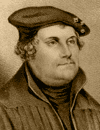
Martin Luther's 95 Theses (1517)
Martin Luther's 95 Theses challenge the Church's practices regarding indulgences and emphasize the necessity of true repentance and faith for salvation.
Martin Luther's 95 Theses, written in 1517, challenges the practices of the Catholic Church regarding indulgences, emphasizing the importance of true repentance and contrition over the buying of pardons. Luther questions the authority of the Pope to grant remission of sins and highlights the need for genuine penance and love for God over monetary contributions. He criticizes the Church's focus on indulgences rather than the Gospel and the true teachings of Christ, urging Christians to follow Christ through trials and tribulations rather than seeking false assurances of peace.
Text
Martin Luther's 95 Theses
Disputation of Doctor Martin Luther
on the Power and Efficacy of Indulgences
by Dr. Martin Luther, 1517
Disputation of Doctor Martin Luther
on the Power and Efficacy of Indulgences
by Dr. Martin Luther, 1517
Published in:
Works of Martin Luther
Adolph Spaeth, L.D. Reed, Henry Eyster Jacobs, et Al., Trans. & Eds.
(Philadelphia: A. J. Holman Company, 1915), Vol. 1, pp. 29-38.
DISPUTATION OF DOCTOR MARTIN LUTHER
ON THE POWER AND EFFICACY OF
INDULGENCES
OCTOBER 31, 1517
Out of love for the truth and the desire to bring it to light,
the following propositions will be discussed at Wittenberg,
under the presidency of the Reverend Father Martin Luther,
Master of Arts and of Sacred Theology, and Lecturer in
Ordinary on the same at that place. Wherefore he requests that
those who are unable to be present and debate orally with us,
may do so by letter.
In the Name our Lord Jesus Christ. Amen.
1. Our Lord and Master Jesus Christ, when He said Poenitentiam
agite, willed that the whole life of believers should be
repentance.
2. This word cannot be understood to mean sacramental penance,
i.e., confession and satisfaction, which is administered by
the priests.
3. Yet it means not inward repentance only; nay, there is no
inward repentance which does not outwardly work divers
mortifications of the flesh.
4. The penalty [of sin], therefore, continues so long as
hatred of self continues; for this is the true inward
repentance, and continues until our entrance into the kingdom
of heaven.
5. The pope does not intend to remit, and cannot remit any
penalties other than those which he has imposed either by his
own authority or by that of the Canons.
6. The pope cannot remit any guilt, except by declaring that
it has been remitted by God and by assenting to God's
remission; though, to be sure, he may grant remission in cases
reserved to his judgment. If his right to grant remission in
such cases were despised, the guilt would remain entirely
unforgiven.
7. God remits guilt to no one whom He does not, at the same
time, humble in all things and bring into subjection to His
vicar, the priest.
8. The penitential canons are imposed only on the living, and,
according to them, nothing should be imposed on the dying.
9. Therefore the Holy Spirit in the pope is kind to us,
because in his decrees he always makes exception of the
article of death and of necessity.
10. Ignorant and wicked are the doings of those priests who,
in the case of the dying, reserve canonical penances for
purgatory.
11. This changing of the canonical penalty to the penalty of
purgatory is quite evidently one of the tares that were sown
while the bishops slept.
12. In former times the canonical penalties were imposed not
after, but before absolution, as tests of true contrition.
13. The dying are freed by death from all penalties; they are
already dead to canonical rules, and have a right to be
released from them.
14. The imperfect health [of soul], that is to say, the
imperfect love, of the dying brings with it, of necessity,
great fear; and the smaller the love, the greater is the fear.
15. This fear and horror is sufficient of itself alone (to say
nothing of other things) to constitute the penalty of
purgatory, since it is very near to the horror of despair.
16. Hell, purgatory, and heaven seem to differ as do despair,
almost-despair, and the assurance of safety.
17. With souls in purgatory it seems necessary that horror
should grow less and love increase.
18. It seems unproved, either by reason or Scripture, that
they are outside the state of merit, that is to say, of
increasing love.
19. Again, it seems unproved that they, or at least that all
of them, are certain or assured of their own blessedness,
though we may be quite certain of it.
20. Therefore by "full remission of all penalties" the pope
means not actually "of all," but only of those imposed by
himself.
21. Therefore those preachers of indulgences are in error, who
say that by the pope's indulgences a man is freed from every
penalty, and saved;
22. Whereas he remits to souls in purgatory no penalty which,
according to the canons, they would have had to pay in this
life.
23. If it is at all possible to grant to any one the remission
of all penalties whatsoever, it is certain that this remission
can be granted only to the most perfect, that is, to the very
fewest.
24. It must needs be, therefore, that the greater part of the
people are deceived by that indiscriminate and highsounding
promise of release from penalty.
25. The power which the pope has, in a general way, over
purgatory, is just like the power which any bishop or curate
has, in a special way, within his own diocese or parish.
26. The pope does well when he grants remission to souls [in
purgatory], not by the power of the keys (which he does not
possess), but by way of intercession.
27. They preach man who say that so soon as the penny jingles
into the money-box, the soul flies out [of purgatory].
28. It is certain that when the penny jingles into the
money-box, gain and avarice can be increased, but the result
of the intercession of the Church is in the power of God
alone.
29. Who knows whether all the souls in purgatory wish to be
bought out of it, as in the legend of Sts. Severinus and
Paschal.
30. No one is sure that his own contrition is sincere; much
less that he has attained full remission.
31. Rare as is the man that is truly penitent, so rare is also
the man who truly buys indulgences, i.e., such men are most
rare.
32. They will be condemned eternally, together with their
teachers, who believe themselves sure of their salvation
because they have letters of pardon.
33. Men must be on their guard against those who say that the
pope's pardons are that inestimable gift of God by which man
is reconciled to Him;
34. For these "graces of pardon" concern only the penalties of
sacramental satisfaction, and these are appointed by man.
35. They preach no Christian doctrine who teach that
contrition is not necessary in those who intend to buy souls
out of purgatory or to buy confessionalia.
36. Every truly repentant Christian has a right to full
remission of penalty and guilt, even without letters of
pardon.
37. Every true Christian, whether living or dead, has part in
all the blessings of Christ and the Church; and this is
granted him by God, even without letters of pardon.
38. Nevertheless, the remission and participation [in the
blessings of the Church] which are granted by the pope are in
no way to be despised, for they are, as I have said, the
declaration of divine remission.
39. It is most difficult, even for the very keenest
theologians, at one and the same time to commend to the people
the abundance of pardons and [the need of] true contrition.
40. True contrition seeks and loves penalties, but liberal
pardons only relax penalties and cause them to be hated, or at
least, furnish an occasion [for hating them].
41. Apostolic pardons are to be preached with caution, lest
the people may falsely think them preferable to other good
works of love.
42. Christians are to be taught that the pope does not intend
the buying of pardons to be compared in any way to works of
mercy.
43. Christians are to be taught that he who gives to the poor
or lends to the needy does a better work than buying pardons;
44. Because love grows by works of love, and man becomes
better; but by pardons man does not grow better, only more
free from penalty.
45. Christians are to be taught that he who sees a man in
need, and passes him by, and gives [his money] for pardons,
purchases not the indulgences of the pope, but the indignation
of God.
46. Christians are to be taught that unless they have more
than they need, they are bound to keep back what is necessary
for their own families, and by no means to squander it on
pardons.
47. Christians are to be taught that the buying of pardons is
a matter of free will, and not of commandment.
48. Christians are to be taught that the pope, in granting
pardons, needs, and therefore desires, their devout prayer for
him more than the money they bring.
49. Christians are to be taught that the pope's pardons are
useful, if they do not put their trust in them; but altogether
harmful, if through them they lose their fear of God.
50. Christians are to be taught that if the pope knew the
exactions of the pardon-preachers, he would rather that St.
Peter's church should go to ashes, than that it should be
built up with the skin, flesh and bones of his sheep.
51. Christians are to be taught that it would be the pope's
wish, as it is his duty, to give of his own money to very many
of those from whom certain hawkers of pardons cajole money,
even though the church of St. Peter might have to be sold.
52. The assurance of salvation by letters of pardon is vain,
even though the commissary, nay, even though the pope himself,
were to stake his soul upon it.
53. They are enemies of Christ and of the pope, who bid the
Word of God be altogether silent in some Churches, in order
that pardons may be preached in others.
54. Injury is done the Word of God when, in the same sermon,
an equal or a longer time is spent on pardons than on this
Word.
55. It must be the intention of the pope that if pardons,
which are a very small thing, are celebrated with one bell,
with single processions and ceremonies, then the Gospel, which
is the very greatest thing, should be preached with a hundred
bells, a hundred processions, a hundred ceremonies.
56. The "treasures of the Church," out of which the pope.
grants indulgences, are not sufficiently named or known among
the people of Christ.
57. That they are not temporal treasures is certainly evident,
for many of the vendors do not pour out such treasures so
easily, but only gather them.
58. Nor are they the merits of Christ and the Saints, for even
without the pope, these always work grace for the inner man,
and the cross, death, and hell for the outward man.
59. St. Lawrence said that the treasures of the Church were
the Church's poor, but he spoke according to the usage of the
word in his own time.
60. Without rashness we say that the keys of the Church, given
by Christ's merit, are that treasure;
61. For it is clear that for the remission of penalties and of
reserved cases, the power of the pope is of itself sufficient.
62. The true treasure of the Church is the Most Holy Gospel of
the glory and the grace of God.
63. But this treasure is naturally most odious, for it makes
the first to be last.
64. On the other hand, the treasure of indulgences is
naturally most acceptable, for it makes the last to be first.
65. Therefore the treasures of the Gospel are nets with which
they formerly were wont to fish for men of riches.
66. The treasures of the indulgences are nets with which they
now fish for the riches of men.
67. The indulgences which the preachers cry as the "greatest
graces" are known to be truly such, in so far as they promote
gain.
68. Yet they are in truth the very smallest graces compared
with the grace of God and the piety of the Cross.
69. Bishops and curates are bound to admit the commissaries of
apostolic pardons, with all reverence.
70. But still more are they bound to strain all their eyes and
attend with all their ears, lest these men preach their own
dreams instead of the commission of the pope.
71 . He who speaks against the truth of apostolic pardons, let
him be anathema and accursed!
72. But he who guards against the lust and license of the
pardon-preachers, let him be blessed!
73. The pope justly thunders against those who, by any art,
contrive the injury of the traffic in pardons.
74. But much more does he intend to thunder against those who
use the pretext of pardons to contrive the injury of holy love
and truth.
75. To think the papal pardons so great that they could
absolve a man even if he had committed an impossible sin and
violated the Mother of God -- this is madness.
76. We say, on the contrary, that the papal pardons are not
able to remove the very least of venial sins, so far as its
guilt is concerned.
77. It is said that even St. Peter, if he were now Pope, could
not bestow greater graces; this is blasphemy against St. Peter
and against the pope.
78. We say, on the contrary, that even the present pope, and
any pope at all, has greater graces at his disposal; to wit,
the Gospel, powers, gifts of healing, etc., as it is written
in I. Corinthians xii.
79. To say that the cross, emblazoned with the papal arms,
which is set up [by the preachers of indulgences], is of equal
worth with the Cross of Christ, is blasphemy.
80. The bishops, curates and theologians who allow such talk
to be spread among the people, will have an account to render.
81. This unbridled preaching of pardons makes it no easy
matter, even for learned men, to rescue the reverence due to
the pope from slander, or even from the shrewd questionings of
the laity.
82. To wit: -- "Why does not the pope empty purgatory, for the
sake of holy love and of the dire need of the souls that are
there, if he redeems an infinite number of souls for the sake
of miserable money with which to build a Church? The former
reasons would be most just; the latter is most trivial."
83. Again: -- "Why are mortuary and anniversary masses for the
dead continued, and why does he not return or permit the
withdrawal of the endowments founded on their behalf, since it
is wrong to pray for the redeemed?"
84. Again: -- "What is this new piety of God and the pope,
that for money they allow a man who is impious and their enemy
to buy out of purgatory the pious soul of a friend of God, and
do not rather, because of that pious and beloved soul's own
need, free it for pure love's sake?"
85. Again: -- "Why are the penitential canons long since in
actual fact and through disuse abrogated and dead, now
satisfied by the granting of indulgences, as though they were
still alive and in force?"
86. Again: -- "Why does not the pope, whose wealth is to-day
greater than the riches of the richest, build just this one
church of St. Peter with his own money, rather than with the
money of poor believers?"
87. Again: -- "What is it that the pope remits, and what
participation does he grant to those who, by perfect
contrition, have a right to full remission and participation?"
88. Again: -- "What greater blessing could come to the Church
than if the pope were to do a hundred times a day what he now
does once, and bestow on every believer these remissions and
participations?"
89. "Since the pope, by his pardons, seeks the salvation of
souls rather than money, why does he suspend the indulgences
and pardons granted heretofore, since these have equal
efficacy?"
90. To repress these arguments and scruples of the laity by
force alone, and not to resolve them by giving reasons, is to
expose the Church and the pope to the ridicule of their
enemies, and to make Christians unhappy.
91. If, therefore, pardons were preached according to the
spirit and mind of the pope, all these doubts would be readily
resolved; nay, they would not exist.
92. Away, then, with all those prophets who say to the people
of Christ, "Peace, peace," and there is no peace!
93. Blessed be all those prophets who say to the people of
Christ, "Cross, cross," and there is no cross!
94. Christians are to be exhorted that they be diligent in
following Christ, their Head, through penalties, deaths, and
hell;
95. And thus be confident of entering into heaven rather
through many tribulations, than through the assurance of
peace.
_________________________________________________________________
This text was converted to ascii format for Project Wittenberg by
Allen Mulvey and is in the public domain. You may freely
distribute, copy or print this text. Please direct any comments
or suggestions to: Rev. Robert E. Smith of the Walther Library at
Concordia Theological Seminary.
E-mail: CFWLibrary@CRF.CUIS.EDU
Surface Mail: 6600 N. Clinton St., Ft. Wayne, IN 46825 USA
Phone: (219) 481-2123 Fax: (219) 481-2126
________________________________________________________________
``Disputatio pro Declaratione Virtutis Indulgentiarum.''
by Dr. Martin Luther, 1483-1546
D. MARTIN LUTHERS WERKE: KRITISCHE GESAMMTAUSGABE.
1. Band (Weimar: Hermann Boehlau, 1883). pp. 233-238.
PW #001-001La
_________________________________________________________________
This text was converted to ascii format for Project Wittenberg by
Rev. Robert E. Smith and is in the public domain. You may freely
distribute, copy or print this text. Please direct any comments
or suggestions to: Rev. Robert E. Smith of the Walther Library at
Concordia Theological Seminary.
E-mail: CFWLibrary@CRF.CUIS.EDU
Surface Mail: 6600 N. Clinton St., Ft. Wayne, IN 46825 USA
Phone: (219) 481-2123 Fax: (219) 481-2126
________________________________________________________________
Amore et studio elucidande veritatis hec subscripta disputabuntur
Wittenberge, Presidente R. P. Martino Lutther, Artium et S.
Theologie Magistro eiusdemque ibidem lectore Ordinario. Quare
petit, ut qui non possunt verbis presentes nobiscum disceptare
agant id literis absentes. In nomine domini nostri Hiesu Christi.
Amen.
1. Dominus et magister noster Iesus Christus dicendo `Penitentiam
agite &c.' omnem vitam fidelium penitentiam esse voluit.
2. Quod verbum de penitentia sacramentali (id est confessionis et
satisfactionis, que sacerdotum ministerio celebratur) non potest
intelligi.
3. Non tamen solam intendit interiorem, immo interior nulla est,
nisi foris operetur varias carnis mortificationes.
4. Manet itaque pena, donec manet odium sui (id est penitentia
vera intus), scilicet usque ad introitum regni celorum.
5. Papa non vult nec potest ullas penas remittere preter eas, quas
arbitrio vel suo vel canonum imposuit.
6. Papa non potest remittere ullam culpam nisi declarando, et
approbando remissam a deo Aut certe remittendo casus reservatos
sibi, quibus contemptis culpa prorsus remaneret.
7. Nulli prorus remittit deus culpam, quin simul eum subiiciat
humiliatum in omnibus sacerdoti suo vicario.
8. Canones penitentiales solum viventibus sunt impositi nihilque
morituris secundum eosdem debet imponi.
9. Inde bene nobis facit spiritussanctus in papa excipiendo in
suis decretis semper articulum mortis et necessitatis.
10. Indocte et male faciunt sacerdotes ii, qui morituris
penitentias canonicas in purgatorium reservant.
11. Zizania illa de mutanda pena Canonica in penam purgatorii
videntur certe dormientibus episcopis seminata.
12. Olim pene canonice non post, sed ante absolutionem
imponebantur tanquam tentamenta vere contritionis.
13. Morituri per mortem omnia solvunt et legibus canonum mortui
iam sunt, habentes iure earum relaxationem.
14. Imperfecta sanitas seu charitas morituri necessario secum fert
magnum timorem, tantoque maiorem, quanto minor fuerit ipsa.
15. Hic timor et horror satis est se solo (ut alia taceam) facere
penam purgatorii, cum sit proximus desperationis horrori.
16. Videntur infernus, purgaturium, celum differre, sicut
desperatio, prope desperatio, securitas differunt.
17. Necessarium videtur animabus in purgatorio sicut minni
horrorem ita augeri charitatem.
18. Nec probatum videtur ullis aut rationibus aut scripturis, quod
sint extra statum meriti seu augende charitatis.
19. Nec hoc probatum esse videtur, quod sint de sua beatitudine
certe et secure, saltem omnes, licet nos certissimi simus.
20. Igitur papa per remissionem plenariam omnium penarum non
simpliciter omnium intelligit, sed a seipso tantummodo
impositarum.
21. Errant itaque indulgentiarum predicatores ii, qui dicunt per
pape indulgentias hominem ab omni pena solvi et salvari.
22. Quin nullam remittit animabus in purgatorio, quam in hac vita
debuissent secundum Canones solvere.
23. Si remissio ulla omnium omnino penarum potest alicui dari,
certum est eam non nisi perfectissimis, i.e. paucissimis, dari.
24. Falli ob id necesse est maiorem partem populi per
indifferentem illam et magnificam pene solute promissionem.
25. Qualem potestatem habet papa in purgatorium generaliter, talem
habet quilibet Episcopus et Curatus in sua diocesi et parochia
specialiter.
1. [26] Optime facit papa, quod non potestate clavis (quam nullam
habet) sed per modum suffragii dat animabus remissionem.
2. [27] Hominem predicant, qui statim ut iactus nummus in cistam
tinnierit evolare dicunt animam.
3. [28] Certum est, nummo in cistam tinniente augeri questum et
avariciam posse: suffragium autem ecclesie est in arbitrio dei
solius.
4. [29] Quis scit, si omnes anime in purgatorio velint redimi,
sicut de s. Severino et Paschali factum narratur.
5. [30] Nullus securus est de veritate sue contritionis,
multominus de consecutione plenarie remissionis.
6. [31] Quam rarus est vere penitens, tam rarus est vere
indulgentias redimens, i. e. rarissimus.
7. [32] Damnabuntur ineternum cum suis magistris, qui per literas
veniarum securos sese credunt de sua salute.
8. [33] Cavendi sunt nimis, qui dicunt venias illas Pape donum
esse illud dei inestimabile, quo reconciliatur homo deo.
9. [34] Gratie enim ille veniales tantum respiciunt penas
satisfactionis sacramentalis ab homine constitutas.
10. [35] Non christiana predicant, qui docent, quod redempturis
animas vel confessionalia non sit necessaria contritio.
11. [36] Quilibet christianus vere compunctus habet remissionem
plenariam a pena et culpa etiam sine literis veniarum sibi
debitam.
12. [37] Quilibet versus christianus, sive vivus sive mortuus,
habet participationem omnium bonorum Christi et Ecclesie etiam
sine literis veniarum a deo sibi datam.
13. [38] Remissio tamen et participatio Pape nullo modo est
contemnenda, quia (ut dixi) est declaratio remissionis divine.
14. [39] Difficillimum est etiam doctissimis Theologis simul
extollere veniarum largitatem et contritionis veritatem coram
populo.
15. [40] Contritionis veritas penas querit et amat, Veniarum autem
largitas relaxat et odisse facit, saltem occasione.
16. [41] Caute sunt venie apostolice predicande, ne populus false
intelligat eas preferri ceteris bonis operibus charitatis.
17. [42] Docendi sunt christiani, quod Pape mens non est,
redemptionem veniarum ulla ex parte comparandam esse operibus
misericordie.
18. [43] Docendi sunt christiani, quod dans pauperi aut mutuans
egenti melius facit quam si venias redimereet.
19. [44] Quia per opus charitatis crescit charitas et fit homo
melior, sed per venias non fit melior sed tantummodo a pena
liberior.
20. [45] Docendi sunt christiani, quod, qui videt egenum et
neglecto eo dat pro veniis, non idulgentias Pape sed indignationem
dei sibi vendicat.
21. [46] Docendi sunt christiani, quod nisi superfluis abundent
necessaria tenentur domui sue retinere et nequaquam propter venias
effundere.
22. [47] Docendi sunt christiani, quod redemptio veniarum est
libera, non precepta.
23. [48] Docendi sunt christiani, quod Papa sicut magis eget ita
magis optat in veniis dandis pro se devotam orationem quam
promptam pecuniam.
24. [49] Docendi sunt christiani, quod venie Pape sunt utiles, si
non in cas confidant, Sed nocentissime, si timorem dei per eas
amittant.
25. [50] Docendi sunt christiani, quod si Papa nosset exactiones
venialium predicatorum, mallet Basilicam s. Petri in cineres ire
quam edificari cute, carne et ossibus ovium suarum.
1. [51] Docendi sunt christiani, quod Papa sicut debet ita vellet,
etiam vendita (si opus sit) Basilicam s. Petri, de suis pecuniis
dare illis, a quorum plurimis quidam concionatores veniarum
pecuniam eliciunt.
2. [52] Vana est fiducia salutis per literas veniarum, etiam si
Commissarius, immo Papa ipse suam animam pro illis impigneraret.
3. [53] Hostes Christi et Pape sunt ii, qui propter venias
predicandas verbum dei in aliis ecclesiis penitus silere iubent.
4. [54] Iniuria fit verbo dei, dum in eodem sermone equale vel
longius tempus impenditur veniis quam illi.
5. [55] Mens Pape necessario est, quod, si venie (quod minimum
est) una campana, unis pompis et ceremoniis celebrantur,
Euangelium (quod maximum est) centum campanis, centum pompis,
centum ceremoniis predicetur.
6. [56] Thesauri ecclesie, unde Pape dat indulgentias, neque satis
nominati sunt neque cogniti apud populum Christi.
7. [57] Temporales certe non esse patet, quod non tam facile eos
profundunt, sed tantummodo colligunt multi concionatorum.
8. [58] Nec sunt merita Christi et sanctorum, quia hec semper sine
Papa operantur gratiam hominis interioris et crucem, mortem
infernumque exterioris.
9. [59] Thesauros ecclesie s. Laurentius dixit esse pauperes
ecclesie, sed locutus est usu vocabuli suo tempore.
10. [60] Sine temeritate dicimus claves ecclesie (merito Christi
donatas) esse thesaurum istum.
11. [61] Clarum est enim, quod ad remissionem penarum et casuum
sola sufficit potestas Pape.
12. [62] Verus thesaurus ecclesie est sacrosanctum euangelium
glorie et gratie dei.
13. [63] Hic autem est merito odiosissimus, quia ex primis facit
novissimos.
14. [64] Thesaurus autem indulgentiarum merito est gratissimus,
quia ex novissimis facit primos.
15. [65] Igitur thesauri Euangelici rhetia sunt, quibus olim
piscabantur viros divitiarum.
16. [66] Thesauri indulgentiarum rhetia sunt, quibus nunc
piscantur divitias virorum.
17. [67] Indulgentie, quas concionatores vociferantur maximas
gratias, intelliguntur vere tales quoad questum promovendum.
18. [68] Sunt tamen re vera minime ad gratiam dei et crucis
pietatem comparate.
19. [69] Tenentur Episcopi et Curati veniarum apostolicarum
Commissarios cum omni reverentia admittere.
20. [70] Sed magis tenentur omnibus oculis intendere, omnibus
auribus advertere, ne pro commissione Pape sua illi somnia
predicent.
21. [71] Contra veniarum apostolicarum veritatem qui loquitur, sit
ille anathema et maledictus.
22. [72] Qui vero, contra libidinem ac licentiam verborum
Concionatoris veniarum curam agit, sit ille benedictus.
23. [73] Sicut Papa iuste fulminat eos, qui in fraudem negocii
veniarum quacunque arte machinantur,
24. [74] Multomagnis fulminare intendit eos, qui per veniarum
pretextum in fraudem sancte charitatis et veritatis machinantur,
25. [75] Opinari venias papales tantas esse, ut solvere possint
hominem, etiam si quis per impossibile dei genitricem violasset,
Est insanire.
1. [76] Dicimus contra, quod venie papales nec minimum venialium
peccatorum tollere possint quo ad culpam.
2. [77] Quod dicitur, nec si s. Petrus modo Papa esset maiores
gratias donare posset, est blasphemia in sanctum Petrum et Papam.
3. [78] Dicimus contra, quod etiam iste et quilibet papa maiores
habet, scilicet Euangelium, virtutes, gratias, curationum &c. ut
1. Co. XII.
4. [79] Dicere, Crucem armis papalibus insigniter erectam cruci
Christi equivalere, blasphemia est.
5. [80] Rationem reddent Episcopi, Curati et Theologi, Qui tales
sermones in populum licere sinunt.
6. [81] Facit hec licentiosa veniarum predicatio, ut nec
reverentiam Pape facile sit etiam doctis viris redimere a
calumniis aut certe argutis questionibus laicorm.
7. [82] Scilicet. Cur Papa non evacuat purgatorium propter
sanctissimam charitatem et summam animarum necessitatem ut causam
omnium iustissimam, Si infinitas animas redimit propter pecuniam
funestissimam ad structuram Basilice ut causam levissimam?
8. [83] Item. Cur permanent exequie et anniversaria defunctorum et
non reddit aut recipi permittit beneficia pro illis instituta, cum
iam sit iniuria pro redemptis orare?
9. [84] Item. Que illa nova pietas Dei et Pape, quod impio et
inimico propter pecuniam concedunt animam piam et amicam dei
redimere, Et tamen propter necessitatem ipsius met pie et dilecte
anime non redimunt eam gratuita charitate?
10. [85] Item. Cur Canones penitentiales re ipsa et non usu iam
diu in semet abrogati et mortui adhuc tamen pecuniis redimuntur
per concessionem indulgentiarum tanquam vivacissimi?
11. [86] Item. Cur Papa, cuius opes hodie sunt opulentissimis
Crassis crassiores, non de suis pecuniis magis quam pauperum
fidelium struit unam tantummodo Basilicam sancti Petri?
12. [87] Item. Quid remittit aut participat Papa iis, qui per
contritionem perfectam ius habent plenarie remissionis et
participationis?
13. [88] Item. Quid adderetur ecclesie boni maioris, Si Papa,
sicut semel facit, ita centies in die cuilibet fidelium has
remissiones et participationes tribueret?
14. [89] Ex quo Papa salutem querit animarum per venias magis quam
pecunias, Cur suspendit literas et venias iam olim concessas, cum
sint eque efficaces?
15. [90] Hec scrupulosissima laicorum argumenta sola potestate
compescere nec reddita ratione diluere, Est ecclesiam et Papam
hostibus ridendos exponere et infelices christianos facere.
16. [91] Si ergo venie secundum spiritum et mentem Pape
predicarentur, facile illa omnia solverentur, immo non essent.
17. [92] Valeant itaque omnes illi prophete, qui dicunt populo
Christi `Pax pax,' et non est pax.
18. [93] Bene agant omnes illi prophete, qui dicunt populo Christi
`Crux crux,' et non est crux.
19. [94] Exhortandi sunt Christiani, ut caput suum Christum per
penas, mortes infernosque sequi studeant,
20. [95] Ac sic magis per multas tribulationes intrare celum quam
per securitatem pacis confidant.
M.D.Xvii.
End of The Project Gutenberg Etext of Martin Luther's 95 Theses
Sermon Outline
- I points: - Introduction to the 95 Theses - The necessity of repentance - Misunderstandings of sacramental penance
- II points: - The limitations of papal authority - The nature of guilt and remission - The role of the Holy Spirit
- III points: - Critique of indulgences - The true treasure of the Church - The importance of true contrition
- IV points: - The dangers of false security in indulgences - The call for genuine Christian living - The relationship between faith and works
- V points: - The need for reform in the Church - The role of the laity in seeking truth - Conclusion and call to action
Key Quotes
“Our Lord and Master Jesus Christ, when He said Poenitentiam agite, willed that the whole life of believers should be repentance.” — Martin Luther
“Every truly repentant Christian has a right to full remission of penalty and guilt, even without letters of pardon.” — Martin Luther
“The true treasure of the Church is the Most Holy Gospel of the glory and the grace of God.” — Martin Luther
Application Points
- Seek genuine repentance in your daily life as a reflection of your faith.
- Understand the importance of Scripture and the Gospel over mere rituals and indulgences.
- Engage in acts of love and mercy rather than relying on indulgences for spiritual assurance.