
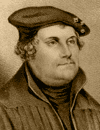
Let Your Sins Be Strong: A Letter From Luther to Melancthon
Martin Luther argues that true mercy and trust in Christ are essential for salvation, and encourages listeners to be sinners, but to trust in Christ's power to forgive and redeem.
Martin Luther preaches about the importance of true mercy and the need to acknowledge and bear our sins honestly, trusting in Christ's victory over sin, death, and the world. He emphasizes that God saves real sinners, not just those with imaginary sins, and encourages believers to have stronger faith in Christ amidst their struggles with sin in this imperfect world. Luther reminds the congregation that no sin, no matter how grave, can separate them from the love of Christ, who paid a great price for their sins and offers true mercy and forgiveness.
Text
Jesus.
Of course, you can only know and absolve those sins which have been
confessed to you; sins which have not been confessed to you, you
neither need to know nor can you absolve them. That is reaching too
high, dear gentlemen."
You cannot convince me that the same is true for the vows made by
priests and monks. For I am very concerned about the fact that the
order of priesthood was instituted by God as a free one. Not so that
of the monks who chose their position voluntarily, even though I have
almost come to the conclusion that those who have entered into that
state at an age prior to their manhood, or are currently at that
stage, may secede with a clear conscience. I am hesitant, however,
with a judgment about those who have been in this state for a long
time and have grown old in it.
2. By the way, St. Paul very freely speaks about the priests (1.Tim:
4, ff), that devils have forbidden them to marry; and St. Paul's
voice is the voice of the divine majesty. Therefore, I do not doubt
that they must depend on him to such a degree that even though they
agreed to this interdiction of the devil at the time, now--having
realized with whom they made their contract--they can cheerfully
break this contract.
3. This interdiction by the devil, which is clearly shown by God's
Word, urges and compels me to sanction the actions of the Bishop of
Kemberg. For God does not lie nor deceive when He says that this is
an interdiction from the devil. If a contract has been made with the
devil it must not endure since it was made in godless error against
God and was damned and repudiated by God. For He says very clearly
(1. Tim. 4:1 Vulg.) that those spirits are in error who are the
originators of the interdictions.
4. Why do you hesitate to join this divine judgment against the gates
of hell? That is not how it was with the oath of the children of
Israel which they gave to the Gibeons. They had it in their laws
that they must offer peace or accept peace offered to them, and
accept into their midst proselytes and those who adhered to their
customs. All this took place. Nothing happened there against the
Lord or by the advice of spirits. For even though in the beginning
they murmured, later on they approved.
5. In addition, consider that the state of being unmarried is only a
human statute and can be readily lifted. Therefore any Christian can
do this. I would make this statement even if the interdiction had
not come from a devil, but from a devout person. However, because
there is no such statement by God concerning the monks, I am
therefore not certain that I should make the same pronouncement
concerning them. For I would not dare to presume, neither advice
another to do so. Would God that we could do this, though, in order
to prevent someone from becoming a monk, or leaving his order during
the years of his virility. For we are to avoid vexations if there is
no relevant scriptural passage available to us, even when dealing
with things which are permitted.
6. Good old Carlstadt is also citing St. Paul (1 Tim.5:9-11), to let
go of the younger widows and select 60-year-olds, wish to God this
could be demonstrated. Quite easily someone might say that the
Apostle referred to the future, while in reference to the past (V.12)
they are condemned because they have broken their first troth.
Therefore this expression has come to naught and cannot be a
dependable basis for the conscience. For that is what we are
searching for. Moreover, this reasoning that it is better to be
married than to burn with vain desire (1 Cor.7:9), or to prevent the
sins of immorality (1 Cor.7:2), by entering into marriage while
committing the sin of the broken troth, that is nothing but common-
sense. We want the scripture and the witness of God's will. Who
knows if the one who is very enthusiastic today will still be so
tomorrow?
7. I would not have allowed marriage for priests for the sole reason
of "burning" had not St. Paul called this interdiction devilish and
hypocritical, condemned by God. Even without the burning he urged
that this unmarried status be cast aside simply for the fear of God.
However, it is necessary to discuss these things more thoroughly. For
I too would love to come to the aid of the monks and nuns. I very
much pity these wretched human beings, these young men and girls who
suffer defilement and burning.
8. Concerning the two elements of the Holy Supper I will not give an
example, but give testimony with Christ's words. Carlstadt does not
show that those who have received only one element have sinned, or
not sinned. I am concerned that Christ did not command either one of
the two, just as He does not command baptism if the tyrant or the
world withhold the water. So also the violence of persecution
separates men and women, which God forbids to separate, neither do
they agree to be separated. Therefore, neither do godfearing hearts
agree that they should be robbed of one of the elements. However,
those who do agree and approve: who can deny that these are not
Christians but Papists who are sinning.
9. There HE does not demand it, and here the tyrant oppresses, I
therefore cannot agree that those who receive only one element are
sinning. For who can exert power to take something when the tyrant
is not willing? Therefore it is only common-sense which observes
here that Christ's institution is not adhered to. Scripture makes no
definition by which we could declare this act a sin. It is Christ's
institution, given in freedom, which cannot be incarcerated as a
whole or in part.
10. It happened to Donatus, the martyr, where several people could
not participate because the cup broke or the wine was spilled. What
if this happens and there is no other wine available? There are other
similar situations. In short, because Scripture does not speak of sin
here, I therefore say there is no sin involved.
11. I am quite pleased, though, that you are re-establishing Christ's
method. For it was just that which I planned to take up with you
first of all upon my return to you. For now we recognize this
tyranny and can oppose it, in order not to be forced to receive only
one of the elements.
12. From here on I will no longer conduct private mass. Rather we
should pray God to give us more of His Spirit. For I am expecting
that the Lord will soon ravish Germany--which she deserves because of
her unbelief, godlessness and hate of the Gospel. However, we shall
be blamed for this chastisement, as we are made out to be heretics
who have provoked God to this action. We shall be scorned by the
people and disdained by the nation. Those, however, will make
excuses for their sins, through which He will manifest that the hard-
hearted do not become godly neither by mercy nor wrath. Let it
happen, let the will of the Lord be done. Amen!
13. If you are a preacher of mercy, do not preach an imaginary but
the true mercy. If the mercy is true, you must therefore bear the
true, not an imaginary sin. God does not save those who are only
imaginary sinners. Be a sinner, and let your sins be strong, but let
your trust in Christ be stronger, and rejoice in Christ who is the
victor over sin, death, and the world. We will commit sins while we
are here, for this life is not a place where justice resides. We,
however, says Peter (2. Peter 3:13) are looking forward to a new
heaven and a new earth where justice will reign. It suffices that
through God's glory we have recognized the Lamb who takes away the
sin of the world. No sin can separate us from Him, even if we were to
kill or commit adultery thousands of times each day. Do you think
such an exalted Lamb paid merely a small price with a meager
sacrifice for our sins? Pray hard for you are quite a sinner.
On the day of the Feast of St. Peter the Apostle, 1521
Sermon Outline
- The Problem of Vows and Interdictions points: - Martin Luther argues that vows and interdictions made by priests and monks are not binding - He cites St. Paul's words in 1 Timothy 4:1, which condemn the devil's interdictions
- The State of Being Unmarried points: - Luther suggests that the state of being unmarried is only a human statute and can be lifted - He argues that any Christian can choose to marry, even if they have previously taken vows of celibacy
- The Importance of Scripture points: - Luther emphasizes the importance of Scripture in guiding our actions and decisions - He argues that we should not follow human tradition or custom, but rather the clear teachings of Scripture
- The Role of Mercy and Trust in Christ points: - Luther argues that true mercy and trust in Christ are essential for salvation - He encourages listeners to be sinners, but to trust in Christ's power to forgive and redeem
Key Quotes
“Be a sinner, and let your sins be strong, but let your trust in Christ be stronger, and rejoice in Christ who is the victor over sin, death, and the world.” — Martin Luther
“No sin can separate us from Him, even if we were to kill or commit adultery thousands of times each day.” — Martin Luther
“Do you think such an exalted Lamb paid merely a small price with a meager sacrifice for our sins?” — Martin Luther
Application Points
- We should not follow human tradition or custom, but rather the clear teachings of Scripture.
- True mercy and trust in Christ are essential for salvation.
- We should trust in Christ's power to forgive and redeem, even if we are sinners.