
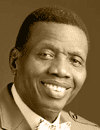
What Do You See
The sermon emphasizes the importance of having a clear vision, focusing on God's presence, and trusting in His ability to overcome problems.
E.A. Adeboye emphasizes the importance of spiritual vision and perspective, highlighting how what we see and how we see it can determine the limits of our blessings and success. Using the example of Abraham in Genesis 13:14-15, he illustrates that our vision can either expand or restrict our potential. Adeboye challenges believers to assess their spiritual sight, encouraging them to strengthen it through faith, prayer, and walking in the Spirit. He warns against focusing too much on problems, as this can diminish faith and magnify obstacles, ultimately leading to defeat.
Text
MEMORISE: 'For all the land which thou seest, To thee will I give it, and to thy seed for ever.' (Gen 13:15)
READ: Numbers 13:17-33
In life, what you see is very important. Equally crucial is how you see what you see. You are not bigger than your vision. What you see may be the limit of where you can go. In Genesis 13:14-15, God asked Abraham to look to the four corners of the earth. He said: 'For all the land which thou seest, to thee will I give it, and to thy seed forever.' This means Abraham was the one to limit himself for he could possess as far as he saw! Your location is also very crucial here. The man on a mountain top will have a broader view of his environment than the man in the valley. Spiritually, where are you? On a mountain top or in the valley?
How powerful is your spiritual sight? How effective are your eyes to see into the realm of the spirit? Hebrews 11:27 states that it is possible to see the invisible through faith. As a child of God, you can strengthen the power of your sight by drawing closer to God, praying in the Spirit and walking In the Spirit regularly. Beside this, when confronted by situations or problems, where do you focus your gaze? At such a crucial moment what you focus on determines what will prevail-the problem solver.
Form our text the twelve spies were sent to spy out the land of promise. They did well, reporting all they saw. They adhered to their terms of reference. But ten of them focused too much on the strength of the inhabitants, their walled cities and the giants who lived there. As they dwelt on this, they forget the Lord their God who had fought and won their battles and suddenly they began to shrink and became like grasshoppers. If you concentrate on your problems, God will become insignificant. That problem will become magnified, faith will vanish and over a period of time you will be swallowed up by your difficulties.
The Psalmist says, 'I will lift up my eyes unto the hills, from whence cometh my help.' From today, when confronted by problems, take them to God in prayer. Lift up your gaze above the problems and to God, the great problem solver- Jehovah Jireh. Keep on magnifying and praising him, expecting him to act. Before you realize it, every problem will have melted into thin air in the presence of the Lord.
ACTION POINT
Ask God to give vision for your life, family,
Business and career in Jesus' Name.
Sermon Outline
- I. The Importance of Vision
- A. What you see is very important
- B. How you see what you see is equally crucial
- II. Limiting Yourself
- A. Abraham's example in Genesis 13:14-15
- B. The importance of location
- III. Strengthening Your Spiritual Sight
- A. Drawing closer to God
- B. Praying in the Spirit and walking in the Spirit
- IV. Focusing on God in Times of Trouble
- A. The example of the twelve spies in Numbers 13:17-33
- B. The importance of magnifying God
Key Quotes
“You are not bigger than your vision.” — E.A. Adeboye
“It is possible to see the invisible through faith.” — E.A. Adeboye
“I will lift up my eyes unto the hills, from whence cometh my help.” — E.A. Adeboye
Application Points
- Ask God to give you vision for your life, family, business, and career.
- Strengthen your spiritual sight by drawing closer to God, praying in the Spirit, and walking in the Spirit regularly.
- Focus on God in times of trouble, magnifying and praising Him, expecting Him to act.