
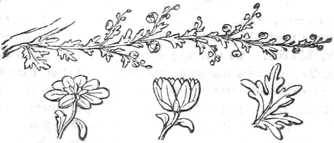
Fig. 349—Wormwood—Artemisia Judaica
This proverbially bitter plant is used in the Hebrew, as in most other languages, metaphorically, to denote the moral bitterness of distress and trouble (Deu 29:18; Pro 5:4; Jer 9:15; Jer 23:15; Lam 3:15; Lam 3:19; Amo 5:7; Amo 6:12). Thence also the name given to the fatal star in Rev 8:10-11. Artemisia is the botanical name of the genus of plants in which the different species of wormwoods are found. The plants of this genus are easily recognized by the multitude of fine divisions into which the leaves are usually separated, and the numerous clusters of small, round, drooping, greenish-yellow or brownish flower-heads with which the branches are laden. It must be understood that our common wormwood does not appear to exist in Palestine, and cannot therefore be that specially denoted by the Scriptural term. Indeed it is more than probable that the word is intended to apply to all the plants of this class that grew in Palestine, rather than to anyone of them in particular. The examples of this genus that have been found in that country are:—
Artemisia Judaica, which, if a particular species be intended, is probably the Absinthium of Scripture. Rauwolff found it about Bethlehem, and Shaw in Arabia and the deserts of Numidia plentifully. This plant is erect and shrubby, with stem about eighteen inches high. Its taste is very bitter; and both the leaves and seeds are much used in Eastern medicine, and are reputed to be tonic, stomachic, and anthelmintic.
Artemisia Romana, which was found by Hasselquist on Mount Tabor. This species is herbaceous, erect, with stem one or two feet high (higher when cultivated in gardens), and nearly upright branches. The plant has a pleasantly aromatic scent; and the bitterness of its taste is so tempered by the aromatic flavor as scarcely to be disagreeable.
Artemisia abrotanum, found in the south of Europe, as well as in Syria and Palestine, and eastward even to China. This is a hoary plant, becoming a shrub in warm countries; and its branches bear loose panicles of nodding yellow flower-heads. It is bitter and aromatic, with a very strong scent. It is not much used in medicine; but the branches are employed in imparting a yellow dye to wool.
Lam 3:15, an intensely bitter and poisonous plant, a symbol for whatever is nauseous and destructive, Deu 29:18 Jer 9:15 . The fruits of vicious indulgence are "better as wormwood," Pro 5:3 ; and injustice and oppression are like wormwood and gall, 1Sa 5:7 6:12.\par The Chaldee paraphrase calls it "the wormwood of death." In Jer 8:10-11, the star called wormwood seems to denote a mighty prince, or power of the air, the instrument, in its fall, of sore judgments on large numbers of the wicked. Compare Dan 10:20-21 Isa 14:12 .\par
Wormwood. Four kinds of wormwood are found in Palestine -- Artemisia nilotica, Artemisia Judaica, Artemisia fructicosa and Artemisia cinerea. The word occurs frequently in the Bible, and generally in a metaphorical sense.
In Jer 9:15; Jer 23:15; Lam 3:15; Lam 3:19, wormwood is symbolical of bitter calamity and sorrow; unrighteous judges are said to "turn judgment to wormwood." Amo 5:7 The Orientals typified sorrows, cruelties and calamities of any kind by plants of a poisonous or bitter nature.
Wormwood. At least five species of this plant (Artemisia) are found in the Holy Land, and are distinguished for intense bitterness. Hence this word is often joined with or used in the same sense as "gall" and "hemlock," to denote what is offensive and nauseous. Deu 29:18; Pro 5:4; Amo 5:7; Amo 6:12. To be obliged to use it as food expresses the extreme of suffering. Jer 9:15; Jer 23:15; Lam 3:15; Lam 3:19.
laanah,
WORMWOOD.—See Gall.
WORMWOOD (la‘ănâh, Deu 29:18, Pro 5:4, Jer 9:16; Jer 23:16, Lam 3:15-16, Amo 5:7; Amo 6:12 [in the last AV
E. W. G. Masterman.
(Hebrew la’anah.)Wormwood, known for its repulsive bitterness (Jeremiah 9:15; 23:15; Deuteronomy 29:18; Lamentations 3:19; Proverbs 5:4). Figuratively it stands for a curse or calamity (Lam., iii, 15), or also for injustice (Amos, V, 7; vi, 13). In Apoc., viii, 11, the Greek equivalent ho apsinthos is given as a proper name to the star which fell into the waters and made them bitter. The Vulgate renders the Hebrew expression by absinithium, except in Deut., xxix, 18, where it translates it amaritudo. It seems that the biblical absinthe is identical with the Artemisia monosperma (Delile), or the Artemisia herba-alba (ASSO); or, again, the Artemisia juidaica Linné. (See PLANTS IN BIBLE.)----------------------------------- HAGEN, Lexicon Biblicum (Paris, 1905); VIGOUROUX, in Dict. de la Bible (Paris, 1895); TRISTAM, Natural History of the Bible (London, 1889). A.J. MAAS The Catholic Encyclopedia, Volume ICopyright © 1907 by Robert Appleton CompanyOnline Edition Copyright © 2003 by K. KnightNihil Obstat, March 1, 1907. Remy Lafort, S.T.D., CensorImprimatur. +John Cardinal Farley, Archbishop of New York
(ἄøéíèïò)
The only passage in the NT in which ἄøéíèïò occurs is Rev_8:11. Wormwood is referred to several times in the OT, the Heb. word used being iÇòÂðÈä, but ἄøéíèïò is nowhere used in the LXX as its Greek equivalent. There is, however, no doubt that ‘wormwood’ is the correct translation of ἄøéíèïò (cf. Liddell and Scott, s.v.). The Heb. iÇòÂðÈä and its Arabic equivalent are both derived from a root meaning ‘to curse.’ It is nearly always associated with gall, the two together being apt emblems of sorrow and calamity by reason of the bitterness of their taste.
There are, according to Tristram, seven species of the Artemisia or wormwood, the Artemisia absinthium being the most common. They all have a bitter taste.
In Rev_8:11 wormwood is not mixed with water but the third part of the water is turned into wormwood. The former operation would not necessarily be destructive of human life, whereas unmixed wormwood is represented as having that effect. Just as the creatures of the sea perished by reason of the burning mass cast into it (Rev_8:9) so human life was destroyed by the conversion of the rivers and streams into wormwood.
Literature.-H. B. Tristram, Natural History of the Bible10, London, 1911, p. 493, Survey of Western Palestine, do., 1884, p. 331; H. B. Swete, Apocalypse of St. John 2, do., 1907, p. 112; EBi iv. 5354f.; SDB , p. 978; HDB iv. 940f.; Murray’s DB , p. 951.
P. S. P. Handcock.
(Revelation 8)
- A type of wood, "apsinthion" in Greek. A liqueur made from extract of wormwood is the French "absinthe". In Old Testament terms the bitterness of wormwood represents divine punishment.
Jer 9:15 (b) This is certainly a description of the bitterness which comes into the soul of those who refuse to worship the Lord, and who reject His Word. (See also Jer 23:15).
Lam 3:15 (b) By this we understand the great depression of spirit, and the bitterness of soul which was experienced by Jeremiah, the prophet, when he was so cruelly rejected by Israel.
Amo 5:7 (a) The judgments of GOD were so severe, and Israel was so evil in their minds, that they were made bitter by GOD’s decisions against them.
Rev 8:11 (b) The curses of GOD, which He will send upon this earth, are bitter to the heart and the soul of His enemies. He will make the so-called pleasures and attraction of the world bitter and offensive in the eyes of those who indulge in them.
Rev 17:3 (b) The Lord represents apostate Christendom as the woman. She grows wealthy, proud, arrogant, wicked and tremendously powerful by her demands upon people, and her control of the heads of government.
Wormwood. A woody shrub covered with small green leaves, with greenish-yellow flowers growing in clusters. Wormwood grows in the desert regions of Palestine and Syria. This plant is mentioned many times in the Bible. It had a bitter taste and a strong aroma ( Jer 9:15).
Wormwood was used symbolically to refer to any calamity or bitter experience ( Deu 29:18; Pro 5:4; Amo 5:7; Rev 8:10-11). An intoxicating drink could also be made from this plant ( Lam 3:15). Wormwood is sometimes translated as bitter weeds or hemlock ( Amo 6:12), Kjv.