
This is a subject on which our knowledge is by no means complete and satisfactory, as the notices respecting it which the Bible supplies are fragmentary and scattered.
With respect to the coins in use among the Hebrews, it is evident that there prevailed among the Hebrews at an early period a very considerable and much employed metallic medium. Mention is made of talents, shekels, half-shekels, and gerahs. It is impossible to determine with absolute certainty the relative value of these coins, but the following table has been constructed from an examination of the coins of Simon Maccabaeus, and is probably very nearly correct:—
Coin | Paris Grains |
Gerah | 13.7 |
Bekah, or common shekel | 137 |
Sacred shekel | 274 |
Maneh | 13,700 |
Talent | 822,000 |
These conclusions find corroboration by being compared with the weights of other Eastern nations, and the whole inquiry authorizes the inference that one general system prevailed in the more civilized nations, being propagated from the East, from an early period of history.
In the New Testament (Mat 17:24) the Temple-tax is a didrachm; from other sources we know that this ’tribute’ was half a shekel; and in Mat 17:27 the stater is payment of this tax for two persons. Now the stater—a very common silver Attic coin, the tetradrachm—weighed 328.8 Paris grains; thus not considerably surpassing the sacred shekel (274 Paris grains). And there is reason in the passage of Matthew and in early writers for regarding the stater of the New Testament as the same with the Attic tetradrachm.
Names of measures of length are for the most part taken from members of the human body, which offered themselves, so to say, naturally for the purpose, and have generally been used in all times and places in instances where minute accuracy was not demanded.
At the basis of the Hebrew system of measures of length lies the cubit, the forearm, or the distance from the point of the elbow to the tip of the third finger.
A longer measure, applied in measuring buildings, was the reed, or more properly ’rod’ (Eze 41:8; Rev 21:15). Smaller measures of length were,
a span, from a root meaning to expand (the hand).
The breadth of the hand (1Ki 7:26; Exo 25:25).
The finger (Jer 52:21), the denomination of the smallest measure of length.
Thus we have the breadth of the finger, of the hand, of the span—the length from the tip of the little finger to the point of the thumb—and the cubit.
As we have no unit of measure given us in the Scriptures, nor preserved to us in the remains of any Hebrew building, and as neither the Rabbins nor Josephus afford the information we want, we have no resource but to apply for information to the measures of length used in other countries. We go to the Egyptians. The longer Egyptian cubit contained about 234.333 Paris lines, the shorter about 204.8. According to this the Hebrew measures of length were these:—
Measure | Paris Lines |
Sacred cubit | 234.333 |
The span | 117.166 |
The palm | 39.055 |
The finger | 9.7637 |
Common cubit | 204.8 |
The span | 102.4 |
The palm | 34.133 |
The finger | 8.533 |
The two sets of measures, one for dry, another for liquid things, rest on the same system, as appears from the equality of the standard for dry-goods, namely the ephah, with that for liquids, namely bath. Mention is made of the homer, cab, bath and ephah—which are the same, hin, and log. The relations of these measures to the homer, the greatest of them, is exhibited in the following table:—
Homer | 1 | ||||||
Bath and Ephah | 10 | 1 | |||||
Seah | 30 | 3 | 1 | ||||
Hin | 60 | 6 | 2 | 1 | |||
Gomer | 100 | 10 | 3 1/3 | 1 2/3 | 1 | ||
Cab | 180 | 18 | 6 | 3 | 1 4/5 | 1 | |
Log | 720 | 72 | 24 | 12 | 7 1/5 | 4 | 1 |
The actual size of these measures, as stated by Josephus, is as follows:—
Size Par. cub. in. | Weight in Water Par. gr. | |
Homer | 19857.7 | 7398000 |
Ephah | 1985.77 | 739800 |
Seah | 661.92 | 246600 |
Hin | 330.96 | 123300 |
Gomer | 198.577 | 73980 |
Cab | 110.32 | 41100 |
Log | 27.58 | 10275 |
Böckh has proved that it is in Babylon we are to look for the foundations of the metrological systems of the ancient world; for the entire system of measures, both eastern and western, must be referred to the Babylonish foot as to its basis. On Babylon also the ancient world was dependent for its astronomy. Hence Babylon appears as the land which was the teacher of the east and the west in astronomical and mathematical knowledge, standing as it were in the middle of the ancient world, and sending forth rays of light from her two extended hands. Palestine could not be closed against these illuminations, which in their progress westward must have enlightened its inhabitants, who appear to have owed their highest earthly culture to the Babylonians and the Egyptians.
Weights And Measure.
A. Weights. -- The general principle of the present inquiry is to give the evidence of the monuments the preference on all doubtful points. All ancient Greek systems of weight were derived, either directly or indirectly, from an eastern source. The older systems of ancient Greece and Persia were the Aeginetan, the Attic, the Babylonian and the Euboic.
1. The Aeginetan talent is stated to have contained 60 minae, 6000 drachme.
2. The Attic talent is the standard weight introduced by Solon.
3. The Babylonian talent may be determined from existing weights found by Mr. Layard at Nineveh. Pollux makes it equal to 7000 Attic drachms.
4. The Euboic talent, though bearing a Greek name, is rightly held to have been originally an eastern system. The proportion of the Euboic talent to the Babylonian talent was probably as 60 to 72. Taking the Babylonian maneh at 7992 grs., we obtain 399,600 for the Euboic talent. The principal if not the only Persian gold coin is the daric, weighing about 129 grs.
The Hebrew talent or talents and divisions. A talent of silver is mentioned in Exodus, which contained 3000 shekels, distinguished as "the holy shekel," or "shekel of the sanctuary." The gold talent contained 100 manehs, 10,000 shekels. The silver talent contained 3000 shekels, 6000 bekas, 60,000 gerahs. The significations of the names of the Hebrew weights must be here stated.
The chief unit was the Shekel (that is, weight), called also the holy shekel or shekel of the sanctuary; subdivided into the beka (that is, half) or half-shekel, and the gerah (that is, a grain or beka).
The chief multiple, or higher unit, was the kikkar (that is, circle or globe, probably for an aggregate sum), translated in our version, after the Septuagint (LXX) Talent; (that is, part, portion or number), a word used in Babylonian and in the Greek hena or mina.
(1) The relations of these weights, as usually: employed for the standard of weighing silver, and their absolute values, determined from the extant silver coins, and confirmed from other sources, were as follows, in grains exactly and in avoirdupois weight approximately:
(2) For gold, a different shekel was used, probably of foreign introduction. Its value has been calculated at from 129 to 132 grains. The former value assimilates it to the Persian daric of the Babylonian standard. The talent of this system was just double that of the silver standard; if was divided into 100 manehs, and each maneh into 100 shekels, as follows:
(3) There appears to have been a third standard for copper, namely, a shekel four times as heavy as the gold shekel (or 528 grains), 1500 of which made up the copper talent of 792,000 grains. It seems to have been subdivided, in the coinage, into halves (of 264 grains), quarters (of 132 grains) and sixths (of 88 grains).
B. Measures. --
I. Measures of Length. -- In the Hebrew, as in every other system, these measures are of two classes: length, in the ordinary sense, for objects whose size we wish to determine, and distance, or itinerary measures, and the two are connected by some definite relation, more or less simple, between their units.
The measures of the former class (length) have been universally derived, in the first instance, from the parts of the human body; but it is remarkable that, in the Hebrew system, the only part used for this purpose is the hand and fore-arm, to the exclusion of the foot, which was the chief unit of the western nations.
Hence, arises the difficulty of determining the ratio of the foot to the Cubit, (The Hebrew word for the cubit (ammah) appears to have been of Egyptian origin, as some of the measures of capacity (the hin and ephah) certainly were). Which appears as the chief Oriental unit from the very building of Noah’s ark. Gen 6:15-16; Gen 7:20.
The Hebrew lesser measures were the finger’s breadth, Jer 52:21 only; the palm or handbreadth, Exo 25:25; 1Ki 7:26; 2Ch 4:5, used metaphorically in Psa 39:5, the span, that is, the full stretch between the tips of the thumb and the little finger, Exo 28:16; 1Sa 17:4; Eze 43:13, and figuratively. Isa 40:12.
The data for determining the actual length of the Mosaic cubit involve peculiar difficulties, and absolute certainty seems unattainable. The following, however, seem the most probable conclusions:
First, that three cubits were used in the times of the Hebrew monarchy, namely :
(1) The cubit of a man, Deu 3:11 or the common cubit of Canaan (in contradistinction to the Mosaic cubit) of the Chaldean standard;
(2) The old Mosaic or legal cubit, a handbreadth larger than the first, and agreeing with the smaller Egyptian cubit;
(3) The new cubit, which was still larger, and agreed with the larger Egyptian cubit, of about 20.8 inches, used in the Nilometer.
Second, that the ordinary cubit of the Bible did not come up to the full length of the cubit of other countries. The reed (kaneh), for measuring buildings (like the Roman decempeda), was to 6 cubits. It occurs only in Ezekiel Eze 40:5-8; Eze 41:8; Eze 42:16-29 The values given in the following table are to be accepted with reservation, for want of greater certainty:
Of measures of distance, the smallest is the pace, and the largest is the day’s journey.
(a) The pace, 2Sa 6:13, whether it be a single, like our pace, or double, like the Latin passus, is defined by nature within certain limits, its usual length being about 30 inches for the former and 5 feet for the latter. There is some reason to suppose that even before the Roman measurement of the roads of Palestine, the Jews had a mile of 1000 paces, alluded to in Mat 5:41. It is said to have been single or double, according to the length of the pace; and hence the peculiar force of our Lord’s saying: "Whosoever shall compel thee [as a courier] to go a mile, go with him twain" -- put the most liberal construction on the demand.
(b) The day’s journey was the most usual method of calculating distances in travelling, Gen 30:36; Gen 31:23; Exo 3:18; Exo 5:3; Num 10:33; Num 11:31; Num 33:8; Deu 1:2; 1Ki 19:4; 2Ki 3:9; Jon 3:3 1Ma 5:24; 1Ma 7:45; Tob 6:1, though but one instance of it occurs in the New Testament Luk 2:44.
The ordinary day’s journey among the Jews was 30 miles; but when they travelled in companies, only ten miles. Neapolis formed the first stage out of Jerusalem according to the former and Beeroth according to the latter computation,
(c) The Sabbath Day’s journey of 2000 cubits, Act 1:12, is peculiar to the New Testament, and arose from a rabbinical restriction. It was founded on a universal, application of the prohibition given by Moses for a special occasion: "Let no man go out of his place on the seventh day." Exo 16:29.
An exception was allowed for the purpose of worshipping at the Tabernacle; and, as 2000 cubits was the prescribed space to be kept between the Ark and the people as well as the extent of the suburbs of the Levitical cities on every side, Num 35:5, this was taken for the length of a Sabbath Day’s journey measured front the wall of the city in which the traveller lived. Computed from the value given above for the cubit, the Sabbath Day’s journey would be just six tenths of a mile.
(d) After the captivity, the relations of the Jews to the Persians, Greeks and Romans caused the use, probably, of the parasang, and certainly of the stadium and the mile. Though the first is not mentioned in the Bible, if is well to exhibit the ratios of the three.
The universal Greek standard, the stadium of 600 Greek feet, which was the length of the race-course at Olympia, occurs first in the Maccabees, and is common in the New Testament. Our version renders it furlong; it being, in fact, the eighth part of the Roman mile, as the furlong is of ours. 2Ma 11:5; 2Ma 12:9; 2Ma 12:17; 2Ma 12:29; Luk 24:13; Joh 6:19; Joh 11:18; Rev 14:20; Rev 21:18.
One measure remains to be mentioned. The fathom, used in sounding by the Alexandrian mariners in a voyage, is the Greek orguia, that is, the full stretch of the two arms from tip to tip of the middle finger, which is about equal to the height, and in a man of full stature is six feet. For estimating area, and especially land, there is no evidence that the Jews used any special system of square measures, but they were content to express by the cubit, the length and breadth of the surface to be measured, Num 35:4,5; Eze 40:27, or by the reed. Eze 41:8; Eze 42:16-19; Rev 21:16.
II. Measures of Capacity. -- The measures of capacity for liquids were:
(a) The log, Lev 14:10. Etc. The name originally signifying basin.
(b) The hin, a name of Egyptian origin, frequently noticed in the Bible. Exo 29:40; Exo 30:24; Num 15:4; Num 15:7-8; Eze 4:11; etc.
(c) The bath, the name meaning "measured", the largest of the liquid measures. 1Ki 7:26; 1Ki 7:38; 2Ch 2:10; Ezr 7:22; Isa 5:10.
The dry measure contained the following denominations:
(a) The cab, mentioned only in 2Ki 6:25, the name meaning literally hollow or concave.
(b) The omer, mentioned only in Exo 16:16-36. The word implies a heap, and secondarily, a sheaf.
(c) The seah, or "measure", this being the etymological meaning of the term and appropriately applied to it, inasmuch as, it was the ordinary measure for household purposes. Gen 18:6; 1Sa 25:18; 2Ki 7:1; 2Ki 7:16. The Greek equivalent occurs in Mat 13:33; Luk 13:21.
(d) The ephah, a word of Egyptian origin and frequent recurrence in the Bible. Exo 16:36; Lev 5:11; Lev 6:20; Num 5:15; Num 28:5; Jdg 6:19; Rth 2:17; 1Sa 1:24; 1Sa 17:17; Eze 45:11; Eze 45:13; Eze 46:5; Eze 46:7; Eze 46:11; Eze 46:14.
(e) The lethec, or "half homer" literally meaning what is poured out; it occurs only in Hos 3:2.
(f) The homer, meaning heap. Lev 27:16; Num 11:32; Isa 5:10; Eze 45:13. It is elsewhere termed cor, from the circular vessel in which it was measured. 1Ki 4:22; 1Ki 5:11; 2Ch 2:10; 2Ch 27:5; Ezr 7:22; Eze 45:14. The Greek equivalent occurs in Luk 16:7 The absolute values of the liquid and the dry measures are stated differently by Josephus and the rabbinists, and as we are unable to decide between them, we give a double estimate to the various denominations.
In the new Testament, we have notices of the following foreign measures:
(a) The metretes, Joh 2:6, Authorized Version, "firkin", for liquids.
(b) The choenix, Rev 6:6, Authorized Version, "measure", for dry goods.
(c) The xestec, applied, however, not to the peculiar measure so named by the Greeks, but to any small vessel, such as a cup. Mar 7:4; Mar 7:8, Authorized Version, "pot".
(d) The modius, similarly applied to describe any vessel of moderate dimensions, Mat 5:15; Mar 4:21; Luk 11:33, Authorized Version, "bushel", though properly meaning a Roman measure, amounting to about a peck.
The value of the Attic metretes was 8.6696 gallons, and consequently the amount of liquid in six stone jars, containing on the average 2 1/2 metretae each, would exceed 110 gallons. Joh 2:6 Very possibly, however, the Greek term represents the Hebrew bath; and if the bath be taken at the lowest estimate assigned to it, the amount would be reduced to about 60 gallons. The choenix was 1-48th of an Attic medimnus, and contained nearly a quart. It represented the amount of corn for a day’s food; and, hence, a choenix for a penny (or denarius), which usually purchased a bushel (Cic. Verr. iii 81), indicated a great scarcity. Rev 6:6.
WEIGHTS:
The Attic
Hussey calculates the shekel at half ounce avoirdupois, and the
MEASURES: Those of length are derived from the human body. The Hebrew used the forearm as the "cubit," but not the "foot." The Egyptian terms
Smyth remarks that no pagan device of idolatry, not even the sun and moon, is pourtrayed in the great pyramid, though there are such hieroglyphics in two older pyramids. He says the British grain measure "quarter" is just one fourth of the coffer in the king’s chamber, which is the same capacity as the Saxon chaldron or four quarters. The small passage of the pyramid represents a unit day; the grand gallery, seven unit days or a week. The grand gallery is seven times as high as one of the small and similarly inclined passages equalling 350 inches, i.e. seven times 50 inches. The names Shofo and Noushofo (Cheops and Chephren of Herodotus) are marked in the chambers of construction by the stonemasons at the quarry. The Egyptian dislike to those two kings was not because of forced labour, for other pyramids were built so by native princes, but because they overthrew the idolatrous temples.
The year is marked by the entrance step into the great gallery, 90.5 inches, going 366 times into the circumference of the pyramid. The seven overlappings of the courses of polished stones on the eastern and the western sides of the gallery represent two weeks of months of 26 days each so there are 26 holes in the western ramp; on the other ramp 28, in the antechamber two day holes over and above the 26. Four grooves represent four years, three of them hollow and one full, i.e. three years in which only one day is to be added to the 14 x 26 for the year; the fourth full from W. to E., i.e. two days to be added on leap year, 366 days. The full groove not equal in breadth to the hollow one implies that the true length of the year is not quite 365 1/4 days. Job (Job 38:6) speaks of the earth’s "sockets" with imagery from the pyramid, which was built by careful measurement on a prepared platform of rock.
French savants A.D. 1800 described sockets in the leveled rock fitted to receive the four corner stones. The fifth corner stone was the topstone completing the whole; the morning stars singing together at the topstone being put to creation answers to the shoutings, Grace unto it, at the topstone being put to redemption (Job 38:7; Zec 4:7); Eph 2:19, "the chief corner stone in which all the building fitly framed together groweth into an holy tern. pie." The topstone was "disallowed by the builders" as "a stone of stumbling and a rock of offense" to them; for the pyramids previously constructed were terrace topped, not topped with the finished pointed cornerstone.
Pyramid is derived from
The cow sacrifice of Israel was an "abomination to the Egyptians"; and the divinely taught builders of the great pyramid were probably of the chosen race, in the line of, though preceding, Abraham and closer to Noah, introducers into Egypt of the pure worship of Jehovah (such as Melchizedek held) after its apostasy to idols, maintaining the animal sacrifices originally ordained by God (Gen 3:21; Gen 4:4; Gen 4:7; Heb 11:4), but rejected in Egypt; forerunners of the hyksos or shepherd kings who from the Canaan quarter made themselves masters of Egypt. The enormous mass of unoccupied masonry would have been useless as a tomb, but necessary if the pyramid was designed to preserve an equal temperature for unexceptionable scientific observations; 100 ft. deep inside the pyramid would prevent a variation of heat beyond 01 degree of Fahrenheit, but the king’s chamber is 180 ft. deep to compensate for the altering of air currents through the passages.
The Hebrew finger, about seven tenths of an inch, was the smaller measure. The palm or handbreadth was four fingers, three or four inches; illustrates the shortness of time (Psa 39:5). The span, the space between the extended extremities of the thumb and little finger, three palms, about seven and a half inches. The old Mosaic or sacred cubit (the length from the elbow to the end of the middle finger, 25 inches) was a handbreadth longer than the civil cubit of the time of the captivity (from the elbow to the wrist, 21 inches): Eze 40:5; Eze 43:13; 2Ch 3:3, "cubits after the first (according to the earlier) measure." The Mosaic cubit (Thenius in Keil on 1Ki 6:2) was two spans, 20 1/2 Dresden inches, 214,512 Parisian lines long.
Og’s bedstead, nine cubits long (Deu 3:11) "after the cubit of a man," i.e. according to the ordinary cubit (compare Rev 21:17) as contrasted with any smaller cubit, was of course much longer than the giant himself. In Eze 41:8 (
The mile was eight furlongs or 1618 English yards, i.e. 142 yards less than the English statute mile; the milestones still remain in some places. Mat 5:41, "compel,"
DRY MEASURES. A cab (2Ki 6:25), a sixth of a seah; four sextaries or two quarts. Omer, an Egyptian word, only in Exodus and Leviticus (Exo 16:16; Lev 23:10); the tenth of an ephah; Josephus makes it seven Attic cotylae or three and a half pints (Ant. 3:6, section 6), but its proportion to the bath (Eze 45:11; Josephus, Ant. 8:2, section 9) would make the omer seven and a half pints; issaron or a tenth was its later name; an omer of manna was each Israelite’s daily allowance; one was kept in the holiest place as a memorial (Exo 16:33-34), but had disappeared before Solomon’s reign (1Ki 8:9).
A
LIQUID MEASURES. The log, a
In the O.T. money was weighed. The first recorded transaction in scripture is that of Abraham buying the field of Ephron the Hittite for four hundred shekels of silver, which Abraham ’weighed’ to Ephron. Gen 23:15-16. The shekel here was a weight. Judas Maccabaeus, about B.C. 141, was the first to coin Jewish money, though there existed doubtless from of old pieces of silver of known value, which passed from hand to hand without being always weighed. Herod the Great coined money with his name on it; and Herod Agrippa had some coins; but after that the coins in Palestine were Roman. The following tables must be taken approximately only: the authorities differ.
WEIGHTS.
The principal weights in use were as follows with their approximate equivalents:
AVOIRDUPOIS.
Pounds ozs. drams.
Gerah (1/20 of a shekel) - - 0.439
Bekah (½ of a shekel) - - 4.390
Shekel - - 8.780
Maneh or pound (60 shekels) 2 0 14.800
Talent, kikkah (50 maneh) 102 14 4.000
Talent of Lead (Zec 5:7), ’weighty piece,’ margin.
Talent (Rev 16:21): if Attic = about 55 lbs.
Pound,
It must be noted that there are two shekels mentioned in the Old Testament: one according to ’the king’s weight,’ probably the standard shekel used for all ordinary business, as in Exo 38:29; Jos 7:21; 2Sa 14:26; Amo 8:5; and another called the ’shekel of the sanctuary,’ of which it is said in Exo 30:13; Lev 27:25; Num 3:47; Num 18:16, ’the shekel is 20 gerahs,’ implying perhaps that the common shekel was different. Michaelis says that the proportion was as 5 to 3, the business shekel being the smaller.
This seems confirmed by the word maneh in the following passages. By comparing 1Ki 10:17 with 2Ch 9:16 it will be seen that a maneh equals 100 shekels (probably, for the word ’shekels’ has been added by the translators); whereas in Eze 45:12 the maneh equals 60 shekels, because the latter would be shekels of the sanctuary. The passage in Ezekiel is obscure, but the sense appears to be that three weights (20, 25, and 15 shekels) should be their maneh, which makes, as in the above table, a maneh = 60 shekels. Some modern tables give the maneh as equal to 50 shekels, from the supposition that this is what is meant in Eze 45:12 in the LXX. The maneh is translated ’pound’ in 1Ki 10:17; Ezr 2:69; Neh 7:71-72.
The word bekah occurs in Exo 38:26; it signifies ’half,’ and is ’half shekel’ in Exo 30:13.
MONEY.
If the weights in the foregoing list be approximately correct, and silver be taken at 5/- per ounce, and gold at £ 4 per ounce Troy, the money value will be about
£. s. d.
Gerah (1/20 of a shekel) 0 0 1.5 Exo 30:13.
Bekah, beqa (½ of a shekel) 0 1 3 Gen 24:22.
Shekel 0 2 6 Gen 23:15.
Dram (daric, a Persian gold coin) about 1 2 0 1Ch 29:7.
Maneh or pound, 60 shekels 7 10 0 Eze 45:12.
Talent of Silver 375 0 0 Ezr 7:22.
Talent of Gold 6000 0 0 Exo 25:39.
With respect to ’Piece of money’ (Gen 33:19; Job 42:11) and ’Piece of silver’ (Jos 24:32) qesitah, Gesenius compares Gen 33:19 with Gen 23:16 and supposes the weight to equal 4 shekels.
£. s. d.
Mite,
Farthing,
Farthing,
Penny,
Piece of silver,
Tribute money,
Piece of money,
Pound,
Talent (Roman)
Piece of silver,
Money,
The Greek word
The above gives no idea of the purchasing value of these sums, which often varied. A penny (
LIQUID MEASURE.
Caph 0.552 pints
Log (1.3 caphs) 0.718 ’’ Lev 14:10-24.
Cab (4 logs) 2.872 ’’ 2Ki 6:25.
Hin (12 logs) 1.077 gallons Exo 29:40.
Bath, Ephah (72 logs) 6.462 ’’ 1Ki 7:26.
Cor, Homer (720 logs) 64.620 ’’ Eze 45:14.
Pot,
Measure,
Firkin,
Measure,
DRY MEASURE.
Log 0.718 pints
Cab (4 logs) 2.872 ’’ 2Ki 6:25.
Omer (1.8 cabs) 5.169 ’’ Exo 16:16; Exo 16:36.
Tenth deal (tenth of an Ephah) 5.169 ’’ Exo 29:40.
Measure, seah (6 cabs) 2.154 gallons 1Sa 25:18.
Ephah (18 cabs) 6.462 " Lev 5:11.
Half Homer, lethek (90 cabs) 4.040 bushels Hos 3:2.
Homer, chomer (180 cabs) 8.081 ’’ Lev 27:16.
Measure,
Bushel,
Measure,
LONG MEASURE.
Finger or Digit, etsba .7584 inches Jer 52:21.
Handbreadth or Palm (4 digits), tephach 3.0337 ’’ 1Ki 7:26.
Span, zereth (3 palms) 9.1012 ’’ Exo 28:16.
Cubit, ammah,
Fathom,
Reed, qaneh, (6 cubits) 9.1012 ’’ Eze 40:3-8.
Furlong,
Sabbath-day’s journey (2000 cubits) 3033.75 ’’ Act 1:12.
Mile,
Acre. As much land as a yoke of oxen would plough in a day. 1Sa 14:14.
The above measures are calculated from the cubit being the same as the Hebrew ammah and the Greek
Though all these reckonings are only approximate, they help to throw light upon many passages of scripture. Thus Isa 5:10 shows that there is a curse resting upon the fields of a covetous man. In Rev 6:6 the quantities prove that the time then spoken of will be one of great scarcity, etc.
WEIGHTS AND MEASURES.—The specific object for which the Gospels were composed did not call for anything like a full detailed use of metrical data. Within their limited compass there are only incidental allusions to a system, or rather systems, of weights and measures. These are naturally scanty and obscure. The most that can be done with them is to identify them as nearly as possible with equivalents in modern systems, and to ascertain their places in those that were current in the Palestine of NT times. At this last point a difficulty at once emerges, due partly to the absence of regard for accuracy and precision in such matters prevalent at the time and place, and partly to the mixture of standards derived from successive and widely differing populations coming in with successive waves of conquest and invasion. The situation was not unlike that of modern Syria, with its bewildering confusion of coinage and other standards of value, brought in and grafted on the native system by French, German, and English merchants.
It is generally agreed by expert metrologists that the basis and fountainhead of all systems of measurement is to be traced to Babylonia. But in passing into Western countries, the Babylonian system was naturally subjected to as many modifications as it entered regions, and gave rise to quite as many secondary or derivative systems. These, during the course of the interrelations of the peoples using them, mutually affected one another; and the result was a variety of values called by the same name, or by names derived from the same original. On account of this fact, etymological processes of reasoning are in this field of little value, if not altogether valueless and misleading. Moreover, throughout the whole history of metrology there is a tendency noticeable towards the shrinkage or reduction of primitive values, making it essential to distinguish with great care between the values current under the same name in different periods of history. In the attempt to reach the exact facts as far as the 1st cent. a.d. is concerned, it will be best to bear in mind that in Palestine during the OT period three main systems of metrology came into use more or less extensively, the Babylonian, the Egyptian, and the Phœnician, and that to these, just before the times of Jesus, the Roman conquest added a fourth as a disturbing element.
I. Weights.—The primitive unit of weight was the shekel. This developed into two forms, the heavy and the light (cf. Kennedy in Hasting’s Dictionary of the Bible , art. ‘Weights and Measures’). The heavy shekel weighed 252.5 grs., and the light just one-half of that. Perhaps while the shekel was still being used in these forms, a third value was attached to it by the introduction of the Syrian shekel of 320 grs., and a fourth value later, viz. the Phœnician of 224.4 grs. In Roman times the denarius was introduced. This was equivalent to the Attic drachm. But Josephus (Ant. iii. viii. 2) represents the Hebrew shekel (
Dr. Den. | Shek. | Tetr. | Min. | Talent. |
Drachm-Denar. | 1 | 52.5 | + | grs. | ||||
Shek. (light). | 2 | 1 | 105 | + | grs. | |||
Shek. (heavy) Tetradrachm | 4 | 2 | 1 | 210 | + | grs. | ||
Mina. | 100 | 50 | 25 | 1 | 5250 | + | grs. | |
Talent. | 6000 | 3000 | 1500 | 60 | 1 | 315000 | + | grs. |
II. Measures
The subdivisions of the cubit were the span, equalling half a cubit; the palm or hand-breadth, one-sixth of a cubit; and the digit or finger-breadth, one twenty-fourth of a cubit. The multiples in common use were the fathom, consisting of four cubits, and the reed, of six cubits. Hence the table:
Digit. | Palm. | Span. | Cubit. | Fathom. | Reed. |
Digit (Finger-breadth) | 1 | -73 | in | |||||
Palm (Hand-breadth) | 4 | 1 | 3. | in | ||||
Span. | 12 | 3 | 1 | 8.75 | in | |||
Cubit. | 24 | 6 | 2 | 1 | 17.52 | in | ||
Fathom. | 96 | 24 | 8 | 4 | 1 | 70.+ | in | |
Reed. | 144 | 36 | 12 | 6 | 1.5 | 1 | 105.5 | in |
In the Gospels the cubit is mentioned in Mat 6:27, Luk 12:25, and Joh 21:8. In all these passages it appears as an approximation, and neither requires nor admits or precise determination. Lengths less than that of the cubit are not alluded to. Of greater lengths the following occur, being outside the usual scale as given above. The stadium, or furlong (Luk 24:13, Joh 6:19; Joh 11:18). The term is borrowed from the Greek scale, and appears there as the equivalent of 600 ft. (more precisely 600 ft. 9 in.), or 400 cubits. The mile (Mat 5:41) was also borrowed, but is taken from the Roman scale, and was equal to 7.5 Greek stadia (furlongs), or 3000 cubits (1700 yds.). The day’s journey (Luk 2:44), which is a common Oriental way of reckoning distances of considerable length at the present day, seems to have been used in ancient times also. It is not, however, reducible to any definite equivalent, and was no doubt a very elastic term. See on this and on ‘Sabbath day’s journey,’ art. Journey.
2. Measures of Surface.—Of measures of area no mention is made in the Gospels or in the NT anywhere. Occasional allusions to the purchase of land (Mat 13:44; Mat 27:7, Luk 14:18; cf. Act 1:18) are not of such a character as to include the measurement used in these and similar transactions.
3. Measures of Capacity.—These naturally fall into liquid and dry measures. Primitively the most common word for measure of volume in Bible lands was perhaps the seah (
As to the equivalency of the seah in the classical Graeco-Roman system, the following data give testimony: Josephus (Ant. ix. iv. 5) says, ‘A seah is equal to one and one-half Italian modii.’ An anonymous writer, cited by Hultsch (Metr. Script. i. 81. 6), speaks to the same effect; so also Jerome (on Mat 13:33), who, however, probably simply reproduces this representation. On the other hand, according to Epiphanius (Metr. Script, i. 82. 8), the seah was equal to one and one-quarter modii (20 sextarii); but that this is not a precise statement appears from the same writer’s equating the seah with 22 sextarii elsewhere (Metr. Script, i. 82. 9). Indirectly from the identification of the bath, the cor, and the hin by Josephus, with their corresponding Roman equivalents (cf. Ant. viii. ii. 9, xv. ix. 2, iii. viii. 3), the value of the seah is computed at 22 sextarii; and as this agrees with the equation of the Babylonian ephah-bath with 66 sextarii (Hultsch, Griech. and Rom.
This gives us the value of the seah in Roman sextarii. The reduction of the sextarii to present-day English standards may be made either upon the basis of the calculations of Hultsch (Metrol p. 453), which yield a sextarius of .96 pt. (cf. Smith, Diet. of Ant., followed by Harper’s Dict. of Class. Lit. and Ant., ed. H. T. Peck), and a seah of 21 + pts. (2 gals. 2 qts. and 1 + pts.); or this reduction may be made upon the basis of the use of the Farnese congius (= 6 sextarii) in the Dresden Museum, which yields a sextarius of .99 pts. The difference in results between these methods amounts to no more than .03 pt. in the Roman sextarius. Neither of the two methods positively excludes, the possibility of error, but the latter appears upon the whole more trustworthy. Thus in the reconstruction of a table we have the equation to start with: sextarius = .99 pt. The seah (22 sext. = 2 Galatians 2 qts. 1.78 pts.) is, then, approximately 23 + pts.
This yields for the dry measure the scale as follows:
Log. | Kab. | Omer. | Seah. | Ephah. | Cor. |
Log. | 1 | = | 1 | pt. | |||||
Kab. | 4 | 1 | = | 4 | pts. | ||||
Omer. | 7.5 | 1.8 | 1 | = | 7½ | pts. | |||
Seah. | 24 | 6 | 3.6 | 1 | = | 23.75 | pts. | ||
Ephah. | 72 | 18 | 10 | 3 | 1 | = | 71.28 | pts. | |
Cor (Homer). | 720 | 180 | 100 | 30 | 10 | 1 | = | 712.8 | pts. |
And for the liquid the scale as follows:
Log. | Hin. | Seah. | Bath. | Cor. |
Log | 1 | = | 1 | pt. | ||||
Hin. | 12 | 1 | = | 11.9 | pts. | |||
Seah. | 24 | 2 | 1 | = | 23.8 | pts. | ||
Bath. | 72 | 6 | 3 | 1 | = | 71.28 | pts. | |
Cor. | 720 | 60 | 30 | 10 | 1 | = | 712.8 | pts. |
These two scales represent the values of measures of capacity of the later days of Judaism. For OT times the value of the seah would have to be made larger, and the table correspondingly increased. For practical purposes the log = sextarius= pt. equation may be deemed sufficient.
In the Gospels the following allusions to the scales occur. The seah (Mat 13:33, Luk 13:21) is the equivalent of one-third of an ephah, and so is meant to designate generally as large a quantity as was usually handled in household necessities. Three seahs are equal to 35½ qts. or 1 bushel. The cor (Luk 16:7) appears under the name of ‘measure,’ the expression being naturally a general and inexact one. The total quantity intended to be indicated is 100 Cors or 1110 bushels.
Measures not included in the above scales occur as follows. The xestes (
Literature.—Hultsch, Griech. u. Röm. Metrologie, ii. (1882), also his Collection of Greek and Roman Sources, under the title of Metrologicorum Scriptorum Reliquiœ, 2 vols. (1864–1866); Lehmann, ‘Altbab. Mass u. Gewicht’ (in Verhandl. d. Berliner Geseltschaft f. Anthropol. 1889); Zuckermann, Das Jüdische Masssystem (1867); Nowack, Heb. Arch, i. 198 ff.; Benzinger, Heb. Arch. 178 ff.
A. C. Zenos.
By: Emil G. Hirsch, Immanuel Benzinger, Joseph Jacobs, Jacob Zallel Lauterbach
Derived from Babylonia. — Biblical Data:
While the references in the Old Testament are sufficient for a general knowledge of the ancient Hebrew system of weights and measures, and of the mutual relations of the several units, they are not adequate for an exact determination of the absolute standard of measurement. The rabbinical statements that a fingerbreadth equals seven barleycorns laid side by side, and that a log is equivalent to six medium-sized eggs, are as indefinite as the statement on the Siloam inscription that the Siloam canal (537.6 meters as measured by Conder) was 1,200 ells long—evidently a round number. Since, however, the entire system of measures corresponds almost exactly with the Babylonian, from which the Hebrew measures were in all probability derived, it may be assumed that the Hebrew system corresponded with the Babylonian with regard to the absolute standard as well. It is true that the Egyptian system may have exerted some influence here and there, as will be shown later, but it is now generally recognized that the culture of ancient Syria, even before the Israelites had migrated there, was almost wholly under Babylonian influence.
I. Measures of Length: The Cubit.
The original measures of length were derived from the human body: the finger, hand, arm, span, foot, and pace. As these measures differ with each individual, they must be reduced to a certain definite standard for general use. The Hebrew system, therefore, had such a standard; the ell ("ammah") contained 2 spans ("zeret"), while each span was made up of 3 handbreadths ("ṭefaḥ") of 4 fingers ("eẓba’ ") each. This division of the ell into 6 handbreadths was the one customarily employed in antiquity, but it was supplanted in Babylonia by the sexagesimal system. The Old Testament mentions two ells of different size. Ezekiel implies that in his measurement of the Temple the ell was equal to a "cubit and a handbreadth" (xl. 5, xliii. 13)—that is, one handbreadth larger than the ell commonly used in his time. Since among all peoples the ell measured 6 handbreadths, the proportion of Ezekiel’s ell to the others was as 7 to 6. The fact that Ezekiel measured the Temple by a special ell is comprehensible and significant only on the assumption that this ell was the standard of measurement of the old Temple of Solomon as well. This is confirmed by the statement of the Chronicler that the Temple of Solomon was built according to "cubits after the first measure" (II Chron. iii. 3), implying that a larger ell was used at first, and that this was supplanted in the course of time by a smaller one.
The Egyptians in like manner used two kinds of ells in exactly the same proportion to each other, namely, the smaller ell of 6 handbreadths and the larger "royal" ell, which was a handbreadth longer. The latter measures 525-528 millimeters, and the former 450 millimeters, estimating a handbreadth as 75 millimeters. It would seem at first sight that the Egyptian system of measurement had influenced the Hebrew, and the two Hebrew ells might naturally be considered identical with the Egyptian measures. This assumption is, however, doubtful. Since all the other measures were derived from Babylon, in all probability the ancient Hebrew ell originated there also. The length of the Babylonian ell is given on the famous statue of King Gudea (beginning of 3d millennium B.C.), found in Telloh in southern Babylonia. A scale is inscribed on this statue, according to which the ell may be reckoned at 495 millimeters, a measurement which is confirmed by certain Babylonian tablets. These measure, according to the Babylonian scale, ⅔ ell, or, according to the metric system, 330 millimeters (1 foot) on each side. The ell of 495 millimeters seems to have been used also in Phenicia in measuring the holds of ships, but these computations can not be discussed in detail here. The length of the ancient Hebrew ell can not be determined exactly with the data now controlled by science; but it was either 525 or 495 millimeters, and this slight difference between the two figures is scarcely appreciable in an estimate of the size of Hebrew edifices, etc.
II. Measures of Capacity:
The Hebrew system here corresponds exactly with the Babylonian. In contradistinction to the Egyptian metrology, which shows the regular geometric progression—1, 10, 20, 40, 80,160—the Hebrew and the Babylonian systems are based on the sexagesimal system. The unit of the Babylonian system was the "maris," a quantity of water equal in weight to a light royal talent. It contained, therefore, about 30.3 liters. The maris was divided into 60 parts, probably called "minæ" (= .505 liter). All the other measures are multiples of this mina: 12, 24, 60, 72 (60 + 12), 120, 720 minæ.
The Log.
In the Hebrew system the log (Lev. xiv. 10) corresponds to the mina. Since the Hellenistic writers equate the log with the Græco-Roman sextarius, whatever these writers say on the relation of the sextarius to other measures applies also to the relation of these measures to the log. The log and the sextarius, however, are not equal in capacity. The sextarius is estimated at .547 liter, while there is no reason to regard the log as larger than the Babylonian mina, especially as other references of the Greek metrologists support the assumption that the log was equal to the mina. The fact that in the Old Testament the log is mentioned only as a fluid measure may be merely accidental, for the dry measures, which are distinguished in all other cases from the liquid measures, also have the log as their unit. The corresponding dry measure may, however, have been known under a different name. The same possibility must be borne in mind in the case of the cab, the next larger measure, containing four logs and mentioned only as a dry measure. A differentiation of the dry and liquid measures gives two simple systems, as follows:
Dry Measures.
|
1 |
homer |
= |
10 |
ephahs |
= |
30 |
se’aim |
= |
180 |
cabs |
= |
720 |
logs |
= |
364.4 |
lit. |
|
|
(cor) |
|
1 |
ephah |
= |
3 |
se’aim |
= |
18 |
cabs |
= |
72 |
logs |
= |
|
36.44 |
lit. |
|
|
|
|
|
|
|
1 |
se’ah |
= |
6 |
cabs |
= |
24 |
logs |
= |
|
12.148 |
lit. |
|
|
|
|
|
|
|
|
|
|
1 |
cab |
= |
4 |
logs |
= |
|
2.024 |
lit. |
|
|
|
|
|
|
|
|
|
|
|
|
|
1 |
log |
= |
|
0.506 |
lit. |
Liquid Measures.
|
1 |
cor |
= |
10 |
baths |
= |
60 |
hins |
= |
180 |
cabs |
= |
720 |
logs |
= |
364.4 |
lit. |
|
|
|
|
1 |
bath |
= |
6 |
hins |
= |
18 |
cabs |
= |
72 |
logs |
= |
36.44 |
lit. |
|
|
|
|
|
|
|
1 |
hin |
= |
3 |
cabs |
= |
12 |
logs |
= |
6.074 |
lit. |
|
|
|
|
|
|
|
|
|
|
1 |
cab |
= |
4 |
logs |
= |
2.024 |
lit. |
|
|
|
|
|
|
|
|
|
|
|
|
|
1 |
log |
= |
0.506 |
lit. |
In these tables that homer has been omitted which is, according to Ex. xvi. 36, one-tenth of an ephah, and which is, therefore, identical with the " ’issaron" (Num. xxviii. 5 et al.). The tenth part of a bath, for fluids, which is mentioned in Ezek. xlv. 14 without a special name, corresponds in content to the homer, or ’issaron, among the dry measures. The homer and its liquid equivalent do not belong to the original system, as may be seen by the proportion the homer bears to the other measures: 3⅓ homers = 1 se’ah, 1⅔ homers = 1 hin, 1 homer = 1⅘ cabs = 7⅕ logs. The tenth part of a bath is, furthermore, mentioned only in Ezekiel and in the Priestly Code. The old division of the ephah and the bath was into three parts; Ezekiel mentions also the sixth part of an ephah. At a later period the se’ah and the cab disappear as dry measures, so that the Priestly Code refers simply to the tenth part of the ephah. This new division into tenths may be connected with the appearance of the decimal system, which can be traced elsewhere, especially in weights and coins.
Babylonian Weight in the Form of a Lion with Inscription
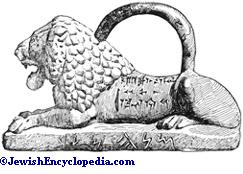
 (= "royal maneh").(From Madden, "History of Jewish Coinage.")
Only one measure in addition to those enumerated above is mentioned in the Old Testament. This is the "letek," which occurs but once (Hosea iii. 2). It is a dry measure, and is uniformly designated in tradition as equal to ⅓ homer, although it is doubtful whether a definite measure is implied by this term. The Septuagint translates "letek" in its single occurrence as
III. Measures of Weight:
It is evident from inscriptions that the Babylonian system of weight was used in Syria and Palestine even before the entrance of the Israelites into the country. The Egyptian inscription of Karnak records the tribute which the kings of Egypt exacted from their Syrian vassals. Although the sums are given according to Egyptian weight, the odd numbers clearly indicate that the figures were computed originally by some other system, which may easily be shown to have been the Babylonian.
The Mina.
The Babylonians reckoned weight in talents, minæ, and shekels. Layard found in the ruins of Nineveh several Babylonian units of weight, some in the form of a crouching lion and others in that of a duck, the former being twice as heavy as the latter. This proves that a heavy and a light talent were used in Babylon, the latter one-half the weight of the former. A heavy talent = 60,600 grams; 1 mina (1/60 talent) = 1,010 grams; 1 shekel = 16.83 grams; 1 light talent = 30,300 grams; 1 light mina = 505 grams; 1 light shekel = 8.41 grams. There was, in addition to this "royal" weight, another "common" weight which was somewhat lighter (compare the large "royal" ell and the "common" ell, mentioned above). According to this common weight the heavy talent weighed 58,944 grams; its mina 982.4 grams; its shekel 16.37 grams; and the light talent, mina, and shekel just one-half as much. The common heavy talent and its subdivisions were the weights current in Syria and Palestine, as Josephus expressly states ("Ant." xiv. 106, ed. Niese). According to him, 1 Jewish mina (of 50 shekels) was equal to 2½ Roman pounds, or 818.62 grams; hence 1 shekel was equivalent to 16.37 grams, and 1 old mina of 60 shekels to 982.2 grams. There were also the half-shekel or bekah ("beḳa,’").
In the course of time the sexagesimal system was superseded in Babylonia also, perhaps under Egyptian influence. The mina of 60 shekels was replaced throughout Asia Minor by the mina of 50 shekels. The shekel remained the same, forming the unit of weight, while the mina and talent were reduced, containing respectively 50 shekels = 818.6 grams and 3,000 shekels = 49,110 grams.
Money.
The period of these changes is unknown. In the Old Testament the first reference occurs in Ezekiel; if the Septuagint is correct in its translation of Ezek. xlv. 12, that passage reads, "You shall count the manhe [mina] as fifty shekels." There is other evidence in Ex. xxxviii. 25 (Priestly Code), where the tax levied upon 603,550 men at ½ shekel each was computed to be 100 talents and 1,775 shekels, whence 1 talent equaled 3,000 shekels, and 1 mina was equivalent to 850 shekels. These measures were further changed in the currency, which was also reckoned in talents, minas, and shekels. In Jewish silver 1 shekel = 14.55 grams, 1 mina = 50 shekels = 727.5 grams, 1 talent = 3,000 shekels = 43,659 grams. What bearing this change—which was confined to silver—had upon the relative values of gold and silver, and how far it was conditioned by the demands of exchange day by day, can not be discussed in detail here (comp. Benzinger, "Arch." pp. 192 et seq.). With this silver shekel the shekel of weight must not be confounded. In the Pentateuch the heavy shekel of weight is called, in contradistinction to the silver shekel, the "holy shekel, the shekel of 20 gerahs" (Ex. xxx. 13; Lev. xxvii. 25; Num. iii. 47). This refers to the tax payable to the Sanctuary, which, it is expressly stated, must not be paid in silver shekels, but according to weight, conforming with ancient custom.
The division of the shekel into 20 gerahs is mentioned only in the passages just quoted and in Ezek. xlv. 12 (LXX.). Otherwise the Old Testament refers only to quarters and halves of shekels. See Money; Numismatics.
Bibliography:
Brandis, Das Münz-, Mass- und Gewichtswesen in Vorderasien bis auf Alexander den Grossen, Berlin, 1866;
Hultsch, Griechische und Römische Metrologie, 2d ed., Berlin, 1882;
Lehmann, Das Altbabylonische Mass- und Gewichtsystem als Grundlage der Antiken Gewicht-, Münz-, und Masssysteme, in Actes du Sème Congr. Internat. des Orient. vol. i., part 2, pp. 165 et seq.;
Benzinger, Arch. pp. 178 et seq., Leipsic, 1894;
Weights and Measures, in Cheyne and Black, Encyc. Bibl.
E. G. H. I. Be.Domestic and Foreign Elements. —In Rabbinical Literature:
The weights and measures of Talmudic literature are a combination of those of the ancient Hebrew system with foreign elements; and it was especially Greek and Roman metrology which became current among the Jews in the post-Biblical period. These two elements, the domestic and the foreign, were, however, so intimately fused that it is often difficult to distinguish between them. In the course of time the Biblical weights and measures underwent various changes which are recorded in the Talmud, where an endeavor is made to determine the original values. The Talmudic system of metrology is especially important since it affords an evaluation of the Biblical units. Talmudic sources deduce the value of Biblical weights and measures by comparing them with those which were current in the period of the Talmud, and the units of this system may often be determined by a comparison with their Greek and Roman equivalents. Talmudic metrology is therefore of importance for the history of civilization, since it bears upon conditions prevailing among the classic peoples of ancient times. The weights and measures mentioned in Talmudic sources are as follows:
Gerah ( ) or Ma’ah (
 ): Units of Weight.
In the Talmud the gerah is mentioned as a unit of weight only with reference to the Bible. Raba makes it the equivalent of a ma’ah, and names as an authority for this equation Onḳelos, the translator of the Pentateuch, who rendered the term "twenty gerahs" (Ex. xxx. 13) by "twenty ma’ot" (Bek. 50a). This ma’ah must be the Tyrian obol or ma’ah; for Bek. 50a says: "Six silver ma’ot are equal to a denarius." Inasmuch as four denarii are equivalent to one sela’, it follows that twenty-four ma’ot are also equal to one sela’; and this equation was used for the Tyrian sela’ (comp. Boeckh, "Metrologische Untersuchungen über Gewichte, Münzfüsse, und Maasse des Alterthums in Ihrem Zusammenhange," p. 59, Berlin, 1838). The Talmud does not indicate the actual weight of the ma’ah, but from Tyrian silver coins still extant its value may be determined. The heaviest Tyrian silver coin in existence weighs 14.34 grams, and 1/24 of this, or 0.5975 gram, is therefore the weight of a ma’ah. This deduction has been based upon the weight of the heaviest Tyrian silver coin because in those that are lighter the loss in weight is evidently due to handling and use.
Shekel ( ; Greek,
This is the next highest unit of weight. The Bible designates the value of the shekel as "twenty gerahs" (Ex. xxx. 13); whence, according to the weight already given for the gerah or ma’ah, the shekel should weigh 20 × 0.5975 gram, or 11.95 grams. The Jerusalem Talmud, however (Sheḳ. 46d), mentions another weight for the shekel, stating that half a shekel is equal to six  ; and the same value is given in Tan., Ki Tissa, ed. Buber, p. 55a. The term
  designates a scruple (
 ). Inasmuch as the Roman pound contains twelve ounces, a half-shekel becomes the equivalent of 1/48 Roman pound, and a whole shekel = 1/24. According to Boeckh, the Roman pound weighed 327.434 grams, and a shekel would accordingly weigh 13.643 grams. In another passage of the Talmud the weight of a shekel is given as 14.34 grams, or the equivalent of the Tyrian silver coin already mentioned. The Talmud states that the silver coin recorded in the Pentateuch was identical with the Tyrian mintage (Bek. 50b); and the Tosefta likewise declares that the silver coin of Jerusalem was identical with that of Tyre (Tosef., Ket. xiii. 3). A shekel was therefore identical with the Tyrian sela’ (Rashi on Bek. l.c.), and its weight was accordingly 14.34 grams. The difference between the weight given by the Jerusalem Talmud (13.643 grams) and that deduced by identifying the shekel with the Tyrian sela’ (14.34 grams) amounts to 0.7 gram only; and it may be explained by assuming that the statement in the Jerusalem Talmud, which makes a half-shekel equal to six
  , is only approximate. On the other hand, the difference between the weight of the shekel given in the Bible (11.95 grams), and that of the Tyrian sela’ of 14.34 grams, with which the Biblical shekel is identified in the Mishnah (Bek. viii. 7) and the Babylonian Talmud (ib. 50a), as well as in Yerushalmi (Ḳid. 59d), is too large to be attributed to inaccuracy in reckoning. The divergence finds its explanation, however, in the Talmudic statement that the shekel was enlarged, the Biblical shekel being originally equivalent to 3⅓ denarii, and being later increased one-fifth, thus becoming equal to four denarii, so that, instead of its original value of twenty gerahs, it later became equivalent to twenty-four. The Biblical shekel weighed 11.95 grams, and the addition of one-fifth (2.39 grams) gives 14.34 grams as the weight of the later coin, which then became equal to the Tyrian sela’. In addition to this shekel, which was called "the shekel of the sanctuary," and which was equal to a sela’, the Mishnah (Ned. iii. 1) and the Talmud (B. M. 52a) mention another shekel, which was the equivalent of half a sela’, or half a "shekel of the sanctuary," and which was probably called the common shekel. This indicates that the value of the shekel varied at different times (on the reasons for these changes and the periods at which they took place see Frankel in "Monatsschrift," 1855, pp. 158 et seq.; Zuckermann, "Ueber Talmudische Gewichte und Münzen," p. 13).
Maneh or Mina ( ; Greek,
In the Mishnah, as well as in the Talmud, the mina is often mentioned as a unit of weight for figs, spices, wool, meat, and the like (Ket. v. 8; ’Eduy. iii. 3; Ḥul. 137b; Ker. 6a; et passim). In the Mishnah it is sometimescalled  or "Italian mina" (Sheb. i. 2, 3), the designation "Iṭalḳi" helping to determine its weight. The Italian mina contained 100 denarii, while the Roman pound contained only ninety-six. A mina was therefore equivalent to 1 1/24 Roman pounds, and since the Roman pound equaled 327.434 grams, the Italian maneh was equal to 341.077 grams, the weight assigned it in the Talmud. From a passage in Ber. 5a it appears that a mina equaled twenty-five shekels; and since, according to the passage already cited from the Jerusalem Talmud (Sheḳ. 46d), a shekel was equal to twelve scruples, a mina was equivalent to 25 × 12, or 300 scruples. The Roman pound contained only 288 scruples, and the mina was therefore equal to 1 1/24 Roman pounds. Besides this mina of twenty-five shekels, the Talmud (Ḥul. 137b-138a) mentions another, which was equal to forty shekels or sela’im.
Liṭra ( ; Greek,
The liṭra, which originally corresponded to the Italian "libra," is mentioned in the Mishnah (Shebu. vi. 3; Bek. v. 1; Tem. iii. 5) and in the Talmud (’Er. 29a; Ket. 67b; et passim) as a unit of weight for figs, vegetables, meat, fish, gold, and silver. The Jerusalem Talmud (Ter. 47b) defines the liṭra as equal to 100 zinin, the zin ( ) being the same as the zuz (
 ), since the Mishnah (Ter. x. 8) uses the term "zuz" in the passage parallel to that in which the Tosefta (Ter. ix.) employs the word "zin." A liṭra was therefore equal to 100 zuzim. From this it follows that a liṭra was equivalent to a mina, since the Talmud also calls a denarius a zuz, which makes a liṭra = 100 zuzim = 100 denarii. As has been stated above, a mina equaled twenty-five shekels, and a shekel was equivalent to four denarii, thus making the mina = 100 denarii = 1 liṭra. In addition to the whole liṭra, pieces of weight of the value of a half, third, and quarter of a liṭra are also mentioned (Tosef., Kelim, B. M. ii.; B. B. 89a; Sifre, Deut. 294 [ed. Friedmann, p. 126b]).
Kikkar ( ):
):
The term "kikkar," generally rendered "talent" (Greek,
Other Weights:
Smaller weights also are indicated by coins, as, for example, the denarius (Tosef., Men. xii.; Shab. ix.) and the zuz (Shab. 110a). In the Jerusalem Talmud (Ta’an. 68a), as well as in Gen. R. (lxxix. 9) and other midrashic passages, the ounce ( ) occurs. In the Mishnah (Sanh. viii. 2) mention is likewise made of the tarṭimar (
 ), which, according to the Talmud (Sanh. 70a), was equivalent to half a mina. The term is a corruption of the Greek
  ), is mentioned in the Jerusalem Talmud (Yoma 41d). This was probably a small copper coin which derived its name from the red color (Latin, "rutilus") of the metal of which it was composed.
It must be borne in mind that the values of the weights often varied in different parts of the country. The Mishnah (Ter. x. 8; Ket. v. 9; etc.) accordingly states that the weights used in Judea had but half the value they possessed in Galilee, so that ten Judean sela’im were equal to five Galilean; and the same assertion is made by Sifre, Deut. 166, and by the Talmud (Ḥul. 137b; comp. Zuckermann, l.c. pp. 11-12).
Eẓba’ ( = "fingerbreadth"): Measures of Length.
The smallest measure of length; it is mentioned as a unit even in the Biblical period (Jer. lii. 21; see Weights and Measures, Biblical Data). The Mishnah often alludes to the eẓba’ as a measure (Kil. vii. 1; Yoma v. 2; Men. xi. 4; Oh. iv. 3; Miḳ. vi. 7), although no value is assigned it. Its length may, however, be deduced from a Talmudic passage; and Zuckermann has found by calculation that the Talmudic eẓba’ was equal to 2.33411 cm. In the Talmud the term "eẓba’ " refers to the thumb as well as to the middle and little fingers. The Talmud therefore draws a distinction between the breadth of the thumb and that of the middle and little fingers, by stating (Men. 41b): "The handbreadth ["ṭefaḥ"] mentioned in the Talmud is equal to four thumbbreadths, or six little-finger breadths, or five middle-finger breadths." The size of an eẓba’ as given above (2.33411 cm.) refers to the breadth of a thumb. From the proportionate dimensions of the thumb, middle finger, and little finger, according to the Talmudic passage already cited, the breadth of the middle finger would be 1.867288 cm., and that of the little finger 1.556 cm.
Ṭefaḥ (= "handbreadth"):
The measure next in size to the eẓba’; it was used as a measure of length in the Bible. The size of the handbreadth is described in the Talmud (Bek. 39b) as equal to four thumbbreadths; and in the passage previously quoted (Men. 41b) this statement is amplified by making it the equivalent of four thumbbreadths, or six little-finger breadths, or five middle-finger breadths. From this proportion of the ṭefaḥ to the breadth of the fingers, its size, according to the measurements given above, appears to have been 9.336443 cm. In addition to the normal handbreadth the Talmud mentions two others (Suk. 7a): one formed by holding the fingers loosely ("ṭefaḥ soḥeḳ"), and the other produced by pressing the fingers firmly together ("ṭefaḥ ’aẓeb"), although the divergence between these handbreadths and the normal is not determined.
Ell:
In addition to the Mosaic ell, which was equal to the mean ell ("ammat benonit") and consisted of six handbreadths (comp. Zuckermann, l.c. p. 17), the Mishnah (Kelim xvii. 9) mentions two others, one of which was half a fingerbreadth andthe other a whole fingerbreadth longer than the mean ell. The standards used for measuring both these ells were said to have been kept in a special place in the Second Temple. The Talmud explains the introduction of these two ells in addition to the mean or Mosaic ell (see Pes. 86a; Men. 98a), and mentions also an ell which contained only five handbreadths (’Er. 3b). The mean ell, equivalent to six handbreadths, was, according to the measurement of the handbreadth given above, equal to 56.018658 cm. The ell which was half a fingerbreadth longer was, therefore, 57.185375 cm. in length, and that which was a whole fingerbreadth longer was 58.352 cm. The Mishnah (Tamid iii. 6) mentions still another ell, called  , which was measured from the tip of the middle finger to the armpit. Inasmuch as the ell which measured six handbreadths was equal to the length of the forearm, and the length of the latter is to the arm as 6 is to 10, it follows that the "ammat sheḥi" measured ten handbreadths, or 93.36443 cm. In the Midrash (Gen. R. xxxvii.) an ell is mentioned under the name
  , by which the Theban ell (
 see Zuckermann, l.c. p. 21.
Garmida ( ):
):
Repeatedly mentioned in the Talmud (Shab. 110a; ’Er. 50b; Pes. 111b; et passim), without any indication of its size. It is noteworthy, however, that the Talmud (B. B. 27a) uses this term to indicate a square ell, without designating it as a square measure, while in ’Er. 14b "garmida" indicates a cubic ell, although the customary term denoting "cubic" is omitted.
Zeret ( = "span"):
This measure, mentioned in the Bible (Ex. xxviii. 16) without any indication of its size, is described in the Tosefta (Kelim, B. M. vi. 12) as "half an ell of six handbreadths." Its measure was, accordingly, 28.009329 cm.
Hasiṭ ( = "content and width of the hasiṭ"):
This term occurs as a measure of length in the Mishnah (’Orlah iii. 2, 3; Shab. xiii. 4), in the Tosefta (Shab. ix.), and in the Talmud (Shab. 79a, 106a), without any indication of its size and without being compared with any other measure. According to Maimonides ("Yad," Shabbat, ix. 7-10), the breadth of the hasiṭ equals the opening between the thumb and the index-finger, which is about the equivalent of ⅔ zeret, or two handbreadths. This appears to be correct, since a Greek measure called "dichas" (
Ḥebel ( = "cord"):
A measure described in the Mishnah (’Er. v. 4) as a cord of fifty ells in length, and in the Talmud (’Er. 58b) as one of four ells.
Teḥum Shabbat ( = "Sabbath-way"):
The extreme distance which a Jew might go in any one direction from his home on the Sabbath. It is defined in the Mishnah (’Er. iv. 3) and in the Talmud (’Er. 51a) as 2,000 Hebrew ells, and it was therefore equal to 112,037.316 cm. This was also the length of the mile ( ), with which the Mishnah (Yoma vi. 18) and both Talmudim (Pes. 93b, 94a; Yer. Yoma 40b) indicated distances. In the Talmud (Yoma 67a) it is explicitly stated that the mile is equal to the teḥum Shabbat; the Hebrew mile was therefore shorter than the Roman, with which it must not be confused.
Pesi’ah ( = "pace"):
The pace is used as a measure of length in the Talmud (’Er. 42b), and its value is defined as one ell (56.018658 cm.).
Ris ( = "stadium"):
The Mishnah uses the term "ris" to indicate distance, and defines its length as 2/15 mile. The Talmud (B. M. 33a) also states that its length was 2/15 mile, or 266⅔ ells. According to Frankel (in "Monatsschrift," 1856, p. 383), the term "ris" is Persian, as is also the term  ("parasang"), used in the Talmud as a measure of length (comp. Tos. B. B. 23a, s.v.
  ), and defined as equal to four miles, or 8,000 ells (Pes. 93b-94a).
Day’s Journey ( ):
):
The Talmud defines a day’s journey for a man of medium gait as ten parasangs, or 80,000 ells.
Superficial Measures.
Measurements of fields are generally indicated in the Talmud by the amount of seed sown in them. The term  , for example, indicates a field in which one se’ah can be sown; the term
  , one which requires two se’aim. The latter space is defined in the Talmud (’Er. 23b) as equal to 5,000 Hebrew square ells, or to 15,690,445.095 sq. cm., and this can be used as a basis for the determination of other superficial measures given in the Talmud.
Solid Measures.
The Talmud mentions separate systems of solid measures for dry and for liquid substances, although some units were used for both. The Mishnah states that the measures were enlarged at some time or other. In addition to the Biblical measure, which is called "desert measure" ( ) in Talmudic sources, the Mishnah (Men. vii. 1) mentions a "Jerusalem measure" (
 ), which was equal to 1⅕ "desert measures," and also alludes (’Er. 82a) to a "Sepphoric measure" (
 ), which was equal to 1⅕ "Jerusalem measures." One se’ah "desert measure" was therefore equal to 25/36 se’ah "Sepphoric measure," and one se’ah "Jerusalem measure" equaled 30/36 se’ah "Sepphoric measure." With regard to the names of the units, it must be noted that the hollow vessels used as measures also served as ordinary utensils; and the name of the vessel likewise designated the measure. The Biblical log is defined by the Talmud (Pes. 109a) as equal to the
  (= Greek
Beẓah ( = "egg"):
The egg is often used in the Talmud as a standard of measurement; and in the Mishnah (Kelim xvii. 6) a method is given by which to determine its size. The Jerusalem Talmud (Ter. 43c) defines the egg as equal to 1/24 cab; and the same value may be deduced from the Babylonian Talmud (’Er. 83a), where a se’ah is described as the equivalent of six cabs, or 144 eggs. Inasmuch as a cab was equal to four logs, it follows that an egg equaled ⅙ log, or 91.565223 cu. cm. The expression  ("laughing eggs") occursas a term for eggs of larger size (’Er. 83a), although the difference between these and ordinary eggs is not stated.
Cab ( ; Greek,
The cab is often mentioned as a measure in Talmudic sources (Kil. ii. 1; Ket. v. 8; Naz. 52b; Soṭah 8b et passim), and its halves, quarters, and eighths are frequently recorded (comp. RaSHBaM on B. B. 89b, s.v.  ). The size of the cab is given in the Jerusalem Talmud (Ter. 47b), where it is said that a se’ah is equal to twenty-four logs. Since a se’ah is equal to six cabs, a cab is equivalent to four logs, or 2,197.406683 cu. cm. The Talmud (Pes. 48a) records also a large cab, containing 1¼ "Sepphoric cabs," and a "Nehardean cab" is likewise mentioned (Ket. 54a), although no indication of its size is given. The expression "terḳab" (
 ; Greek,
Ḳapiza ( ):
):
A small vessel often used as a measure and mentioned in several Talmudic passages (Shab. 10b; Pes. 48b; Giṭ. 70a; et passim). That the ḳapiza was smaller than the cab is clear both from Ḥul. 25a and from Shab. 103a, as well as from the discussion in B. B. 90b. The commentaries disagree as to its size, one defining it as a quarter, and another as three-quarters, of a cab, while in one passage in Menaḥot (78a) Rashi makes it equivalent to ½ cab. In that case it would be identical with the Persian "kawiz" (Greek,  ("Papa’s secret"; B. B. 90b).
Se’ah ( ; Greek,
The Biblical se’ah recurs as a measure in the Mishnah, from which it appears (Parah i. 1; Ter. iv. 7; Men. vii. 1) that it was equal to six cabs, or 13,184.44 cu. cm. Another se’ah, which was used in Arbela and called an "Arbelian se’ah" ( ), is mentioned in the Jerusalem Talmud (Pe’ah 20a; Soṭah 17b), although no comparison is drawn between it and the ordinary se’ah.
Modius ( ):
):
A measure mentioned in the Talmud, although its value is not designated (Giṭ. 57a; Yer. Shab. 13c; Pes. 30a). In one passage, however (’Er. 83a), the term is taken as a synonym of "se’ah" (comp. Zuckermann, l.c. pp. 40-41).
Tuman ( = "an eighth"):
Mentioned in the Talmud as a dry measure (B. B. 89b), its value being defined as one-eighth of a cab.
’Ukla ( ):
):
A dry measure mentioned in the Talmud, its value being given by RaSHBaM as 1/20 cab = ⅕ log. According to another interpretation, the ’ukla was equal to 1/32 cab, or ⅛ log, as stated by Rashi (’Er. 29a, s.v. "’Ukla"). The first interpretation, however, is the correct one; and an ’ukla was therefore equal to ⅕ log = 109.8743 cu. cm. (comp. Zuckermann, l.c. p. 42).
Ephah ( ):
):
The Biblical ephah is mentioned in the Mishnah (Men. vii. 1), where its value is defined as three se’aim.
Cor ( ):
):
The Biblical cor is defined in the Talmud (B. B. 86b, 105a; comp. Men. 77a) as equal to thirty se’aim.
Letek ( ):
):
Although the letek is mentioned in the Bible as a measure, no value is assigned it. From examples given in the Mishnah (Sheb. vi. 3) and in the Talmud (Sheb. 43a; B. M. 80a, b), however, it appears that it was equal to ½ cor = 15 se’aim (comp. Hos iii. 2 in the Greek versions).
Pesiḳta ( ; Greek,
A measure mentioned in the Mishnah (Tamid v. 5) as the equivalent of a letek.
Ardaba ( ):
):
Among its measures the Talmud alludes to the  , which is the
  of the Shulḥan ’Aruk, and consequently the ardaba used by the Egyptians and Persians (or Medes). The context in the Talmudic passage (B. M. 80b) does not show which ardaba was equivalent to the
  there mentioned, but it is at least clear that the latter was not the ancient Egyptian measure (comp. Zuckermann, l.c. pp. 46-47).
Ḳomeẓ ( ) or Kuna (
 ):
):
In the Talmud the handful is often mentioned as a measure, especially for medical purposes. The term varies, however, in the different passages. In Shab. 110b, ’Er. 29b, and Giṭ. 69b-70a it is called "buna," but in Giṭ. 69a, Ket. 99b, and ’Ar. 21b, "kuna." The hollow form of the hand was called "kuna," from  (= "basin"), and this term designated the quantity which one could hold in the palm of his hand. The ḳomeẓ mentioned in the Bible (Lev. ii. 2, v. 12) con-notes, according to the Talmud, the quantity one can grasp between the palm of the hand and the three middle fingers.
Geriwa ( ):
):
A weight frequently mentioned in the Talmud as a measure for solids (’Er. 29b; Pes. 32a; Ned. 50b; B. Ḳ. 96a; et passim), but without any indication of its value. A single passage, however (’Er. 14b), states that 2,000 baths, which were equal to 6,000 se’aim, were equivalent to 6,000 geriwot. It would follow, therefore, that a geriwa was identical with a se’ah.
Gerib ( ):
):
This measure, which in name resembles the geriwa, is mentioned in the Talmud (Giṭ. 69b) as a measure for solids (comp. Rashi ad loc., where he identifies it with the geriwa). A cask or a jar serving as a large measure for fluids also was called "gerib" (Shab. 13b), and the Mishnah (Ter. x. 8) mentions a  ("garab") containing two se’aim.
Liquid Measures.
Besides the log, the Talmud mentions also half-logs and quarter-logs, as well as eighths, sixteenths, and sixty-fourths of a log. The quarter-log was often called simply "quarter" ("rebi’it"; comp. RaSHBaM on B. B. 89b), and was likewise designated by the term  (
(
Anṭel ( ; Greek,
A measure frequently mentioned in the Talmud as containing ¼ log (B. B. 58b). Ḥul. 107a alludes to a "naṭla" (= anṭel), which had the same capacity. "Anṭel" is the name of a utensil, which was also used as a measure.
Ambiga ( or
or  ):
):
In the Talmud the anpaḳ and anbag are compared with the anṭel (B. B. 58b), whence it may be inferred that, like it, they were equivalent to ¼ log.
Measures of Weight
|
|
Talent. |
Mina. |
Italian Mina. |
Tarṭimar. |
Shekel of the Sanctuary. |
Common Shekel. |
Zuz. |
Gerah. |
|
Talent |
1 |
|
|
|
|
|
|
|
|
Mina |
37½ |
1 |
|
|
|
|
|
|
|
Italian Mina |
60 |
1⅗ |
1 |
|
|
|
|
|
|
Tarṭimar |
120 |
3⅕ |
2 |
1 |
|
|
|
|
|
Shekel of the Sanctuary |
1,500 |
40 |
25 |
12½ |
1 |
|
|
|
|
Common Shekel |
3,000 |
80 |
50 |
25 |
2 |
1 |
|
|
|
Zuz |
6,000 |
160 |
100 |
50 |
4 |
2 |
1 |
|
|
Gerah |
36,000 |
960 |
600 |
300 |
24 |
12 |
6 |
1 |
|
Grams |
21,510 |
573.6 |
358.5 |
179.25 |
14.34 |
7.17 |
3.585 |
.5975 |
Measures of Length.
|
|
Day’s Journey. |
Ris (Parasang). |
Sabbath Day’s Journey. |
Ris (Stadium). |
Ammah (Pesi’ah). |
Zeret. |
Hasiṭ. |
Ṭefaḥ. |
Eẓba’. |
|
Day’s Journey |
1 |
|
|
|
|
|
|
|
|
|
Ris (Parasang) |
10 |
1 |
|
|
|
|
|
|
|
|
Sabbath Day’s Journey |
40 |
4 |
1 |
|
|
|
|
|
|
|
Ris (Stadium) |
300 |
30 |
7½ |
1 |
|
|
|
|
|
|
Ammah (Pesi’ah) |
80,000 |
8,000 |
2,000 |
266⅔ |
1 |
|
|
|
|
|
Zeret |
320,000 |
32,000 |
8,000 |
533⅓ |
2 |
1 |
|
|
|
|
Hasiṭ |
480,000 |
48,000 |
12,000 |
800 |
3 |
1½ |
1 |
|
|
|
Ṭefaḥ |
960,000 |
96,000 |
24,000 |
1,600 |
6 |
3 |
2 |
1 |
|
|
Eẓba |
3,840,000 |
384,000 |
96,000 |
6,400 |
24 |
12 |
8 |
4 |
1 |
|
Centimeters |
4,481,492.64 |
448,149.264 |
112,037.316 |
14,938.3088 |
56.018658 |
28.009329 |
18.672886 |
9.33644 |
2.33411 |
Dry Measures.
|
|
Cor. |
Letek (Pesiḳta). |
Ephah. |
Se’ah (Geriwa). |
Cab. |
Ḳapiza. |
Log. |
Tuman. |
’Ukla. |
Beẓah. |
|
Cor |
1 |
|
|
|
|
|
|
|
|
|
|
Letek (Pesiḳta) |
2 |
1 |
|
|
|
|
|
|
|
|
|
Ephah |
10 |
5 |
1 |
|
|
|
|
|
|
|
|
Se’ah (Geriwa) |
30 |
15 |
3 |
1 |
|
|
|
|
|
|
|
Cab |
180 |
90 |
18 |
6 |
1 |
|
|
|
|
|
|
Ḳapiza |
360 |
180 |
36 |
12 |
2 |
1 |
|
|
|
|
|
Log |
720 |
360 |
72 |
24 |
4 |
2 |
1 |
|
|
|
|
Tuman |
1,440 |
720 |
144 |
48 |
8 |
4 |
2 |
1 |
|
|
|
’Ukla |
3,600 |
1,800 |
360 |
120 |
20 |
10 |
5 |
2½ |
1 |
|
|
Beẓah |
4,320 |
2,160 |
432 |
144 |
24 |
12 |
6 |
3 |
1⅕ |
1 |
|
Cubic Centimeters |
395,533.2 |
197,766.6 |
39,553.32 |
13,184.44 |
2,197.406683 |
1,098.782676 |
549.391338 |
274.695669 |
109.8743 |
91.565223 |
Liquid Measures.
|
|
Meṭarta |
Kuza. |
Log (Kaisa, Xestes). |
Antel (Naṭla. Anpak, Anbag. Kuza). |
Barzina. |
Ḳorṭab. |
|
Meṭarta |
1 |
|
|
|
|
|
|
Kuza |
12 |
1 |
|
|
|
|
|
Log (Ḳaisa, Xestes). |
72 |
6 |
1 |
|
|
|
|
Anṭel (Naṭla, Anpaḳ Anbag, Kuza) |
288 |
24 |
4 |
1 |
|
|
|
Barzina |
2,304 |
192 |
32 |
8 |
1 |
|
|
Ḳorṭab |
4,608 |
384 |
64 |
16 |
2 |
1 |
|
Cubic Centimeters |
39,553.32 |
3,296.11 |
549.391338 |
137.347834 |
17.168479 |
8.584239 |
Tamnita ( = "eighth"):
In the Talmud (Pes. 109a) R. Johanan mentions the old "eighth" of Tiberias, which was about ¼ log larger than the new "eighth"; and the Jerusalem Talmud (Pes. 37c) likewise alludes to an old "eighth" of Sepphoris, which was equal to half the "eighth" of Tiberias.
Ḳorṭab ( )
)
A small measure mentioned in the Mishnah and in the Talmud (Men. xii. 4; Miḳ. iii. 1; R. H. 13a; B. B. 90a), its capacity being defined as 1/64 log (Tosef., B. B. v. 10).
Kuṭit ( ) and Zir (
 ):
):
In the Sifra, Ḳiddushin, a large measure is mentioned under the name of  , while a smaller one is designated as
  . The Romans had a large oblong cask, called "seria," which they used for wine and oil; while a small tub for the same purpose was termed "guttus." Both these vessels are mentioned in the Sifra as equivalents of the Biblical "mesurah."
Ḳaisa ( ):
):
A measure mentioned in the Talmud (Ber. 44b), though without any indication of its value. According to Rashi ad loc., it was the equivalent of a log.
Hemina ( ; Greek,
A measure mentioned in Targum Sheni to Esther i. 8. It was probably identical with the Roman "termina," which was used for both liquids and solids (comp. Boeckh, l.c. pp. 201, 203).
Meṭarta ( ; Greek,
A measure mentioned in the Talmud (’Ab. Zarah 10b), and corresponding to the Attic metretes = 72 xestes. Although the metretes is a liquid measure, the meṭarta is mentioned in the Talmud (l.c.) as being used for dry substances, no strict distinction being drawn between dry and liquid measures.
Barzina ( ):
):
Mentioned in the Talmud (Shab. 109b) as a small measure, no value being indicated. The Shulḥan ’Aruk (s.v.) regards it as equal to 1/32 log.
Kuza ( ; Greek,
A measure mentioned both in the Mishnah (Tamid iii. 6) and in the Talmud (Shab. 33b; B. M. 40a; B. B. 96b), and probably equal to the Attic
Ḳesusṭaban ( ; Greek,
A measure mentioned in the Jerusalem Talmud (B. M. 10c), the context indicating that it was of small size. Its name is probably a diminutive of
Tarwad ( ):
):
A measure mentioned several times in the Talmud, its size being indicated in Naz. 50b. According to one opinion it was the equivalent of a heaping handful, while according to another it equaled an ordinary handful.
Shorgash ( ):
):
A measure mentioned in the Talmud (’Er. 29b). According to the ’Aruk it was well known in Pumbedita.
Kizba ( ):
):
A measure mentioned in the Talmud (Men. 69b), and, according to Rashi (ad loc.) and the Shulḥan ’Aruk (s.v.), equal to a handbreadth.
In addition to the units enumerated in this article, the Talmud employs several indefinite measures, such as the sizes of various fruits (olives, pomegranates, and the like), to indicate certain quantities.
The foregoing tables sum up the results reached in the present investigation.
Bibliography:
B. Zuckermann, Ueber Talmudische Gewichte und Münzen, Breslau, 1862;
idem, Das Jüdische Maassystem und Seine Beziehungen zum Griechischen und Römischen, in Breslauer Jahresbericht, ib. 1867;
Scheftel, ’Erek Millin, Berdychev, 1905.
WEIGHTS AND MEASURES.—Since the most important of all ancient Oriental systems of weights and measures, the Babylonian, seems to have been based on a unit of length (the measures of capacity and weight being scientifically derived there from), it is reasonable to deal with the measures of length before proceeding to measures of capacity and weight. At the same time it seems probable that the measures of length in use in Palestine were based on a more primitive, and (so far as we know) unscientific system, which is to be connected with Egypt. The Babylonian system associated with Gudea (c
I. Measures of Length
The Hebrew unit was a cubit 1/6 of a reed, Eze 40:5), containing 2 spans or 6 palms or 24 finger’s breadths. The early system did not recognize the foot or the fathom. Measurements were taken both by the 6-cubit rod or reed and the line or ‘fillet’ (Eze 40:3, Jer 31:39; Jer 52:21, 1Ki 7:15).
The ancient Hebrew literary authorities for the early Hebrew cubit are as follows. The ‘cubit of a man’ (Deu 3:11) was the unit by which the ‘bedstead’ of Og, king of Bashan, was measured (cf. Rev 21:17). This implies that at the time to which the passage belongs (apparently not long before the time of Ezekiel) the Hebrews were familiar with more than one cubit, of which that in question was the ordinary working cubit. Solomon’s Temple was laid out on the basis of a cubit ‘after the first (or ancient) measure’ (2Ch 3:3). Now Ezekiel (Eze 40:5; Eze 43:13) prophesies the building of a Temple on a unit which he describes as a cubit and a band’s breadth, i.e. 7/5 of the ordinary cubit. As in his vision he is practically reproducing Solomon’s Temple, we may infer that Solomon’s cubit, i.e. the ancient cubit, was also 7/5 of the ordinary cubit of Ezekiel’s time. We thus have an ordinary cubit of 6, and what we may call (by analogy with the Egyptian system) the royal cubit of 7 hand’s breadths. For this double system is curiously parallel to the Egyptian, in which there was a common cubit of 0.450 m. or 17.72 in., which was 6/7 of the royal cubit of 0.525 m. or 20.67 in. (these data are derived from actual measuring rods). A similar distinction between a common and a royal norm existed in the Babylonian weight-system. Its object there was probably to give the government an advantage in the case of taxation; probably also in the case of measures of length the excess of the royal over the common measure had a similar object.
We have at present no means of ascertaining the exact dimensions of the Hebrew ordinary and royal cubits. The balance of evidence is certainly in favour of a fairly close approximation to the Egyptian system. The estimates vary from 16 to 25.2 inches. They are based on: (1) the Siloam inscription, which says: ‘The waters flowed from the outlet to the Pool 1200 cubits,’ or, according to another reading, ‘1000 cubits.’ The length of the canal is estimated at 537.6 m., which yields a cubit of 0.525 to 0.527 m. (20.67 to 20.75 in.) or 0.538 m. (21.18 in.) according to the reading adopted. Further uncertainty is occasioned by the possibility of the number 1200 or 1000 being only a round number. The evidence of the Siloam inscription is thus of a most unsatisfactory kind. (2) The measurements of tombs. Some of these appear to be constructed on the basis of the Egyptian cubit; others seem to yield cubits of 0.575 m. (about 22.6 in.) or 0.641 m. (about 25.2 in.). The last two cubits seem to be improbable. The measurements of another tomb (known as the Tomb of Joshua) seem to confirm the deduction of the cubit of about 0.525 m. (3) The measurement of grains of barley. This has been objected to for more than one reason. But the Rabbinical tradition allowed 144 barley-corns of medium size, laid side by side, to the cubit; and it is remarkable that a recent careful attempt made on these lioes resulted in a cubit of 17.77 in. (0.451 m.), which is the Egyptian common cubit. (4) Recently it has been pointed out that Josephus, when using Jewish measures of capacity, etc., which differ from the Greek or Roman, is usually careful to give an equation explaining the measures to his Greek or Roman readers, while in the case of the cubit he does not do so, but seems to regard the Hebrew and the Roman-Attic as practically the same. The Roman-Attic cubit (11/2 ft.) is fixed at 0.444 m. or 17.57 in., so that we have here a close approximation to the Egyptian common cubit. Probably in Josephus’ time the Hebrew common cubit was, as ascertained by the methods mentioned above, 0.450 m.; and the difference between this and the Attic-Roman was regarded by him as negligible for ordinary purposes. (5) The Mishna. No data of any value for the exact determination of the cubit are to be obtained from this source. Four cubits is given as the length of a loculus in a rock-cut tomb; it has been pointed out that, allowing some 2 inches for the bier, and taking 5 ft. 6 in. to 5 ft. 8 in. as the average height of the Jewish body, this gives 4 cubits = 5 ft. 10 in., or 171/2 in. to the cubit. On the cubit in Herod’s Temple, see A. R. S. Kennedy in art. Temple (p. 902b), and in artt. in ExpT
The general inference from the above five sources of information is that the Jews had two cubits, a shorter and a longer, corresponding closely to the Egyptian common and royal cubit. The equivalents are expressed in the following table:—
Royal System. | Common System. |
Metres. | Inches. | Metres. | Inches. | |
Finger’s breadth | 0.022 | 0.86 | 0.019 | 0.74 |
Palm = 4 fingers | 0.088 | 3.44 | 0.075 | 2.95 |
Span = 3 palms | 0.262 | 10.33 | 0.225 | 8.86 |
Cubit = 2 spans | 0.525 | 20.67 | 0.450 | 17.72 |
Reed = 6 cubits | 3.150 | 124.02 | 2.700 | 106.32 |
Parts and multiples of the unit.—The ordinary parts of the cubit have already been mentioned. They occur as follows: the finger’s breadth or digit (Jer 52:21, the daktyl of Josephus); the palm or hand’s breadth (1Ki 7:26, Eze 40:5; Eze 40:43; Eze 43:13 etc.); the span (Exo 28:16; Exo 39:9 etc.). A special measure is the gômed, which was the length of the sword of Ehud (Jdg 3:16), and is not mentioned elsewhere. It was explained by the commentators as a short cubit (hence EV
The Sabbath day’s journey (Act 1:12) was usually computed at 2000 cubits. This was the distance by which the ark preceded the host of the Israelites, and it was consequently presumed that this distance might be covered on the Sabbath, since the host must be allowed to attend worship at the ark. The distance was doubled by a legal fiction: on the eve of the Sabbath, food was placed at a spot 2000 cubits on, and this new place thus became the traveler’s place within the meaning of the prescription of Exo 16:29; there were also other means of increasing the distance. The Mt. of Olives was distant a Sabbath day’s journey from Jerusalem, and the same distance is given by Josephus as 5 stadia, thus confirming the 2000 cubits computation. But in the Talmud the Sabbath day’s journey is equated to the mil of 3000 cubits or 71/2 furlongs; and the measure ‘threescore furlongs’ of Luk 24:13, being an exact multiple of this distance, seems to indicate that this may have been one form (the earlier?) of the Sabbath day’s journey.
In later times, a Byzantine writer of uncertain date, Julian of Ascalon, furnishes information as to the measures in use in Palestine (Provincial measures, derived from the work of the architect Julian of Ascalon, from the laws or customs prevailing in Palestine,’ is the title of the table). From this we obtain (omitting doubtful points) the following table:—
1. The finger’s breadth.
2. The palm = 4 finger’s breadths.
3. The cubit = 11/2 feet = 6 palms.
4. The pace = 2 cubits = 3 feet = 12 palms.
5. The fathom = 2 paces = 4 cubits = 6 feet.
6. The reed = 11/2 fathoms = 6 cubits = 9 feet = 36 palms.
7. The plethron = 10 reeds = 15 fathoms = 30 paces = 60 cubits = 90 feet.
8. The stadium or furlong = 6 plethora = 60 reeds = 100 fathoms = 200 paces = 400 cubits = 600 feet.
9. (a) The million or mile, ‘according to Eratosthenes and Strabo’ = 8 1/3 stadia = 8331/3 fathoms.
(b) The million ‘according to the present use’ = 71/2 stadia = 750 fathoms = 1500 paces = 3000 cubits.
10. The present million of 71/2 stadia = 750 ‘geometric’ fathoms = 8331/3 ‘simple’ fathoms; for 9 geometric fathoms = 10 simple fathoms.
We may justifiably assume that the 3000 cubits of 9 (b) are the royal cubits of 0. 525 m. The geometric and simple measures according to Julian thus work out as follows:—
Geometric. | Simple. |
Metres. | Inches. | Metres. | Inches. | |
Finger’s breadth | 0.022 | 0.86 | 0.020 | 0.79 |
Palm | 0.088 | 3.44 | 0.080 | 3.11 |
Cubit | 0.525 | 20.67 | 0.473 | 18.62 |
Fathom | 2.100 | 82.68 | 1.890 | 74.49 |
Measures of area.—For smaller measures of area there seem to have been no special names, the dimensions of the sides of a square being usually stated. For land measures, two methods of computation were in use. (1) The first, as in most countries, was to state area in terms of the amount that a yoke of oxen could plough in a day (cf. the Latin jugerum). Thus in Isa 5:10 (possibly also in the corrupt 1Sa 14:14) we have ‘10 yoke’ (tsemed) of vineyard. Although definite authority is lacking, we may perhaps equate the Hebrew yoke of land to the Egyptian unit of land measure, which was 100 royal cubits square (0.2756 hectares or 0.6810 acre). The Greeks called this measure the aroura. (2) The second measure was the amount of seed required to sow an area. Thus ‘the sowing of a homer of barley’ was computed at the price of 50 shekels of silver (Lev 27:16). The dimensions of the trench which Elijah dug about his altar (1Ki 18:32) have also recently been explained on the same principle; the trench (i.e. the area enclosed by it) is described as being ‘like a house of two seahs of seed’ (AV
II. Measures of Capacity
The terms ‘handful’ (Lev 2:2) and the like do not represent any part of a system of measures in Hebrew, any more than in English. The Hebrew ‘measure’ par excellence was the seah, Gr. saton. From the Greek version of Isa 5:10 and other sources we know that the ephah contained 3 such measures. Epiphanius describes the seâh or Hebrew modius as a modius of extra size, and as equal to 11/4 Roman modius = 20 sextarii. Josephus, however, equates it with 11/2 Roman modius = 24 sextarii. An anonymous Greek fragment agrees with this, and so also does Jerome in his commentary on Mat 13:33. Epiphanius elsewhere, and other writers, equate it with 22 sextarii (the Bab.
The ephah (the word is suspected of Egyp. origin) of 3 seâhs was used for dry measure only; the equivalent liquid measure was the bath (Gr. bados, batos, keramion, choinix). They are equated in Eze 45:11, each containing 1/10 of a homer. The ephah corresponds to the Gr. artabe (although in Isa 5:10 six artabai go to a homer) or metrçtes. Josephus equates it to 72 sextarii. The bath was divided into tenths (Eze 45:14), the name of which is unknown; the ephah likewise into tenths, which were called ‘ômer or ‘issaron (distinguish from homer = 10 ephahs). Again the ephah and bath were both divided into sixths (Eze 45:13); the 1/6 bath was the hin, but the name of the 1/6 ephah is unknown.
The homer (Eze 45:11, Hos 3:2) or cor (Eze 45:14, Luk 16:7; Gr. koros) contained 10 ephahs or baths, or 30 seâhs. (The term ‘côr’ is used more especially for liquids.) It corresponded to 10 Attic metrçtai (so Jos.
The reading lethek which occurs in Hos 3:2, and by Vulgate and EV
The hin (Gr. hein) was a liquid measure = 1/2 seâh. In Lev 19:36 the LXX
The ‘omer (Gr gomor) is confined to dry measure. It is 1/10 ephah and is therefore called assaron or ‘issaron (AV
The cab (2Ki 6:25, Gr. kabos) was both a liquid and a dry measure. From Josephus and the Talmud it appears that it was equal to 4 sextarii, or 1/2 hin. In other places it is equated to 6 sextarii, 5 sextarii (‘great cab’ = 1 1/4 cab), and 1/4 modius (Epiphanius, who, according to the meaning he attaches to modius here, may mean 4, 5, 51/2, or 6 sextarii l).
The log (Lev 14:10; Lev 14:12) is a measure of oil; the Talmud equates it to 1/12 hin or 1/24 seâh, i.e. 1/4 cab. Josephus renders the 1/4 cab of 2Ki 6:25 by the Greek xestes or Roman sextarius, and there is other evidence to the same effect.
A measure of doubtful capacity is the nebet of wine (Gr. version of Hos 3:2, instead of lethek of barley). It was 150 sextarii, by which may be meant ordinary sextarii or the larger Syrian sextarii which would make it = 3 baths. The word means ‘wine-skin.’
We thus obtain the following table (showing a mixed decimal and sexagesimal system) of dry and liquid measures. Where the name of the liquid differs from that of the dry measure, the former is added in italics. Where there is no corresponding liquid measure, the dry measure is asterisked.
The older portion of this system seems to have been the sexagesimal, the ‘ômer and 1/10 bath and the lethek (if it ever occurred) being intrusions.
Homer or cor | 1 |
* Lethek | 2 | 1 |
Ephah, bath | 10 | 5 | 1 | ||||||||||
Seâh | 30 | 15 | 3 | 1 | |||||||||
1/6 ephah, hin | 60 | 30 | 6 | 2 | 1 | ||||||||
‘Omer or ‘issaron, 1/10 bath. | 100 | 50 | 10 | 31/3 | 12/3 | 1 | |||||||
1/2 hin | 120 | 60 | 12 | 4 | 2 | 11/5 | 1 | ||||||
Cab | 180 | 90 | 18 | 6 | 3 | 14/5 | 11/2 | 1 | |||||
1/4 hin | 240 | 120 | 24 | 8 | 4 | 23/8 | 2 | 11/3 | 1 | ||||
1/2 cab, 1/8 hin | 360 | 180 | 36 | 12 | 6 | 33/5 | 3 | 2 | 11/2 | 1 | |||
1/4 cab, log | 720 | 360 | 72 | 24 | 12 | 71/5 | 6 | 4 | 3 | 2 | 1 | ||
* 1/8 cab | 1440 | 720 | 144 | 48 | 24 | 142/5 | 12 | 8 | 6 | 4 | 2 | 1 |
When we come to investigate the actual contents of the various measures, we are, in the first instance, thrown back on the (apparently only approximate) equations with the Roman sextarius (Gr. xestes) and its multiples already mentioned. The tog would then be the equivalent of the sextarius, the bath of the metrçtes, the cab (of 6 logs) of the Ptolemaic chous. If log and sextarius were exact equivalents, the ephah of 72 logs would = 39.39 litres, = nearly 8 2/3 gallons. This is on the usual assumption that the sextarius was 0.545 1. or 0–96 Imperial pints. But the exact capacity of the sextarius is disputed, and a capacity as high as 0.562 l. or 0.99 imperial pint is given for the sextarius by an actually extant measure. This would give as the capacity of the ephah-bath 40.46 l. or 71.28 pints. But it is highly improbable that the equation of log to sextarius was more than approximate. It is more easy to confound closely resembling measures of capacity than of length, area, or weight.
Name of Measure. | (1) Lôg = 0.505 1. | (2) Ephah = 65 Pints. | (3) Lôg = 0.99 Pint. | Rough Approximation on Basis of (3). |
Litres. | Gallons. | Litres. | Gallons. | Litres. | Gallons. | ||
Homer (cor) | 363.7 | 80.053 | 369.2 | 81.25 | 405 | 89.28 | 11 bushels |
Lethek | 181.85 | 40.026 | 184.6 | 40.62 | 202 | 44.64 | 51/2 bushels |
Ephah-bath | 36.37 | 8.005 | 36.92 | 8.125 | 40.5 | 8.928 | 9 gallons |
Seâh | 12.120 | 2.668 | 12.3 | 2.708 | 13.5 | 2.976 | 11/2 pecks |
Great hin | 9.090 | 2.001 | 9.18 | 2.234 | 10.08 | 2.232 | 21/4 gallons |
Hin | 6.060 | 1.334 | 6.12 | 1.356 | 6.72 | 1.488 | 11/2 gallons |
Sacred hin | 4.545 | 1.000 | 4.59 | 1.117 | 5.04 | 1.116 | 9 pints |
‘Omer | 3.657 | 0.800 | 3.67 | 0.813 | 4.05 | 8.893 | 71/5 pints |
1/2 hin | 3.030 | 0.667 | 3.06 | 0.678 | 3.36 | 0.744 | 6 pints |
Cab | 2.020 | 0.445 | 2.05 | 0.451 | 2.25 | 0.496 | 4 pints |
1/2hin | 1.515 | 0.333 | 1.53 | 0.339 | 1.68 | 0.372 | 3 pints |
1/2 cab | 1.010 | 0.222 | 1.02 | 0.226 | 1.12 | 0.248 | 2 pints |
Log | 0.505 | 0.111 | 0.51 | 0.113 | 0.56 | 0.124 | 1 pint |
1/2 cab | 0.252 | 0.055 | 0.26 | 0.056 | 0.28 | 0.062 | 1/2 pint |
Other methods of ascertaining the capacity of the ephah are the following. We may assume that it was the same as the Babylonian unit of 0.505 l. (0.89 pint). This would give an ephah of 36.37 l., or nearly 8 gallons or 66.5 sextarii of the usually assumed weight, and more or less squares with Epiphanius’ equation of the seâh or 1/3 ephah with 22 sextarii. Or we may connect it with the Egyptian system, thus: both the ephah-hath and the Egyptian-Ptolemaic artabe are equated to the Attic metrçtes of 72 sextarii. Now, in the case of the artabe this is only an approximation, for it is known from native Egyptian sources (which give the capacity in terms of a volume of water of a certain weight) that the artabe was about 36.45 l., or a little more than 64 pints. Other calculations, as from a passage of Josephus, where the cor is equated to 41 Attic (Græco-Roman) modii (i.e. 656 sextarii), give the same result. In this passage modii is an almost certain emendation of medimni, the confusion between the two being natural in a Greek MS. There are plenty of other vague approximations, ranging from 60 to 72 sextarii. Though the passage of Josephus is not quite certain in its text, we may accept it as having the appearance of precise determination, especially since it gives a result not materially differing from other sources of information.
In the above table, the values of the measures are given according to three estimates, viz. (1) log = Babylonian unit of 0.505 l.; (2) ephah = 65 pints; (3) log = sextarius of 0.99 pint.
Foreign measures of capacity mentioned in NT.—Setting aside words which strictly denote a measure of capacity, but are used loosely to mean simply a vessel (e.g. ‘cup’ in Mar 7:4), the following, among others, have been noted. Bushel (Mat 5:15) is the tr.
III. Measures of Weight
The system of weights used in Palestine was derived from Babylonia. Egypt does not seem to have exerted any influence in this respect. The chief denominations in the system were the talent (Gr. talanton, Heb. kikkar meaning, apparently, a round cake-like object), the mina (Gr. mna, Heb. maneh; tr.
Heavy. | Light. |
Grains Troy. | Grammes. | Grains Troy. | Grammes. | |
Talent | 757,380 | 49,077 | 378,690 | 24,539 |
Mina | 12,623 | 818 | 6,311.5 | 409 |
Shekel | 252.5 | 16.36 | 126.23 | 8.18 |
Value of the gold shekel in silver | 3,366.6 | 218.1 | 1,684.3 | 109.1 |
i.e., ten pieces of silver of | 336.6 | 21.81 | 168.4 | 10.91 |
Or fifteen pieces of silver of | 224.4 | 14.54 | 112.2 | 7.27 |
N. B.—One heavy talent = 98.154 lbs. avoirdupois; one heavy mina = 1.636 lb. avoirdupois.
Now the pieces of 1/10 and 1/15 of the value of the gold shekel in silver were the units on which were based systems known as the Babylonian or Persic and the Phœnician respectively; the reason for the names being that these two standards seem to have been associated by the Greeks, the first with Persia, whose coins were struck on this standard, the second with the great Phœnician trading cities, Sidon, Tyre, etc. For convenience’ sake the names ‘Babylonian’ and ‘Phœnician’ may be retained, although it must be remembered that they are conventional. The above table gives the equivalents in weights on the two systems, both for the precious metals (in which the mina weighed 50 shekels) and for trade (in which it weighed 60 shekels).
Babylonian. | Phœnician. | ||||
Light. | Heavy. | Light. | |||
Grains. | Grammes. | Grains. | Grammes. | Grains. | Grammes. | Grains. | Grammes. | |
Shekel | 336.6 | 21.81 | 168.4 | 10.91 | 224.4 | 14.54 | 112.2 | 7.27 |
Mina of 50 shekels | 16,830 | 1090.5 | 8,420 | 545.25 | 11,220 | 727 | 5,610 | 363.5 |
Mina of 60 shekels | 20,196 | 1308.68 | 10,098 | 654.34 | 13,464 | 872.45 | 6,732 | 436.23 |
Talent of 3000 shekels | 1,009,800 | 65,430 | 504,900 | 32,715 | 673,200 | 43,620 | 336,600 | 21,810 |
Talent of 3600 shekels | 1,211,760 | 78,520.77 | 605,880 | 39,260.38 | 807,840 | 52,347.18 | 403,920 | 26,173.59 |
The evidence of actual weights found in Palestine is as follows: 1. 2. 3. Three stone weights from Tell Zakarîyâ, inscribed apparently netseph, and weighing—
10.21 | grammes = | 157.564 | grains troy. |
9.5 | grammes = | 146.687 | grains troy. |
9.0 | grammes = | 138.891 | grains troy. |
4. A weight with the same inscription, from near Jerusalem, weighing 8.61 grammes = 134.891 grains troy.
5. A weight from Samaria inscribed apparently 1/4 netseph and 1/2 shekel, weighing 2.54 grammes = 39.2 grains troy; yielding a netseph of 9.16 grammes = 156.8 grains troy. This has been dated in the 8th cent. b.c.; and all the weights are apparently of pre-exilic date. There are other weights from Gezer, which have, without due cause, been connected with the netseph standard; and a second set of weights from Gezer, Jerusalem, Zakarîyâ, and Tell el-Judeideh may be ignored, as they seem to bear Cypriote inscriptions, and represent a standard weight of 93 grammes maximum. Some addition must be allowed to Nos. 2 and 3 of the above-mentioned netseph weights, for fracture, and probably to No. 4, which is pierced. The highest of these weights is some 10 grains or 0.7 grammes less than the light Bab.
The evidence as to the actual use of this weight in Palestine is as follows: From Exo 38:25 f. it appears that the Hebrew talent contained 3000 shekels. Now, Josephus equates the mina used for gold to 21/2 Roman pounds, which is 12,633.3 grains troy, or 818.625 grammes; this is only 10 grains heavier than the heavy mina given above. From Josephus also we know that the kikkar or talent contained 100 minæ. The talent for precious metals, as we have seen, contained 3000 shekels; therefore the shekel should be 100×12633/3000 grains = 421 grains. We thus have a heavy shekel of 421 grains, and a light one of 210.5 grains. There is other evidence equating the Hebrew shekel to weights varying from 210.48 to 210.55 grains. This is generally supposed to be the Phœnician shekel of 224.4 grains in a slightly reduced form. Exactly the same kind of reduction took place at Sidon in the course of the 4th cent. b.c., where, probably owing to a fall in the price of gold, the weight of the standard silver shekel fell from about 28.60 grammes (441.36 grains) to 26.30 grammes (405.9 grains). A change in the ratio between gold and silver from 131/3:1 to 121/2:1 would practically, in a country with a coinage, necessitate a change in the weight of the shekel such as seems to have taken place here; and although the Jews had no coinage of their own before the time of the Maccabees, they would naturally be influenced by the weights in use in Phœnicia. The full weight shekel of the old standard probably remained in use as the ‘shekel of the sanctuary,’ for that weight was 20 gerahs (Eze 45:12, Exo 30:13), which is translated in the LXX
Foreign weights in the NT.—The ‘pound’ of spikenard (Joh 12:3) or of myrrh and aloes (19:39) is best explained as the Roman libra (Gr. litra) of 327.45 grammes. The ‘pound’ in Luk 19:13 f. is the money-mina or 1/60 of the Roman-Attic talent (see art. Money, 7 (j)). The ‘talent’ mentioned in Rev 16:21 also probably belongs to the same system.
For further information see esp. A. R. S. Kennedy, art. ‘Weights and Measures’ in Hastings’ DB
G. F. Hill.
1. Linear Measures:
It was quite natural that men should have found a standard for linear measures in the parts of the human body, and we find the cubit, originally the length of the forearm, taken as the standard, and the span, the palm and the digit, or finger-breadth, associated with it in linear measurement. They do not seem to have employed the foot, though it is represented in the two-thirds of the cubit, which was used by the Babylonians in the manufacture of building-brick.
This system, though adequate enough for man in the earliest times, was not so for an advanced stage of civilization, such as the Babylonians reached before the days of Abraham, and we find that they had introduced a far more accurate and scientific system (see CUBIT). They seem to have employed, however, two cubits, of different lengths, one for commercial purposes and one for building. We have no undoubted examples of either, but judging by the dimensions of their square building-bricks, which are regarded as being two-thirds of a cubit on a side, we judge the latter to have been of about 19 or 20 inches. Now we learn from investigations in Egypt that a similar cubit was employed there, being of from 20.6 to 20.77 inches, and it can hardly be doubted that the Hebrews were familiar with this cubit, but that in more common use was certainly shorter. We have no certain means of determining the length of the ordinary cubit among the Hebrews, but there are two ways by which we may approximate its value. The Siloam Inscription states that the tunnel in which it was found was 1,200 cubits long. The actual length has been found to be about 1, 707 feet, which would give a cubit of about 17.1 in. (see PEFS, 1902, 179). Of course the given length may be a round number, but it gives a close approximation.
Again, the Mishna states that the height of a man is 4 cubits, which we may thus regard as the average stature of a Jew in former times. By reference to Jewish tombs we find that they were of a length to give a cubit of something over 17 inches, supposing the stature to be as above, which approximates very closely to the cubit of the Siloam tunnel. The consensus of opinion at the present day inclines toward a cubit of 17.6 inches for commercial purposes and one of about 20 inches for building. This custom of having two standards is illustrated by the practice in Syria today, where the builder’s measure, or
Of multiples of the cubit we have the measuring-reed of 6 long cubits, which consisted of a cubit and a hand-breadth each (Eze 40:5), or about 10 feet. Another measure was the Sabbath day’s journey, which was reckoned at 2,000 cubits, or about 1,000 yards. The measuring-line was used also, but whether it had a fixed length we do not know. See SABBATH DAY’S JOURNEY; MEASURING LINE.
In the New Testament we have the fathom (
Linear Measure |
Finger or digit ( | about ¾ in. | |
Hand-breadth or palm ( | 4 digits | about 3 in. |
Span ( | 3 palms | about 9 in. |
Cubit ( | 2 spans | about 17.6 in. |
Reed ( | 6 cubits, 6 palms | about 10 ft. |
Sabbath day’s journey ( | 2,000 cubits | about 3,600 ft. |
2. Measures of Capacity:
Regarding the absolute value of the measures of capacity among the Hebrews there is rather more uncertainty than there is concerning those of length and weight, since no examples of the former have come down to us; but their relative value is known. Sir Charles Warren considers them to have been derived from the measures of length by cubing the cubit and its divisions, as also in the case of weight. We learn from Eze 45:11 that the
Liquid Measure |
1 log ( | appr. 1 pint |
4 logs, 1 kab ( | appr. 2 qts. |
12 logs, 3 kabs, 1 hin ( | appr. 1 ½ gals. |
72 logs, 18 kabs, 6 hins, 1 bath ( | appr. 9 gals. |
720 logs, 180 kabs, 60 hins, 10 baths, 1 homer or kor ( | appr. 90 gals. |
Dry Measure |
1 log | appr. 1 pint |
4 logs, 1 kab | appr. 2 qts. |
7 ½ logs, 1 omer ( | appr. 3 qts., 1 1/5 pts. |
24 logs, 6 kabs, 3 ½ omers, 1 seah ( | appr. 1 ½ pecks |
72 logs, 18 kabs, 10 omers, 3 seahs, 1 ephah ( | appr. 4 ½ pecks |
360 logs, 90 kabs, 50 omers, 15 seahs, 5 ephahs, 1 lethech ( | appr. 5 bu., 2 ½ pecks |
720 logs, 180 kabs, 100 omers, 30 seahs, 10 ephahs, 2 lethechs, 1 homer or kor (Ezk Eze 45:14) | appr. 11 bu., 1 peck |
3. Weights:
Weights were probably based by the ancients upon grains of wheat or barley, but the Egyptians and Babylonians early adopted a more scientific method. Sir Charles Warren thinks that they took the cubes of the measures of length and ascertained how many grains of barley corresponded to the quantity of water these cubes would contain. Thus, he infers that the Egyptians fixed the weight of a cubic inch of rain water at 220 grains, and the Babylonians at 222 2/9. Taking the cubic palm at 25, 928 cubic inches, the weight of that quantity of water would be 5, 760 ancient grains. The talent he regards as the weight of 2/3 of a cubit cubed, which would be equal to 101, 6 cubic palms, but assumes that for convenience it was taken at 100, the weight being 576,000 grains, deriving from this the
The
Examples of ancient weights have been discovered in Palestine by archaeological research during recent years, among them one from Samaria, obtained by Dr. Chaplin, bearing the inscription, in Hebrew
The above is the Phoenician standard. In the Babylonian the shekel would be 160 or 320 grains; the
Table of Hebrew Weights |
about 11 grains | |
about 122 grains | |
about 224 or 225 grains | |
about 11,200 grains | |
Talent = 60 (Exo 38:25, | about 672,000 grains |