
I think it right to stop at this word, because we meet with it very often in the Scripture, though it is to be lamented that our little acquaintance with the customs of the people of the East, makes us lose numberless beauties in the sacred volume, when we meet with expressions of a local nature, for want of being acquainted with their manners and customs. The vails worn by the women, were chiefly, no doubt, intended for the concealment of their persons. Female children were no vails, we are told by the historians of thosecountries, until they had arrived at seven or eight years of age; after that, if a woman was seen uncovered, it became the mark of a woman of ill - fame. Hence Rebekah put on the vail on her approach to Isaac. (Gen. 24. 65.) And Tamar disguised herself with her vail. (Gen. 38. 14.) Indeed, so much the use of vails was observed in the eastern world, that the married women, it is said, were never seen, even in their families, without the Radid, as they called the married vail. These things, will, in some measure, serve to explain those passages in the apostle Paul’s writings to the Corinthians of the women praying or prophecying uncovered, that is, unvailed, because it implied the want of chastity. And this one circumstance alone leads us into a proper apprehension of the apostle’s whole discourse. (See 1 Cor. xi. 3 - 15.)
There is a great beauty in that passage of the Songs respecting the church, which, if explained to us in allusion to the custom of vails, becomes very sweet and interesting. "The watchmen (said she) that went about the city found me, they smote me, they wounded me: the keepers of the walls took away my vail from me." (Song v. 7.) If the reader enters into the full apprehension of the custom of the vail, he will consider the spouse of Christ as here clothed with her Radid, her marriage vail, shewing who she was, and that shewas in subjection to her own husband, (Ephes. v. 23, 24.) seeking him in the ordinances, which are here called the streets of the city, were she ought to seek him; and the watchmen, the ministers of the gospel, found her in this enquiry, but instead comforting her with some new and sweet view of her Lord, speaking to her in her then dispirit case and circumstances, in shewing her the safety of a soul justified in Christ’s blood and righteousness, however dark and uncomfortable in herself; instead of this, time keepers tookaway her vail, her covering in Christ, treated her as if a strumpet, as though she was not married to Jesus, and had no right to the Radid, or marriage vail.
I pause over this view of the subject to ask my own heart, while I desire the reader to consult his own also, whether this treatment may not in the present hour be too often shewn to the church, the spouse of Christ, in numberless instances of the individual members of his mystical body, when ministers, watchmen, and keepers of the walls of Zion, instead of strengthening seeking souls in the Lord Jesus’s blood and righteousness, are taking away their confidence in him, to direct them in seeking somewhat in themselves. Oh, how little do the best - taught ministers of Christ know of their people’s sorrows, and of Jesus’s all - suitableness and all - sufficiency! But to take away the believer’s Radid, her marriage vail, her wedding garment, her nuptial band, in Christ, oh! what a wounding, what smiting, of a poor sin - sick soul must this be! And it is possible yea, more than possible, that Christ own ministers may but too often fall into this error, when, instead of making Christ what God the Father had made him, the Alpha and Omega of his church, theyare directing their people to somewhat besides Jesus for comfort and consolation. The general direction to what is called experience, by way of confidence, is a sad instance of this kind.
While speaking of vails, I must not forget to notice the vail of the temple, which was appointed by the Lord to separate the outer place where the daily service was performed from the holy of holies, into which the high priest entered once in a year, on the great day of atonement. We have the account of it, Exod. 26, &c. Lev. 16. - - and these Scriptures are again blessedly explained to the church by the Holy Ghost, Heb. ix. 1 - 12.
That this vail was figurative and typical, need not be insisted upon. The most superficial attention to Scripture very fully shews this. The human nature of the Lord Jesus was no doubt represented by the temple itself; hence Jesus spake of the temple of his body. (John 2: 9 - 22.) And the vail of the temple, forming a separation, and none but the high priest passing within it, and that only once in a year, and even not without blood, those were too striking particularities not to he understood as pointing to him who hath entered withhis own blood into "heaven itself, there to appear in the presence of God for us." But the fullest and most delightful explanation of the vail of the temple, was given in the moment of our Lord’s death on the cross; for when the Lord Jesus bowed his sacred head, and gave up the ghost, instantly, we are told, the vail of the temple was rent in twain, by some invisible hand, from the top to the bottom; thus signifying that now, from the highest heaven to the lowest earth, Jesus had opened a new and living way by his blood, and was now not only entered himself within the vail, but as our forerunner, and that we should assuredly follow him, that "where he is there we might be also."
And as Jesus had now opened a new and living way of his people, so he had broken down all the vails of separation between himself and his redeemed The Jew and the Gentile were now brought into one fold, the vail of mysteries, of ordinances, of darkness, of ignorance, of blindness, in short the vail of all obstructions was now no more. Jesus had now, agreeably to his prophecy, destroyed in his holy mountain the church "the face of the covering cast over all people, and the vail that was spread over all nations." (Isa. xxv. 7.)
And it is a sweet addition to all those precious views of the Lord Jesus removing every vail in his church, when he hath in the heart of his redeemed also taken away the vail of unbelief, and opened, to the soul’s comfort, sweet and soul - ravishing views of his own person and glory. Reader, think what a glorious object will that day, that wonderful day, open to the soul, when Jesus, removing the last vail of death, shall appear in all his beauty to take home his redeemed to himself, and when they, awakening up after his likeness, shall be fully and eternally satisfied with his presence for ever.
Women were wont to cover their faces with veils in token of modesty, of reverence, and subjection to their husbands, Gen 24:65; 1Co 11:3, &c. In modern times, the women of Syria never appear in the streets without their veils. These are of two kinds, the furragi and the common Aleppo veil; the former being worn by some of the Turkish women only, the latter indiscriminately by all. The first is in the form of a large cloak, with long straight sleeves, and a square hood hanging flat on the back; it is sometimes made of linen, sometimes of a shawl or cloth. This veil, reaching to the heels, conceals the whole of the dress, from the neck downward; while the head and face are covered by a large white handkerchief over the head dress and forehead, and a smaller one tied transversely over the lower part of the face, hanging down on the neck. Many of the Turkish women, instead of the smaller handkerchief, use a long piece of black crape stiffened, which, sloping a little from the forehead, leaves room to breathe more freely. In this last way, the ladies are completely disguised; in the former, the eyes and nose remaining visible, they are easily known by their acquaintances. The radid is a species of veil, which Calmet supposes is worn by married women, as a token of their submission and dependence, and descends low down on the person. To lift up the veil of a virgin is reckoned a gross insult; but to take away the veil of a married woman is one of the greatest indignities that she can receive, because it deprives her of the badge which distinguishes and dignifies her in that character, and betokens her alliance to her husband, and her interest in his affections. This is the reason why the spouse so feelingly complains; “They took away my veil,
The ordinary Aleppo veil is a linen sheet, large enough to cover the whole habit from head to foot, and is brought over the face in a manner to conceal all but one eye. This is perhaps alluded to by the bridegroom in these words: “Thou hast ravished my heart with one of thine eyes,”
Son 4:9. In Barbary, when the ladies appear in public, they always fold themselves up so closely in their hykes, that, even without their veils, one can discover very little of their faces. But, in the summer months, when they retire to their country seats, they walk abroad with less caution; though, even then, on the approach of a stranger, they always drop their veils, as Rebekah did on the approach of Isaac. But, although they are so closely wrapped up, that those who look at them cannot see even their hands, still less their face, yet it is reckoned indecent in a man to fix his eyes upon them; he must let them pass without seeming at all to observe them. When a lady of distinction, says Hanway, travels on horseback, she is not only veiled, but has generally a servant, who runs or rides before her to clear the way; and on such occasions the men, even in the market places, always turn their backs till the women are past, it being thought the highest ill manners to look at them. A lady in the east considers herself degraded when she is exposed to the gaze of the other sex, which accounts for the conduct of Vashti in refusing to obey the command of the king. Their ideas of decency, on the other hand, forbid a virtuous woman to lay aside or even to lift up her veil in the presence of the other sex. She who ventures to disregard this prohibition inevitably ruins her character. From that moment she is noted as a woman of easy virtue, and her act is regarded as a signal for intrigue. Pitts informs us that in Barbary the courtezan appears in public without her veil; and, in Pro 7:13-14, the harlot exposes herself in the same indecent manner: “So she caught him, and kissed him, and with an impudent face,” a face uncovered and shameless, “said unto him, I have peace-offerings with me, this day have I paid my vows.” But it must nevertheless be remarked, that, at different times, and in different parts of the east, the use, or partial use of the veil has greatly varied.
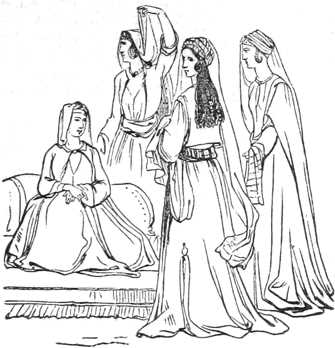
Fig. 337—Dress Veils, etc. indoor
In ancient as in modern times there were different kinds of this essential article of an Eastern female’s attire. These are essentially of two descriptions. The first, and which alone offer any resemblance to the veils used among us, are those which the Eastern women wear indoors, and which are usually of muslin or other light texture, attached to the head-dress and falling down over the back. They are of different kinds and names, some descending only to the waist, while others reach nearly to the ground. These are not used to conceal the face.
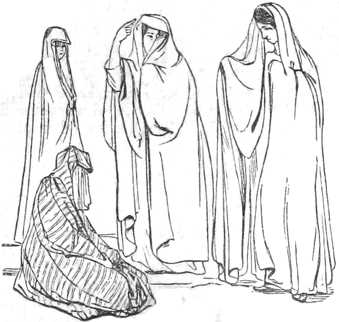
Fig. 338—Outdoor Veils
The veils mentioned in Scripture were, no doubt, mostly analogous to the wrappers of different kinds in which the Eastern women envelop themselves when they leave their houses. These are of great amplitude, and, among the common people, of strong and coarse texture, like that in which Ruth carried home her corn (Rth 3:15).
An indispensable part of the outdoor dress of Eastern Ladies, who live secluded from the sight of all men except their own husbands and their nearest relatives. If an Egyptian lady is surprised uncovered, she quickly draws her veil over her face, with some exclamation like, "O my misfortune." To lift or remove one’s veil was to insult and degrade her, Gen 24:65 Son 5:7 1Co 11:5,10 . The custom of wearing veils, however, has not been prevalent at all times. Sarah the wife of Abraham, and Rebekah and her companions at the well do not appear to have worn them, Gen 12:14,15 24:16. Compare also Gen 38:14,15 Pro 7:13 . See ABIMELECH.\par Veil were of different kinds. Those now worn in Syria and Egypt may be divided into two classes, the one large and sometimes thick, the other small and of lighter materials. The usual indoor veil is of thin muslin, attached to the headdress, and falling over the back, sometimes to the feet. A similar veil is added to the front of the headdress on going abroad, partially covering the face and hanging low. The other veil, to be worn in the street, is a large mantle or sheet, of black silk, linen, or some coarse material, so ample as to envelope the whole person and dress, leaving but one of the eyes exposed, Son 4:9 . Such was the veil worn by Rth 3:15, translated "mantle" in Isa 3:22 . Many women wear no other veil than this. The Greek word translated "power" in 1Co 11:10, probably means a veil, as a token of her husband’s rightful authority and her own subordination. This was to be worn in their Christian assemblies "because of the angels;" that is, because of the presence either of true angels, or of the officers of the church, who being unaccustomed to see the unveiled faces of women, might be distracted by them in the discharge of their public duties.\par For the "veil of the temple," see TABERNACLE and TEMPLE.\par
Veil. With regard to the use of the veil, it is important to observe that it was by no means so general in ancient as in modern times. Much of the scrupulousness in respect of the use of the veil dates from the promulgation of the Koran, which forbade women appearing unveiled except in the presence of their nearest relatives.
In ancient times, the veil was adopted only in exceptional cases, either as an article of ornamental dress, Son 4:1; Son_ 4:3; Son_ 6:7, or by betrothed maidens in the presence of their future husbands, especially at the time of the wedding, Gen 24:65, or lastly, by women of loose character for purposes of concealment. Gen 38:14. Among the Jews of the New Testament age, it appears to have been customary for the women to cover their heads (not necessarily their faces) when engaged in public worship.
Ordinarily women among the Jews, Egyptians, and Assyrians, appeared in public with faces exposed (Gen 12:14; Gen 24:16; Gen 24:65; Gen 20:16; Gen 29:10; 1Sa 1:12). Assyrian and Egyptian sculptures similarly represent women without a veil. It was Mahometanism that introduced the present veiling closely and seclusion of women; the veil on them in worship was the sign of subjection to their husbands (1Co 11:4-15).
See VAIL.
VEIL.—‘The veil of the temple was rent in twain from the top to the bottom’ when Jesus died (Mat 27:51, Mar 15:38, Luk 23:45). The Temple is, of course, the Temple of Herod, and the veil is, the ‘second veil’ (Heb 9:3) which divided the
It is a curious fact that Jewish tradition also records the occurrence of certain prodigies about this time. Josephus (BJ vi. v. 3) enumerates several portents which presaged the destruction of the Temple: a sword appeared suspended over the city, a heifer about to be sacrificed brought forth a lamb, and the brazen gate opened of its own accord. Lightfoot (Prospect of the Temple, xx. 1 [Pitman’s ed. ix. 329]) says: ‘There are three remarkable things, which the Jews do date from forty years before the destruction of the Temple—namely this of the Temple-doors’ opening of themselves, and the Sanhedrin’s flitting from the room Gazith, and the scarlet list on the scapegoat’s head not turning white.’ Compare Plutarch’s account of the prodigies which foreshadowed the murder of Caesar.
In Heb 10:20 the veil of the Tabernacle is interpreted as symbolizing the corporeal nature of Christ, and in later mysticism phenomenal existence is termed ‘the veil.’ In 2Co 3:12 ff. the veil (
T. H. Weir.
By: Cyrus Adler, Judah David Eisenstein
A cover for the face; a disguise. From the earliest times it has been a sign of chastity and decency in married women to cover their faces with veils in the presence of strangers. This custom is still in vogue in the Orient. The putting on of the veil marked the transition from girlhood to womanhood. Rebekah, the bride, covered herself with a veil on meeting Isaac, the groom (Gen. xxiv. 65). A widow did not wear a veil (ib. xxxviii. 19). The custom of dressing the virgin bride with a veil is mentioned in the Mishnah; covered with a veil ("hinuma") and seated on a litter, she was carried in the wedding-procession from her father's house to the nuptial ceremony (Ket. ii. 1). In modern times the bride is "covered" with a veil in her chamber in the presence of the groom, just before they are led under the canopy. In some countries the groom, and in others the rabbi, performs the ceremony of covering the bride.
Moses, when speaking to the people after he had come down from Mount Sinai, covered his face with a veil as his skin shone so brightly that the people feared to come nigh him (Ex. xxxiv. 29-35).
The veil was used as a disguise by Tamar to mislead Judah (Gen. xxxviii. 14). The prophet "disguised himself with his headband over his eyes" (I Kings xx. 38, R. V.).
VEIL.—See Vail.
It will be seen that there is a certain reference to what in modern times would be termed a “veil” only in (2) above. For a possible additional reference see MUFFLER.
The use of the face veil as a regular article of dress was unknown to the Hebrew women, and if “veil” is to be understood in Son 4:1, etc., it was worn as an ornament only. The modern oriental custom of veiling is due to Mohammedan influence and has not been universally adopted by Jewesses in the Orient. In New Testament times, however, among both Greeks and Romans, reputable women wore a veil in public (Plutarch Quaest. Rom. xiv) and to appear without it was an act of bravado (or worse); Tarsus, Paul’s home city, was especially noted for strictness in this regard (Dio of Prusa, Tarsica prior, section symbol 48). Hence, Paul’s indignant directions in 1Co 11:2-16, which have their basis in the social proprieties of the time. The bearing of these directions, however, on the compulsory use of the hat by modern women in public worship would appear to be very remote.
For the Veil of the Tabernacle and the Temple see next article.
(êáôáðÝôáóìá)
The tabernacle was divided into two parts by means of a veil or curtain, which the writer of Hebrews calls ‘the second veil’ (ôὸ äåýôåñïí êáôáðÝôáóìá, Heb_9:3), to distinguish it from the screen which hung before the entrance to the Holy Place. It was of fine tapestry, and was suspended upon four pillars overlaid with gold (Exo_26:31-32). Josephus (Ant. VIII. iii. 3) calls it ἐíäüôåñïí êáôáðÝôáóìá, and Philo (de Gig. 12) ôὸ ἐóþôáôïí êáôáðÝôáóìá, but it was pre-eminently the veil (äַôָּøֹëֶú, while the curtain at the door of the Holy Place was known as îָñָêְ, translation ‘a screen’ in Revised Version ), and it is the only one referred to in the NT. In Heb_6:19 ‘the place within the veil’ (ôὸ ἐóþôåñïí ôïῦ êáôáðåôÜóìáôïò), which only the high priest might enter once a year, is figuratively used of heaven, the inmost shrine into which Jesus, a High Priest of another order, has entered as a Forerunner. In Heb_10:20 the veil is allegorized as the corporeal and earthly nature of the Christ, who is said to have dedicated a way into heaven ‘through the veil, that is, his flesh.’ As the veil of the tabernacle, and that of the Temple, hung between the high priest and the shrine which was hallowed by the Shekinah, so Christ’s frail humanity lay between Him and the glory of the heavenly sanctuary. His flesh had to be rent-as the Temple veil was rent (Mar_15:38)-that He might enter, and by so entering He became a Pioneer and Path-finder for all seekers after immortality.
James Strahan.