
Tithe, etc. (Lev 27:30-32), derived from the word signifying ’ten,’ which also means ’to be rich;’ hence ten is the rich number, because including all the units under it. This number seems significant of completeness or abundance in many passages of Scripture. Jacob said unto Laban, ’Thou hast changed my wages these ten times’ (Gen 31:41); ’Am not I better to thee than ten sons?’ (1Sa 1:8); ’These ten times have ye reproached me’ (Job 19:3); ’Thy pound hath gained ten pounds’ (Luk 19:16), etc. This number, as the end of less numbers and beginning of greater, and as thus signifying perfection, sufficiency, etc. may have been selected for its suitableness to those Eucharistic donations to religion, etc. which mankind were required to make probably in primeval times. Abraham gave to Melchizedec, ’a priest of the most high God,’ a tenth of all the spoils he had taken from Chedorlaomer (Gen 14:20; Heb 7:4). The incidental way in which this fact is stated, seems to indicate an established custom. Jacob’s vow (Gen 28:22) seems simply to relate to compliance with an established custom; his words are, literally, ’And all that thou shalt give me, I will assuredly tithe it unto thee.’ The Mosaic law, therefore, in this respect, as well as in others, was simply a reconstitution of the patriarchal religion. Thus, the tenth of military spoils is commanded (Num 31:31 sq.). For the Jaw concerning tithes generally, see Lev 27:30, etc. where they are first spoken of as things already known. These tithes consisted of a tenth of all that remained after payment of the first-fruits of seeds and fruits, and of calves, lambs, and kids. This was called the first tithe, and belonged to God as the sovereign and proprietor of the soil (Lev 27:30-32; 2Ch 31:5-6). The proceeds of this rent, God, as king, appropriated to the maintenance and remuneration of His servants the Levites, to be paid to them in their several cities (Num 18:21-24). A person might redeem or commute in money his tithes of seeds and fruits, by adding the value of a fifth part to them (Lev 27:31). Out of this tithe the Levites paid a tenth to the priests, called the tithe of tithes, or tithe of holy things (Num 18:26-28); and another tithe of the produce of the fields belonging to their cities (Num 18:29). The first tithe being paid, the proprietor had to set apart out of the remainder a second tithe, to be expended by him in the courts of the tabernacle, in entertaining the Levites and his own family, etc. (Lev 27:18). If the trouble and expense of transporting this second tithe in kind to the tabernacle were too great, he might turn it into money, but this he must take in person, and expend there for the appointed purpose (Deu 12:24-28). It seems that the people were left to their own consciences in regard to the just payment of their tithes, subject, however, to the solemn declaration ’before the Lord,’ which they were required to make concerning it every third year (Deu 26:12-16). Possibly the Levites were not prohibited from taking due care that they received their rights, inasmuch as in later times, at least, they paid their own tithes to the priests under sacerdotal supervision (Neh 10:38).
Upon examination it will be found that the payments required by Moses of the Jewish people were exceedingly moderate, and were no doubt easily borne till they chose to incur the additional expenses of a regal establishment. It pleased God, while sustaining the relation to them of sovereign and proprietor of the land, to require the same quit-rent of one-tenth which was usually paid to the kings in other nations (1Sa 8:14-15; 1Sa 8:17; comp. 1Ma 11:35). Aristotle speaks of it as ’an ancient law’ at Babylon. In Egypt one-fifth was paid to the king, which was more than the first-fruits and first and second tithes put together. This quit-rent God appointed to be paid to the Levites for their subsistence, since their festive share in the second tithes can hardly be accounted part of their income. They had, as a tribe of Israel, an original right to one-twelfth of the land, for which they received no other compensation than the tithes, subject to the sacerdotal decimation, their houses, and glebes. In return for these, they consecrated their time and talents to the service of the public [LEVITES]. The payment of tithes, etc. was reestablished at the restoration of religion by Hezekiah (2Ch 31:5-6; 2Ch 31:12), and upon the return from the captivity by Nehemiah (Neh 10:37; Neh 12:44; Neh 13:5). The prophet Malachi reproves the people for their detention of the tithes, etc. for which they had brought a divine chastisement by famine upon themselves, and promises a restoration of plenty upon their amendment (Mal 3:8-12; comp. 3:9; Sir 35:9). In our Savior’s time the Pharisees scrupulously paid their tithes, but neglected the weightier matters of the law. His comment on their conduct conveys no censure on their punctiliousness on this point, but on their neglect of more important duties: ’These ought ye to have done, and not to leave the other undone’ (Mat 23:23; Luk 18:12).
A tenth, the proportion of a man’s income devoted to sacred purposes from time immemorial, Gen 14:20 28:22. This was prescribed in the Mosaic law, Num 31:31 . A twofold tithe was required of each Jewish citizen. The first consisted of one-tenth of the produce of his fields, trees, flocks, and herds, to be given to God as the sovereign Proprietor of all things and as the king of the Jews, Lev 27:30-32 1Sa 8:15,17 . The proceeds of this tax were devoted to the maintenance of the Levites in their respective cities, Num 18:21-24 . A person might pay this tax in money, adding one-fifth to its estimated value. The Levites paid a tenth part of what they received to the priests, Num 18:26-28 . The second tithe required of each landholder was one-tenth of the nine parts of his produce remaining after the first tithe, to be expended at the tabernacle or temple in entertaining the Levites, his own family, etc., changing it first into money, if on account of his remoteness he chose to do so, Deu 12:17-19,22 -29 14:22-27. Every third year a special provision was made for the poor, either out of this second tithe or in addition to it, Deu 14:28-29 . These tithes were not burdensome; but the pious Israelite found himself the richer for their payment, though it does not seem to have been enforced by any legal penalties. The system of tithes was renewed both before and after the captivity, 2Ch 31:5,6,12 Neh 10:37 12:44 13:5; but they were not always regularly paid, and hence the divine blessing was withheld, Mal 3:8-12 . The Pharisees were scrupulously exemplary in paying their tithes, but neglected the more important duties of love to God and man, Mat 23:23 .\par The principle of the ancient tithes, namely, that ministers of the gospel and objects of benevolence should be provided for by the whole people of God, according to their means, is fully recognized in Scripture as applicable to the followers of Christ. He sent his servants forth, two and two, without provisions or purses, to receive their support from the people, since "the laborer is worthy of his hire," Mat 10:9-14 Luk 10:4-8,16 . Paul also reasons in the same way, 1Co 9:13,14 Gal 6:6 . For purpose of piety and beneficence, he directed the Corinthians, and virtually all Christians, to lay aside from their income, on the first day of the week, as the Lord had prospered them, 1Co 16:2 . There is no reason to doubt that the early Christians gave more freely of their substance than did the ancient Jews, Mal 4:34-36 2Co 8:1-4 .\par
Tithe. The proportion of property, devoted to religious uses, from very early times. Instances of the use of tithes are found, prior to the appointment, of the Levitical tithes under the law. In biblical history, the two prominent instances are --
Abram presenting the tenth of all his property, or rather of the spoils of his victory, to Melchizedek. Gen 14:20; Heb 7:2; Heb 7:6.
Jacob, after his vision at Luz, devoting a tenth of all his property to God, in case, he should return home in safety. Gen 28:22.
The first enactment of the law, in respect of tithe, is the declaration that the tenth of all produce, as well as of flocks and cattle, belongs to Jehovah and must be offered to him; that the tithe was to be paid in kind, or, if redeemed, with an addition of one fifth to its value. Lev 27:30-33 . This tenth is ordered to be assigned to the Levites as the reward of their service, and it is ordered further thatm they are themselves to dedicate to the Lord a tenth of these receipts, which is to be devoted to the maintenance of the high priest. Num 18:21-28. This legislation is modified, or extended, in the book of Deuteronomy, that is, from thirty-eight to forty years later.
Commands are given to the people. -- To bring their tithes, together with their votive, and other offerings and first-fruits, to the chosen centre of worship, the metropolis, there to be eaten in festive celebration, in company with their children, their servants and the Levites. Deu 12:5-18.
All the produce of the soil was to be tithed; and these tithes, with the firstlings of the flock and herd, were to be eaten in the metropolis.
But in case of distance, permission is given to convert the produce into money, which is to be taken to the appointed place, and there laid out in the purchase of food for a festal celebration, in which the Levite is, by special command, to be included. Deu 14:22-27.
Then follows the direction that , at the end of three years, all the tithe of that year, is to be gathered and laid up, "within the gates," and that a festival is to be held, of which the stranger, the fatherless, and the widow, together with the Levite, are to partake. Deu 5:28-29.
Lastly, it is ordered that after taking the tithe in each third year, "which is the year of tithing," an exculpatory declaration is to be made by every Israelite that he has done his best to fulfill the divine command, Deu 26:12-14.
From all this we gather --
(1) That one tenth of the whole produce of the soil was to be assigned for the maintenance of the Levites.
(2) That out of this the Levites were to dedicate a tenth to God for the use of the high priest.
(3) That a tithe, in all probability a second tithe, was to be applied to festival purposes.
(4) That in every third year, either this festival tithe or a third tenth was to be eaten in company with the poor and the Levites.
(These tithes in early times took the place of our modern taxes, us well as of gifts for the support of religious institutions. -- Editor).
The Amount To Be Tithed
Gen_28:20-22; Num_18:20-21.
The Tithe Belonging To The LORD
Lev_27:30.
Tithing Your Increase
Deu_14:22-29.
Who Pays Their Tithe, But Does Not Do Weightier Matters Of The Law
Mat_23:23; Luk_11:42; Luk_18:9-12.
TITHE.—On the tithe as a Jewish institution, see art. ‘Tithe’ in Hasting’s Dictionary of the Bible .
Our Lord makes but three references to the tithes, and they are all of the observance of them by the Pharisees (Mat 23:23, Luk 11:42; Luk 18:12). In the first two passages He contrasts the minute exactness with which the Pharisees observe their less important and external laws of tithe with their careless disregard of the inner and more important virtues of justice, mercy, faith, and the love of God. In Luk 18:12 He illustrates how compliance with external requirements, especially when these are exceeded, as in the case of the Pharisees, and dissociated from the corresponding state of heart, breeds a culpable and overweening self-righteousness. Our Lord in these references, as also in Mat 5:19, recognizes degrees of importance in the Law’s demands. Minute observance of the less important does not excuse from attending to the greater, but neither does compliance with the greater absolve from the obligation to observe the lesser. ‘This ought ye to have done, and not to leave the other undone.’ Our Lord evidently thought the tithe, as well as the other OT institutions, of Divine origin, and binding upon the Jews of His day. At the same time, He foresaw a period when outward observances should give place to the more purely inward, as men should worship the Father in spirit and in truth (Joh 4:21-24). See also artt. Anise and Rue.
G. Goodspeed.
( ):
):
By: Joseph Jacobs, M. Seligsohn, Wilhelm Bacher
—Biblical Data:
Tithing one's possessions was a very ancient custom, existing as early as the time of the Patriarchs. Abraham gave Melchizedek "tithes of all" (Gen. xiv. 20); and Jacob made a vow that if he should return to his father's house in safety he would acknowledge Yhwh as his Lord and would give Him a tenth of everything he possessed (ib. xxviii. 20-22). Later the Mosaic law made the tithe obligatory upon the Israelites. The tithe, whether of the seed of the land or of the fruit of the tree, belonged to Yhwh and consequently was holy. It was redeemable by "adding thereto the fifth part thereof." The tithe of cattle, however, was not redeemable; and if one beast was exchanged for another both became holy unto the Lord. The method of levying the tithe of cattle is indicated: they were counted singly; and every tenth one that passed under the rod became the tithe animal (Lev. xxvii. 30-33).
There is apparently a discrepancy between the Book of Numbers and that of Deuteronomy with regard to the tithe. In Num. xviii. 21-26 it is stated that "all the tenth in Israel" is given to the Levites "for an inheritance"; as they had no part in theland, the tithe was to be their principal source of sustenance. On the other hand, the Levites themselves were required to give the priests a tenth of all the tithes received by them. Deut. xiv. 22-29, however, enjoins the annual tithing of the increase of the field only; this was to be eaten before the Lord, that is to say, in the city in which the Temple was built. But if the distance to such city was so great as to render the transportation of all the tithes impracticable, the people might convert the tithe into money and spend the sum in the city on eatables, etc. ("whatsoever thy soul desireth"; ib. verse 26). Every third year the tithes were not to be carried to the city of the Temple, but were to be stored at home ("within thy gates"), and "the Levite, the stranger, and the fatherless, and the widow" were to "eat and be satisfied" (ib. verse 29). It is to be concluded that, the seventh year being a Sabbatical year and no tithing being permissible therein, the tithe of the first, second, fourth, and fifth years of every cycle of seven years had to be brought to the Temple and eaten by the landowner and his family, while the tithe of the third and sixth years was to be left at home for the poor.
The third year was called the year of tithing; and after the distribution of the tithe among the Levites and others, the landowners were required to announce solemnly before the Lord that they had observed all the laws connected therewith, concluding such declaration with a prayer for God's blessing (ib. xxvi. 12-15). A mourner was not allowed to eat the tithe, nor might one employ it for any unclean use, nor give it for the dead.
Samuel informed the Israelites that they would have to give a tenth of everything to the king (I Sam. viii. 15, 17). When the Israelites afterward fell into idolatry, they continued to bring their tithes to the temple of their idols; but they seem to have adopted another system of offering them (comp. Amos iv. 4, Hebr. and R. V.). King Hezekiah again imposed the tithe on his subjects; and the people of Judah brought it in abundance, apparently for the use of the Levites. Indeed, the quantity was so great that the king ordered special chambers in the Temple to be prepared for its reception (II Chron. xxxi. 6-12). The same arrangement was made later by Nehemiah (Neh. x. 39, xiii. 12).
—In Rabbinical Literature:
According to the Rabbis, the Books of Numbers and Deuteronomy are complementary to each other (comp. Tithe, Biblical Data); consequently there can be no contradiction between them. Thus there were three kinds of tithes: (1) that given to the Levites as stated in Num. xviii. 21 et seq., and termed "the first tithe" ("ma'aser rishon"); (2) the tithe which was to be taken to Jerusalem and there consumed by the landowner and his family, and which was termed "the second tithe" ("ma'aser sheni"), it being taken from what remained after the first tithe had been appropriated; and (3) that given to the poor ("ma'aser 'ani"). Therefore two tithes were to be taken every year except in the seventh year: Nos. 1 and 2 in the first, second, fourth, and fifth years; Nos. 1 and 3 in the third and sixth years.
The Tithing Year.
The Rabbis inferred from Deut. xiv. 22 that each tithe was to be taken of every year's produce separately, whether of crops, of cattle, or of anything else subject to tithing (Sifre, Deut. 105; Ter. i. 5; R. H. 8a, 12b). Also they fixed a particular day to mark the beginning of the year for tithing. The first of Elul according to R. Meïr, or the first of Tishri according to R. Eleazar and R. Simeon, is the new year for the tithing of cattle; the first of Tishri, for the produce of the land; the first of Shebaṭ according to the school of Shammai, or the fifteenth of Shebaṭ according to the school of Hillel, for the fruit of the trees (R. H. i. 1). The removal of the tithes and the recitation of the confession (comp. Deut. xxvi. 12 et seq.) must take place on the eve of the Passover festival of the fourth and seventh years of every cycle of seven years. Although the removal is mentioned only with regard to the tithe of the poor, the Rabbis concluded that the other two tithes must also be cleared away at the same time (Sifre, Deut. 109). The Rabbis fixed the following rules by which one might distinguish tithable produce: it must be eatable, the property of an individual, and the product of the soil. Fruit must be ripe enough to be eaten; when one eats untithed fruit in an immature state, he is not guilty of having transgressed the Law (Ma'as. i. 1 et seq.). As appears from the Bible, the law of tithing was originally to be applied in Palestine only; the Prophets, however, ordained that tithing should be observed in Babylonia also, it being near Palestine. The earlier rabbis applied the law of tithing to Egypt and to the lands of Ammon and Moab (Yad. iv. 3); and the scribes seem to have instituted tithes in Syria (Dem. vi. 11; comp. Shulḥan 'Aruk, Yoreh De'ah, 331, 1 et seq.).
Merit of the Tithe.
The Rabbis emphasize in more than one instance the importance of tithes. Tithing is one of the three things through the merit of which the world was created (Gen. R. i. 6), and by virtue of which the Israelites obtain from God their desire (Pesiḳ. xi. 96b; Tan., Re'eh). Through the merit of tithes, also, the Israelites after death escape the punishment which the wicked suffer for twelve months in hell (Pesiḳ. xi. 97b-98a; Midr. Mishle xxxi.). The Patriarchs observed the law of tithing, concerning which statement there are two different accounts: (1) Abraham offered the first tithe, Isaac brought the heave-offering for the priests ("terumah gedolah"), and Jacob brought the second tithe (Pesiḳ. R. 25 [ed. Friedmann, p. 127b]); (2) Abraham presented the heave-offering, Isaac offered the second tithe, and Jacob brought the first one (Pesiḳ. xi. 98a; comp. Gen. R. lxiv. 6; Num. R. xii. 13; Pirḳe R. El. xxvii., xxxiii.). He who partakes of fruit that has not been tithed is like one who eats carrion; and Judah ha-Nasi's opinion is that one who eats fruit of which the tithe for the poor has not been appropriated is deserving of death (Pesiḳ. xi. 99a, b). One of the interpretations of Prov. xxx. 4 is that he who fulfils the duty of tithing causes rain to fall, and that he who fails therein causes drought (Yalḳ., Prov. 962). Non-fulfilment of the law of tithing brings hurricanes (Midr. Teh. to Ps. xviii.).
The tithe for the poor gave rise to the tithingof one's earnings, with the object of distributing among the needy the sum so appropriated. This is inferred in Sifre (quoted in Tos. to Ta'an. 9a) from Deut. xiv. 22, and is therefore considered as an obligation imposed by the Mosaic law ("Ṭure Zahab" to Shulḥan 'Aruk, Yoreh De'ah, 249, 1; comp. Isaiah Horwitz, "Shene Luḥot ha-Berit," and Joseph Hahn, "Yosef Omeẓ," p. 176, Frankfort-on-the-Main, 1723). Joel Sirkes in his "Bayit Ḥadash" (to Shulḥan 'Aruk, l.c.), however, thinks that tithing one's earnings is simply a custom and is not obligatory either under the Mosaic or under the rabbinical law. The whole of the tithe must be given to the poor; and no part of it may be appropriated to any other religious purpose (Shulḥan 'Aruk, l.c., Isserles' gloss).
—Critical View:
There are evidently two conflicting sources with regard to tithes. D mentions only the tithes of corn, wine, and olive-oil, which were to be levied every year and to be eaten by the landowner in the Holy City in the first, second, fourth, and fifth years of every Sabbatical cycle, while in the third and sixth years they were to be distributed among the Levites, strangers, orphans, and widows (Deut. xii. 16, xiv. 22 et seq.). P, on the other hand, destines this tithe for the Levites (Num. xviii. 21 et seq.); and, in a probably late addition (Lev. xxvii. 30-33), tithing is extended to the fruit of the trees and to cattle also. It is true that in D the Levites, too, have a share in the tithe (Deut. xii. 18; comp. xiv. 27); but the owner's invitation to the Levite to partake thereof seems to have been voluntary. It may be noticed that in the priestly part of the Book of Ezekiel (xliv. 15 et seq.) there is no mention whatever of a tithe appointed for the Levites. Nehemiah instituted such a tithe; and he directed that the Levites should give a tithe of their portions to the priests (see Tithe, Biblical Data). Hence it may be concluded that the passages in Numbers and Leviticus regarding tithes were written under the influence of the Book of Nehemiah.
That the tithe spoken of in D, and which is termed by the Rabbis "the second tithe" (see Tithe in Rabbinical Literature), is more ancient has been concluded by W. R. Smith ("Rel. of Sem." 2d ed., pp. 245 et seq.), who, moreover, thinks that in earlier times the tribute was not a fixed amount, but that it took the form of first-fruits, and that at a later period a tithe was fixed to provide the public banquets at sacred festivals. Subsequently the tithe became the prerogative of the king (I Sam. viii. 15, 17); but from the Book of Amos (iv. 4) it appears that in the time of that prophet the Israelites paid tithes for the use of their sanctuaries in the Northern Kingdom, as, similarly, in the Persian period the tithes were converted to the use of the Temple of Yhwh (Mal. iii. 8-10). Those instituted by Nehemiah for payment to the Levites were a development of the heave-offering ("terumah") given to the priests. Not only do the terms "terumah" and "ma'aser" often occur together in the Old Testament, but it is stated in Neh. x. 37 et seq. that the Levites were required to collect their tithes under the supervision of a priest. R. Eleazar b. Azariah held that the first tithe might also be paid to the priest (Yeb. 86b).
Title-Page of Tractate Menaḥot, Printed by Daniel Bomberg, Venice, 1522.(From the Sulzberger collection in the Jewish Theological Seminary of America, New York.)
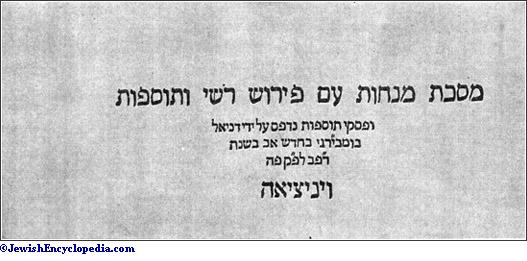
Comparing verse 30 with verse 32 of Lev. xxvii., it may be concluded that the tithe of cattle was to go to the priests or the Levites. This was the opinion of Philo ("De Prœmiis Sacerdotum," § 2 [ed. Mangey, ii. 234]); but the Rabbis refer the whole passage to the second tithe (Sifre, Deut. 63; Ḥag. i. 4; Men. vii. 5).
In the Pentateuch we find legislation as to tithes in three places. (1) According to Lev 27:30-33, a tithe had to be given of the seed of the land, i.e. of the crops, of the fruit of the tree, e.g. oil and wine, and of the herd or the flock (compare Deu 14:22, Deu 14:23; 2Ch 31:5, 2Ch 31:6). As the herds and flocks passed out to pasture they were counted (compare Jer 33:13; Eze 20:37), and every 10th animal that came out was reckoned holy to the Lord. The owner was not allowed to search among them to find whether they were bad or good, nor could he change any of them; if he did, both the one chosen and the one for which it was changed were holy. Tithes of the herds and flocks could not be redeemed for money, but tithes of the seed of the land and of fruit could be, but a 5th part of the value of the tithe had to be added. (2) In Num 18:21-32 it is laid down that the tithe must be paid to the Levites. (It should be noted that according to Heb 7:5, ’they that are of the sons of Levi, who receive the office of the priesthood ... take tithes of the people.’ Westcott’s explanation is that the priests, who received from the Levites a tithe of the tithe, thus symbolically received the whole tithe. In the time of the second temple the priests did actually receive the tithes. In the Talmud (
There is thus an obvious apparent discrepancy between the legislation in Leviticus and Deuteronomy. It is harmonized in Jewish tradition, not only theoretically but in practice, by considering the tithes as three different tithes, which are named the First Tithe, the Second Tithe, and the Poor Tithe, which is called also the Third Tithe (
The explanation given by many critics, that the discrepancy between Deuteronomy and Leviticus is due to the fact that these are different layers of legislation, and that the Levitical tithe is a post-exilian creation of the Priestly Code, is not wholly satisfactory, for the following reasons: (1) The allusion in Deu 18:1, Deu 18:2 seems to refer to the Levitical tithe. (2) There is no relation between the law of Nu 18 and post-exilian conditions, when the priests were numerous and the Levites a handful. (3) A community so poor and disaffected as that of Ezra’s time would have refused to submit to a new and oppressive tithe burden. (4) The division into priests and Levites cannot have been of the recent origin that is alleged. See LEVITES.
W. R. Smith and others suggest that the tithe is simply a later form of the first-fruits, but this is difficult to accept, since the first-fruits were given to the priest, while the tithes were not. The whole subject is involved in considerable obscurity, which with our present information cannot easily be cleared away.
The Talmudic law of tithing extends the Mosaic Law, with most burdensome minuteness, even to the smallest products of the soil. Of these, according to some, not only the seeds, but, in certain cases, even the leaves and stalks had to be tithed (
Considering the many taxes, religious and secular, that the Jews had to pay, especially in post-exilian times, we cannot but admire the liberality and resourcefulness of the Jewish people. Only in the years just after the return from exile do we hear that the taxes were only partially paid (Neh 13:10; compare Mal 1:7 ff; and for pre-exilian times compare 2Ch 31:4 ff). In later times such cases seldom occur (
- see Tenth-part
A portion of your earnings (often considered to be 10 percent of gross income) that you set aside to give to the Lord (see Genesis 28:22; Malachi 3:10). (For further study, turn to "Give to God.")
—New Believer’s Bible Glossary
A portion of one’s earnings, usually one tenth, that are given to those who perform the work of the Lord since it belongs to the Lord (Lev 27:30-33). Those who received tithes the OT consisted of priests (Num 18:21-32). Further OT references are Gen 14:20; Gen 28:22; 2Ch 31:5f; Mal 3:7-12).
In the NT there is no command to tithe a tenth (since we are not under law but grace). But the tithe is mentioned in Luk 18:9-14; 1Co 16:1; 2Co 8:1-24).