Tib´ni (building of God), one of those factious men who took a prominent part in the troubles which followed the violent death of Elah. He disputed the throne of Israel with Omri, and the civil war which was thus kindled between the two factions lasted for about three years with varying success, till the death of Tibni left his adversary master of the crown, B.C. 929 (1Ki 16:21-23).
An unsuccessful competitor with Omri the general, for the throne of Israel, during three years after the death of Elah, 1Ki 16:18- 23.\par
Tib’ni. (intelligent). After Zimri had burnt himself in his palace, there was a division in the northern kingdom, half of the people following Tibni, the son of Ginath, and half following Omri. 1Ki 16:21-22. Omri was the choice of the army; Tibni was, probably, put forward by the people of Tirzah, which was, then, besieged by Omri and his host. The struggle between the contending factions lasted four years, compare 1Ki 16:16; 1Ki 16:23, (B.C. 926-922), when-Tibni died.
Son of Ginath. After Zimri had burned himself to death half the people followed Tibni, half Omri. The contest lasted four years (1Ki 16:18; 1Ki 16:21-22), and issued in the death of Tibni and in Omri’s accession. The men of Tirzah which Omri besieged probably promoted the cause of Tibni. The Septuagint say Joram his brother helped his cause.
[Tib’ni]
Son of Ginath: he aspired to be king of Israel as the successor of Zimri, but was slain by the followers of his rival Omri after a contest of four years. 1Ki 16:21-22.
By: Joseph Jacobs, M. Seligsohn
One of the rulers of the kingdom of Israel during the interregnum between Zimri and Omri; son of Ginath. When Zimri, after a reign of seven days, had ended his life, the people of Israel were divided into two factions, one siding with Omri, and the other with Tibni. Omri's followers gained the upper hand; and, finally, Tibni having died, Omri was declared king (I Kings xvi. 21-22). From a comparison of verses 15 and 23 of the chapter just cited, it appears that Tibni was regent over half the kingdom of Israel for a period of four years. According to the Septuagint (ad loc.), Tibni had a brother named Joram, who seconded him in the dispute over the throne and who died at the same time as himself, probably at the hands of Omri's party.
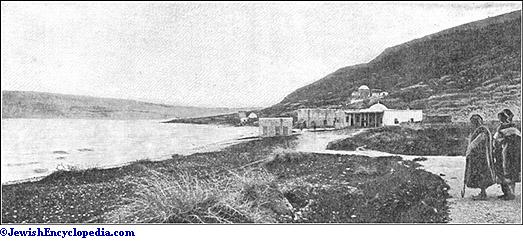
View of Tiberias Showing the Tomb of Rabbi Meïr.(From a photograph by the American Colony at Jerusalem.)