
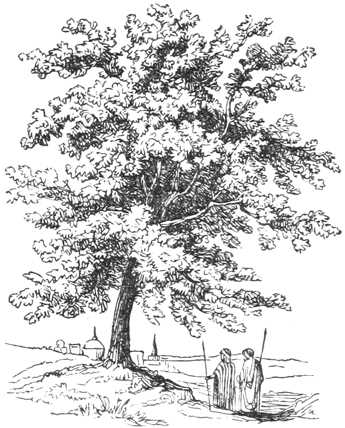
Fig. 329—Terebinth tree
This is the proper rendering of the word (Alah) which has been variously translated as oak, teil tree, elm, and even plane. In Palestine and the neighboring countries, the terebinth seems to be regarded with much the same distinction as the oak is in our northern latitudes. The tree is long lived. About the time of Christ, there was at Mamre near Hebron a venerable terebinth, which a tradition, old in the time of Josephus, alleged to be that under which Abraham pitched his tent (Gen 13:18).
Dr. Robinson states, that at the point where the roads from Gaza to Jerusalem, and from Hebron to Ramleh, cross each other, he observed an immense terebinth tree, the largest he saw anywhere in Palestine; ’This species (Pistacia Terebinthus) is without doubt,’ he adds, ’the terebinth of the Old Testament, and under the shade of such a tree Abraham may well have pitched his tent at Mamre.’ The terebinth is not an evergreen, as has often been represented, but its small feathered lancet shaped leaves fall in the autumn, and are renewed in the spring. The flowers are small, and are followed by small oval berries, hanging in clusters from two to five inches in length, resembling much the clusters of the vine when the grapes are just set. From incisions in the trunk, there is said to flow a sort of transparent balsam, constituting a very pure and fine species of turpentine, with an agreeable odor, and hardening gradually into a transparent gum [OAK].
See OAK.\par
See OAK AND TEREBINTH:
TEREBINTH does not occur at all in AV
E. W. G. Masterman.
It is clear that the translators are uncertain which translation is correct, and it would seem not improbable that then there was no clear distinction between oak and terebinth in the minds of the Old Testament. writers; yet the two are very different trees to any but the most superficial observation.
The terebinth - Pistacia terebinthus (Natural Order, Anacardiaceae), Arabic
From this tree a kind of turpentine is obtained, hence, the alternative name “turpentine tree” (Ecclesiasticus 24:16 the King James Version, the Revised Version (British and American) “terebinth”).