
The principal city of Damascus: made memorable from the frequent wars with Israel.
that part of Asia which, bathed by the Mediterranean on the west, had to the north Mount Taurus, to the east the Euphrates and a small portion of Arabia, and to the south Judea, or Palestine. The orientals called it Aram. The name, which has been transmitted to us by the Greeks, is a corruption or abridgment of Assyria, which was first adopted by the Ionians, who frequented these coasts after the Assyrians of Nineveh had reduced that country to be a province of their empire, about B.C. 750. By the appellation of Syria is ordinarily meant the kingdom of Syria, of which, since the reign of the Seleucidae, Antioch has been the capital. The government of Syria was for a long time monarchical; but some of its towns, which formed several states, were republics. With regard to religion, the Syrians were idolaters. The central place of their worship was Hieropolis, in which was a magnificent temple, and near the temple a lake that was reputed sacred. In this temple was an oracle, the credit of which the priests used every method to support. The priests were distributed into various classes, and among them were those who were denominated Galli, and who voluntarily renounced the power of transmitting the succession in their own families. The Syrians had bloody sacrifices. Among the religious ceremonies of the Syrians, one was that any one who undertook a journey to Hieropolis began with shaving his head and eye-brows. He was not allowed to bathe, except in cold water, to drink any liquor, nor to lie on any but a hard bed, before the term of his pilgrimage was finished. When the pilgrims arrived, they were maintained at the public expense, and lodged with those who engaged to instruct them in the sacred rites and ceremonies. All the pilgrims were marked on the neck and wrists. The youth consecrated to the goddess the first-fruits of their beard and hair, which was preserved in the temple, in a vessel of gold or silver, on which was inscribed the name of the person who made the offering. The sight of a dead person rendered it unfit for any one to enter into the temple during the whole day. The dynasties of Syria may be distributed into two classes; those that are made known to us in the sacred writings, or in the works of Josephus, acknowledged by the orientals; and the Seleucidan kings, successors of Alexander, with whom we are acquainted by Greek authors. The monarchy of Syria continued two hundred and fifty-seven years.
Syr´ia. It is difficult to define the limits of ancient Syria, as the name seems to have been very loosely applied by the old geographers. In general, however, we may perceive that they made it include the tract of country lying between the Euphrates and the Mediterranean, from the mountains of Taurus and Amanus in the north, to the desert of Suez and the borders of Egypt on the south; which coincides pretty well with the modern application of the name. It may be described as composed of three tracts of land, of very different descriptions. That which adjoins the Mediterranean is a hot, damp, and rather unwholesome, but very fruitful valley. The part next to this consists of a double chain of mountains, running parallel from south-west to northeast, with craggy precipitous rocks, devious valleys, and hollow defiles. The air is here dry and healthy; and on the western declivities of the mountains are seen beautiful and highly cultivated terraces, alternating with well-watered valleys, which have a rich and fertile soil, and are densely peopled. The eastern declivities, on the contrary, are dreary mountain deserts, connected with the third region, which may be described as a spacious plain of sand and rock, presenting an extensive and almost unbroken level.
Spring and autumn are very agreeable in Syria, and the heat of summer in the mountain districts is supportable. But in the plains, as soon as the sun reaches the equator, it becomes of a sudden oppressively hot, and this heat continues till the end of October. On the other hand, the winter; is so mild, that orange-trees, fig-trees, palms, and many tender shrubs and plants flourish in the open air while the heights of Lebanon are glittering with snow and hoar-frost. In the districts, however, which lie north and east of the mountains, the severity of winter is greater, though the heat of the summer is not less. At Antioch, Aleppo, and Damascus, there are ice and snow for several weeks every winter. Yet, upon the whole, the climate and soil combine to render his country one of the most agreeable residences throughout the East.
The principal Syrian towns mentioned in Scripture are the following, all of which are noticed under their respective names in the present work:—Antioch, Seleucia, Helbon, Rezeph, Tiphsah, Rehoboth, Hamath, Riblah, Tadmor, Baal-Gad, Damascus, Hobah, Beth-Eden.
Syria, when we first become acquainted with its history, was divided into a number of small kingdoms, of which the most important of those mentioned in Scripture was that of which Damascus was the metropolis. A sketch of its history’ is given under Damascus. These kingdoms were broken up, or rather consolidated by conquerors, of whom the first appears to have been Tiglathpileser, King of Assyria, about 750 B.C. After the fall of the Assyrian monarchy, Syria came under the Chaldean yoke. It shared the fate of Babylonia when that country was conquered by the Persians; and was again subdued by Alexander the Great. At his death in B.C. 323 it was erected into a separate monarchy under the Seleucidae, and continued to be governed by its own sovereigns until, weakened and devastated by civil wars between competitors for the throne, it was finally, about B.C. 65, reduced by Pompey to the condition of a Roman province, after the monarchy had subsisted 257 years. On the decline of the Roman Empire, the Saracens became the next possessors of Syria, about A.D. 622; and when the crusading armies poured into Asia, this country became the chief theater of the great contest between the armies of the Crescent and the Cross, and its plains were deluged with Christian and Muslim blood. For nearly a century the Crusaders remained masters of the chief places in Syria; but at length the power of the Muslims predominated, and in 1186 Saladin, Sultan of Egypt, found himself in possession of Syria. It remained subject to the sultans of Egypt till, in A.D. 1517, the Turkish sultan, Selim I, overcame the Memlook dynasty, and Syria and Egypt became absorbed in the Ottoman Empire. In 1832, a series of successes over the Turkish arms gave Syria to Mehemet Ali, the Pasha of Egypt; from whom, however, after nine years, it again passed to the Turks, in consequence of the operations undertaken for that purpose by the fleet under the command of Admiral Stopford, the chief of which was the bombardment of Acre in November, 1840. The treaty restoring Syria to the Turks was ratified early in the ensuing year.
In Hebrew ARAM, a large district of Asia, lying, in the widest acceptation of the name, between the Mediterranean, Mount Taurus, and the Tigris, and thus including Mesopotamia, that is, in Hebrew, Syria of the two rivers. See ARAM 2. Excepting the Lebanon range, it is for the most part a level country. In the New Testament, Syria may be considered as bounded west and north-west by the Mediterranean and by Mount Taurus, which separates it from Cilicia and Cataonia in Asia Minor, east by the Euphrates, and south by Arabia Deserta and Palestine, or rather Judea, for the name Syria included also the northern part of Palestine.\par The valley between the ridges of Lebanon and Anti-Lebanon was called Coele-Syria and Phoenicia were subject to the king of Babylon, and they afterwards were tributary to the Persian monarchs. After the country fell into the hands of the Romans, Syria was made the province of a proconsul; to which Judea, although governed by its own procurators, was annexed in such a way, that in some cases an appeal might be made to the proconsul of Syria, who had at least the power of removing the procurators from office. Syria is now in the possession of the Turks. Its better portions have been thickly populated from a very early period, and travellers find traces of numerous cities wholly unknown to history.\par
Syr’ia. Syria is the term used throughout our version for the Hebrew, Aram, as well as for the Greek, Zupia. Most probably, Syria is for Tsyria, the country about Tsur, or Tyre, which was the first of the Syrian towns known to the Greeks. It is difficult to fix the limits of Syria. The limits of the Hebrew, Aram, and its subdivisions are spoken of under Aram. See Aram.
Syria, proper, was bounded by Amanus and Taurus on the north; by the Euphrates and the Arabian desert on the east; by Palestine on the south; by the Mediterranean near the mouth of the Orontes; and then by Phoenicia on the west. This tract is about 300 miles long from north to south, and from 50 to 150 miles broad. It contains an area of about 30,000 square miles.
General physical features. -- The general character of the tract is mountainous, as the Hebrew name, Aram, (from a root signifying, "height"), sufficiently implies. The most fertile and valuable tract of Syria is the long valley intervening between Libanus and Anti-Libanus. Of the various mountain ranges of Syria, Lebanon possesses the greatest interest. It extends from the mouth of the Litany to Arka, a distance of nearly 100 miles. Anti-Libanus, as the name implies, stands lower against Lebanon, running in the same direction, that is, nearly north and south, and extending the same length. See Lebanon.
The principal rivers of Syria are the Litany and the Orontes. The Litany springs from a small lake situated in the middle of the Coele-Syrian valley, about six miles to the southwest of Baalbek. It enters the sea about five miles north of Tyre. The source of the Orontes is, but about 15 miles from that of the Litany. Its modern name is the Nahr-el-Asi, or "rebel stream", an appellation given to it on account of its violence and impetuosity in many parts of its course.
The chief towns of Syria may be thus arranged, as nearly as possible in the order of their importance: 1, Antioch; 2, Damascus; 3, Apamea; 4, Seleucia; 5, Tadmor or Palmyra; 6, Laodicea; 7, Epiphania (Hamath); 8, Samosata; 9, Hierapolis (Mabug); 10, Chalybon; 11, Emesa; 12, Heliopolis; 13, Laodicea ad Libanum; 14, Cyrrhus; 15, Chalcis; 16, Poseideum; 17, Heraclea; 18, Gindarus; 19, Zeugma; 20, Thapsacus.
Of these, Samosata, Zeugma and Thapsacus are on the Euphrates; Seleucia, Laodicea, Poseideum and Heraclea, on the seashore; Antioch, Apamea, Epiphania and Emesa (Hems), on the Orontes; Heliopolis and Laodicea ad Libanum, in Coele-Syria; Hierapolis, Chalybon, Cyrrhus, Chalcis and Gindarns, in the northern highlands; Damascus, on the skirts, and Palmyra, in the centre, of the eastern desert.
History. -- The first occupants of Syria appear to have been of Hamitic descent -- Hittites, Jebusites, Amorites, etc. After a while, the first comers, who were still to a great extent nomads, received a Semitic infusion, while most, probably, came to them from the southeast. The only Syrian town whose existence, we find distinctly marked at this time is Damascus, Gen 14:15; Gen 15:2, which appears to have been already a place of some importance. Next to Damascus, must be placed Hamath. Num 13:21; Num_ 34:8.
Syria at this time, and for many centuries afterward, seems to have been broken u, p among a number of petty kingdoms. The Jews first come into hostile contact with the Syrians, under that name, in the time of David. Gen 15:18; 2Sa 8:3-4; 2Sa 8:13. When, a few years later, the Ammonites determined on engaging in a war with David, and applied to the Syrians for aid, Zolah, together with Beth-rehob sent them 20,000 footmen, and two other Syrian kingdoms furnished 13,000. 2Sa 10:6.
This army being completely defeated by Joab, Hadadezer obtained aid from Mesopotamia, 2Sa 10:16, and tried the chance of a third battle, which, likewise, went against him, and produced the general submission of Syria to the Jewish monarch. The submission, thus begun, continued under the reign of Solomon. 1Ki 4:21. The only part of Syria which Solomon lost, seems to have been Damascus, where an independent kingdom was set up by Rezon, a native of Zobah. 1Ki 11:23-25.
On the separation of the two kingdoms, soon after the accession of Rehoboam, the remainder of Syria, no doubt, shook off the yoke. Damascus now became decidedly the leading state, Hamath being second to it, and the northern Hittites, whose capital was Carchemish, near Bambuk, third. See Damascus. Syria became attached to the great Assyrian empire, from which it passed to the Babylonians, and from them to the Persians, In B.C. 333, it submitted to Alexander without a struggle.
Upon the death of Alexander, Syria became, for the first time, the head of a great kingdom. On the division of the provinces among his generals, B.C. 321, Seleucus Nicator received Mesopotamia and Syria. The city of Antioch was begun in B.C. 300, and, being finished in a few years, was made the capital of Seleucus’ kingdom. The country grew rich with the wealth, which now flowed into it on all sides.
Syria was added to the Roman empire by Pompey, B.C. 64, and as it holds an important place, not only in the Old Testament but in the New, some account of its condition under the Romans must be given. While the country, generally, was formed into a Roman province, under governors who were, at first, proprietors, or quaestors, then procounsuls, and finally legates, there were exempted from the direct rule of the governor in the first place, a number of "free cities" which retained the administration of their own affairs, subject to a tribute levied according to the Roman principles of taxation; secondly, a number of tracts, which were assigned to petty princes, commonly natives, to be ruled at their pleasure, subject to the same obligations with the free cities as to taxation.
After the formal division of the provinces between Augustus and the senate, Syria, being from its exposed situation among the province principis, were ruled by legates, who were of consular rank, (consulares), and bore severally the full title of "Legatus Augusti pro praetore". Judea occupied a peculiar position; a special procurator was, therefore, appointed to rule it, who was subordinate to the governor of Syria, but within his own province had the power of a legatus.
Syria continued without serious disturbance, from the expulsion of the Parthians, B.C. 38, to the breaking out of the Jewish war, A.D. 66. In A.D. 44-47, it was the scene of a severe famine. A little earlier, Christianity had begun to spread into it, partly by means of those who "were scattered" at the time of Stephen’s persecution, Act 11:19, partly by the exertions of St. Paul. Gal 1:21. The Syrian Church soon grew to be one of the most flourishing, Act 13:1; Act 15:23; Act 15:35; Act 15:41; etc. (Syria remained under Roman and Byzantine rule till A.D. 634, when it was overrun by the Mohammedans; after which, it wa, s for many years, the scene of fierce contests, and was finally subjugated by the Turks, A.D. 1517, under whose rule it still remains. -- Editor).
Septuagint Greek for Hebrew
On the W. two mountain chains run parallel to one another and to the coast from the latitude of Tyre to that of Antioch, namely, Lebanon and Antilebanon; Lebanon the western chain at its southern end becomes Bargylus. Mount Amanus, an offshoot of Taurus, meets the two long chains at their northern extremity, and separates Syria from Cilicia. The valley between Lebanon and Antilebanon is the most fertile in Syria, extending 230 miles, and in width from 8 to 20 miles. The southern portion is Coelosyria and Hamath. The Litany in this valley (
The chief towns were Antioch, Damascus, Tadmor or Palmyra, Laodicea, Hamath (
In both the country between the middle Euphrates and Egypt appears parceled out among many tribes or nations; in the N. the Hittites, Hamathites, Phoenicians, and Syrians of Damascus; in the S. the Philistines and Idumeans. Damascus in both appears the strongest state, ruled by one monarch from one center; Hamath with its single king is secondary (2Ki 19:13; 1Ch 18:9). In contrast with these two centralized monarchies stand the Hittites and the Phoenicians, with their several independent kings (1Ki 10:29; 1Ki 20:1). Chariots and infantry, but not horsemen, are their strength The kings combined their forces for joint expeditions against foreign countries. Egypt and Assyria appear in both in the background, not yet able to subdue Syria, but feeling their way toward it, and tending toward the mutual struggle for supremacy in the coveted land between the Nile and the Euphrates (G. Rawlinson, Hist. Illustr. of Old Testament).
Syria passed under Assyria (Tiglath Pileser slaying Rezin and carrying away the people of Damascus to Kir), Babylon, and Graeco Macedonia successively. At Alexander’s death Seleucus Nicator made Syria head of a vast kingdom, with Antioch (300 B.C.) as the capital. Under Nicator’s successors Syria gradually disintegrated. The most remarkable of them was Antiochus IV (Epiphanes), who would have conquered Egypt but for the mediation of Rome (A.D. 168). Then he plundered the Jewish temple, desecrated the holy of holies, and so caused the revolt of the Jews which weakened the kingdom. The Parthians under Mithridates I overran the eastern provinces, 164 B.C. Syria passed under Tigranes of Armenia, 83 B.C., and finally under Rome upon Pompey’s defeat of Mithridates and Tigranes his ally, 64 B.C.
In 27 B.C. at the division of provinces between the emperor and the senate Syria was assigned to the emperor and ruled by legates of consular rank. Judaea, being remote from the capital (Antioch) and having a restless people, was put under a special procurator, subordinate to the governor of Syria, but within his own province having the power of a legate.
Syria (syr’i-ah); Hebrew, Aram. Syria proper was bounded by Amanus and Taurus on the north, by the Euphrates and the Arabian desert on the east, by Palestine on the south, by the Mediterranean near the mouth of the Orontes, and then by Phœnicia on the west. This tract is about 300 miles long from north to south, and from 50 to 150 miles broad, between the Libanus and the Anti-Libanus ranges. Of the various mountain ranges of Syria, Lebanon possesses the greatest interest. The principal rivers of Syria are the Litany and the Orontes. Among the principal cities are Damascus, Antioch, Hamath, Gebal, Beirut, Tadmor or Palmyra, Heliopolis or Baalbec, and Aleppo. Baalbec is one of the most wonderful rains in Syria; Damascus is the oldest and largest city. Syria is now one of the divisions of Asiatic Turkey, and contains about 60,000 square miles. The population is estimated at about 2,000,000—Mohammedans, Jews, and Christians of various churches. The language usually spoken is the Arabic.
By: Emil G. Hirsch, Immanuel Benzinger
Country in Asiatic Turkey. The terms "Syria" and "Syrians" do not occur in Hebrew; they are found first in the Greek period. FollowingNöldeke, these terms are usually explained as abbreviations of "Assyria" and "Assyrians." The identity of the two names is affirmed by Herodotus (vii. 63), who regarded "Assyrians" as the barbarian form, and "Syrians" the Greek spelling. The name "Syrians" has recently been derived by Winckler (in Schrader, "K. A. T." 3d ed., pp. 27 et seq.) from the "Suri" mentioned in the cuneiform inscriptions as a Babylonian designation for "the West," including Mesopotamia, northern Syria, and Asia Minor as far as the Halys—regions which had been inhabited by Arameans since the middle of the second millennium. In the Septuagint "Syria" is used to translate the Hebrew "Aram."
Political Meaning and History.
In a political sense the name "Syria" denotes the empire of the Seleucids, the territory implied varying with the boundaries of their dominions; for the great Syrian kingdom, whose capital originally was Babylon, and then Antioch on the Orontes, had no essential unity, but lost one district after another, until, in 65 B.C., Pompey made the remnant a Roman province which corresponded in general to the Syria of the ancient and modern geographers. Strabo, Pliny, and Ptolemy give the boundaries of Syria as the Taurus on the north, the Arabian desert on the south, the Mediterranean on the west, and the lower portion of the Euphrates and the region now called the Syrian desert (but anciently termed the Arabian desert) on the east. The southern portions of this region, Arabia Deserta and Petræa, as well as Palestine, did not belong to the Roman province of Syria, but formed independent districts. The term "Syria" now includes the district which lies to the east of the Mediterranean, between Egypt and Asia Minor, and stretches from the coast to the desert. Whether this desert, the great Syro-Arabian desert, called the Hamaḍ (the Arabia Deserta of the ancients), is to be regarded as a part of Syria or Arabia is a question of minor importance.
The boundaries of Syria are essentially natural ones: the Mediterranean on the west, and the desert on the east and south, although the desert forms no hard-and-fast limit, since the area available for habitation and cultivation has varied at different times. Since early times it has been a problem, as it still is, whether even a strong government could protect the peasants that cultivated the land on the desert frontiers against the predatory attacks of the war-like Bedouins. When such protection could be given, the arable districts increased in extent; but when the reverse was the case, the desert gained, or, in other words, the nomads forced the peasants to withdraw. Thus, during the Roman period the Ḥauran (comp. Palestine) had many flourishing villages and a large population, while under Turkish dominion it has fallen into the hands of the nomads and become desolate. Only within the last two decades has the Turkish government assumed control in the border districts and placed certain localities under military control, thereby making a distinct change for the better and driving the Bedouins farther back.
The Taurus Range.
The northern boundary is formed by the great Taurus range that runs from west to east, from Lake Van to Cilicia Trachea, where it slopes down to the Mediterranean. In the northwest, Syria is separated from eastern Cilicia, or Cilicia Campestris, by the chain anciently known as the Amanus, which runs northeast, from the northeast corner of the Mediterranean (the Gulf of Issus) through the Taurus. This range, however, has several easy passes, so that Cilicia Campestris, even as far as the Taurus, was always influenced by Syrian civilization. The region bounded by these limits never formed a political unit, and it had a history only so far as it formed a part of some greater country. In civilization, on the other hand, it was one, for this entire region was under the immediate and powerful influence of Babylonia and Assyria, which had impressed their own characteristics on the culture of all these lands.
This district is marked geographically by a system of dips running through the entire region from north to south. The "great Syrian dip" begins in the valley of the Ḳarasu, north of the ancient Antioch, and traverses the valleys of the Orontes (Nahr al-Aṣi) and the Leontes (Nahr al-Liṭani). Between Lebanon and Anti-Lebanon the upper courses of both these rivers lie in the depression now called Al-Biḳa' and corresponding to the ancient Cœle-Syria. The dip then sinks quickly, with the Jordan valley, below the level of the Mediterranean, reaching its greatest breadth and depth (793 meters below sea-level) in the Dead Sea. From that point it rises again to the 'Arabah, but it may nevertheless be traced as far as the Gulf of Aila. This dip, caused by the faulting of the great cretaceous layers bounding the Syrian desert, divides the land geographically into two sections, the mountain-ranges in both running for the most part parallel with it. The deepest depression is reached in the Dead Sea, while the mountains attain their highest point in Lebanon and Anti-Lebanon, the former on the west and the latter on the east of the great dip, being separated by the plain of Al-Biḳa'. The highest peaks of Lebanon are the Jabal Makmal (3,052 meters) and the Ḍahr al-Ḳuḍib (3,063 meters), both east of Tripoli, while the highest point of Anti-Lebanon is Mount Hermon (2,860 meters).
In the north, the Lebanon range ends at the Nahr al-Kabir, being continued beyond this plain by the Jabal Nuṣairiyyah, while beyond the valley of the Orontes rise the mountains anciently known as the Amanus, although they have no generic modern name. In the south, Lebanon finds its continuation in the west-Jordan hill-country of Palestine, but on the east of the great depression the chain of Anti-Lebanon comes to its northern terminus south of the Lake of Ḥums, the valley of the Orontes being marked by only slight elevations. Southward, however, the east-Jordan plateau shows considerable elevations (comp. Palestine). The valley between the two halves has been fully described, so far as its lower portion, the Jordan valley, is concerned, in the article Palestine. The northern part, the fertile district of the ancient Cœle-Syria, has its watershed at Baalbek. In this vicinity arise the two great rivers which drain the plain. The Nahr al-Liṭani, the ancient Leontes, flows southward, and is separated by the chain of the Jabal al-Ḍahr on the east from the source of the Jordan, the Nahr Ḥaṣbani, which flows parallel with it. The Leontes then turns sharply to the west, entering the Mediterranean a little to the north of Tyre. The course of the Orontes (Nahr al-Aṣi) is directly antithetical, since it flows for a long distance northward through the entire plain, and does not bend to the west until it reaches the northern limits of the Jabal Nuṣairiyyah.
The Seacoast.
The seacoast of Syria consists for the most part of a narrow strip of land, the Lebanon frequently extending almost to the water. In the north the coast has many more indentations than in the south, and consequently possesses better harbors. The best of these is St. George's Bay, on which is situated Beirut, now the commercial center of Syria. The coast district, for the greater part, is separated from the interior by a mountain chain which is crossed by few passes. It must, therefore, be distinguished from the interior in political relations also, since the fact that its inhabitants, the Phenicians, were a maritime and commercial people whose interests lay seaward rather than inland, had its basis primarily in geographical conditions. The southern portion of the eastern desert which borders on Palestine is barren and uninhabitable, but the greater part of the northern district between Anti-Lebanon and the Euphrates may be regarded as inhabitable. From Anti-Lebanon to the Euphrates a range of hills runs northeast, and in their northern portion in ancient times there was a series of settlements at the various springs, although now only heaps of ruins remain.
In like manner the road from Damascus to the Euphrates runs along the southern slopes through a series of oases which were inhabited. Of these the most important are Palmyra and Damascus. Palmyra, or Tadmor, still is, as it has ever been, a stopping-point for caravans from Damascus to Bagdad, and, having all natural facilities for the development of a great commercial city, it became the capital of a powerful kingdom in the third century of the present era. Damascus also is an extremely ancient city, and owes its greatness and its importance to the fact that it is an oasis in the desert. The water from the eastern slope of Hermon forms the Nahr al-Barada and the Nahr al-A'waj (respectively the Amana and the Pharpar of the Bible), and these steams, flowing to the east, are lost in swamps in the desert, thus forming a large oasis, in the center of which the city lies. Since there is no direct route from the valley of the Jordan to Cœle-Syria, the road from southern Syria to the north, like the highway of commerce from Arabia to the north, naturally passes through Damascus. It has already been stated that the route from the Euphrates to the sea was by way of Palmyra and Damascus.
Ethnic Factors.
With the exception of the latter city, all the ancient towns are now abandoned, and this entire region, which once was populated, has now fallen into the hands of the nomads, who continually press forward from the interior of Arabia. The statement has already been made that the extensive district of Syria never had a political unity of its own, nor does it appear in history, except as a part of some great empire, such as the Babylonian or the Persian. (For the earliest history compare Damascus; Hittites.) It was not until after the death of Alexander that a kingdom bore the name of Syria. When his dominions were divided among the Diadochi, who succeeded him, the greater part of the Asiatic provinces of the empire of the Achæmenidæ came, together with Babylon as the capital, into the possession of Seleucus I., Nicator, and his successors, this Seleucid kingdom being called Syria, although this term was scarcely accurate. The capital was soon shifted westward, Seleucus himself, the founder of the dynasty, making Antioch on the Orontes his metropolis, and thus creating a center of Greek civilization in western Asia. The inherent weakness of the new kingdom lay in the fact that it was a huge conglomerate of the most varied ethnic components, with no essential unity. An additional factor was the war with the Egyptian Ptolemies for the possession of Egypt. This conflict lasted for a century, and it did not end until the reign of Antiochus III. (198 B.C.), after it had seriously weakened the kingdom, especially under Antiochus I. (280-261). The danger was equally great when the Parthians won their independence in the middle of the third century. Even Antiochus III., the Great (222-187), who was able to resist Egypt, was powerless to subject the Parthians.
The war against the Romans ended in 190, when the battle of Magnesia broke the power of Antiochus. By the terms of peace he was forced to surrender all lands lying north of the Taurus and Halys. The kingdom now hastened to its fall. The endeavor of Antiochus IV., Epiphanes (175-164) to Hellenize the Jews led to the Hasmonean revolt and the loss of southern Syria. Despite all the struggles for the throne, the dynasty, although reduced in territory to Syria alone after the middle of the second century, retained a show of power until the invasion of the Armenians, who conquered the country under their king Tigranes in 83 B.C. Their power, however, was of short duration, for they in turn were soon crushed by the Romans. The last of the Seleucids, Antiochus XIII., Asiaticus (69-64), lost his kingdom in 64, when Pompey declared the entire country a Roman province. This province was placed under a Roman governor at Antioch, although the smaller Syrian dynasties, such as those of Commagene, Chalcis, Damascus, Petra, and Jerusalem, were left undisturbed. In 70 C.E. Palestine was separated from Syria, and itself became a province ruled by an imperial governor. Later, during the reign of Hadrian, Syria was divided into three parts: Cœle-Syria (with Antioch as the capital), Syria Euphratensis (with Hierapolis as the capital), and Phœnice (with Emesa [Ḥums] as the capital); the last named province embraced the coast with the adjacent inland districts.
The present (1905) population of Syria is 3,317,600.
Bibliography:
Burckhardt, Travels in Syria, 1822;
Porter, Five Years in Damascus, 1855;
Burton and Drake, Unexplored Syria, 1872;
Riemann and Puchstein, Reisen in Nordsyrien, 1890;
Cuinet, Syrie, Liban et Palestine, 1896;
Oppenheim, Vom Mittelmeer zum Persischen Golf, 1900.
See also the bibliographies of the articles Palestine and Phenicia.
GEOGRAPHY AND POLITICAL DIVISIONS, ANCIENT AND MODERNA country in Western Asia, which in modern times comprises all that region bounded on the north by the highlands of the Taurus, on the south by Egypt, on the east by Mesopotamia and the Arabia Desert, and on the west by the Mediterranean; thus including with its area the ancient and modern countries of Aram or North Syria, a portion of the Hittite and Mitanni kingdoms, Phœnicia, the land of Canaan or Palestine, and even a section of the Sinaitic Peninsula. Strictly speaking, however, and especially from the point of view of Biblical and classical geography, which is the one followed in this article, Syria proper composes only that portion of the above-mentioned territories that is bounded on the north and north-west by the Taurus and Asia Minor, on the south by Palestine, on the east by the Euphrates, the Syro-Arabian desert and Mesopotamia, and on the west by the Mediterranean. The northern portion is elevated, the eastern is level, extending to the Syro-Arabian desert; the north-western is crowned by the Amanus and Taurus mountains, while the mountains of Lebanon and Anti-Lebanon are parallel ranges on the north of Palestine or south of Syria. Between these two ranges is the long narrow valley called Cœle-Syria (Hollow Syria). Its chief rivers are the Litâny (Leontes), the Orontes (Al-’Asi), and the Barad or Abana. Cœle-Syria varies in breadth from three or four miles to fifteen miles, and in some places broken by projecting spurs of the Lebanon ranges. At its northern end it curves round to the west and opens out to the Mediterranean. It has two slopes, a northerly and a southerly one, and both are fertile and beautiful. This valley was always an important route of travel between Mesopotamia, the Mediterranean coast, Arabia, and Egypt. The whole of Syria, however, is about 250 miles in length, and an average of 130 miles in breadth, having a total area of about 32,500 square miles. The most important towns of Syria in ancient times were Damascus, Karkamish, Hamath, Baalbec, Palmyra or Tadmur, Riblah, Antioch, Daphne, Seleucia, Abila, Chalcis, Lybo, Laodicea, Arethusa, and Apamæa, whereas the famous cities of Tyre, Sidon, Beritus Byblos, and Aradus belong properly speaking to Phœnicia. The most important towns of modern Syria are Alexandretta, Antakia, Beirut, Aleppo, Latakyah, Hamah, Homs, Tripoli, Damascus, Sayda, Akka and Jaffa.The name "Syria" was formerly believed to be either an abbreviation of "Assyria" or derived from Tsur (Tyre), hence Tsurya, and that it was of Greek origin. This, however, is untenable, as the name, in all probability, is derived from the old Babylonian name Suri, applied originally to the north-eastern portion of the present Syria. Later on the name Syria was applied by the Greeks and the Romans to the whole of Syria, or the country lying between the Euphrates, the Mediterranean, the Taurus, and Egypt. By the Babylonians and the Assyrians it was called "Amurru" (the Land of the Amorites) and Martu (the West-Land). The extreme northern part of it was also known as "Khatti", or the Land of the Hittites, whilst the most southern region was known as "Kena’nu" or "Kanaan" (Palestine). In Arabic it is called either "Suriyya" (Syria) or "Al-Sham" (the country situated to the "left"), in opposition to "El-Yemen", or South Arabia, which is situated to the "right". The political and geographic divisions of Syria have been numerous and constantly varying. In the Old Testament it is generally called "Aram", and its inhabitant "Arameans". But there were several Biblical "Arams", viz: "Aram-naharaim" or "Aram of the Two Rivers", i. e., Mesopotamia; "Paddon-Aram" (the region of Haran), in the extreme north of Mesopotamia; "Aram-Ma’rak" to the north of Palestine; "Aram-beth Rehob", "Aram-Sobah", etc. The Syrian Aram, however, which corresponds to the classical Syria is called generally in the Old Testament "Aram of Damascus" from the principal city of the country. It is one of these Arameans, or Syrians, who occupied Central Syria, with Damascus as the capital city, that we hear most in the Old Testament.During the Greek and Roman dominations the political divisions of Syria were indefinite and almost unintelligible. Strabo mentions five great provinces: (1) Commagene, a small territory in the extreme north, with Samosata for capital, situated on the Euphrates; (2) Seleucia, lying south of the former, and subdivided into four divisions, according to the number of its chief cities, viz: Antioch Epidaphne, Seleucia, in Pieria; Apamæa, and Laodicea; (3) Cœle-Syria, comprising Laodicea and Libanum, Chalcia, Abilene, Damascus, Ituræa, and others farther south, included in Palestine; (4) Phœnicia; (5) Judæa. Pliny’s divisions are still more numerous than those of Strabo. It appears that each city on rising to importance gave its name to a surrounding territory, larger or smaller, and this in time assumed the rank of a province. Ptolemy mentions thirteen provinces: Cammagene, Pieria, Cyrrhestica, Seleucia, Casiotis, Chalibonitis, Chalcis, Apamene, Laodicea, Phœnicia, Cœle-Syria, Palmyrene, and Batanea, and he gives a long list of the cities contained in them. Under the Romans, Syria became a province of the empire. Some portions of it were permitted to remain for a time under the rule of petty princes, dependent on the imperial government. Gradually, however, all these were incorporated, and Antioch was the capital. Under Hadrian the province was divided into two parts: Syria-Major, on the north, and Syria-Phœnice, on the south. Towards the close of the fourth century another partition of Syria was made, and formed the basis of its ecclesiastical government: (1) Syria Prima, with Antioch as its capital; (2) Syria Secunda, with Apamæa as its capital; (3) Phœnicia Prima, including the greater part of ancient Phœnicia, with Tyre as its capital; (4) Phœnicia Secunda, also called Phœnicia ad Libanum, with Damascus as its capital. During the Arabian domination, i. e., from the seventh to the fifteenth century, Syria was generally divided into six large districts (Giunds), viz: (1) Filistîn (Palestine), consisting of Judæa, Samaria, and a portion of the territory east of the Jordan, its capital was at Ramlah, Jerusalem ranking next; (2) Urdun (Jordan) of which the capital was Tabaria (Tiberias), roughly speaking it consisted of the rest of Palestine as far as Tyre; (3) Damascus, a district which included Baalbeck, Tripoli, Beirut, and the Hauran; (4) Hams, including Hamah; (5) Qinnasrin, corresponding to northern Syria; the capital at first was Qinnasrin, to the south of Aleppo, by which it was afterwards superseded; (6) the sixth district was the military frontier (’awâsim) bordering upon the Byzantine dominions in Asia Minor. Under the present Turkish rule, Syria is divided into the following six vilayets, or provinces: (1) the Vilayet of Aleppo, with the 3 liwas of Aleppo, Marash, and Urfa; (2) the independent Liwa of Zor (Deir es-Zor); (3) the Vilayet of Beirut, including the south coast of the mouth of the Orontes, the mountain-district of the Nosairiyeh and Lebanon to the south of Tripoli, further the town of Beirut and the country between the sea and the Jordan from Saida to the north of Jaffa, and is divided into 5 liwas: Ladikiyeh, Tarabulus, Beirut, ’Akka (Acre), and Nabulus; (4) Lebanon, from the north of Tripoli to the north of Saida, exclusive of the town of Beirut, forms an independent liwa, administered by a governor and with the rank of mushîr; (5) the Vilayet of Suriyya (Syria), comprises the country from Hamah to the Hijaz—the capital is Damascus—and is divided into the liwas of Hamah, Damascus, Hauran, and Kerak; (6) El-Quds, or Jerusalem, is an independent liwa under a mutesarrif of the first class. At the head of each vilayet is a vali, or governor-general, whose province is divided into departments (sanjak, liwa), each presided over by a mutesarrif; each department again contains so many divisions (kaimmakamlik, kada), each under a kaimmakam; and these again are divided into districts (mudiriyeh, nahiya) under mudirs. The independent liwas of Ez-Zor and El-Quds stand in direct connexion with the central government at Constantinople. ETHNOGRAPHY OF MODERN SYRIAEthnographically, the modern inhabitants of Syria consist of Arabs, Turks, Jews, and Franks or Europeans. (1) The Syrians are direct descendants of the ancient Arameans who inhabited the country from about the first millennium B.C. and who spoke Aramaic. Most of these embraced Christianity and spoke Aramaic until about the seventh century, when Arab invasion forced the Arabic language to become the vernacular tongue of the country. Aramaic, however, held its ground for a considerable time and traces of it are still to be found in the liturgy of the so-called Syrian, Chaldean, and Maronite Churches, as well as in three villages of the anti-Libanus. (2) The Arabian population consists of hadari, or settles, and bedawi (p. bedu) or nomadic tribes. The settled population is of very mixed origin, but the Bedouins are mostly of mixed Arab blood. They are the direct descendants of the half-savage nomads who have inhabited Arabia from time immemorial. Their dwellings consist of portable tents made of black goats’ hair. There are two main branches. One of these consist of the ’Ænezch who migrate in winter towards Central Arabia, while the other embraces those tribes which remain permanently in Syria. (3) The Turks are not a numerous class in the community of Syria. They are intellectually inferior to the Arabs, but the lower classes are generally characterized by patriarchal simplicity of manner. There are two parties of Turks, the Old, and the Young, or Liberal Party. In Northern Syria, as well as on the Great Hermon, are still several nomadic Turkish tribes, or Turcomans, whose mode of life is the same as that of the Bedouin Arabs. (4) The Jews who remained in the country are but few in number; most of those who now reside in Palestine are comparatively recent settlers from Europe. (5) The Franks (Europeans) form a very small proportion of the population. Distinct from them are the so-called "Levantines", who are either Europeans or descendants of Europeans, who have entirely adopted the manners of the country. RELIGIONS OF MODERN SYRIAIn regard to religion, the modern inhabitants of Syria consist of Mohammedans, Christians, and Jews. The first are divided into Sunnites, or orthodox Mohammedans, Metawileh, Nusairiyyeh, or Ansairiyyeh, and Ismaliyyeh. To these may be added the Druzes. The Christians include Roman Catholics of the Latin Rite; Roman Catholic Greeks or Melchites; Maronites (all Roman Catholic); Roman Catholic Syrians, Roman Catholic Chaldeans, Roman Catholic Armenians, Schismatic Syrians, i. e., Monophysites, commonly called Jacobites; Schismatic Armenians, Catholic Armenians, and Protestants.The Mohammedans or MoslemsThe Moslems are and have been for the last twelve centuries the lords of the land and still constitute the great majority of its inhabitants. They are generally ignorant and fanatical, although of late education has spread among the better class in the larger towns. Till a few years ago they were inclined to look with contempt on all other peoples and religions. This, however, is gradually disappearing owing to the wonderful strides the Christians of Syria have been making of late in the matter of schools, universities, hospitals, seminaries, and educational and commercial institutions. The Syrian Muslims are generally noble in bearing, polite in address, and profuse in hospitality; but they are regardless of truth, dishonest in their dealings, and immoral in their conduct. In large towns the greater proportion of the upper classes are both physically and morally feeble, owing to the effects of polygamy, early marriages, and degrading vices; but the peasantry are robust and vigorous, and much might be hoped from them if they were brought under the influence of liberal institutions, and if they had examples around them of the industry and the enterprise of Western Europe. Experience, indeed, has already shown that they are not slow to adopt the improvement of other lands. In religion, the Mohammedans of Syria are Sunnites, or traditionalists—that is, in addition to the written word of the Koran, they recognize the Sunna, a collection of tradition sayings of the Prophet, which is a kind of supplement to the Koran directing the right observance of many things omitted in that book. They are in general exact in observance of the outward rites of their religion.The MetawilehThe Metawileh (sing. Metaly) are the followers of ’Aly, the son-in-law of Mohammed. His predecessors, Abu Bekr, ’Omar, and Othman, they do not acknowledge as true khalifs. ’Aly they maintain is the lawful Imam; and they hold that the supreme authority, both spiritual and temporal, belongs of right to his descendants alone. They reject the Sunna, and are therefore regarded as heretics by the orthodox. They are allied in faith to the Shi’ites of Persia. They are almost as scrupulous in their ceremonial observance as the Hindus. The districts in which they chiefly reside are Ba’albek, where their chiefs are the noted family of Harfush; Belad Besharah, on the southern part of the Lebanon range; and a district on the west bank of the Orontes, around the village of Hurmul. They also occupy several scattered villages in Lebanon.The NusairiyyehIt is not easy to tell whether these people are Mohammedans or not. Their religion still remains a secret, notwithstanding all attempts lately made to dive into their mysteries. They are represented as holding a faith half Christian and half Mohammedan. They believe in the transmigration of souls, and observe in a singular, perhaps idolatrous, manner a few of the ceremonies common in the Eastern Church. They inhabit a range of mountains extending from the great valley north of Lebanon to the gorge of the Orontes at Antioch.The IsmailiyyehThe Ismailiyyeh, who inhabit a few villages on the eastern slopes of the Ansairiyeh mountains, resemble the Nusairiyyeh in this, that their religion is a mystery. There were originally a religious-political subdivision of the Shi’ites, and are the feeble remains of a people too well known in the time of the Crusades as the Assassins. They have still their chief seat in the castle of Masyad, on the mountains west of Hamah.The Druzes(The generic name in Arabic is ed-Deruz, sing. Derzy). The peculiar doctrines of the Druzes was first propagated in Egypt by the notorious Hakim, third of the Fatimite dynasty. This khalif, who gave himself out as a prophet, though he acted more like a madman, taught a system of half-materialism, asserting that the Deity resided in ’Aly. In A. D. 1017 a Persian of the sect of Batanism called Mohammed Ben-Ismail ed-Dorazy, settled in Egypt, and became a devoted follower and stimulator of Hakim. He not only affected to believe in and propagate the pretensions of the new Egyptian prophet, but he added to his doctrines that of the transmigration of souls, which he had brought from his native country, and he carried his fanaticism to such an extent that the people at last drove him out of Egypt. He took refuge in Wady el-Teim, at the western base of Hermon; and being secretly supplied with money by the Egyptian monarch, propagated his dogmas, and became the founder of the Druzes. His system was enlarged, and to some degree modified, by other disciples of Hakim, especially by the Persian Hamzeh, whom the Druze still venerate as the founder of their sect and the author of their law. Hamzeh tried to gain over the Christians by representing himself as the Messiah whose advent they expected. For further details see DRUZES.The JewsThe Jews of Syria are of several different classes. The Sephardim are the Spanish-Portuguese Jews, who immigrated after the expulsion of the Jews from Spain under Isabella I; most of them now speak Arabic, though some still speak a Spanish patois. The Ashkenazim are from Russia, Galicia, Hungary, Bohemia, Moravia, Germany, and Holland, and speak the dialect known as Yiddish. These again are well divided into the Perushim and the Chasadim. The Jews of the East have retained their character to a considerable extent, and are generally tall and slender in stature. They live in the towns, generally in a quarter of their own. HISTORY OF CHRISTIANITY IN SYRIAThe history of Christianity in Syria proper during the first three centuries and down to the Council of Nicea (A. D. 325), centres chiefly about Antioch, while from the time of the Council of Nicea to the Arab invasion it is absorbed into that of the Antiochine Patriarchate (see ANTIOCH, THE CHURCH OF), just as the Christianity of Palestine is practically that of Jerusalem, of Egypt, that or Alexandria, of the West that of Rome, of Mesopotamia and Persia that of Seleucia Ctesiphon, and of the Byzantine Greek Church that of Constantinople. As Jewish Christianity originated at Jerusalem, so Gentile Christianity started at Antioch, then the leading center of the Hellenistic East, with Peter and Paul as its apostles. From Antioch it spread to the various cities and provinces of Syria, among the Hellenistic Syrians as well as among the Hellenistic Jews who, as a result of the great rebellions against the Romans in A. D. 70 and 130, were driven out from Jerusalem and Palestine into Syria. The spread of the new religion was so rapid and successful that at the time of Constantine Syria was honeycombed with Christian churches. The history of the Christian Church in Syria during the second and third centuries is rather obscure, yet sufficient data to furnish a fair idea of the rapid spread of Christianity in Syria have been collected by Harnack in his well-known work "The Mission and Expansion of Christianity in the First Three Centuries" (Eng. Tr., 2nd ed., London 1908, vol. II, pp. 120 sqq.).Outside the city of Antioch, that "fair city of the Greeks" (see Isaac of Antioch’s "Carmen", 15, ed. Bickell, i, 294), Syriac was the language of the people; in fact it was spoken by the lower classes in Antioch itself and only among the upper classes of the Greek towns was it displaced by Greek. The Syriac spirit was wedded to Greek, however, even here, and remained the predominant factor in religious and social life, although at first and indeed for long it did not look as if it would. Yet, in this Christian world, Christianity seems to have operated from Edessa, rather than from Antioch. The wide territory lying between these cities was consequently evangelized from two centres during the third century: from Antioch in the West by means of Greek Christian propaganda, and from Edessa in the East by means of one which was Syro-Christian. The inference is that the larger towns practically adopted the former while the country towns and villages went over to the latter. At the same time there was also a Western Syrian movement of Christianity, thought it did not amount to much, both in and after the days of Paul of Samosata and Zenobia. The work of conversion, so it would appear, made greater headway in Cœle-Syria, however, than in Phœnicia. No fewer than twenty-two bishops from Cœle-Syria attended Nicea (two chorepiscopi), including several who had Hellenic names. Hence we may infer the existence of no inconsiderable number of national Syrian Christians. By about 325 the district round Antioch seems to have contained a very large number of Christians, and one dated (331) inscription runs as follows: "Christ, have mercy; there is but one God."In Chysostom’s day these Syria villages appear to have been practically Christian. Lucian, the priest of Antioch, declares in his speech before the magistrate in Nicomedia (311) that "almost the greater part of the world now adheres to this Truth, yea whole cities; even if any of this evidence seems suspect, there is no doubt regarding multitudes of country-folk, who are innocent of guile" (pars paene mundi eam maior huic veritate adstipulatur, urbes integræ, aut si in his alquid suspectum videtur, contestatur de his etiam agrestis manus, ignara figmenti); and although this may reflect impressions he had just received in Bythynia, there was substantial ground for the statement in the local circumstances of Syria. The number of clergy in 303 throughout Syria is evident from Eus., H. E., viii, 6: "An enormous number were put in prison at every place. The prisons, hitherto reserved for murderers and riflers of graves, were now packed everywhere with bishops, priests, deacons, lectors, and exorcists". Further data at our command are as follows: (1) Acts, xv, already mentions churches in Syria besides Antioch. (2) Ignatius, apropos of Antioch (ad Philad., 10) mentions "Churches in the neighbourhood" which had already bishops of their own. These certainly included Seleucia, the seaport of Antioch, mentioned in Acts, viii, 4. (3) Apamæa was a centre of Elkesaites. (4) Dionys. Alex. (in Eus., "H. E.", VIII, v) observes that the Roman church frequently sent contributions to the Syrian Churches. (5) The document of the Antiochene Synod of 268 (Eus., VII, xxx), mentions, in connexion with Antioch, "bishops of the neighbouring country and cities".The towns in the vicinity of Antioch, both far and near, must already have had bishops, in all or nearly all cases, if country bishops were in existence. From Eus. VI, vii, we learn that by about A. D. 200 there was a Christian community as Rhossus which was gravitating towards Antioch. (6) Two chorepiscopi from Cœle-Syria attended the Council of Nicea. In Martyrol Hieron. (Achelis, "Mart. Hieron," p. 168) a martyrdom is noted as having occurred "in Syria provencia regione Apamæ vico Aprovavicta" but both of these places are unknown. (7) Bishops from the following places in Cœle-Syria were present at Nicea: Antioch, Seleucia, Laodicea, Apameæ, Raphaneæ, Hieropolis (=Maybug, Bambyce), Germanicia, Samosata, Doliche, Balaneæ Gabula, Zeugma, Larissa, Epiphania, Arethusa, Neocæsarea, Cyrrhus, Gindron, Arbokadama, and Gabala. These towns lay in the most diverse districts of this wide country, on the seaboard, in the valley of the Orantes, in the Euphrates Valley, between the Orontes and the Euphrates, and in the north. Their distribution shows that Christianity was fairly uniform and fairly strong in Syria about 325, as is strikingly shown by the rescript of Daza to Sabinus (Eus, "H. E.", IX, ix), for we must understand the experiences undergone by the churches of Syrian Antioch and Asia Minor, when we read the emperor’s words about almost all men abandoning the worship of the gods and attaching themselves to the Christian people. This remark is not one to be taken simply as a rhetorical flourish. For later speaking in one place about the first edict of Diocletian, Eusebius proceeds as follows: "Not long afterwards, as some people in the district called Melitene and other districts throughout Syria attempted to usurp the kingdom, a royal decree went forth to the effect that the head officials of the churches everywhere should be put in prison and chains" (VIII, vi, 8). Eusebius does not say it in so many words, but the context makes it quite clear that the emperor held the Christians responsible for both of these outbreaks (that of Melitene being unknown to history). This means that the Christians in Melitene and Syria must have been extremely numerous, otherwise the emperor would never have met revolutionary outbreaks (which, in Syria, and, one may conjecture, in Melitene also, originated with the army) with edicts against the Christian clergy. The Bishop of Rhossus was not at Nicea (Rhossus, however, may also be assigned to Cilicia). But as we already know, Rhossus did possess a Christian Church about A. D. 200, which came under the supervision of the church at Antioch. There was a Jewish Christian church at Berœa (Aleppo) in the fourth century. The local gentile Christian church cannot have been important; cf. The experience of Julian there (Ep. xvii, p. 516, ed. Hertlein).As to Phœnicia, one of the most important provinces of Syria, the history of Christianity there is also obscure. Here again we learn from the Acts of the Apostles that Christianity reached Phœnician cities at a very early period. When Paul was converted there were already Christians at Damascus (Acts 9:2, 10 sqq., 19; for Christians in Tyre see 22:4; for Ptolemais see 21:7; for Sidon, 27:3; and in general, 11:19). The metropolitan position of Tyre, which was the leading city of the East for manufactures and trade, made it the ecclesiastical capital of the province; but it is questionable if Tyre enjoyed this pre-eminence as early as the second century, for at the Palestinian Synod on the Eastern controversy, Cassius, the Bishop of Tyre, and Clarus, the Bishop of Ptolemais, took counsel with the Bishop of Ælia and of Cæsarea (Eus., "H. E.", V, xxv), to whom they seem to have been subordinate. On the other hand, Marinus of Tyre is mentioned in a letter of Dionysius of Alexandria (ibid, VII, v, 1) in such a way as to make his metropolitan dignity extremely probable. Martyrs in or from Tyre, during the great persecution, are noted by Eusebius, VIII, vii, 1 (VIII, viii) VIII, xiii, 3. Origen died at Tyre and was buried there. It is curious also to note that the learned Antiochine priest, Dorotheus, the teacher of Eusebius, was appointed by the emperor (Diocletian, or one of his immediate predecessors) to be the director of the purple-dyeing trade in Tyre (Eus., "H. E.", VII, xxxii). A particularly libelous edict issued by the Emperor Daza against the Christians is preserved by Eusebius (IX, vii) who copied it from the pillar in Tyre on which it was cut, and the historian’s work reaches its climax in the great speech upon the reconstruction of the church at Tyre, "by far the most beautiful in all Phœnicia" (X, iv). This speech is dedicated to Paulinus, Bishop of Tyre, in whose honour indeed the whole of the tenth book of its history is written. Unfortunately we get no information whatever, in this long address, upon the Christian community at Tyre. We can only infer the size of the community from the size of the church building, which may have stood where the ruins of the large crusading church now astonish the traveller (cf. Baedecker’s "Palestine", pp. 300 sq). Tyre as a Christian city was to Phœnicia what Cæsarea was to Palestine. It seems to have blossomed out as a manufacturing and trading centre during the imperial age, especially in the third century. A number of passages in Jerome give characteristic estimates of its size and importance. In Sidon, Origen stayed for some time (Hom, xiv, 2 in Josuam), while it was there that the presbyter Zenobius (Eus., "H. E.", VIII, xiii, 3) died in the great persecution, as did some Christians at Damascus (IX, v). Eleven bishops, but no chorepsicopi, were present at the Council of Nicea from Phœnicia; namely the bishops of Tyre, Ptolemais, Damascus, Sidon, Tripolis, Paneas, Berytus, Palmyra, Alassus, Emessa, and Antaradus. From Eusebius we also learn that many Jewish Christians resided in Paneas (Eus., "H. E.", VII, xvii, 18). Tripolis is mentioned even before the Council of Nicea (in "Mart. Pal.," III, where a Christian named Dionysius comes from Tripolis); the Apostolic Constitutions (vii, 46) declare that Marthones was bishop of this town as early as the Apostolic age; while, previous to the Council of Nicea, Hellenicus, the local bishop, opposed Arius (Thedoret, "H. E.", I, iv), though Gregory, Bishop of Berytus, sided with him (loc. cit,; for Berytus, see also "Mart. Pal.", iv). The local church was burnt under Julian (cf. Thed., "H. E.", IV, xx). Eusebius (VIII, xiii) calls Silvanus, at the period of the great persecution, bishop, not of Emesa, but of "the churches round Emesa". Emesa thus resembled Gaza; owing to the fanaticism of the inhabitants, Christians were unable to reside within the town itself, they had to quarter themselves in the adjoining villages. Anatolius, the successor of Silvanus, was the first to take up his abode within the town. Theodoret ("H. E.", III, vii), writing at the age of Julian, says that the church there was xxx (newly built). With regard to Heliopolis, we have this definite information, that the town acquired its first church and bishop, thanks to Constantine, after 325 (cf. "Vita Constant.", III, lviii, and Socrat., I, xviii). The "Mart. Syriacum" mentions one martyr, Lucius, at Heliopolis. Christians were also deported ("Mart. Pal.", XIII, ii) by Daza to Lebanon for penal servitude. One martyrdom makes it plain that there were Christians at Byblus. At Choda (Kabun), north of Damascus, there were also numerous Jewish Christians in the days of Eusebius.We have no information in detail upon the diffusion and density of the Christian population throughout Phœnicia. Rather general and satisfactory information is available for Syria, a province with which Phœnicia was at that time very closely bound up; even the Phœnicia tongue had long been dislodged by Syriac. From the letters of Chysostum and the state of matters which still obtained in the second half of the sixth century, however, it is quite clear that Christianity got a firm footing only on the seaboard, while the inland districts of Phœnicia remained pagan for the most part. Yet it was but recently, not earlier than the third century, that these Phœnician-Hellenic cults had experienced a powerful revival. The situation is quite clear: wherever Christianity went, it implied Hellenizing, and vice versa. Christianity, in the first instance, only secured a firm footing where there were Greeks. The majority of the Phœnicia towns where Christian bishops can be traced lay on the coast; i. e., there were towns with a strong Greek population. In the large pagan cities, Emesa and Heliopolis, Christians were not tolerated. Once we leave out inland locations where "heretics", viz., Marcionites and Jewish Christians resided, the only place in the interior where Christians can be found are Damascus, Paneas, and Palmyra. Damascus, the great trading city, was Greek (cf. Mommsen, "Rom. Gesch.", V., p. 473; Eng. Trans, II, 146); so was Paneas. In Palmyra, the headquarters of the desert trade, a strong Greek element also existed (Mommsen, p. 425 sq.; Eng. Trans, II, 96 sq.). The national royal house at Palmyra, with its Greek infusion, was well-disposed not towards the Greek but towards the scanty indigenous Christians of Syria, as may be inferred from the relations between Paul of Samosata and Zenobia, no less than from the policy adopted by Rome against him.The Edict of Milan (A. D. 313) marks the beginning of a better-known period in the history of Syrian Christianity, during which the See of Antioch was filled by a succession of bishops illustrious throughout the church, and the Church in Syria was involved in the most troublesome period of church history and theology, which marks the beginning of those fatal schisms, heresies, and Christological controversies which led to the final separation of the Syrian Church and the Churches of the East from the Church of Rome (see ARIANISM; NESTORIANISM; MONOPHYSITISM). The death of Severus (542), the deposed Monophysite Patriarch of Antioch, may be taken to mark the beginning of a new period in the history of the Syrian Church; for from this date the double succession in the See of Antioch has been maintained to the present day. The death of Emperor Maurice (A. D. 602), and the succession of his murderer, Phocas, gave the signal for the Persians to ravage the Roman dominions. Hitherto Mesopotamia had been the arena of war between the rival powers, and Dara, Amida, and Nisibis the keys of possession. But Heraclius came to the throne in 602 to find all Syria in the hands of Chosroes. First Damascus, then the holy city itself fell before the Persian general Shahrbarz (614), and the Patriarch Zecharius was carried off with the True Cross itself, to grace the infidel’s triumph. Never since Constantinople was built had there been such a disaster; and at Chalcedon itself, almost opposite the very walls of the capital, the Persians were encamped, stretching out their hands to the Slavs and the Avars, who threatened the city on the north side of the isthmus, and inviting them to join in its destruction. An insulting and blasphemous letter from the Persian king aroused the emperor and all Christendom; while from Constantinople to Arabia the Church poured forth her treasures of plate and money to help in the crusade. Constantinople was fortified, and with a gigantic effort, worthy of the great conquerors of the world’s history, Heraclius drove back the Persians, cutting them off in Celicia, and forcing them finally to make an abject appeal for mercy in the very royal palace of Dastagerd itself. Chosroes had been already murdered by his son, who submitted to Heraclius (A. D. 628). The emperor returned, leaving the East in peace, to restore the cross to its place in Jerusalem.Meanwhile in an obscure corner of the empire Mohammed had been born, and in this very year sent round a letter demanding for a new creed the submission of the kings of the earth. "The year of flight" (622) had passed, and Mohammed was at the head of a devoted band of followers ready to conquer Arabia and perhaps the world. It was an epoch of the world’s history, and twice the patriarchs of Jerusalem saw the abomination of desolation standing in the holy place, and thought the end of all things at hand. Ten years after Sharzbarz (637), when the glories of Heraclius paled before the storm of Arab conquest, Sophronius the Patriarch and Omar the Arab stood side by side at the altar of the Church of the Holy Sepulchre in Jerusalem. East of the Mediterranean the Roman Empire had given way forever, and the Arab arms now ruled the Churches which the councils of two centuries before had cut off from the orthodox communion. For the future it was not the Melchite or Imperialist to whom the Eastern Churches were to acknowledge an unwilling homage, but the sword of Islam. Byzantine history now affected them little, for the successors of Heraclius had enough to do to keep the Saracen fleets away from the capital. The famous Iconoclastic controversy begun by Leo the Isaurian, was continued for nearly a hundred years (720-802) by his successors. How little the second great controversy of the times affected the Syrians may be judged by their own language in regard to the "Procession of the Holy Ghost." The words inserted in the Creed by the Western Church were the occasion of the rupture, for which the rival claims of Gregory of Rome and John Scholasticus of Constantinople had paved the way; and the ninth century witnessed the unseemly recriminations and the final break between the two great communions.In the seventh century the Syrian Christians fade from the general history of the Church. The Arabs were inclined to favour them as rivals of the Greeks and early in the eighth century Wâlid secured the entry of their patriarch into Antioch, whence they had been driven by the Greeks since the death of Jacobus Baradæus. But he remained there only a short time, nor where his people free from the persecutions which Abdelmalik and Yazid ordered against the Christians; while in 771 the Khalif Abdullah took a census throughout Syria and Mesopotamia, ordering all Jews and Christians, especially at Jerusalem, to be branded on the neck and forehead. A short-lived union between the Syrians and the Armenians (726) was followed by persecution at the hands of the Greeks (750), who took away many Syrians and Armenian slaves from Mesopotamia to the West. Two centuries later, Nicephorus Phocas, anxious to unite Christendom against the Arabs, caused John Sarighta, the Patriarch of the Syrians, to be brought to Constantinople, there to discuss with Polyeuctus, patriarch of that city, the differences that divided them. In the letter written by John to Mennas of Alexandria we perceive how much the controversy had become a mere matter of verbal expression, and how the Syrians clung to the words which Greek tyranny had made the badge of a rival party. The imprisonment of John, added to other acts of tyranny, confirmed their hatred of the Greeks, and made them prefer even the domination of the Moslem. From the eighth and ninth century down to our own times the history of Christianity in Syria is the history of Nestorianism and of the Nestorian Church, of Eutychianism and the Monophysite or Jacobite Syrian Church, of the Monophysite Armenian Church of Syria, of the Greek Schism, and of the Byzantine, Russian, and Greek, or the so-called Orthodox Eastern Church; the Schismatic and Melchite (Catholic) Greek Patriarchates of Antioch, the Latin Patriarchate of Antioch, and the Maronite Church, for all which see respective articles. STATISTICS OF THE VARIOUS CHRISTIAN SECTS AND CHURCHESThe Christians of modern Syria, schismatic as well as Catholic, are divided into the following sects and churches:Greek Orthodox, i. e., the Syrian Greek Schismatic ChurchThe Greek Orthodox of Syria are under the jurisdiction of the Patriarch of the Greek Orthodox of Antioch, whose residence is at Damascus and who has under his jurisdiction two suffragan or auxiliary bishops attached to him personally, and 13 eparchies, or archdioceses, 50,000 families, or about 250,000 subjects, most of whom dwell in Syria proper. Of these thirteen eparchies, eleven are in Syria, one in Northern Mesopotamia, one in Armenia and Asia Minor. The Greek Orthodox of Syria have 5 schools with 810 pupils in Beirut; 24 in Damascus and surrounding villages, with 2215 pupils and 60 teachers; and 12 in northern Syria with 2400 pupils and 65 teachers. The liturgy of the Syrian Greek Orthodox is that of the Greek Church, and the liturgical language, Greek with a great deal of Arabic, which is the vernacular of all the Christians of Syria.Greek Melchites, i.e. The Roman Catholic Syrians of the Greek RiteThese are under the jurisdiction of the Greek-Melchite Patriarch of Antioch, whose residence is at Damascus, and who has under his patriarchal jurisdiction 4 archdioceses, 8 dioceses, 2 patriarchal vicariates (at Jerusalem and Alexandria), with a total of about 125,000 thousand souls, divided as follows: (1) Archdiocese of Aleppo, 6 churches and chapels, 10,000 souls, 86 colleges superintended by Franciscan, Capuchin, and Jesuit missionaries; (2) Archdiocese of Bostra and Hauran with 12,000 souls, 4 churches and 8 chapels, 15 priests and 4 schools; (3) Archdiocese of Homs and Hamah, with 8000 souls, 20 churches and chapels, 20 priests and 18 schools, residence at Homs; (4) Archdiocese of Tyre, with 6200 souls, 11 churches and chapels, 20 priests, of which 15 are Basilian monks, and 13 schools, residence at Sur (Tyre); (5) Diocese of Beirut and Djebail, with 15,000 souls, one seminary at Ain-Traz, 150 parishes, 195 churches and chapels, and 19 schools, residence at Beirut; (6) Diocese at Cæsarea-Philipi, or Baneas, with 4500 souls, 15 parishes, 9 churches and chapels, 17 priests, and 19 schools, residence at Gemaidat-Marjoun; (7) Diocese of Damascus, of which the patriarch himself is the ordinary, with one suffragan bishop, with 12,000 souls, 9 parishes, and 9 churches; (8) Diocese of Heliopolis or Ba’albeck, with 5000 souls, 9 parishes, 10 churches, 15 priests and 8 schools, residence at Ba’albeck; (9) Diocese of Ptolemais or Saint John of Acre, with 9000 souls, 24 stations, 25 churches, 34 priests, and 8 schools, residence at Akka; (10) Diocese of Sidon, with 18,000 souls, 38 churches and chapels, 41 priests, 34 schools, residence at Sayda; (11) Diocese of Tripoli, erected in 1897; (12) Diocese of Zahle and Furzoul, with 17,000 souls, 30 churches and chapels, 35 priests, 12 schools, residence at Zahle.The two patriarchal vicariates at Jerusalem and Alexandria have a dozen parishes in the latter and four or five parishes in the former. The Greek-Melchites have also a parish with a church in Marseilles, another in Paris (since 1889), and several in the United States. In Jerusalem they have the seminary of St. Anne, founded in 1882 by Cardinal Lavigerie, under the direction of the White Fathers. The number of these average between 125 and 150. They have also a seminary in Rome founded for them in 1577 by Gregory XIII, under the name of College of St. Athanasius; also a small seminary in Beirut, and a larger one at Ain-Traz. Three indigenous religious orders, for men and women alike, are still in existence in Syria, viz: The Aleppine, with 40 monks and 18 nuns; the Baladites of the Order of St. John, with 96 monks and 42 nuns; and the Mokhallakites, or Salvatorians, with 200 monks and 25 nuns. The rules followed by these three orders are either those of St. Basil or St. George. From the time of Gregory XIV (1831-46) the patriarch of the Greek-Melchites is allowed to assume the title of "Patriarch of Antioch, Alexandria, and Jerusalem".The Syrian Jacobites, i.e. MonophysitesThey are under the jurisdiction of the Syrian Jacobite Patriarch of Antioch, whose residence is at Der-el-Zafaran near Mardan in Northern Mesopotamia. The Syrian Jacobites were formerly very numerous and scattered all over Western Asia, Egypt, and India, having had in the twelfth and thirteen centuries as many as 20 metropolitans and 100 bishops or dioceses. At present they have but eight archbishops and 3 bishops with a total of about 80,000 souls, not including those of Malabar, in India, who are not under the direct jurisdiction of the Syrian Jacobite Patriarch of Antioch. The episcopal sees of this church, with the exception of that of Jerusalem, whose titular bishop resides at Za’faran near Mardan, are all situated in Mesopotamia, and in the extreme northeastern section of Syria. Their liturgical language is Syriac (see MONOPHYSITES).Catholic SyriansThese consist mainly of those Syrian Jacobites who in the last five or six centuries have gradually given up the Monophysite heresy, and embraced the Catholic faith, though retaining their Syrian rite, customs, and liturgy. In course of time they have become numerous enough to have a patriarch of their own with several diocese and bishops. They are to be found mainly in Syria, Palestine, Mesopotamia, and Babylonia. Their patriarch, whose official residence is at Mardin, but who lives sometimes in Mosul, and sometimes in Aleppo or Beirut, in Syria, is officially entitled the "Syrian Patriarch of Antioch", having under his jurisdiction nine diocese with a total of about 40,000 souls, divided as follows: (1) Diocese of Bagdad, with 2000 souls, 3 churches, 6 priests, and 1 school, residence Bagdad; (2) Diocese of Damascus with 4000 souls, 6 parishes, 6 churches, 12 priests, and 6 schools, residence Damascus; (3) Archdiocese of Homs and Hanah, with 3000 souls, 5 parishes and 5 churches, residence Homs; (4) Diocese of Aleppo, with 4000 souls, 3 parishes, 3 churches, and 15 priests, residence at Aleppo; (5) Diocese of Beirut, with 700 souls, 1 church and 3 priests; (6) Diocese of Diarbekir, with 1000 souls, 3 parishes, 3 churches, and 7 priests; (7) Diocese of Djezire, with 2000 souls, 7 churches, 10 priests, and 6 schools, residence at Djezire; (8) Diocese of Mardin with 5000 souls, 7 stations, 9 churches, 25 priests, and 7 schools; (9) Diocese of Mosul, with 10,000 souls, 8 parishes, 12 churches, and 25 priests, residence Mosul. The liturgical language of this church is Syriac.Catholics of the Latin RiteThe Catholics of the Latin Rite in Syria are not very numerous, and are under the jurisdiction of the Apostolic Delegate of Syria, whose residence is at Beirut (formerly at Aleppo). They number about 7000, scattered all over the large towns of Syria, and are either of Italian or French descent, having settled in Syria mainly for commercial or educational purposes. The so-called Latin Patriarchate of Antioch owes its origins to the times of the Crusades of the eleventh, twelfth, and thirteenth centuries, in connection with the Latin Patriarchate of Jerusalem, both of which nowadays are simply titular, without any jurisdiction, and their titulars reside in Rome. The Latin Patriarch of Antioch has under his titular jurisdiction the following titular archbishoprics: Apamea, Adana, Tarsus, Anazarbe, Seleucia, Irenopolis, Cyr, Hierapolis, Edessa, Amida, Nisibis, Emesa, Heliopolis, Palmyra, Damascus, Philadelphia, Bostra, Almire, Derbe, Epiphania, Gabala, and Rosea. For Amenians (Catholic or schismatic), see ARMENIA; for Chaldeans (Catholic) see CHALDEAN CHRISTIANS. The last group of Christians in Syria, and perhaps the most important one, consists of the Maronites of Mt. Lebannon. They form by far the largest Christian community of Syria and are all in union with the Catholic Church. (See MARONITES)The latest approximate statistics of the population and various denominations of Syria are—total population, 3,226,160; Mohammedans, 2,209,450; Catholic Christians, 555,949; non-Catholic Christians, 435,389; Nusairiyyeh, about 150,000; Ismailiyyeh, about 120,000; Druzes, about 70,000; Jews, 65,246. CATHOLIC MISSIONS IN SYRIAThe beginnings of Catholic missions in Syria may be appropriately traced back to the age of the Crusaders and the establishment of the Latin Patriarchate of Antioch in 1100, and that of the Vicariate Apostolic of Aleppo in 1762. The first Latin Patriarch of Antioch was appointed in either 1100 (according to Le Quien) or 1098 (according to Mas Latrie) by Pope Urban II. The first appointee was Bernard, Bishop of Artesia, near Antioch. He died in 1132 and was succeeded by Raoul, from Dumfront in Normandy, who, owing to flagrant acts of impertinence and insubordination to the Holy See, was forced to resign in 1142. He was succeeded by Aimeric or Amaury, of Limoges, who, having incurred the displeasure of Renaud de Chatillion, Prince of Antioch, was persecuted, tortured, and finally compelled to flee to Jerusalem. In 1160, however, he was restored to his see by Baudouin II, Prince of Aleppo. Soon, however, Behemond III, Prince of Antioch, drove Amaury out of his see and offered it, instead, in 1611, to the Greek patriarch, Athanasius. On the death of the latter in 1170, caused by a terrific earthquake, in which most of the Greek clergy also lost their lives, the Greeks lost their influence and power with the people. In 1196 Amaury himself died, and was succeeded by Pierre d’Angouléme, Bishop of Tripoli. In 1204 Pierre of Capua, known as Pierre d’Amalfi, was chosen Patriarch of Antioch. Bohemond IV, however, soon began to intrigue to replace him with the Greek Patriarch, Simeon III; but he was excommunicated by the Patriarch and by the pope himself, Innocent III, which caused the whole Latin clergy to rebel against the king. Pietro d’Amalfi, nevertheless, was imprisoned by Bohemond and died in 1208, and was succeeded by the Latin Bishop of Jerusalem, Pietro d’Capoa, nephew of the deceased patriarch. Bohemond IV, however refused to acknowledge him. In the meanwhile, after many quarrels and vicissitudes, King Bohemond and the Latin clergy agreed to the election of Ranier, in 1219, as Patriarch of Antioch, after having succeeded in inducing the pope to create the Greek occupant of the see, the Patriarch Peter, a cardinal. Ranier died in 1226 and was succeeded in 1228 by Albert Rezato, who was present at the Council of Lyon in 1245 and who died a short time afterwards.In the thirteenth and fourteenth centuries several Latin patriarchs occupied the see of Antioch, but were constantly harassed and molested by the Greek clergy and by the Frankish princes themselves, who for political purposes were ever ready to sacrifice religious interests in order to secure the good will of the native Greek Syrians. In the year 1348, however, the Latin Patriarchate of Antioch came to an end, as far as effective jurisdiction was concerned, although it continued to exist till our own time simply as a titular dignity. The present Latin Patriarch of Antioch resides in Rome. In the thirteenth century, however, when it was at its height, the Latin Patriarchate of Antioch had under its jurisdiction Laodicea, Gabala, Antaradus or Tortosa, Tripoli, Biblos, Seleucia, Tarsus, Corycos, Mamistra, Edessa, Apamea, Balanea, Artesia, Albaria, Larissa, Mariames, Hierapolis, Cyr, Nicosia, Paphos, Famagusta, and Limasol (see Le Quien, "Oriens Christianus", III, 1165-1232). During these two centuries, the presence of so many Catholic bishops, clergy, and lay people in Palestine and Syria was productive of good Catholic missionary results, as, owing precisely to the contact of the Latins with the various Oriental Schismatic Churches of the Near East, a large number of Greeks, Nestorians, Jacobite Syrians, and Menophysite Armenians, not infrequently led by their own bishops and clergy, embraced the Catholic Faith.The second centre of Catholic propaganda in Syria was the Latin Vicariate Apostolic of Aleppo. This vicariate was first established in 1762, extending its jurisdiction and its beneficial missionary influence all over Syria, Cyprus, Egypt, and Arabia, all of which provinces were then, by a special decree of the Congregation of the Propaganda, detached from the Vicariate Apostolic of Constantinople. Its first occupant was the Lazarist Bassu. After his death, and, in fact, several decades later, in 1817, he was succeeded by Mgr. Gandolfi, of the Congregation of the Mission, who was replaced in 1827 by Mgr. Losanna, titular bishop of Abydos. From 1827 down to 1896, owing to the special rights and privileges enjoyed by the Franciscans as the custodians of the Holy Land, all the Latin Vicars Apostolic of Aleppo were selected from the Franciscan order as follows: A. Fazio (1836-38); Father Fillardell (1839-52) who died a martyr in Constantinople in 1852; P. Brunoni (1853); S. Milani (1874-76); L. Piavi in 1877, who in 1899 was made Latin Patriarch of Jerusalem; and G. Bonfigli in 1890, who in 1896 was transferred to the Latin Vicariate Apostolic of Egypt. In the meanwhile the residence was transferred from Aleppo to Beirut, which was gradually becoming the most influential and progressive town of the Near East. In 1896 a French Dominican, Mgr Charles Duval, for nearly thirty years missionary at Mosul, succeeded Bonfigli. Duval died in 1904 and was succeeded on January 17 of the following year (1905) by Mgr. Frediano Giannini, titular Archbishop of Serra.During the course of the nineteenth century the Vicariate Apostolic of Syria suffered several losses. In 1838, Egypt and Arabia were taken away; and in 1848 Jerusalem was elevated to the rank of Latin patriarchate with jurisdiction over Palestine, Southern Phœnicia, and the islands of Cyprus. But on the other hand the Vicariate Apostolic of Syria obtained full jurisdiction over all the Latins of this vicariate, this prerogative being definitely withdrawn from the supervision of the Holy Land. The Vicariate Apostolic of Syria embraces at present the following territory: on the north its boundary line starts from the Gulf of Adalia, and touching the southern limits of Taurus, stretches toward the Euphrates, making a bend at Hamah. On the east it is the desert of Palmyra; on the south, Palestine; on the west the Mediterranean Sea. Since their institution the vicars of Syria have held the title vicars Apostolic of the Holy See for the non-Latin Catholics who live within the limits of their province. Their power as delegates, however, has not undergone the same restrictions as their authority of Vicars Apostolic; and Catholics of the Oriental Rite in the Latin Patriarchate of Jerusalem are subject to Syria by way of delegation.The Latin communities, especially the French, have developed very extensively, particularly in this century, under the Vicariate Apostolic of Syria. They afford at the present time the strongest bulwark against the increasing encroachments of both Protestant and orthodox missions which are seducing with money and promises the hard-working but poor people of Syria. The Capuchins, stationed in Syria since 1627, care for the parishes of Antioch, Baabdath, Beirut and Mersina; they have besides houses at Aleppo, Abey, Ghazir Koderbeck, and Salima. Their religious however are but few in number. The Franciscans have twelve convents in the following places: Aintab, Aleppo, Beirut, Damascus, Harissa, Ienige-Kale, Kenaye, Latakie, Marash, Sayda, Sour, and Tripoli. They also have ten parishes and number about 56 religious. Their college at Aleppo is in a flourishing condition and numbers 140 pupils. The Trappists have a house at Sheikle by Akbes, near Alexandretta. The Lazarists, established at Syria since 1784, have five houses with parishes and missions at Antoura, Beirut, Damascus, and Tripoli. They number about 37 religious and possess in the villages of Lebanon a large number of primary schools which they themselves visit and maintain. The Carmelites, stationed in Syria since 1650, have five residences: at Alexandretta, which forms a parish, in Beylan, Biscerri, Kobbayat, and Tripoli. Their religious are about 8 in number. The Brothers of the Christian Schools have four primary schools in Beirut, Latakie, Tripoli, and Tripoli-by-the-Sea.The Jesuits were established for the first time in 1595, and later returned to Syria at the invitation of Mgr. Mazloum and in obedience to the order of Gregory XVI. Their mission numbers 174 members, of whom 66 are priests, 47 scholastics, and 61 brother assistants. After being stationed at Zeilah, and later in Mesopotamia, the Jesuits founded at Ghazir in 1846 the oriental Seminary which was transferred to Beirut in 1875 and has an enrollment of 50 students. This seminary has already sent forth over 130 priests. The younger religious of the Antonines, of the Maronite Rite, or the Basilian and of the Greek Rite, follow their courses of philosophy and theology with the seminarists, all being related by similarity of rite. In 1848 the Jesuits established another college at Ghazir; this, too, was transferred to Beirut and has become the celebrated College of St. Joseph. At 1883 the medical school was added, which to-day is attended by 130 students; the college has 500 students enrolled. Eight religious professors and six French doctors take part in the instruction of the students and direct the most complete printing establishment in the Orient, publishing a bi-weekly newspaper in Arabic, the "Beshîr", and the bi-monthly Arabic review, "Al-Mashrik". In 1896 P. Barnier founded at Sayda in the region of Akkar a normal school which is attended by 40 pupils; also an orphanage at Tanail.During the last three centuries the Catholic missionaries of Syria have had to contend against heavy odds and difficulties occasioned by the Mohammedans, the Druzes, and the various Oriental Schismatic Churches, and, in the last century, also against many obstacles and antagonisms offered by the Syrian Protestant Missions. But notwithstanding opposition they have forged ahead and are regenerating the Christians of Syria into a new life, mainly through the channels of religious instruction, conversion, and educational and philanthropic enterprise. The Jesuits, the Lazarists, and of late the Christian Brothers have achieved such progress in the line of religious and educational work that they have under their care, at the present, nearly 300 schools, with 400 teachers and some 14,000 pupils. The Jesuits alone have under their care 155 elementary schools scattered all over Syria; 5 in Beirut with 16 teachers and 900 pupils; 5 in Damascus with 6 teachers and 250 pupils; 19 in Bikfaya with 29 teachers and 1300 pupils; 29 in Ghazir with 27 teachers and nearly 2000 pupils; 21 at Homs with 30 teachers and 1000 students; 27 at Sayda with 55 teachers and 1500 pupils; 18 at Tanail with 22 teachers and 900 students; and 21 at Zahle with 30 teachers and nearly 1300 students. The Lazarists, established in Syria in 1784, have under their care 110 elementary schools and nearly 6000 pupils. Their high school and college at Antours and Damascus have 300 and 200 students respectively. The Sisters of St. Vincent De Paul have charge of some 80 female schools and 4000 girls. The Sisters of Nazareth of Lyons, established in 1871, have schools and pensionnats at Beirut, St. John of Acre, Shefamar, Haifa, and Nazareth, with about 2000 pupils. The Sisters of St. Joseph of Marseilles, established in Syria in 1846, have several schools at Beirut, Sayda, Nazareth, Tyre, and Deir-el-Qamar, with about 1500 pupils. The Sisters of the Holy Family have a large school at Beirut, with over 250 pupils. The Sisters of the Good Shepard of Angers have an orphanage at Hammana, with 150 inmates. Finally, the Miriamettes, an order of native nuns, established in 1860, have under their care not less than 41 schools, 85 teachers, and some 3500 pupils, scattered all over Syria; 1 at Beirut, 2 at Celip, 9 at Bikfaya, 1 in Damascus, 6 at Ghazir, 2 at Homs, 6 at Sayda, 6 at Tanail, and 8 at Zahle.-----------------------------------BURCKHARDT, Travels in Syria and the Holy Land (1822), 1-309; WORTABET, The Syrians (London, 1896); CHESNET, Euphrates Expedition, (London, 1838); RITTER, Erkunden von Asien, XVII, pts. 1 and 2 (Berlin, 1854-65); VON KREMER, Mittelsyrien und Damascus (Vienna, 1853); BURTON AND DRAKE, Unexplored Syria (London, 1852); RECLUS, Nouv. géog. univers. d’Asie Antérieure (1884); PORTER, Five Years in Damascus (London, 1855); BLUNT, Bedouins of the Euphrates (London, 1870); de VOGUE, Syrie Centrale (Paris, 1865-77); Idem, Syrie, Palestine, Mont Athos (Paris, 1879); SACHAU, Reise in Syrien u. Mesopotamien (Leipzig, 1883); MILLER, Alone through Syria (London, 1891); CHARMES, Voyage en Syrie (Paris, 1891); LADY BURTON, Inner Life of Syria (London, 1875); POST, Flora of Syria, Palestine, and Sinai (Beirut, 1896); HUMANN and PUCKSTEIN, Reisen in Nord-Syrien (1890); POST, Essays on the Sects and Nationalities of Syria, etc. (London, 1890); GOODRICH-FREER, In a Syrian Saddle (London, 1905); BELL, The Desert and the Sown (London, 1907); LORTET, La Syrie d’aujord’hui (Paris, 1884); CURTIS, To-day in Syria and Palestine (New York, 1903); LIBBY AND HOSKINS, The Jordan Valley and Petra (New York, 1905); INCHBOLD, Under the Syrian Sun (Philadelphia, 1907); KELMAN and THOMAS, From Damascus to Palmyra (London, 1908); MARGOLIOUTH, Cairo, Jerusalem, and Damascus (London, 1907); QUINET, Syrie, Lebon, et Palestine (Paris, 1896); BAEDEKER, Palestine and Syria (Leipsic, 1906); DUPONT, Cours Géographique dé l’Empire Ottoman (Paris, 1907); G. SMITH, Historical Geography of the Holy Land (London, 1900).For the religious history of Christian Syria, see the bibliographies appended to articles on the various Orientals schisms, Churches, rites, etc.; see also BURKIT, Early Eastern Christianity (London, 1904); HARNACK, Mission and Expansion of Christianity, etc (2 vols., 2nd ed., 1908); ADENEY, The Greek and the Eastern Churches (Edinburgh, 1908); FORTESCUE, The Orthodox Eastern Church (London, 1907); STANLEY, The Eastern Church (London, 1876); PERRY, Six Months in an Eastern Monastery (1905); BADGER, The Nestorians and Their Rituals (London, 1852); NEALE, Hist. of the Holy Eastern Church (5 vols., London, 1850-61); ASSEMANI, Bibliotheca Orientalis (4 vols., Rome, 1719-28); LA QUIEN, Oriens Christianus (Paris, 1740); SIDAROUSS, Des Patriarchats, etc (1906); de JEHAY, De la Situation des sujets Ottomans non-Mussulmans (Brussels, 1906); O’LEARY, The Syrian Church and Fathers (London, 1909); REBBATH, Documents pour servir á l’histoire du Christianisme en Orient I (Paris, 1905); CHARON, Hist. des Patriarchats Melkites etc. (Rome, 1909—); AVRIL, Les Eglises autonomes et autocéphales (1895); Idem, Les Grecs melkites (1988); Idem, Une Mission religieuse en Orient au XVIe siècle (1866); BETH, Die Orientalisch Christenheit der Mittelmeerländer (Berlin, 1902); BREHIER, Le schisme Orientale du XIe siècle (1899); BRIGHTMAN, Liturgies, Eastern and Western, I (Oxford, 1896); DUCHESNE, The Churches Separated from Rome (New York, 1907); HEFELE - LE CLERQ, Hist. de Conciles (Paris, 1907, sqq.); NILLES, Kalendarium Manuale utriusque Ecclesiæ Orientalis et Occidentalis (Innsbruck, 1896-97); PISANI, Etudes d’historie religiuse á travers l’Orient (Paris, 1897); Pitzipios, L’Eglise Orientale (1855); SHOPOFF, Les Réformes et la Protection des Chrétiens de Turquie 1673-1904 (Paris, 1904); VERNAY and DAMBMANN. Le Puissances étrangères dans le Levant, en Syrie et en Palestine (1900); See also the general histories of the Church by SCHAFF, HERGENBÖTHER, ALZOG, DUCHESNE, etc., and in particular the two French periodicals devoted mainly to the study of the oriental churches, viz: Revue de l’Orient Chrétien and L’Echos d’Orient, Paris; also the full bibliography in Chevalier’s Répertoire des sources historiques du Moyen Age, under the articles Syrie and Antioche.Catholic Missions.—WADDING, Anales Minorum (10 vols, 1731-45); MARCELLINO da CIVEZZO, Storia Universale delle Missioni francescane (4 vols, 1859); LA QUIEN, Oriens Christ. (Paris, 1740); Missiones Catholicæ descriptæ (Rome, 1901); PIOLET, Les Missions Cath. Francasies au XIXe siècle I (Paris, 1901), 295-360; LIVET, Les Missions Cath. au XIXe siècle (Lille, 1895); LAUNAY, Hist. des Missions Etrangères (3 vols., Paris, 1894); HENRION, Hist. des Missions Cath. (Paris, 1847); PISANI, op. cit.; WERNER, Atlas des Missions Cath. (Freiburg, 1886); Annales des Propagation de la foi (Lyons), passim; Bulletin des Œuvres d’Orient, passim; SILBERNAGL, Verfassung der Kirchen des Orients (Ratisbon, 1865); KOEHLER, Die katholischen der Kirchen des Morganlandes (Darmstadt, 1906)’ WERNER, Orbis terrarum catholicus (Freiburg, 1890); FRANCO, L’Eglise Greque Melchite, etc. (1898); JULIEN, La nouvelle mission de la compagnie de Jésus en Syrie (Tours, 1899); W. M. MARSHALL, Christian Missions (London, 1888); HAHN, Gesch. des katho. Missionen (5 vols., Cologne, 1857-1865); DJUNKOVSKY, Dict. des Missions Cath (Paris, 1864); BERNARDEN DE ROUEN, Hist. universalle des missions franciscaines (Paris, 1898); and the two reviews mentioned above viz: Revue de l’Orient Chrétien, passim, and L’Echos d’Orient.GABRIEL OUISSANI Transcribed by M. Donahue The Catholic Encyclopedia, Volume XIVCopyright © 1912 by Robert Appleton CompanyOnline Edition Copyright © 2003 by K. KnightNihil Obstat, July 1, 1912. Remy Lafort, S.T.D., CensorImprimatur. +John Cardinal Farley, Archbishop of New York
1. Name and Its Origin
2. Other Designations
3. Physical
(1) The Maritime Plain
(2) First MoUntain Belt
(3) Second Mountain Belt
(4) Great Central Valley
(5) The Eastern Belt
(6) Rivers
(7) Nature of Soil
(8) Flora
(9) Fauna
(10) Minerals
(11) Central Position
4. History
(1) Canaanitic Semites
(2) Sargon of Agade
(3) Babylonian Supremacy
(4) Hittite and Aramean
(5) Hittites and Egyptians
(6) Amarna Period
(7) Rameses II
(8) Philistines
(9) Tiglath-pileser I
(10) Aramean States
(11) Peaceful Development
(12) Shalmaneser II
(13) Tiglath-pileser III
(14) Shalmaneser IV and Sargon
(15) Pharaoh-necoh and Nebuchadnezzar
1. Name and Its Origin:
The name does not occur in the Massoretic Text nor the Peshitta of the Old Testament, but is found in the Septuagint, in the Peshitta of the New Testament and in the Mishna In the Septuagint it represents “Aram” in all its combinations, as Aram-zobah, etc. The name itself first appears in Herodotus vii. 63, where he says that “Syrians” and “Assyrians” were the Greek and barbarian designations of the same people. Otherwise he is quite vague in his use of the term. Xenophon is clearer when he (Anab; vii. 8, 25) distinguishes between Syria and Phoenicia. Syria is undoubtedly an extension of the name “Suri” the ancient Babylonian designation of a district in North Mesopotamia, but later embracing regions beyond the Euphrates to the North and West, as far as the Taurus. Under the Seleucids, Syria was regarded as coextensive with their kingdom, and the name shrank with its dimensions. Strabo, Pliny and Ptolemy give its boundaries as the Taurus Mountains, the Euphrates, the Syro-Arabian desert and the Mediterranean, and the territory within these limits is still politically designated Syria, though popularly Palestine is generally named separately.
2. Other Designations:
Homer (Iliad ii. 785) and Hesiod (Theog. 304) call the inhabitants of the district “Arimoi,” with which compare the cuneiform “Arimu” or “Aramu” for Arameans. The earliest Assyrian name was “Martu,” which Hommel regards as a contraction of “Amartu,” the land of the “Amurru” or Amorites. In Egyptian records the country is named “Ruten” or “Luten,” and divided into “Lower” and “Upper,” the former denoting Palestine and the latter Syria proper.
3. Physical:
(1) The Maritime Plain.
Syria, within the boundaries given, consists of a series of belts of low and high land running North and South, parallel to the Mediterranean. The first of these is the maritime plain. It consists of a broad strip of sand dunes covered by short grass and low bushes, followed by a series of low undulating hills and wide valleys which gradually rise to a height of about 500 ft. This belt begins in North Syria with the narrow Plain of Issus, which extends to a few miles South of Alxandretta, but farther South almost disappears, being represented only by the broader valleys and the smaller plains occupied by such towns as Latakia, Tripolis and Beirut. South of the last named the maritime belt is continuous, being interrupted only where the Ladder of Tyre and Mt. Carmel descend abruptly into the sea. In the Plain of Akka it has a breadth of 8 miles, and from Carmel southward it again broadens out, till beyond Caesarea it has an average of 10 miles. Within the sand dunes the soil is a rich alluvium and readily yields to cultivation. In ancient times it was covered with palm trees, which, being thence introduced into Greece, were from their place of origin named
(2) First Mountain Belt.
From the maritime plain we rise to the first mountain belt. It begins with the Amanus, a branch of the Taurus in the North. Under that name it ceases with the Orontes valley, but is continued in the
(3) Second Mountain Belt.
Along with this may be considered the parallel mountain range. Beginning in the neighborhood of Riblah, the chain of anti-Lebanon extends southward to Hermon (9,200 ft.), and thence stretches out into the plateau of the Jaulan and Hauran, where we meet with the truncated cones of extinct volcanoes and great sheets of basaltic lava, especially in
(4) Great Central Valley.
Between Lebanon and Anti-Lebanon lies the great valley of Coele-Syria. It is continued northward along the Orontes and thence stretches away eastward to the Euphrates, while southward it merges into the valleys of the Jordan and the Arabah. From the sources of the Orontes and Leontes at Baalbek (4,000 ft.) it falls away gently to the North; but to the South the descent is rapid. In
(5) The Eastern Belt.
To the East of the Anti-Lebanon belt there is a narrow stretch of cultivated land which in some places attains a breadth of several miles, but this is always determined by the distance to which the eastern streams from Anti-Lebanon flow. Around Damascus the Abana (Barada) and neighboring streams have made the district an earthly paradise, but they soon lose themselves in the salt marshes about 10 miles East of the city. Elsewhere the fruitful strip gradually falls away into the sands and rocks of the Syrian desert, barren alike of vegetable and animal life.
(6) Rivers.
The mountain ranges determine the course of the rivers and their length. The streams flowing westward are naturally short and little more than summer torrents. Those flowing to the desert are of the same character, the only one of importance being the Abana, to which Damascus owes its existence. Only the great central valley permits the formation of larger rivers, and there we find the Orontes and Leontes rising within a few feet of each other beside Baalbek, and draining Coele-Syria to the North and South, till breaking through the mountains they reach the sea. The Jordan is the only other stream of any size. In ancient, as also in modern times, the direction of these streams determined the direction of the great trade route from Mesopotamia to Egypt through Coele-Syria and across pal, as also the position of the larger towns, but, not being themselves navigable, they did not form a means of internal communication.
(7) Nature of Soil.
The variation in altitude both above and below the sea-level is naturally conducive to a great variety of climate, while the nature of the disintegrating rocks and the alluvial soil render great productivity possible. Both of the mountain belts in their whole length consist chiefly of cretaceous limestone, mixed with friable limestone with basaltic intrusions and volcanic products. The limestone is highly porous, and during the rainy season absorbs the moisture which forms reservoirs and feeds the numerous springs on both the eastern and western slopes. The rocks too are soft and penetrable and can easily be turned into orchard land, a fact that explains how much that now appears as barren wastes was productive in ancient times as gardens and fruitful fields (Bab Talmud,
(8) Flora.
The western valleys and the maritime plain have the flora of the Mediterranean, but the eastern slopes and the valleys facing the desert are poorer. On the southern coasts and in the deeper valleys the vegetation is tropical, and there we meet with the date-palm, the sugar-cane and the sycomore. Up to 1,600 ft., the products include the carob and the pine, after which the vine, the fig and the olive are met with amid great plantations of dwarf oak, till after 3,000 ft. is reached, then cypresses and cedars till the height of 6,200 ft., after which only Alpine plants are found. The once renowned “cedars of Lebanon” now exist only in the Qadisha and Baruk valleys. The walnut and mulberry are plentiful everywhere, and wheat, corn, barley, maize and lentils are widely cultivated. Pasture lands are to be found in the valleys and plains, and even during the dry season sheep, goats and cattle can glean sufficient pasturage among the low brushwood.
(9) Fauna.
The animal world is almost as varied. The fox, jackal, hyena, bear, wolf and hog are met nearly everywhere, and small tigers are sometimes seen (compare 2Ki 14:9). The eagle, vulture, partridge and blue pigeon are plentiful, and gay birds chirp everywhere. The fish in the Jordan and its lakes are peculiar and interesting. There are in all 22 varieties, the largest being a kind of perch, the coracinus, which is known elsewhere also in the Nile (Josephus, Ant., III, x, 8), and a peculiar old-world variety locally named
(10) Minerals.
In both the eastern and the western mountain belts there are abundant supplies of mineral wealth. They consist chiefly of coal, iron, bitumen, asphalt and mineral oil, but they are mostly unworked. In the Jordan valley all the springs below the level of the Mediterranean are brackish, and many of them are also hot and sulfurous, the best known being those Tiberias.
(11) Central Position.
The country, being in virtue of its geographical configuration separated into small isolated districts, naturally tended to break up into a series of petty independent states. Still the central position between the Mesopotamian empires on the one hand and Egypt and Arabia on the other made it the highway through which the trade of the ancient world passed, gave it an importance far in excess of its size or productivity, and made it a subject of contention whenever East and West were ruled by different powers.
4. History:
(1) Canaanitic Semites.
When history begins for us in the 3rd millennium BC, Syria was already occupied by a Semitic population belonging to the Canaanitic wave of immigration, i.e. such as spoke dialects akin to Hebrew or Phoenician. The Semites had been already settled for a considerable time, for a millennium earlier in Egypt we find Semitic names for Syrian articles of commerce as well as Semites depicted on the Egyptian monuments.
(2) Sargon of Agade.
Omitting as doubtful references to earlier relations between Babylonia and Syria, we may consider ourselves on solid ground in accepting the statements of the Omen Tablets which tell us that Sargon of Agade (2750 BC) four times visited the land of Martu and made the peoples of one accord. His son Naram-sin, while extending the empire in other directions maintained his authority here also. Commercial relations were continued, and Babylonia claimed at least a supremacy over Martu, and at times made it effective.
(3) Babylonian Supremacy.
Hammurabi and also his great-grandson Ammisatana designate themselves in inscriptions as kings of Martu, and it is very likely that other kings maintained the traditional limits of the empire. The long-continued supremacy of Babylon not only made itself felt in imposing place-names, but it made Assyrian the language of diplomacy, even between Syria and Egypt, as we see in the Tell el-Amarna Letters.
(4) Hittite and Aramean.
By the middle of the 2nd millennium BC we find considerable change in the population. The Mitanni, a Hittite people, the remains of whose language are to be found in the still undeciphered inscriptions at Carchemish, Marash, Aleppo and Hamath, are now masters of North Syria. See HITTITES.
The great discoveries of Dr. H. Winckler at Boghazkeui have furnished a most important contribution to our knowledge. The preliminary account may be found in OLZ, December 15, 1906, and the Mitteilungen der deutschen orient. Gesellschaft, number 35, December, 1907.
Elsewhere the Aramean wave has become the predominant Semitic element of population, the Canaanitic now occupying the coast towns (Phoenicians) and the Canaan of the Old Testament.
(5) Hittites and Egyptians.
At this time Babylonia was subject to the Kassites, an alien race of kings, and when they fell, about 1100 BC, they gave place to a number of dynasties of short duration. This gave the Egyptians, freed from the Hyksos rule, the opportunity to lay claim to Syria, and accordingly we find the struggle to be between the Hittites and the Egyptians. Thothmes I, about 1600 BCa overran Syria as far as the Euphrates and brought the country into subjection. Thothmes III did the same, and he has left us on the walls of Karnak an account of his campaigns and a list of the towns he conquered.
(6) Amarna Period.
In the reign of Thothmes IV the Hittites began to leave their mountains more and more and to press forward into Central Syria. The Tell el-Amarna Letters show them to be the most serious opponents to the Egyptian authority in Syria and Palestine during the reign of Amenhotep IV (circa 1380 BC), and before Seti I came to the throne the power of the Pharaohs had greatly diminished in Syria. Then the Egyptian sphere only reached to Carmel, while a neutral zone extended thence to Kadesh, northward of which all belonged to the Hitites.
(7) Rameses II.
Rameses II entered energetically into the war against Hatesar, king of the Hittites, and fought a battle near Kadesh. He claims a great victory, but the only result seems to have been that his authority was further extended into the neutral territory, and the sphere of Egyptian influence extended across Syria from the Lycus (Dog River) to the South of Damascus. The arrangement was confirmed by a treaty in which North Syria was formally recognized as the Hittite sphere of influence, and, on the part of the Assyrians who were soon to become the heirs of the Hittite pretensions, this treaty formed the basis of a claim against Egypt. About the year 1200 BC the Hittites, weakened by this war, were further encroached upon by the movements of northern races, and the empire broke up into a number of small separate independent states.
(8) Philistines.
Among the moving races that helped to weaken and break up the Hittite influence in Syria were the Pulusati (or Purusati), a people whose origin is not yet definitely settled. They entered Syria from the North and overcame all who met them, after which they encamped within the Egyptian sphere of influence. Rameses III marched against them, and he claims a great victory. Later, however, we find them settled in Southeastern Palestine under the name of Philistines. Their settlement at that time is in harmony with the Tell el-Amarna Letters in which we find no trace of them, while in the 11th century BC they are there as the inveterate foes of Israel.
(9) Tiglath-Pileser I.
Assyria was now slowly rising into power, but it had to settle with Babylon before it could do much in the West. Tiglath-pieser I, however, crossed the Euphrates, defeated the Hittite king of Carchemish, advanced to the coast of Arvad, hunted wild bulls in Lebanon and received gifts from the Pharaoh, who thus recognized him as the successor of the Hittites in North Syria.
(10) Aramean States.
When the Hittite empire broke up, the Arameans in Central Syria, now liberated, set up a number of separate Aramean states, which engaged in war with one another, except when they had to combine against a common enemy. Such states were established in Hamath, Hadrach, Zobah and Rehob. The exact position of Hadrach is still unknown, but Hamath was evidently met on its southern border by Rehob and Zobah, the former extending along the Biqa’a to the foot of Hermon, while the latter stretched along the eastern slopes of Anti-Lebanon and included Damascus, till Rezon broke away and there set up an independent kingdom, which soon rose to be the leading state; Southeast of Hermon were the two smaller Aramean states of Geshur and Maacah.
(11) Peaceful Development.
For nearly three centuries now, Syria and Palestine were, except on rare occasions, left in peace by both Mesopotamia and Egypt. In the 12th century BC Babylonia was wasted by the Elamite invasion, and thereafter a prolonged war was carried on between Assyria and Babylonia, and although a lengthened period of peace succeeded, it was wisely used by the peaceful rulers of Assyria for the strengthening of their kingdom internally. In Egypt the successors of Rameses III were engaged against the aggressive Theban hierarchy. During the XXIst Dynasty the throne was usurped by the high priests of Amen, while the XXIId were Lybian usurpers, and the three following dynasties Ethiopian conquerors.
(12) Shalmaneser II.
In the 9th century Asshur-nazirpal crossed the Euphrates and overran the recently established state of Patin in the Plain of Antioch. He besieged its capital and planted a colony in its territory, but the arrangement was not final, for his successor, Shalmaneser II, had again to invade the territory and break up the kingdom into a number of small principalities. Then in 854 BC he advanced into Central Syria, but was met at Karkar by a strong confederacy consisting of Ben-hadad of Damascus and his Syrian allies including Ahab of Israel. He claims a victory, but made no advance for 5 years. He then made three unsuccessful expeditions against Damascus, but in 842 received tribute from Tyre, Sidon and Jehu of Israel, as recorded and depicted on the Black Obelisk. It was not till the year 797 that Ramman-nirari, after subduing the coast of Phoenicia, was able to reduce Mari’a of Damascus to obedience at which time also he seems to have carried his conquests through Eastern Palestine as far as Edom. The Assyrian power now suffered a period of decline, during which risings took place at Hadrach and Damascus, and Jeroboam II of Israel was able (2Ki 14:25) to extend his boundaries northward to the old limits.
(13) Tiglath-Pileser III.
It thus happened that Tiglath-pileser III (745-728) had to reconquer the whole of Syria. He captured Arpad after two years’ warfare (742-740). Then he divided the territory of Hamath among his generals. At this juncture Ahaz of Judah implored his aid against Rezin of Damascus and Remaliah of Israel. Ahaz was relieved, but was made subject to Assyria. Damascus fell in 732 BC and a Great Court was held there, which the tributary princes of Syria, including Ahaz (2Ki 16:10), attended. The Assyrian empire now possessed the whole of Syria as far as the River of Egypt. Sibahe, however, encouraged revolt in what had been the Egyptian sphere of infiuence and insurrections took place in Phoenicia and Samaria.
(14) Shalmaneser IV and Sargon.
After some difficulty Shalmaneser IV compelled Tyre and Sidon to submit and to pay tribute. Samaria, too, was besieged, but was not taken till Sargon came to the throne in 722. Hamath and Carchemish again rose, but were finally reduced in 720 and 717 respectively. Again in 711 Sargon overran Palestine and broke up a fresh confederacy consisting of Egypt, Moab, Edom, Judah and the Philistines. In 705 the Egyptians under Sibahe and their allies the Philistines under Hanun of Gaza were defeated at Raphia.
The last three rulers of Assyria were in constant difficulties with Babylonia and a great part of the empire was also overrun by the Scythians (circa 626 BC), and so nothing further was done in the West save the annexation of the mainland possessions of Phoenicia.
(15) Pharaoh-Necoh and Nebuchadnezzar.
In 609 when Assyria was in the death grapple with Babylonia, Pharaoh-necoh took advantage of the situation, invaded Syria, and, defeating Josiah en route, marched to Carchemish. In 605, however, he was there completely defeated by Nebuchadnezzar, and the whole of Syria became tributary to Babylonia. the former Syrian states now appear as Babylonian provinces, and revolts in Judah reduced it also to that position in 586 BC.
Under Persian rule these provinces remained as they were for a time, but ultimately “Ebir nari” or Syria was formed into a satrapy. The Greek conquest with the Ptolemies in Egypt and the Seleucids in Babylon brought back some of the old rivalry between East and West, and the same unsettled conditions. On the advent of Rome, Syria was separated from Babylonia and made into a province with Antioch as its capital, and then the Semitic civilization which had continued practically untouched till the beginning of the Christian era was brought more and more into contact with the West. With the advent of Islam, Syria fell into Arab hands and Damascus became for a short time (661-750 AD) the capital of the new empire, but the central authority was soon removed to Babylonia. Thenceforward Syria sank to the level of a province of the caliphate, first Abbasside (750-1258), then Fatimite (1258-1517), and finally Ottoman.
(Óõñßá)
This term is employed in the Septuagint as the equivalent of the Heb. Arâm. It is probably the same word as the Babylonian Suri, which was applied to a N. Euphratean district. ‘Syria’ was distinct from ‘Assyria,’ though Herodotus (vii. 63) confounds Ἀóóýñéïé and Óýñéïé as barbarian and Greek forms of a single ethnic term. As defined by Strabo (XVI. ii. 1), who is followed by Pliny and Ptolemy, Syria was bounded on the W. by the Mediterranean, on the N. by the Tauric range of mountains, on the E. by the middle Euphrates and the Hamâd or desert steppe, and on the S. by the Sinaitic peninsula. Its component parts (ib. XVI. ii. 2) were Commagene, Seleucis, Ccelesyria, Phcenicia, and Judaea . The whole country was about 400 miles from N. to S., with a mean breadth of 150 miles. But there was a special, and a still prevalent, usage, wherein Syria was restricted to that part of the wider area which lies N. of Palestine, exclusive of Phcenicia. Under the Ottoman system Syria denotes no more than the district of Damascus, for the vilayets of Aleppo and Beyrout, as well as the sanjaks of Lebanon and Jerusalem, form separate areas.
The most prominent physical features of Syria are two parallel mountain ranges trending N. and S. The western range, springing from Taurus, includes Mt. Casius and Lebanon, and broadens out into the table-land of Galilee, Samaria, and Judaea . The eastern system, which rises into Anti-Libanus and culminates in Hermon, may be traced in Jebel Hauran and the mountains of Moab as far as Horeb. Between Lebanon and the sea is the plain of Phcenicia, which has only a few torrent-streams. From the high lacustrine district of Ccelesyria, between Lebanon and Anti-Libanus, the Orontes flows northward, the Litâny and Jordan southward. To the east of Hermon, the Abana (or Barada), after creating the oasis of Damascus, loses itself in desert marshes. The district of Commagene has two river-basins, which belong respectively to the Cilician and the Euphratean river-systems.
Most of the nationalities which have settled in Syria have been of the Semitic stock. Separated from one another by great mountain barriers, they have never formed a political unity, but during the centuries in which their freedom was undisturbed by the military powers on the Nile and Euphrates valleys they developed types of civilization and culture which, through the commerce of Phcenicia and the religion of Judaea , have powerfully influenced mankind. The Arabs who founded the Nabataean kingdom, with Petra as its centre, were largely affected by the manners and customs of their Aramaean neighbours.
The foundation of Greek cities in Syria after the time of Alexander the Great was of primary importance for the country. Antioch was built as the seat of the Seleucid dynasty, and became the third, if not the second, city in the world. The Graeco-Syrian civilization extended far down both sides of Jordan, and, but for the crazy policy of Antiochus Epiphanes and the consequent Maccabaean revolt, might have absorbed Judaea itself. Syria was conquered for the Romans by Pompey in 63 b.c. The province of that name which he constituted did not embrace the whole country of Syria in the wider sense. It extended from the Gulf of Issus in the N. to a little beyond Damascus in the S. The rest of ancient Syria was to be found partly in the territories of numerous free cities, and partly in petty principalities subject to Rome, while Commagene had become an independent kingdom before the time of Pompey’s conquest. Syria was geographically related to Cilicia, with which it easily communicated by the Pylae Syriae (Beilan Pass), and Augustus formed the great triple province of Syria-Cilicia-PhCEnice, which subsisted throughout the 1st cent. a.d. Syria and Cilicia formed a single mission-field for the Apostolic Church, and are therefore several times named together in the NT (Act_15:23; Act_15:41, Gal_1:21). Hadrian constituted the three provinces of Syria, Syria-PhCEnice, and Syria-Palestina. Antioch remained the capital of Syria till the time of Septimius Severus, who gave the honour to Laodicea (now Latakia), making it a colonia. After the Muhammadan conquest (a.d. 636) the old Semitic capital, Damascus, regained its ascendancy. Syria suffered greatly at the hands of the Mongols (a.d. 1260), and never recovered its old prosperity.
Literature.-J. L. Porter, Five Years in Damascus, 2 vols., 1855; G. A. Smith, Historical Geography of the Holy Land (G. A. Smith) 4, 1897; H. C. Butler, Architecture and other Arts, 1903; G. L. Bell, The Desert and the Sown, 1907.
James Strahan.
The land of Syria bordered Israel to the north and stretched up into the mountains beyond the headwaters of the Euphrates River. The Old Testament mentions Syria chiefly in relation to its wars with Israel during the time of the divided kingdom. The New Testament mentions it chiefly in relation to the expansion of the early church.
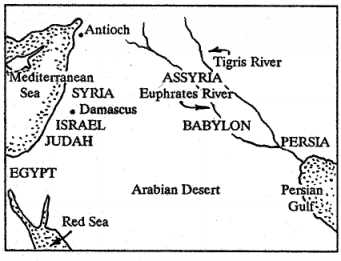
Old Testament records
Originally Syria was known as Aram, and some versions of the Bible consistently use ‘Aram’ rather than ‘Syria’ in the Old Testament narratives (see ARAM). The land included parts of Mesopotamia, along with various smaller kingdoms such as Zobah, Geshur and Hamath (Deu 23:4; Jdg 3:8; 1Sa 14:47; 2Sa 3:3; 2Sa 8:3; 2Sa 8:9). The capital of Syria during the time of its conflict with Israel was Damascus (1Ki 11:24; Isa 7:8; see DAMASCUS).
The ‘Israel’ with whom Syria fought was the northern part of the divided Israelite nation, as distinct from Judah, the southern part. Syria’s oppression of Israel began, it seems, during the reign of the Syrian king Ben-hadad I (1Ki 15:16-22).
During the reign of the next king, Ben-hadad II, a combined army of Syria and neighbouring states attacked the Israelite capital, Samaria, but was defeated twice (1Ki 20:1-31). The prophet Elisha on one occasion healed the commander-in-chief of the Syrian army, and on another was consulted when the Syrian king was ill (2Ki 5:1-14; 2Ki 8:7-8).
Ben-hadad II was assassinated by Hazael, who then seized the throne for himself. Hazael was a brutal enemy who repeatedly attacked Israel and butchered its people (2Ki 8:12-15; 2Ki 8:28; 2Ki 10:32; 2Ki 12:17; 2Ki 13:3; 2Ki 13:22; Amo 1:3-4). During the reign of the next king, Ben-hadad III, Israel regained much of the territory that it had lost to Hazael (2Ki 13:25). Syria continued to decline in power, and Israel at one stage took control of Damascus for a brief period (2Ki 14:28).
With the rise of Assyria to power, both Syria and Israel were in danger of being conquered. The Syrian king Rezin and the Israelite king Pekah combined to attack Judah, with the aim of forcing Judah into a three-nation alliance that might be able to withstand Assyria. But Judah appealed to Assyria for help, and Assyria responded by conquering Syria and much of Israel (2Ki 15:37; 2Ki 16:5-9; Isa 7:1-9; Isa 17:1-3). This marked the end of Syria as a separate and independent nation (732 BC).
Into the New Testament era
During the latter part of the fourth century BC, Alexander the Great established the Greek Empire throughout eastern Europe and western Asia. After Alexander’s death in 323 BC, the empire split into sectors under the control of Alexander’s Greek generals. One of these sectors was centred on Syria, and in 300 BC the city of Antioch was built as the administrative capital of the Syrian sector (see ANTIOCH IN SYRIA).
A dynasty of thirteen kings, most of them bearing the name Antiochus, reigned over Syria for about two and a half centuries. At first they commanded a large area stretching as far as Asia Minor in the west and Persia in the east. But over the years they consistently lost territory, till in the end they controlled only Syria itself. (For details of this era see GREECE.) Then, in 64 BC, they were conquered by Rome, and Syria became a province of the emerging Roman Empire (Luk 2:2).
Christianity first came to Syria through the efforts of Greek-speaking Jewish Christians who had been forced out of Jerusalem after the execution of Stephen (Act 8:1; Act 9:1-2; Act 9:10; Act 9:19; Act 11:19-20). Paul was converted in Syria and carried out his first recorded evangelistic ministry there (Act 9:1-22; Gal 1:21). He played an important part in the early growth of the church in Antioch (Act 11:19-26), and when opportunities arose he visited churches throughout the province (Act 15:41; Act 18:18-22).