
A place where the Jews meet to worship God.
The mode of conducting religious instruction and worship in the primitive Christian churches, was derived for the most part from the practice which anciently prevailed in synagogues. But there were no regular teachers in the synagogues, who were officially qualified to pronounce discourses before the people; although there were interpreters who rendered into the vernacular tongue, namely, the Hebraeo-aramean, the sections, which had been publicly read in the Hebrew.
The “synagogue preacher,”
The other persons who were employed in the services and government of the synagogue, in addition to the one who read the Scriptures, and the person who rendered them into the vernacular tongue, were as follows:
4. “The servants of the synagogue,”
Those who held some office in the church were the regularly qualified instructers in these religious meetings; and yet laymen had liberty to address their brethren on these occasions the same as in the synagogues; also to sing hymns, and to pray; which, in truth, many of them did, especially those who were supernaturally gifted, not excepting the women.
Those females who were not under a supernatural influence were forbidden by the Apostle Paul to make an address on such occasions, or to propose questions; and it was enjoined on those who did speak, not to lay aside their veils, 1Co 11:5; 1Co 14:34-40. The reader and the speaker stood; the others sat; all arose in the time of prayer. Whatever was stated in a foreign tongue was immediately rendered by an interpreter into the speech in common use. This was so necessary, that Paul enjoined silence on a person who was even endowed with supernatural gifts, provided an interpreter was not at hand, 1Co 14:1-33. It was the practice among the Greek Christians to uncover their heads when attending divine service, 1Co 11:11-16; but in the east, the ancient custom of worshipping with the head covered was retained. Indeed, it is the practice among the oriental Christians to the present day, not to uncover their heads in their religious meetings, except when they receive the eucharist.
It is affirmed that in the city of Jerusalem alone there were no less than four hundred and sixty or four hundred and eighty synagogues. Every trading company had one of its own, and even strangers built some for those of their own nation. Hence we find synagogues of the Cyrenians, Alexandrians, Cilicians, and Asiatics, appointed for such as came up to Jerusalem from those countries, Act 6:9.
Syn´agogue, a Jewish place of worship. The Greek, from which the word is immediately derived, denotes ’an assembly;’ but afterwards, by a natural deflection of meaning, came to designate the building in which such assembly met.
The precise age of the introduction of synagogues among the Israelites, it does not appear easy to determine. In all probability, however, they had their origin about the period of the exile; and there were then peculiar circumstances which called for their establishment. Deprived of the solemnities of their national worship, yet still retaining their religious convictions, and keenly feeling the loss they had endured, earnestly, too, longing and praying for a restoration of their forfeited privileges, the captive Israelites could not help meeting together for the purposes of mutual sympathy, counsel, and aid, or of prayer and other devout exercises. But prayer makes every spot holy ground. Some degree of secrecy, too, may have been needful in the midst of scoffing and scornful enemies. Thus houses of prayer would arise; and the peculiar form of the synagogue worship—namely, devotion apart from external oblations—would come into being.
The authority of the Talmudists (such as it is) would go to show that a synagogue existed wherever there were ten families. What, however, is certain is, that in the times of Jesus Christ synagogues were found in all the chief cities and lesser towns of Palestine. From Act 6:9, it appears that every separate tribe and colony had a synagogue in Jerusalem. Synagogues were built sometimes on the outside of cities, but more frequently within, and preferably on elevated spots. At a later period they were fixed near burial-places. A peculiar sanctity was attached to these spots, even after the building had fallen to ruin. In the Synagogue pious Israelites assembled every Sabbath and festival day, the women sitting apart from the men; and at a later period, on every second and fifth day of each week, for the purposes of common prayer, and to hear portions of the sacred books read; which was performed sometimes by anyone of the company (Luk 2:16), or, according to Philo, by anyone of the priests or elders, who expounded each particular as he proceeded. The writings thus read aloud and expounded were the Law, the Prophets, and other Old Testament books (Act 13:15; Act 15:21).
The expositor was not always the same person as the reader. A memorable instance in which the reader and the expositor was the same person, and yet one distinct from the stated functionary, may be found in Luk 4:16, sq., in which our Lord read and applied to himself the beautiful passage found in the prophecy of Isaiah (Isa 61:4).
After the reading and exposition were concluded, a blessing was pronounced, commonly by a priest. The people gave a response by uttering the word Amen; when the assembly broke up (1Co 14:16).
At the head of the officers stood the ’ruler of the synagogue.’ who had the chief direction of all the affairs connected with the purposes for which the synagogue existed (Luk 8:49; Luk 13:14; Mar 5:35, seq.; Act 18:8). Next in rank were the elders (Luk 7:3), called also ’heads of the synagogue’ (Mar 5:22; Act 13:15), as well as ’shepherds’ and ’presidents,’ who formed a sort of college or governing body under the presidency of the chief ruler. There was in the third place ’the angel of the church,’ who in the synagogue meetings acted commonly as the speaker, or as the Protestant minister, conducting the worship of the congregation, as well as performed on other occasions the duties of secretary and messenger. Then came, fourthly, ’the minister’ (Luk 4:20), the attendant who handed the books to the reader, was responsible for the cleanliness of the room, and for its order and decency, and opened and closed the synagogue, of which he had the general care. In addition, there probably were almoners or deacons (Mat 6:2), who collected, held, and distributed the alms of the charitable.
In regard to the furniture of the synagogue, seats merely are mentioned in the New Testament (Mat 23:6; Jas 2:3). The ’chief seats,’ or rather ’front seats,’ were occupied by the Scribes and Pharisees. The outfit may have been more simple in the days of Christ; still there was probably then, as well as at a later period, a sort of pulpit, and a desk or shelf, for holding the sacred books. Some sort of summary judicature seems to have been held in the synagogues, and punishments of flogging and beating inflicted on the spot (Mat 10:17; Mat 23:34; Mar 13:9; Luk 12:11; Luk 21:12; Act 22:19; Act 26:11; 1Co 11:22). The causes of which cognizance was here taken were perhaps exclusively of a religious kind. It certainly appears from the New Testament that heresy and apostasy were punished before these tribunals by the application of stripes.
A word which primarily signifies an assembly; but, like the word church, came at length to be applied to the buildings in which the ordinary Jewish assemblies for the worship of God were convened. From the silence of the Old Testament with reference to these places of worship, many commentators and writers of biblical antiquities are of opinion that they were not in use till after the Babylonish captivity; and that before that time, the Jews held their social meetings for religious worship either in the open air or in the houses of the prophets. See 2Ki 4:23 . In Psa 74:8, it is at least very doubtful whether the Hebrew word rendered synagogues, refers to synagogue-buildings such as existed after the captivity. Properly the word signifies only places where religious assemblies were held. In the time of our Savior they abounded.\par Synagogues could only be erected in those places when ten men of age, learning, piety, and easy circumstances could be found to attend to the service, which was enjoined in them. Large towns had several synagogues; and soon after the captivity their utility became so obvious, that they were scattered over the land, and became the parish churches of the Jewish nation. Their number appears to have been very considerable; and when the erection of a synagogue was considered a mark of piety, Luk 7:5, or a passport to heaven, we need not be surprised to hear that they were multiplied beyond all necessity, so that in Jerusalem alone there were not fewer than 460 or 480. They were generally built on the most elevated ground, and consisted of two parts. The westerly part of the building contained the ark or chest in which the book of the law and the section of the prophets were deposited, and was called the temple by way of eminence. The other, in which the congregation assembled, was termed the body of the synagogue. The people sat with their faces towards the temple, and the elders in the contrary direction, and opposite to the people; the space between them being occupied by the pulpit or reading desk. The seats of the elders were considered more holy than the others, and are spoken of as "the chief seats in the synagogues," Mat 23:6 . The women sat by themselves in a gallery secluded by latticework.\par The stated office-bearers in every synagogue were ten, forming six distinct classes. We notice first the Archisynagogos, or ruler of the synagogue, who regulated all its concerns and granted permission to address the assembly. Of these there were three in each synagogue. Dr. Lightfoot believes them to have possessed a civil power, and to have constituted the lowest civil tribunal, commonly known as "the council of three," whose office it was to judge minor offences against religion, and also to decide the differences that arose between any members of the synagogue, as to money matters, thefts, losses, etc. To these officers there is perhaps an allusion in 1Co 6:5 . See also JUDGMENT. The second officer-bearer was "the angel of the synagogue," or minister of the congregation, who prayed and preached. In allusion to these, the pastors of the Asiatic churches are called "angels," Jer 2:3 .\par The service of the synagogue was as follows: The people being seated, the "angel of the synagogue" ascended the pulpit, and offered up the public prayers, the people rising from their seats, and standing in a posture of deep devotion, Mat 6:5 Mar 11:25 Luk 18:11,13 . The prayers were nineteen in number, and were closed by reading the execration. The next thing was the repetition of their phylacteries; after which came the reading of the law and the prophets. The former was divided into fifty-four sections, with which were united corresponding portions from the prophets; (see Mal 13:15,27 15:21) and these were read through once in the course of the year. After the return from the captivity, an interpreter was employed in reading the law and the prophets, Neh 8:2-8, who interpreted them into the Syro-Chaldaic dialect, which was then spoken by the people. The last part of the service was the expounding of the Scriptures, and preaching from them to the people. This was done either by one of the officer, or by some distinguished person who happened to be present. The reader will recollect one memorable occasion on which our Savior availed himself of the opportunity thus afforded to address his countrymen, Luk 4:20 ; and there are several other instances recorded of himself and his disciples teaching in the synagogues. See Mat 13:54 Mar 6:2 Joh 18:20 Mal 13:5,15,44 14:1 17:2-4,10 18:4,26 19:8. The whole service was concluded with a short prayer or benediction.\par The Jewish synagogues were not only used for the purposes of divine worship, but also for courts of judicature, in such matters as fell under the cognizance of the Council of Three, of which we have already spoken. On such occasions, the sentence given against the offender was sometimes, after the manner of prompt punishment still prevalent in the East, carried into effect in the place where the council was assembled. Hence we read of persons being beaten in the synagogue, and scourged in the synagogue, Mat 10:17 Mar 13:9 Mal 22:19 26:11 2Co 11:24 . To be "put out of the synagogue," or excommunicated from the Jewish church and deprived of the national privileges, was punishment much dreaded, Joh 9:22 12:42 16:2. In our own day the Jews erect synagogues wherever they are sufficiently numerous, and assemble on their Sabbath for worship; this being conducted, that is, the reading or chanting of the Old Testament and of prayers, in the original Hebrew, though it is a dead language spoken by few among them. Among the synagogues of Jerusalem, now eight or ten in number, are some for Jews of Spanish origin, and others for German Jews, etc., as in the time of Paul there were separate synagogues for the Libertines, Cyreians, Alexandrians, etc., Mal 6:9 .\par
Synagogue. History. -- The word synagogue (sunagoge), which means a "congregation", is used, in the New Testament, to signify a recognized place of worship. A knowledge of the history and worship of the synagogues is of great importance, since, they are the characteristic institution of the later phase of Judaism. They appear to have arisen during the exile, in the abeyance of the Temple-worship, and to have received their full development, on the return of the Jews from captivity. The whole history of Ezra presupposes the habit of solemn, probably of periodic, meetings. Ezr 8:15; Neh 8:2; Neh 9:1; Zec 7:5.
After the Maccabaean struggle for independence, we find almost every town or village had its one or more synagogues. Where the Jews were not in sufficient numbers to be able to erect and fill a building, there was the proseucha (proseuche), or place of prayer, sometimes open, sometimes covered in, commonly by a running stream, or on the seashore, in which devout Jews and proselytes met to worship, and perhaps to read. Act 16:13 Juven. Sat. Iii. 296. It is hardly possible to overestimate the influence of the system thus developed. To it, we may ascribe the tenacity with which, after the Maccabaean struggle, the Jews adhered to the religion of their fathers, and never again relapsed into idolatry.
Structure. -- The size of a synagogue varied with the population. Its position was, however, determinate. It stood, if possible, on the highest ground, in or near the city to which it belonged. And its direction too was fixed. Jerusalem was the Kibleh of Jewish devotion. The synagogue was so constructed that the worshippers, as they entered and as they prayed, looked toward it. The building was commonly erected at the cost of the district. Sometimes, it was built by a rich Jew, or even, as in Luk 7:5, by a friend or proselyte.
In the internal arrangement of the synagogue, we trace an obvious analogy to the type of the Tabernacle. At the upper or Jerusalem end stood the ark, the chest which, like the older and more sacred Ark, contained the Book of the Law. It gave to that end, the name and character of a sanctuary. This part of the synagogue was naturally the place of honor. Here were the "chief seats," for which Pharisees and scribes strove so eagerly, Mat 23:6, and to which the wealthy and honored worshipper was invited. Jas 2:2-3.
Here too, in front of the ark, still reproducing the type of the Tabernacle, was the eight-branched lamp, lighted only on the greater festivals. Besides this, there was one lamp kept burning perpetually. More toward the middle of the building was a raised platform, on which several persons could stand at once, and in the middle of this, rose a pulpit, in which the reader stood to read the lesson, or sat down to teach.
The congregation were divided, men on one side, women on the other, with a low partition, five or six feet high, running between them. The arrangements of modern synagogues, for many centuries, have made the separation more complete by placing the women in low side galleries, screened off a lattice-work.
Officers. -- In smaller towns, there was often, but one rabbi. Where a fuller organization was possible, there was a college of elders, Luk 7:3, presided over by one, who was "the chief of the synagogue." Luk 8:41; Luk 8:49; Luk 13:14; Act 18:8; Act 18:17. The most prominent functionary, in a large synagogue, was known as the sheliach, (legatus).
The officiating minister, who acted as the delegate of the congregation, and was, therefore, the chief reader of prayers, etc., in their name. The chazzan, or "minister" of the synagogue, Luk 4:20, had duties of a lower kind, resembling those of the Christian deacon, or sub-deacon. He was to open the doors, and to prepare the building for service. Besides these, there were ten men attached to every synagogue, known as the ballanim, (otiosi). They were supposed to be men of leisure, not obliged to labor for their livelihood, able, therefore, to attend the week-day as well as the Sabbath services. The legatus of the synagogues appears in the angel, Rev 1:20; Rev 2:1, perhaps, also in the apostle of the Christian Church.
Worship. -- It will be enough, in this place, to notice in what way, the ritual, no less than the organization, was connected with the facts of the New Testament history, and with the life and order of the Christian Church. From the synagogue, came the use of fixed forms of prayer. To that, the first disciples had been accustomed from their youth. They had asked their Master to give them a distinctive one, and he had complied with their request, Luk 11:1, as the Baptist had done before for his disciples, as every rabbi did for his.
"Moses" was "read in the synagogues every Sabbath day," Act 15:21, the whole law being read consecutively, so as to be completed, according to one cycle, in three years. The writings of the prophets were read, as second lessons, in a corresponding order. They were followed by the derash, Act 13:15, the exposition, the sermon of the synagogue.
The conformity extends, also, to the times of prayer. In the hours of service, this was obviously the case. The third, sixth and ninth hours were in the times of the New Testament, Act 3:1; Act 10:3; Act 10:9 , and had been, probably, for some time before, Psa 55:17; Dan 6:10, the fixed times of devotion. The same hours, it is well known, were recognized in the Church, of the second century, probably, in that of the first also.
The solemn days of the synagogue were the second, the fifth and the seventh, the last, or Sabbath, being the conclusion of the whole. The transfer of the sanctity of the Sabbath to the Lord’s Day involved a corresponding change in the order of the week, and the first, the fourth, the sixth, became to the Christian society what the other days had been to the Jewish.
From the synagogue, lastly, come many less conspicuous practices, which meet us in the liturgical life of the first three centuries: Ablution, entire or partial, before entering the place of meeting, Joh 13:1-15; Heb 10:22; standing, and not kneeling, as the attitude of prayer, Luk 18:11; the arms stretched out; the face turned toward the Kibleh of the east; the responsive, amen, of the congregation to the prayers and benedictions of the elders. 1Co 14:16.
Judicial functions. -- The language of the New Testament shows that the officers of the synagogue exercised, in certain cases, a judicial power. If is not quite so easy, however, to define the nature of the tribunal, and the precise limits of its jurisdiction. In two of the passages referred to -- Mat 10:17; Mar 13:9 -- they are carefully distinguished from the councils. It seems probable that the council was the larger tribunal of twenty-three, which sat in every city, and that, under the term, synagogue, we are to understand a smaller court, probably that of the ten judges, mentioned in the Talmud.
Here also, we trace the outline of a Christian institution. The Church, either by itself, or by appointed delegates, was to act as a court of arbitration, in all disputes its members. The elders of the church were not, however , to descend to the trivial disputes of daily life. For the elders, as for those of the synagogue, were reserved the graver offences, against religion and morals.
Hebrew
Jehoshaphat’s mission of priests and Levites (2Ch 17:7-9) implies there was no provision for regular instruction except the septennial reading of the law at the feast of tabernacles (Deu 31:10-13). In Psa 74:4; Psa 74:8 (compare Jer 52:13; Jer 52:17, which shows that the psalm refers to the Chaldaean destruction of the sanctuary) the "congregations" and "synagogues "refer to the tabernacle or temple meeting place between God and His people; "
Synagogues in the strict and later sense are not mentioned until after the desecration of the temple by Antiochus Epiphanes. The want of the temple in the Babylonian captivity familiarized the exiles with the idea of spiritual worship independent of locality. The elders often met and sat before the prophet, Ezekiel to hear Jehovah’s word (Eze 8:1; Eze 11:15-16; Eze 14:1; Eze 20:1); in Eze 33:31 the people also sit before him to hear. Periodic meetings for hearing the law and the prophets read were customary thenceforth on the return (Ezr 8:15; Neh 8:2; Neh 9:1; Zec 7:5; Act 15:21). When the Jews could not afford to build a synagogue they built "an oratory" (
The synagogue required no priest to minister; this and the reading of the Old Testament prepared the way for the gospel. Sometimes a wealthy Jew or a proselyte built the synagogue (Luk 7:5). The
The elders were called
There were also the ten
The prophets were similarly read as second lessons; the exposition (
Preparatory ablutions (Heb 10:22; Joh 13:1-15; Tertullian, Orat. 11), standing in prayer, not kneeling (Luk 18:11; Tertullian 23), the arms stretched out (Tertullian 13), the face toward the E. (Clemens Alex., Strom.), the Amen in responses (1Co 14:16), the leaping as if they would rise toward heaven in the Alexandrian church (Clemens Alex., Strom. 7:40) as the Jews at the tersanctus of Isaiah 6 (Vitringa 1100, Buxtorf 10), are all reproductions of synagogue customs. However the Hebrew in prayer wears the
The Great Synagogue (Mar 7:3 "the elders"; Mat 5:21-27; Mat 5:33, "they of old time") is represented in the rabbinical book,
The only Old Testament notice of anything like such a body is Neh 8:13, "chiefs of the fathers of all the people, the priests; and the Levites ... Ezra the scribe" presiding. The likelihood is that some council was framed at the return from Babylon to arrange religious matters, the forerunner of the Sanhedrin. Vitringa’s work on the synagogue, published in 1696, is the chief authority. In the last times of Jerusalem 480 synagogues were said to be there (see Act 6:9). Lieut. Conder found by measurement (taking the cubit at 16 in.) that a synagogue was 30 cubits by 40, and its pillars 10 ft. high exactly.
There are in Palestine eleven specimens of synagogues existing; two at Kefr Bir’im, one at Meiron, Irbid, Tell Hum, Kerazeh, Nebratein, two at El Jish, one at Umm el ’Amed, and Sufsaf. In plan and ornamentation they are much alike. They are not on high ground, nor so built that the worshipper on entering faced Jerusalem, except that at Irbid, The carved figures of animals occur in six out of the eleven. In all these respects they betray their later origin, as vitally differing from the known form of synagogue and tenets of the earlier Jews. Their erection began probably at the close of the second century, the Jews employing Roman workmen, at the dictation of Roman rulers in the time of Antoninus Pins and Alexander Severus, during the spiritual supremacy of the Jewish patriarch of Tiberias.
Synagogue. A place of public worship for Jews. Greek term means a congregation. Synagogues were instituted after the exile by Ezra and Nehemiah. See Act 15:21: "For Moses of old time hath in every city them that preach him, being read in the synagogues every sabbath day." In the later periods of Jewish history synagogues were not only found in all the chief cities and lesser towns in Syria, but in the principal cities of the Roman empire. Mar 1:21; Act 6:9; Act 9:2-20; Luk 7:5. The establishment of these synagogues providentially prepared the way for the preaching of the gospel. As any one who happened to be present was at liberty to read and expound the sacred books, Act 13:14-15; Act 15:21, this privilege afforded our Lord and his disciples many opportunities for preaching the gospel of the kingdom in the various synagogues. Isa 61:4; Luk 4:16; Luk 4:28; Mat 13:54; Mar 6:2; Joh 18:20; Act 13:5-44; Act 14:1; Act 17:2; Act 17:17; Act 18:4; Act 18:26; Act 19:8. The "ruler of the synagogue" granted permission to read or speak. Luk 8:49; Luk 13:14; Mar 5:35; Act 18:8. The "minister," answering nearly to the modern sexton of the synagogue, was the attendant who handed the books to the reader, and opened and closed the synagogue. Luk 4:20. The "elders" of the synagogue preserved order in the assembly, Luk 7:3; Mar 5:22; Act 13:15, and appear also to have constituted the lowest tribunal, which took cognizance mainly of religious matters, and sometimes inflicted the punishment. Mat 10:17; Mat 23:34; Mar 13:9; Luk 12:11; Luk 21:12; Joh 16:2; Act 22:19; Act 26:11. Ruins of synagogues, in several places in Palestine, have been found.
This word occurs but once in the A.V. of the Old Testament, Psa 74:8, but the same Hebrew word (moed ) is many times translated ’congregation.’ Mr. Darby, and the R.V. margin translate in Psa 74:8 "places of assembly." The word
In the exploration of Palestine remains of buildings have been discovered, which are judged to have been synagogues. They are uniform in plan, and differ from the ruins of churches, temples, and mosques. In two of them an inscription in Hebrew was over the main entrance, one in connection with a seven-branched candlestick, and the other with figures of the paschal lamb. A plain rectangular building answered the purpose. They were often erected by general contributions, though at times by a rich Jew, or in some instances by a Gentile, as the one built by the centurion at Capernaum. Luk 7:5.
An ark was placed at one end, in which were deposited the sacred books. Near this was the place of honour, or the ’chief seats,’ which some sought after, Mat 23:6, and Jas 2:2-3 (where the word translated ’assembly’ is ’synagogue’). Nearer the centre of the building was a raised platform with a kind of desk or pulpit, where the reader stood. A screen separated the women from the men.
It is known that a portion of the law and of the prophets was read every Sabbath, and it is clear from Act 13:15 that if any one was present who had a "word of exhortation for the people," the opportunity was given for its delivery. Prayers also were doubtless offered, but how far these resembled the modern Jewish ritual is not known. The Lord spoke of the hypocrites who loved to pray standing in the synagogues, where they also ostentatiously offered their alms. Mat 6:2; Mat 6:5.
It was the custom of the Lord to visit the synagogues, and in them He wrought some of His miracles and taught the people. Mat 4:23. In Luke 4 the Lord, in the synagogue at Nazareth, stood up to read, and there was handed to Him the book of the prophet Isaiah. After reading a portion which set forth His own attitude among them (stopping in the middle of a sentence), He sat down and spake "gracious words" to them. His exposition of the passage is not given except "This day is this scripture fulfilled in your ears." It is recorded that the people were in the habit of freely expressing their opinions respecting what was taught, and here they said, "Is not this Joseph’s son?" In Act 13:45 the Jews "spake against those things which were spoken by Paul, contradicting and blaspheming."
Paul also was permitted to speak in the synagogue at Damascus, when he showed the Jews that Jesus was the Son of God, Act 9:20; and often afterwards he ’reasoned’ or ’disputed’ (
It is important to see that everywhere in their own buildings a clear testimony was borne by the Lord Himself as to the significance of His appearance among them; and afterwards by Paul and others to the work He had accomplished by His death and resurrection for them - reference being constantly made to the scriptures which they professed to reverence and to follow. The reality of the testimony was happily proved by the salvation of many, and which left those who refused it without excuse.
To be "put out of the synagogue" was the Jewish excommunication. The Lord told His disciples that this would be enforced towards them. Joh 9:22; Joh 16:2. The only case recorded is that of the man born blind, when he bore testimony to Christ. It was a happy exchange for him, for the Lord thereupon revealed Himself to him as the Son of God. Joh 9:34-38. Of others we read that many of the chief rulers believed on the Lord, but feared to confess Him lest they should be cast out, "for they loved the praise of men more than the praise of God." Joh 12:42-43.
It is evident from what Pilate said to the Jews in reference to the Lord - "Take ye him, and judge him according to your law" - that they were allowed to judge certain matters and to inflict limited punishments. Joh 18:31. This appears to have been carried out wherever there was a synagogue, though it is not clear who were the judges, probably the ’elders’ mentioned in Luk 7:3. The Lord told His disciples that they would be scourged in the synagogues, Mat 10:17; and Paul confessed that when persecuting the church he had imprisoned and beaten in every synagogue those that believed on the Lord. Act 22:19. Paul himself doubtless suffered the like punishment in the same buildings. 2Co 11:24. Thus a very undignified use was made of their places of worship.
The officials connected with the synagogues were
1. the zaqenim,
2. an
3. the sheliach, a delegate of the congregation, who acted as chief reader: he is not mentioned in the New Testament.
4. the chazzan,
5. the batlanim, described as ’leisure men,’ who attended meetings regularly. There were at least ten of these attached to each synagogue, so as to form a quorum, ten being the lowest number to form a congregation.
SYNAGOGUE OF SATAN. Some who professed, like Jews, to have a claim to be considered the people of God on the ground of hereditary right. These are declared to be liars, for they really form a congregation of Satan, doing his work in seducing the saints from their heavenly character. Rev 2:9; Rev 3:9. In both cases they may be Jews actually, though disowned of God.
SYNAGOGUE
1. The name.—
2. Origin and history.—In NT times the institution of the synagogue was popular and widespread, and was believed to date back ‘from generations of old’ (Act 15:21); but few materials are available for assistance in the attempt to trace its actual history, and its origin can only be conjectured. Later traditions (e.g. Pal.
4. Site, architecture, equipment.—Two rules as to the building of synagogues require that they should stand on an elevated site, and, like the Temple, be entered from the east. The Galilaean ruins show that these rules were not followed in the 1st cent. in Palestine; for the ruins do not occupy prominent positions, and in every instance except one the entrance is from the south. In different countries the local style of architecture was adopted, and there never was any style peculiar to synagogues. In Palestine, as the ruins indicate, Graeco-Roman influences can be traced, with an over-elaboration of ornament that was rather Oriental in its character. The building proper consisted of a quadrilateral, divided into three or five aisles by means of two or four rows of pillars. Admission was gained through three doors, in front of which was sometimes a highly decorated portico. Of the equipment the most important item was the press or ark containing the sacred writings. Above it was a canopy, and in front a curtain; and each of the rolls was wrapped in an embroidered cloth. In small synagogues, near the ark, which stood probably against the wall opposite the entrance, was a raised tribune, furnished with a lectern for the reader and a chair for the speaker (Luk 4:20). In larger buildings this platform was brought forward nearly to the centre. The chief seats (Mat 23:6, Mar 12:39, Luk 11:43; Luk 20:46) were in front of the platform and ark, or in larger synagogues at the further end of the building, opposite the doors, and in either case faced the congregation, who generally sat on chairs or mats arranged across the building, sometimes lengthways, with an open space between the first ranks on either side. Lamps were a regular part of the furniture, and were probably in use in our period, since two early traditions refer to the oil that was burnt and to the custom of keeping the lamps lighted through the Day of Atonement (Terumoth, xi. 10; Pesachim, iv. 4). The adoption of a screened gallery or even of separate seats for women was a late arrangement, and not the custom in our period. No such rule occurs in the Talmud or other ancient source, whilst the evidence points to the actual participation of women in the synagogal service (cf. JBL
6. The synagogue as a place of worship.—Before the destruction of the Temple the ordinary services were simpler than they afterwards became; but the order followed generally the rule prescribed at a later date in the Mishna (Meg. iv. 3). Of the four principal parts (a) the first was the Shema‘ (so called from the opening word of Deu 6:4, which should read ‘Hear, O Israel; the Lord our God, the Lord is one,’ as cited in Mar 12:29), with introductory and closing benedictions. It is true that this verse is cited in the NT without any mention of its liturgical use; but other evidences point to a contrary conclusion. The Shema‘ comprised altogether Deu 6:4-9; Deu 11:13-21 and Num 15:37-41, in which the wearing of frontlets and fringes is prescribed as a symbolic reminder of legal obligations. That these injunctions were interpreted literally by the zealous legalists of our Saviour’s time is shown by His references to the wearing of phylacteries (Mat 23:5). This practice is difficult to explain except on the assumption that the passages quoted in justification were supposed to be invested with special sanctity. Both customs may be confidently referred to the period of the ascendency of the Ḥasidim, a century and more before the birth of Christ; and the recitation of the Shema‘ with its accompanying ritual was a confession, both of faith in the unity of God and of the imperative obligation to keep His Law. (b) What prayers originally followed the recitation of the Shema‘, it is impossible at present to say. Those adopted at a later time would be inappropriate before the destruction of the Temple, the memory of which colours several of the phrases. From the example of the Baptist in teaching his disciples to pray, and from the request for similar instruction addressed to Jesus (Luk 11:1), it may be inferred that forms of prayer were not yet familiar to the Jews, and possibly that a disposition towards the adoption of such forms was now arising. Psalms or selections may have been used; but the time had apparently not yet come for anything more, (c) The reading of extracts from the Law and the Prophets was the central part of the synagogal worship on the Sabbath day. That this was customary in NT times appears from many passages (e.g. Luk 4:17, cf. Act 13:15; Act 15:21, 2Co 3:15). The sections of the Law were apportioned among several members of the congregation, any male who was acquainted with Hebrew being eligible. Next a passage was read from the Prophets by any one upon whom the choice of the ruler of the synagogue fell. Eventually an official lectionary was adopted, so arranged that the reading of the Pentateuch was completed in a year, the section from the Prophets being selected as far as possible with a view to enforce the lesson of that from the Law; but in the time of Christ the reader of the Prophetic section seems to have been at liberty to select whatever part he liked (Luk 4:17). (d) With the reading of the Scripture the service proper terminated. Gradually, as Hebrew ceased to be a spoken language, it was found necessary to translate the lessons into Aramaic or Greek or whatever might be the vernacular of the congregation. For this purpose an interpreter (methurgeman) was employed, or the schoolmaster or any competent man amongst the audience acted in his stead. The lesson from the Law was paraphrased verse by verse, that from the Prophets by three verses at a time (Meg. iv. 4). These paraphrases were not literal translations, but rather condensed interpretations, of a passage, and mark an important stage in the history of preaching. The next development was an extended exposition, which was the usage in NT times (Mat 4:23, Mar 1:21; Mar 6:2, Luk 6:6, Joh 18:20). The instruction was didactic rather than rhetorical, as may be inferred from the sitting posture (Luk 4:20, cf. Mat 5:1; Mat 26:55, Joh 8:2); and though naturally the Rabbis were looked to for such service, they had not yet become a class of professional preachers, but any distinguished stranger (cf. Act 13:15), or even any ordinary member of the community, might be invited to give an address.
7. The synagogue school.—The OT ideal makes parents responsible for the education of their children, and draws an idyllic picture of the father and the son turning every opportunity to profit for instruction in religion and in duty (Deu 6:7). Such an arrangement was suitable only to primitive times (cf. § 2); and as trade extended, and the father’s absence from home became necessary and frequent, the need of public elementary schools made itself felt. The main idea of the synagogue service was originally instruction rather than worship, for which in its associated forms the Temple was provided, and in its intimate forms privacy could be secured. Not only does the NT make teaching the chief function, but Philo in one place (Mangey, ii. 168) almost protests against synagogues being regarded as other than schools. The adults in their regular services educated themselves in the Law, and strengthened the social as well as the private sense of obligation. The children were gathered regularly for instruction of a similar kind in the synagogue itself or an adjoining room, under the care of the hazzan, or, in larger centres of population, of a professional teacher. For advanced studies and for technical Jewish training, provision was made in some of the towns or near the residence of some distinguished Rabbi; but everywhere the elementary school was an inseparable adjunct of the synagogue. See artt. Boyhood (Jewish), and Education.
8. The synagogue as a court.—Under the strict conception of a theocracy there can be no distinction between things ecclesiastical and things civil. Hence, in places where the population was preponderantly Jewish, local administration was in the hands of a court, which took cognizance of all the Jewish interests of the neighbourhood, and of which the Roman over-rule was apt to avail itself for both executive and minor judicial business. Where the Jews were outclassed in numbers or influence, the synagogal authority was proportionately reduced, though without any loss of respect within the Jewish community. If there were several synagogues in a Jewish town, all were knit together into some kind of organization, under a controlling council which regulated also all the civil affairs of the community. The case of a town with but a single synagogue was simpler, but not radically distinct. Here the council, or local Sanhedrin (Mat 5:22; Mat 10:17, Mar 13:9), met in the synagogue, where their plans were matured, their decisions taken, and often their penalties exacted. The court proper consisted of twenty-three members where the population was considerable, elsewhere of seven; and this college of elders (Luk 7:3) or rulers (Mat 9:18; Mat 9:23, Luk 8:41) exercised a wide jurisdiction. For minor offences (Makkoth iii. 1) the penalty was scourging (Mat 10:17; Mat 23:34, cf. Act 22:19; not to be confused with the Roman penalty of scourging of Mat 20:19 and Joh 19:1), limited to forty stripes save one (cf. 2Co 11:24), and administered in the synagogue by the hazzan. Excommunication was the punishment of offences that were thought to imperil the stability of the Jewish community (Luk 6:22, Joh 9:22; Joh 12:42; Joh 16:2). See art. Excommunication in vol. i. p. 559a.
9. Other uses of the synagogue.—There are indications in early Jewish literature, belonging some of them to the 1st cent., that the synagogue served also the purposes of a public hall or general meeting-place, and regulations for its reverent treatment were gradually adopted. Notices respecting the interests of the community at large, or even of private members, were given there (Baba mezia, 28b). It was the place for funeral orations over the death of men of distinction, and at a later period could be used for some of the ceremonies of private mourning (ib.). Josephus says (Vita, 54) that political meetings were held in the synagogues at the time of the war against Rome. They became increasingly a common meeting-ground for the Jews of the neighbourhood, where their affairs might be discussed informally or in a summoned assembly, and a variety of matters might be conveniently settled. Thus a secularizing—or, from a Jewish point of view, a communal—tendency developed, such as had already shown itself in the case of the courts of the Temple (Mat 21:12, Mar 11:15, Joh 2:14 ff.); and arrangements had eventually to be made in the interest of decorum. People were forbidden to discuss trifles on the premises of a synagogue, or to walk aimlessly about, to shelter there from the heat or rain, to come in with soiled shoes or garments, or to make a thoroughfare of the courts. Some of these regulations are of a later date than the Gospels, but their necessity arose from habits that were already becoming fixed. The synagogue was not only a place of authoritative instruction in the Law, but the centre of the Jewish life of a district, and, as such, its purposes were determined by both social and racial needs.
10. Financial administration.—Most of the officials of the synagogue were honorary; but the schoolmaster and the attendant would require at least partial support, whilst the cost of erection, with that of repairs and maintenance, must have been considerable, to say nothing of the fees paid at a later period to ‘ten unemployed men’ as the minimum of a congregation. It is a problem, for the settlement of which sufficient materials are not at present available, how these expenses were met. In some cases a wealthy man, Jew or Gentile, wishing to ingratiate himself with the people or out of pure kindness, may have provided a synagogue (cf. Luk 7:5; Jos.
Literature.—Of the works cited in Hasting’s Dictionary of the Bible , Schürer is still the most important. The German edition is the best; the reference to the English translation is n.
R. W. Moss.
By: Wilhelm Bacher, Lewis N. Dembitz
Established During the Exile.
The origin of the synagogue, in which the congregation gathered to worship and to receive the religious instruction connected therewith, is wrapped in obscurity. By the time it had become the central institution of Judaism (no period of the history of Israel is conceivable without it), it was already regarded as of ancient origin, dating back to the time of Moses (see Yer. Targ., Ex. xviii. 20 and I Chron. xvi. 39; Pesiḳ. 129b; Philo, "De Vita Mosis," iii. 27; Josephus, "Contra Ap." ii., § 17; Acts xv. 21). The "house of the people" (Jer. xxxix. 8 [Hebr.]) is interpreted, in a midrash cited by Rashi and Ḳimḥi (ad loc.), as referring to the synagogue, and "bet 'amma," the Aramaic form of this phrase, was the popular designation in the second century for the synagogue (Simeon b. Eleazar, in Shab. 32a). The synagogue as a permanent institution originated probably in the period of the Babylonian captivity, when a place for common worship and instruction had become necessary. The great prophet, in the second part of the Book of Isaiah, in applying the phrase "house of prayer" to the Temple to be built at Jerusalem (Isa. lvi. 7 and, according to the very defensible reading of the LXX., also lx. 7), may have used a phrase which, in the time of the Exile, designated the place of united worship; this interpretation is possible, furthermore, in such passages as Isa. lviii. 4. The term was preserved by the Hellenistic Jews as the name for the synagogue (
After the return from the Captivity, when the religious life was reorganized, especially under Ezra and his successors, congregational worship, consisting in prayer and the reading of sections from the Bible, developed side by side with the revival of the cult of the Temple at Jerusalem, and thus led to the building of synagogues. The place of meeting was called "bet ha-keneset," since an assembly of the people for worship was termed a "keneset"; the assembly described in Neh. ix.-x. was known in tradition as the "great assembly" ("keneset ha-gedolah"; see Synagoġue, The Great). The synagoguecontinued to be known by this name, although it was called also, briefly, "keneset" (Aramaic, "kanishta"), and, in Greek,
Spread of Synagogues.
The synagogues of Palestine are first mentioned in Ps. lxxiv., in which the words "mo'ade el" (verse 8) were interpreted as meaning "synagogue" as early as Aquila, although strictly it connotes merely a place of assembly (comp. "bet mo'ed," Job xxx. 23; "bet wa'ad," Ab. i. 4). Neither of the first two books of the Maccabees, however, mentions the burning of the synagogues of the country during the persecutions by Antiochus. The synagogue in the Temple at Jerusalem is mentioned in halakic tradition (see Yoma vii. 1; Soṭah vii. 7, 8; Tosef., Suk. iv.). According to one legend, there were 394 synagogues at Jerusalem when the city was destroyed by Titus (Ket. 105), while a second tradition gives the number as 480 (Yer. Meg. 73d et al.). Other passages give the additional information that the foreign Jews at Jerusalem had their own synagogues. Thus there was a synagogue of the Alexandrian Jews (Tosef., Meg. ii.; Yer. Meg. 73d); this synagogue is mentioned in Acts vi. 9 (comp. ix. 29), which refers also to the synagogues of the Cyrenians, Cilicians, and Asiatics. Josephus mentions both the synagogue built by Agrippa I. at Dora ("Ant." xix. 6, § 3) and the great synagogue at Tiberias, in which, during the war against Rome, political meetings were once held on the Sabbath and the following days ("Vita," § 54). The synagogue of Cæarea rose to importance during the inception of this uprising (Josephus, "B. J." ii. 14, §§ 4-5); it was called the "revolutionary synagogue" ("kenishta di-meradta") as late as the fourth century (see Grätz, "Gesch." 2d ed., iv. 313).
The evangelists refer to the synagogues of Nazareth (Matt. xiii. 54; Mark vi. 2; Luke iv. 16) and Capernaum (Mark i. 21; Luke vii. 5; John vi. 59) as places where Jesus taught. There are but few details given in traditional literature concerning the other synagogues of Palestine, although mention is made of those in Beth-shean (Scythopolis; Yer. Meg. 74a), Cæsarea (Yer. Bik. 65d; see above), Kefar Tiberias (Pesiḳ. R. 196b), Kifra, or Kufra (Yer. Ta'an. 68b; Meg. 70a), Lydda (Yer. Sheḳ. v., end), Maon (Shab. 139a; Zab. 118b), Sepphoris (Pesiḳ. 136b [the great synagogue]; Yer. Ber. 9a; Yer. Shab. 8a [the Synagogue of the Babylonians]; Yer. Ber. 6a [the Synagogue of the Vine]), Tiberias (Ber. 8a, 30b [thirteen synagogues]; Yer. Ta'an. 64a [the Synagogue of the
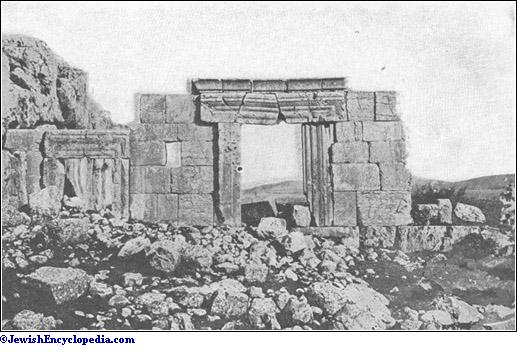
Ruins of an Ancient Synagogue at Meron.(From a photograph by the Palestine Exploration Fund.)
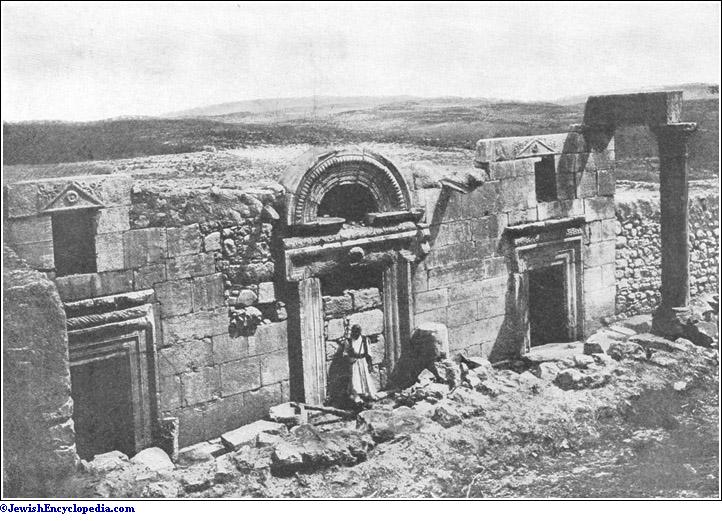
Ruins of an Ancient Synagogue at Kafr Bir'im, the Most Perfect Remains of a Synagogue in Palestine.(From a photograph by the Palestine Exploration Fund.)
The earliest document relating to the settlement of the Jews in Egypt and their adoption of Ḥellenic customs was discovered in 1902. This is a marble slab with the following inscription in Greek: "In honor of King Ptolemy and Queen Berenice, his sister and wife, and their children, the Jews [dedicate] this synagogue" (
In Syria the great synagogue of Antioch was famous; to it, according to Josephus ("B. J." vii. 3, § 3), the successors of Antiochus Epiphanes presented the bronze votive offerings which had been taken from Jerusalem. Its site was occupied in the fourth century by a Christian basilica dedicated to the Maccabean martyrs (the seven brothers mentioned in II and IV Maccabees [see Cardinal Rampolla in "Rev. de l'Art Chrétien," 1899, p. 390]). The apostle Paul preached in various synagogues in Damascus (Acts ix. 20). In the account of his journeys through Asia Minor, Macedonia, and Greece he mentions synagogues at Antioch in Pisidia, Iconium, Ephesus, Philippi, Thessalonica, Berœa, Athens, Corinth, and Salamis (several synagogues; Acts xiii. 5, 14; xiv. 1; xvi. 13; xvii. 1, 10, 17; xviii. 4, 7).
Philo speaks of the synagogues of the capital of the Roman empire at the time of Augustus ("De Legatione ad Caium," § 23); and the inscriptions show that Rome contained a synagogue named in honor of the emperor Augustus, another called after Agrippa, and a third after a certain Volumnus. One synagogue received its name from the Campus Martius, and one from the Subura, a populous quarter of Rome; while another was termed "the Synagogue of the Olive-Tree." The inscriptions refer even to a synagogue of "the Hebrews," which belonged probably to a community of Jews who spoke Hebrew or Aramaic. The synagogue of Severus at Rome is mentioned in an ancient literary document dealing with the variant readings in a copy of the Pentateuch (see Schürer, "Gesch." 3d ed., iii. 44 et seq.; Berliner, "Gesch. der Juden in Rom," i. 62 et seq.).
The ruins of a synagogue were discovered in 1883 at Hammam-Lif, near Carthage. A Latin inscription was found in the outer court, while a mosaic with an inscription, and picturing various animals and the seven-branched candle-stick, was set in the floor of the synagogue itself ("R. E. J." xiii. 45-61, 217-223). Remains of ancient synagogues, some of which date from the second or, perhaps, even from the first century of the common era, have been found in various localities of northern Galilee, in the vicinity of Lake Merom, and on the shores of Lake Gennesaret (see Renan, "Mission de Phénicie," pp. 761-783). The best preserved of these ruins are those of Kafr Bir'im; while those of Ḳaṣyun contain a Greek inscription from the reign of the emperor Septimius Severus. These Galilean ruins are especially important as showing the architecture of the ancient Palestinian synagogues, which bears general traces of Greco-Roman influence, although it has not surrendered its individuality (see Schürer, l.c. ii. 462). It may be noted here that the great synagogue of Alexandria is designated as
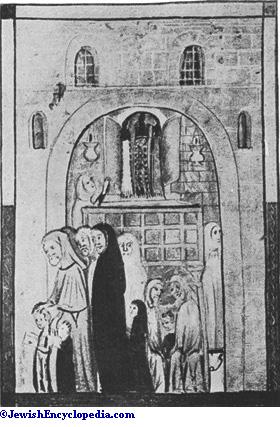
Illuminated Representation of a Synagogue.(From the Sarajevo Haggadah of the fourteenth century.)
Only a few synagogues of the Babylonian diaspora are mentioned by name in the Talmud. Those situated in Shaf we-Yatib, near Nehardea, and in Huẓal (Meg. 29b) were believed to be the oldest on Babylonian soil and were said to have been founded at the time of the Captivity. In the third century there was a synagogue named in honor ofDaniel ('Er. 21a), and in the following century there was a synagogue of "the Romans" at Maḥoza, which belonged probably to Jews from the Roman empire (Meg. 26b). In Babylonia the synagogues were frequently situated outside the cities, in many cases at a considerable distance from them (see Ḳid. 73b; Shab. 24b; comp. Tan., ed. Buber, "Ḥayye Sarah," p. 7), this custom, apparently, being due to the fact that after the destruction of the synagogues by the Persians during the Sassanian period the Jews were forbidden to rebuild within the city limits (see Hastings, "Dict. Bible," iii. 638).
The synagogue and the academy were the two institutions which preserved the essence of the Judaism of the Diaspora and saved it from annihilation. As the place of public worship, the synagogue became the pivot of each community, just as the Sanctuary at Jerusalem had been the center for the entire people. Ezek. xi. 16, "Yet will I be to them as a little sanctuary," was rightly interpreted, therefore, to mean that in its dispersion Israel would retain the synagogue as a sanctuary in miniature in compensation for the loss of the Temple (Targ. ad loc.), and the community crystallized around the synagogue, the only possible organization for the Jews of the Diaspora. Synagogal worship, therefore, however much it might vary in detail in different countries, was the most important visible expression of Judaism, and the chief means of uniting the Jews scattered throughout the world; while the academy, in like manner, guaranteed the unity of the religious spirit which animated the synagogue. The synagogue, consequently, is the most important feature of the Jewish community, which is inconceivable without it.
Importance of the Institution.
A history of the synagogue is possible only in so far as Jewish history is considered from the point of view of this important institution. A distinction may be drawn, however, between its internal and its external history, the former dealing with the changes in the cult connected with the synagogue and with its different institutions, and the latter treating of the fortunes of the followers of Judaism and of their social and cultural status in so far as these influenced the synagogue.
In sketching briefly the external history of the synagogue, it is, in a sense, ominous that the first allusion to it (in Ps. lxxiv.) should be to its destruction. For nearly fifteen hundred years razed synagogues typified the fortunes of the Jewish communities, especially in Christian countries. In the Roman empire, during the fourth century, Theodosius the Great was frequently obliged to check the excessive zeal of the Christians, who burned and plundered synagogues or transformed them into churches (Grätz, "Gesch." 2d ed., iv. 385). His son Arcadius likewise was compelled to take stringent measures against the proposed destruction of synagogues in Illyria in 397. Theodosius II. (408-450), however, expressly forbade the Jews to build new synagogues; and when the Christians of Antiochia seized certain Jewish places of worship, the emperor, although he at first commanded their restoration, was later persuaded by St. Simeon Stylites to revoke the edict.
In Medieval Times
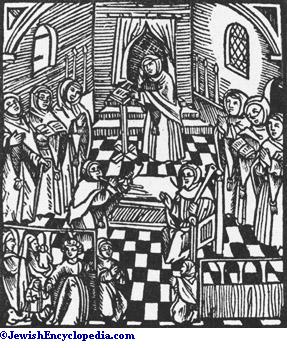
Interior of a Sixteenth-Century Synagogue.(From a woodcut of 1530.)
Eight years before (415), the Christians of Alexandria, instigated by Bisbop, Cyril, had confiscated the synagogue there and forced the Jews to emigrate, while at Constantinople the great synagogue was dedicated as the Church of the Mother of God, probably during the reign of Theodosius II. When the victories of Belisarius subjugated northern Africa to the Byzantine empire, Justinian commanded (535) that the synagogues should be transformed into churches. During the reign of Theodoric the Great the Christian populace of Rome burned the synagogue; but although he commanded the Senate to punish those who had done so, and though he permitted the Jews of Genoa to repair theirs, he allowed neither the building nor the decoration of synagogues elsewhere. Pope Gregory the Great was noted for his justice toward the Jews; yet he was unable to restore the synagogues that had been taken from them at Palermo by Bishop Victor and dedicated as churches, although he obliged the bishop to pay for them. During the Merovingian period a synagogue at Orleans was destroyed by the mob, and the Jews were unable to induce King Guntram to permit it to be rebuilt (584). The epoch of the Crusades wasinitiated by "the liberation of Jerusalem," when the victorious crusaders drove the Jews into a synagogue and cremated them there (1099). In France, Philip Augustus commanded in his edict of expulsion, dated 1181, that the synagogues should be transformed into churches, and at the coronation of King Richard I. eight years later the synagogues of London were destroyed by the crusaders. When Philip the Fair expelled the Jews from France, in 1307, the synagogues were either sold or given away, one of those in Paris being presented by the king to his coachman; Louis X. restored them when the Jews were recalled in 1315. At the time of the Black Death (1349) the entire community of Vienna sought death in the synagogue in order to escape persecution. In 1473 the Jews were expelled from Mayence and their synagogue dedicated to Christian worship. Two decades later all the Jews were expelled from Spain, their synagogues were turned into churches and convents, and the magnificent synagogue at Toledo, built in the fourteenth century by the statesman Samuel Abulafia, became the Church de Nuestra Señora de San Benita (or del Transito), still existing as a monument to the former splendor of the Jewish culture of Spain.
Synagogues in Spain.
The following information regarding transformed synagogues still existing in Spain is given by Kayserling: In the Calle de la Sinagoga in Toledo there is, in addition to the former synagogue of Samuel Abulafia, the great synagogue built in the reign of Alfonso X., now the Church of Santa Maria la Blanca, a name given it by Vicente Ferrer in the early part of the fifteenth century, when it was dedicated. Both these buildings were restored in the last decade of the nineteenth century, after being closed as churches and declared to be national monuments. One of the large synagogues of Seville was transformed into the Church of S. Bartolomé in 1482, and is now one of the finest in the city; its Hebrew inscriptions were seen by Rodrigo Castro, the author of "Antiguedada de Sevilla," in 1630. The old synagogue at Segovia, burned in 1899, was dedicated as the Church of Corpus Christi (see "R. E. J." xxxix. 209-216). A church at the entrance to the ghetto of Saragossa is said to have been a synagogue; but there are no documents to verify this statement, although the style of architecture supports it. On the synagogue discovered by Fidel Fita under the name of the Church of Santa Quiteria, at Cordova, see "R. E. J." ix. 157, x. 245.
When the Jews of Ratisbon were expelled in 1519, their synagogue, which was built of freestone, was demolished by the citizens (even the nobles and the bishop taking part in the work of destruction), and a church was erected on the site. The intention of Ferdinand I. of Austria to transform the synagogues of Prague into churches (1557) was not executed, and it was reserved for Leopold I., another member of the house of Hapsburg, to issue the last general order to this effect recorded in history. When the Jews were expelled from Vienna, in 1670, a church was built on the site of their demolished synagogue.
Interior of the Synagogue at Rotterdam.(From an old print.)
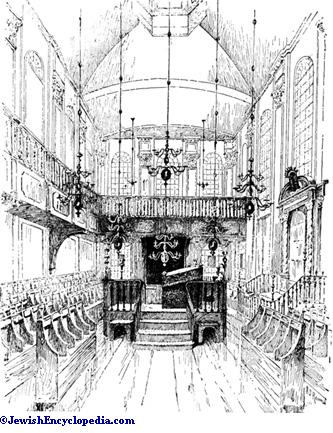
In Islam.
These episodes in the history of the synagogue in Christian countries have had very few parallels in Mohammedan lands, although the rule of Islam also began with an edict against the synagogue. It was decreed in the "pact of Omar" (see Jew. Encyc. vi. 655, s.v. Islam) that in those countries which should be conquered no new synagogues might be built, nor old ones repaired. The calif Al-Mutawakkil confirmed this decree in the ninth century, and commanded all synagogues to be transformed into mosques. The Egyptian calif Al-Ḥakim (d. 1020) also destroyed synagogues, and many were razed inAfrica and Spain by the fury of the Almohades (after 1140). The great synagogue of Jerusalem was destroyed in 1473, although the Jews were soon permitted to rebuild it. In eastern Mohammedan countries the names of Biblical personages or of representatives of tradition (e.g., a tanna or amora) were given to many synagogues. The following examples are taken from Benjamin of Tudela ("Itinerary"), from the list of tombs compiled for R. Jehiel of Paris (1240), and from a similar list entitled "Eleh ha-Massa'ot"; the two last-named sources are appended to Grünhut's edition of Benjamin of Tudela (pp. 140-160). Some examples are found also in Pethahiah's itinerary, and in Sambari's chronicle of the year 1682, printed in Neubauer, "M. J. C." i. In the following list the name "Sambari" precedes the page numbers of citations from this latter source; all other references are to the pages of Grünhut's edition of Benjamin of Tudela's "Itinerary."
Legendary Foundations.
Interior of the Synagogue at Algiers.(From an old print.)
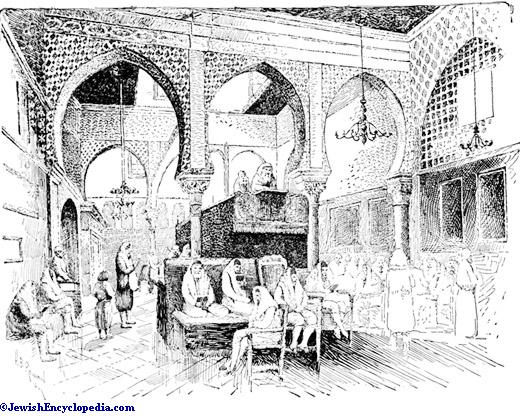
In the village of Jaujar, in Egypt, there was a synagogue named in honor of the prophet Elijah, since Phinehas b. Eleazar was born there (Sambari, p. 121; Phinehas = Elijah; see Jew. Encyc. v. 122). The synagogue of the Palestinians at Fostat was also called after Elijah; the prophet Jeremiah was said to have prayed there (Sambari, p. 118; p. 137); and there were other synagogues of Elijah at Damascus (p. 157, "between the gardens—a very splendid edifice "), Byblus (p. 158, "an extraordinarily splendid edifice "), Laodicea (p. 158), and Ḥama (p. 159), while Grätz believed ("Gesch." 1st ed., v. 53) that there was a synagogue of Elijah also in Sicily, at the time of Pope Gregory I. Benjamin found a "Keneset Mosheh" outside the city of Fostat (p. 94). According to Sambari (p. 119; comp. p. 137), the name of "Kanisat Musa" was given to the synagogue of Damwah (see Jew. Encyc. v. 64, s.v. Egypt), in which Moses himself was said to have prayed (comp. Ex. ix. 29), and in which, on the 7th of Adar, the Jews of all Egypt assembled, during the period of the Nagids, for fasting and prayer. One of the three synagogues of Aleppo was called after Moses (p. 158). Benjamin mentions synagogues named in honor of Ezra at Laodicea (= Kalneh; comp. Sambari, p. 158), Haran, and Jazirat ibn Omar, on the upper Tigris, the first one having been built, he was told, by Ezra himself (pp. 47 et seq.). Pethahiah mentions two synagogues built by Ezra at Nisibis. There was a synagogue at Ezra s tomb, and one near the grave of the prophet Ezekiel; the latter was said to have been built by King Jehoiachin ("Itinerary," ed. Benisch, pp. 61, 68). In the province of Mosul (Ashur), Benjamin (p. 48) saw the synagogues of the three prophets Obadiah, Jonah, and Nahum. The tomb of Daniel at Susa and the graves of Mordecaiand Esther (pp. 68, 75, Pethahiah) were placed in front of synagogues, and Benjamin (p. 41) mentions a synagogue near Tiberias named in honor of Caleb, the son of Jephunneh—apparently the synagogue built, according to Pethahiah's itinerary, by Joshua, the son of Nun.
At Ramlah (Rama) the Christians found the tomb of Samuel beside the synagogue (p. 39, Benjamin), while at Kafr Jubar, near Damascus, there was a synagogue built, according to legend, by Elisha (Sambari, p. 152). Among the Tannaim the name of Simeon b. Yoḥai was given to two synagogues, one at Meron (pp. 141, 154) and the other at Kafr Bir'im (p. 154, "a very splendid edifice, built of large stones with great pillars"; see above). At Damascus, according to Benjamin, there was a synagogue of Eleazar b. 'Arak (Pethahiah says Eleazar b. Azariah), and at Nisibis one of Judah b. Bathyra. Several Babylonian synagogues mentioned by Benjamin were named in honor of amoraim: the synagogues of Rab, Samuel, Isaac, Nappaḥa, Rabba, Mar Ḳashisha, Ze'era b. Ḥama, Mari, Meïr (at Hillah), Papa, Huna, Joseph, and Joseph b. Ḥama (pp. 60, 61, 63, 65). All these synagogues stood at the graves of the amoraim whose names they bore.
These examples show that the synagogues bearing the names of Biblical or Talmudic celebrities were often similar in character to the "ḳubbah" (vault; Hebr.  ) regularly built over the grave of a Mohammedan saint, and serving as an oratory for the pilgrims to the tomb. Similar ḳubbahs were erected, according to Benjamin (p. 63), over the graves of Hananiah, Mishael, and Azariah, the three friends of Daniel, near the tomb of Ezekiel. In his commentary on Job xxi. 32 Ibn Ezra states that Hai Gaon explained the word "gadish" as the "ḳubbah over the grave, according to the custom in Mohammedan countries."
Special Synagogues.
Some of the synagogues mentioned in the sources quoted above are described as buildings of exceptional beauty, although statements to that effect are rarely found elsewhere. It is also quite noteworthy that Benjamin of Tudela does not praise the architecture of any synagogue in the European countries through which he traveled; but it must be borne in mind that the cities of Spain were not included in his descriptions. According to Judah al-Ḥarizi, there were several magnificent synagogues at Toledo, second to none, among them being the splendid edifice built by Joseph b. Solomon ibn Shoshan (Grätz, "Gesch." 3d ed., vi. 189). The synagogue of Samuel Abulafia at Toledo and other Spanish synagogues still standing have been mentioned above. Bagdad contained twenty-eight, according to Benjamin of Tudela (Pethahiah says thirty), in addition to the synagogue of the exilarch, which is described by Benjamin as a "building resting on marble columns of various colors and inlaid with gold and silver, with verses from the Psalms inscribed in golden letters upon the pillars. The approach to the Ark was formed by ten steps, and on the upper one sat the exilarch together with the princes of the house of David." The anonymous itinerary mentioned above, in referring to the synagogue which the author saw at Tyre, describes it as "a large and very fine building" (Benjamin of Tudela, ed. Grünhut, p. 158).
The synagogue of Worms, built in the eleventh century (see A. Epstein, "Jüdische Alterthümer in Worms und Speier," Breslau, 1896), and the Altneue Synagogue of Prague are the two oldest structures of their kind which still exist in Europe, and are of interest both historically and architecturally. The five Roman synagogues built under one roof formed until recently a venerable architectural curiosity. The great synagogue of Amsterdam, dedicated in 1675, is a monument both to the faith of the Hispano-Portuguese Maranos and to the religious freedom which Holland was the first to grant to the modern Jews; a similar monument is the Bevis Marks Synagogue, London, which was dedicated in 1701 (see Gaster, "History of the Ancient Synagogue," London, 1901).
Interior of an Old Synagogue at Jerusalem(From a photograph by E. N. Adler.)
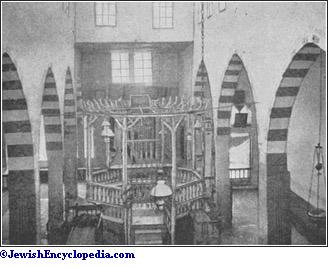
Wooden Synagogues.
Interior of the Shearith Israel Synagogue, New York.(From the original drawing in the possession of the architect Arnold W. Brunner.)
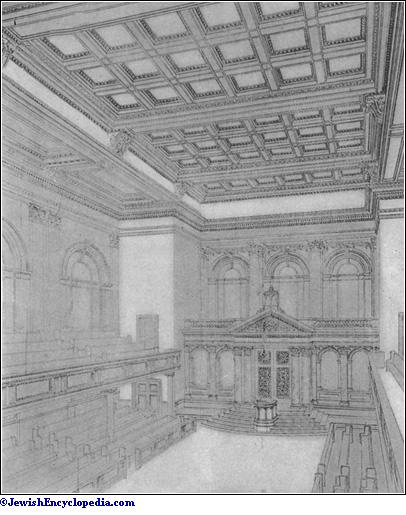
Main Entrance to Temple Beth-El, New York.(From the original drawing in the possession of the architect Arnold W. Brunner.)
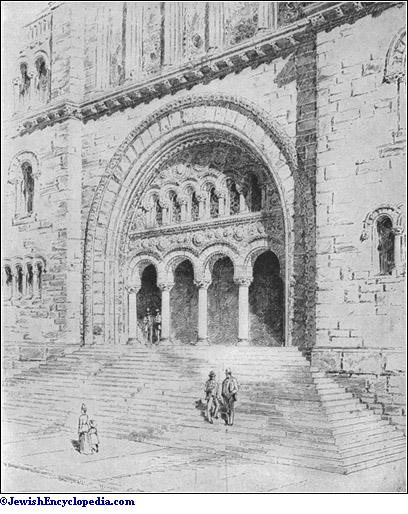
Special reference must be made to the wooden synagogues built in the sixteenth and seventeenth centuries in some Polish cities, many of them being markedly original in style. They also attest the wealth and culture of the Polish Jews before the year 1548 (see M. Bersohn, "Einiges über die Alten Holzsynagogen in Polen," in "Mitteilungen der Gesellschaft für Jüdische Volkskunde," 1901, viii. 159-183; 1904, xiv. 1-20). Bodenschatz, in the middle of the eighteenth century, stated that "rather handsome and large synagogues are found in Germany, especially in Hamburg, and also among the Portuguese, as well as in Prague, particularly in the Polish quarter, besides Fürth and Bayersdorf; but the Dutch synagogues are more splendid than all the rest" ("Die Kirchliche Verfassung der Juden," ii. 35).
Object of Splendid Buildings.
In the nineteenth century the great changes which ushered in a new epoch in the history of the civic and intellectual status of the European Jews affected also the style and the internal life of the synagogue, especially as religious reform proceeds primarily from that institution, and is chiefly concerned with synagogal worship. A private synagogue at Berlin (1817) became the first "seminary for young Jewish preachers" (Grätz, "Gesch." xi. 415); while the synagogue of the Reform-Tempel-Verein at Hamburg (1818) was the first to introduce radical innovations in the ritual of public worship, thereby causing a permanent schism in Judaism, both in Germany and elsewhere. These reforms likewise influenced the arrangement of the synagogue itself. The introduction of the organ, the shifting of the almemar from the center of the building to a position just in front of the Ark, the substitution of stationary benches for movable desks, and the abolition of the high lattices for women, were important from an architectural point of view. The chief factors which promoted and determined the construction of new synagogues were the emancipation of the Jews from the seclusion of the ghetto, their increasing refinement of taste, and their participation in all the necessities and luxuries of culture. Internal causes, however, which were not always unmixed blessings, were the prime agents in the increased importance of the synagogue. As the external observances of religion and the sanctity of tradition lost in meaning and often disappeared entirely within the family and in the life of the individual, the synagogue grew in importance as a center for the preservation of Judaism. It thus becomes explicable why the religious attitude of both large and small communities in Europe and America appears most of all in the arrangement and the care of the synagogues; and it is not mere vanity and ostentation, which lead communities on both sides of the Atlantic to make sacrifices in order to build splendid edifices for religious purposes, such as are found in many cities.
Main Entrance to Shearith Israel Synagogue, New York.(From the drawing in the possession of the architect Arnold W. Brunner.)
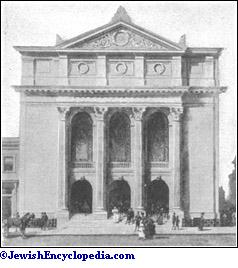
The increasing importance which the synagogue has thus acquired in modern Jewish life is, consequently, justified from a historical point of view, both because it is a development of the earliest institution of the Diaspora—one which it has preserved for two thousand years—and because it is the function of the synagogue to maintain the religious life and stimulate the concept of Judaism within the congregation. The synagogue has in the future, as it has had in the past, a distinct mission to fulfil for the Jews.
Ground-Plan of the Synagogue at Reichenberg, Bohemia.
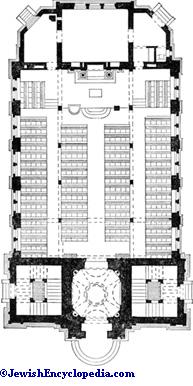
Bibliography:
Down to the completion of the Talmud, see the sources mentioned in Schürer, Gesch. 3d ed., ii. 427-464.
Bacher, in Hastings, Dict. Bible;
Grätz, Gesch. iv.-xi.;
Abrahams, Jewish Life in the Middle Ages, pp. 1-34, London, 1896;
L. Palsczy, Zsidó Templomsk Európában, in Jahrb. der Ungarisch-Israelitischen Litteraturgesellschaft, 1898, pp. 1-44.
W. B.Position of Synagogue Building.
—Legal Aspect:
Interior of the Mikvé Israel Synagogue, Philadelphia.(From a photograph.)
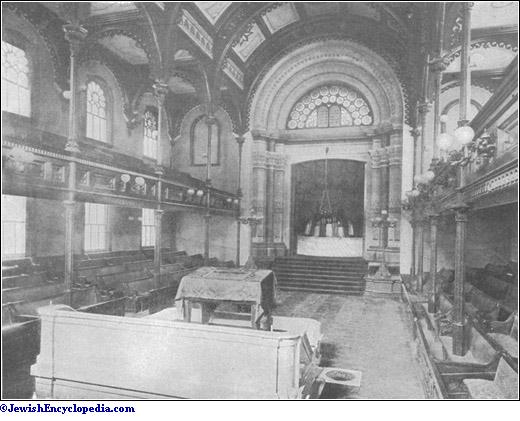
Interior of the Synagogue of the Spanish and Portuguese Jews at Montreal, Canada.(From a photograph.)
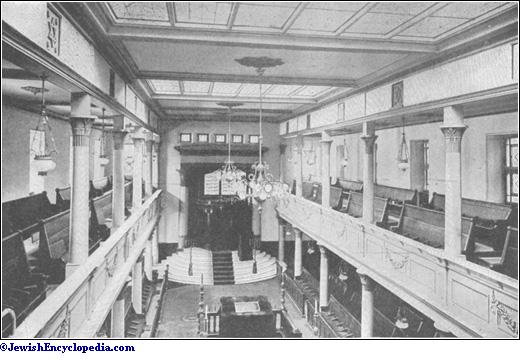
No mention is made in the Talmud of any tax for the building of synagogues; but the Tosefta to B. B. i. 6, as reported by Alfasi, says: "The men of a city urge one another to build a synagogue [ ] and to buy a book of the Law, the Prophets, and the Hagiographa" (see "Yad," Tefillah, xi.; Shulḥan 'Aruk, Oraḥ Ḥayyim, 150, 151). The codes teach, further, on the strength of a saying ascribed to Rab (Shab. 11a), that the building should stand in the highest part of the town (comp. Prov. i. 21) and rise above all surrounding edifices. Of course, this rule can not always be carried out where the Jews live as a small minority in a town of Gentiles; but a synagogue should never occupy the lower part of a house which contains bedrooms in an upper story. According to a tosefta, the doors of the synagogue should be in the east; but the opinion has prevailed that they should be opposite the Ark and in that part of the room toward which the worshipers face in prayer. The Ark is built to receive the scrolls of the Law. "They put a platform in the middle of the house," says Maimonides, "so that he who reads from the Law, or he who speaks words of exhortation to the people, may stand upon it, and all may hear him" (see Almemar). According to the same author, the elders sit facing the people, who are seated in rows one behind the other, all with their eyes turned toward the elders and toward the Holy Place (neither code speaks in this connection of the women's gallery). When the "messenger of the congregation" arises in prayer he stands on the floor before the Ark (this, however, is not the custom among the Sephardim of the present time). In the Holy Land, in Syria, Babylonia, and North Africa, etc., the floor is spread with matting, on which the worshipers sit; but in the countries of Christendom they occupy chairs or benches.
Honor Must Be Paid to Synagogue.
Honor should be paid to synagogues and houses of study. People must not conduct themselves lightly nor laugh, mock, discuss trifles, or walk about therein; in summer they must not resort to it for shelter from the heat, nor in winter should they make it serve as a retreat from the rain. Neither should they eat or drink therein, although the learned and their disciples may do so in case of an emergency. Every one before entering should wipe the mud from his shoes; and no one should come in with soiled body or garments. Accounts must not be cast in the synagogue or house of study, except those pertaining to public charity or to religious matters. Nor should funeral speeches be delivered therein, except at a public mourning for one of the great men of the time. A synagogue or house of study which has two entrances should not be used as a thoroughfare; this rule was made in analogy with that in the Mishnah (Ber. ix. 5) forbidding the use of the Temple mount as a thoroughfare.
Synagogue at Zaragorod, Russia.(From a woodcut.)
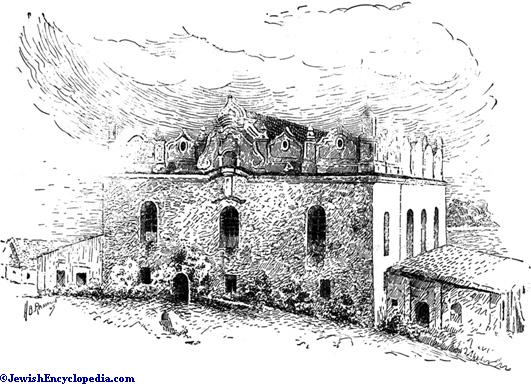
Some honor is to be paid even to the ruins of a synagogue or house of study. It is not proper to demolish a synagogue and then to build a new one either on the same spot or elsewhere; but the new one should be built first (B. B. 3b), unless the walls of the old one show signs of falling. A synagogue may be turned into a house of study, but not viceversa; for the holiness of the latter is higher than that of the former, and the rule is (Meg. iii. 1): "They raise up in holiness, but do not lower in holiness."
The synagogue of a village, being built only for the people around it, may be sold on a proper occasion; but a synagogue in a great city, which is really built for all Israelites who may come and worship in it, ought not to be sold at all. When a small community sells its synagogue, it ought to impose on the purchaser the condition that the place must not be turned into a bath-house, laundry, cleansing-house (for vessels), or tannery, though a council of seven of the leading men in the community may waive even this condition (ib. 27b).
SYNAGOGUE
1. Meaning and history.—Like its original synagôgç (lit. a gathering, assembly—for its use in LXX
The origin of the synagogue as a characteristic institution of Judaism is hidden in obscurity. Most probably it took its rise in the circumstances of the Hebrew exiles in Babylonia. Hitherto worship had practically meant sacrifice, but sacrifice was now impossible in a land unclean (cf. Hos 3:4; Hos 9:3 f.). There was still left to the exiles, however, the living word of the prophet, and the writings of God’s interpreters from a former age. In those gatherings in the house of Ezekiel of which we read (Eze 8:1; Eze 20:1-3) we may perhaps detect the germs of the future synagogue. We are on more solid ground when we reach the religious reform of Ezra and Nehemiah (b.c. 444–443). With the introduction of the ‘Law of Moses’ as the norm of faith and life, the need for systematic instruction in its complex requirements was evident to the leaders of the reform, as is clear from Neh 8:7 f. The closing century of the Persian rule, b.c. 430–330, may therefore be regarded as the period of the rise and development of the synagogue. From this period, more precisely from the reign of Artaxerxes iii. Ocbus (358–337), may be dated the only mention of the synagogue in OT, viz. Psa 74:8 ‘they have burned up all the synagogues of God in the land.’ The papyrus finds of recent years have contained not a few references to the synagogues of the Jewish communities in Egypt, from the time of the third Ptolemy, Euergetes, b.c. 247–221, onwards (details in Schürer, GJV
By the first century of our era the synagogue was regarded as an institution of almost immemorial antiquity. In referring it back to Moses himself, Josephus (c. Apion. ii. 17) is only echoing the contemporary belief, which is also reflected in the words of the Apostle James, ‘for Moses from generations of old hath in every city them that preach him, being read in the synagogues every sabbath’ (Act 15:21 RV
2. The synagogue building and its furniture.—Remains, more or less extensive, of Jewish synagogues still survive from the second and third, more doubtfully from the first, centuries of our era, chiefly in Galilee. The examination of these remains, first undertaken by the Palestine Exploration Fund (see Survey of West Pal. i. 224 ff. with plans), has recently been carried out more fully by the German Orient Society, and the results published in the Society’s Mittheilungen (Nos. 23, 27, 29 [1904, 1905]). In plan and details of ornamentation these Galilæan synagogues display a general similarity. The buildings are rectangular in shape, and divided into three or five aisles by two or three rows of pillars. The entrance is almost always in the south front, and often consists of a large main, and two smaller side, entrances. The most elaborate was the synagogue of Capernaum, where, as elsewhere, traces were found of galleries running round three sides of the central aisle. These were probably assigned to the women (for a similar arrangement in Herod’s Temple, see Temple § 11 (b)), although the question of the separation of the sexes in NT times is one on which the best authorities disagree.
As regards the furniture of the synagogue, the most important item was the chest or cupboard (tçbâ, the ‘ark’), in which the sacred rolls of the Law and the Prophets were kept. The synagogues of NT times were also doubtless provided with a raised platform (bçmâ), on which stood the reading-desk from which the Scriptures were read. The larger portion of the area was occupied by benches for the congregation, the worshippers facing southwards, in Galilee at least, towards the holy city. A few special seats in front of the bçmâ, and facing the congregation, were occupied by the heads of the community. These are the ‘chief seats in the synagogues’ coveted by the Pharisees (Mat 23:5 and ||). In front of the ‘ark’ a lamp burned day and night.
3. The officials of the Synagogue.—The general management of the synagogue of a Jewish town, where it served also as a court of justice and—in the smaller towns and villages at least—as a school, was in the hands of the elders of the community. It had no special priest or ‘minister,’ as will appear presently. It was usual however, to appoint an official called ‘the ruler of the synagogue’ (Mar 5:22, Luk 8:41, and oft.), to whom the authorities of the community committed the care of the building as well as the more important duty of seeing that everything connected with the public services was done ‘decently and in order.’ Hence the indignation of the ruler of Luk 13:14 at the supposed breach of the decorum of worship related in the preceding verses (vv. 10–13). It lay with the ruler also to select the readers for the day, and to determine the order in which they were to be called up to the reading-desk. Occasionally, it would seem, a synagogue might have two or more rulers, as at Antioch of Pisidia (Act 13:15).
The only other permanent official was the chazzân, ‘the ‘attendant’ of Luk 4:20 RV
4. The synagogue service in NT times.—For this part of our subject we are dependent mainly on the fuller information preserved in the Mishna, which reflects the later usage of the 2nd century. According to Megillah, iv. 3, the service consisted of four parts, and with this the scattered hints in the Gospels and Acts agree. These parts are: (a) the recitation of the Shema’, (b) the lifting up of hands, i.e. the prayers, (c) the lessons from the Law and the Prophets, and (d) the priestly benediction. Two elements of the full service, however, are here omitted as not strictly belonging to the essentials of worship, viz. the translation of the lessons into the vernacular, and the sermon.
(a) The recitation of the Shema’.—The shema’ is the standing designation of three short sections of the Pentateuch, Deu 6:4-9 (which opens with the word Shema’ = ‘Hear,’ whence the name) Deu 11:13-21, Num 15:37-41. Their recitation by the congregation was preceded and followed by one or two short benedictions, such as that beginning, ‘Blessed be thou, Adonai, our God, King of the universe, who didst form the light and create darkness.’
(b) The lifting up of hands.—In contrast to the first item of the service, in which all took part, the prayers were said by a single individual chosen for the purpose, named ‘the deputy of the congregation,’ the worshippers’ however, repeating the Amen at the close of each collect. This mode of prayer in the public services was taken over by the early Church, as is attested by 1Co 14:16 (where the word rendered ‘the giving of thanks’ is the Gr. equivalent of that rendered ‘benediction’ below). By the middle of the 2nd cent. a.d. a formal liturgy had been developed—the famous ‘eighteen benedictions,’ which may be read in any Jewish prayer-book. It is impossible, however, to say with certainty how many of these were in use in our Lord’s day. Dalman is of opinion that at least twelve of the eighteen collects are older than a.d. 70. These he arranges in three groups, consisting of three opening benedictions, six petitions, and three closing benedictions (see his art. ‘Gottesdienst [synagogaler]’ in Hauck’s PRE
(c) The OT lessons.—The liturgy was followed by a lesson from the Law. The five books were divided into 154 (or more) Sabbath pericopes or sections, so that the whole Pentateuch was read through in three years (or 31/2 years, half of a Sabbatic period). The custom of calling up seven readers in succession—a priest, a Levite, and five others—may be as old as the 1st century. After the Law came, at the Sabbath morning service only a lesson from the Prophets, read by one person and left to his choice. It was the haphtarâ, as the prophetic lesson was termed, that our Lord read in the synagogue of Nazareth (Luk 4:16 ff.). ‘The Hagiographa except Esther, were not at this period read at Divine service. Even the Psalms had no place in the usual service’ (Dalman).
In order that the common people might follow the lessons with Intelligence, these were translated into Aramaic, the vernacular of Palestine, by an interpreter (methurgemân—our ‘dragoman’ is from the same root). The unique position of the Law in the estimation of the time is shown by the fact that the Pentateuch lessons had to be translated a verse at a time, while the Prophets might he rendered three verses at a time. Reader and interpreter stood while at the reading-desk.
At this point in the service at the principal diets of worship, the sermon was introduced. The preacher sat while giving his exposition, which is so often described in NT as ‘teaching’ (Mat 4:23, Mar 1:21; Mar 6:2 etc.). In the synagogue there was full liberty of prophesying.’ Any member of the community was free to exercise his gift. When a likely stranger was present, he was invited by the ruler of the synagogue to address the congregation (Act 13:15). (d) The service was closed by a priest pronouncing the priestly benediction, Num 6:24-26; if no priest was present, it is said that a layman gave the blessing in the form of a prayer.
On some occasions, at least, it was usual to ask the alms of the congregation (Mat 6:2) on behalf of the poor. The full service, as sketched above, was confined to the principal service of the week, which was held on the forenoon of the Sabbath. At the other services, such as those held daily in the larger towns, where ten ‘men of leisure’ were available to form the minimum legal congregation, and the Monday and Thursday services, some of the items were omitted.
5. The influence of the Synagogue.—This article would be incomplete without a reference, however brief, to the influence of the synagogue and its worship not only upon the Jews themselves, but upon the world of heathenism. As to the latter, the synagogue played a conspicuous part in the preparatio evangelica. From the outworn creeds of paganism many earnest souls turned to the synagogue and its teaching for the satisfaction of their highest needs. The synagogues of ‘the Dispersion’ (Joh 7:35, Jas 1:1, 1Pe 1:1, all RV
The work which the synagogue did for Judaism itself is best seen in the ease with which the breach with the past involved in the destruction of the Temple in a.d. 70, and the cessation of sacrificial worship, was healed. The highest religious life of Judaism had already transferred its channels from the grosser and more material forms of the Temple to the spiritual worship of the synagogue.
Nor must a reference be wanting to the fact that the synagogue, and not the Temple, supplied the mould and model for the worship of the Christian Church.
6. The Great Synagogue.—In late Jewish tradition Ezra is alleged to have been the founder and first president of a college of learned scribes, which is supposed to have existed in Jerusalem until the early part of the Gr. period (c
A. R. S. Kennedy.
The place of assemblage of the Jews. This article will treat of the name, origin, history, organization, liturgy and building of the synagogue. I. NAMEThe Greek sunagogé, whence the Latin synagoga, French synagogue, and English synagogue, means a meeting, an assembly; and is used by the Septuagint to translate the Hebrew . The Aramaic translation is (cf. Arabic Kanîsah, a church) to which is akin the New Hebrew . The place of assemblage was termed in New Hebrew, , , meeting house, i. e., oikos sunagoges. In the course of time, the single word synagogue came to mean not only the meeting but the meeting-house, the teaching thereof and, in the broadest sense, the body politic of the Jews. This broad sense of the word synagogue is seen in John’s use of ’aposunagogós , "excommunicated" or "put out of the synagogue" (cf. ix, 22; xii, 42; xvi, 2). Another Greek name for synagogue in use among Hellenistic Jews, is proseuké, shortened after the analogy of sunagogé, from oikos proseukos, house of prayer (cf. Philo, "In Flacc.", §§6, 7; "Ad Gaium", §§20, 23, 43). This phrase is in the Septuagint translation of Isaias (lvi, 7): "My house shall be called the house of prayer () for all nations." The Latinized proseucha of Juvenal (Sat., III, 296) means the Jewish house of prayer or synagogue. Josephus (Antiq., XVI, vi, 2) cites an edict of Augustus which calls the Synagogue sabbateíon, the Sabbath-house. II. ORIGINObscurity enshrouds the first beginnings of the synagogue. The Jerusalem Talmud (in Ex., xviii, 20) dates it from the time of Moses; so, too, the tradition of the Alexandrian Jews, according to the witness of Philo, "De Vita Mosis" (III, 27) and Josephus, "Contra Apion." (II, 17). This rabbinical tradition is not reliable. It was probably during the Babylonian captivity that the synagogue became a national feature of Hebrew worship. Afar from their Temple, the exiled Jews gathered into local meeting-houses for public worship. Sacrifice was denied them; prayer in common was not. The longer their exile from the national altar of sacrifice, the greater became their need of houses of prayer; this need was met by an ever-increasing number of synagogues, scattered thrroughout the land of exile. From Babylonia this national system of synagogue worship was brought to Jerusalem. That the synagogue dates many generations earlier than Apostolic times, is clear from the authority of St. James: "For Moses of old time [’ek geneon ’archaíon] hath in every city them that preach him in the synagogues, where he is read every sabbath" (Acts 15:21). III. HISTORYFrom the outset of Christianity the synagogue was in full power of its various functions; the New Testament speaks thereof fifty-five times. The word is used to denote the body politic of the Jews twelve times: twice in Matthew (x, 17; xxiii, 34); once in Mark (xiii, 9); three times in Luke’s Gospel (viii, 41; xii, 11; xxi, 12), and four times in his Acts (vi, 9; ix, 2; xxii, 19; xxvi, 11); and twice in the Johannine writings (Revelation 2:9; 3:9). The more restricted meaning of meeting-house occurs forty-three times in the New Testament -- seven in Matthew (iv, 23; vi, 2, 5; ix, 35; xii, 9; xiii, 54; xxiii, 6); seven times in Mark (i, 21, 23, 29, 39; iii, 1; vi, 2; xii, 39); twelve times in Luke’s Gospel (iv, 15, 16, 20, 28, 33, 38, 44; vi, 6; vii, 5; xi, 43; xiii, 10; xx, 46), and fourteen times in his Acts (ix, 20; xiii, 5, 14, 42; xiv, 1; xv, 21; xvii, 1, 10, 17; xviii, 4, 7, 19, 26; xix, 8); twice in John (vi, 59; xviii, 20); once in James (ii, 2). Our Lord taught in the synagogues of Nazareth (Matthew 13:54; Mark 6:2; Luke 4:16), and Capharnaum (Mark 1:21; Luke 7:5; John 6:59). Saint Paul preached in the synagogues of Damascus (Acts 9:20), Salamina in Cyprus (Acts 13:5), Antioch in Pisidia (Acts 13:14), Iconium (xiv, 1), Philippi (xvi, 13), Thessalonica (xvii, 1), Borœa (xvii, 10), Athens (xvii, 17), Corinth (xviii, 4, 7), and Ephesus (xviii, 19). It is worthy of note that despite his frequent use of the Jewish meeting-house, St. Paul in his stern antagonism never once deigns to make mention of the synagogue. He designates Judaism by the term "circumcision", and not, as do the Evangelists, by the word "synagogue". And even in speaking of the Jews as "the circumcision", St. Paul avoids the received word peritomé, "a cutting around", a word employed by the Alexandrian Philo for Judaism and reserved by the Apostle for Christianity. The sworn foe of the "false circumcision" takes a current word katatomé, "a cutting down", and with the vigorous die of his fancy, stamps thereon an entirely new and exclusively Pauline meaning -- the false circumcision of Judaism.At the time of the destruction of Jerusalem (A.D. 70) there were in the city itself 394 synagogues, according to the Babylonian Talmud (Kethuth, 105a); 480, according to the Jerusalem Talmud (Megilla 73d). Besides these synagogues for the Palestinian Jews, each group of Hellenistic Jews in Jerusalem had its own synagogue -- the Libertines, the Alexandrians, the Cyrenians, the Cilicians, etc. (Acts 6:9). Josephus speaks of the synagogue which Agrippa I erected in Dora (Antiq., XIX, vi, 3), of the Cæsarean synagogue which revolted against Rome (Bell. Jud., II, xiv, 4), of the great synagogue of Tiberias (Vita, 54), and of the synagogue of Antioch in Syria to which the sacred vessels were borne away in the time of the Seleucid War (Bell. Jud., VII, iii, 3). Philo is authority for the existence, during the first century A. D., of many synagogues in Alexandria (Leg. ad Gaium, 20), and of not a few in Rome (Ibid., 23). In Northern Galilee, are numerous ruins whose style of architecture and inscriptions are indications of synagogues of the second and, maybe, the first century A. D. The Franciscans are now engaged in the restoration of the ruined synagogue of Tel Hum, the site of ancient Capharnaum. This beautiful and colossal synagogue was probably the one in which Jesus taught (Luke 7:5). Of the ruined synagogues of Galilee, that of Kefr Bir’im is the most perfectly preserved. Various Greek inscriptions, recently discovered in Lower Egypt, tell of synagogues built there in the days of the Ptolemies. A marble slab, unearthed in 1902 some twelve miles from Alexandria, reads: "In honour of King Ptolemy and Queen Berenice, his sister and wife, and their children, the Jews (dedicate) this proseuché. Both the Jerusalem and the Babylonian Talmud make mention of numerous Galilean synagogues which were centres of rabbinical literary, and religious and politican influence at Sepphoris, Tiberias, Scythopolis, etc. Every Jewish settlement was obliged by Talmudic law to have its synagogue; the members of the community could oblige one another to the building and maintaining thereof; indeed the members of the Jewish community were designated "sons of the synagogue". For further history of the synagogue, see JEWS AND JUDAISM.The Great Synagogue is worthy of special mention, as to it is assigned, by Jewish tradition, the important rôle of forming the Canon of the Old Testament. It is said to have been founded by Esdras in the middle of the fifth century B. C., and to have been a permanent and legislative assemblage for two and a half centuries. The Mishnah (Pirke Aboth, I, 1) claims that the Prophets handed down the Torah to the men of the Great Synagogue. "Aboth Rabbi Nathan" (a post-Talmudic treatise) paraphrases this statement by including the last three Prophets in this assemblage: "Aggeus, Zacharias and Malachias received [the Torah] from the Prophets; and the men of the Great Synagogue received from Aggeus, Zacharias and Malachias". How long this supposedly authoritative body held control of the religion of Israel, it is impossible to tell. Jewish chronology from the Exile to Alexander’s conquest is far from clear. Rabbi Jeremiah (Jerus. Talmud, Berakot, 4d) says that one hundred and twenty elders made dictions of Kiddush and habdalah. The Talmud, on the contrary (Peah, II, 6), hands down Torah from the Prophets to the Zugoth (Pairs) without the intervention of the Great Synagogue. Be the Great Synagogue of Jewish tradition what it may, historical criticism has ruled it out of court. Kuenen, in his epoch-making monograph "Over die Mannen der groote synagoge" (Amsterdam, 1876), shows that a single meeting came to be looked upon as a permanent institution. The Levites and people met once and only once, probably on the occasion of the covenant described by Nehemias (Nehemiah 8-10), and the important assemblage became the nucleus round which were wrapped the fables of later Jewish tradition. Such is the conclusion of W. R. Smith, "The Old Testament in the Jewish Church", p. 169; Ryle, "Canon of the Old Testament", p. 250; Buhl, "Canon and Text of the Old Testament", p. 33; Driver, "Introduction to the Literature of the Old Testament", 6th ed., p. 7. IV. ORGANIZATION(1) Judicial. The "sons of the synagogue" were governed by a council called bêth dîn, "house of justice"; or sunédrion "council" (transliterated , Sanhedrin); or boulé, "council". The members of this council were twenty-three in larger towns, seven in smaller; and were called ’árchontes, "rulers" (Matthew 9:18, 23); Luke, viii, 41), or presbúteroi, "ancients" (Luke 7:3). The "rulers of the synagogue" had it in their power to punish by excommunication, scourging and death. (a) Excommunication from the synagogal community was termed herem, , ’anáthema, (see ANATHEMA). Both the Hebrew and Greek words mean that an object is "sacred" or "accursed" (cf. Arabic hárîm, the harem, a precinct sacred to the women of a household or the mosque of a community). (b) Scourging (, cf. Makkoth, III, 12; mastigón, cf. Matthew 10:17; 23:34; déro,, cf. Mark 13:9; Acts 22:19) was thirty-nine stripes (Makkoth, III, 10; 2 Corinthians 11:24) laid on by the "servant of the synagogue", hazzan, ‘uperétes, for minor offences. Three elders made up a tribunal competent to inflict the penalty of scourging. It is likely by this lesser tribunal that Our Lord refers: "Whosoever is angry with his brother shall be in danger of the judgment", ’énochos ’éstai te krísei (Matthew 5:22). (c) The death penalty was inflicted by the Sanhedrin in full session of twenty-three elders (cf. Sanhedrin I, 4). To this penalty or to that of excommunication should probably be referred Our Lord’s words: "And whosoever shall say to his brother, Raca, shall be in danger of the council", ’énochos ’éstai to sunedrío (Matthew 5:22).(2) Liturgical. The "ruler of the synagogue", (Mark 5:22, 35, 36,, 38; Luke 8:49; 13:14; Acts 13:15; 18:8, 17), rôsh hákkeneséth (Sota, VII, 7) presided over the synagogue and its services. This presidency did not prevent the "sons of the synagogue" from freely officiating. Witness the freedom with which Our Lord and St. Paul stood up to explain the Scriptures in the various synagogues of Palestine and the Diaspora. The hazzan, "servant", handed the scrolls to the readers and taught the children. V. LITURGYThere were five parts in the synagogue service:(1) The Shema’ is made up of Deut., vi, 4-9; xi, 13-21; Num., xv, 37-41 -- two opening blessings for morning and evening, one closing blessing for morning and two for evening. These benedictions are named Shema‘ from the opening word, the imperative : "Hear, O Israel; Jahweh our God is one Jahweh". The origin of the Shema‘, as of other portions of Jewish liturgy, is unknown. It seems undoubtedly to be pre-Christian. For it ordains the wearing of the phylacteries or frontlets -- prayer-bands borne upon the arm and between the eyes -- during the recitation of the great commandment of the love of God (cf. Deuteronomy 6:8; 11:18). These philacteries (phulaktéria) are called in the Talmud, "the prayer which is for the hand", , and "the prayer which is for the head", . The wearing of the two bands was in vogue in Christian times (Matthew 23:5; Josephus, "Antiquit.", IV, 8:13).(2) The Prayer is called "the eighteenth", Shemónéh ‘esréh ), because of its eighteen benedictions and petitions. There are two recensions -- the Babylonian, which is commonly in use, and the Palestinian, which Schechter recently discovered in a Cairo genizah (MSS.-box). Dalman (Worte Jesu, p. 304) considers that petitions 7, 10-14, are later than the destruction of Jerusalem (A. D. 70). The twelfth petition of the Palestinian recension shows that the Christians were mentioned in this daily prayer of the synagogue:"May the Christians and heretics perish in a moment; May they be blotted out of the book of life; May they not be written with the just."The Babylonian recension omits , Christians. The Lord’s prayer is made up, in like manner, out of petitions and praises, but in a very unlike and un-Jewish spirit of love of enemies.(3) Torah. The Jerusalem Talmud (Megilla, 75a) tells us that the reading of the Law on sabbaths, feast-days, new moons, and half feast-days is of Mosaic institution; and that Esdras inaugurated the reading of Torah on Mondays, Thursdays, and Saturdays. This Talmudic tradition, though not very reliable, points to a very ancient custom. The law is divided into fifty-four sections, sedarîm, which make up a pericopic sabbath reading of the Pentateuch. Special readings are assigned for special sabbaths; seven readers are called upon at random, and each reads his share.(4) The Prophets. Parallel to the pericopic reading of Torah is a pericopic reading from the Prophets, or second part of the Hebrew Canon. These sections are chosen with a view to exemplify or drive home the lesson from the Law which precedes. The name of the section from the Prophets, haphtara (from Hiph‘il of , "to dismiss"), indicates that at first the synagogue service here came to a close.(5) The Scripture Lesson. Even by the time of Christ, the exposition of Scripture was part of the synagogal liturgy (Matthew 4:23; Mark 1:21; 6:2). Any of the brethren might be called upon to give the "word of exhortation" (Acts 13:15). The Talmudic statute (Megilla, IV, 4) was that the methúrgeman, interpreter, paraphrase the section from Torah one verse at a time and the section from the Prophets one to three verses at a time. These paraphrases are called tárgûmîm; a lengthy exposition of a section is a midrash. There was formerly an antiphonal chanting of one or other of Psalms cv-cvii, cxi-cxix, cxvi-cxviii, cxxv, cxxxvi, cxxxxvi-cl. The precentor chanted verse after verse and the choir repeated the first verse of the psalm. At the end he chanted the doxology and called upon the people to answer "Amen", which they did. VI. BUILDING(1) Site. In Palestine, the synagogues were built within the city. In the Diaspora,a site was generally chosen outside the city gate and either by the seaside or river-side (Acts 16:13). The Tosephta (Megilla, IV, 22) ordains that the synagogue be in the highest place of the city and face to the east. The ruins of Galilean synagogues show no observance of this ordinance.(2) Style of Architecture. There seems to have been no established style of synagogal architecture. Until recent years, the synagogue has been built in whatsoever style had vogue in the place and at the time of building. The ruined synagogue of Merom is in severe Doric. That of Kafr Bir’im is in a Græco-Roman modification of Corinthian. The building is quadrangular in form. On the main façade there are three doorways, each of which has a highly ornamented architrave; above the centre doorway is a carefully carved Roman arch. Later on, Russian synagogues were built in decidedly Russian style. In Strasburg, Munich, Cassel, Hanover, and elsewhere the synagogues show the influence of the different styles of the churches of those cities. The cruciform plan is naturally not followed; the transepts are omitted. Synagogues of Padua, Venice, Livorno and other Italian cities are in the Renaissance style. Since the expulsion of the Jews from Spain, Moorish forms have gradually come to be considered the distinctive trait of synagogal architecture. El Transito and Santa Maria la Blanca, both in Toledo, are two of the finest examples of this Moorish architecture under Jewish influence.(3) Interior Setting. The Ark, arôn tébah, containing the sacred scrolls, stood at the eastern end opposite the entrance to the rectangular building. In the center was a raised platform (bema, ), and thereupon the lectern (’analogion, ). This elevated platform is also called "Almenar", a word corrupted from the Arabic Al-minbar, the "chair", the "pulpit". These two furnishings are the most essential interior settings of the synagogue. The Ark was originally but a niche in the wall. In time, as the most dignified feature, it received most concern in the decorative scheme. Nowadays, it is raised on high, approached by three or more steps and covered by an elaborately embellished canopy. The Almenar, too, has undergone various embellishments. It is approached by steps, sometimes has seats, is railed in and at times surrounded by a grille, round about or on both sides of it, are the seats for the congregation (klintér, ). The first seats, protokathedría (cf. Matthew 23:6; Mark 12:39; Luke 11:43 and 20:46) are those nearest the Ark; they are reserved for those who are highest in rank (cf. Tosephta, Megilla, IV, 21). Women, at least since the Middle Ages, sit in galleries to which they enter by stairways from the outside. These galleries were formerly set very high; but now are low enough to show both the Ark and the Almemar.-----------------------------------     SCHÜRER, Gesch., II (3rd ed., Leipzig, 1873), 427-64, tr. (Edinburgh, 1885-87); GRÄTZ, Gesch., IV-XI (Leipzig, 1863-88); ZUNZ, Gottesdienstliche Vorträge der Juden (Berlin, 1832); DALMAN, Synagogaler Gottesdienst, in HERZOG’s Real- Encyklopädie; ABRAHAMS, Jewish Life in the Middle Ages (London, 1896); LÖW, Der Synagogale Ritus in Monatschrift, 1884, IV, 1-71; KOHLER, Ueber die Ursprüngs u. Grundformen der synagogalen Liturgie in Monatschrift, 1893, XXXVII, 441-51.WALTER DRUM. Transcribed by WGKofron In memory of Fr. John Hilkert, Akron, Ohio. Fidelis servus et prudens, quem constituit Dominus super familiam suam. The Catholic Encyclopedia, Volume XIVCopyright © 1912 by Robert Appleton CompanyOnline Edition Copyright © 2003 by K. KnightNihil Obstat, July 1, 1912. Remy Lafort, S.T.D., CensorImprimatur. +John Cardinal Farley, Archbishop of New York
1. Name
2. Origin
3. Spread of Synagogues
4. The Building
(1) The Site
(2) The Structure
(3) The Furniture
5. The Officials
(1) The Elders
(2) The Ruler
(3) The Servant (or Servants)
(4) Delegate of the Congregation
(5) The Interpreter
(6) The Almoners
6. The Service
(1) Recitation of the “Shema’”
(2) Prayers
(3) Reading of the Law and the Prophets
(4) The Sermon
(5) The Benediction
LITERATURE
1. Name:
Synagogue, Greek
2. Origin:
That the synagogue was, in the time of our Lord, one of the most important religious institutions of the Jews is clear from the fact that it was thought to have been instituted by Moses (Apion, ii, 17; Philo, De Vita Moses, iii. 27; compare Targum Jer to Exo 18:20). It must have come into being during the Babylonian exile. At that time the more devout Jews, far from their native land, having no sanctuary or altar, no doubt felt drawn from time to time, especially on Sabbath and feast days, to gather round those who were specially pious and God-fearing, in order to listen to the word of God and engage in some kind of worship. That such meetings were not uncommon is made probable by Eze 14:1; Eze 20:1. This would furnish a basis for the institution of the synagogue. After the exile the synagogue remained and even developed as a counterpoise to the absolute sacerdotalism of the temple, and must have been felt absolutely necessary for the Jews of the Dispersion. Though at first it was meant only for the exposition of the Law, it was natural that in the course of time prayers and preaching should be added to the service. Thus these meetings, which at first were only held on Sabbaths and feast days, came also to be held on other days, and at the same hours with the services in the temple. The essential aim, however, of the synagogue was not prayer, but instruction in the Law for all classes of the people. Philo calls the synagogues “houses of instruction, where the philosophy of the fathers and all manner of virtues were taught” (compare Mat 4:23; Mar 1:21; Mar 6:2; Luk 4:15, Luk 4:33; Luk 6:6; Luk 13:10; Joh 6:59; Joh 18:20; CAp, ii, 17).
3. Spread of Synagogues:
In Palestine the synagogues were scattered all over the country, all the larger towns having one or more (e.g. Nazareth, Mat 13:54; Capernaum, Mat 12:9). In Jerusalem, in spite of the fact that the Temple was there, there were many synagogues, and all parts of the Diaspora were represented by particular synagogues (Act 6:9). Also in heathen lands, wherever there was a certain number of Jews, they had their own synagogue: e.g. Damascus (Act 9:2), Salamis (Act 13:5), Antioch of Pisidia (Act 13:14), Thessalonica (Act 17:1), Corinth (Act 18:4), Alexandria (Philo, Leg Ad Cai, xx), Rome (ibid., xxiii). The papyrus finds of recent years contain many references to Jewish synagogues in Egypt, from the time of Euergetes (247-221 BC) onward. According to Philo (Quod omnis probus liber sit, xii, et al.) the Essenes had their own synagogues, and, from
4. The Building:
(1) The Site.
There is no evidence that in Palestine the synagogues were always required to be built upon high ground, or at least that they should overlook all other houses (compare PEFS, July, 1878, 126), though we read in the Talmud that this was one of the requirements (
(2) The Structure.
Of the style of the architecture we have no positive records. From the description in the Talmud of the synagogue at Alexandria (
(3) The Furniture.
We only know that there was a movable ark in which the rolls of the Law and the Prophets were kept. It was called
5. The Officials:
(1) The Elders.
These officials (Luk 7:3) formed the local tribunal, and in purely Jewish localities acted as a Committee of Management of the affairs of the synagogue (compare
(2) The Ruler.
Greek
(3) The Servant (or Servants).
Greek
(4) Delegate of the Congregation.
Hebrew
(5) The Interpreter.
Hebrew
(6) The Almoners.
(
6. The Service:
(1) Recitation of the “Shema’”.
At least ten persons bad to be present for regular worship (
(2) Prayers.
The most important prayers were the
The following is the first of the eighteen: “Blessed art Thou, the Lord our God, and the God of our fathers, the God of Abraham, the God of Isaac, and the God of Jacob: the great, the mighty and the terrible God, the most high God Who showest mercy and kindness, Who createst all things, Who rememberest the pious deeds of the patriarchs, and wilt in love bring a redeemer to their children’s children for Thy Name’s sake; O King, Helper, Saviour and Shield! Blessed art Thou, O Lord, the Shield of Abraham.”
The prayers of the delegate were met with a response of Amen from the congregation.
(3) Reading of the Law and the Prophets.
After prayers the
(4) The Sermon.
After the reading from the Law and the Prophets followed the sermon, which was originally a caustical exposition of the Law, but which in process of time assumed a more devotional character. Anyone in the congregation might be asked by the ruler to preach, or might ask the ruler for permission to preach.
The following example of an old (lst century AD) rabbinic sermon, based on the words, “He hath clothed me with the garments of salvation” (Isa 61:10, a verse in the chapter from which Jesus took His text when addressing the synagogue of Nazareth), will serve as an illustration of contemporary Jewish preaching:
“Seven garments the Holy One - blessed be He! - has put on, and will put on from the time the world was created until the hour when He will punish the wicked Edom (i.e. Roman empire). When He created the world, He clothed Himself in honor and majesty, as it is said (Psa 104:1): ’Thou art clothed in honor and majesty.’ Whenever He forgave the sins of Israel, He clothed Himself in white, for we read (Dan 7:9): ’His raiment was white as snow.’ When He punishes the peoples of the world, He puts on the garments of vengeance, as it is said (Isa 59:17): ’He put on garments of vengeance for clothing, and was clad with zeal as a cloke.’ The sixth garment He will put on when the Messiah comes; then He will clothe Himself in a garment of righteousness, for it is said (same place) : ’He put on righteousness as a breast-plate, and an helmet of salvation upon His head.’ The seventh garment He will put on when He punishes Edom; then He will clothe Himself in
’Blessed is the hour when the Messiah shall come!
Blessed the womb out of which He shall come!
Blessed His contemporaries who are eye-witnesses!
Blessed the eye that is honored with a sight of Him!
For the opening of His lips is blessing and peace;
His speech is a moving of the spirits;
The thoughts of His heart are confidence and cheerful-ness;
The speech of His tongue is pardon and forgiveness;
His prayer is the sweet incense of offerings;
His petitions are holiness and purity.
O how blessed is Israel, for whom such has been prepared!
For it is said (Psa 31:19): “How great is Thy goodness, which thou hast laid up for them that fear thee” ’ ”
(
(5) The Benediction.
After the sermon the benediction was pronounced (by a priest), and the congregation answered Amen (
Literature.
L. Zunz, Die gottesdienstlichen Vortrage der Juden, 2nd edition; Herzfeld, Geschichte des Volkes Israel, III, 129-37, 183-226; Hausrath, Neutestamentliche Zeitgesch., 2d edition, 73-80; HJP, II, 357-86; GJV4, II; 497-544; Edersheim, Life and Times of Jesus the Messiah, 5th edition, I, 431-50; Oesterly and Box, “The Religion and Worship of the Synagogue,” Church and Synagogue, IX, number 2, April, 1907, p. 46; W. Bacher, article “Synagogue” in HDB; Strack, article “Synagogen,” in RE, 3rd edition, XIX.
1. The name.-The name ‘synagogue’ (óõíáãùãÞ, Aram. ëְּðִéùְׁäָּà, Heb. ëְּðָñֶú, ‘assembly,’ like ἐêêëçóßá, Septuagint for either òֵãִä or ÷ָäָì, ‘congregation’) denotes primarily the religious community of Jews (Sir_24:23, Luk_12:11, Act_9:2; Act_26:11; also used by the Judaeo-Christians [Epiphan. Haer. xxx. 18; Harnack, ad Hermas Mand. xi. 9]) but became afterwards the regular term for the Jewish place of worship. Aram. áֵּëְּðִéùְׁúָּà (see E. Levy, Neuhebr. und chald. Wörterbuch über die Talmud-im und Midraschim, Leipzig, 1876-89, s.v.) = Heb. áֵּéú çַëְּðֶñֶú, ‘the house of the congregation’ (Mishna throughout); so Philo, ed. Mangey, ii. 458; Jos. Ant. XIX. vi. 3, Bellum Judaicum (Josephus) II. xiv. 4-5, VII. iii. 3; Cod. Theodos. xvi. 8. Often ðñïóåõ÷Þ is used for ïἶêïò ðñïóåõ÷ῆò, ‘house of prayer’ (Septuagint to Isa_56:7; Isa_60:7; Philo, ed. Mangey, ii. 523, 535, 568, 596, 600; Jos. Vita, 54; Act_16:13), for ðñïóåõêôÞñéïí (Philo, ed. Mangey, ii. 168), and for óáââáôåῖïí = ‘Sabbath place’ in an edict of Augustus (Jos. Ant. XVI. vi. 2). Through the Pauline writings ἐêêëçóßá (Fr. église) became the exclusive name for the Christian Church in the double sense of congregation and house of worship (Schürer, GJV [Note: JV Geschichte des jüdischen Volkes (Schürer).] ii.3 [Leipzig, 1898] 433, 443; but cf. F. Spitta, Zur Geschichte und Litteratur des Urchristentums, ii. [Göttingen, 1896] 343).
2. Origin.-Like the beginnings of all great movements in history, the origin of the institution is wrapped in obscurity. The ancients ascribed it to Moses (Philo, ed. Mangey, ii. 168; Jos. c. Apion. ii. 17; Act_15:21, Targ. [Note: Targum.] Exo_18:20; cf. Targ. [Note: Targum.] Jdg_5:2, 1Ch_16:39, Isa_1:13, Amo_5:12). But the Mosaic system of sacrifices had no provision made for regular prayers; and so the identification of ‘the house of the people’ (Jer_39:8 [see Rashi and Ḳimḥi]) with the synagogue is without foundation. The synagogue is a new creation for which the Exile alone offered the conditions (see Wellhausen, Isr. und jüd. Gesch.6, pp. 149, 194). As the prescribed sacrifices could not be offered on foreign soil, which was regarded as ‘unclean’ (Amo_7:17, Eze_4:13), another organized form of worship became an imperative necessity. In place of the priesthood, whose exclusive domain was the Temple with its sacrificial cult, a new class of men in the Exile voiced the needs of the people, accentuating the significance of prayer and song as the more spiritual elements of the Divine service, and at the same time appealed to the people, like the prophets of old, by words of warning and consolation, offering public instruction through the Word of God, whether spoken or read. Such a class of men were the ’anâvîm, ‘the meek ones,’ ḥasîdîm, ‘the godly ones,’ or kedôshîm, ‘the holy ones,’ of the Psalms; they had devotional assemblies of their own (Psa_1:5; Psa_26:12; Psa_89:7; Psa_107:32; Psa_111:1; Psa_149:1). To them, in fact, the Psalm literature owes in the main its origin, and they coined the language of prayer (see I. Lceb, La Littérature des pauvres dans la Bible, Paris, 1892); hence the abundance of prayers in the post-Exilic literature (1Ch_17:16-27; 1Ch_29:10-19, 2Ch_6:14-42; 2Ch_14:11; 2Ch_20:6-12, Ezr_9:6-15, Neh_9:6-38, Dan_2:20-23; Dan_9:4-19, also Isa_36:15-20), not to mention the apocryphal books such as the Maccabees, Enoch, Judith, etc. Music and song likewise occupy a prominent place in the Chronicles and the Psalms, while they are ignored in the Priestly Code. The very fact that the Exilic seer speaks of ‘an house of prayer for all peoples’ (Isa_56:7; cf. Septuagint to Isa_60:7) indicates the existence of places for devotional assemblies of the people in the Exile. King Solomon’s dedication prayer, which was composed in the Exile (1Ki_8:46 ff.), also shows that the exiled Jews prayed ‘in the land of the enemy’ with their faces turned towards Jerusalem, exactly as did Daniel (Dan_6:10). Such devotional assemblies were held on the banks of rivers (Psa_137:1; cf. Eze_1:3, Dan_8:2), the Sabbath, which assumed a higher meaning in the Exile (see Wellhausen, loc. cit.), as well as the feast and fast days offering the incentives to the same (Isa_58:4; Isa_58:13, Zec_7:5; cf. 2Ki_4:23). To such assemblies the writings of Deutero-Isaiah were in all likelihood addressed (cf. L. Herzfeld, Geschichte des Volkes Israel, Leipzig, 1871, i. 132); and the composition of the prophetical books in their present shape, with the message of comfort at the end of each portion or book, if not also that of the Pentateuch (cf., for instance, Lev_27:34 as the conclusion of the Holiness Code), seems to have been made with such devotional assemblies in view. Whether the new religious spirit which emanated from Persia under Cyrus exerted a re-awakening influence on Judaism, as E. Meyer (Geschichte des Alterthums, Stuttgart, 1884-1901, iii. 122-200) asserts, or not, it is certain that Parsiism had a large share in the shaping of the synagogal liturgy, as pointed out by Graetz (Geschichte der Juden, ii. [1876] 409-418, note 14) and J. H. Schorr (He-Ḥâlûẓ, vii. [1865], viii. [1869]).
3. History.-The words of Eze_11:16 (see Targ. [Note: Targum.] Meg. 29a), ‘To Israel scattered among the nations I shall be a little sanctuary,’ were actually verified through the synagogue, as Bacher (see article ‘Synagogue’ in Hasting's Dictionary of the Bible (5 vols) ) states. It is noteworthy that the synagogue at Shâf Yâthîb near Nahardea in Babylonia was in the 2nd cent. taken to be the work of King Jehoiachin, who was said to have had the stones and the earth brought from Jerusalem; and it was claimed to be the seat of the Shekinah like the Temple of yore, the statue erected there (against the Jewish Law) being probably a Persian symbol of the Divine Presence (Meg. 29a; Rôsh hash. 24b; Kohler, MGWJ [Note: GWJ Monatsschrift für Geschichte und Wissenschaft des Judentums.] xxxviii. [1893] 442). The claim of being the seat of the Shekinah was also raised for another old synagogue at Hûzâl (Meg. 29a). Another one was ascribed to Daniel (‛Erûb. 21a).
The earliest testimony for the existence of the synagogue in Palestine is found in Psa_74:6 : ‘They have burned up all the synagogues of God in the land’ (so Symmachus and Aquila for îֹåֹòֲãַéÎàַì). Most commentators refer the psalm to the Maccabaean time, though it seems strange that the destruction of the synagogues should not have been mentioned in the Maccabaean books. H. L. Strack (PRE [Note: RE Realencyklopädie für protestantische Theologie und Kirche.] 3 xix. 224) refers the psalm to the war of Artaxerxes Ochus (359-333 b.c.). Wellhausen (loc. cit.) thinks that the synagogue took the place of the ancient bâmôth (‘high places’)-a view which seems to be confirmed by Targ. [Note: Targum.] on 1Ch_16:39 and 1Ma_3:46; cf. Ḳimḥi on Jdg_20:1. Possibly the rule to have the synagogue in the heights of the city (Tôs. Meg. iv. 23; cf. Tanḥ. Beḥuḳḳothai, ed. S. Buber, Wilna, 1885, p. 4; Shabb. 11a; Epiphan. Haer. lxxx. 1) has some connexion with this ancient practice. On the other hand, the site of the synagogue was, on account of the necessary ablutions, preferably chosen near some flowing water or at the seaside, as is shown by the Halicarnassus decree (Jos. Ant. XIV. x. 23: ‘They may make their proseuches at the seaside, following the customs of their fathers’; cf. Act_16:13). Hence also the interpretation of ‘the well in the field’ (Gen_29:2), that is the synagogue (Ber. R. lxx. 8). Owing to this, the synagogue was frequently outside the city (Ḳid. 73b, Shab. 24b, Rashi; Tanḥ. Ḥayç Sârâh, ed. Buber, p. 7; Ṭûr. Ô. Ḥ. 236; cf. Mekilta Bô, 1; Shemôṭh R. on Exo_9:29; Philo, ed. Mangey, ii. 298). There being no special provision made for a synagogue within the Temple, the Hall of the Hewn Stones was used for the daily prayer (Tâmîd iv-v), but Rabbi Joshua of the 1st cent. (Tôs. Suk. iv. 5) speaks of a synagogue and a school-house on the Temple hill near by. The term îְìֵàֲúִé (= 481, being the numerical value of the letters) in Isa_1:21 causes the Haggâdist to speak of 480 synagogues which Jerusalem had besides the Temple (Jer. Meg. 73d, Keth B. 35c, ‛Çkâh R. Introd. 12; Babl. Keth. has erroneously 394). It is certain that the number was quite large, as may be seen from Act_6:9 (cf. 2:5-11), according to which each settlement of foreign Jews had a synagogue of its own-Alexandrians (cf. Tôs. Meg. iii. 6, iv. 13), Cyrenians, Cilicians, and Asiatics. Epiphanius (de Mensuris, 14) speaks of seven on Zion. Josephus (Vita, 54) mentions the Great Synagogue at Tiberias, where during the Roman war political meetings took place (see also ‛Çrûb. x. 10). In the 5th cent. Tiberias had thirteen synagogues (Ber. 8a), one in the village of Tiberias (Pesîḳ. R. 196b). The synagogue at Caesarea, where the revolt against Rome was started (Bellum Judaicum (Josephus) II. xiv. 4-5), continued its existence under the name of the synagogue of the revolution to the 4th cent. (Jer. Bik. iii. 65d), and was probably the one in which Rabbi Abbahu had his frequent disputes with the Church Fathers (H. Graetz, Geschichte der Juden, iv.3 [1893] 288). The Gospels mention the synagogues of Capernaum (Mar_1:21 and ||s) and Nazareth (Luk_4:16 and ||) wherein Jesus taught. The former was built for the Jews by the Roman centurion, a proselyte (Luk_7:5-6). About the interesting ruins discovered in recent times of many synagogues in Galilee from the 1st and 2nd centuries, possibly even that of Capernaum, see Schürer, GJV [Note: JV Geschichte des jüdischen Volkes (Schürer).] ii.4 [1901] 517, note 59. At Sepphoris, the seat of the academy of Rabbi Judah, the prince, of the 2nd cent., one synagogue was called ‘the great Synagogue’ (Pesîḳ. 136b); another one, probably after an engraved symbol, ‘the Synagogue of the Vine’ (Jer. Nâzîr, vii. 56a). The wealth spent on the synagogue at Lydda gave the Rabbis cause for complaint (Jer. Shekâlîm, v. 49b). As Philo (ed. Mangey, ii. 168) says, each city inhabited by Jews had its synagogue ‘for instruction in virtue and piety’ (cf. Tôs. B.M. xi. 23 and Sanh. 17b).
The oldest synagogue on record is that built in Alexandria under Ptolemy III. (247-221 b.c.) and dedicated to him and his sister Berenice according to the inscription discovered in 1902 (Schürer, GJV [Note: JV Geschichte des jüdischen Volkes (Schürer).] ii.4, 497, iii.4 [1909] 41). The large Jewish population had many synagogues in the different quarters of the city (Philo, ed. Mangey, ii. 568), the largest and most famous of which was the one built in the shape of a basilica and described in glowing colours (Tôs. Suk. iv. 6, Jer. Suk. v. 55a, Babl. Suk. 51a); it was totally destroyed under Trajan (Graetz, Gesch. der Juden, iv.3 117). The legendary narrative 3Ma_7:17-20 tells of the founding of a synagogue at Ptolemais in Southern Egypt under Ptolemy IV. In Syria the most famous was the Great Synagogue at Antioch, to which the brazen vessels carried off from the Temple at Jerusalem by Antiochus Epiphanes were presented by his successors (Bellum Judaicum (Josephus) VII. iii. 3). Damascus also had a number of synagogues; in these Paul the Apostle preached (Act_9:2-20). Throughout Asia Minor, Macedonia, Greece and its islands, in cities such as Ephesus, Philippi, Thessalonica, Athens, and Corinth, the synagogues, being the gathering-places for Jews and ‘God-fearing’ half-proselytes (Act_13:16; Act_13:26; Act_13:43; Act_17:17), offered a sphere of activity to St. Paul and his fellow-workers (Act_13:5; Act_13:14; Act_14:1; Act_16:13; Act_17:1; Act_17:10; Act_17:17; Act_18:4; Act_18:7). In Rome there were quite a number of synagogues at the time of Augustus (Philo, ed. Mangey, ii. 569), and the inscriptions discovered in recent times mention nine different ones named either after persons, such as Augustus, Agrippa, and Volumnus, or after places, such as Campus (Martius) and the Subura, or after the language of the members, Hebraic or the vernacular, one after the trade ‘lime burners,’ and another after an engraved symbol ‘the Synagogue of the Olive Tree.’ A synagogue of Severus is mentioned in Ber. R. ix. 5 quoted by Ḳimḥi on Gen_1:3 (Schürer, GJV [Note: JV Geschichte des jüdischen Volkes (Schürer).] iii.4, 83g). On disputes held there by Palestinian masters with Romans and Christians under Domitian see H. Vogelstein and P. Rieger, Geschichte der Juden in Rom, i. [Berlin, 1896] 29.
4. Form and furniture of the synagogue.-Like the Alexandrian Great Synagogue and the Hall of Hewn Stones in the Temple (Yômâ, 25a), the synagogue at Tiberias had the form of a basilica with a double row of pillars (Midr. Tehillîm on Psalms 93 [end]). As to the style of the synagogue, as shown by the ruins in Galilee see Schürer, GJV [Note: JV Geschichte des jüdischen Volkes (Schürer).] ii.4 446; their orientation, however, does not conform to the rule that they should be directed towards the East, corresponding with the tabernacle (Num_3:38). However, the same was also the rule for the Church (Apost. Const. ii. 57, 3, 14; cf. Tylor, PC [Note: C Primitive Culture (E. B. Tylor).] 3, London, 1891, ii. 426 ff.).
The chief furniture was the úֵּáָä, ‘ark’ (Meg. iii. 1, Ta‛an. ii. 1), in which the scrolls were kept covered with cloth or put in a case, over which was spread a baldachin (kilah) or curtain (pârôketh, Exo_26:31; Jer. Meg. 73d, 75b). It was placed near the upper end of the synagogue, and in front of it stood the ‘delegate of the congregation,’ who offered the prayer (Ber. v. 3, 4 and elsewhere). In the centre was the bçmâh (= âῆìá, ‘platform’) made of wood (Sôṭâ, vii. 8; Suk. 51b; cf. Neh_8:4 Authorized Version , ‘the pulpit of wood’), called in more modern times almemar, the Muhammadan al-minbar (Jewish Encyclopedia , s.v. ‘Almemar’); upon it stood or sat in a chair called ‘the seat of Moses’ (Mat_23:2; cf. article ‘China’ in Jewish Encyclopedia iv. 37a) those who read from the scroll of the Law or other sacred books, which were placed upon the lectern, called after the Greek ἀíáëïãåῖïí (see Levy, Wörterbuch, s.vv. àðìðéï and áּéîä), or the tablets. There were also chairs set for the elders and the scribes (Tôs. Suk. iv. 6, Mat_23:6 and ||). For the candelabra (menôrâh) see Tôs. Meg. iii. 3, Jer. Meg. 74a.
5. Organization of the synagogue.-The members of a religious community having a synagogue for its centre-and there were, as shown above, often many in the larger cities-were called bene hakkeneseth, ‘sons of the synagogue’ (Meg. ii. 5, iii. 1). The number required for the formation of a synagogue community was ten (Bekôr. v. 5, Zâbîm, iii. 2, Tôs. Meg. iv. 3, Sanh. i. 6). At the head was a ruler, rôsh hak-keneseth (Yômâ, vii. 1, Sôṭâ, vii. 7) = ἀñ÷éóõíÜãùãïò (Mar_5:22, Luk_13:14, Act_13:15; cf. Luk_8:41), whose function was to maintain order in the synagogue and to decide who should conduct the service. The subaltern officer, who had to carry out the orders of the former, assisting him in keeping order, hand the sacred scroll to the reader and return it to its place (Sôṭâ, vii. 7, Luk_4:20), take charge of the palm branches of the Sukkôth feast (Suk. iv. 4), and give the signal for the service (Tôs. Suk. iv. 6, Sifrç Nu 39) and for the suspension from work on Sabbath and Holy-day Eve (Tôs. Suk. iv. 12), was called ḥazzan hak-keneseth = ὑðçñÝôçò (Epiph. Haer. xxx. 11). He also assisted in the instruction of the school children by showing the passage that was to be read (Shab. 13) and acted as lictor of the synagogue court in scourging offenders (Mak. iii. 12, Tôs. Mak. v. 12). In the course of time, however, he rose in rank while officiating in smaller congregations as leader in prayer and as instructor (Jer. Yeb. xii. 13a, Jer. Ber. ix. 12, Bablî Meg. 23h, Mas. Sôferîm x. 8, xiv. 1; Pirḳç de R.E. xii. [end]). For the various functions of the service itself no permanent official existed in the ancient time, and he who was to lead in prayer was selected by the congregation-mostly through its ruler-as the representative, or ‘the delegate of the community,’ shelîaḥ zîbbûr, and upon being invited in the usual formula-at least in the Talmudic period-‘Come and bring for us the offering,’ he stepped in front of the ark to offer the prayer (Ber. v. 3-5, Jer. Ber. iv. 8b). In Mishnaic times it seems that the functions of reciting the Shemâ’ (the proclamation of the Unity of God, Deu_6:4-9, and its corollaries Deu_11:13-21 and Num_15:37-41), with its accompanying benedictions, of reading from the Prophets, and of offering the Priestly Blessing at the close of the service were all preferably assigned to one person (Meg. iv. 5); but this was by no means the case originally (see below). For the reading from the Pentateuch different members of the congregation were called up, on Sabbath seven, on the Day of Atonement six, on festival days five, on New Moon and semi-festivals four, and on the second and fifth weekdays and Sabbath afternoons three (Meg. iv. 1-2), and as a rule Aaronites first and Levites afterwards (Giṭṭîn, v. 5). The one who was to translate the text into the vernacular (Aramaic), called metûrgemân (Meg. iv. 4), was, however, permanently engaged. The more learned men of the congregation, and especially learned guests, were as a rule invited to read the last portion and some portion from the Prophets, which they afterwards expounded in a sermon. This prophetic portion was called in Aramaic aphṭartâ (Heb. haphthârâh-word of dismissal; whence the name of the last reader, maphṭîr [see Levy, Wörterbuch, s.v. àôèøúà], Tanḥ. Terûmâh, 1; Luk_4:16 f.).
It was principally on Sabbath and festival days, when the people were at leisure, that the service was well attended, and accordingly the weekly lesson from the Torah was read in full (cf. Philo, ed. Mangey, ii. 282, 630, 458); wherefore the synagogue was called the ‘Sabbath place’ par excellence (Jos. Ant. XVI. vi. 2; cf. Bacher’s quotation from Payne Smith, article ‘Synagogue,’ in Hasting's Dictionary of the Bible (5 vols) iv. 636b). On Monday and Thursday the villagers coming to the cities for the court or the market attended the synagogue in sufficient numbers to have a portion of the Torah read (Tôs. Ta‛an. ii. 4). On week days only larger cities had the required ‘ten men of leisure’ (baṭlânîm || Meg. i. 3, Sanh. 17b; see Jewish Encyclopedia , article ‘Baṭlanim’) for the daily service; later it became a fixed custom to engage ‘ten men of leisure’ for the holding of the daily service where the attendance was too small.
6. The service: its elements and its development.-The Divine service assumed at the very outset a two-fold character: it was to offer common devotion and public instruction. But the devotional part, again, consisted at the very beginning, as far as we can trace it, of two elements: (a) the confession of faith, (b) the real prayer (tefillâh).
(a) The confession of faith, termed in the Mishna ‘the acceptance of the yoke of sovereignty of God,’ Ḳabbâlath ‛ôl Malkût Shâmayim (Ber. ii. 2), by the recital of the Shema‛ (Deu_6:4-9; Deu_11:13; Deu_11:21, Num_15:37-41), was preceded by two benedictions, one containing the praise of the Lord as the Giver of light in view of the rising sun each morning, and of the Withdrawer of the light of day each evening, and another containing the praise of the Lord as Giver of the Law to Israel, His chosen people, and followed by one benediction beginning with a solemn attestation of the monotheistic truth proclaimed in the Shemâ‛, and ending with the praise of God as the Redeemer of Israel with reference to the deliverance from Egypt mentioned in the closing verse of the Shemâ‛ chapters (Num_15:41). That this part is very old is shown, not merely by the discussion of the oldest Rabbinical schools concerning the details of observing the commandment found in Deu_6:7 : ‘When thou liest down, and when thou risest up,’ but by Josephus’ source (Ant. IV. viii. 13), which ascribes to Moses the recital of the Shemâ’ and of the benediction for Israel’s redemption. But what Philo tells of the Therapeutes, that ‘they prayed each morning and evening for the light of heaven’ (ed. Mangey, ii. 475), and Josephus of the Essenes, that ‘they offer prayers handed down from their fathers towards the rising sun as if supplicating for its rising,’ that is to say, with hands outstretched towards the streaks of light coming forth (Bellum Judaicum (Josephus) II. viii. 5; cf. Enoch lxxxiii. 11, Wis_16:28, Sib. Orac. iii. 591f.), which corresponds with what the Talmud says (Ber. 9b, Jer. Ber. i. 3a) of the Vethîḳîm, ‘the enduring, conscientiously pious’ (another name for the Essenes), that ‘they recited the Shemâ‛ at the time of the radiance of the morning sun,’ points almost with certainty to Zoroastrian influence (see, besides Graetz, Schorr, and Kohler, also T. K. Cheyne, The Origin and Religious Contents of the Psalter [BL [Note: L Bampton Lecture.] ], London, 1891, pp. 283, 448), and thus indicates a time when these prayers were offered under the open sky.
(b) The real prayer (tefillâh) consisted of either eighteen benedictions or seven benedictions on Sabbath and festival days. In both cases the three opening and three concluding benedictions were the same. On week days, however, twelve specific prayers are offered between these, six concerning human life in general and five concerning the national life of the Jewish people, the twelfth containing the supplication that all the prayers offered either collectively or individually be heard, whereas on Sabbaths and festivals only one specific prayer with reference to the day is offered.
The three opening benedictions are: (1) Birkath Âbôth, ‘the praise of the God of the fathers,’ dwelling on the merits of the patriarchs and closing with the words ‘Shield of Abraham’; (2) Gebûrôth, ‘the praise of the Divine Omnipotence,’ as manifested in cosmic life and in the future resurrection: it closes, ‘Blessed be Thou who revivest the dead’; (3) Ḳedûshâh, ‘the sanctification of the Lord by the heavenly hosts’: it closes with, ‘Blessed be Thou, the holy God.’ The three concluding benedictions are: (1) ‛Abôdâh, prayer for the favourable acceptance of the Divine service in the Temple, which, since the destruction of the Temple, has been changed into a prayer for the restoration of the sacrificial cult: it now closes, ‘Blessed be Thou who restorest Thy Shekinah to Zion’; (2) Hôdââh, thanksgiving for all the bounties of life and the wondrous doings of Providence; (3) Birkath Kôhanîm, the benediction connected with the Priestly Blessing (Num_6:24-27), which formed the conclusion of the service.
The twelve week-day benedictions are: (1) prayer for knowledge and wisdom; (2) for spiritual regeneration; (3) for Divine forgiveness; (4) for the redemption of those in bondage; (5) for the healing of the sick; (6) for the produce of the year; (7) for the gathering of the dispersed of Israel; (8) for the restoration of a reign of righteousness; (9) originally for the destruction of the kingdom of arrogancy (= the heathen powers): after the Bar Cochba war, however, it was changed into a curse of the heretics and (Christian) informers in the service of Rome; (10) prayer for the leading authorities, the Zaddîḳîm, the Ḥasîdîm, the elders, the remnant of the Sôferîm, and the proselytes; (11) originally a prayer for the restoration of the Davidic dynasty in Jerusalem, afterwards divided into a prayer for Jerusalem’s restoration as the city of God and another for the Branch of David-hence arose nineteen instead of eighteen week-day prayers (cf. Tôs. Ber. ii. 25, Jer. Ber. ii. 4d-5d, iv. 8ac, Rôsh hash. iv. 49c; Lekaḥ Tob Waëthḥanan; Yalḳûṭ on 1 Samuel 2; Ber. 28bf.); (12) prayer for the acceptance of all petitions (see Schürer, GJV [Note: JV Geschichte des jüdischen Volkes (Schürer).] ii.4 540). As to the age of these prayers in their original form, the mention of the Sanhedrin, elders, and the remnant of the Sôferîm in the 10th (resp. 13th) prayer indicates the Maccabaean, if not the pre-Maccabaean, time (cf. also Sir_51:12 and Schürer, GJV [Note: JV Geschichte des jüdischen Volkes (Schürer).] ii.4 542 n. [Note: . note.] , 156). The three opening and three concluding benedictions have been preserved in a more elaborate and original form in the ancient Church liturgy that came down under the name of Clement (Apost. Const. vii. 33-35, 37-38, viii. 37), the opening and concluding formulas being almost identical (see article ‘Didascalia’ in Jewish Encyclopedia iv. 593 ff.). The Sabbath and Holy-day benediction (Apost. Const. vii. 36) has also the original Jewish character. All these prayers evidently originated in Hasidaean circles, and were only afterwards reduced in length to suit the people at large, as the synagogue became a common institution (see also L. Zunz, Göttesdienstliche Vorträge der Juden2, Frankfort a.M., 1892, pp. 379-383, and G. Dalman, Die Worte Jesu, Leipzig, 1898, p. 299 ff.). As a matter of fact, the entire angelology of the first Shema’ benediction and of the third of the eighteen benedictions is, like those in the ancient Church liturgy, altogether Essene in character, intended only for the initiated into the ‘higher wisdom,’ and the popularization of these prayers was as much the work of the synagogue as was the propagation of religious knowledge among the people-a work begun by the Levites (Neh_8:7; Neh_9:5, 2Ch_19:8; 2Ch_31:2; 2Ch_35:3; Test. Levi, viii. 7; Yômâ, 26a; Tanḥ. Waëra, 4; Num. R., i., iii., v.) and achieved in the course of centuries through the synagogue by the Pharisees (see R. T. Herford, Pharisaism, London, 1912, pp. 80-83).
The reading from the Law introduced by Ezra (Neh_8:5) became soon afterwards a fixed custom for each Sabbath, and so the Pentateuch was completed at first in triennial (possibly originally septennial [cf. Deu_31:10]) and later in annual cycles (Zunz, op. cit., p. 3 f.), it having been divided at first into 154 and afterwards into 54 sections accordingly. The seven men called up for public reading seem to have been originally identical with the seven leading men of each community (Meg. 26a; Jos. Ant. IV. viii. 14, Bellum Judaicum (Josephus) II. xx. 5), probably the Ḥeber‛Îr (Tôs. Bik. iii. 12, Ber. iv. 7, and elsewhere), but were afterwards chosen from among all the members of the synagogue. The reading from the Prophets which followed that from the Pentateuch (Act_13:15) is probably of an older origin than the latter; its selection was left to the preacher of the day (Luk_4:17), but afterwards the selection for each Sabbath and Holy-day was fixed so as to correspond with the character of the day or the Pentateuch section.
7. Women in the synagogue.-Women could not be members of the synagogue, though they seem to have performed synagogal functions of their own, and so prominent women were elected as mothers of the synagogue (‘Mater Synagogae’ [Schürer, GJV [Note: JV Geschichte des jüdischen Volkes (Schürer).] iii.4 88]). They attended the service (Act_16:13, Ab. Zârâ 38b, Sôṭâ 22a), but could take no part in the common service (Tôs. Meg. iv. 11, Bab [Note: ab Babylonian.] . Meg. 23a). They were without doubt at all times (Tôs. Suk. iv. 11, Bab. [Note: Babylonian.] Suk. 51b; cf. Philo, ad. Mangey, ii. 482; Ḳid. 81a; Chrysos. Hom. 74 in Matt., quoted by Lcew) separated from the men by some sort of wall or barrier (against Lcew, Gesammelte Schriften, iv. 62 f., and Bacher, loc. cit.). See also Schürer, GJV [Note: JV Geschichte des jüdischen Volkes (Schürer).] ii.4 521, 527, where the emporium found in the ruins of the ancient synagogue is correctly assigned by him to the women.
8. Schoolhouse.-The synagogue was at the outset the place for public instruction (Philo, ed. Mangey, ii. 168: ‘Their houses of worship are nothing but schools of wisdom and virtue’; and Jos. c. Apion. ii. 17-18), and at an early time elementary schools for the young were established therein, or near by (Jer. Keth. xiii. 35c; M.K. iii. 31d; Bab. [Note: Babylonian.] Ḳid. 30a; Ber. 17a; Meg. 28b; B.B. 21; Giṭṭ. 58a).
9. Other uses of the synagogue.-To eat, drink, or sleep in the synagogue was regarded as profanation, but it was used for funeral addresses (Tôs. Meg. iii. 7; Bab [Note: ab Babylonian.] . Meg. 28b), for public announcement, especially of charity donations (Lev. R. xxxii. 6; Schürer’s quotation of Mat_6:2 refers to the Temple [see articles ‘Alms’ in Jewish Encyclopedia i. and ‘Didascalia,’ ib. iv. 591d-592a]). The ancient Ḥasîdîm or Essenes seem to have had their meals in, or near, the synagogue, and the poor were housed and fed in rooms adjoining it (Pes. 101a; Kohler, MGWJ [Note: GWJ Monatsschrift für Geschichte und Wissenschaft des Judentums.] xxxvii. 494). Punishment by scourging was inflicted in the synagogue (Mat_10:17; Mat_23:34, Act_26:11).
10. The synagogue discipline.-The maintenance of the synagogue community required certain disciplinary measures to keep obnoxious or hostile elements out. The following were the different forms of exclusion or excommunication used against unsubmissive members.
(1) Ḥerem, anathema-a term used since 2Es_10:8 (see articles ‘Anathema’ and ‘Ban’ in Jewish Encyclopedia ) in the sense of absolute exclusion from the congregation (M.Ḳ. 16a; 1Co_16:22, where the Greek ἀíÜèåìá is followed by the Aramaic formula Mârân athâ [‘thou art accursed’] Gal_1:8), for which also the term ἀðïóõíÜãùãïò is used (Joh_9:22; Joh_12:42; Joh_16:2; Apost. Const. II. xliii. 1, III. viii. 3, IV. viii. 3; the Syrian Didascalia is less exact).
(2) Niddûy, conditional or temporary exclusion-a term used chiefly in Mishna (Ta’an. iii. 8, M.Ḳ. iii. 1-2; ‛Çdûy. v. c; Midd. 112; Jer. M.Ḳ. 81a; Bab [Note: ab Babylonian.] . Ber. 19a; M.Ḳ 16-17; B.Ḳ. 112b ff.; Ned. 7b, and elsewhere). It corresponds with ἀöïñßæåéí (Luk_6:22; Apost. Const. II. xvi. 3, 4; xxi. 3, 7; xxviii. 2, 4; xl. 2; xlvi., xlvii. 3; xlviii. 1; III. viii. 2; VI. xliii. and VII. ii. 8; also in the later ecclesiastical rules [VIII. xxviii. 3, 7, 8; xxxii. 5; xlvii. 5, 8ff.]); probably also with ἐêâÜëëåéí ἐê ôῆò ἐêêëçóßáò, 3Jn_1:10.
(3) Nezîphâh, severe public reprimand implying a seven days’ seclusion in accord with Num_12:14 (cf. Sifrç, ad loc.; M.Ḳ. 16a; Shab. 115a), found as early as the 1st cent. b.c. in Apost. Const. II. xvi. 3-4; cf. article ‘Didascalia’ in Jewish Encyclopedia iv. 589d, against Hamburger, article ‘Bann,’ p. 150.
(4) Shammatâ, handing over to desolation (from shammâinion with another lady called Euodiaemâmâh = ðáñáäïῦíáé ôῷ Óáôáíᾷ, 1Co_5:5; cf. Jos. Bellum Judaicum (Josephus) II. viii. 8 and Jewish Encyclopedia i. 561-562; M.Ḳ. 17a).
(5) Lûṭ, execration-a milder form of shammatâ resorted to by the Talmudic leader in Babylonia (see article ìåè in Levy, Wörterbuch; M.K. 16d; cf. Jdg_5:23, Deu_27:15-26).
(6) Corporal punishments such as the thirty-nine stripes for transgression of Mosaic commandments (Deu_25:3, 2Co_11:24) or beating for rebelliousness against the Rabbinical authorities-Makkath Mardûth (Nâzîr iv. 3, 2Co_11:25, Act_16:22). The entire disciplinary system, which in the course of time became rather less severe in the same measure as heresy and antagonism ceased within the synagogue (M.Ḳ. 16ab), was no longer clearly understood in Talmudic times; it receives better light, however, from the Essene Church rules preserved in the Apost. Const. II. xl. 2-43 and 47, as shown above. It is from the ancient Hasidaean synagogue that the Christian Church adopted her own disciplinary system.
Literature.-E. Schürer, GJV [Note: JV Geschichte des jüdischen Volkes (Schürer).] ii.4 [Leipzig, 1907] 497-541, where the entire literature is given; W. Bacher, article ‘Synagogue,’ in Hasting's Dictionary of the Bible (5 vols) . Especially to be mentioned are L. Lcew, Der synagogale Ritus (= Gesammelte Schriften, Szegedin, 1889-1900, iv. 1-71, v. 21-33); K. Kohler, ‘Ueber die Ursprünge und Grundformen der synagogalen Liturgie,’ in MGWJ [Note: GWJ Monatsschrift für Geschichte und Wissenschaft des Judentums.] xxxvii. [1893] 441-451, 489-497; W. O. E. Cesterley and G. H. Box, The Religion and Worship of the Synagogue, London, 1907; W. Bousset, Religion des Judentums2, Berlin. 1906, pp. 83, 197f., 197 ff.; J. Wellhausen, Israelitische und jüdische Geschichte6, do., 1907, pp. 193 f., 199f.; I. Elbogen, Der jüdische Gottesdienst in seiner geschichtlichen Entwicklung, Leipzig, 1913.
K. Kohler.
During the time of the Jews’ captivity in Babylon, they were unable to carry out sacrificial rituals. Not only were they in a foreign land, but their place of sacrifice, the Jerusalem temple, had been destroyed in 587 BC. The Jewish religious leaders therefore placed greater emphasis on teaching the moral commandments of the law than on teaching temple rituals. When the Jews returned to Jerusalem and rebuilt the temple (completed in 516 BC), they maintained this emphasis on teaching and explaining the law (Neh 8:1-4; Neh 8:7-8; Neh 9:1-3). This teaching activity was a contributing factor in the emergence of local meeting places known as synagogues (from a Greek word meaning ‘to gather or bring together’).
Community centre
A synagogue was a centre for prayer, worship, teaching and administration in any locality where there were enough Jews to make such a centre workable. It was a gathering point for the Jews in the locality, a place where they had fellowship and discussed community affairs. The gathering as well as the building could be called the synagogue (Luk 12:11). There was no altar in a synagogue and no sacrifices were offered there.
Wherever the Jews went they built synagogues, with the result that there were synagogues in many countries of the ancient world (Mar 1:21; Luk 4:16; Act 9:1; Act 13:5; Act 13:14; Act 17:1; Act 17:10; Act 18:1; Act 18:4; Act 19:8). These synagogues soon became more important in the development and operation of Judaism than the temple in Jerusalem. They helped give Judaism the particular features with which we are familiar in the New Testament.
The leaders of the synagogues were the recognized leaders in the Jewish community and were known as elders (Mar 15:1; Luk 7:3-5). They had power to punish wrongdoers, even to the extent of arresting them, whipping them, or expelling them from the synagogue community (Mat 10:17; Mat 23:34; Joh 9:22; Joh 16:2; Act 22:19).
Religious services
In design a synagogue was a simple building. It consisted of a main meeting room entered through a porch, with an open court outside. During religious services, women and men sat on opposite sides of the room, with the leaders sitting in the chief seats, facing the audience (Mat 23:6). The chief leader was known as the ruler of the synagogue (Mar 5:22; Act 18:8).
Synagogue services were conducted at least every Sabbath and were under the control of the leaders (Mar 1:21; Luk 13:14; Act 13:14-15). The service opened with prayers, followed by readings from the Old Testament scrolls. These were kept in a special box and were handed to the reader by an attendant (Luk 4:16-17; Luk 4:20; Act 15:21).
Since many Jews were not familiar with the Hebrew language, a paraphrase or interpretation of the Old Testament readings was usually given. (These paraphrases, known as targums, later became authorized interpretations and eventually were put into writing.) Then followed an address. This was usually based on the previously read portion of Scripture (Luk 4:20-21), and was given either by one of the leaders or by some other suitable person whom the leaders invited (Luk 4:16-17; Luk 6:6; Act 13:15; Act 17:10-11; Act 18:4). The service was closed with prayers.
By the time of Jesus, the people who most influenced the teaching given in the synagogues were the scribes, or teachers of the law. These people had risen to places of power during the centuries leading up to the New Testament era (see SCRIBES), but instead of teaching the law of Moses they taught Judaism, a system of religious regulations that they had developed (Mat 23:2-8; Mar 7:1-5; Mar 12:38-39; Luk 6:6-7).
Because of the scribes, the synagogues became more of a hindrance than a help to God’s people. Jesus often came into conflict with the synagogue authorities, and so did the early Christians (Mat 6:2; Mat 6:5; Mat 10:17; Mat 12:9-14; Luk 13:14-15; Joh 9:22; Joh 12:42; Act 14:1-2; Act 17:1-5; Act 18:4-7; Rev 2:9; Rev 3:9).
A place in many cities where
Jews gathered for prayer, study of the
Scriptures, and other public meetings.
A Jewish house of worship. Traditionally the first synagogues were established during the Babylonian exile. The early synagogues had a place in the center of the room where the sacred scrolls were kept and from where they were read. It is from the worship order established in synagogues that our modern church patterns of reading and expounding upon scripture from the pulpit are derived.