
One curious particular in the cultivation of the fruit must not be passed over. Pliny, Dioscorides, and Theophrastus observe that the fruit must be cut or scratched, either with the nail or with iron, or it will not ripen; but four days after this process it will become ripe. To this same purpose Jerom, on Amo 7:14, says, that without this management the figs are excessively bitter. These testimonies, together with the Septuagint and Vulgate version, are adduced to settle the meaning of the word
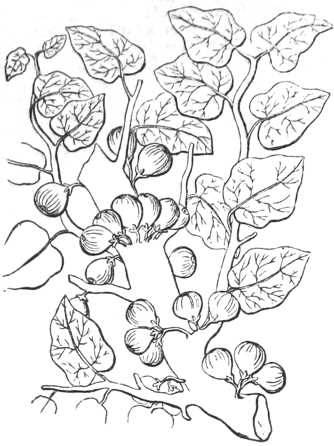
Fig. 326—Sycamore-Fig: Ficus Sycomorus
This word occurs in several passages of the Old Testament. From the context it is evident that it must have been a tree of some size, common in the plains, unable to bear great cold, with wood of inferior quality, but still cultivated and valued on account of its fruit. It was not what is called sycamore in this country, which is a kind of maple, and in some of its characters the reverse of what is required, but rather the mulberry tree, the Ficus Sycomorus of botanists, which is a genuine species of Ficus. The fruit in its general characters resembles that of the fig, while the leaves resemble those of the mulberry tree.
The ancients were well acquainted with it; and it is common in Egypt as well as in Syria. In Egypt, being one of the few trees indigenous in that country, its wood was proportionally much employed, as in making mummy-cases, though it is coarse grained, and would not be valued where other trees are more common. Though the wood of this sycamore is coarse grained, it is yet very durable in a dry climate like that of Egypt; hence the mummy-cases even in the present-day seem as if made with fresh wood. This may, no doubt, be partly ascribed to the preservative effects of the resinous coats, paints, etc. with which they are impregnated. That the sycamore was cultivated and esteemed in Palestine we learn from 1Ch 27:28, ’And over the olive trees and the sycamore trees that were in the low plains was Baal-hanan the Gederite.’ This was on account of its fruit, which it bears on its stem and branches, like the common fig, and continues to produce in succession for months. The fruit is palatable, sweetish in taste, and still used as food in the East. As the sycamore is a lofty, shady tree, it is well suited for climbing up into, as described in Luk 19:4, where Zacchaeus ascends one to see Jesus pass by.
Sycamore. (Hebrew, shikmah). Although it may be admitted that the sycamine is properly, and in Luk 17:6, the mulberry, and the sycamore, the mulberry, or sycamore-fig, (Ficus sycomorus), yet the latter is the tree generally referred to in the Old Testament, and called by the Septuagint (LXX), sycamine, as 1Ki 10:27; 1Ch 27:28; Psa 78:47; Amo 7:14. The Sycamore, or fig-mulberry, is in Egypt and Palestine, a tree of great importance and very extensive use. It attains the size of a walnut tree; has wide-spreading branches; and affords a delightful shade. On this account, it is frequently planted by the waysides.
Its leaves are heart-shaped, downy on the under side, and fragrant. The fruit grows directly from the trunk itself on little sprigs, and in clusters like the grape. To make it eatable, each fruit, three or four days before gathering, must, it is said, be punctured with a sharp instrument, or the finger-nail. This was the original employment of the prophet, Amos, as he says. Amo 7:14. So great was the value of these trees that David appointed for them in his kingdom, a special overseer, as he did for the olives, 1Ch 27:28, and it is mentioned as one of the heaviest of Egypt’s calamities, that her sycamore were destroyed by hailstones.
Luk 19:4. Often planted by the wayside for shade.
shiqmah,
SYCOMORE [ ; Ficus, Sycomorus]):
By: Emil G. Hirsch, Immanuel Benzinger
A medium-sized bushy tree of Syria and Egypt, allied to the common fig. It is often mentioned in the Bible (Amos vii. 14; I Kings x. 27; Isa. ix. 9, 11; Ps. lxxviii. 47; I Chron. xxvii. 28; II Chron. i. 15, ix. 27), and still grows plentifully in the plain along the coast, the Shefelah (comp. the ancient name of the place Haifa, Sykaminon, after the Greek designation of the tree [
Sycamore. A huge evergreen tree growing to a height of about 12 to 15 meters (40-50 feet) with a trunk circumference of over 6. 5 meters (20 feet). The trunk forked near the ground, and the branches grew outward.
The leaves of the sycamore, sometimes called the sycamore fig, were heart-shaped, resembling the leaves of the mulberry. The fruit was similar to the true fig but was inferior in quality. These yellow figs grew in cluste rs close to the branches.
Sycamores were trees of the plains ( 1Ki 10:27) and could not tolerate colder climates ( Psa 78:47). The sycamore was the tree which Zacchaeus climbed to gain a better view of Jesus ( Luk 19:4).