
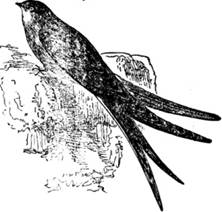
Fig. 324—Swift—Dururi
The species of this bird in Syria and Palestine, so far as they are known, appear all to be the same as those of Europe: they are,
The chimney swallow, with a forked tail, marked with a row of white spots.
The martin or common window swallow.
Sand-martin or shore-bird, not uncommon in northern Egypt, near the mouths of the Delta, and in southern Palestine, about Gaza, where it nestles in holes, even on the sea-shore.
The swift or black martin, distinguished by its larger size, short legs, very long wings, forked tail, and by all the toes of the feet turning forward: these, armed with small, crooked, and very sharp claws, enable the bird to hang against the sides of walls, but it cannot rise from the ground on account of the length of its wings.
Swallow. Hebrew, deror in Psa 84:3; Pro 26:2; Hebrew, ’agur in Isa 38:14; Jer 8:7; but "crane" is more probably, the true signification of ’agur, See Crane. The rendering of the Authorized Version for deror seems correct.
The characters ascribed in the passages, where the names occur , are strictly applicable to the swallow, namely, its swiftness of flight, its meeting in the buildings of the Temple, its mournful, garrulous note, and its regular migrations, shared indeed in common with several others. Many species of swallow occur in Palestine. All those common in England are found.
1. deror. This is interpreted ’roving about,’ which agrees well with the habits of the swallow or swift. They come and go, and are not domesticated. Pro 26:2. In Psa 84:3 it is typical of the wanderer finding rest and protection in God’s house.
2. agur, mentioned with the word sis, translated ’crane’ and ’swallow;’ but sis doubtless refers to the swallow, and agur to the crane. The swallow (or perhaps the swift) is mentioned as ’chattering,’ or having a ’garrulous note,’ and it is migratory. Isa 38:14; Jer 8:7. Several species of the swallow frequent Palestine: the Hirundo rustica, H. rufula, etc. A species of swift finds the Jordan valley warm enough in the winter, and need not migrate.
By: Emil G. Hirsch, I. M. Casanowicz
Rendering in the English versions for "deror" (Ps. lxxxiv. 4 [A. V. 3]; Prov. xxvi. 2) and for "sus" or "sis" (Isa. xxxviii. 14: Jer. viii. 7 [A. V. "crane"]). There are about ten species of swallow (Hirundinidœ) and the closely allied martin and swift (Cypselidœ) in Palestine. In the Talmud "senunit" is the usual name for the swallow, and the Biblical "deror" is also used. A distinction is made between the white, the green (or yellow), and the house swallow (Ḥul. 62a). The senunit, which, according to Shab. 77b, inspires the eagle with dread, may perhaps be intended for another bird of the species Tyrannus intrepidus, which seats itself on the back of the eagle and which resembles the swallow.
Bibliography:
Tristram, Nat. Hist. p. 204;
Lewysohn, Zoologie des Talmuds, p. 206.
SWALLOW.—1. dĕrôr (Psa 84:3, Pro 26:2). The allusion to the nesting of this bird in the sanctuary and its swift (unalighting) flight fits the swallow. 2. ‘âgûr (Isa 38:14, Jer 8:7). See Crane. 3. sûs, sîs, should be tr.
These birds are near relatives and so alike on the wing as to be indistinguishable to any save a close observer. Yet the Hebrews knew and made a difference. The swallow is a trifle larger and different in color. It remains all the year, while in numerous instances the swift migrates and is a regular sign of returning spring. The swallow is of long and tireless flight. The swift is so much faster that the sound of its wings can be heard when passing. The swallow plasters a mud nest under eaves, on towers, belfries, and close to human habitations. The swifts are less intimate, building in deserted places, under bridges and on rocky crevices. The swallows utter constantly a rather sweet low note; the swifts chatter harshly and incessantly at their nests. These differences are observable to the most careless people. Scientists separate the birds on account of anatomical structure also. Despite this, the birds are confused in most of our translations.
“Like a swallow or a crane, so did I chatter;
I did moan as a dove; mine eyes fail with looking upward:
O Lord, I am oppressed, be thou my surety” (Isa 38:14).
Here
“As the sparrow in her wandering, as the swallow in her flying,
So the curse that is causeless alighteth not” (Pro 26:2).
This reference might apply to either, remembering always that the swift took its name from its exceptional flight, it being able to cover over 80 miles an hour. However, the swallow is credited with 800 miles in a night.
“Yea, the sparrow hath found her a house,
And the swallow a nest for herself, where she may lay her young,
Even thine altars, O Yahweh of hosts,
My King, and my God” (Psa 84:3).
Here is one instance, at least, where the swallow is at home and the translation correct. The swift might possibly have built in the temple: the swallow was sure to be there.
(noun)
Psa 84:3 (c) This bird is used to describe the apostasy of Israel. The altars of GOD should have been hot with fires for sacrifice. Instead they were so cold, neglected and unused that the birds felt free to make their nests in them.
Pro 26:2 (a) In this case the bird is used to illustrate GOD’s definite dealings with men. The swallow flies for a purpose, she knows where she is going, and what she is doing. So it is when GOD punishes sinners. It is an intelligent punishment.
Isa 38:14 (a) Hezekiah uses the mournful sounds of the swallow to illustrate the sadness of his own heart.
(verb)
Isa 25:8 (b) When our Lord returns for His people, they will not die, but will be caught up alive into Heaven. A victorious ascension will take the place of the sadness of death.
Isa 28:7 (b) The drunkard is conquered by the liquor. He becomes a slave to that which he drinks. He is submerged under the terrible appetite for wine.
Isa 49:19 (b) In this prophecy the Lord is informing us that the people who conquered Israel will be driven far away from them, and they will no longer be engulfed by their enemies, but will be free to expand their country.
Lam 2:2 (b) The wrath of GOD in conquering Israel and pouring out His wrath over them is described in this way. Israel was helpless in the hands of an angry GOD, and He consumed them in His wrath. This is in contrast, or perhaps, in comparison with verse 16 in which we find that the enemies of Israel engulfed them. From GOD’s standpoint He did it, but the enemies of Israel were the means and the agents by which GOD did it. (See also Jer 51:34).
Hos 8:8 (b) This action is used to describe the scattering of the Jews among the Gentiles in which they were absorbed after their dispersion.
Amo 8:4 (b) This describes the cruel power of the rich as they destroyed the poor, and the powerful as they destroyed the weak.
Oba 1:16 (b) The suicide of the heathen is described in this way. They drink iniquity, they live on their sins, they revel in rioting and drunkenness, and all of this serves to destroy the people.
Mat 23:24 (b) This figure describes the ease with which hypocrites believe impossible statements, and use them as though they were true.
1Co 15:54 (b) Here is a graphic description of the way in which death for the Christian will be abolished when CHRIST returns to catch up His church in the Rapture. The living Christians will be caught up to Heaven without dying.
Swallow. The swallow is a migratory bird quite familiar to residents of the Holy Land. Frequently on the move to warmer climates, swallows gather in huge flocks to travel thousands of miles. A chattering flock can make quite a racket (Isa 38:14). The psalmist makes an interesting distinction between the sparrow, who finds a home, and the swallow, who gets a nest (Psa 84:3). Only a permanent resident needs a home. Some translations render the Hebrew word for swallow as thrush (Jer 8:7), (NIV, NASB) or wryneck (Jer 8:7), (NEB).
Swallows spend most of their time in the air, catching insects on the wing. They are beautiful birds, brightly colored, with forked tails.