A wilderness so called. Here it was that, Hagar found a sweet Bethel: see Gen. 16. throughout, well worth regarding. And how many of God’s dear children have found the same wilderness dispensations laying a foundation for rich enjoyments! I verily believe that the family of Jesus would have lost some of their most precious seasons, had they lost some of their wilderness exercises. It was not without an eye to this that the Lord said, Therefore, behold, I will allure her, and bring her into the wilderness, and speak comfortably to her." (Hos. 2: 14.) Indeed, the very word Shur, a wall, carries with it this idea. Reader, do not forget it if at any time Jesus brings you into Shur. He who brings you there will not leave you there, but will manifest himself to you there. Oh, how precious the faith that enables a soul to say, under all wilderness straits and difficulties, Thou God seest me! Oh, for all the family of Jesus to call such wildernesses Beer - lahai - roi - - namely, the well of him that liveth and seeth me!"
Shur, a city on the confines of Egypt and Palestine (Gen 16:7; Gen 20:1; Gen 25:18; 1Sa 15:7; 1Sa 27:8). Josephus makes it the same as Pelusium (Antiq. vi. 7. 3; comp. 1Sa 15:7) but this city bore among the Hebrews the name of Sin. More probably Shur was somewhere in the vicinity of the modern Suez. The desert extending from the borders of Palestine to Shur, is called in Exo 15:22, the ’desert of Shur,’ but in Num 33:8, the ’desert of Etham.’
Shur. (a wall). A place, just without the eastern border of Egypt. Shur is first mentioned in the narrative of Haggar’s flight from Sarah. Gen 16:7. Abraham, afterward, "dwelled between Kadesh and Shur, and sojourned in Gerar." Gen 20:1. It is also called Ethami. The wilderness of Shur was entered by the Israelites, after they had crossed the Red Sea. Exo 15:22-23. It was also called the wilderness of Etham. Num 33:8. Shur may have been a territory town, east of the ancient head of the Red Sea; and from its being spoken of as a limit, it was, probably, the last Arabian town, before entering Egypt. See Etham.
Outside the eastern border of Egypt. ("a wall".) The strip of desert which skirts the wall-like range of
In Gen 25:18 Shur is defined to be "before (i.e. E. of) Egypt." So 1Sa 15:7; 1Sa 27:8; Josephus (Ant. 6:7) makes it Pelusium, near the Nile’s mouth; others the N.E. part of the wilderness of Paran, now al Jifar. Gesenius makes Shur the modern Suez. Israel entered "the wilderness of Shur" when they had crossed the Red Sea (Exo 15:22-23). The wilderness of Shur is the whole district between the N.E. frontier of Egypt and Palestine, Shur being derived from the Egyptian
SHUR.—A place or district on the N.E. border of Egypt (Gen 16:7; Gen 20:1; Gen 25:18, Exo 15:22, 1Sa 15:7; 1Sa 27:8). The name in Aramaic means ‘wall,’ and, as Egyp. th is regularly rendered by sh in Aramaic, Shur is probably the Egyp. city Thor (the vocalization is uncertain), a fortress near the N.E. frontier, and capital of the 14th nome of Lower Egypt. This Thor lay on a stream or canal named Shi-Hôr (See Shihor), and malefactors were sent thither after having their noses cut off. It is tempting to identify it with Rhinocorura (See Egypt [River of]), but it was on the banks of a fresh-water canal and 10 days’ march from Gaza. Perhaps it is the later Sele, near el-Kantara, on the Suez Canal.
F. Ll. Griffith.
Beheld: rampart (as point of observation)
Brugsch, however, proposed to regard Shur (“the wall”) as equivalent to the Egyptian
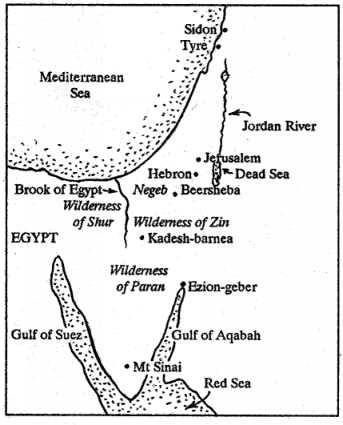
Shur was a desert region in the north of the Sinai Peninsular. It was bounded by Egypt on the west (the border being along the line of the present-day Suez Canal), and the Negeb on the east (the border being along the Brook of Egypt) (Gen 20:1; Exo 15:22; 1Sa 15:7; 1Sa 27:8). The main inland route from Egypt to Jerusalem passed through the Wilderness of Shur and the Judean towns of Beersheba and Hebron (Gen 13:1; Gen 13:18; Gen 16:7; Gen 21:14; Gen 46:5). (For further details see PALESTINE, sub-heading ‘Negeb’.)