
It was among the prophecies of the dying patriarch Jacob, (Gen. 4:ix. 13.) that Zebulun should dwell in "the haven of the sea, and be an haven for ships." And how distant soever this allusion may appear to some concerning the days of Christ, and the eventual
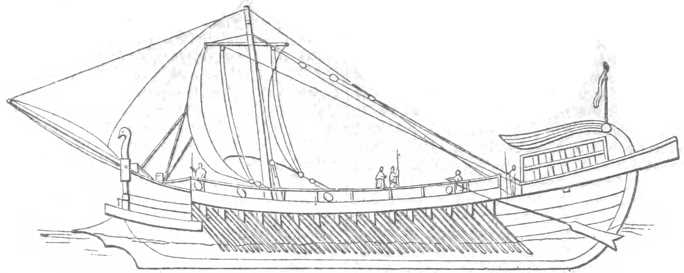
Fig. 319—Ancient Ship of the largest kind
In few things is there greater danger of modern associations misleading the reader of the Scriptures than in regard to the subject of the present article. Both the ships and the navigation of the ancients, even of the most maritime states, were as dissimilar as things of the same kind can well be to the realities which the terms now represent. Navigation confined itself to coasting, or if necessity, foul weather, or chance drove a vessel from the land, a regard to safety urged the commander to a speedy return, for he had no guide but such as the stars might afford under skies with which he was but imperfectly acquainted. And ships, whether designed for commercial or warlike purposes, were small in size and frail in structure.
The Jews cannot be said to have been a seafaring people; yet their position on the map of the world is such as to lead us to feel that they could not have been ignorant of ships and the business which relates thereunto. Phoenicia, the north-western part of Palestine, was unquestionably among, if not at the head of, the earliest cultivators of maritime affairs. Then the Holy Land itself lay with one side coasting a sea which was anciently the great highway of navigation, and the center of social and commercial enterprise. Within its own borders it had a navigable lake. And the Red Sea itself, which conducted towards the remote east, was at no great distance even from the capital of the land. Then at different points in its long line of sea-coast there were harbors of no mean repute. Yet the decidedly agricultural bearing of the Israelitish constitution checked such a development of power, activity, and wealth, as these favorable opportunities might have called forth on behalf of seafaring pursuits. And it is evident that the Israelites must have only partially improved their local advantages, since we find Hiram, king of Tyre, acting as carrier by sea for Solomon, engaging to convey in floats to Joppa the timber cut in Lebanon for the temple, and leaving to the Hebrew prince the duty of transporting the wood from the coast to Jerusalem. And when, after having conquered Elath and Ezion-geber on the further arm of the Red Sea, Solomon proceeded to convert them into naval stations for his own purposes, he was still, whatever he did himself, indebted to Hiram for ’shipmen that had knowledge of the sea’ (1Ki 9:26; 1Ki 10:22).
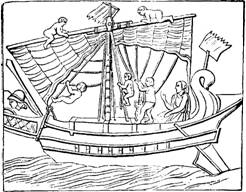
Fig. 320—Ancient Light-vessel, Pompeii
The reader of the New Testament is well aware how frequently he finds himself with the Savior on the romantic shores of the Sea of Gennesareth. There Jesus is seen, now addressing the people from on board a vessel (Mat 13:2; Luk 5:3); now sailing up and down the Lake (Mat 8:23; Mat 9:1; Mat 14:13; Joh 6:17). Some of his earliest disciples were proprietors of barks which sailed on this inland sea (Mat 4:21; Joh 21:3; Luk 5:3). But it is evident that these ’ships’ must have been small, though they were more than mere boats.
The vessels connected with Biblical history were for the most part ships of burden, almost indeed exclusively so, at least within the period of known historical facts. In a ship of this kind was Paul conveyed to Italy. They were, for the purposes to which they were destined, rounder and deeper than ships of war, and sometimes of great capacity. In consequence of their bulk, and when laden, of their weight, they were impelled by sails rather than by oars. On the prow stood the insignia from which the ship was named, and by which it was known. These in Acts (Act 28:11) are called ’sign’ which it appears consisted in this case of figures of Castor and Pollux, brilliant constellations, auspicious to navigators. Each ship was provided with a boat, intended in the case of peril to facilitate escape (Act 27:16; Act 27:30; Act 27:32), and several anchors (Act 27:29; Act 27:40); also a plumb-line for sounding (Act 27:28). Mention is made (Act 27:40) of a ’mainsail,’ which, however, should probably be rather termed the ’topsail.’ In great danger it was customary to gird the vessel with cables, in order to prevent her from falling to pieces under the force of wind and sea (Act 27:17). The captain was denominated steersman, though he was a different person from him who had the actual charge of the helm.
The dangers of the ocean to sailors on board such ships as these were, and in the then ignorance of navigation, caused sailing to be restricted to the months of spring, summer, and autumn; winter was avoided. To the Romans the sea was opened in March and closed in November (Act 27:9); and ships which towards the end of the year were still at sea earnestly sought a harbor in which to pass the winter (Act 27:12).
The ships of the ancients were very imperfect in comparison with modern ones. Navigators crept carefully along the shores, from one headland or prominent point to another, making a harbor if practicable every night; and when out of sight of land, being ignorant of the compass and quadrant, they guided their course by the sun and certain stars. Even in St. Paul’s time, vessels passing from Palestine to Italy, sometimes wintered on the way!\par Mal 27:12 28:11. The ancient ships were in general small, though a few large ships are on record. They were often highly ornamented both at the prow and the stern; and the figurehead or "sign," by which the vessel was known, was sometimes an image of its tutelar divinity. They were usually propelled by oars often in several "banks" or rows one above another, as well as by sails. In war, the galley tried to pierce and run down its antagonist.\par The Phoenicians were celebrated for their ships and their extensive commerce, as appears from Ezekiel’s description, Eze 27:1-36, as well as from numerous ancient historians. Though Joppa and in Christ’s time Caesarea were Jewish ports, 2Ch 2:18 Jon 1:3, yet the Jews were never a maritime people, and most of their foreign navigation would appear to have been carried on by the aid of Phoenicians, 1Ki 9:26 10:22 22:49,50. Paul’s graphic and faithful description of his voyage and shipwreck in Mal 27:1-44, discloses many of the peculiarities of ancient navigation. For the "ship of Tarshish," see TARSHISH.\par
Ship. No one writer in the whole range of Greek and Roman literature has supplied us with so much information concerning the merchant-ships of the ancients as St. Luke in the narrative of St. Paul’s voyage to Rome. Acts 27,28. It is important to remember that he accomplished it in three ships: first, the Adramyttian vessel which took him from Caesarea to Myra, and which was probably a coasting-vessel of no great size, Act 27:1-6, secondly, the large Alexandrian corn-ship, in which he was wrecked on the coast of Malta, Act 27:6-28; and thirdly, another large Alexandrian corn-ship, in which he sailed from Malta by Syracuse and Rhegium to Puteoli. Act 28:11-13.
Size of ancient ships. -- The narrative which we take as our chief guide affords a good standard for estimating this. The ship, in which St. Paul was wrecked had persons on board, Act 27:37, besides a cargo of wheat, Act 27:10; Act 27:38, and all these passengers seem to have been taken on to Puteoli in another ship, Act 28:11, which had its own crew and its own cargo. Now, in modern transport-ships, prepared far carrying troops, it is a common estimate to allow a toll and a half per man. On the whole, if we say that an ancient merchant-ship might range from 500 to 1000 tons, we are clearly within the mark.
Steering apparatus. -- Some commentators have fallen into strange perplexities from observing that in Act 27:40, ("the fastenings of the rudders"); St. Luke uses the plural. Ancient ships were, in truth, not steered at all by rudders fastened or hinged to the stern, but by means of two paddle-rudders one on each quarter, acting in a rowlock or through a port-hole as the vessel might be small or large.
Build and ornaments of the hull. -- It is probable that there was no very marked difference between the bow and the stern. The "hold," Jon 1:5, would present no special peculiarities. That personification of ships which seems to be instinctive led the ancients to paint an eye on each side of the bow. Compare Act 27:15. An ornament of the ship which took Paul from Malta to Pozzuoli is more explicitly referred to. The "sign" of that ship, Act 28:11, was Castor and Pollux; and the symbols of those heroes were doubtless painted or sculptured on each side of the bow.
Under-girders. -- The imperfection of the build, and still more (see below, 6) the peculiarity of the rig, in ancient ships, resulted in a greater tendency than in our times, to the starting of the pranks, and consequently to leaking and foundering. Hence, it was customary to take on board peculiar contrivances, suitable called "helps," Act 27:17, as precautions against such dangers. These were simply cables or chains, which, in case of necessity, could be passed round the frame of the ship, at right angles to its length, and made tight.
Anchors. -- Ancient anchors were similar in form to those which we use now, except that they were without flukes. The ship in which Paul was sailing had four anchors on board. The sailors on this occasion anchored by the stern. Act 27:29.
Masts, sails, ropes and yards. -- The rig of an ancient ship was more simple and clumsy than that employed in modern times. Its great feature was one large mast, with one large square sail fastened to a yard of great length. Hence, the strain upon the hull, and the danger of starting the planks, were greater than under the present system, which distributes the mechanical pressure more evenly over the whole ship.
Not that there were never more masts than one, or more sails than one on the same mast, in an ancient merchantman; but these were repetitions, so to speak, of the same general unit of rig. Another feature of the ancient, as of the modern, feature of the ancient, as of ship is the flag at the top of the mast. Isaiah l.c., and Isa 30:17. We must remember that the ancients had no compass, and very imperfect charts and instruments, if any at all.
Rate of sailing. -- St. Paul’s voyages furnish excellent data for approximately estimating this; and they are quite in harmony with what we learn from other sources. We must notice here, however -- what commentators sometimes curiously forget -- that winds are variable. That the voyage between Troas and Philippi, accomplished on one occasion, Act 16:11-12, in two days, occupied on another occasion, Act 20:6, five days. With a fair wind, an ancient ship would sail fully seven knots an hour.
Sailing before the wind. -- The rig which has been described is, like the rig of Chinese junks, peculiarly favorable to a quick run before the wind. Act 16:11; Act 27:16. It would, however, be a great mistake to suppose that ancient ships could not work to windward. The superior rig and build, however, of modern ships enable them to sail nearer to the wind than was the case in classical times. A modern ship, if the weather is not very boisterous, will sail within six points of the wind. To an ancient vessel, of which the hull was more clumsy and the yards could not be braced so tight, it would be safe to assign seven points as the limit.
Boats on the Sea of Galilee. -- In the narrative of the call of the disciples to be "fishers of men," Mat 4:18-22; Mar 1:16; Mar 1:20; Luk 5:1-11, there is no special information concerning the characteristics of these. With the large population around the Lake of Tiberias, there must have been a vast number of both fishting boats and pleasure boats, and boat building must have been an active trade on its shores.
Among the earliest shipbuilders were the Phoenicians, whose commerce and voyages made them foremost in the maritime science of early ages, and traces of whose ships are frequently met with. (On PAUL’S voyage, see EUROCLYDON; MELITA; CNIDUS; CRETE; FAIR HAVENS.) Paul was first in the Adramyttian coasting vessel from Caesarea to Myra; then in the large Alexandrian grain ship wrecked at Malta; then in another Alexandrian grain ship from Malta by Syracuse and Rhegium to Purcell. Luke shows accurate nautical knowledge, yet not professional, but of an observer, telling what was done but not the how or the why.
Fourteen different verbs he uses of the progression of a ship, peculiar to himself and appropriate to each case:
The largest on record was Ptolemy Philopator’s war galley, 420 ft. long by 57 ft. broad, under 5,000 tons. "The governor" in Jas 3:4 is the "helmsman" (
An eye was painted on each side of the bow; so Luke’s phrase (
Anchoring by the stern, the ancients were prepared to anchor in the gale such as Paul encountered; and Purdy (Sailing Directions, 180) says that the holding ground at Malta where Paul was wrecked is quite good enough to have secured the anchors and ship in spite of the severe night. In Act 27:40, for "mainsail" translated "foresail," which was needed to put the ship about and to run it aground. Vessels were propelled by oars as well as by sails (Eze 27:29; Isa 33:21; Jon 1:13). Of the 32 parts or points of the compass card a modern ship will sail within six points of the wind. The clumsier ancient ship probably could sail within seven points. In a heavy gale the ship would lie to, with the right side to the storm, the object being not progress but safety; as under the lee of Clauda (Act 27:14-17).
To anchor was impossible; to drift would have brought the ship to the fatal Syrtis off Africa. The wind was E.N.E. (Euraquilo); the direction of drift being W. by N., and the rate of drift one mile and a half an hour; the shipwreck must have been off Malta. Having no compass or charts, they seldom ventured voyaging in winter (Act 27:9), and the absence of visible sun or stars seriously embarrassed them (Act 27:20). In the intricate passages between islands and mainland they did not sail by night when the moon was dark (Act 20:13-16; Act 21:1). Thomson (Land and Book, 401-404) mentions seeing but one rickety boat on the sea of Galilee, which was once covered with fishermen’s boats; contrast the fact that Josephus (B. J., 2:21, section 8-10) mentions his collecting here 280 boats, with four men in each.
The Israelites were not a maritime people. Solomon had a ’navy of ships’ at Ezion Geber, the eastern branch of the Red Sea; but Hiram sent his shipmen ’that had knowledge of the sea’ with the servants of Solomon. Ships of Tharshish are also mentioned both in connection with Solomon and Jehoshaphat. 1Ki 9:26-27; 1Ki 10:11; 1Ki 10:22; 1Ki 22:48-49; 2Ch 20:36-37; Psa 48:7. The ships so often mentioned on the Sea of Galilee in the Gospels were what are now called fishing boats, and were used as such. The ships in which Paul sailed on the Mediterranean were of course larger; those in which he was taken to Rome are well described by Luke in the Acts of the Apostles: the ship wrecked at Malta was evidently an Alexandrian wheat-ship. The nautical terms employed by Luke show that he was well acquainted with maritime subjects. Acts 27. The word for GALLEY in Isa 33:21 is the same as that translated ’navy’ in the Kings.
SHIP.—See Boat.
(íáῦò, occurring in Act_27:41 only, ‘a vessel of considerable size’; cf. ðëïῖïí, ‘ship, boat, sailing vessel,’ Act_20:13; Act_20:38; Act_21:2-3; Act_21:6; Act_27:2 ff; Act_28:11, Jam_3:4, Rev_8:9; Rev_18:17; Rev_18:19, and frequently in the Gospels; cf. also ðëïéÜñéïí, ‘a little boat,’ Mar_3:9; Mar_4:36, Joh_21:8, and ἡ óêÜöç, ‘a skiff,’ used of the small life-boat which was towed astern the larger vessel on which St. Paul sailed from Palestine to Italy, Act_27:16; Act_27:30; Act_27:32)
The ancient Hebrews were not given to seafaring, Solomon (1Ki_5:9; 1Ki_9:26-28; 1Ki_10:22) and Jehoshaphat (1Ki_22:48-49) being the only important exceptions. They preferred agricultural and pastoral life. Besides, Canaan had no good harbours, and almost the entire coast remained permanently in the possession of others, the Phcenicians holding all north of Mt. Carmel, and the Philistines most of that to the south. Simon the Hasmonaean (circa, about 145 b.c.) was the first to make a harbour. ‘He took Joppa for haven, and made it an entrance for the isles of the sea’ (1Ma_14:5). According to Josephus (Bellum Judaicum (Josephus) I. xxi. 5, Ant. XV. ix. 6), Herod the Great added a second harbour at Caesarea. As early as 400 b.c. the Greeks demonstrated their ability to construct large ships. Dionysius I. of Syracuse built ships with four ranks of oarsmen (Pliny, Historia Naturalis (Pliny) vii. 57; Diod. Sic. xiv. 41, 42). In the days of St. Paul the Romans controlled the commerce of the Mediterranean.
It is to St. Luke that we owe the most vivid as well as the most accurate account of sea-voyaging which has come down to us from antiquity. Experts in naval science agree that it is without a parallel (cf. J. Smith, The Voyage and Shipwreck of St. Paul4). Luke must have possessed a genuine Greek love for things nautical. The wealth of detail contained in Acts 27, 28 regarding St. Paul’s experiences from Caesarea to Puteoli, which covered a period of six months (Sept. a.d. 58 to March 59), is invaluable. But long prior to this most eventful voyage, St. Paul had become experienced in nautical affairs. Writing to the Corinthians, he says, ‘Thrice I suffered shipwreck, a night and a day have I been in the deep’ (2Co_11:25), clinging perhaps to some floating plank or other timber of a wrecked vessel (cf. Act_27:44).
In the voyage to Italy St. Paul and his fellow-prisoners were carried in three different vessels: (1) In a ship of Adramyttium (a town near Troas in Mysia), probably a coasting vessel which was returning home for the winter (Act_27:2). The centurion’s plan probably was, originally, to take the prisoners all the way to Mysia, and from there cross over and join the Egnatian Way, which ran overland from Byzantium through Philippi to Dyrrachium, thence crossing to Italy. As a matter of fact, they sailed by this vessel only from Caesarea to Myra in Lycia. (2) In a corn-ship of Alexandria bound for Italy, from Myra to Melita, one of the great fleet of merchant ships which assisted in feeding Rome (Act_27:6). This was the vessel which was wrecked. (3) In a second corn-ship of Alexandria, which brought them from Melita to Puteoli (Act_28:11).
The following points in connexion with these ships are especially noteworthy:
1. Size of ships.-While we are not informed as to their exact dimensions, we do know that they were capable of carrying not only a considerable cargo of wheat but also 276 souls all told (though the Vaticanmanuscript reads but 76), and that when one was wrecked another took all these persons on board (Act_27:37-38, Act_28:11). It has been estimated that the capacity of such vessels must have ranged from 500 to 1000 tons. This is corroborated by what we know in general about Roman merchant vessels. That, for example, on which Josephus was wrecked, he tells us, carried ‘about six hundred’ (Vita, 3). Lucian (Ðëïῖïí ἢ Åὐ÷áß) also describes a vessel which was driven by a storm into the port of Athens, which measured the equivalent of 180 ft. in length by 45 ft. in breadth, having an approximate tonnage of 1200. And, according to Athenaeus (28:37), the war galley of Ptolemy Philopator measured 420 by 57 ft. (cf. J. Smith, Voyage and Shipwreck4, pp. 187 ff., 234 ff.).
2. The officers.-(a) The sailing-master, steersman, pilot (ÊõâåñíÞôçò, Act_27:11; cf. Rev_18:17; in the Authorized Version of Jam_3:4 called ‘the governor,’ ὁ åὐèýíùí); and (b) the ship-owner, ship-master, captain (íáýêëçñïò); he it was who hired out his vessel, wholly or in part, for purposes of transportation, probably also receiving the fares.
3. The sailors, called íáῦôáé, seamen, shipmen, crew.-It was their keen ears that detected the sounds of the breakers when they were nearing land (Act_27:27; Act_27:30).
4. The sails (óêåῦïò, translated ‘gear,’ Act_27:17; the same word is used in Act_10:11 of the great sheet which Peter saw in a vision; cf. ἀñôÝìùíá, translated ‘foresail,’ Act_27:40).-Roman ships usually bore but one large square sail, on which for the most part they depended to propel the vessel. Pliny says there was also a sail at the stern, but this J. Smith regards as exceptional (Pliny, Proaem. xix.; Smith, Voyage and Shipwreck4, p. 192). This large mainsail was fastened to a long yard. It was furled by being drawn up to the yard. It was reefed in time of storm (cf. Act_27:15). From a drawing, preserved at Pompeii, of a vessel dating from the time of the apostles, it is evident that Roman sails were sewn across both vertically and horizontally by bands of rope to check any rent from extending beyond the square in which it occurred. They were made of costly material-byssus, or shesh-and sometimes bore designs, which were woven into them. The ships of Antony and Cleopatra carried purple sails. Tyrian sails were richly embroidered. As St. Paul was a tent-maker, he probably understood sail-making also, and may have more than once crossed the Mediterranean, earning his passage by plying his trade. In times of storm a vessel could not safely carry the large mainsail, or even the yard-arm; hence these were lowered on the deck, and a small storm-sail or ‘foresail’ (ἀñôÝìùí) was hoisted to take their place. This was what was actually done on St. Paul’s ship just before running aground (Act_27:40). Some, however, following Breusing, interpret the ‘gear’ which was ‘lowered’ (Act_27:17) to mean that cables with weights attached were lowered into the sea to retard the vessel in its progress to inevitable destruction (so Blass, Gcerne, Knabenbauer, and, to a modified extent, also Wendt).
5. The masts.-Nothing is said of masts in the account except by implication. There must have been a large mainmast, and probably a foremast also at the bow. They were made of strong wood, possibly of cedar (cf. Eze_27:5). There is no proof that these Roman corn-ships bore a mizzenmast or aftermost mast, though doubtless the Romans at this time possessed three-masted vessels.
6. The anchor (ἄãêõñá, Act_27:29-30; Act_27:40).-Four are specially mentioned in Act_27:29, but others were doubtless carried, for use at both bow and stern. Originally, the ancients used large stones, but in Roman times they made anchors of iron. They consisted of a main stock with two teeth-like extremities, not always ‘without flukes’ (cf. Roschach in Daremberg-Saglio’s Dictionnaire des Antiquités, 1873-75, p. 267). Anchors were needed to prevent a vessel from being cast on the rocks. Those on the ill-fated vessel with St. Paul were finally cast off into the sea and abandoned (Act_27:40). A singularly beautiful figurative use is made of the expression in Heb_6:19, in which the Apostle speaks of hops as ‘an anchor of the soul’ (see Anchor).
7. The rudder (ðçäÜëéïí, Act_27:40; cf. Jam_3:4).-The Greek word comes from a root meaning ‘the blade of an oar’; hence a rudder was primarily a broad float oar or paddle. It was probably hung by straps or ropes from the after part of the ship, and was managed by the steersman or master of the vessel (êõâåñíÞôçò). When not in use, as for example in harbour, it was made fast either to the side of the ship or on deck. When a vessel was on the verge of running aground, the rudder was loosed to carry the ship up the beach (Act_27:40). Of the rudder, also, a striking figurative use is made by the apostle James in speaking of the tongue; he says that, as a little rudder can turn about a great ship, so the tongue can control the whole nature of man (Act_3:4-5).
8. Helps (Act_27:17, ‘They used helps, undergirding the ship,’ âïçèåßáéò ἐ÷ñῶíôï, ὑðïæùííýíôåò ôὸ ðëïῖïí).-These were cables for undergirding and strengthening the hull especially in bad weather, in order to prevent the ship’s timbers from yielding under strain. The vessels of the Romans were so loosely built that they had to be frapped. This was done either lengthwise round the ship from stem to stern above the water-line (as Breusing and Torr are disposed to think) or transversely, amidship under the keel, encircling the vessel (as Balmer, J. Smith, and others). The verb ‘undergirding’ favours the latter view, though both processes may have been in vogue.
9. Tackling (óêåõÞ, Act_27:19).-A comprehensive term including all the ship’s necessary furniture, its fittings and equipment, everything movable lying on deck or anywhere about, not in actual use-these were cast overboard the third day.
10. The little boat (ἡ óêÜöç, Act_27:16; Act_27:30; Act_27:32).-Every large merchant ship probably had one or more such skiffs to serve as life-boats. They were usually towed behind. That attached to St. Paul’s ship was dragging water-logged astern, until, under the lee or Cauda, it was taken up for greater security (Act_27:16). When the sailors felt that danger was imminent, they began to lower it in order to escape to land (Act_27:30), but St. Paul promptly detected their scheme and reported them to the centurion, whereupon it was cut loose and dropped overboard (Act_27:32).
11. Ropes (ó÷ïéíßá, Act_27:32).-These held the little life-boat, but, being cut, the boat was allowed to fall off into the sea. No incident in the voyage shows so well the faith which the soldiers had in St. Paul.
12. Sign (ðáñÜóçìïí, Act_28:11).-Roman ships bore individual ensigns. That on which St. Paul left Melita bore the sign ‘Dioscuri,’ the Twin Brothers, referring to the heroes Castor and Pollux, the twin sons of Zeus, who were generally regarded as protectors of voyagers. In Greek mythology they were the heroes of many adventures, and were worshipped as divinities, particularly by Dorians and at Rome. To them, as the patron deities of the seamen, this third ship was dedicated. Why the ensign of this particular vessel should be given is not clear, but perhaps it was because of the captain’s courage in starting in winter (February?) on so perilous a voyage-Melita to Puteoli. Sometimes eyes also were painted or sculptured on the prows of vessels (cf. Act_27:15, ἀíôïöèáëìåῖí, lit. [Note: literally, literature.] ‘to look at the wind eye to eye’). The hull, too, was often painted and decorated, the ornament on the stern-post being commonly a swan or a goose-head. From the hull (ðñýìíá, Act_27:29) rose the flagstaff which carried the pennant.
13. Speed, winds, currents, direction, etc.-A vessel’s rate of sailing depended much upon the wind. The voyage from Troas to Philippi St. Paul made on one occasion apparently in two days (Act_16:11-12), whereas on another it required five (Act_20:6). With a fair wind, Roman ships ordinarily averaged, it is reckoned, seven knots an hour. Being rigged like modern Chinese junks, they were peculiarly well fitted to make good speed before the wind. When the winds were unfavourable, ships could be made to sail ‘within seven points of the wind’; for example, St. Paul’s vessel maintained a N.W.W. course from Cauda to Melita in spite of an E.N.E. Euraquilo, or north-easter (Act_27:14). Roman sailors knew also how to make use of the currents of the Mediterranean. Thus, the ship of Adramyttium sailed northward from Sidon under the lee of Cyprus against winds that were contrary (Act_27:4), probably helped somewhat by a coast current which flows in that direction. In a very severe storm, sailors made their ships ‘lie to,’ the object being, not to make progress, but to ride out the gale, as under the lee of Cauda (Act_27:14-17). But with vessels of only moderate size, rigged with sails unequally distributed over the deck, and having at best very imperfect charts, and with no compass, shipwrecks were of common occurrence. Sailing was avoided as much as possible in the winter season because the heavens were then frequently clouded and it was impossible to take observations (Act_27:20, Act_28:11), Plumb-lines were carried for purposes of sounding (Act_27:28), and possibly other instruments, such as windlasses; but the science of navigation in apostolic times was still in its infancy.
Most remarkable is the fact that before setting out to sea it was customary even among the Greeks and Romans to supplicate the protecting deities for a prosperous voyage (cf. Wis_14:1, Jon_1:5).
Literature.-J, Smith, The Voyage and Shipwreck of St. Paul4, 1880; A. Breusing, Die Nautik der Alten, 1886; J. Vars, L’Art nautique dans l’antiquité et spécialement en Grèce, d’après A. Breusing, 1887; H. Balmer, Die Romfahrt des Apostels Paulus und die Seefahrtskunde im röm. Kaiserzeitalter, 1905; Cecil Torr, Ancient Ships, 1894; A. Böckh, Urkunden über das Seewesen des attischen Staates, 1840; H. Guthe, article ‘Ships and Navigation’ in Standard Bible Dictionary, 1909; M. A. Canney, article ‘Ship’ in Encyclopaedia Biblica iv.; F. H. Woods, article ‘Ships and Boats’ in Hastings’ Single-vol. Dictionary of the Bible ; article ‘Ship’ in Piercy’s Illustrated Bible Dictionary, 1908; P. Watts, article ‘Ship’ in Encyclopaedia Britannica 11 xxiv.; R. M. Blomfield, article ‘Ships and Boats’ in Hasting's Dictionary of the Bible (5 vols) v.
George L. Robinson.
Pro 30:19 (b) This indicates the remarkable guidance of the Lord in directing His own through the trackless lanes of life and bringing them safely to the desired haven.
Israelites were not seafaring people, partly because the Mediterranean coast south of Mt Carmel had shallow waters and sandy shores, with no good sites for harbours. North of Mt Carmel, however, there were good harbours at Tyre and Sidon. This was one reason why the Phoenicians became a famous seafaring nation in Old Testament times (Eze 27:2; Eze 27:25; Eze 28:2; see PHOENICIA).
In the time of the Israelite monarchy, King Hiram of Phoenicia and King Solomon of Israel established a fleet of ships to operate between the Red Sea port of Ezion-geber and India. Because of the Israelites’ lack of seafaring experience, Solomon had to rely on the Phoenician seamen to guide and teach his men. The ships used on this route were known as ‘ships of Tarshish’. This was a technical name for a certain kind of ocean-going cargo ship, not an indication of the port to which or from which a ship was sailing (1Ki 9:26-28; 1Ki 10:11; 1Ki 10:22; see TARSHISH).
‘Ships of Tarshish’, like other large ships, may have been driven by oars or by sails (Isa 33:21; Isa 33:23; Eze 27:6-8; Eze 27:26; Eze 27:29). River boats, which were much smaller, may have been made of papyrus reeds (Isa 18:1-2).
God’s judgment on the greedy commercial giant Phoenicia (Tyre) was pictured by the prophet Ezekiel as the sinking of a great ship. The ship had been beautifully made of the best materials from all parts of the trading world. Its planks, masts, oars and decking were made of the best timbers, its sails of the finest linen, and its colours of the most expensive dyes. The rowers, sailors and craft workers who made up its crew were highly skilled people from many countries. Tyre’s trade, however, became so great that the ship became overloaded. When caught in a storm at sea, it sank. All its cargo was lost and all the crew drowned (Eze 27:1-9; Eze 27:25-27; Eze 28:2-8; cf. Rev 18:19).
In New Testament times huge grain ships sailed from Alexandria in Egypt to Greece and Rome (Act 27:6; Act 28:11). They were capable of carrying large cargoes and several hundred people (Act 27:18; Act 27:37). Being sailing ships, they had to stay in port during winter months, when severe storms were likely to wreck them (Act 27:9-20). During the stormy season the ship’s crew wrapped strong ropes or metal bands around the hulls of the ships to hold their timbers together (Act 27:17).
The smaller boats that sailed on the Lake of Galilee were used mainly for fishing or carrying passengers (Mat 4:21-22; Mat 8:23-27; Mat 9:1; Luk 5:2-7; Joh 6:22-23; Joh 21:3). They were driven either by sails or by oars, depending on the weather conditions (Mar 6:48; Joh 6:19).