
See DRAGON under BEAST.
The interesting circumstance as related in the very opening of the Bible concerning the subtlety of the serpent, and the direct application of it to the devil, renders it a subject of peculiar importance in a work of this kind that it should be noticed. I do not mean, however, by what I have said, to enter into all the wonderful relations which we meet with in sacred record concerning the serpent. It will be sufficient to all the purposes I mean to offer upon the subject, to observe that the Great and Almighty Author of Scripture hath inmany places plainly declared that by the serpent is intended the devil, yea, the devil is expressly called the old serpent. (Rev. xii, 9.) I beg that this may be fully understood. And it were to be much wished that the sense of it was as fully impressed upon the mind of every reader. (See Job 26. 13. Isa. 27. 1.)
The whole tenor of Scripture, therefore being directed to set forth the devil under this image and figure of the serpent, there appears a beautiful analogy between the brazen serpent lifted, up in the wilderness at the command of God, and the Lord Jesus lifted up on the cross for the salvation of his people by the same authority - - and for this plain reason, because none but the serpent of all the creatures in the creation of God was cursed; and therefore none but the serpent among the creatures of God could be the suitable typeor figure to represent Christ when redeeming, his people from the curse of the law, "being made a curse for them. And as the simple act of faith in the Israelite in the wilderness, when beholding the brazen serpent as typical of Christ, became the sole means of recovery when dying under the effects of the serpent’s poison in the old dispensation, so the simple act of faith in the Lord Jesus Christ becomes the sole cause of salvation when dying under the consequences of sin and Satan under the New. Indeed so Christhimself explained it and so the faithful in all ages have understood it; and, no doubt, thousands who are now in glory, while they were upon earth, accepted this beautiful illustration of the subject, and lived and died in the most firm conviction of the truth of it, to the Lord’s glory, and their souls’ happiness.
I have thought it worth while to be the more particular on this point, not because there is the least question to be made of our Lord’s own illustration of this subject, but because some doubts have arisen whether it was truly a serpent which beguiled Eve, or some other creature. But while the uniform testimony of Scripture is with this subject, and the devil is continually called by the name of serpent through the whole of the Bible, and while the faithful in all ages have, without a single instance of departure, received no otheridea, it should seem the safest method to accept the good old way of translation, assured that if the fact had not been so, God the Holy Ghost would have taught the church accordingly. The objection arising from the Serpent’s being endowed with speech and reined in conversing with our first mother, and persuading her by argument, is no more in reality an objection than that of the ass possessing both in the instance of Balaam’s history. Both were miraculous; both induced by the sovereign power of God for theaccomplishment of the Lord’s purposes. And of the two examples of the kind, surely, the great event of man’s apostacy became a much more important occasion for such a miracle than the condemnation of a single character like Balaam.
I cannot help making a farther remark, that the Hebrew name for serpent (Nechash) is the general name used throughout the whole Scripture. And it is not only an ingenious but a beautiful thought of Mr. Parkhurst in his Lexicon, page 390, that the reason for which Moses in the wilderness when commanded to make the figure of a fiery serpent, made it of brass or copper, was not only because it was the nearest in resemblance to the colour of the serpent, but also from the noxious qualities of poison in it. For, saith Mr. P. "asman, no doubt, was acquainted with animals long before he had any knowledge of minerals and their qualities, it seems highly probable that the primeval language might in some instances, and where there was a similarity of qualified, describe the latter by names deduced from those which were at first given to the former. And in the present case it is observable that copper is not only of a serpentine colour, but resembles those noxious animals in its destructive properties, being in all its preparations accounted poisonous.All this is strikingly just upon the presumption that the word (Nechash) he rendered, as it hath uniformly been rendered, serpent, by all the translators of the Bible for centuries; but, if another beast of the field be substituted the beauty in the resemblance, is lost. It is worthy of farther remark, in confirmation, that the church all along considered the word (Nechash, ) which is rendered in our translation serpent, to have been uniformly connected with the idea of this beast; for we find, in the days of Hezekiah, that inhis removing the brazen serpent which Moses had made, and calling it not immediately (Nechash, ) but Nehushtan, thus playing upon the word, but still preserving the idea of the thing itself the good old king plainly, proved what the judgement of the church concerning it was in his day. Hezekiah saw that Israel had idolized the type, and forgotten the thing signified, therefore in removing it, and calling it Nehushtan, he aimed to direct the minds of the people from the type and shadow to him it was intended to prefigure. (See2Kings 18: 4. See Nehushtan.)
In Egypt and other oriental countries, a serpent was the common symbol of a powerful monarch; it was embroidered on the robes of princes, and blazoned on their diadem, to signify their absolute power and invincible might, and that, as the wound inflicted by the basilisk is incurable, so the fatal effects of their displeasure were neither to be avoided nor endured. These are the allusions involved in the address of the prophet, to the irreconcilable enemies of his nation: “Rejoice not thou, whole Palestina, because the rod of him that smote thee is broken; for out of the serpent’s roots shall come forth a cockatrice, and his fruit shall be a fiery flying serpent,” Isa 14:29. Uzziah, the king of Judah, had subdued the Philistines; but taking advantage of the weak reign of Ahaz, they again invaded the kingdom of Judea, and reduced some cities in the southern part of the country under their dominion. On the death of Ahaz, Isaiah delivers this prophecy, threatening them with a more severe chastisement from the hand of Hezekiah, the grandson of Uzziah, by whose victorious arms they had been reduced to sue for peace; which he accomplished, when “he smote the Philistines, even unto Gaza, and the borders thereof,” 2Ki 18:8. Uzziah, therefore, must be meant by the rod that smote them, and by the serpent from whom should spring the fiery flying serpent, that is, Hezekiah, a much more terrible enemy than even Uzziah had been. But the symbol of regal power which the oriental kings preferred to all others, was the basilisk. This fact is attested by its Arabian name melecha, from the Hebrew verb malach, “to reign;” from its Greek name
All the other species of serpents are said to acknowledge the superiority of the real or the fabled basilisk, by flying from its presence, and hiding themselves in the dust. It is also supposed to live longer than any other serpent; the ancient Heathens therefore pronounced it immortal, and placed it in the number of their deities; and because it had the dangerous power, in general belief, of killing with its pestiferous breath the strongest animals, it seemed to them invested with the power of life and death. It became, therefore, the favourite symbol of kings; and was employed by the prophet, to symbolize the great and good Hezekiah, with strict propriety.
“Dan shall be a serpent by the way, an adder,
3. The seraph, or fiery flying serpent, to a Biblical student, is one of the most interesting creatures that has yet been mentioned. It bears the name of an order among the hosts of heaven, whom Isaiah beheld in vision, placed above the throne of Jehovah in the temple; the brazen figure of this serpent is supposed to be a type of our blessed Redeemer, who was for our salvation lifted up upon the cross, as the serpent was elevated in the camp of Israel, for the preservation of that people. It is the only species of serpent which the almighty Creator has provided with wings, by means of which, instead of creeping or leaping, it rises from the ground, and leaning upon the extremity of its tail, moves with great velocity. It is a native of Egypt, and the deserts of Arabia; and receives its name from the Hebrew verb seraph, which signifies to burn, in allusion to the violent inflammation which its poison produces, or rather to its fiery colour, which the brazen serpent was intended to represent. Bochart is of opinion, that the seraph is the same as the hydrus, or, as Cicero calls it, the serpent of the waters. For, in the book of Isaiah, the land of Egypt is called the region from whence come the viper and flying seraph, or burning serpent. AElian says, they come from the deserts of Libya and Arabia, to inhabit the streams of the Nile; and that they have the form of the hydrus.
The existence of winged serpents is attested by many writers of modern times. A kind of snakes were discovered among the Pyrenees, from whose sides proceeded cartilages in the form of wings; and Scaliger mentions a peasant who killed a serpent of the same species which attacked him, and presented it to the king of France. Le Blanc, as quoted by Bochart, says, at the head of lake Chiamay are extensive woods and vast marshes, which it is very dangerous to approach, because they are infested with very large serpents, which, raised from the ground on wings resembling those of bats, and leaning on the extremity of their tails, move with great rapidity. They exist, it is reported, about these places in so great numbers that they have almost laid waste the neighbouring province. And, in the same work, Le Blanc affirms that he had seen some of them of immense size, which, when hungry, rushed impetuously on sheep and other tame animals. But the original term
4. The dragon. In Hebrew, the word
1. Those of the hills and mountains.
2. Those of the valleys and caves.
3. Those of the fens and marshes.
The first is the largest, and covered with scales resplendent as burnished gold. They have a kind of beard hanging from their lower jaw, their aspect is frightful, their cry loud and shrill, their crest bright yellow, and they have a protuberance on their heads, as the colour of a burning coal. Those of the flat country are of a silver colour, and frequent rivers, to which the former never come. Those of the marshes are black, slow, and have no crest. Their bite is not venomous, though the creatures be dreadful.” This description agrees in every particular with the boa, which is justly considered as the proper dragon. But so great is the inconsistency of the human mind, that the creature which is now an object of universal dislike was, in early times, honoured with religious worship by every nation of the earth. Rites were devised and temples built to its honour; and priests were appointed to conduct the ceremonies. These miserable idolaters appeared before the altars of their contemptible deity in gorgeous vestments, their heads adorned with serpents, or with the figures of serpents embroidered on their tiaras, when the creatures themselves were not to be had; and in their frantic exclamations cried out, in evident allusion to the triumph which the old serpent obtained over our first mother, Eva, Eva. So completely was Satan permitted to insult our fallen race, that the serpent, his chosen agent in accomplishing our ruin, was actually raised to the first place among the deities of the Heathen world, and reverenced by the most solemn acts of worship. The figure of the serpent adorned the portals of the proudest temples in the east.
The serpent was a very common symbol of the sun; and he is represented biting his tail, and with his body formed into a circle, in order to indicate the ordinary course of this luminary; and under this form it was an emblem of time and eternity. The serpent was also the symbol of medicine, and of the gods which presided over it, as of Apollo and AEsculapius. In most of the ancient rites we find some allusion to the serpent, under the several titles of Ob, Ops, Python, &c. This idolatry is alluded to by Moses, Lev 20:27. The woman of Endor, who had a familiar spirit, is called Oub, or Ob, and it is interpreted Pythonissa: the place where she resided, says the learned Mr. Bryant, seems to have been named from the worship then instituted; for Endor is compounded of En-ador, and signifies fons pithonis, the “fountain of lights,” the oracle of the god Ador; which oracle was probably founded by the Canaanites, and had never been totally suppressed. His pillar was also called Abbadir, or Abadir, compounded of ab and adir, and meaning the serpent deity Addir, the same as Adorus. In the orgies of Bacchus, the persons who partook of the ceremony, used to carry serpents in their hands, and with horrid screams call upon Eva! Eva! Eva being, according to the writer just mentioned, the same as epha, or opha, which the Greeks rendered ophis, and by it denoted a serpent, and containing no allusion to Eve, as above conjectured. These ceremonies, and this symbolic worship, began among the magi, who were the sons of Chus; and by them they were propagated in various parts. Wherever the Ammonians founded any places of worship, and introduced their rites, there was generally some story of a serpent. There was a legend about a serpent at Colchis, at Thebes, and at Delphi; and likewise in other places. The Greeks called Apollo himself Python, which is the same as Oupis, Opis, or Oub. In Egypt there was a serpent named Thermuthis, which was looked upon as very sacred; and the natives are said to have made use of it as a royal tiara, with which they ornamented the statues of Isis. The kings of Egypt wore high bonnets, terminating in a round ball, and surrounded with figures of asps; and the priests likewise had the representation of serpents upon their bonnets. Abadon, or Abaddon, mentioned in the Rev 9:11, is supposed by Mr. Bryant to have been the name of the Ophite god, with whose worship the world had been so long infected. This worship began among the people of Chaldea, who built the city of Ophis upon the Tigris, and were greatly addicted to divination, and to the worship of the serpent. From Chaldea the worship passed into Egypt, where the serpent deity was called Canoph, Caneph, and C’neph; it also had the name of Ob, or Oub, and was the same as the Basiliscus, or royal serpent, the same as the Thermuthis, and made use of by way of ornament to the statues of their gods. Thee chief deity of Egypt is said to have been Vulcan, who was styled Opas; he was the same as Osiris, the sun, and hence was often called Ob-el, or Pytho, sol; and there were pillars sacred to him, with curious hieroglyphical inscriptions bearing the same name, whence among the Greeks, who copied from the Egyptians, every thing gradually tapering to a point was styled obelos, or obeliscus. As the worship of the serpent began among the sons of Chus, Mr. Bryant conjectures that from thence they were denominated Ethiopians and Aithiopians, from Ath-ope, or Ath-opes, the god whom they worshipped, and not from their complexion: the Ethiopes brought these rites into Greece, and called the island where they first established them, Ellopia, Solis Serpentis insula, the stone with Euboea, or Oubaia, that is, the Serpent Island. The same learned writer discovers traces of the serpent worship among the Hyperboreans, at Rhodes, named Ophiusa, in Phrygia, and upon the Hellespont, in the island Cyprus, in Crete, among the Athenians, in the name of Cecrops, among the natives of Thebes in Boeotia, among the Lacedaemonians, in Italy, in Syria, &c, and in the names of many places, as well as the people where the Ophites settled. One of the most early heresies introduced into the Christian church was that of the Ophitae, who introduced serpents emblematically among their rites.
This is seen in many of the medals, the relics of Gnosticism which are still preserved.
The form assumed by the tempter when he seduced our first parents, has been handed down in the traditions of most ancient nations; and, though animals of the serpent tribe were very generally worshipped by the Pagans, as symbols of the Agathodemon; they were likewise viewed as types or figures of the evil principle.
1. One of the most remarkable accounts of the primeval tempter under the shape of a serpent occurs in the Zend-Avesta of the ancient Persians.
2. To the dracontian Ahriman of the Persians, the malignant serpent caliya of Hindoo theology appears to be very closely allied. He is represented, at least, as the decided enemy of the mediatorial god; whom he persecutes with the utmost virulence, though he is finally vanquished by his celestial adversary.
3. The serpent typhon of the Egyptians, who is sometimes identified with the ocean, because the deluge was esteemed the work of the evil principle; and the serpent python of the Greeks, who is evidently the same as the monster typhon; appear to have similarly originated, in the first instance, from some remembrance of the form which Satan assumed when in paradise. Perhaps also the notion, that python was oracular,—a notion which caused the so frequent use of serpents in the rites of divination, may have sprung from a recollection of the vocal responses which the tempter gave to Eve under the borrowed figure of that reptile.
4. We may still ascribe to the same source that rebellious serpent whose treason seems to have been so well remembered among the inhabitants of Syria. Pherecydes, a native of that country, bestows upon him the Greek name of ophioneus, or the “serpent god;” which, in fact, is a mere translation of the Syriac or Chaldaic nachash. He represents him as being the prince of those evil spirits who contended with the supreme god Cronus, and who in consequence were ejected from heaven. Their happiness being thus justly forfeited, they were henceforth plunged in the depths of Tartarus, hateful and mutually hating each other. From Syria and the east the legend passed into Greece, mingled, however, with allusions to the deluge.
5. The same evil being, in the same form, appears again in the mythology of the Goths or Scythians. We are told by the ancient Scalds, that the bad principle, whom they denominate loke, unites great personal beauty with a malignant and inconstant nature: and he is described as surpassing all creatures in the depth of his cunning and the artfulness of his perfidy. Here the pristine glory and majesty of Satan, before the lineaments of celestial beauty were defaced by his rebellious apostasy, seem not obscurely to be alluded to; while the craft and malevolence, which mark his character as a fallen angel, are depicted with sufficient accuracy.
The most remarkable corroboration, however, of the Mosaic history is to be found in those fables which involve the mythological serpent, and in the worship which was so generally offered to him throughout the world. The worship of the serpent may be traced in almost every religion throughout ancient Asia, Europe, Africa, America. But how an object of abhorrence could have been exalted into an object of veneration, must be referred to the subtlety of the arch enemy himself, whose constant endeavour has been rather to corrupt than obliterate the true faith, that, in the perpetual conflict between truth and error, the mind of man might be more surely confounded and debased. Among other devices, that of elevating himself into an object of adoration, has ever been the most cherished. It was that which he proposed to our Lord: “All these things will I give thee, if thou wilt fall down and worship me.” We cannot, therefore, wonder that the same being who had the presumption to make this proposal to the Son of God, should have had the address to insinuate himself into the worship of the children of men. In this he was unhappily but too well seconded by the natural tendency of human corruption. The unenlightened Heathen, in obedience to the voice of nature, acknowledged his dependence upon a superior being. His reason assured him that there must be a God; his conscience assured him that God was good; but he felt and acknowledged the prevalence of evil, and attributed it naturally to an evil agent. But as the evil spirit, to his unillumined mind, seemed as omnipotent as the good agent, he worshipped both; the one, that he might propitiate his kindness; the other, that he might avert his displeasure. The great point of devil worship being gained, namely, the acknowledgment of the evil spirit as God, the transition to idolatry became easy. The mind, once darkened by the admission of an allegiance divided between God and Satan, became gradually more feeble and superstitious, until at length sensible objects were called in to aid the weakness of degraded intellect; and from their first form as symbols, passed rapidly through the successive stages of apotheosis, until they were elevated into gods. Of these the most remarkable was the serpent; upon the basis of tradition, regarded, first as the symbol of the malignant being; subsequently considered talismanic and oracular; and lastly, venerated and worshipped as divine.
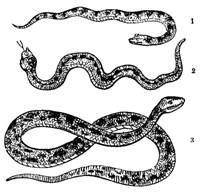
Fig. 316—1. Shephiphon: Cerastes.
2. Peten: Coluber Lebetina.
3. Python tigris Albicans; probably Thaibanne.
Serpents may be divided generally into two very distinct sections—the first embracing all those that are provided with moveable tubular fangs and poison-bags in the upper jaw; all regarded as ovoviviparous, and called by contraction vipers: they constitute not quite one fifth of the species hitherto noticed by naturalists. The second section, much more numerous, is the colubrine, not so armed, but not therefore always entirely innocuous, since there may be in some cases venomous secretions capable of penetrating into the wounds made by their fixed teeth, which in all serpents are single points, and in some species increase in size as they stand back in the jaws. The greater part, if not all, the innocuous species are oviparous, including the largest or giant snakes, and the pelamis and hydrophis, or water-serpents, among which several are venomous.
Scriptural evidence attests the serpent’s influence on the early destinies of mankind; and this fact may be traced in the history, the legends, and creeds of most ancient nations. It is far from being obliterated at this day among the pagan, barbarian, and savage tribes of both continents, where the most virulent and dangerous animals of the viviparous class are not uncommonly adored, but more generally respected, from motives originating in fear; and others of the oviparous race are suffered to abide in human dwellings, and are often supplied with food, from causes not easily determined, excepting that the serpent is ever considered to be possessed of some mysterious superhuman knowledge or power.
The supposed winged serpent, which appears to be alluded to in ’the fiery flying serpent’ of Isaiah (Isa 14:29; Isa 30:6), seems, as well as the ’adder,’ to have been a species of Haye, and probably one of the more eastern species or varieties, which have the faculty of actually distending the hood, as if they had wings at the side of the head, and are the same as, or nearly allied to, the well known spectacle-snake of India.
The serpent named Ephoeh (Job 20:16, and Isa 30:6), and which seems to be the same as the ’viper’ of the New Testament (Mat 3:7; Mat 12:34; Mat 23:33; Luk 3:7; Act 28:3), was probably a species allied to the Effah, a serpent which, although not above a foot in length, is regarded as the most formidable of Northern Africa.
The serpent which in Deu 32:33; Job 20:14; Job 20:16; Psa 58:4; Psa 91:13; Isa 11:8, occurs under the Hebrew name of Pethen, is probably the Bætan of Forskal; the Coluber (vipera)Lebetina of Linn., and by him characterized as one foot in length, the body spotted with black and white, and oviparous (?), though excessively poisonous. This is usually regarded as the ’asp’ of the ancients, and the ’deaf adder’ of Psa 58:5-6. This is uncertain; and it may be remarked that the so-called ’deaf adder’ is not without hearing, but is only not obedient to the musical notes of the serpent-charmers.
The serpent called in the Hebrew of Deu 8:15, by the name of tzimmaon, appears to be the ’Drought’ of some versions, so called because of the intolerable thirst occasioned by its bite. It would therefore seemingly form in modern nomenclature one of the genus Hurria, and subgenus Dipsas or Bongarus; but no species of this division of snakes has yet been found in Western Asia. Another serpent mentioned in Scripture is the tzepha, or tziphoni, translated ’cockatrice’ in Pro 23:32, and Isa 11:8. This is an indefinite English name, which belongs to no identified serpent, and now appears only in the works of ancient compilers and heralds, where it is figured with a crest though there is no really crested or frilled species known to exist in the whole Ophidian order. There are, however, two very distinct species of horned serpents in Egypt and Northern Africa, probably extending to Syria and Arabia. They are of different genera; for the Cerastes, supposed to be the shephiphon of the Bible, is a viper with two scales on the head, one above each eye, standing erect somewhat in the form of horns. This is a dangerous species, usually burrowing in sand near the holes of jerboas, and occasionally in the cattle-paths; for there are now few or no ruts of cart-wheels, where it is pretended they used to conceal themselves to assault unwary passers. It is still common in Egypt and Arabia.
Serpent. The Hebrew word, nachash, is the generic name of any serpent. The following are the principal biblical allusions to this animal --
its subtlety is mentioned in Gen 3:1;
its wisdom is alluded to by our Lord in Mat 10:18;
the poisonous properties of some species are often mentioned, see Psa 58:4; Pro 25:32;
the sharp tongue of the serpent is mentioned in Psa 140:3; Job 20:16;
the habit serpents have of lying concealed in hedges and in holes of walls is alluded to in Ecc 10:8;
their dwelling in dry sandy places, in Deu 8:10;
their wonderful mode of progression did not escape the observation of the author of Pro 30:1, who expressly mentions it as "one of the three things which were too wonderful for him." Pro 30:19.
The art of taming and charming serpents is of great antiquity, and is alluded to in Psa 58:5; Ecc 10:11; Jer 8:17, and doubtless intimated by St. James, Jas 3:7, who particularizes serpents among all other animals that "have been tamed by man." It was under the form of a serpent, that the devil seduced Eve; hence, in Scripture, Satan is called "the old serpent," Rev 12:9, and compare 2Co 11:3. Hence, as a fruit of the tradition of the Fall, the serpent, all through the East, became the emblem of the spirit of evil, and is so pictured, even on the monuments of Egypt.
It has been supposed by many commentators that the serpent, prior to the Fall, moved along in an erect attitude. It is quite clear that an erect mode of progression is utterly incompatible with the structure of a serpent; consequently, had the snakes before the Fall moved in an erect attitude, they must have been formed on a different plan altogether. The typical form of the serpent, and its mode of progression, were, in all probability, the same before the Fall as after it; but subsequent to the Fall. Its form and progression were to be regarded with hatred and disgust by all mankind, and thus, the animal was cursed above all cattle," and a mark of condemnation was forever stamped upon it.
Serpents are said in Scripture to "eat dust," see Gen 3:14; Isa 65:25; Mic 7:17. These animals, which, for the most part, take their food on the ground, do, consequently, swallow with it, large portions of sand and dust. Throughout the East, the serpent was used as an emblem of the evil principle, of the spirit of disobedience and contumacy.
Much has been written on the question of the "fiery serpents" of Num 21:6; Num 21:8, with which, it is usual to erroneously identify, the "fiery flying serpent" of Isa 14:29 and Isa 30:6. The word "fiery," probably signifies "burning," in allusion to the sensation produced by the bite. The Cerastes, or the Naia haje, or any other venomous species frequenting Arabia, may denote the "serpent of the burning bite," which destroyed the children of Israel. The snake that fastened on St. Paul’s hand, when he was at Melita, Act 28:5, was probably the common viper of England, Pelias berus. See also Adder; Asp.
When God punished the murmurs of the Israelites in the wilderness, by sending among them, serpents whose fiery bite was fatal, Moses, upon their repentance, was commanded to make a serpent of brass, whose polished surface shone like fire, and to set it up on the banner-pole in the midst of the people; and whoever was bitten by a serpent had but to look up at it and live. Num 21:4-9. The comparison used by Christ, Joh 3:14-15, adds a deep interest to this scene.
To present the serpent form, as deprived of its power to hurt, impaled as the trophy of a conqueror was to assert that evil, physical and spiritual, had been overcome, and thus, helped to strengthen the weak faith of the Israelites in a victory over both. Others look upon the uplifted serpent as a symbol of life and health, as it having been so worshipped in Egypt. The two views have a point of contact, for the serpent is wisdom.
Wisdom, apart from obedience to God, degenerates to cunning, and degrades and envenoms man’s nature. Wisdom, yielding to the divine law, is the source of healing and restoring influences, and the serpent form, thus became, a symbol of deliverance and health; and the Israelites were taught that it would be so with them in proportion as they ceased to be sensual and rebellious. Preserved as a relic, whether on the spot of its first erection, or elsewhere, the brazen serpent, called by the name of Nehushtan, became an object of idolatrous veneration, and the zeal of Hezekiah destroyed it, with the other idols of his father. 2Ki 18:4. See Nehushtan.
Wise in shunning danger (Mat 10:16). Poisonous: Psa 58:4; Psa 140:3, "they have sharpened their tongues" to give a deadly wound, "like a serpent" (Psa 64:3). Lying hid in hedges (Ecc 10:8) and in holes of walls (Amo 5:19). Their wonderful motion is effected by the vertebral column and the multitudinous ribs which form so many pairs of levers, enabling them to advance (Pro 30:19); the serpent, though without feet or wings, trails along the rock (stony places being its favorite resort) wheresoever it will, leaving no impression of its way, light, gliding without noise, quick, and the mode unknown to us.
The curse in Gen 3:14 is mainly on Satan, but subordinately on the serpent his tool; just as the ox that gored a man was to be killed, so the serpent should suffer in his trailing on the belly and being the object of man’s disgust and enmity. They shall eat the dust at last (i.e. be utterly and with perpetual shame laid low), of which their present eating dust in taking food off the ground is the pledge (Isa 65:25; Mic 7:17; Isa 49:23; Psa 72:9).
The
Serpent. The serpent is a creature distinguished for its subtility, Gen 3:1, and wisdom in avoiding danger, Mat 10:16, as well as for the instinctive dread which it inspires in man and most animals. About one-sixth of all the species known are venomous. The devil is called "the serpent" and "the old serpent," Rev 12:9; Rev 12:14-15, probably in allusion to his subtility and malice, and also to the fact that in tempting our first parents to disobey God he employed a serpent or assumed the form of one. 2Co 11:3. We frequently find references in Scripture to serpent-charming. Psa 58:4-5; Ecc 10:11; Jer 8:17; Jas 3:7. This practice is still common in the east. Serpent-charmers carry enormous snakes, generally black, about them, allow them to crawl all over their persons and into their bosoms—always, however, with certain precautions, either necessary or pretended to be so. They repeatedly breathe strongly into the face of the serpent, and occasionally blow spittle or some medicated composition upon them. In Psa 58:4-6, there is evidently an allusion to certain kinds of serpents which cannot be charmed. Such serpents there still are, which the charmer cannot subdue; and instances are related in which they have fallen victims to their daring attempts. When God punished the murmurs of the Israelites in the wilderness by sending among them serpents whose fiery bite was fetal, Moses, upon their repentance, was commanded to make a serpent of brass, whose polished surface shone like fire, and to set it up on the banner-pole in the midst of the people; and whoever was bitten by a serpent had but to look up at it and live. Num 21:4-9. This brazen serpent was a type of Christ: "As Moses lifted up the serpent in the wilderness, even so must the Son of man be lifted up, that whosoever believeth in him should not perish, but have eternal life." Joh 3:14-15. To present the serpent form, as deprived of its power to hurt, impaled as the trophy of a conqueror, was to assert that evil, physical and spiritual, had been overcome, and thus help to strengthen the weak faith of the Israelites in a victory over both. The "fiery flying serpent" of Isa 30:6 has no relation to the "fiery" or "burning serpents" of Num 21:6; Num 21:8. The latter were so called from the "fiery" or burning nature of their bite or sting.
The Hebrew word most commonly translated serpent is nachash, agreeing with
Satan has succeeded in causing the serpent to be worshipped all over the world. Nachash is also the word for the serpents that bit the Israelites in Num 21:6-9. In Num 21:8, for the serpent that Moses was told to make, the word is saraph, ’FIERY SERPENT,’ signifying that the poison burnt like fire, as we say ’a burning pain,’ though the serpents may also have been of a red colour. From the bite of these serpents much people died.
The serpents mentioned in Isa 14:29; Isa 30:6, are described as ’FIERY FLYING SERPENTS.’ There is no known species of serpent that fly: the allusion may be to those which dart short distances from tree to tree; but in both the passages the language is figurative.
Three other words are translated ’serpent:’ zachal, Deu 32:24; tannin Exo 7:9-12 (to what particular species these refer is not known); and
The taming and charming of serpents is alluded to, which shows that it was an ancient practice. Psa 58:4-5; Ecc 10:11; Jer 8:17.
The Lord bade His disciples be as wise as serpents, probably an allusion to Gen 3:1. The word ’subtil’ there is translated by the same word in the LXX as used in this passage. It is ’prudence.’
SERPENT.—The prevalence of serpents in ancient Palestine is illustrated by the fact that no fewer than 11 Heb. words are rendered ‘serpent’ in OT. Tristram (Nat. Hist. of Bible) states that 33 different species of serpent are still found in Syria. Of 18 varieties which he himself secured, 13 were innocuous and 4 deadly, including cobras and vipers. Naturally there are numerous references, in the OT, in the NT, and in Rabbinical literature, to serpents as well-known but generally disagreeable inhabitants of the country. So unpleasantly common were they, that it was regarded as one of the perpetual miracles of Jerusalem that no one was ever bitten by a serpent there. The references in the Gospels may conveniently be grouped under three heads.
1. In Mat 10:16 our Lord charges His disciples, ‘Be ye wise as serpents’ (
2. But the phrase which follows in Mat 10:16 ‘and harmless (
In all the above passages,
3. Very different is the passage Joh 3:14 ‘and as Moses lifted up the serpent (
Literature.—On the symbolism of the serpent: Baudissin, Studien zur Semit. Religiongesch. i. 257–292; Nöldeke, ‘Die Schlange nach arab.
G. Gordon Stott.
By: Emil G. Hirsch, I. M. Casanowicz
The following terms are used in the Old Testament to denote serpents of one kind or another: (1) "naḥash," the generic and most frequently used term; (2) "peten" (asp or adder; Deut. xxxii. 33; Isa. xi. 8; et al.), perhaps identical with the Egyptian cobra (Naja haje), which is found in southern Palestine, and is frequently kept by snake-charmers; (3) "ẓefa’" (A. V. "cockatrice," R. V. "basilisk," LXX. "asp"; Isa. xiv. 29); (4) "ẓif’oni" (adder, basilisk, cockatrice; Isa. xi. 8, lix. 5, et al.), perhaps the large viper (Duboia xanthina); it is identified also, by some, with the cat-snake (Tarbophis fallax); (5) "ef’eh" (Arabic, "af’a" = "viper"), connected in Isa. xxx. 6 with Egypt; (6) "shefifon" (adder; Gen. xlix. 17 [R. V., margin, "horned snake"]), perhaps identical with the Cerastes hasselquistii, said to have been the asp with which Cleopatra killed herself; (7) "’akshub" (Ps. cxl. 3; LXX. "asp," Arabic version, "viper," A. and R. V. "adder"; Talmud and Rashi, a kind of spider, or tarantula [comp. "’akkabish"]); (8) "zoḥale ’afar" (Deut. xxxii. 24; comp. Micah vii. 17, which designates the serpent as creeping on the earth); (9)"tannin" (Ex. vii. 9 et seq.; elsewhere, "dragon," "monster"); (10) "ḳippoz" (Isa. xxxiv. 15; A. V. "great owl," R. V. "arrow-snake"; the connection suggests some bird); (11) "saraf" and "naḥash saraf" (Num. xxi. 6; Deut. viii. 15; the epithet "fiery" probably refers to the burning sensation and inflammation caused by the venom of the snake).
The idea of flying serpents ("saraf me’ofef"; Isa. xiv. 29, xxx. 6) rests, perhaps, on the confusion of serpents with lizards, which is found also in classical writers. They belong to those fanciful creatures with which folk-lore peoples the desert regions ("Pal. Explor. Fund, Quarterly Statement," 1894, p. 30). For the "naḥash bariaḥ" and "naḥash ’akalaton" in Isa. xxvii. 1 see Leviathan.
Serpents abound in Palestine, as well as in Egypt, the Sinaitic Peninsula, and the Arabian desert. According to Tristram, the serpent tribe is represented in Palestine by eighteen species, mostly belonging to the genera Ablabes and Zamanis, of the Colubridœ family.
The qualities and habits attributed to the serpent in the Old Testament are subtlety (comp. Gen. iii. 1), the disposition to lie concealed in holes, walls, and thickets (comp. Amos v. 19; Eccl. x. 8; Prov. xxx. 18-19), and the habit of eating dust (comp. Gen. iii. 14; Isa. lxv. 25), a belief in which was common among the Greeks and Romans. The art of serpent-charming is referred to in Ex. iv. 3, vii. 9, Jer. viii. 17, and Eccl. x. 11. The ability to stiffen serpents into rods is still possessed by Oriental jugglers.
In the Talmud.
The generic names for the serpent are "naḥash" and  (Ber. 12b). Like fish, the snake has its eyes in the sides of its head (Niddah 23a); and it is endowed with a keen sense of hearing (’Ab. Zarah 30b). Its back is curved, its belly flat (Ned. 25a). Its mode of progression is by slowly raising first the head and then gradually the rest of the body (Ber. 12b). Serpents copulate with their bellies turned toward each other; the period of gestation is seven years, during which intercourse continues (Bek. 8a). The serpent lives in empty cisterns and in houses, where it has a dangerous enemy in the cat, the latter being immune to its poison (Ḥag. 3a et al.). It tastes dust in whatever it eats; still it is fond of water, wine, milk, and melted suet (Ter. viii. 4; ’Ab. Zarah 30a, b; Shab. 85a; Beẓah 7b). It is driven off by the smoke of the burning antler of the hart (Yalḳuṭ Shim’oni, ii. 97c; comp. Ælianus, "De Natura Animalium," ix. 20; Pliny, "Historia Naturalis," viii. 32, 50). The skin of the serpent was made into covers for the seats of kings (Yer. Ned. iv.; Ḥal. 3); and in Pirḳe R. El. xx. (comp. Gen. R. xxiv. 6) it is said that the garments of Adam and Eve (Gen. iii. 21) were made of the same material.
Their Poison.
The poison of the serpent forms a coherent mass (B. ḳ. 115b). It varies in strength and weight. That of a young serpent is heaviest, and falls to the bottom when dropped into a vessel of water; that of an older one remains suspended midway; and that of a very old one floats on the surface. While the serpent is one of the three creatures which grow stronger with age (the other two being the fish and the swine), the intensity and deadliness of its poison decreases with advancing age (’Ab. Zarah 30b). The poison of the serpent is deadly (’Ab. Zarah 31b). If it is left in the wound it causes a burning pain, so that one sentenced to die by fire may be bitten by a snake instead (Soṭah 8b). The poison spreads through the whole body, and it is therefore dangerous to eat the flesh of an animal which was bitten by a snake (Ter. viii. 6), and even to wear sandals made from its hide (Ḥul. 94a, Rashi). If the bone of a snake enters the foot death may result (Pes. 112b). The snake alone of all animals harms without gain to itself, and is therefore compared to the slanderer (Ta’an. 8a et al.). It is also revengeful (Yoma 23a). Still, it seldom attacks unless provoked; and it gives warning by hissing (Ber. 33a; Shab. 121b). The snakes of Palestine were considered particularly dangerous (ib.); but it is mentioned as one of the perpetual miracles of Jerusalem that no one there was ever bitten by a snake (Ab. v. 5).
The flesh of the snake, mixed with other things, was considered the most effective antidote against the poison of the snake as well as of other animals (Shab. 109b). Other cures for snake-bite are: placing the bitten part into the body of a hen which has been opened alive; applying to the wound the embryo taken from the womb of a sound, white she-ass; and putting crushed gnats on the wound (Yoma 83b; Shab. 77b, 109b). A snake cooked in olive-oil was considered a curative for itch (Shab. 77b).
Species or Varieties.
Probably the anaconda is referred to in Ned. 25a et al., where it is related that in the time of Shabur a serpent devoured the straw of thirteen stables. The ringed snake is mentioned under the name of  (comp. Greek
  , which, however, in some passages seems to designate some kind of worm, as, for instance, in Ber. 62b and Giṭ. 57a. Another name for the dragon is
  (Ket. 49b; comp. Targ. on Jer. x. 9).
A bad wife is called a snake in the proverb, "No man can live in the same basket with a snake" (Ket. 72a). But the appearance of a snake in a dream is of good omen (Ber. 57a). For the relation of the serpent to Adam and Eve see Shab. 146a.
Bibliography:
Tristram, Natural History of the Bible, p. 269;
Lewysohn, Zoologie des Talmuds, p. 234;
O. Günther, Die Reptilien und Amphibien von Syrien, Palästina, und Cypern, 1880.
SERPENT.—
1. nâchâsh, generic name (cf. Arab.
2. ‘eph’eh (root to ‘groan’ or ‘hise,’ cf. Arab
3. ‘akshûb, Psa 140:3 ‘adder.’ The root meaning (cf. Arab.
4. pethen, tr.
5. shĕphîphôn Gen 49:17, tr.
6. tsepha‘, Isa 14:29, AV
7. tsiphô‘nî, Pro 23:32 ‘adder’; Isa 11:8; Isa 59:6, Jer 8:17, ‘cockatrice,’ RV
8. qippôz. Isa 34:15, AV
9. sârâph. Isa 14:29; Isa 30:6 ‘fiery serpent,’ coupled with nâchâsh in Num 21:6, Deu 8:15.
10. zôchălç ’âphâr, Deu 32:24; zôchălç’ erets, Mic 7:17; some creature that glides on or into the earth, probably therefore a serpent. Cf. Worm, 5.
11. tannîn, tr.
12. (Gr.) echidna—any poisonous serpent (Mat 3:7; Mat 12:34; Mat 23:33, Luk 3:7, Act 28:3).
Serpents are very common in the Holy Land and in the wilderness to the south. Over 30 species are known. Though the great majority are really harmless, all are dreaded by the natives, and several kinds are most deadly. Fatal snake bites are by no means uncommon; the writer knows of seven cases at first hand. The Egyptian cobra (Naja haji) is found, but fortunately is not common. It is the favourite with snake-charmers, and is very probably the pethen, tr.
Some of the references to serpents do not apparently refer to any natural object. This view is taken in the translation in Isa 14:29 of tsepha‘, and in Isa 11:3; Isa 59:5, Jer 8:17 of tsiph’ ônî, where ‘cockatrice’ occurs in AV
E. W. G. Masterman.
An emblem of Satan and sin. The tempter appeared in that form to our first parents in Eden. In Christian art it is associated with
Blessed Virgin Mary where it is often placed beneath her feet: "the seed of the woman shall crush his head."
Saint Benedict of Nursia
Saint Christina of Bolsena
Saint Hilary
Saint Hilda of Whitby
Saint Honorat
Saint James of the Marches
Saint John the Evangelist
Saint Julius of Novara
Saint Luis Beltran
Saint Patrick
On the other hand, a serpent twined around a cross is an emblem of Our Lord, recalling the brazen serpent which Moses erected to cure the Israelites in the desert.
1. General:
Serpents are not particularly abundant in Palestine, but they are often mentioned in the Bible. In the Hebrew there are 11 names. The New Testament has four Greek names and the Septuagint employs two of these and three others as well as several compound expressions, such as
2. Serpents of Palestine and Syria:
The following list includes all the serpents which are certainly known to exist in Palestine and Syria, omitting the names of several which have been reported but whose occurrence does not seem to be sufficiently confirmed. The range of each species is given.
(1) Harmless Serpents.
Typhlops vermicularis Merr., Greece and Southwestern Asia; T. simoni Bttgr., Palestine; Eryx jaculus L., Greece, North Africa, Central and Southwestern Asia; Tropidonotus tessellatus Laur., Central and Southeastern Europe, Central and Southwestern Asia; Zamenis gemonensis Laur., Central and Southeastern Europe, Greek islands, Southwestern Asia; Z. dahlii Fitz., Southeastern Europe, Southwestern Asia, Lower Egypt; Z. rhodorhachis Jan., Egypt, Southwestern Asia, India; Z. ravergieri Menatr., Southwestern Asia: Z. nummifer Renss., Egypt, Syria, Palestine, Cyprus, Asia Minor; Oligodon melanocephalus Jan., Syria, Palestine, Sinai, Lower Egypt; Contia decemlineata D. and B., Syria, Palestine; C. collaris Menerr., Greek islands, Cyprus, Asia Minor, Syria, Palestine; C. rothi Jan., Syria, Palestine; C. coronella Schleg., Syria, Palestine
(2) Somewhat Poisonous Serpents.
Tarbophis savignyi Blgr., Syria, Palestine, Egypt; T. fallax Fleischm., Balkan Peninsula, Greek islands, Cyprus, Asia Minor, Syria, Palestine; Coelopeltis monspessulana Herre., Mediterranean countries, Caucasus, Persia; Psammophis schokari Forsk., North Africa, Southwestern Asia; Micrelaps muelleri Bttgr., Syria, Palestine
(3) Deadly Poisonous Serpents.
Vipera ammodytes L., Southeastern Europe, Asia Minor, Syria; Vipera lebetina L., North Africa, Greek islands, Southwestern Asia; Cerastes cornutus Forsk., Egypt, Sinai, Arabia; Echis coloratus Gthr., Southern Palestine, Arabia, Socotra.
To this list should be added the scheltopusik, a large snake-like, limbless lizard, Ophiosaurus apus, inhabiting Southeastern Europe, Asia Minor, Persia, Syria and Palestine, which while perfectly harmless is commonly classed with vipers.
Of all these the commonest is Zamenis nummifer, Arabic
Among the somewhat poisonous snakes, a very common one is Coelopeltis monspessulana, Arabic
The commonest of the deadly poisonous snakes is Vipera lebetina, which attains the length of a meter, has a thick body, a short tail, a broad head and a narrow neck. It is spotted somewhat as Zamenis nummifer, but the spots are less regular and distinct and the ground color is gray rather than yellow. It does not seem to have a distinct name. Cerastes cornutus, having two small horns, which are modified scales, over the eyes, is a small but dangerous viper, and is found in the south. Not only are the species of poisonous serpents fewer than the non-poisonous species, but the individuals also appear to be less numerous. The vast majority of the snakes which are encountered are harmless.
3. Names:
As stated above, all of the Hebrew and Greek names except
(1) The commonest Hebrew word is
(2)
(3)
(4)
(5)
(6)
(7)
(8)
(9)
“Dan shall be a serpent (
An adder (
That biteth the horse’s heels,
So that his rider falleth backward.”
This has been thought to be Cerastes cornulus, on the authority of Tristram (NHB), who says that lying in the path it will attack the passer-by, while most snakes will glide away at the approach of a person or large animal. He adds that his horse was much frightened at seeing one of these serpents coiled up in a camel’s footprint. The word is perhaps akin to the Arabic
(10)
(11)
(12)
(13)
(14)
(15)
That the different Hebrew and Greek names are used without clear distinction is seen from several examples of the employment of two different names in parallel expressions:
“Their poison is like the poison of a serpent (
They are like the deaf adder (
“They have sharpened their tongue like a serpent (
Adders’ (
“For, behold, I will send serpents (
“They shall lick the dust like a serpent (
“He shall suck the poison of asps (
“Their wine is the poison of serpents (
“And the sucking child shall play on the hole of the asp (
See also (8) and (9) above.
4. Figurative:
Most of the Biblical references to serpents are of a figurative nature, and they usually imply poisonous qualities. The wicked (Psa 58:4), the persecutor (Psa 140:3), and the enemy (Jer 8:17) are likened to venomous serpents. The effects of wine are compared to the bites of serpents (Pro 23:32). Satan is a serpent (Gen 3; Rev 12:9; Rev 20:2). The term “offspring of vipers” is applied by John the Baptist to the Pharisees and Sadducees (Mat 3:7) or to the multitudes (Luk 3:7) who came to hear him; and by Jesus to the scribes and Pharisees (Mat 12:34; Mat 23:33). Dan is a “serpent in the way ... that biteth the horse’s heels” (Gen 49:17). Serpents are among the terrors of the wilderness (Deu 8:15; Isa 30:6). Among the signs accompanying believers is that “they shall take up serpents” (Mar 16:18; compare Act 28:5). It is said of him that trusts in Yahweh:
“Thou shalt tread upon the lion and adder:
The young lion and the serpent shalt thou trample under foot” (Psa 91:13).
In the millennium, “the sucking child shall play on the hole of the asp, and the weaned child shall put his hand on the adder’s den” (Isa 11:8). The serpent is subtle (Gen 3:1; 2Co 11:3); wise (Mat 10:16); accursed (Gen 3:14); eats dust (Gen 3:14; Isa 65:25; Mic 7:17). The adder is deaf (Psa 58:4). The serpent lurks in unexpected places (Gen 49:17; Ecc 10:8; Amo 5:19). Serpents may be charmed (Psa 58:5; Ecc 10:11; Jer 8:17). Among four wonderful things is “the way of a serpent upon a rock” (Pro 30:19).
(ὄöéò)
Apart from the Gospels, the only occurrences of the word ‘serpent’ in the NT are in the Epistles to the Corinthians (1Co_10:9, 2Co_11:3) and in the Apocalypse (Rev_9:19; Rev_12:9; Rev_12:14-15; Rev_20:2). In 1Co_10:9 the writer exhorts his readers not to tempt Christ sorely as the Israelites did, with the result that they were allowed to perish from time to time (ἀðþëëõíôï) by the inflammatory bites of serpents. In the second passage (2Co_11:3) he expressed the fear lest, as the serpent beguiled Eve through his subtlety, so the minds of the Corinthian converts should be corrupted from the simplicity and single-mindedness of Christ. In both cases the tempter is Satan, and in both cases his nefarious work is accomplished by subtlety and deception, but in Genesis his agent is the serpent, while here the ‘ministers’ of Satan (2Co_11:15) are the Judaizers (2Co_11:13). In Rev_12:9 the Devil appears in his time-honoured rôle as a serpent, and he is identified both with the great Dragon and with the person called ‘Satan’ in the later books of the OT and in Jewish literature. The name ‘Satan’ was familiar to the later Jews, and occurs fourteen times (ὁ óáôáíᾶò) in the Gospels, twice in the Acts of the Apostles, ten times, in the Pauline Epistles, and eight times in the Apocalypse. The earth was no new sphere for the exercise of his devilish activities, but henceforth his scope was to be confined thereto, and this limitation of his powers seems only to have intensified his animosity and desire for revenge. A torrent of water issued from his mouth (Rev_12:15) which was designed to sweep away the Woman, but this malicious attempt recoiled on the Devil’s own head, and the destructive flood was swallowed up by the earth which was his own domain. The purpose to which the Roman Emperors set themselves was to eradicate and stamp out the very name of Christianity as well as the memory of the Founder of that religion. The futility and complete failure of the attempt are too obvious to admit of comment. In Rev_20:2 the Devil is again identified with the great Dragon and Satan. The Dragon has from the outset (Rev_13:2; Rev_13:4) been the real instigator and author of the revolt led by the Beast and the False Prophet, but hitherto he has escaped justice. Now, however, he is seized and bound for a period of a thousand years. The period of his imprisonment is indeed limited, but its length forms a striking contrast to the short duration of heathenism-a thousand two hundred and threescore days (Rev_11:3 ff.).
In Rev_9:19 the tails of the horses in the vision are likened to serpents, just as the tails of the locusts in Rev_9:3 are compared to scorpions. The power of these horses resides in their mouth and in their tails. The tails are incongruously said to have heads, but the incongruity is perhaps atoned for by the additional horror thereby imparted to these superhuman animals.
Serpents are very common in Palestine and in the wilderness of Sinai; over thirty species are known, the majority of which are, however, harmless. Most of the innocuous serpents belong to the genera Ablabes and Zamanis of the Colubrine family. Many of these are brilliantly coloured; they are well proportioned and slender, with a gradually tapering tail, and they live exclusively on land. The majority are of rather small size, but some are very large. A species very frequently found in the marshes and lakes is the Tropidonotus hydrus. A few species of harmless sand-snakes have also been found, of which the Eryx jaculus is the most common.
The poisonous snakes of the country are the following: the cobra (Naja haje), and four viperine snakes, two true vipers, the Vipera euphratica and the Vipera ammodytes, the Daboia xanthina, and the Echis arenicola, a dangerous reptile which is very frequently encountered in the hotter and drier parts of the country. With the exception of the Daboia xanthina, they all belong to the Mediterranean and North African fauna, or are closely allied thereto. The Daboia xanthina is a beautifully marked yellow serpent and the largest of the vipers in Palestine, as well as one of the most dangerous. The Naja haje, or Egyptian cobra, is of rare occurrence. It is the species especially popular with snake-charmers. Another very deadly serpent is the Cerastes hasselquistii, or ‘horned serpent.’ It lies in ambush in depressions in the way (cf. Gen_49:17) and attacks the wayfarer. It is 12 or 18 ins. long, and of a sandy colour with brown or blackish spots. See, further, Asp, Viper.
Literature.-H. B, Tristram, Survey of Western Palestine, London, 1884, p. 140 f., The Natural History of the Bible10, do., 1911, pp. 269-277; W. M. Thomson, The Land and the Book, 3 vols., do., 1881-86, vol. i. ‘South Palestine and Jerusalem,’ pp. 188-189; J. C. Geikie, The Holy Land and the Bible, do., 1903, pp. 88-90; Hastings’ Single-vol. Dictionary of the Bible , p. 837; Hasting's Dictionary of the Bible (5 vols) iv. 459-460; Encyclopaedia Biblica iv. 4391-4397; H. B. Swete, The Apocalypse of St. John 2, London, 1907, pp. 124, 154, 159, 260; The Speaker’s Commentary, do., 1881, vol. iii. pp. 310-311, 457-458.
P. S. P. Handcock.
Gen 3:1 (a) This is a type of Satan for he is so described in Rev 12:9.
Num 21:6 (b) It is a type of sin in all of its terrible effect on the people.
Num 21:8 (a) It is a type of the Lord JESUS when He was made sin for us (2Co 5:21) as He hung on Calvary. (See Joh 3:14).
Mat 7:10 (b) This is a symbol of a harmful, injurious thing which the Christian, in his ignorance, thinks is good and profitable. The Lord sees that he is mistaken in his request and so refuses to give it to him because He knows it would harm. GOD says "no" to the request.
See Snake