
This is a pure Hebrew word, and written exactly as it is here. The translators of the Bible have thought proper to preserve, entire as they found it. We find it scattered up and down in the book of the Psalms no less than seventy times; sometimes several times in one Psalm, and in many of the Psalms not at all. It is three times also in this third chapter of Habakkuk, and no where else that I remember in all the Scripture.
It would furnish matter for a separate treatise to bring into one view all that hath been said upon this word Selah; and after all we should be still left to conjecture. Some ancient writers have considered it as a word of particular observation, as if Selah meant to tell the reader to pause, said consider what went before. But this opinion is liable to great objection; for in this case David and Habakkuk are the only writers that thus impress consideration on their Readers, and they that always, neither at what we should consider themost striking parts of their writings: and if this were indeed the sense of Selah, how comes it that not one of the Lord’s servants have ever used?
Others, and that a great majority of writers on Scripture, have concluded that the word Selah had reference to the music in the temple - service, and was a note of the ancient psalmody, but which now and for a long time, hath lost its use. This opinion doth not seem more satisfactory than the former; for supposing this to be the case, it were unaccountable that the Holy Ghost should have uniformly watched the word so as to preserve it with equal care as the Scriptures themselves with which the word is connected.
One class more have concluded that the word Selah means an end, not unlike the Amen. And though there might seem an objection to this, in that the word is more frequently found in the middle part of the psalm or hymn, and not at the last verse, yet, say they, the sense of that part ends there. I humbly conceive that this explanation, though in part it may be right, yet is not wholly so. If the word Selah means the end, perhaps it may be found not to mean the end of the Psalm where it stands, but to a higher end, evenpointing to him who is the end of the law for righteousness to every one that believeth, and to whom the law of Moses, and the prophets, and the Psalms, all refer as the end. (Luke 24. 44.) He is the great end, no doubt, as well as the beginning, in his mediatorial character, of all the creation of God, the Amen, and the faithful witness of heaven. (Rev 3:14.) But here I leave the subject. I am persuaded the word Selah is important; and I am inclined to thin, like some other words preserved to us in the Psalms that itrefersto Christ. If the reader wishes to look at theses other words, let him turn to the word Musician.
This expression is found in the Psalms seventy-four times, and thrice in the Prophet Habakkuk. The interpreters Symmachus and Theodotion generally translate selah by diapsalma, which signifies “a rest” or “pause” in singing. Jerom and Aquila translate it “for ever.” Some moderns pretend that selah has no signification, and that it is only a note of the ancient music, whose use is no longer known; and, indeed, selah may be taken away from all the places where it is found without interrupting the sense of the psalm. Calmet says it intimates the end, or a pause, and that is its proper signification; but as it is not always found at the conclusion of the sense, or of the psalm or song, so it is highly probable the ancient musicians put selah in the margin of their psalters, to show where a musical pause was to be made, or where the tune ended.
Selah, word
Selah, place
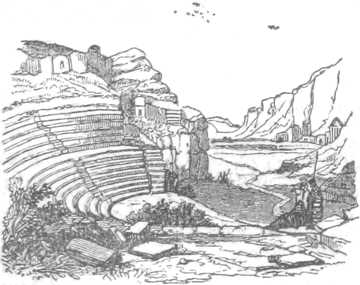
Fig. 314—Petra, from above the Amphitheater
Se´lah, or rather Sela (rock); Gr. Petra, which has the same signification as Selah, the metropolis of the Edomites in Mount Seir. In the Jewish history it is recorded that Amaziah, king of Judah, ’slew of Edom in the valley of Salt ten thousand, and took Selah by war, and called the name of it Joktheel unto this day’ (2Ki 14:7). This name seems however to have passed away with the Hebrew rule over Edom, for no further trace of it is to be found; and it is still called Selah by Isaiah (Isa 16:1). These are all the certain notices of the place in Scripture. Mention is made of it by Strabo, Pliny, and other ancient writers; but from A.D. 536, down to the present century, not the slightest notice of the city is to be found in any quarter; and as no trace of it as an inhabited site is to be met with in the Arabian writers, the probability seems to be that it was destroyed in some unrecorded incursion of the desert hordes, and was afterwards left unpeopled. It was identified by Burckhardt in 1812 as the ancient capital of Arabia Petraea; and since that time has been visited by various travelers, who have given a minute description of its present condition.
The ruined city lies in a narrow valley, surrounded by lofty, and, for the most part, perfectly precipitous mountains. Those which form its southern limit are not so steep as to be impassable; and it is over these, or rather through them, along an abrupt and difficult ravine, that travelers from Sinai or Egypt usually wind their laborious way into the scene of magnificent desolation. The ancient and more interesting entrance is on the eastern side, through the deep narrow gorge of Wady Syke. The boundaries of the city are marked with perfect distinctness by the precipitous mountains by which the site is encompassed; and they give an extent of more than a mile in length, nearly from north to south, by a variable breadth of about half a mile. The sides of the valley are walled up by perpendicular rocks, from four hundred to six or seven hundred feet high. The northern and southern barriers are neither so lofty nor so steep, and they both admit of the passage of camels.
The chief public buildings occupied the banks of the river and the high ground farther south, as their ruins sufficiently show. One sumptuous edifice, which seems to have been a palace, remains standing, though in an imperfect and dilapidated state. It is an imposing ruin, though not of the purest style of architecture, and is the only constructed edifice now standing in Petra.
In various other parts of the valley are piles of ruins—columns and hewn stones—parts no doubt of important public buildings, which indicate the great wealth and magnificence of this ancient capital, as well as its unparalleled calamities. A large surface on the north side of the river is covered with substructions, which probably belonged to private habitations.
The mountain torrents which, at times, sweep over the lower parts of the ancient site, have undermined many foundations, and carried away many a chiseled stone, and worn many a finished specimen of sculpture into unshapely masses. The soft texture of the rock seconds the destructive agencies of the elements. Even the accumulations of rubbish, which mark the site of all other decayed cities, have mostly disappeared; and the extent which was covered with human habitations can only be determined by the broken pottery scattered over the surface, or mingled with the sand—the universal, and, it would seem, an imperishable memorial of popular cities that exist no longer.
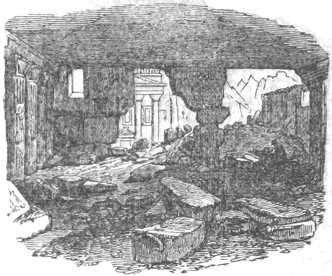
Fig. 315—Interior of a tomb
The attention of travelers has however been chiefly engaged by the excavations which, having more successfully resisted the ravages of time, constitute at present the great and peculiar attraction of the place. These excavations, whether formed for temples, tombs, or the dwellings of living men, surprise the visitor by their incredible number and extent. They not only occupy the front of the entire mountain by which the valley is encompassed, but of the numerous ravines and recesses, which radiate on all sides from this enclosed area. Were these excavations, instead of following all the sinuosities of the mountain and its numerous gorges, ranged in regular order, they probably would form a street not less than five or six miles in length. By far the largest number were manifestly designed as places for the interment of the dead; and thus exhibit a variety in form and size, of interior arrangement and external decorations, adapted to the different fortunes of their occupants. Some of them are plain and unadorned, but there is a vast number of excavations enriched with various architectural ornaments. The interior of these unique and sumptuous monuments is quite plain and destitute of all decoration, but the exteriors exhibit some of the most beautiful and imposing results of ancient taste and skill which have remained to our times. The front of the mountain is wrought into facades of splendid temples, rivaling in their aspect and symmetry the most celebrated monuments of Grecian art. Columns of various orders, graceful pediments, broad rich entablatures, and sometimes statuary all hewn out of the solid rock, and still forming part of the native mass, transform the base of the mountain into a vast splendid pile of architecture, while the overhanging cliffs, towering above in shapes as rugged and wild as any on which the eye ever rested, form the most striking and curious of contrasts.
But nothing contributes so much to the almost magical effect of some of these monuments, as the rich and various colors of the rock out of which, or more properly in which, they are formed. Red, purple, yellow, azure or sky blue, black and white, are seen in the same mass distinctly in successive layers, or blended so as to form every shade and hue of which they are capable—as brilliant and as soft as they ever appear in flowers, or in the plumage of birds, or in the sky when illuminated by the most glorious sunset. It is more easy to imagine than describe the effect of tall, graceful columns, exhibiting these exquisite colors in their succession of regular horizontal strata.
A musical term which occurs seventy-three times in the Psalms, and is found also in Hab 3:3,9,13 . It usually occurs at the end of a period or apostrophe, but sometimes at the end only of a clause. This difficult word, it is now generally believed, was a direction for a meditative pause in the singing of a psalm, during which perhaps there was an instrumental interlude.\par
Se’lah. This word, which is found only in the poetical books of the Old Testament, occurs seventy-one times in the Psalms, and three times in Habakkuk. It is probably a term which had a meaning in the musical nomenclature of the Hebrews, though what that meaning may have been is now a matter of pure conjecture. (Gesenius and Ewald and others think it has much the same meaning as our interlude, a pause in the voices singing, while the instruments perform alone. -- Editor)
Seventy-one times in the Psalms, three times in Habakkuk. From
A term occurring in Hab 3:3; Hab 3:9; Hab 3:13, and many times in the Psalms. There have been various suggestions as to its meaning, but its signification is not really known. The Targum mostly renders the word ’for ever.’ The LXX has
(Hebrew,  ):
):
By: Emil G. Hirsch
Term of uncertain etymology and grammatical form and of doubtful meaning. It occurs seventy-one times in thirty-nine of the Psalms, and three times in Hab. iii. It is placed at the end of Ps. iii., ix., xxiv., xlvi., and in most other cases at the end of a verse, the exceptions being Ps. lv. 20, lvii. 4, and Hab. iii. 3, 9. Of the psalms in which it is found, twenty-three belong to the group in which "Elohim" is used to designate God; twenty-eight to that called by Briggs the "director’s ( ="choir-leader"; See Psalms, Critical View) copies"; and twenty to the "Davidie" collection. Again, nine of the twelve Korahite and seven (LXX. eight, including lxxx. 8) of the twelve Asaph psalms have the term. Three psalms with "Selah" are headed "Miktam"; seven, "Maskil"; ten, "Shir"; twenty-six, "Mizmor"; while Habakkuk iii. is superscribed "Tefillah."
Technical Term.
That the real significance of this curious term (or combination of letters) was not known even by the ancient versions is evidenced by the variety of renderings given to it. The Septuagint, Symmachus, and Theodotion translate  = "in secula" or
  = "semper"). Theodotion in Ps. ix. 17 has the translation
  ); and the Sexta,
  ; and he explains this as, referring to the custom of the people of reciting a doxology at the end of paragraphs of the liturgical psalms. In five passages (see Field, Hexapla on Ps. xxxviii. [Hebr, xxxix.] 12) Aquila offers, according to the Hexaplar Syriac,
  ="song," the
  seem to indicate a "ḳere"
  (with "ḳameẓ" on account of
Modern Views.
Nor is there greater unanimity among modern scholars than among the ancient versions. Only on one point there agreement, namely, that "Selah" has no grammatical connection with the text. It is either a liturgico-musical mark or a sign of another character with a bearing on the reading or the verbal form of the text. As thirty-one of the thirty-nine psalms with the caption "To the choir-master [ ]" present "Selah," the musical value of the mark has been regarded as well assured. In keeping with this it has been assigned to the root
  , as an imperative that should properly have been vocalized
  , "Sollah" (Ewald, "Kritische Grammatik der Hebräischen Sprache,"p. 554; König, "Historisch-Kritisches Lehrgebäude der Hebräischen Sprache," ii., part i., p. 539). The meaning of this imperative is given as "Lift up," equivalent to "loud" or "fortissimo," a direction to the accompanying musicians to break in at the place marked with crash of cymbals and blare of trumpets, the orchestra playing an interlude while the singers’ voices were hushed. The effect, as far as the singer was concerned, was to mark a pause. This significance, too, has been read into the expression or sign, "Selah" being held to be a variant of "shelah" (
 ="pause"). But as the interchange of "shin" and "samek" is not usual in Biblical Hebrew, and as the meaning "pause" is clearly inapplicable in the middle of a verse or where a pause would interrupt the sequence of thought, this proposition has met with little favor. Neither has that which proposes to treat it as a loan-word from the Greek
Grätz ("Kritischer Commentar zu den Psalmen," i. 93 et seq.) argues that "Selah" introduces a new paragraph as it were, a transition in thought, and also in some instances a quotation (e.g., Ps. lvii. 8 et seq. from cviii. 2 et seq.). The fact that the term occurs four times at the end of a psalm would not weigh against this theory. As stated above, the Psalms were meant to be read in sequence, and, moreover, many of them are fragments; indeed, Ps. ix. is reckoned one with Ps. x. in the Septuagint, which omits
More Liturgical than Musical.
Another series of explanations is grounded on the assumption that its signification is liturgical rather than musical. It marks the place, and is an appeal, for the bystanders to join in with a eulogistic response. Briggs ("Jour. Bib. Lit." 1899, p. 142) accepts the etymology and grammatical explanation given above, i.e., that "Selah" is a cohortative imperative, meaning "Lift up [your benediction]," the eulogy with which psalms or sections of psalms were concluded. One would expect the imperative to be in the plural if the address was to more than one bystander. However, Briggs’ explanation indicates the line along which the mystery connected with this term or combination of consonants is to be removed. It has been suspected that "Selah" is an artificial word formed from initials.
Probably a Contracted Form.
That is probably the case, though the resolution of the initials usually suggested, 
 (= "Return to the beginning, O singer"), has to be abandoned. The renderings in the versions, "’olmin,"
  is a corruption for
  —the word "’olam" standing for the first noun in the benediction—create a strong presumption that the initials of the verse in which "’olam" occurs are hidden in the puzzling word "Selah." Grätz (l.c.) shows that in Ps. lv. 20
  is a corruption for
  (or even for
  ), meaning "destroy"; and a similar corruption of the first and third consonants throughout has contrived to make "Selah" the "crux interpretum." If in some instances
  or
or  (= "destroy") be read and in others
  , the enigma disappears. "K l ḥ" represents the eulogy "Ki le’olam ḥasdo" (
 ), hence the
  or
or  , and perhaps
 , actually do occur in passages where "Selah" might stand equally well and with as little bearing on the context (Ps. lii. 11, 12). In Ps. xxxiv. 11
  at the end is certainly superfluous; but it stands where one would expect this very term
  ; and, therefore, it is not too bold a conjecture to read here
  in the sense of a technical abbreviation of the eulogy. In this connection the midrash on Ps. cxviii. is of importance; quoting Isaiah iii. 10, it commands that after the mention of the righteous the words
  should be added, but that after reference to an evil-doer a curse should be pronounced.
The latter injunction throws light on many passages in which "Selah" has another sense than that noted above, and in which it should be read  or
or  (= "Destroy them"), as one word. It is noticeable that the term occurs frequently after areference to evil-doers (Ps. iv. 3; vii. 6; ix. 21; xxxii. 5; xlix. 14 [xlix. 16 ?]; lii. 5; liv. 5; lvii. 4, 7; lix. 6; lxii. 5; lxvi. 7; lxxxii. 2; lxxxviii. 8; lxxxix. 46, 49; cxl. 6; Hab. iii. [A. V. ii.] 13); and at the mention of these the bystanders break forth into malediction, as they do into benediction at the mention of God’s wonderful deeds. Their comment on the recital is "Destroy them," "Make an end of them," or "of the evils," i.e., "Forego" (as in Ps. lxxxviii. 8). "Selah" is thus identical with
  as twice repeated in Ps. lix. 14(Hebr.), "Destroy in anger; destroy that they be no more." This very verse ends with "Selah," which, as explained above, is a repetition (but in the mouths of the bystanders) of the passionate outcry
  (="Destroy").
Sometimes Meaning "Delete."
Some few passages remain in which  seems to fit in neither as a eulogy—i.e., as a corruption of
  or as an artificial combination of initials making
  —nor as an imprecation. But even in these the reading
  (="Destroy") suggests itself, not indeed as a liturgical response, but as a note to indicate that something in the text should be deleted. This seems to be the case in Ps. lv. 8 (R. V. 7), where verses 8 and 9 virtually conflict; for the desert is the place where storms blow. "Selah" here has the appearance of a sign that the verse, being a quotation from somewhere else and really not belonging to the psalm, should be omitted. The same holds good in Ps. lxxxi. 8, where the third member of the verse is clearly it marginal note explanatory of the preceding. "Selah" after
 , "at the waters of Meribah, "indicates this fact, and means
  (="Delete"). Another instance of this is Ps. lx. 6, where the words
  break the connection between verses 6a and 7, and really make no sense. In Hab. iii. (ii.) 3, 9, also, "Selah" points to some defect in the text.
Perhaps the latter use of the term will throw light on the origin of the Greek  was visible, e.g.,
  , meaning "responsive, antiphonal song," corroborates the assumption that the benediction or malediction was marked as anticipated in the passage.
"Selah" occurs also in the text of the Shemoneh ’Esreh. This fact shows that at the time when the text of this prayer was finally fixed, the term had become a familiar one; and as the "Shemoneh ’Esreh" draws its vocabulary largely from the Psalms, the appearance of "Selah" in the prayer is not strange. In the Talmud that word is treated as a synonym of "neẓaḥ" and "wa’ed," all three signifying eternal continuance without interruption (’Er. 54a, 
 ). Ḳimḥi connects the term with the verb
  (= "lift up"), and applies it to the voice, which should be lifted up, or become louder at the places marked by it (commentary on Ps. iii. 2). Ibn Ezra (on Ps. iii. 2) regards it as an equivalent of
  or
or  , an affirmative corroborative expletive.
SELAH.—A Heb. liturgical-musical term of uncertain meaning. It occurs (a) in the OT, (b) in the Psalms of Solomon, and (c) in the Jewish (Synagogue) Liturgy.
In the OT the term occurs 74 times altogether in the Heb. text, viz. 71 times in the Psalter, and 3 in the Prayer of Habakkuk (Hab 3:1-19). In the Gr. tr.
Various explanations have been proposed as to the etymology and meaning of the term. Perhaps the least improbable of these is that which regards it as a liturgical direction intended to indicate the place for lifting up the voices in a doxology at the close of a section; such a doxology might have been sung at the end of a psalm or section of a psalm which liturgically was separated from the following (cf. the use of the ‘Gloria’ at the end of Psalms or [in the case of the 119th] at the end of sections of the Psalm in Christian worship). Or it may have been a direction to the orchestra—‘Lift up! loud!’—to strike in with loud music (after the soft accompaniment to the singers’ voices) during a pause in the singing. Other theories, such as that it represents a Heb. transliteration of a Greek word (e.g. psalle) or an abbreviation of three words, have little probability. The meaning of the LXX
G. H. Box.
A word appearing in Psalms and
Habakkuk that was apparently an instruction
for the singers or musicians, perhaps
meaning to pause or to get louder.