
See Mount Seir.
the Horite, whose dwelling was to the east and south of the Dead Sea, in the mountains of Seir, Gen 14:6; Gen 36:20; Deu 2:12; where at first reigned the descendants of Seir the Horite, of whom Moses gives us a list in Gen 36:20-30; 1 Chronicles 38, 39, &c. The posterity of Esau afterward were in possession of the mountains of Seir, and Esau himself dwelt there when Jacob returned from Mesopotamia, Gen 33:3; Gen 33:14; Gen 36:8-9.
SEIR, MOUNT, a mountainous tract, extending from the southern extremity of the Dead Sea, to the Gulf of Acaba, or Ezion-Geber. The whole of this tract was probably before called Mount Hor, and was inhabited by the Horites, the descendants, as it is thought, of Hor, who is no otherwise known, and whose name is now only retained in that part of the plain where Aaron died. These people were driven out from their country by the Edomites, or the children of Esau, who dwelt there in their stead, and were in possession of this region when the Israelites passed by in their passage from Egypt to the land of Canaan. The country had, however, been previously overrun, and no doubt very much depopulated, by the invasion of Chedorlaomer, king of Elam. At what time the name of Hor was changed to that of Seir cannot be ascertained. Mount Seir rises abruptly on its western side from the valleys of El Ghor and El Araba; presenting an impregnable front to the strong country of the Edomite mountaineers, which compelled the Israelites, who were unable (if permitted by their leader) to force a passage through this mountain barrier, to skirt its western base, along the great valley of the Ghor and Araba. and so to “compass the land of Edom by the way of the Red Sea,” that is, to descend to its southern extremity at Ezion-Geber, as they could not penetrate it higher up. To the southward of this place Burckhardt observed an opening in the mountains, where he supposed the Israelites to have passed. This passage brought them into the high plains on the east of Mount Seir, which are so much higher than the valley on the west, that the mountainous territory of the Edomites was every where more accessible: a circumstance which perhaps contributed to make them more afraid of the Israelites on this border, whom they had set at defiance on the opposite one. The mean elevation of this chain cannot be estimated at less than four thousand feet. In the summer it produces most of the European fruits, namely, apricots, figs, pomegranates, olives, apples, and peaches; while in winter deep snows occasionally fall, with frosts, to the middle of March. The inhabitants, like those of most mountainous regions, are very healthy. Burckhardt says, that there was no part of Syria in which he saw so few invalids: a circumstance which did not escape the observation of the ancients; who denominated it, Palaestina tertia sive salutaris. [Palestine the third or the healthy.]
Se´ir (hairy)
A phylarch or chief of the Horim, who were the former inhabitants of the country afterwards possessed by the Edomites.
Seir, Mount. The mountainous country of the Edomites, extending from the Dead Sea to the Elanitic Gulf. The name is usually derived from the Seir above mentioned, and as he was a great chief of the original inhabitants, it is difficult to reject such a conclusion. These mountains were first inhabited by the Horim (Gen 14:6; Deu 2:12); then by Esau (Gen 32:3; Gen 33:14; Gen 33:16) and his posterity (Deu 2:4; Deu 2:19; 2Ch 20:10). The northern part of them now bears the designation of Jebal, and the southern that of esh-Sherah, which seems no other than a modification of the ancient name. The whole breadth of the mountainous tract between the Arabah (the great valley between the Dead Sea and Elanitic Gulf) and the eastern desert above is about 15 or 20 geog. miles. These mountains are quite different in character from those which front them on the other (west) side of the Arabah. The latter seem to be not more than two-thirds as high as the former, and are wholly desert and sterile; while those on the east appear to enjoy a sufficiency of rain, and are covered with tufts of herbs and occasional trees. The valleys are also full of trees and shrubs and flowers, the eastern and higher parts being extensively cultivated, and yielding good crops. It is indeed the region of which Isaac said to his son Esau, ’Behold, thy dwelling shall be of the fatness of the earth, and of the dew of heaven from above’ (Gen 27:39).
A mountain in the territory of Judah (Jos 15:10).
1. A mountain of Judah, near Kirjath-jearim, Jos 15:10 .\par 2. A Horite, one of the primitive rulers of the country south and southeast of the Dead Sea, Gen 36:20 Deu 2:12 .\par 3. A mountainous tract lying between the southern extremity of the Dead Sea and the eastern gulf of the Red Sea. Mount Hor formed part of Seir, and is the only part that retains its original name. See IDUMEA.\par
Se’ir. (hairy, shaggy).
1. We have both "land of Seir," Gen 32:3; Gen 36:50, and "Mount Seir." Gen 14:6. It is the original name of the mountain range extending along the east side of the valley of Arabah, from the Dead Sea to the Elanitic Gulf. The Horites appear to have been the chief of the aboriginal inhabitants, Gen 36:20, but it was ever, afterward, the possession of the Edomites, the descendants of Esau.
The Mount Seir of the Bible extended much farther south than the modern province, as is shown by the words of Deu 32:1-8 It had the Arabah on the west, Deu 32:1; Deu 32:8; it extended as far south as the head of the Gulf of Akabah, Deu 32:8; its eastern border ran along the base of the mountain range where the plateau of Arabia begins. Its northern order is not so accurately determined. There is a line of "naked" white hills or cliffs which run across the great valley about eight miles south of the Dead Sea, the highest eminence being Mount Hor, which is 4800 feet high.
2. Mount Seir, an entirely different place from the foregoing; one of the landmarks on the north boundary of the territory of Judah. In Jos 15:10 only. It lay westward of Kirjath-jearim, and between it and Beth-shemesh. If Kuriel el-Enab is the former, and Ain-shems is the latter, of these two, then, Mount Seir cannot fail to be the ridge, which lies between the Wady Aly and the Wady Ghurab. In a pass of this ridge is the modern village of Seir.
Seir (sç’ir). 1. Mount Seir, Gen 14:6, or land of Seir, Gen 32:3; Gen 36:30, the mountainous region lying north of the eastern gulf of the Red Sea. Deu 2:1-8. The ragged appearance of the tract as viewed from the mountain generally recognized as Mount Hor, the central and highest peak, 4800 feet high, justifies its name. See Idumæa. 2. Mount Seir, Jos 15:10, was a landmark on the northern boundary of Judah, between Kirjath-jearim and Bethshemesh.
Ancestor of the Horites who dwelt in Mount Seir and ’the land of Seir.’ Gen 36:20-21; 1Ch 1:38.
By: Emil G. Hirsch, Immanuel Benzinger, Joseph Jacobs, Frederick T. Haneman
1. Region that took its name from Seir the Horite, whose descendants occupied it, followed by Edom and his descendants. The earliest reference to the name is found in the Harris Egyptian papyrus, in which Rameses III. says (c. 1200 B.C.) that he gained a victory over the "Sa-’a-ira" (="Se’irim"), one of the Bedouin tribes of the desert. A distinction was at that time made between them and the Edomites. It has not been definitely decided whether the Seirites are identical with the Sheri mentioned in one of the Tell el-Amarna tablets. The Old Testament makes no distinction between them and the Edomites. According to the Old Testament, the Horites occupied the country before the Edomites (Gen. xiv. 6, xxxvi. 20; Deut. ii. 12, 22). These statements do not contradict the Egyptian account, since the word "Horite" (="cave-dweller") is not the name of a certain tribe, but may be a designation for the Seirites. The Edomites probably conquered the country after 1200 B.C. The Old Testament mentions most frequently the "mountains" of Seir (Gen. xxxvi. 8 et seq.; Deut. i. 2, ii. 1, et passim).But the phrase "land of Seir" also occurs (Gen. xxxii. 3, xxxvi. 30), as well as "sons of Seir" (II Chron. xxv. 11, 14; Gen. xxxvi. 20 et seq.), the latter referring both to the original inhabitants, the Horites, and to the Edomite population. The name of Seir, when used alone, designates either the land of Seir (Gen. xxxiii. 14 et passim) or the inhabitants (Ezek. xxv. 8). This district, the mountains of Seir, is Esau’s home (Gen. xxxvi. 8), assigned to him and his descendants by Yhwh (Deut. ii. 5). Its location is given in Deut. ii. 1. The people of Israel skirted the mountains of Seir on the south so as not to enter Edomite territory; then they followed the eastern edge northward to the steppe of Moab. Hence the mountains of Seir lay on the east side of the Araba, that is, the dip extending from the Dead Sea southward to the northern point of the Gulf of Akaba, (see Palestine; comp. Gen. xiv. 6). Mountains rise on both sides of the dip, those on the east being considerably higher than those on the west. On the north the mountains end in the deep cut of the Wadi al-Aḥsa; and on the south a steep slope of the mountains forms a natural boundary toward Moab, while on the east the hills slope down toward the Syrian desert.The country of Seir is only about 15 or 20 miles wide, and is now called Jabal al-Shara. It is traversed by several valleys running east and west to the Araba. The mountain-tops are now bare, but the ancient name is generally interpreted to mean "a wooded region." The country is described as fertile: the information regarding it is still insufficient, being confined to the accounts of a few travelers. Although the name of Seir was originally that of this mountain country, it was gradually used in a wider sense, as designating the land of Edom; but the territory of Edom included the mountain country west of the Araba. The name is used in this wider sense in, for example, Judges v. 4, Deut. xxxiii. 2, and Josh. xi. 17. See Edom.Bibliography: Buhl, Gesch. der Edomiter, Leipsic, 1893.
2. Mountain, or mountain range, in Judah, between Kirjath-jearim and Chesalon, on the frontier of Benjamin; therefore, perhaps, the high ridge on which the village of Saris is now situated.
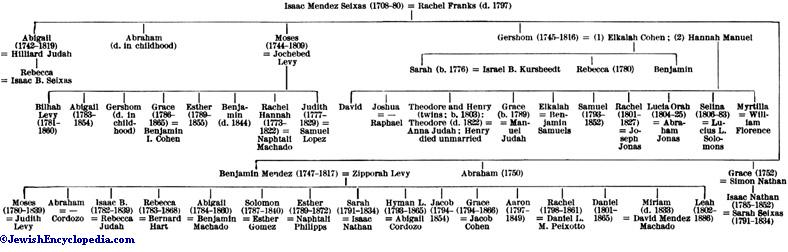
Seixas Pedigree.
SEIR.—1. The name of a mountainous district east of the ‘Arabah, peopled by the Edomites. It was originally occupied by Horites or ‘cave-dwellers’ (Gen 14:6). Mt. Seir is practically synonymous with Edom (cf. Gen 32:3 ‘the land of Seir, the field of Edom’). 2. ‘Mt. Seir’ mentioned in Jos 15:10 among the points defining the boundaries of Judah. The name may still be preserved in that of the ruins at Sârîs, S.W. of Kiriath-jearim.
(1) (
(2) (